Peso Hits Record Low 62.68 as Oil Tops $100
The peso closed at a record low of 62.68 to the dollar as Brent crude passed $100 a barrel, dragging the stock index down and prompting talk of further central bank tightening. Bank of America forecast Philippine growth slowing to 2.5 percent in 2026, the weakest in Southeast Asia.

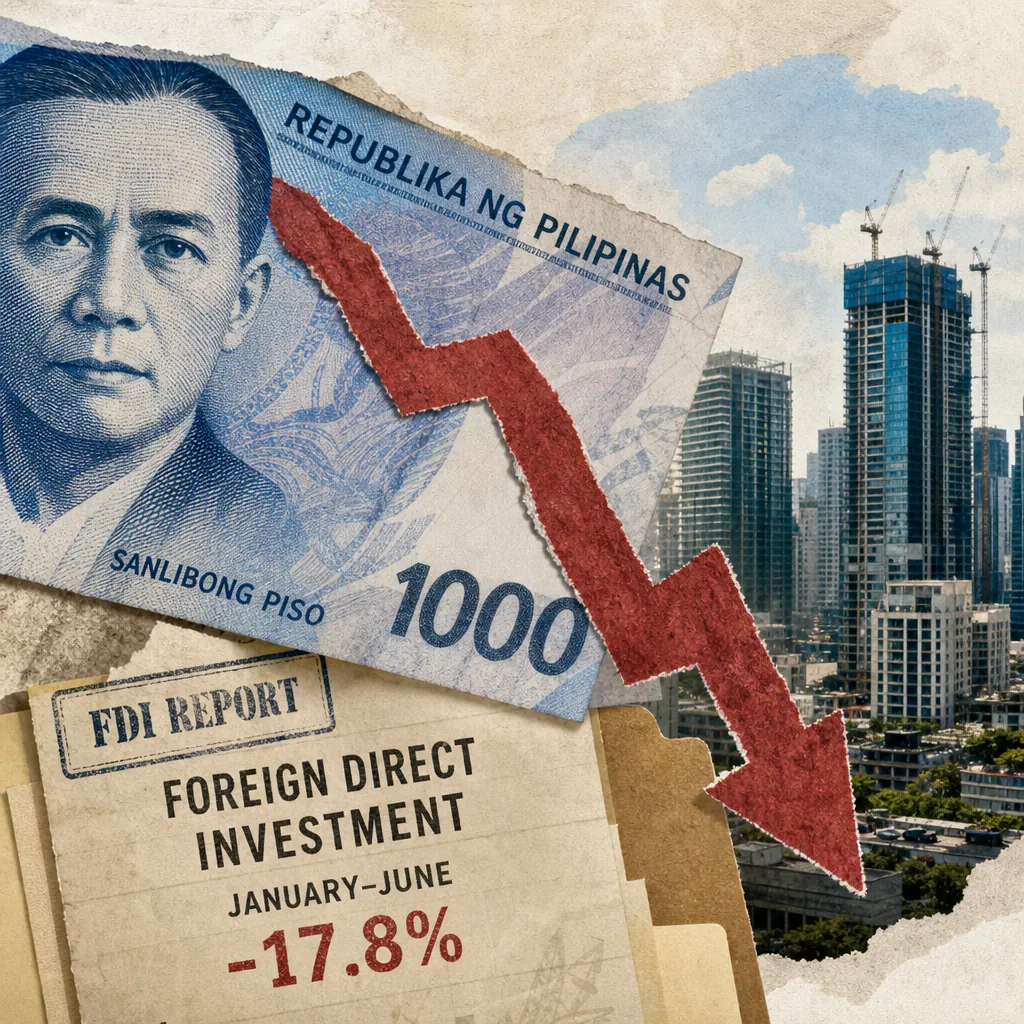
The peso closed at 62.68 to the US dollar on Friday, September 11, 2026, its weakest finish on record, after Brent crude oil climbed past $100 a barrel for the first time in months amid renewed United States–Iran tensions.629 The currency lost 14.5 centavos from Thursday's close of 62.535, according to data from the Bankers Association of the Philippines, the industry group that logs the daily interbank rate.29 It has now weakened about 8 percent since February 28, when it closed at 57.66, and Friday marked its 24th record low since the Middle East conflict began in March.32 The Philippine Stock Exchange index fell 0.61 percent, or 37.42 points, to 6,061.81, while the broader All Shares index dropped 0.74 percent to 3,358.40.42
The peso's slide dominated the day's business coverage, drawing at least eight separate reports across broadsheets and online news in the items reviewed here, with the largest single item — a Daily Tribune broadsheet analysis — carrying an estimated ₱625,041 in advertising-equivalent value, the notional cost of buying the same column space as paid advertising.32 That figure measures the cost of the coverage, not how many people read it. The story ran on two tracks: the currency itself, and what it signals about the Bangko Sentral ng Pilipinas (BSP), the country's central bank, which has already raised its benchmark interest rate three times since March to defend the peso and contain inflation.32
Away from the currency, the day's items captured a second, quieter current: a wave of corporate and institutional news — a first-time credit rating for online gaming firm DigiPlus, a 50-year milestone for investment house Unicapital, a planned October listing for GCash's parent company, and a ₱1.5-billion loan facility for women micro-entrepreneurs. Together they sketch a financial sector still raising capital and expanding even as the macroeconomic picture darkens. Bank of America (BofA) Global Research kept its 2026 Philippine gross domestic product (GDP) growth forecast at 2.5 percent, unchanged from June, while raising its forecast for the broader Association of Southeast Asian Nations (Asean) region to about 5 percent from 4.7 percent.3 GDP is the total value of goods and services a country produces; a 2.5 percent growth rate would be a sharp slowdown from 2025 and the weakest in the region.
Key themes
- Peso closes at record 62.68 to the dollar, its 24th low since March. The currency fell 14.5 centavos on Friday alone and has lost 8 percent of its value against the dollar since February 28.632 The trigger was Brent crude oil topping $100 a barrel — and later $104 — as US–Iran tensions threatened energy supplies, pushing investors toward dollar-denominated safe-haven assets.2029
- Bank of America sees Philippine growth slowing to 2.5 percent in 2026, the weakest in Asean. BofA held its forecast unchanged from June while raising its regional outlook to about 5 percent, citing an artificial-intelligence-driven electronics boom that is benefiting other Southeast Asian economies more than the Philippines.3 The gap between the Philippines and its neighbors is widening.
- A former central bank deputy governor says the market was not convinced by August's rate hike. Diwa Guinigundo wrote that the peso's slide immediately after the BSP's August 27 increase — its third consecutive hike — suggests investors doubted the central bank's commitment to controlling inflation.32 The BSP's benchmark rate now sits at 5 percent.39
- Banks disagree on whether the BSP will raise rates again this year. BDO Unibank expects the central bank to hold at its October meeting but acknowledges that El Niño weather disruptions and higher labor costs could force one more increase.39 El Niño is a periodic warming of Pacific Ocean waters that brings drought to the Philippines and tends to push up food prices.
- DigiPlus receives its first credit rating: B1 with a stable outlook from Moody's. The rating places the online gaming company in the middle tier of "non-investment grade" — the top notch of the speculative category — reflecting its leadership in Philippine online gaming and a strong financial profile with low debt and net cash.5 Moody's is a global credit ratings agency; its assessments help determine how much a company pays to borrow.
- GCash's parent company plans a October listing that could let users become shareholders. Mynt Inc. has received Securities and Exchange Commission approval for an initial public offering (IPO) — the process by which a private company sells shares to the public for the first time — running October 6 to 12, with a listing on the Philippine Stock Exchange on October 20 under the ticker GCASH.19 The company has about 40 million users in the Philippines.
- Citi and a German development bank close a ₱1.5-billion loan for women micro-entrepreneurs. Citi is directly providing more than ₱300 million and coordinated the broader package with DEG, part of Germany's KfW Group, mobilizing over ₱1.2 billion more for OnePuhunan, a microfinance institution.21 It is DEG's first debt transaction in the Philippine financial-inclusion sector.
- Unicapital Group marks 50 years of Philippine capital markets work. The investment house, founded in 1976, has mobilized debt and equity capital for corporations and emerging enterprises and offers services including ULoan and UTrade.2 The milestone comes as the broader market faces pressure from the peso and oil prices.
How the narratives stack
Dominant: The peso's record low and its knock-on effects on stocks and inflation expectations. This story carried the most weight in the items reviewed — eight separate reports across broadsheets and online news, with the largest single item valued at an estimated ₱625,041 in advertising-equivalent terms.32 The coverage was consistent: the peso closed at 62.68, down 14.5 centavos, its 24th record low since March, driven by oil above $100 a barrel and safe-haven dollar demand.629 The stock market fell in tandem, with the main index losing 0.61 percent.42 Within the captured set, this was the story that dominated the business pages.
Counter-narrative: The BSP may not need to raise rates again, despite the peso's weakness. BDO Unibank expects the central bank to hold its benchmark rate at 5 percent at its October meeting, noting that inflation slowed for a fourth consecutive month to 6.1 percent in August from 6.2 percent in July.39 That is a counterweight to the view — expressed by former BSP Deputy Governor Diwa Guinigundo — that the peso's slide shows markets were not reassured by August's hike and that further tightening may be warranted.32 The two positions are not contradictory: inflation is easing, but the currency and oil prices pose upside risks that could force the BSP's hand. The disagreement is about which force prevails.
Emerging: A cluster of capital-markets and corporate-finance developments that point to a sector still raising money and expanding despite the macroeconomic gloom. DigiPlus received its first credit rating, a B1 with stable outlook from Moody's, citing its leadership in Philippine online gaming and strong financial profile.5 Mynt Inc., the parent of GCash, has regulatory approval for an October IPO that could let millions of users become shareholders.19 Citi and Germany's DEG closed a ₱1.5-billion co-financing loan for OnePuhunan to expand microfinance for women entrepreneurs.21 Arthaland Corp. reduced its preferred share offering to ₱2.5 billion and extended the offer period to September 25.37 PNB Holdings may tap the market for a follow-on offering — a share sale after a company is already listed — as early as next year.41 MUFG Bank's Manila branch began operating as a universal bank on September 1 after the BSP approved a license upgrade, giving it broader powers beyond deposits and loans.38 These are not crisis stories; they are signs of a financial system still functioning.
Under-covered: The peso's effect on ordinary households and the government's fiscal position received less direct attention in the items reviewed than the currency's daily moves. The Daily Tribune broadsheet analysis noted that the peso has depreciated 8 percent since February 28, which raises the cost of imported goods — including oil, which the Philippines buys in dollars — and makes foreign debt more expensive to service.32 A weaker peso also makes imported food and fuel more costly, feeding into the inflation that the BSP is trying to contain. The coverage noted these effects but did not develop them at length; the focus stayed on the currency's daily closes and the central bank's next move.
Platform insights
The monitoring writeup for this window did not include social-media engagement data. The items reviewed were news articles and blog posts, not social posts, so there are no likes, shares, views, or comments to report. The conversation as captured here ran through news outlets and blogs rather than social platforms.
Key voices and communities
Currency and bond analysts. Jonathan L. Ravelas, senior adviser at Reyes Tacandong & Co., said the dollar-peso rate weakened to 62.68 as oil broke $100 a barrel, favoring demand for the greenback.29 Michael L. Ricafort, chief economist at Rizal Commercial Banking Corporation (RCBC), noted the peso had weakened for three straight trading days as Brent crude hit $104 a barrel, a 3.5-month high.29 These are the voices that translate daily market moves into cause and effect for business readers.
Former and current central bank officials. Diwa Guinigundo, a former BSP deputy governor, wrote that the peso's immediate reaction to August's rate hike was instructive: the market did not seem fully convinced the BSP had signaled an unambiguous commitment to staying on top of inflation.32 His commentary carries weight because of his former position and because it frames the debate over whether the BSP's tightening has been sufficient.
Bank economists. Alyssa Nuñez of BDO Unibank said the bank continues to expect the BSP to pause at its October meeting while acknowledging that upside risks have not disappeared entirely.39 Her note represents the view that inflation is easing enough to allow the central bank to wait.
Corporate finance and capital-markets executives. Unicapital Director Jaime Martirez shared milestones as the group marked 50 years.2 PNB Holdings chief financial officer Ponciano Carreon Jr. said the property company could explore a follow-on offering after its lock-up period expires around late March or early April 2027.41 These voices represent the companies still seeking capital despite market volatility.
Policy and regulatory figures. Senator Mark Villar, chairman of the Senate Committee on Banks and author of the Anti-Financial Account Scamming Act (AFASA), asked the BSP to submit a report on the law's results, including data on scammers caught and prosecuted.25 AFASA is a law that gives the central bank and law enforcement tools to go after online financial fraud. BSP General Counsel Roberto Figueroa said the law had significantly helped the central bank's ability to fight scams and fraud, citing 527 cases resolved by the Philippine National Police Anti-Cybercrime Group in 2025 and a decline in online scam incidents in the first half of 2026.25
Narrative streams
Peso hits 24th record low as oil tops $100 a barrel
The peso closed at 62.68 to the dollar on Friday, down 14.5 centavos from Thursday's 62.535, according to Bankers Association of the Philippines data.29 It was the currency's 24th record low since the Middle East conflict began in March, and it has now lost 8 percent of its value since February 28, when it closed at 57.66.32 The proximate cause was oil: Brent crude climbed past $100 a barrel and later reached $104, a 3.5-month high, as renewed US–Iran tensions and Houthi attacks on Saudi oil infrastructure raised fears of supply disruptions.2029 Oil is priced in dollars, so when crude gets more expensive, demand for dollars rises and the peso weakens. Investors also moved toward dollar-denominated assets as a safe haven, compounding the pressure.20
The stock market fell in response. The Philippine Stock Exchange index shed 0.61 percent, or 37.42 points, to close the week at 6,061.81, while the All Shares index declined 0.74 percent to 3,358.40.42 Luis Limlingan of Regina Capital said elevated oil prices raised concerns about inflation and macroeconomic indicators, weighing on market sentiment, and that the weaker currency encouraged investors to reduce risk exposure.42 Trading volume in the currency market eased to $1.1 billion from $1.2 billion the prior session.6
The read for the sector: a weaker peso raises the cost of imported fuel and food, which feeds into the inflation that the BSP is trying to control, and it makes dollar-denominated debt more expensive for companies and the government to service. For ordinary Filipinos, the most direct effect is at the pump and in the grocery store, where imported goods cost more. For businesses that borrow in dollars or import raw materials, margins come under pressure. The peso's slide also makes Philippine assets cheaper for foreign investors, which could attract capital — but only if investors are confident the currency will stabilize.
BSP faces pressure to raise rates again, but banks disagree
The BSP raised its benchmark interest rate by 25 basis points on August 27, its third consecutive hike since the energy shock began in March, bringing the policy rate to 5 percent.3239 A basis point is one-hundredth of a percentage point. The central bank's goal is to make holding pesos more attractive and to cool inflation, which slows for a fourth consecutive month to 6.1 percent in August from 6.2 percent in July.39 Inflation is the rate at which prices rise; 6.1 percent means prices were 6.1 percent higher in August than a year earlier.
Diwa Guinigundo, a former BSP deputy governor, wrote that the peso breached the ₱62 threshold for the first time and sank to consecutive record lows immediately after the August hike, which he said might indicate that markets were not reassured the government is doing all it can to address the economy's woes. "To be sure, the peso is influenced by global dollar strength, oil prices and other external forces. But its immediate reaction to a rate hike is nevertheless instructive: the market did not seem fully convinced that the BSP had signaled an unambiguous commitment to staying on top of inflation," he said.32
BDO Unibank economist Alyssa Nuñez said the bank continues to expect the BSP to pause at its October meeting, while acknowledging that upside risks have not disappeared entirely. She cited weather disruptions from El Niño and higher labor costs as potential triggers for one final increase.39 El Niño is a climate pattern that brings drier conditions to the Philippines, which can reduce agricultural output and push food prices higher.
The read for the sector: borrowers with variable-rate loans — mortgages, business credit lines — face the prospect of higher payments if the BSP tightens again. Savers with peso deposits would earn more interest. For banks, the question is whether the BSP's tightening has done enough to stabilize the currency or whether more is needed, which affects their lending margins and the creditworthiness of their borrowers. The disagreement between BDO and Guinigundo is not about the facts but about the BSP's next move, and it will be resolved at the October policy meeting.
DigiPlus receives first credit rating as online gaming faces regulatory scrutiny
Moody's Ratings assigned DigiPlus Interactive Corp. its first corporate family rating: B1 with a stable outlook.5 A corporate family rating is an assessment of a company's overall creditworthiness — its ability to repay its debts. The B1 rating places DigiPlus in the middle tier of "non-investment grade," which means lenders consider it riskier than investment-grade companies but still the top notch of the speculative category.5 Moody's said the rating reflects DigiPlus's leadership in the Philippine online gaming market and a strong financial profile underpinned by low leverage, robust cash generation, and a net cash position.5 Leverage is the amount of debt a company carries relative to its equity; low leverage means less risk.
The rating also cited regulatory and expansion risks. DigiPlus is led by tycoon Eusebio Tanco, and its first-quarter earnings fell 33 percent amid the delinking of e-wallets from gaming platforms — a regulatory change that required digital wallets to be separated from online gambling apps.5 That change reduced the ease with which users could fund gaming accounts.
The read for the sector: a first credit rating gives DigiPlus a benchmark that lenders and investors can use to price its debt, which could lower its borrowing costs if the rating holds. But the B1 rating also signals that the company operates in a sector where regulation can change quickly and where earnings are sensitive to policy shifts. For the broader online gaming industry, the rating is a signal that at least one major player has the financial strength to weather regulatory turbulence — but the delinking rule remains a drag on growth.
GCash parent plans October IPO that could make users shareholders
Mynt Inc., the parent company of GCash, has received approval from the Securities and Exchange Commission (SEC) for an initial public offering that would list on the Philippine Stock Exchange in October.19 The SEC is the government agency that regulates securities markets. An IPO is how a company invites ordinary investors to buy a slice of its business through shares that will be traded on the open market. The offering will run from October 6 to October 12, with a listing on October 20 under the ticker GCASH.19 GCash has about 40 million users in the Philippines who rely on it for sending remittances, paying utilities, and online shopping.19
The read for the sector: the IPO would give GCash a new source of capital and a public currency for acquisitions or expansion. For users, it offers a chance to become shareholders in a platform they already use daily — a rare opportunity in a market where retail investors are often shut out of major listings. For the Philippine Stock Exchange, a large technology listing could draw new investors and increase trading volume. The risk is that the IPO prices into a weak market: the main index is down and the peso is at a record low, which could dampen demand for new shares.
Citi and DEG close ₱1.5-billion loan for women micro-entrepreneurs
Citi and DEG, a German development finance institution that is part of KfW Group, announced the closing of a co-financing loan of more than ₱1.5 billion for OnePuhunan, also known as CreditAccess Philippines Financing Company Inc.21 Citi is directly providing more than ₱300 million and acted as coordinator for the broader financing partnership, mobilizing over ₱1.2 billion in additional funding from DEG.21 It is DEG's first debt transaction in the financial-inclusion sector in the Philippines.21 Financial inclusion refers to efforts to give more people access to banking, credit, and insurance.
All loan proceeds will facilitate the expansion of OnePuhunan's microfinance operations, which serve women micro-entrepreneurs.21 Micro-entrepreneurs are people who run very small businesses, often from home, and who typically lack access to traditional bank loans.
The read for the sector: the loan expands the pool of credit available to women who run small businesses, a segment that banks have historically underserved. For Citi, the transaction reinforces its presence in Philippine financial inclusion and its role as a coordinator of development finance. For DEG, it opens a new sector in the Philippines. For the micro-entrepreneurs who receive the loans, the capital can mean the difference between expanding a business and standing still. The risk is that microfinance loans carry higher default rates than conventional bank lending, particularly in a slowing economy.
Unicapital marks 50 years as capital markets face pressure
Unicapital Group marked its 50th anniversary on September 8, 2026, having mobilized debt and equity capital for corporations, institutions, and emerging enterprises across the Philippines since 1976.2 The company offers full-service investment banking, treasury, lending, and stock brokerage solutions, including services branded ULoan and UTrade.2 Unicapital Director Jaime Martirez shared the group's milestones as it celebrated five decades of debt and equity capital generation.2
The read for the sector: Unicapital's longevity is a reminder that Philippine capital markets have grown and professionalized over five decades, but the anniversary comes as the market faces headwinds from the peso's slide and oil prices above $100 a barrel. For companies seeking capital, the environment is more expensive: a weaker peso raises the cost of foreign-currency borrowing, and a falling stock market makes equity issuance less attractive. Unicapital's ability to raise capital for clients in this environment will be a test of its franchise.
Other corporate and institutional developments
Arthaland Corp., a real estate developer led by the Po family, reduced its upcoming preferred share offering to ₱2.5 billion and extended the offer period to September 25 from September 18, with the listing date moved accordingly.37 Preferred shares are a class of stock that typically pays a fixed dividend and has priority over common shares in the event of liquidation. The SEC approved the changes.37
PNB Holdings Corp., the property arm of Lucio Tan's Philippine National Bank, may tap investors through a follow-on offering as early as next year, provided market conditions improve and the fundraising coincides with a major project or acquisition. Chief financial officer Ponciano Carreon Jr. said the company could explore the offering after its six-month lock-up period expires around late March or early April 2027.41 A follow-on offering is a share sale conducted after a company is already listed.
MUFG Bank Ltd.'s Manila branch began operating as a universal bank on September 1 after the BSP approved a license upgrade. The shift from commercial to universal banking gives the branch broader powers beyond traditional activities such as accepting deposits and extending loans.38 The BSP's Monetary Board approved the request through a resolution dated May 21 and issued the certificate of authority on June 5.38 Universal banking allows a bank to engage in investment banking, insurance, and other financial services under one roof.
Senator Mark Villar asked the BSP to submit a report on the results of the Anti-Financial Account Scamming Act (AFASA), the law he authored to combat online scams. BSP General Counsel Roberto Figueroa said the law had significantly helped the central bank's ability to fight scams and fraud, citing 527 cases resolved by the Philippine National Police Anti-Cybercrime Group in 2025 and a decline in online scam incidents in the first half of 2026.25 Villar said he is confident the law's positive results will strengthen investigations and prosecutions against scammers and may allow victims to recover lost funds.25
Separately, a GSMA report launched September 9 at the Digital Trust Summit in Kuala Lumpur found that nearly half of scam incidents consumers reported in six Southeast Asian markets remain unresolved, undermining digital trust across the region.24 GSMA is the global trade body for mobile network operators. The report warns that online scams and fraud could undermine progress toward broader digital ambitions as Asean speeds up its digital economy, artificial intelligence, and digital government plans.24
Conversation trajectory
Watch the BSP's October policy meeting. The central bank's next rate decision is the single most important scheduled event for the peso and for borrowers. BDO expects a hold at 5 percent, but Guinigundo's commentary suggests the market may want more. If the BSP holds and the peso stabilizes, the pressure eases; if the peso continues to slide, a fourth hike becomes more likely. Observation window: through the October meeting.
Track oil prices and Middle East tensions. The peso's slide is driven primarily by oil above $100 a barrel and safe-haven dollar demand. If Brent crude retreats below $100, the peso could recover some ground; if it climbs further, the currency will face more pressure. Observation window: the next two to four weeks, as US–Iran tensions evolve.
Watch the GCash IPO pricing. Mynt Inc.'s offering runs October 6 to 12, with a listing on October 20. The pricing will reveal how much investors are willing to pay for a major technology listing in a weak market. A strong reception could encourage other companies to list; a weak one could delay offerings like PNB Holdings' planned follow-on. Observation window: October 6–20.
Monitor inflation data for September. August inflation slowed to 6.1 percent, the fourth consecutive month of easing. If September data shows a further slowdown, the case for holding rates strengthens; if oil prices push inflation back up, the BSP may have to act. Observation window: the next inflation release, typically in early October.
Track the peso's daily closes. The currency has set 24 record lows since March. Each new low is a data point, but the more important signal is whether the pace of decline accelerates or slows. A period of stability would suggest the market is adjusting; continued daily declines would suggest deeper problems. Observation window: daily through the end of September.
Watch for corporate follow-through on capital raising. Arthaland's reduced offering, PNB Holdings' potential follow-on, and the GCash IPO are all tests of investor appetite. If these deals price well, it signals that capital markets remain open despite the macro headwinds; if they struggle, it signals a broader pullback. Observation window: through the fourth quarter.
Response guidance
For corporate treasurers and CFOs: stress-test dollar exposure. The peso has lost 8 percent against the dollar since February 28. Companies with dollar-denominated debt or imported inputs should model scenarios at 63, 64, and 65 to the dollar and identify which contracts or suppliers can be renegotiated. The goal is not to predict the rate but to know at what level margins become unsustainable.
For banks and lenders: communicate rate scenarios clearly to borrowers. The BSP's next move is uncertain, with BDO expecting a hold and former officials suggesting more tightening may be needed. Lenders should give borrowers plain-language explanations of how a variable-rate loan would change if the policy rate rises another 25 basis points, and what that means for monthly payments.
For companies planning capital raises: consider timing and size. Arthaland reduced its preferred share offering and extended the offer period, a sign that demand is softer than expected. Companies considering IPOs or follow-on offerings should weigh whether to proceed now or wait for market conditions to improve, and should size deals conservatively.
For consumer-facing businesses: prepare for higher input costs. A weaker peso makes imported goods more expensive, and oil above $100 a barrel raises transport and energy costs. Businesses that sell imported products should decide early whether to absorb costs, pass them on, or adjust package sizes, and should communicate any changes to customers before they appear on shelves.
For communicators in financial services: explain the peso's effect on ordinary households. The coverage focused on daily currency moves and the BSP's next decision. Audiences need the translation: what a weaker peso means for the price of rice, fuel, and imported medicine, and what it means for remittances from overseas Filipino workers, which are worth more in pesos when the currency is weak. Use concrete examples rather than exchange-rate jargon.
For online gaming and digital finance firms: prepare for continued regulatory scrutiny. DigiPlus's B1 rating cited regulatory risks, and the delinking of e-wallets from gaming platforms already cut its first-quarter earnings by 33 percent. The BSP's report on AFASA and the GSMA findings on unresolved scams suggest that regulators and consumers are paying closer attention to digital fraud. Companies should ensure their compliance and customer-protection messaging is current and specific.
For companies with exposure to the Middle East: monitor supply chains and insurance costs. The peso's slide is tied to oil prices and US–Iran tensions. Firms that ship through the Strait of Hormuz or rely on Middle Eastern suppliers should review contingency plans and insurance coverage, and should communicate any potential disruptions to customers early.
For all financial institutions: watch the GCash IPO as a market signal. The October listing will be the largest technology offering in recent memory. Its reception will indicate whether investors are willing to take on risk in a weak market, which affects the cost of capital for every other company considering a listing. A strong debut could open the window for others; a weak one could close it.
See the full picture behind today's signals.
This report draws from Media Meter's MediaWatch, our real-time monitoring engine tracking 2,470+ Philippine sources across print, broadcast, digital, and social. Explore how the platform turns raw coverage into decision-grade intelligence, then see how it's configured for teams like yours — whether you're in PR agencies, corporate comms, government, or marketing.
Want more? Browse our Report Library for sector and crisis intelligence, or request a demo and we'll have your brand set up before the call.
Want this kind of intelligence on your brand?
This brief is built on the same MediaWatch methodology that runs continuously across every brand we monitor. See your competitive landscape, Impact Score, and narrative trajectory in a 30-minute demo.