Mikha Lim's 90-day LTO suspension draws praise
BINI's Mikha Lim loses her license for 90 days over phone use while driving, and the MMDA's Gabriel Go publicly credits her for owning the mistake. The same day, transport agencies move on motorcycle-taxi rider caps, LRT-2 train shortages and ASEAN Summit traffic plans.

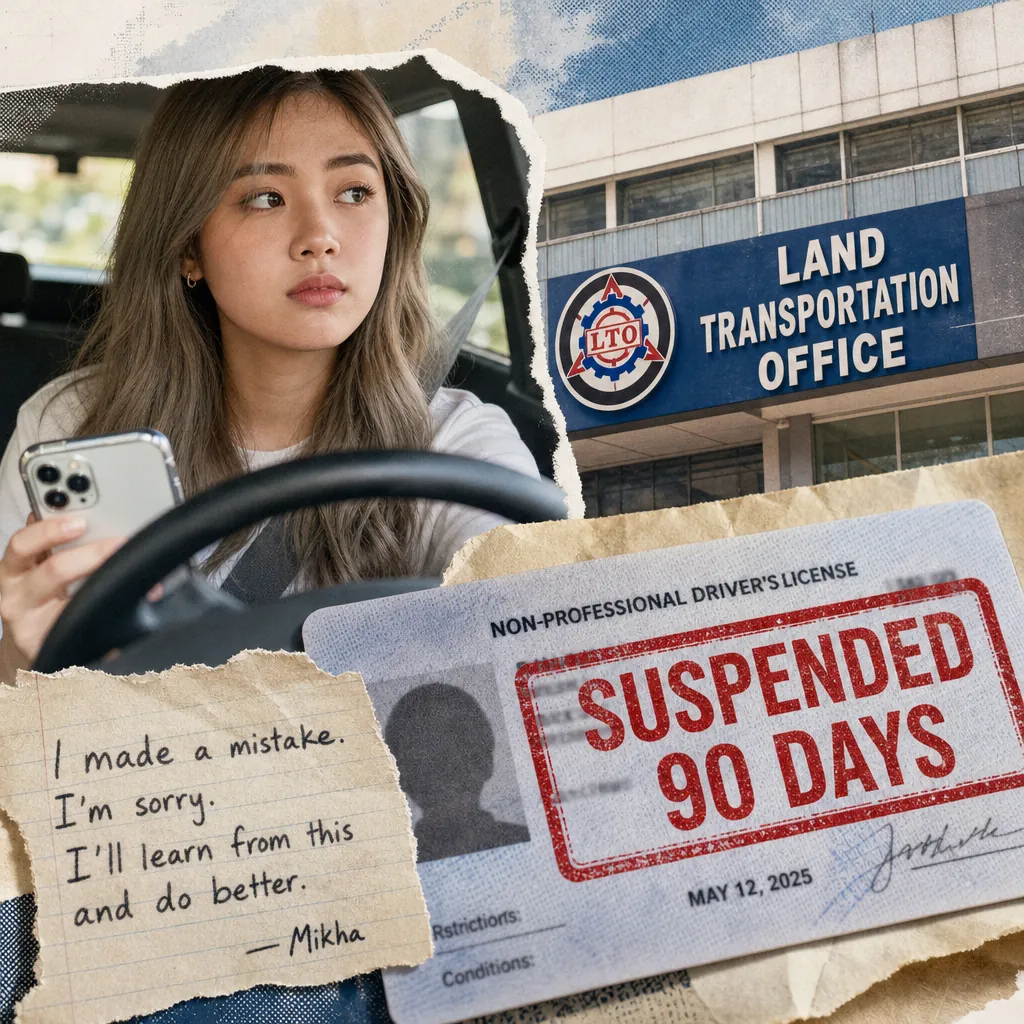
A pop star's traffic violation became the day's most-quoted transport story. On November 11, Mikha Lim of the P-pop group BINI posted an apology on X for using her cellphone while driving, and by November 12 the Land Transportation Office (LTO) had suspended her driver's license for 90 days 47. The LTO is the national agency that issues licenses and enforces road rules; a 90-day suspension means she cannot legally drive for three months. The case drew coverage across at least four outlets in this set, from tabloid-adjacent online news to the Philippine Star's editorial page, and it pulled in the Metropolitan Manila Development Authority (MMDA), the agency that manages traffic across the capital region 12170.
What made it travel was not the violation but the response to it. Gabriel Go, head of the MMDA's Special Operations Group-Strike Force — the unit known for flagging traffic violators — posted on Facebook that Lim had done the right thing. "Nagkamali man pero handang harapin ang pagkakamali at tinanggap ito bilang aral," he wrote, and then, in English: "I gotta give it to her, this is what you call ACCOUNTABILITY!" 1. Lim's own statement was equally direct: "There is absolutely no excuse for using my phone while behind the wheel. It was careless and irresponsible" 21. She said she had already reported to the LTO and was going through due process 21.
The rest of the day's transport news was quieter but carried more consequence for people who do not have a driver's license to lose. A motorcycle-taxi riders' group asked the government to legalize the industry and base rider allocations on passenger demand 4. The LTO in Western Visayas suspended a taxi driver's license for 90 days after a road-rage video showed him wielding a bolo 62. The LTO's Negros Island Region office warned ride-hailing and public utility drivers against harassing passengers, after serving a show-cause order on a driver accused of threatening remarks 50. The Light Rail Transit Authority confirmed only eight of LRT-2's ten trains were running 37. The Department of Transportation (DOTr) said it would add 50 buses to the EDSA Busway ahead of the holidays and the ASEAN Summit 58. And the MMDA said major roads would stay open during the 49th Association of Southeast Asian Nations (ASEAN) Summit, with the number coding scheme suspended from November 16 to 18 38.
Key themes
- Mikha Lim's license suspension ran for 90 days and drew praise from the MMDA's own enforcer. The LTO suspended the BINI member's license after video she recorded herself showed her holding a phone with both hands while driving 70. Go's Facebook post turned a penalty story into a story about accountability 1.
- The LTO framed the sanction as proof that fame buys no exemption. LTO chief Markus Lacanilao said, "It is our duty to ensure that the law is enforced fairly, regardless of a person's status or position. Whether famous or not, everyone is expected to comply with traffic laws" 70. The Philippine Star's editorial used the case to argue the country should hold the famous to a higher bar, not a lower one 70.
- Motorcycle-taxi riders asked for legalization and demand-based rider caps. Metro co-convener Jayson Luna said the DOTr and the Land Transportation Franchising and Regulatory Board (LTFRB) should introduce long-term reforms, and that "no rider loses their livelihood" 4. The call followed the LTFRB's ₱555.75-million fine on Move It for exceeding its authorized rider allocation by 55,575 rider-partners across Metro Manila, Cebu City and Cagayan de Oro 4.
- LRT-2 ran eight of ten trains while its future ownership was being prepared for bidding. Transportation Secretary Giovanni Lopez said one train was being fitted with a new operating control panel and another was under repair 37. The line will also be bid out to a private operator 37.
- The DOTr added 50 EDSA Busway buses for the holiday and summit period. The department expects 30,000 more passengers daily and said another increase would follow in December 58. Four of seven non-operational elevators at busway stations have been repaired, including at Guadalupe 58.
- The MMDA will keep major roads open during the ASEAN Summit and suspend number coding November 16 to 18. The agency will deploy 2,637 personnel for traffic management, with security exclusion zones, alternate routes and designated truck routes around summit venues 38.
- The LTO's regional offices suspended two drivers in one day for conduct unrelated to paperwork. A taxi driver in Iloilo lost his license for 90 days after a video showed him pulling a bolo on a motorcycle rider 62; a TNVS driver in Negros received a show-cause order over harassing remarks to a passenger 50.
- Gabriel Go's move to the DOTr was approved the same day he praised Lim. MMDA Chairman Don Artes said Go's transfer had been approved, with Ruby Bron of the Swift Traffic Action Group named as his successor 55. Transportation Secretary Vince Dizon had earlier submitted Go's name for appointment as an assistant secretary 55.
How the narratives stack
Dominant. The Mikha Lim case dominated the items captured here. Four separate outlets covered it — Manila Bulletin Online twice, Milyonaryo and the Philippine Star's editorial page — and the coverage spanned straight news, a celebrity-adjacent item and an opinion piece 1214770. The story had a clean arc: viral video, public apology, government sanction, and then an unusual twist when the enforcer praised the violator. The Philippine Star editorial gave it the widest frame, comparing Philippine enforcement with South Korea's and arguing that "the bar for proper behavior is set higher for the famous, wealthy or politically influential" 70. Within this set, the Lim story carried the most column inches of any transport item.
Counter-narrative. The motorcycle-taxi story sits against the Lim case in an uncomfortable way. Lim's sanction was individual and swift; the riders' complaint is structural and slow. Metro's Luna asked for "better regulations, fairer rider allocation and full legalization of the motorcycle taxi industry" 4. The LTFRB's ₱555.75-million fine on Move It — calculated at roughly ₱10,000 per excess rider-partner — shows the regulator treating rider caps as a compliance matter rather than a demand question 4. The riders' argument is that caps set without reference to passenger demand push drivers into informal work or out of the industry entirely. That argument got one story in this set, against four for the celebrity case.
Emerging. Two threads point forward. The first is the LRT-2 situation: eight of ten trains running, a line slated for privatization, and a DOTr feasibility study into whether buses can use roads 37. The second is the ASEAN Summit traffic plan, which suspends number coding for three days and deploys 2,637 MMDA personnel 38. Both will be tested within the week. The EDSA Busway expansion — 50 new buses now, more in December — is the DOTr's attempt to get ahead of the holiday crush before it peaks 58.
Under-covered. The LTO's regional enforcement actions got the least attention in this set. The Iloilo road-rage case involved a taxi driver allegedly pulling a bolo on a motorcycle rider, and the LTO suspended his license for 90 days under Section 48 of Republic Act 4136, the Land Transportation and Traffic Code, which prohibits reckless driving 62. The Negros case involved a TNVS driver accused of offensive and threatening remarks toward a passenger, with the LTO's Intelligence and Investigation Unit serving the show-cause order at his residence 50. Both stories describe the same problem — driver conduct that makes public transport feel unsafe — and both got a single item each. The LTO-NIR's statement that "passenger safety, welfare, and dignity must be upheld by all transport service providers" applies equally to the celebrity case and to these 50.
Platform insights
- Facebook. Go's post praising Lim was the day's most-cited social item in this set, and it worked because it inverted the expected script: the enforcer who normally calls out violators publicly commended one 1. The post included a screenshot of Lim's X apology, which meant Facebook audiences saw the apology secondhand, filtered through the MMDA official's framing. That framing — "this is what you call ACCOUNTABILITY!" — is the kind of line that travels because it is short, capitalized and quotable 1.
- X. Lim posted her apology directly on X, which is where the original statement lives 2147. The platform's role here was as the official channel for a celebrity's mea culpa, not as a discussion forum. The apology text was then screenshotted and redistributed to Facebook, which is where most of the reaction in this set appears to have happened.
- Reddit and YouTube. Neither platform appears in the items captured here. The conversation in this set ran through Facebook and X, with news outlets doing the amplification.
Key voices and communities
BINI fans and P-pop audiences. The group's fan base is the reason a traffic violation became national news. Lim's apology was pitched directly at them — "I promise to learn from this and do better" — and the speed of her response suggests a team that understood the audience would be watching 47. For fans, the story resolved well: their idol admitted fault, took the penalty and got public credit from an enforcement official 1.
Road-safety and enforcement officials. Go and LTO chief Lacanilao both used the case to make a broader point about equal enforcement 170. Go's post was personal and congratulatory; Lacanilao's statement was institutional. Together they framed the sanction as a demonstration that the LTO applies the same rules to celebrities and ordinary drivers.
Motorcycle-taxi riders and their advocates. Metro's Luna spoke for drivers whose livelihoods depend on rider allocations set by the LTFRB 4. His framing — "no rider loses their livelihood" — puts the human cost of cap enforcement at the center, in contrast to the regulator's compliance framing.
Commuters on LRT-2 and EDSA. These are the people affected by the train shortage and the busway expansion, and they are the least organized voice in this set. The LRT-2 story notes that waiting times lengthened and stations grew crowded 37; the EDSA story notes slower operations and longer lines, particularly in Ortigas and mall areas 58. Neither story quotes a commuter.
Editorial pages. The Philippine Star's editorial is the only opinion voice in this set, and it used the Lim case to argue for a broader standard: that the famous should be held to a higher bar, not a lower one, and that the country should look to examples like South Korea 70.
Narrative streams
The LTO suspended Mikha Lim's license for 90 days and the MMDA's enforcer thanked her for it
The sequence matters. Lim posted a video of herself holding her phone with both hands while driving; the video circulated; she apologized on X on November 11; the LTO suspended her license for 90 days; and on November 12 Go posted his praise 47701. The LTO's sanction was not a fine or a warning — it was a three-month suspension, which for a professional performer who drives herself is a practical inconvenience as well as a legal penalty. Lim said she had reported to the LTO and was "going through due process to face the appropriate penalties" 21.
Go's post is the reason the story got a second day. His unit, the Special Operations Group-Strike Force, is the MMDA team that catches traffic violators, so his endorsement carried weight that a generic comment would not 1. He wrote that Lim "accepted it as a lesson" and attached a screenshot of her apology 1. The Philippine Star editorial picked up the thread and pushed it further, arguing that in countries like South Korea "arrest, detention, conviction and imprisonment are swift and efficient" for the famous, and that the Philippines should match that standard 70.
The read for the sector: the LTO and MMDA have found a template for handling celebrity violations — swift sanction, public statement from the agency head, and a visible acknowledgment when the violator complies. That template works when the violator apologizes quickly. It will be tested the first time a celebrity does not. For road-safety advocates, the case is useful because it puts distracted driving on front pages with a concrete penalty attached: 90 days without a license, not a token fine.
Motorcycle-taxi riders asked for legalization after a ₱555.75-million fine on Move It
The LTFRB fined Move It ₱555.75 million for exceeding its authorized allocation by 55,575 rider-partners across Metro Manila, Cebu City and Cagayan de Oro 4. The fine works out to roughly ₱10,000 per excess rider. Metro, a riders' group, responded by calling for a review of rider limits, arguing they should be based on passenger demand rather than set as fixed caps 4. Luna said the group's "longstanding call has been to ensure that no rider loses their livelihood" and that the LTFRB and DOTr should introduce "long-term reforms that benefit both riders and commuters" 4.
The underlying policy question is what rider caps are for. The LTFRB regulates motorcycle taxis — two-wheeled ride-hailing services — through a framework that limits how many rider-partners each platform may accredit, partly to manage safety and partly to keep the market orderly. Platforms that exceed their allocation are fined per excess rider. Riders argue the caps are set without reference to how many people actually want rides, which pushes drivers toward informal arrangements or off the platforms entirely. The regulator's position, implied by the fine, is that caps are caps and platforms must comply.
The read for the sector: the fine is large enough to change platform behavior — Move It will either shed rider-partners or pay again — but it does not resolve the demand question. If passenger demand exceeds the capped supply, the excess demand does not disappear; it moves to informal services or to other platforms. Riders' groups will keep pressing for a demand-based formula, and the LTFRB will face the question of whether its caps are protecting riders or restricting them.
LRT-2 ran eight of ten trains while the line's ownership was being prepared for bidding
The Light Rail Transit Authority announced limited train availability due to upgrades and repairs, and Transportation Secretary Lopez confirmed that eight of the line's ten trains were operational, with one being fitted with a new train operating control panel and another under repair 37. Waiting times lengthened and stations grew crowded 37. The same week, commuters learned the line will be bid out to a private operator 37. The DOTr is also studying whether buses can use roads — a feasibility study that, read plainly, asks whether bus augmentation can substitute for rail capacity 37.
Antipolo commuters received what one report described as a three-part package: 20 buses with discounted fares, the feasibility study, and the privatization news 37. The LRT-2 is a commuter rail line running from Recto in Manila to Antipolo in Rizal, and it carries riders who have few alternative routes. Eight of ten trains means a 20 percent cut in capacity on a line that was already crowded at peak.
The read for the sector: privatization bidders will price the line on its assets and ridership, and a line running at 80 percent of its fleet capacity is a different proposition from one running at full strength. Commuters will judge the privatization by whether trains arrive more often, not by who owns them. The DOTr's bus feasibility study is an admission that rail capacity alone will not cover the gap in the near term.
The DOTr added 50 EDSA Busway buses and the MMDA suspended number coding for the ASEAN Summit
Two separate congestion measures landed the same day. The DOTr said it would deploy 50 additional buses on the EDSA Busway starting Thursday, expecting 30,000 more passengers daily ahead of Christmas and the ASEAN Summit 58. Transportation Secretary Dizon said he instructed the LTFRB and the DOTr's road sector to increase bus numbers, and that another increase would follow in December 58. He also reported that four of seven non-operational elevators at busway stations had been repaired, including at Guadalupe 58.
Separately, the MMDA said major thoroughfares would remain open during the 49th ASEAN Summit, with security exclusion zones, alternate routes and designated truck routes around venues 38. The agency will deploy 2,637 personnel and suspend the number coding scheme from November 16 to 18 38. Number coding restricts cars from major roads on set days based on their license plate endings; suspending it gives motorists more flexibility but also puts more cars on the road.
The read for the sector: the EDSA Busway expansion is a supply-side fix — more buses, repaired elevators — aimed at the holiday surge. The number-coding suspension is a demand-side concession that will test whether the busway can absorb extra cars. Both measures will be judged in the same week, and the MMDA's 2,637 personnel will be spread across summit security and everyday traffic management at the same time.
The LTO suspended two drivers in one day for conduct that had nothing to do with paperwork
In Iloilo City, the LTO's Western Visayas office placed a taxi driver's license under a 90-day preventive suspension after a video showed him allegedly wielding a bolo and attempting to attack a motorcycle rider 62. Regional Director Gaudioso P. Geduspan II issued the order on November 12, a day after the incident in Barangay Ungka, Jaro 62. The suspension order cited concerns about the driver's "temperament, discipline and fitness to operate a public utility vehicle" and invoked Section 48 of Republic Act 4136, the Land Transportation and Traffic Code, which prohibits reckless driving 62.
In Negros, the LTO's Negros Island Region office served a show-cause order on a TNVS driver accused of making offensive, threatening and harassing remarks toward a passenger 50. The order gives the driver a chance to explain before the agency decides whether further action is warranted 50. The LTO-NIR said abusive language and harassment will not be tolerated and that passenger safety, welfare and dignity must be upheld 50.
The read for the sector: the LTO is using license suspension and show-cause orders as conduct tools, not just paperwork tools. For ride-hailing platforms, that means driver behavior complaints can now escalate to license action, which puts pressure on platforms to screen and monitor drivers more closely. For passengers, it means a complaint to the LTO can produce a concrete result within a day.
Gabriel Go's transfer to the DOTr was approved as he praised Lim
MMDA Chairman Don Artes said Go's transfer to the DOTr had been approved, with Ruby Bron of the Swift Traffic Action Group named as his successor 55. Transportation Secretary Dizon had earlier submitted Go's name for appointment as an assistant secretary, and Artes said Go had yet to file a formal resignation 55. Dizon said Go had already been helping the DOTr before his formal appointment 55.
The timing is coincidental but useful: the official who publicly praised Lim for accountability is the same official moving to the department that oversees the LTO. Go's profile — built on catching traffic violators — travels with him.
The read for the sector: the DOTr gains a public-facing enforcement figure at the assistant-secretary level, and the MMDA loses one. Bron inherits the Strike Force's caseload, including the visibility that comes with it. For communicators, Go's move means the DOTr's public voice on enforcement will likely become more prominent, not less.
Conversation trajectory
November 16–18: ASEAN Summit traffic measures. The number coding suspension and the 2,637-person MMDA deployment will be tested over three days 38. Watch for congestion reports on alternate routes and for whether the security exclusion zones displace traffic into residential areas. The summit ends November 18; the first weekday commute after it will show whether the measures worked.
Late November: LRT-2 capacity. The line is running eight of ten trains, with one train being fitted with a new control panel and another under repair 37. Watch for announcements on when the two trains return and whether the privatization bidding timeline is published. If the repairs slip past December, the holiday crush will hit a line already at 80 percent capacity.
December: EDSA Busway expansion. The DOTr said another bus increase would follow in December 58. Watch for the number of additional buses and whether the remaining three non-operational elevators are repaired. The holiday surge is the test case for whether the busway can absorb the extra passengers the department expects.
Ongoing: motorcycle-taxi rider allocation. The LTFRB has not said whether it will review the rider cap formula in response to Metro's call 4. Watch for a statement from the LTFRB or DOTr on whether demand-based allocation is under consideration, and for whether Move It appeals or pays the ₱555.75-million fine.
Ongoing: LTO conduct enforcement. The Iloilo taxi driver's 90-day suspension and the Negros TNVS driver's show-cause order are both in process 6250. Watch for the outcome of the Negros case and for whether the LTO issues a broader statement on passenger harassment complaints.
Trigger events. A second celebrity traffic violation would test whether the LTO's equal-enforcement framing holds. A Move It appeal or a rival platform's expansion would reopen the rider-cap question. An LRT-2 breakdown during the holiday period would put privatization and capacity on the front pages together.
Response guidance
Road-safety messaging. Use the Lim case as a concrete example: a 90-day license suspension is the penalty for holding a phone while driving, and it applies to everyone 70. Avoid framing the story as a celebrity scandal; frame it as an enforcement outcome with a specific consequence. The LTO's own line — "whether famous or not, everyone is expected to comply" — is the message 70.
Celebrity and influencer crisis response. Lim's apology worked because it was fast, direct and free of excuses: "There is absolutely no excuse" 21. The lesson for public figures is that acknowledging the penalty and naming the process — reporting to the LTO, undergoing due process — closes the story faster than a vague statement. Go's public praise shows that enforcement officials will amplify a good apology 1.
Motorcycle-taxi advocacy. Riders' groups should lead with the livelihood argument and pair it with a demand-based formula 4. The ₱555.75-million fine is a concrete number that shows what fixed caps cost platforms; the next step is to show what they cost riders. Pair the legalization call with data on passenger demand by city.
Commuter communication during the ASEAN Summit. The MMDA's plan is public: major roads open, number coding suspended November 16–18, 2,637 personnel deployed 38. Communicators should push the specific dates and the alternate routes, not general advisories. Commuters plan around dates, not sentiments.
Ride-hailing and taxi platforms. The LTO's conduct enforcement is now a platform risk 5062. Platforms should review their complaint escalation processes and make clear to drivers that harassment complaints can reach the LTO. A show-cause order served at a driver's residence is a reputational event for the platform as well as the driver.
Rail and bus operators. The LRT-2 and EDSA Busway stories are about capacity and access 3758. Communicate specific numbers — eight of ten trains, 50 additional buses, four of seven elevators repaired — rather than general promises of improvement. Commuters measure these things in waiting time.
See the full picture behind today's signals.
This report draws from Media Meter's MediaWatch, our real-time monitoring engine tracking 2,470+ Philippine sources across print, broadcast, digital, and social. Explore how the platform turns raw coverage into decision-grade intelligence, then see how it's configured for teams like yours — whether you're in PR agencies, corporate comms, government, or marketing.
Want more? Browse our Report Library for sector and crisis intelligence, or request a demo and we'll have your brand set up before the call.
Want this kind of intelligence on your brand?
This brief is built on the same MediaWatch methodology that runs continuously across every brand we monitor. See your competitive landscape, Impact Score, and narrative trajectory in a 30-minute demo.