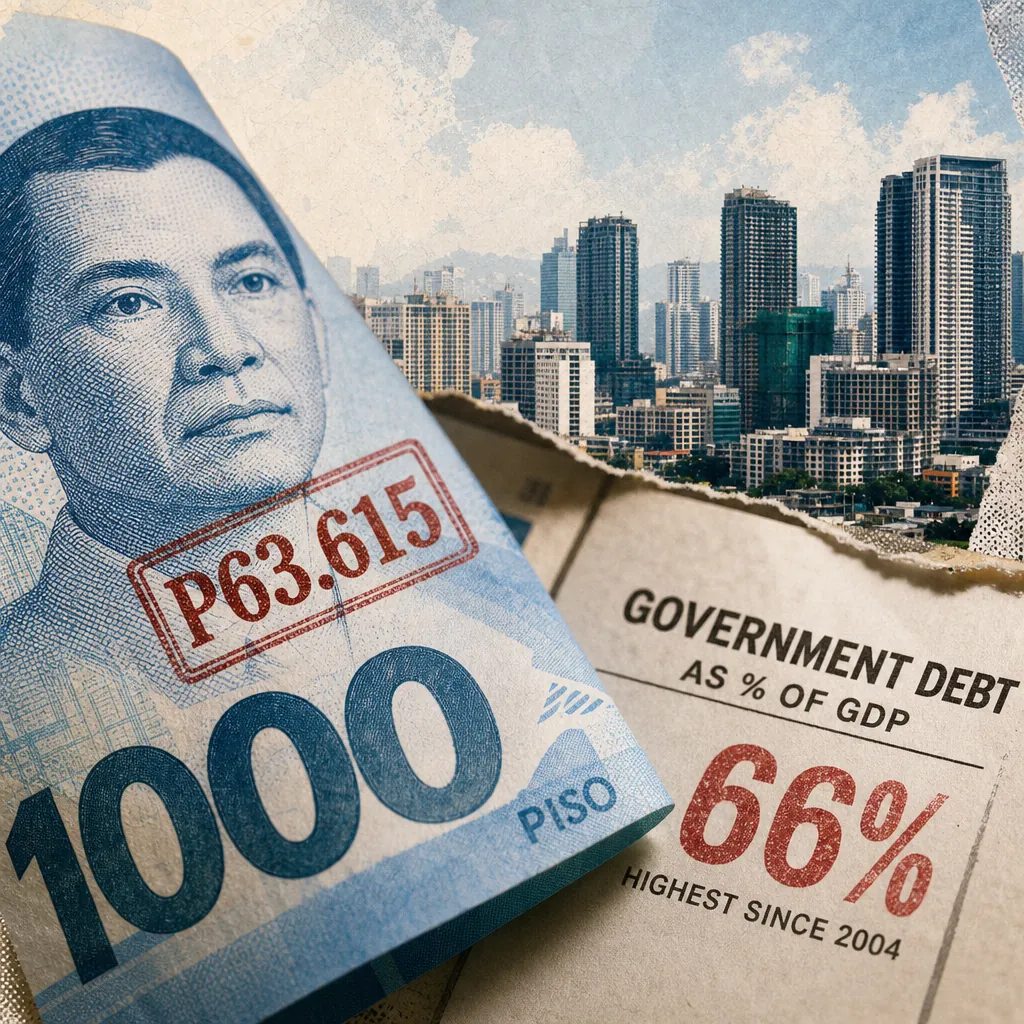
Peso hits record P63.95 as PSEi falls to 5,641
The peso closed at a record low of P63.95 to the dollar and the Philippine Stock Exchange index fell 1.53 percent to 5,641.18, as investors weighed rising oil prices, weak infrastructure spending and the possibility of stagflation. The same day, President Marcos swapped the heads of the transport and public works departments.

The peso closed at P63.95 to the dollar on Monday, October 26, its fifth straight record low, after weakening 33.5 centavos from the previous low of P63.615 3. The Philippine Stock Exchange index (PSEi) — the benchmark for the country's largest listed companies — fell 1.53 percent, or 87.45 points, to 5,641.18, its lowest close in almost two weeks 61. The two moves together made the day's dominant economic story: a currency at an all-time low and an equities market following it down, driven by rising global oil prices, weak public infrastructure spending, and concern that the country may be entering stagflation — a combination of slow growth and persistent inflation 3.
The peso has now depreciated by P5.16, or 8.78 percent, from the P58.79 to a dollar recorded on December 29, 2025 3. That means a dollar bought about 8.8 percent more pesos at Monday's close than at the end of last year, making imports — fuel, food, raw materials — more expensive in local currency. The stock market's decline was broad: the all-shares index dropped 1.01 percent, or 32.17 points, to 3,161.12 61. Analysts attributed the fall to the same set of pressures. "Persistent macro headwinds continue to weigh on sentiment and could keep investors on the sidelines ahead of the third-quarter earnings season and the Federal Reserve's policy rate decision," said Denise Joaquin, a research analyst at COL Financial Group 61.
The currency and market story ran alongside a separate development in government: President Ferdinand Marcos Jr. swapped the secretaries of the Department of Transportation (DOTr) and the Department of Public Works and Highways (DPWH), returning Vince Dizon to the transport portfolio and moving Giovanni "Banoy" Lopez to public works 55. The Palace said the move was meant to "accelerate reform" at both agencies, with Dizon tasked to "fix the daily commute" and Lopez to "make sure the reforms there last" at an agency rocked by a corruption scandal involving flood control projects 55. The reshuffle was announced Monday and led the Manila Times podcast for Tuesday morning 40.
Key themes
- The peso closed at a record P63.95 to the dollar, its fifth straight all-time low. The currency weakened 33.5 centavos from the previous record of P63.615 and has lost 8.78 percent of its value against the dollar since December 29, 2025 3. A weaker peso raises the local-currency cost of imported fuel and goods, feeding into inflation.
- The PSEi fell 1.53 percent to 5,641.18, its lowest close since October 14. The broader all-shares index dropped 1.01 percent to 3,161.12 61. The decline was attributed to the peso's slide, rising oil prices, weak infrastructure spending and uncertainty over the Bangko Sentral ng Pilipinas's next rate move 61.
- Marcos swapped the transport and public works secretaries to "accelerate reform." Vince Dizon returns to the DOTr and Giovanni Lopez moves to the DPWH, which is under scrutiny over alleged anomalies in flood control projects 55. The Palace said the changes were meant to address commuting problems and sustain reforms at public works 55.
- The National Bureau of Investigation widened its flood control probe to 26 more projects. Six DPWH officials and engineers were relieved over questionable projects in Davao City, and the new cases span Southeastern Mindanao, Bulacan, Cebu, Calabarzon, Bayombong and Bulacan South 39. The 26 are separate from the 47 projects already under investigation in Davao City 39.
- Pag-IBIG financed 68,514 homes worth P111.29 billion in the first nine months of 2026, up 15 percent in units and 20 percent in loan releases. Socialized housing loans jumped 173 percent to 10,904 homes worth P12.10 billion, raising that segment's share of Pag-IBIG-financed homes to nearly 16 percent from 7 percent a year earlier 4159. The figures were reported by Human Settlements Secretary Jose Ramon Aliling, who chairs the Pag-IBIG Fund board 41.
- Urban poor groups protested outside the Department of Human Settlements and Urban Development (DHSUD), accusing it of "ghosting" them. About 500 leaders and members of the Urban Poor Action Committee (UPAC) wore ghost costumes and carried placards reading "DHSUD, Huwag Mo Kaming I-Ghost" to demand faster implementation of land proclamations, land titles and funding 38. The protest came the same day Pag-IBIG reported its socialized housing gains.
- Vista Land's 2025 net income fell 69.6 percent to P2.33 billion as costs rose. Revenue slipped 3.1 percent to P35.8 billion and total costs and expenses climbed 25.2 percent to P19.04 billion 26. The company still met its 2025 cash flow target, reporting earnings before interest, taxes, depreciation and amortization (Ebitda) of P24.2 billion 26.
- MREIT's third-quarter distributable income more than doubled to P1.93 billion after asset infusions. Revenue rose 90 percent to P2.71 billion and gross leasable area nearly doubled to about 951,000 square meters from 482,000 78. The real estate investment trust declared a third-quarter cash dividend of P0.2762 per share 78.
How the narratives stack
Dominant. The peso's record low and the stock market's decline dominated the business pages in the items captured here. The Manila Times led its business section with the peso story, reporting the fifth straight record close and the 8.78 percent depreciation since December 3. BusinessWorld's market report put the PSEi's 1.53 percent fall in the context of the currency's slide and the Federal Reserve's upcoming policy decision 61. The Inquirer's market story added that infrastructure spending had contracted for 14 consecutive months, citing Luis Limlingan of Regina Capital Development Corp. 61. The peso story also carried the heaviest coverage value in the set: the Manila Times online item was estimated at P623,492 in advertising-equivalent terms, and the Inquirer Plus market story at P124,816 361. That figure measures the estimated cost of buying the same space as advertising, not the number of readers.
Counter-narrative. The Cabinet reshuffle offered a competing frame: that the government is responding to the economic pressure with personnel changes. The Palace's message was that Dizon would "fix the daily commute" and Lopez would "make sure the reforms there last" at public works 55. The Manila Times podcast led with the reshuffle as its banner story for Tuesday 40. The appointment of Lopez to the DPWH came as the NBI widened its flood control investigation to 26 more projects and relieved six DPWH officials in Davao City 39. The reshuffle and the probe are two halves of the same story: the government is changing leadership at an agency under investigation while the investigation expands.
Emerging. The housing numbers told a different story from the currency and market reports. Pag-IBIG's socialized housing loans rose 173 percent, and the segment's share of total homes financed nearly doubled to 16 percent 41. That growth came under the Expanded Pambansang Pabahay para sa Pilipino (4PH) program, the Marcos administration's flagship housing initiative 59. The same day, urban poor groups protested outside the DHSUD, saying the agency had failed to resolve land and housing concerns despite four years of consultations 38. The two stories sit side by side: more government-backed financing is reaching low-income homebuyers, while groups representing the poorest say the land and title problems remain unresolved.
Under-covered. The peso's effect on ordinary households — through imported fuel, food and transport costs — was mentioned in the market stories but not developed. The Manila Times noted that a weaker currency could worsen inflation by raising the cost of imported goods and inputs 61. The Inquirer's market report said further rate hikes could temper inflation but place more pressure on consumer spending and business expansion 61. The specific impact on household budgets, and the question of whether the Bangko Sentral ng Pilipinas will raise rates again, were left for another day.
Platform insights
The monitoring writeup for this window did not include social media posts with engagement figures. The conversation captured here is drawn from news articles, and the platform breakdown below reflects where those articles were published rather than how social media users responded.
- Online news. The peso and market stories ran across multiple online outlets — the Manila Times, BusinessWorld, the Inquirer and Inquirer Plus — with the Manila Times item carrying the highest estimated advertising-equivalent value in the set at P623,492 3. The reshuffle story ran on Inquirer Plus and was the lead item in the Manila Times's daily podcast 5540.
- Broadsheet. BusinessWorld and the Manila Standard carried the housing, property and corporate earnings stories in print. BusinessWorld's Vista Land report and MREIT report ran in the corporate news section 2678. The Manila Standard's front page carried the urban poor protest photo and story 38.
- Tabloid. The tabloid items in the set covered entertainment and crime, including the Star Awards and a motorcycle collision in Cavite, and did not carry the economic stories.
- Blogs. Blog items covered lifestyle and advocacy topics, including the Hero For All awards and a hotel Halloween promotion, and did not engage with the peso or market story 266.
Key voices and communities
Financial analysts and market reporters. Denise Joaquin of COL Financial Group and Luis Limlingan of Regina Capital Development Corp. provided the market commentary, linking the peso's slide to inflation expectations and the central bank's next move 61. Their framing — that investors are waiting for third-quarter earnings and the Federal Reserve's decision — set the tone for the business coverage.
Government economic managers. The Palace, through Presidential Communications Office Secretary Lino Cayetano, framed the Cabinet reshuffle as a reform move 55. Human Settlements Secretary Jose Ramon Aliling, who chairs the Pag-IBIG Fund board, presented the housing numbers as evidence that the administration's affordable housing push is working 41.
Urban poor organizations. The Urban Poor Action Committee, with about 500 members from Metro Manila, Rizal and Bulacan, staged the protest outside the DHSUD 38. Their message — that the government has "ghosted" them — put a human face on the housing crisis that the Pag-IBIG numbers do not capture.
Property developers and real estate investment trusts. Vista Land, MREIT, Megawide and SM Prime all had developments in the set. Vista Land reported lower earnings but met its cash flow target 26. MREIT reported doubled distributable income 78. Megawide completed P1.2 billion in horizontal housing projects 38. SM Prime was reported to be buying beachfront properties in Puerto Princesa 80.
Narrative streams
The peso's record low and the stock market's decline
The peso's close at P63.95 to the dollar on Monday was the fifth consecutive trading day it hit an all-time low 3. The currency opened at P63.535 and traded between P63.5 and P63.95, with volume reaching P1.648 billion, higher than the previous P1.284 billion 3. The peso has now lost 8.78 percent of its value against the dollar since December 29, 2025 3. The stock market followed: the PSEi fell 1.53 percent to 5,641.18, and the all-shares index dropped 1.01 percent to 3,161.12 61. The PSEi opened at 5,706.13, climbed to an intraday high of 5,709.08, but ended at the session's low 61.
The drivers were a mix of global and domestic. Rising global oil prices were cited in both the Manila Times and Inquirer reports 361. Weak public infrastructure spending was another: Limlingan noted that infrastructure spending had contracted for 14 consecutive months 61. Concerns over inflation and further interest rate hikes added to the pressure 3. The Bangko Sentral ng Pilipinas's next move was a particular focus, with analysts saying further rate hikes could temper inflation but weigh on consumer spending and business expansion 61.
For households, the peso's slide means imported goods — fuel, rice, cooking oil, medicine — cost more in pesos. The Manila Times noted that a weaker currency could worsen inflation by raising the cost of imported goods and inputs 3. For businesses that import raw materials or borrow in dollars, the currency's fall raises costs and complicates debt servicing. For investors, the combination of a weak currency, rising oil prices and uncertainty over rate hikes is a reason to stay on the sidelines 61. The third-quarter earnings season and the Federal Reserve's policy decision are the next scheduled events that could change the picture 61.
The Cabinet reshuffle and the flood control investigation
President Marcos swapped the heads of the DOTr and the DPWH on Monday, returning Vince Dizon to the transport department and moving Giovanni "Banoy" Lopez to public works 55. Dizon headed the DOTr from February to September 2025 before moving to the DPWH, while Lopez succeeded him at transport 55. The Palace said the President was counting on the two officials' expertise to ease commuting problems and sustain reforms at the public works agency, which has been rocked by a corruption scandal involving flood control projects 55. "We are shifting gears to accelerate reform," Marcos said in a statement read by Cayetano 55.
The reshuffle came as the National Bureau of Investigation widened its probe into alleged flood control anomalies, placing 26 additional projects under scrutiny and relieving six DPWH officials and engineers over questionable projects in Davao City 39. The new cases are spread across several regions: nine under the NBI's Southeastern Mindanao Regional Office, seven in Bulacan and five in Cebu, with two more under the Fraud and Financial Crimes Division and one each in Calabarzon, Bayombong in Nueva Vizcaya and Bulacan South 39. The 26 projects are separate from the 47 flood control projects already under investigation in Davao City 39.
The flood control scandal has already touched the courts. The Sandiganbayan Third Division on Monday denied the prosecution's motion to have Associate Justice Ronald Moreno inhibit from the malversation case of former Senator Bong Revilla, who faces charges over the alleged illegal disbursement of P76.9 million for a purported ghost flood control project in Pandi, Bulacan 46. The court said the motion lacked merit 46.
For the transport sector, Dizon's return to the DOTr puts a former public works chief in charge of the daily commute, with the Palace signaling that commuting problems are a priority 55. For the construction industry, Lopez's move to public works means a new secretary will oversee the agency's response to the flood control investigation and the reforms the Palace says it wants to sustain 55. For contractors and local governments that deal with the DPWH, the leadership change and the expanding probe create uncertainty about project approvals and payments.
Pag-IBIG's socialized housing loans rise 173 percent
Pag-IBIG Fund financed 68,514 homes worth P111.29 billion in the first nine months of 2026, up from 59,789 homes worth P93.03 billion in the same period last year — a 15 percent increase in units and a 20 percent rise in loan releases 41. Within that total, socialized housing loans jumped 173 percent to 10,904 homes from 3,987, and the amount released rose 172 percent to P12.10 billion from P4.45 billion 41. Socialized housing's share of Pag-IBIG-financed homes rose to nearly 16 percent from 7 percent a year earlier 41.
The growth came under the Expanded Pambansang Pabahay para sa Pilipino (4PH) program, the Marcos administration's flagship housing initiative aimed at making homeownership more accessible to low-income families 59. Pag-IBIG, formally the Home Development Mutual Fund, is the government's housing provident fund; it collects mandatory contributions from workers and uses them to finance housing loans. Aliling, who chairs the Pag-IBIG board, said the figures showed that the President's directive to make affordable housing accessible was producing results 59.
For low-income families, the numbers mean more government-backed financing is available for socialized housing units. For developers, the growth in socialized housing represents a market segment that is expanding even as the broader property market faces higher costs and weaker demand. Vista Land's 2025 results showed the pressure on the private market: net income fell 69.6 percent to P2.33 billion as costs rose 26. The company still met its Ebitda target of P24.2 billion and launched 46 horizontal projects worth P49.6 billion 26. Megawide completed P1.2 billion in horizontal housing projects, including Northscapes San Jose del Monte in Bulacan and Southscapes Trece Martires in Cavite 38.
Urban poor groups protest outside the DHSUD
About 500 leaders and members of the Urban Poor Action Committee staged a protest outside the Department of Human Settlements and Urban Development on Monday, wearing white ghost costumes and carrying placards reading "DHSUD, Huwag Mo Kaming I-Ghost" 38. The group accused the agency of failing to resolve long-standing land and housing concerns despite four years of consultations 38. They demanded direct dialogue with Secretary Aliling and other officials authorized to make decisions, faster implementation of presidential proclamations reserving land for socialized housing, the issuance of land titles to qualified occupants, and adequate funding to complete the process 38.
The protest used the popular term "ghosting" — abruptly cutting off contact without explanation — to describe what the group said was the government's failure to provide concrete answers 38. The action came the same day Pag-IBIG reported its socialized housing gains, setting up a contrast between the government's financing numbers and the complaints of the poorest households. The group also criticized the government's Pambansang Pabahay program, according to the Manila Standard report 38.
For the housing sector, the protest signals that the government's housing program faces a credibility problem among the constituencies it is meant to serve. The 4PH program's financing numbers are growing, but the land titles and proclamations that would let urban poor families secure their tenure remain unresolved, according to the protesters 38. For DHSUD, the challenge is to show that the consultations lead to concrete action on land and titles, not just financing.
Property and corporate earnings: Vista Land, MREIT, Megawide and SM Prime
Vista Land & Lifescapes Inc. reported 2025 attributable net income of P2.33 billion, down 69.6 percent from a year earlier, as total costs and expenses rose 25.2 percent to P19.04 billion 26. Revenue slipped 3.1 percent to P35.8 billion, and real estate sales revenue fell 8.7 percent to P15.18 billion as fewer sold properties reached completion 26. The company said 2024 results benefited from adjustments that reduced reported costs, while no similar adjustments were made last year 26. Despite the earnings decline, Vista Land met its 2025 Ebitda target of P24.2 billion and launched 46 horizontal residential projects worth an estimated P49.6 billion, led by its Camella brand 26.
MREIT Inc., the real estate investment trust backed by Megaworld Corp., reported third-quarter distributable income of P1.93 billion, up 106 percent year-on-year, and revenue of P2.71 billion, up 90 percent 78. The growth followed more than P43 billion in asset infusions under its fourth and fifth waves, which nearly doubled gross leasable area to about 951,000 square meters from 482,000 78. Portfolio occupancy exceeded 90 percent, and the company declared a third-quarter cash dividend of P0.2762 per share 78.
Megawide Construction Corp. completed P1.2 billion worth of horizontal housing projects, including Northscapes San Jose del Monte in Bulacan, a P575-million project developed by its real estate unit PH1 World Developers, and three residential blocks comprising 40 units at Southscapes Trece Martires in Cavite under a P593-million contract 38. SM Prime Holdings Inc. was reported to be buying beachfront properties in Puerto Princesa, Palawan, as the city pushes for integrated development 80. Mayor Lucilo Bayron said the SM Group had bought almost all of the beachfront properties on the west coast, from Barangay Napsan to Simpocan 80.
For the property sector, the results show a split between developers focused on horizontal housing and those with recurring rental income. Vista Land's earnings fell but its cash flow held, while MREIT's income doubled on asset infusions. The peso's slide adds to the cost of imported construction materials and raises the cost of dollar-denominated debt, a pressure that applies across the sector. Leechiu Property Consultants noted that aging condominiums in Makati's central business district could offer redevelopment opportunities if Congress passes the proposed Condominium Redevelopment Act, which would ease voting requirements for redevelopment 38.
Conversation trajectory
The peso's next close (daily, through the week). The peso has hit a record low for five consecutive trading days 3. Watch whether it breaks through P64 to the dollar, a level the Manila Times headline flagged as near 3. A further slide would raise the cost of imported fuel and food and increase pressure on the Bangko Sentral ng Pilipinas to raise rates.
The Bangko Sentral ng Pilipinas policy meeting (scheduled). Analysts cited the central bank's next move as a key concern for investors 61. A rate hike could temper inflation but weigh on consumer spending and business expansion; a hold could let the peso weaken further. The timing of the next meeting is the checkable horizon.
Third-quarter earnings season (over the next several weeks). COL Financial's Joaquin said investors are waiting for third-quarter earnings and the Federal Reserve's policy decision 61. The earnings results will show how companies are coping with the weaker peso and higher costs.
The NBI flood control investigation (ongoing). The probe has expanded to 26 more projects beyond the 47 in Davao City 39. Watch for additional project lists, more relieved officials, and whether the investigation reaches contractors or elected officials.
The DPWH leadership transition (over the next 4–6 weeks). Lopez takes over public works as the agency responds to the flood control probe 55. Watch for statements on project approvals, payment schedules and reforms.
Pag-IBIG's full-year housing numbers (early 2027). The first nine months showed 68,514 homes financed and socialized housing up 173 percent 41. The full-year figures will show whether the pace held through the fourth quarter.
The DHSUD's response to the urban poor protest (near term). The protesters demanded direct dialogue with Secretary Aliling 38. Watch for whether the agency agrees to meet and whether it announces action on land proclamations and titles.
Response guidance
For financial institutions and market communicators: explain the peso's effect on household costs in plain terms. The peso's 8.78 percent depreciation since December 2025 raises the local-currency cost of imported fuel, food and medicine 3. Messages that connect the exchange rate to specific household expenses — transport fares, rice prices, electricity — will be more useful than market commentary alone.
For government communicators: pair the reshuffle announcement with concrete timelines for the DPWH reforms. The Palace framed the Cabinet swap as a move to "accelerate reform" 55. The NBI's expanded probe and the relieved officials in Davao City are the context audiences will bring to the announcement 39. Specific milestones for project reviews and procurement changes will carry more weight than general reform language.
For housing agencies and Pag-IBIG: address the land-title gap alongside the financing numbers. The 173 percent rise in socialized housing loans is a strong number 41, but the urban poor protest the same day shows that financing alone does not resolve tenure concerns 38. Communications that acknowledge the land and title issues and give a timeline for resolving them will be more credible than financing figures alone.
For property developers: prepare for questions about currency exposure and construction costs. The peso's slide raises the cost of imported materials and dollar-denominated debt. Vista Land's earnings decline and MREIT's asset-infusion growth show two different models 2678. Developers should be ready to explain how they are managing currency risk and whether their projects are exposed to imported inputs.
For all sectors: avoid treating the stock market's daily moves as a measure of the economy's health. The PSEi's 1.53 percent fall is a measure of investor sentiment on the day, not of household conditions 61. Communications that conflate the two will mislead audiences about what the numbers mean.
For communicators in the transport sector: watch the DOTr transition. Dizon's return to transport comes with a mandate to "fix the daily commute" 55. Transport groups and commuter organizations should prepare to engage with the new secretary on fare, route and service issues.
For communicators covering the flood control issue: follow the court cases as well as the investigations. The Sandiganbayan's denial of the prosecution's motion against Justice Moreno keeps the Revilla malversation case on its current track 46. The court proceedings and the NBI probe are separate tracks that will produce news on different schedules.
See the full picture behind today's signals.
This report draws from Media Meter's MediaWatch, our real-time monitoring engine tracking 2,470+ Philippine sources across print, broadcast, digital, and social. Explore how the platform turns raw coverage into decision-grade intelligence, then see how it's configured for teams like yours — whether you're in PR agencies, corporate comms, government, or marketing.
Want more? Browse our Report Library for sector and crisis intelligence, or request a demo and we'll have your brand set up before the call.
Want this kind of intelligence on your brand?
This brief is built on the same MediaWatch methodology that runs continuously across every brand we monitor. See your competitive landscape, Impact Score, and narrative trajectory in a 30-minute demo.