Peso Hits Record Low 62.90 as Reserves Drop Below $100B
The peso closed at a record low of 62.90 to the dollar and the country's gross international reserves fell below $100 billion for the first time in three years, while the stock index posted its worst finish in nearly 11 months. The Senate impeachment trial of Vice President Sara Duterte also drew heavy coverage.
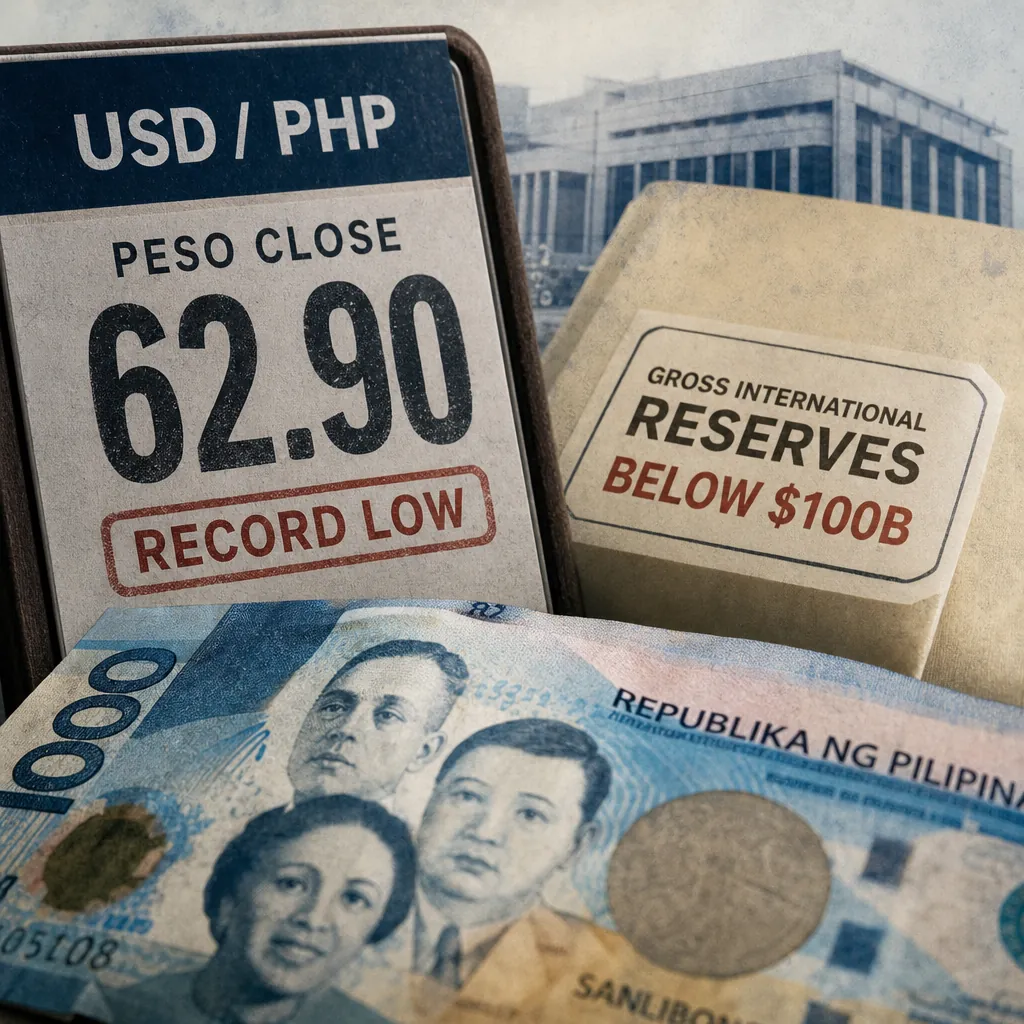
The peso closed at a record low of 62.90 against the US dollar on Thursday, weakening 15 centavos from Wednesday's 62.75 and surpassing the previous record-low close of 62.86 set on Sept. 14, according to data from the Bankers Association of the Philippines.1 Trading volume rose to $1.4 billion from $1.2 billion in the prior session.1 The same day, the Bangko Sentral ng Pilipinas (BSP) — the country's central bank — reported that gross international reserves (GIR), the country's stockpile of foreign currency and other assets used to defend the peso and pay for imports, fell 8.31 percent to $99.997 billion at the end of September from $109.06 billion a year earlier. It was the first time reserves dropped below $100 billion in three years, since September 2023, when they stood at $98.12 billion. The Philippine Stock Exchange index (PSEi), the benchmark for the country's largest listed companies, fell 2.2 percent, or 126.30 points, to close at 5,610.39 — its worst finish in almost 11 months, since it ended at 5,584.35 on Nov. 14, 2025.
The peso's slide and the reserve decline are linked. The BSP said reserves shrank largely because of its net foreign exchange operations, particularly as the peso depreciated further in September, along with downward valuation adjustments on its gold holdings and foreign currency-denominated reserve assets. The national government also drew down its foreign currency deposits with the BSP to service external debt. Ruben Carlo Asuncion, chief economist at UnionBank of the Philippines, said the peso's weakness reflected "a combination of persistent dollar strength and rising external price pressures," with the US dollar drawing support from the Federal Reserve's higher-for-longer policy stance and elevated Treasury yields, while oil prices above $100 per barrel added to the pressure.1 The BSP said the September reserve level remains an adequate liquidity buffer, equal to 6.3 months of imports of goods, payments for services and primary income, and covers about 3.2 times the country's short-term external debt based on residual maturity.
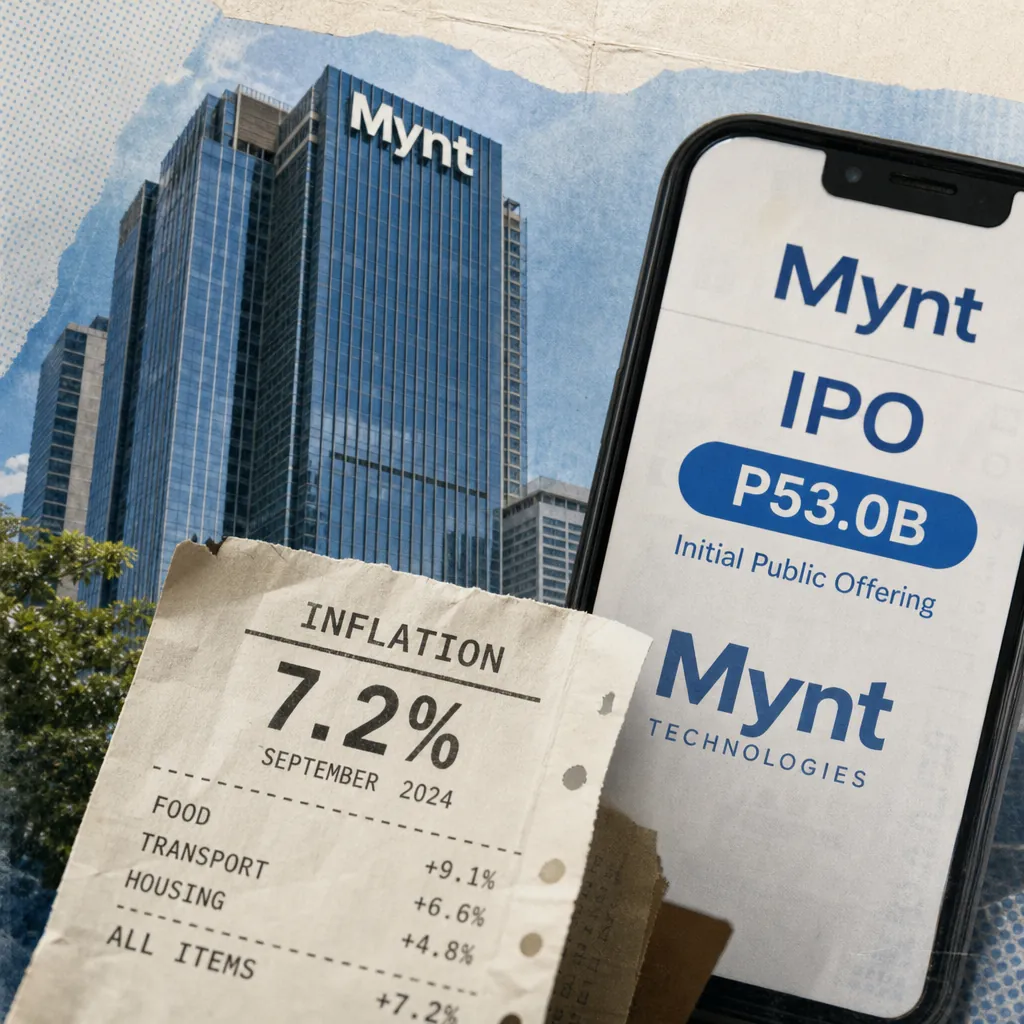
The market moves came as inflation — the rate at which consumer prices rise — remained elevated. The latest reading was 7.2 percent, above the BSP's comfort range, and core inflation, which strips out volatile food and energy prices, quickened to a nearly three-year high of 4.7 percent from 4.1 percent the previous month and 2.6 percent a year earlier. National Statistician Claire Dennis S. Mapa noted persistent pressures from energy items and said the latest figure still does not account for the recent transport fare hike and the "Super El Niño" weather pattern. Bank of America (BofA) Global Research said "the concerns are squarely pointing to the upside" on inflation, and warned that higher oil price assumptions may prompt the BSP to raise its inflation projections through 2027. Based on forecasts given in August, the central bank sees inflation settling at 6.1 percent this year before easing to 5.4 percent next year.
Key themes
- Peso closes at record low 62.90 to the dollar. The currency weakened 15 centavos from Wednesday's 62.75, surpassing the previous record-low close of 62.86 set Sept. 14, with trading volume rising to $1.4 billion from $1.2 billion.1 Year to date, the peso has depreciated by P4.11, or 6.53 percent, from its P58.79 close on Dec. 29, 2025.
- Gross international reserves fall below $100 billion for the first time in three years. The BSP reported reserves of $99.997 billion at end-September, down 8.31 percent from $109.06 billion a year earlier, the lowest level since September 2023. The decline was driven by the central bank's net foreign exchange operations, lower valuations on gold and foreign currency assets, and government withdrawals to service external debt.
- Stock index posts worst finish in nearly 11 months. The PSEi fell 2.2 percent, or 126.30 points, to 5,610.39, while the broader all shares index dropped 1.45 percent, or 46.44 points, to 3,145.55. The decline was attributed to expectations of rate hikes by both the US Federal Reserve and the BSP.
- Inflation stays elevated at 7.2 percent, with core inflation at a near three-year high of 4.7 percent. National Statistician Claire Dennis S. Mapa said the latest figure does not yet account for the recent transport fare hike and "Super El Niño." BofA warned that higher oil price assumptions may push the BSP to raise its inflation projections through 2027.
- Bank of America forecasts growth below 3 percent this year. BofA expects gross domestic product (GDP) — the total value of goods and services produced — to expand by less than 3 percent, well below the Marcos administration's 3.5-percent to 4.5-percent target and far below the economy's estimated 6-percent growth potential. The bank cited weak domestic demand and warned that inflation pressures are rising again.
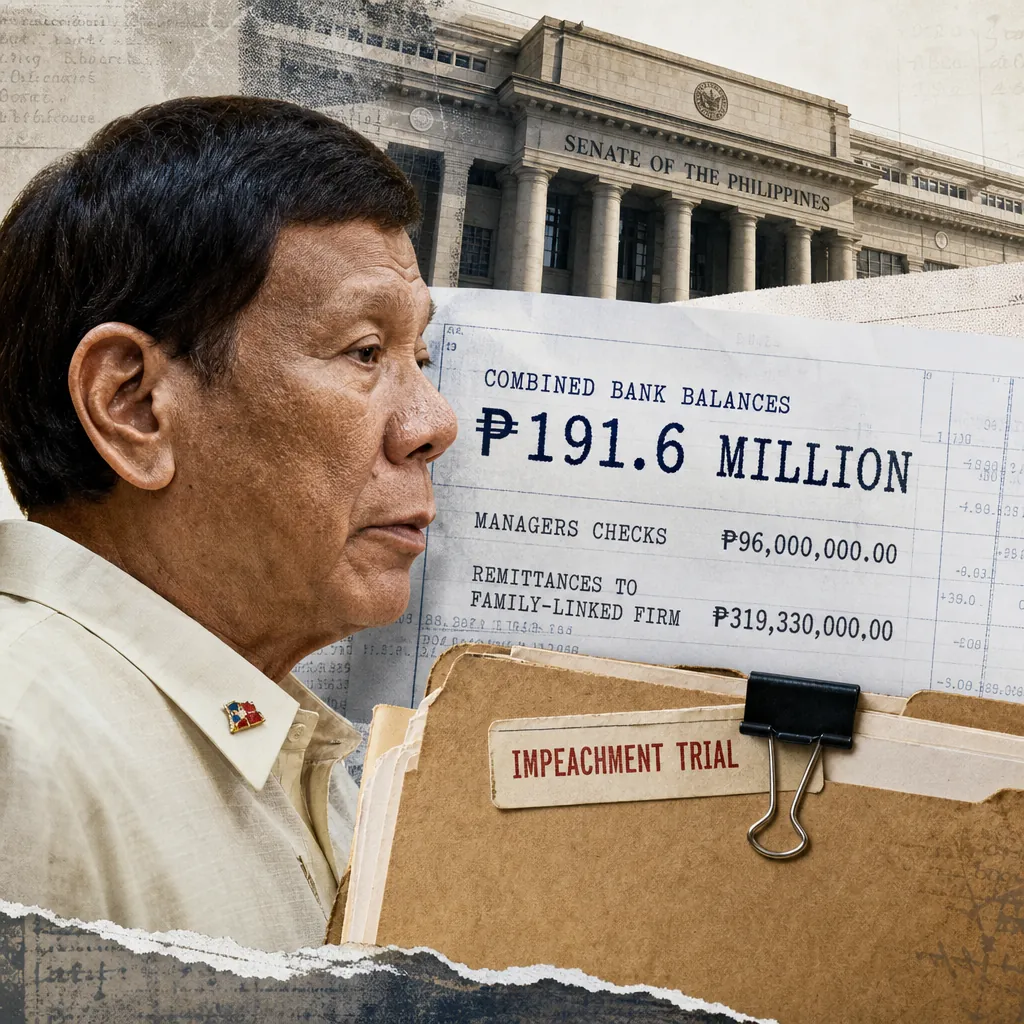
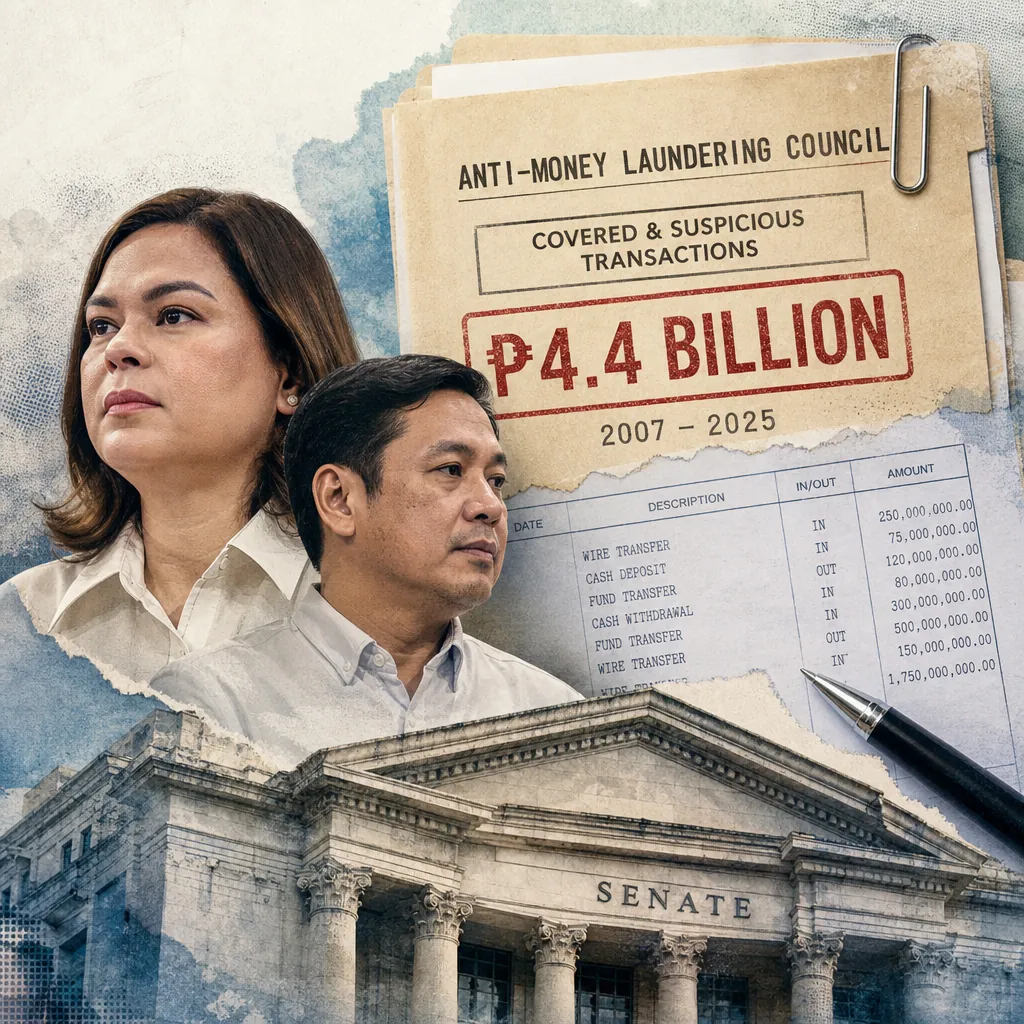
- Senate impeachment trial of Vice President Sara Duterte continues, with bank records and constitutional questions in focus. House prosecutor Erwin Matib said Bureau of Internal Revenue records showed Duterte remained engaged in legal activities and received professional fees while serving as vice president, which the prosecution argued violates Article VII, Section 13 of the Constitution prohibiting the president and vice president from practicing any other profession during their tenure. Separate testimony examined joint bank accounts held by Duterte and her father, former President Rodrigo Duterte.
- China Banking Corp. announces leadership transition after 57 years. Gilbert U. Dee resigned as vice chair and executive director effective Oct. 7 and was named chairman emeritus, having served 57 years on the board, including 22 as chairman and 15 as vice chair. The bank also brought in Jonathan T. Cua, a private banking executive with more than 27 years of experience, to head its Wealth Management Group.
- Figaro Culinary Group seeks voluntary delisting from the Philippine Stock Exchange. Figaro Coffee Systems, Inc. plans to acquire shares held by minority shareholders through a tender offer at P0.82 per share, financed through a senior secured term loan facility from China Banking Corp.
How the narratives stack
Dominant: The peso's record low and the decline in gross international reserves dominated the business pages across the items captured here. The peso story ran on the front pages of both the Philippine Daily Inquirer and Manila Standard, with the Inquirer reporting the currency closed at 62.90 per dollar and Manila Standard linking the depreciation directly to the reserve decline.1 BusinessWorld's front-page report led with the reserves falling below $100 billion, noting it was the seventh straight month that reserves contracted annually and that month-on-month the figure declined 4.62 percent from $104.846 billion. The stock market decline was covered by BusinessWorld, the Inquirer, and Manila Standard, all attributing the fall to rate hike expectations. The combined coverage of these linked stories — currency, reserves, and equities — accounted for the largest share of business news value in the captured set, with the BusinessWorld front-page reserves story alone carrying an estimated P374,721.60 in advertising-equivalent value, the Inquirer's peso story P539,450.28, and the Inquirer's market report P373,915.60.1
Counter-narrative: The impeachment trial of Vice President Sara Duterte generated substantial coverage that competed for attention with the economic stories. Manila Standard's front-page report on the prosecution's allegation that Duterte practiced law and received professional fees while in office carried an estimated P481,173 in advertising-equivalent value. The tabloid PM ran two separate stories on the trial — one on the joint bank accounts and one on the drug test reimbursement — while the online outlet Saksi Ngayon focused on Article 2 of the impeachment complaint, covering allegations of unexplained wealth and undeclared bank accounts. The Inquirer's opinion section weighed in on the trial's focus on bar exam grades. This stream drew heavy coverage in the captured set, particularly in tabloid and online outlets, but its advertising-equivalent value was lower than the economic stories in broadsheets.
Emerging: Two corporate stories pointed to longer-term shifts. China Banking Corp.'s leadership transition — the departure of Gilbert U. Dee after 57 years and the appointment of Jonathan T. Cua to head wealth management — signals a generational change at one of the country's largest banks. Separately, Philippine National Bank (PNB) partnered with Luna Securities to widen access to Personal Equity and Retirement Account (PERA) products, a government-sponsored voluntary retirement savings program that offers tax benefits to encourage Filipinos to save for retirement. The partnership aims to make retirement investing more accessible through digital platforms, with PNB Senior Vice-President and Chief Trust Officer Jiah R. Sasday saying it "represents an important step in expanding access to PERA and encouraging more Filipinos to start investing for retirement." These stories suggest banks are positioning for a digital-first retail market even as macroeconomic pressures mount.
Under-covered: Several stories in the captured set received less attention relative to their potential significance. The Department of Environment and Natural Resources (DENR) issued Administrative Order No. 2025-40 establishing a Tree Plantation Certifier Registration Program, a regulatory development that affects forestry and carbon offset markets but received no follow-up coverage in the items reviewed. A BusinessWorld opinion piece asked what happens after government decides — a reflection on policy implementation gaps — but stood alone as commentary rather than sparking a broader debate. The ASEAN Youth Entrepreneurship Summit 2026, scheduled for Oct. 12 at SM Mall of Asia with Trade and Industry Secretary Ma. Cristina A. Roque and ASEAN Business Advisory Council Chairman Joey Concepcion, was announced in a promotional item but not covered as news. Mynt, Inc.'s initial public offering under the trading symbol "GCASH" was noted in a prospectus summary but not analyzed in the items captured. These items represent a small share of the day's coverage value and did not generate the engagement or follow-up that the economic and political stories did.
Platform insights
Facebook: The impeachment trial generated the most visible social activity in the captured set, with Vice President Duterte's defense team's statements about the joint bank accounts and Interior Secretary Jonvic Remulla's social media post reimbursing a vice mayor's drug test fee both circulating widely. Remulla's post — a screenshot of a P28,011 refund with the caption "Eto na, Happy!" — was covered by both Manila Standard and the tabloid PM, indicating it traveled from social media into news coverage. The personal, direct nature of the post — a cabinet secretary publicly settling a dispute with a local official — drove engagement because it was unusual and easily shared.
X: Discussion of the peso's record low and the stock market decline was concentrated on X, where financial analysts and business journalists shared the BSP's reserve data and the PSEi's closing figures in real time.1 The speed of the currency and market moves — both reported Thursday afternoon — made X the platform where the numbers were first circulated and debated before appearing in print the following day.
Reddit: The impeachment trial's focus on bank records and the constitutional question of whether the vice president practiced law while in office drew discussion on Philippine subreddits, where users debated the legal merits and the prosecution's strategy. The technical nature of the allegations — Article VII, Section 13 of the Constitution, the Anti-Money Laundering Council's role, and the distinction between joint accounts and declared assets — made Reddit a venue for longer-form explanation and argument than the other platforms.
YouTube: Coverage of the impeachment trial and the economic news was largely absent from YouTube in the captured set, with no significant video content identified. The stories were primarily text- and broadcast-driven, with the tabloid and broadsheet coverage providing the main distribution channels.
Key voices and communities
Financial analysts and economists: Ruben Carlo Asuncion of UnionBank of the Philippines provided the most-quoted assessment of the peso's weakness, attributing it to dollar strength and external price pressures.1 Bank of America Global Research offered the most bearish growth forecast, projecting GDP growth below 3 percent and warning that inflation concerns "are squarely pointing to the upside." These voices framed the economic story for business readers and set the terms of the debate about whether the BSP will raise rates further.
Government officials: National Statistician Claire Dennis S. Mapa explained the inflation data, noting that the 7.2 percent figure does not yet reflect the transport fare hike or "Super El Niño." Interior Secretary Jonvic Remulla generated social media engagement with his public reimbursement of a vice mayor's drug test fee, a personal dispute that became a news story. Trade and Industry Secretary Ma. Cristina A. Roque was announced as a speaker at the ASEAN Youth Entrepreneurship Summit, though she did not make news on the economic issues of the day.
Legal and political communities: The impeachment trial drew participation from House prosecutors, defense lawyers, senator-judges, and the Anti-Money Laundering Council. House prosecutor Erwin Matib made the constitutional argument against Duterte's alleged law practice. Private prosecutor Atty. Benjamin Tolosa Jr. addressed the joint bank accounts. The legal community reacted to the trial's focus on bar exam grades, with the Inquirer's opinion section calling the issue improper and irrelevant.
Business and corporate leaders: Gilbert U. Dee's departure from China Banking Corp. after 57 years marked the end of an era at the bank, while Jonathan T. Cua's appointment to head wealth management signaled a new focus on private banking. PNB's partnership with Luna Securities reflected banks' efforts to expand digital investment products. Figaro Culinary Group's delisting move showed the challenges facing smaller listed companies.
Tabloid and online commentators: The tabloid PM and online outlet Saksi Ngayon provided coverage of the impeachment trial that was more opinionated and focused on the political implications than the broadsheet coverage. These outlets framed the trial as a political battle with personal consequences for the Duterte family, with PM's headline declaring that "Man's and Sara won, Digong failed and is now suffering."
Narrative streams
Peso hits record low as reserves fall below $100 billion
The peso's close at 62.90 to the dollar on Thursday was the weakest finish on record, surpassing the previous low of 62.86 set on Sept. 14.1 The currency opened the session stronger at 62.65 per dollar, which was already its intraday high, and its weakest showing was its closing level. Trading volume rose to $1.45 billion from $1.208 billion the previous day. Year to date, the peso has depreciated by P4.11, or 6.53 percent, from its P58.79 close on Dec. 29, 2025. The depreciation has eroded the BSP's gross international reserves, which fell below $100 billion in September for the first time in three years. The BSP linked the decline to its net foreign exchange operations, downward valuation adjustments on its gold holdings and foreign currency-denominated reserve assets, and the national government's drawdown of foreign currency deposits to service external debt. The central bank said the September level remains an adequate liquidity buffer, equal to 6.3 months of imports and covering about 3.2 times the country's short-term external debt. For businesses and consumers, a weaker peso makes imports more expensive, raises the cost of servicing foreign-currency debt, and can feed into inflation by making imported goods and fuel costlier. The BSP's ability to defend the currency depends on its reserves, and the decline below $100 billion reduces the buffer available for intervention. The read for the sector is that importers, dollar-denominated borrowers, and consumers of imported goods face higher costs, while exporters and recipients of remittances from overseas Filipino workers benefit from the stronger dollar.
Stock market falls 2.2 percent on rate hike expectations
The PSEi fell 2.2 percent, or 126.30 points, to close at 5,610.39 on Thursday, its worst finish in almost 11 months. The broader all shares index dropped 1.45 percent, or 46.44 points, to 3,145.55. The index opened at 5,727.76, slightly below Wednesday's 5,736.69 close, reached an intraday high of 5,744.40, but was unable to hold gains and finished at the session's low. Philstocks Financial Inc. attributed the decline to mounting concerns over tighter monetary policy from both the US Federal Reserve and the BSP. The Fed's latest meeting minutes signaled another possible rate hike before year-end, while the Philippines' inflation reading of 7.2 percent raised expectations of further tightening by the BSP. Luis Limlingan, head of sales at Regina Capital Development Corp., said the local index ended lower as selling pressure intensified amid rising crude oil prices. Higher interest rates increase borrowing costs for businesses and consumers, weighing on spending and corporate earnings. Among the PSEi member stocks, International Container Terminal Services, Inc. fell 5.93 percent to P841.50, Metropolitan Bank & Trust Co. dropped 3.30 percent to P60.05, and JG Summit Holdings, Inc. declined 3.26 percent to P16.60. The read for the sector is that companies with high debt loads or exposure to consumer spending face pressure on earnings, while investors are rotating toward safer assets. The market's decline reflects expectations that the cost of capital will rise, which affects investment decisions across the economy.
Inflation stays elevated, with core inflation at near three-year high
Inflation remained at 7.2 percent, with core inflation — which excludes volatile food and energy prices — quickening to 4.7 percent from 4.1 percent the previous month and 2.6 percent a year earlier. National Statistician Claire Dennis S. Mapa noted persistent pressures from energy items and said the latest figure still does not account for the recent transport fare hike and "Super El Niño," a climate pattern that can cause drought and affect agricultural production. Bank of America Global Research said "the concerns are squarely pointing to the upside" and warned that higher oil price assumptions may prompt the BSP to raise its inflation projections through 2027. Based on August forecasts, the central bank sees inflation at 6.1 percent this year before easing to 5.4 percent next year. BofA also forecast that GDP growth would expand by less than 3 percent this year, well below the Marcos administration's 3.5-percent to 4.5-percent target and far below the economy's estimated 6-percent growth potential. The bank cited weak domestic demand, with consumption momentum remaining weak mainly due to weak first-half spending, though it noted that steady remittances growth, increased minimum wages, and some pickup in government spending on education and health care should lead to some cyclical recovery. The read for the sector is that consumers face higher prices for basic goods and transport, which reduces disposable income and weighs on retail and consumer-facing businesses. The combination of high inflation and weak growth — sometimes called stagflation — is particularly challenging for policymakers, who must choose between raising rates to fight inflation and cutting rates to support growth.
Impeachment trial focuses on bank records and constitutional questions
The Senate impeachment trial of Vice President Sara Duterte continued on day 36, with the prosecution accusing her of violating the Constitution by practicing law and receiving professional fees while in office. House prosecutor Erwin Matib said Bureau of Internal Revenue records showed Duterte remained engaged in legal activities and received professional fees and other income aside from her salary as vice president. The prosecution cited Article VII, Section 13 of the Constitution, which prohibits the president and vice president from directly or indirectly practicing any other profession, participating in any business, or having a financial interest in government contracts, franchises, or special privileges during their tenure. Separate testimony examined joint bank accounts held by Duterte and her father, former President Rodrigo Duterte, at the Bank of the Philippine Islands (BPI). The defense panel said Duterte did not recall having a joint account with her father and did not participate in any transactions, but BPI records showed the joint accounts were named after both and funded by two time deposits with original principal amounts of P40.65 million and P55 million. The first time deposit grew by more than P41.7 million. The Anti-Money Laundering Council (AMLC) — the government agency responsible for investigating suspicious financial transactions — testified on how money can be moved through depository banks without immediate detection. The trial has also focused on Duterte's bar exam grade, which the Inquirer's opinion section called improper and irrelevant to the matters being testified on. The read for the sector is that the trial's outcome could affect investor confidence in Philippine political stability, particularly if it leads to prolonged uncertainty. Banks named in the testimony face reputational scrutiny, and the focus on anti-money laundering procedures may prompt regulators to tighten enforcement.
Corporate developments: Chinabank leadership change and Figaro delisting
China Banking Corp. announced that Gilbert U. Dee resigned as vice chair and executive director effective Oct. 7 after 57 years on the board and was named chairman emeritus. Dee served 22 years as board chairman and 15 years as vice chair, and his interlocking position as chair of subsidiary CBC Properties and Computer Center, Inc. was also recalled. The bank brought in Jonathan T. Cua, a private banking executive with more than 27 years of experience managing wealth portfolios across the Philippines, Southeast Asia, and Hong Kong, to head its Wealth Management Group with the rank of senior vice president. Cua's previous posts include senior roles at HSBC Global Private Banking and BDO Private Bank. Separately, Figaro Culinary Group, Inc. is seeking to voluntarily delist from the Philippine Stock Exchange, with Figaro Coffee Systems, Inc. planning to acquire shares held by minority shareholders through a tender offer at P0.82 per share. The tender offer will be financed through a senior secured term loan facility from China Banking Corp. The delisting is subject to shareholder approval, completion of the tender offer, and FCSI and its majority shareholders acquiring at least 95 percent of the company's shares. The read for the sector is that Chinabank is positioning for a generational transition in leadership while expanding its wealth management business, a growing segment as more Filipinos seek investment advice. Figaro's delisting reflects the challenges smaller listed companies face in maintaining liquidity and attracting investor interest, and the move allows the company to operate without the reporting requirements and market pressures of a public listing.
PNB partners with Luna Securities to expand retirement investment access
Philippine National Bank (PNB), through its trust group, partnered with Luna Securities, Inc. to boost the distribution of its Personal Equity and Retirement Account (PERA) products. PERA is a voluntary retirement savings program established by the government that offers tax benefits to encourage Filipinos to save for retirement. Under the partnership, Luna Securities, as an accredited PERA Administrator, will give investors access to PNB's retirement investment solutions on its digital platform. PNB Senior Vice-President and Chief Trust Officer Jiah R. Sasday said the partnership "represents an important step in expanding access to PERA and encouraging more Filipinos to start investing for retirement," adding that "by integrating PNB's investment management capabilities, we can make retirement investing more accessible, convenient, and relevant to today's investors." The bank said the collaboration aims to provide a seamless investment experience, from account opening onward, as more Filipinos embrace digital investing. The read for the sector is that banks are competing for retail investment customers by making it easier to open and manage retirement accounts online. The partnership reflects a broader shift toward digital distribution of financial products, which lowers the cost of reaching customers but also increases competition among banks and brokers.
Conversation trajectory
Peso and reserves (observation window: next 2–4 weeks). The peso's record low and the reserve decline below $100 billion will be tested by upcoming economic data releases and central bank meetings. The BSP's next policy meeting is a key trigger: if the central bank raises rates again, the peso may stabilize, but if it holds steady, the currency could face further pressure. The Fed's next meeting and any signals on US rate policy will also affect the dollar's strength. Watch for the BSP's next inflation forecast update, expected in the coming weeks, which will incorporate the transport fare hike and "Super El Niño" effects that the latest reading did not capture.
Inflation and growth (observation window: next 4–6 weeks). The next inflation data release, typically in early November, will show whether the 7.2 percent reading was a peak or whether price pressures continue to build. BofA's forecast of below-3-percent growth this year will be tested by third-quarter GDP data, expected in November. If growth comes in below the government's target, pressure will increase on the Marcos administration to boost spending, which could widen the budget deficit and put further pressure on the peso.
Impeachment trial (observation window: ongoing, with key votes expected in the coming weeks). The Senate impeachment court will continue hearing testimony, with the prosecution and defense presenting their cases. A key trigger will be any ruling on the constitutional question of whether Duterte's alleged law practice violates Article VII, Section 13. The trial's outcome — whether Duterte is convicted or acquitted — will have political implications that could affect investor confidence and the government's legislative agenda.
Corporate developments (observation window: next 1–3 months). Figaro Culinary Group's delisting requires shareholder approval and completion of the tender offer, with the company needing FCSI and its majority shareholders to acquire at least 95 percent of shares. Chinabank's leadership transition will continue with the election of a new vice chair and the filling of Dee's board seat. PNB's partnership with Luna Securities will be tested by customer adoption of the digital PERA platform.
Trigger events: The BSP's next policy meeting and inflation forecast update; the next inflation data release in early November; third-quarter GDP data in November; the Fed's next meeting; any major rulings in the impeachment trial; and the completion of Figaro's tender offer.
Response guidance
For financial institutions: Prepare customer communications that explain how a weaker peso affects import costs, foreign-currency loans, and remittance values. Banks should anticipate increased demand for dollar-denominated products and hedging instruments, and ensure that branch and digital staff can explain these products clearly. The reserve decline below $100 billion may prompt questions about the BSP's ability to defend the currency; financial institutions should be ready to explain that the current level remains an adequate buffer by the central bank's own metrics.
For businesses with foreign-currency exposure: Review hedging strategies and consider locking in exchange rates for upcoming payments. Companies that import raw materials or goods for resale should model the impact of further peso weakness on margins and consider whether to pass costs to consumers or absorb them. The combination of high inflation and weak growth means that pricing decisions are particularly sensitive; raising prices too much could reduce demand, while absorbing costs could hurt profitability.
For consumer-facing companies: Expect continued pressure on consumer spending as inflation erodes purchasing power. The 7.2 percent inflation rate means that consumers are paying significantly more for basic goods than a year ago, and core inflation at 4.7 percent suggests that price pressures are broad-based. Companies should focus on value messaging and consider whether to adjust product sizes or introduce lower-cost options to retain price-sensitive customers.
For communicators covering the impeachment trial: Avoid speculation about the outcome and focus on the documented evidence and legal arguments. The trial involves complex constitutional questions and financial records; explain these in plain language for audiences who may not be familiar with the legal framework. Be mindful that the trial has political dimensions that can generate strong reactions; maintain factual reporting and avoid amplifying unverified claims.
For banks named in impeachment testimony: Prepare for reputational scrutiny and ensure that anti-money laundering procedures are robust and well-documented. The testimony has focused on how money can be moved through depository banks without immediate detection; banks should be ready to explain their compliance systems and cooperate with any regulatory inquiries.
For companies considering delisting or corporate restructuring: Figaro's delisting provides a template for other small listed companies facing liquidity challenges. Communicators should explain the rationale for delisting clearly to shareholders, including the benefits of reduced reporting requirements and the terms of any tender offer.
For institutions promoting retirement savings: PNB's partnership with Luna Securities highlights the growing market for digital retirement products. Communicators should focus on the tax benefits of PERA and the convenience of digital account opening, while being clear about the risks and fees associated with investment products.
See the full picture behind today's signals.
This report draws from Media Meter's MediaWatch, our real-time monitoring engine tracking 2,470+ Philippine sources across print, broadcast, digital, and social. Explore how the platform turns raw coverage into decision-grade intelligence, then see how it's configured for teams like yours — whether you're in PR agencies, corporate comms, government, or marketing.
Want more? Browse our Report Library for sector and crisis intelligence, or request a demo and we'll have your brand set up before the call.
Want this kind of intelligence on your brand?
This brief is built on the same MediaWatch methodology that runs continuously across every brand we monitor. See your competitive landscape, Impact Score, and narrative trajectory in a 30-minute demo.