PH Economy Slows to 2.3% as Debt Hits 22-Year High
The Philippines' Q2 GDP growth slowed to 2.3%, the weakest in five years, while the debt-to-GDP ratio hit a 22-year high. This snapshot examines the economic signals, banking sector trends, and automotive industry developments covered in the day's news.
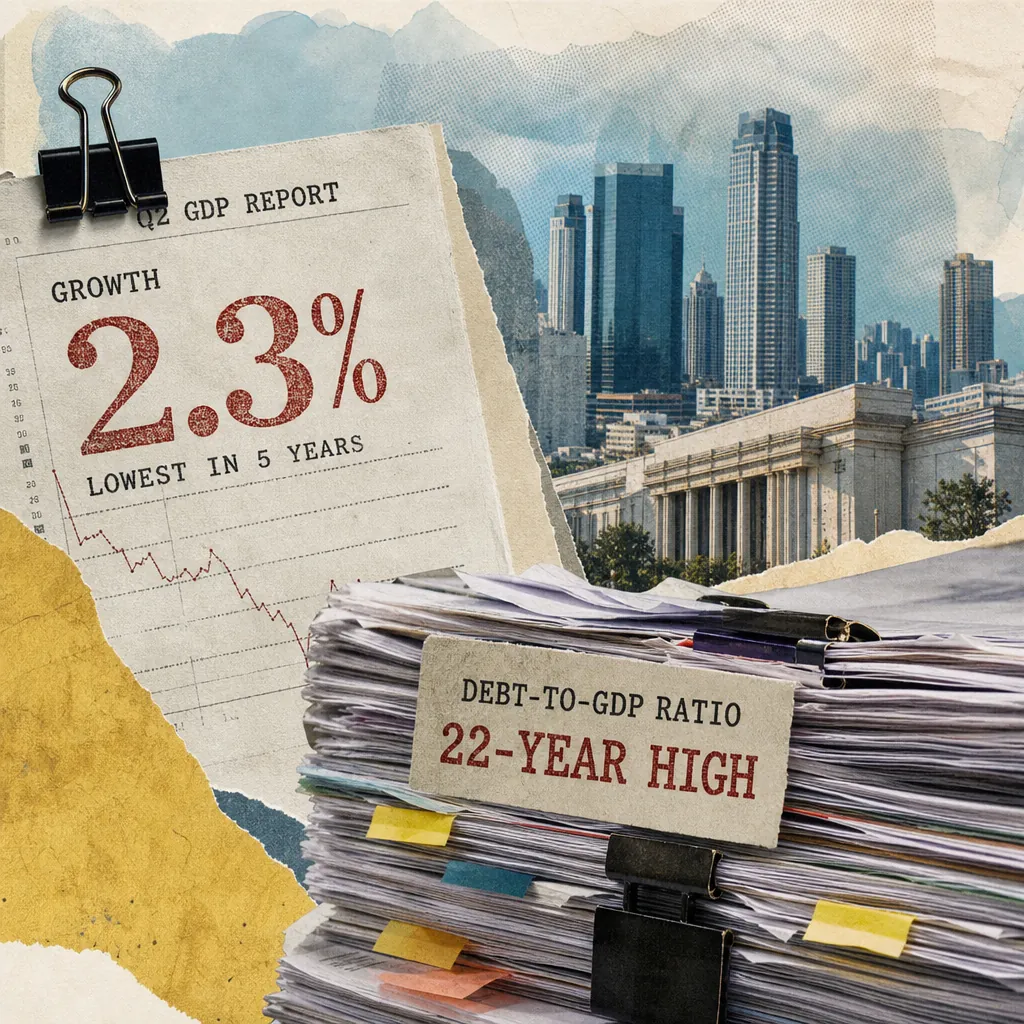
The Philippine economy hit a rough patch in the second quarter, with growth slowing to its weakest pace in five years and the national debt burden reaching a 22-year high. The day's coverage painted a picture of an economy grappling with external shocks, cautious consumers, and a banking sector that is pulling back on lending to small businesses. Yet amid the gloom, there were pockets of resilience: the stock market edged higher, banks reported steady core revenues, and the automotive industry continued to roll out new hybrid models. This snapshot synthesizes the day's news and social conversation to give a clear-eyed view of where the economy stands and what to watch next.
Key themes
- GDP growth slows to 2.3% in Q2 – The Philippine economy grew at its slowest pace in five years, as household consumption remained subdued due to the Middle East conflict and an infrastructure scandal curbed investments. The figure fell short of the government's target and raised concerns about meeting the annual goal.
- Debt-to-GDP ratio hits 22-year high – The national government's debt reached 66% of GDP in June, the highest since 2004. Weak growth and sluggish investment are complicating efforts to reduce the debt burden, though economists say it remains manageable if growth recovers.
- Foreign reserves dip to near two-year low – Gross international reserves fell to $103.4 billion in July, the lowest since January 2025, as the government paid down offshore debt and the central bank intervened in the peso market. The buffer is now below the central bank's revised year-end forecast.
- Bank lending to MSMEs remains sluggish – Loans to micro, small, and medium enterprises accounted for only 4.48% of banks' total lending portfolio in Q2, well below the mandated 10%. Both lenders and borrowers are retreating amid economic uncertainty.
- PSBank's first-half profit drops 40% – Philippine Savings Bank saw net income fall to P1.3 billion as it increased loan-loss provisions by 76% to strengthen buffers against emerging risks. Core revenues remained resilient, with net interest income growing 2%.
- Automakers push hybrids in the Philippines – Ford launched a new Platinum variant of its Territory Hybrid, Audi debuted the RS 5 Avant plug-in hybrid, and GAC announced the upcoming GS4 Max HEV. The moves signal a growing focus on electrified vehicles in the local market.
- Cooperative sector shows resilience – Stories highlighted the growth of large cooperatives like Sorosoro Ibaba Development Cooperative and Ayala Coop, which have expanded from small beginnings into major economic players, underscoring the sector's role in community development.
- Financial literacy and disaster preparedness gain attention – BPI relaunched its Jumpstart savings account for children, while Cebuana Lhuillier partnered with the government on disaster preparedness, reflecting a broader push for financial inclusion and resilience.
How the narratives stack
Dominant – The dominant narrative in the captured set is the economic slowdown. The GDP growth figure of 2.3% for Q2, the weakest in five years, was covered by multiple outlets, including Philstar Online, which also reported on the debt-to-GDP ratio hitting a 22-year high. These stories dominated the business pages, with coverage worth an estimated ₱695,000 in advertising-equivalent value for the GDP piece alone. The narrative is one of concern: the economy is growing too slowly to meet targets, and the debt burden is rising. This is a sector signal that warrants close monitoring.
Counter-narrative – Despite the weak GDP, the stock market managed to close higher, with the PSEi advancing 0.2% to 6,290.35. Investors shrugged off the disappointing data, suggesting they had already priced in the slowdown. This counter-narrative offers a glimmer of optimism, indicating that the market may see the current weakness as temporary.
Emerging – An emerging narrative is the shift toward hybrid and electric vehicles in the Philippine automotive market. With Ford, Audi, and GAC all launching or announcing new hybrid models, there is a clear trend toward electrification. This is a positive development for the sector, potentially boosting consumer interest and aligning with global sustainability trends.
Suppressed – A story that received relatively little attention but is significant is the sluggish lending to MSMEs. While the BSP data was covered, the deeper implications for small business growth and job creation were not fully explored. The fact that MSME lending is at 4.48% of total loans, far below the mandated 10%, is a critical issue that deserves more scrutiny, as it affects the backbone of the economy.
Platform insights
- Facebook – Facebook was likely the primary platform for sharing news articles, especially from outlets like Inquirer and Philstar. Posts about the GDP slowdown and debt ratio likely generated significant engagement, with users expressing concern about the economy. The automotive launches also likely sparked interest among car enthusiasts.
- X (formerly Twitter) – On X, financial analysts and economists likely weighed in on the GDP data, offering quick reactions and analysis. The hashtag #GDPPH may have trended. The stock market's resilience despite weak GDP was also a topic of discussion, with some users noting that the market often looks ahead.
- YouTube – YouTube saw activity from automotive content creators covering the new hybrid launches. Videos featuring the Ford Territory Hybrid Platinum and Audi RS 5 Avant PHEV likely attracted views from car enthusiasts. Additionally, the cooking show controversy involving RFK Jr. may have drawn attention, but that is outside the industry focus.
- Reddit – On Reddit, subreddits like r/Philippines and r/phinvest likely discussed the economic slowdown and its implications for personal finance. Users may have shared the MSME lending story, debating the challenges small businesses face in accessing credit.
Key voices and communities
- Economic analysts and economists – Figures like UnionBank chief economist Ruben Carlo Asuncion provided expert commentary on the debt-to-GDP ratio, calling it "manageable" but warranting close monitoring. Their analysis shapes the narrative around fiscal sustainability.
- Government officials – National Statistician Dennis Mapa and BSP officials were key voices, providing official data and context. Their statements are crucial for understanding the numbers and the government's response.
- Banking executives – PSBank president Jose Vicente Alde and BPI CEO Jose Teodoro Limcaoco offered insights into the banking sector's performance and initiatives. Their comments highlight the industry's resilience and focus on customer needs.
- Automotive industry players – Executives from Ford, Audi, and GAC were featured in launch announcements, emphasizing the growing importance of hybrids in the Philippine market. Their voices signal a strategic shift toward electrification.
- Community and cooperative leaders – Stories about cooperatives like SIDC and Ayala Coop highlighted the voices of community leaders, showcasing the sector's growth and its role in economic development.
Narrative streams
Economic slowdown: GDP growth at 2.3%
The Philippine economy grew by only 2.3% in the second quarter of 2026, the slowest pace in five years, according to the Philippine Statistics Authority. This was down from 2.8% in the first quarter and 5.4% in the same period last year. The slowdown was attributed to subdued household consumption due to the Middle East conflict and an infrastructure scandal that curbed investments and public construction. First-semester growth averaged 2.6%, making the government's annual target of 3.5-4.5% increasingly difficult to achieve. This is the lowest growth since the pandemic-induced contraction in Q1 2021. The news drew heavy coverage, with Philstar Online's report worth an estimated ₱695,000 in advertising-equivalent value. For ordinary Filipinos, this means fewer job opportunities and slower income growth, as the economy is not expanding fast enough to absorb new workers. The government may need to recalibrate its economic policies to stimulate growth.
Debt-to-GDP ratio at 22-year high
The national government's debt reached 66% of GDP in June, the highest since 2004, according to the Bureau of the Treasury. This is up from 65.2% in March. The rising debt burden is a concern because it means a larger portion of the budget goes to interest payments, leaving less for public services. However, UnionBank chief economist Ruben Carlo Asuncion noted that the ratio "remains manageable" provided economic growth recovers. The coverage of this story was substantial, with Philstar Online's article valued at an estimated ₱416,696 in advertising-equivalent value. For the average citizen, a high debt-to-GDP ratio can lead to higher taxes or reduced government spending in the future, as the government works to service its debt.
Foreign reserves dip to near two-year low
The Philippines' gross international reserves fell to $103.4 billion in July, the lowest since January 2025, according to the Bangko Sentral ng Pilipinas. The decline was driven by government debt payments and central bank intervention to stabilize the peso. The reserves are now below the central bank's revised year-end forecast of $104 billion. Foreign reserves act as a cushion against external shocks, helping the country pay for imports and service foreign debt. A lower buffer makes the economy more vulnerable to global market volatility. The story was covered by Inquirer Online and Philstar Online, with combined advertising-equivalent value of over ₱560,000. For the public, this could mean a weaker peso, which makes imported goods more expensive and can fuel inflation.
MSME lending remains sluggish
Loans to micro, small, and medium enterprises accounted for only 4.48% of banks' total lending portfolio in Q2, down from 4.53% in the previous quarter, according to BSP data. This is far below the mandated 10% under the Magna Carta for MSMEs. In peso terms, MSME loans totaled ₱572.74 billion out of a ₱12.8-trillion portfolio. The sluggish lending is attributed to both lenders and borrowers retreating amid economic uncertainty. This is a critical issue because MSMEs are the backbone of the Philippine economy, employing a large portion of the workforce. Limited access to credit hampers their growth and ability to create jobs. The story was covered by Inquirer Online and Inquirer Plus, with combined advertising-equivalent value of over ₱526,000. For small business owners, this means continued difficulty in securing financing to expand or even maintain operations.
PSBank profit drops 40% on higher provisions
Philippine Savings Bank reported a 39.8% decline in first-half net income to ₱1.3 billion, as the bank increased loan-loss provisions by 76% to ₱1.5 billion. Despite the earnings drop, core revenues remained resilient, with net interest income growing 2% to ₱6.7 billion. Total assets expanded 5% to ₱234 billion. PSBank president Jose Vicente Alde said the bank remains committed to meeting customers' financing needs while maintaining a disciplined approach to lending. The higher provisions suggest the bank is preparing for potential loan defaults, reflecting a cautious outlook on the economy. The story was covered by Inquirer Online and Manila Times Online, with combined advertising-equivalent value of over ₱480,000. For depositors and borrowers, this indicates that banks are becoming more risk-averse, which could make loans harder to obtain.
Automotive industry shifts to hybrids
The Philippine automotive market saw a flurry of hybrid launches on August 7. Ford Philippines introduced the new Platinum variant of its Territory Hybrid, featuring a 1.5-liter hybrid system producing 215 horsepower. Audi Philippines unveiled the RS 5 Avant plug-in hybrid, its first high-performance PHEV, with 639 horsepower. GAC Philippines announced the upcoming launch of the GS4 Max HEV, a 2.0-liter hybrid crossover. These launches signal a growing trend toward electrified vehicles in the country, driven by consumer demand for fuel efficiency and environmental awareness. The coverage was significant, with Carmudi Philippines Journal's article on the Ford Territory valued at an estimated ₱386,635 in advertising-equivalent value, and ZIGWHEELS' articles on Audi and GAC valued at ₱351,090 and ₱172,584, respectively. For car buyers, this means more options for hybrid vehicles, which offer lower fuel costs and reduced emissions.
Cooperative sector showcases resilience
A feature story highlighted the growth of the Sorosoro Ibaba Development Cooperative (SIDC), which started with ₱11,800 from 59 residents in 1969 and now has over 81,000 members and assets of ₱7.7 billion. Similarly, the Ayala Coop, founded by 21 employees in 1995, has grown to nearly 40,000 members with assets exceeding ₱6 billion. These stories underscore the importance of cooperatives in community development and financial inclusion. The Cooperative Development Authority (CDA), created through Republic Act 6939 in 1990, has been the government's lead agency for the sector. The coverage, published in Manila Times Online and Head Topics Online, had a combined advertising-equivalent value of over ₱1.45 million, indicating strong interest in cooperative success stories. For the public, cooperatives offer an alternative to traditional banking, especially in rural areas.
Financial literacy and disaster preparedness
BPI relaunched its Jumpstart savings account for children aged 7 to 17, emphasizing the importance of teaching financial responsibility early. BPI president Jose Teodoro Limcaoco said that saving habits built in childhood can lead to discipline and confidence in adulthood. Meanwhile, Cebuana Lhuillier partnered with the National Disaster Risk Reduction and Management Council to launch a nationwide disaster preparedness initiative, providing seminars and emergency go-bags to flood-prone communities. These initiatives reflect a broader push for financial inclusion and community resilience. The BPI story was covered by Daily Tribune Online, and the Cebuana Lhuillier story by Inquirer Online, with combined advertising-equivalent value of over ₱359,000. For families, these programs offer tools to build savings and prepare for emergencies, which is especially important in a country prone to natural disasters.
Conversation trajectory
- Over the next 1-2 weeks: Expect continued analysis of the Q2 GDP data, with economists revising their full-year forecasts. The government may face pressure to announce stimulus measures. Watch for any policy responses from the BSP, such as interest rate adjustments.
- Over the next 1-3 months: The debt-to-GDP ratio will remain a key concern, especially if growth does not pick up. The government's fiscal position will be closely monitored. The MSME lending issue may gain traction as advocacy groups push for better credit access.
- Over the next 6-12 months: The automotive industry's shift toward hybrids is likely to accelerate, with more models expected to launch. This could boost the local manufacturing sector and reduce fuel imports. The cooperative sector may also see increased support as a driver of inclusive growth.
Trigger events to watch:
- BSP policy meeting announcements
- Government stimulus or fiscal reform proposals
- Monthly inflation data
- New vehicle launches and sales figures
- Updates on the infrastructure scandal and its impact on public construction
Response guidance
For communicators in the financial and economic sectors, the key is to balance transparency with reassurance. When discussing economic data, acknowledge the challenges but highlight resilience and long-term fundamentals. For banks, emphasize prudent risk management and commitment to supporting customers. For automotive companies, focus on the benefits of hybrids, such as fuel savings and environmental impact. For cooperatives, showcase success stories to build trust and attract new members. Avoid overly optimistic language that may seem out of touch with public concerns. Instead, provide clear, factual information and actionable advice. Engage with audiences on social media by addressing their questions and concerns directly, using plain language and relatable examples.
See the full picture behind today's signals.
This report draws from Media Meter's MediaWatch, our real-time monitoring engine tracking 2,470+ Philippine sources across print, broadcast, digital, and social. Explore how the platform turns raw coverage into decision-grade intelligence, then see how it's configured for teams like yours — whether you're in PR agencies, corporate comms, government, or marketing.
Want more? Browse our Report Library for sector and crisis intelligence, or request a demo and we'll have your brand set up before the call.
Want this kind of intelligence on your brand?
This brief is built on the same MediaWatch methodology that runs continuously across every brand we monitor. See your competitive landscape, Impact Score, and narrative trajectory in a 30-minute demo.