Philippine Banks Face Trust Gap Amid Rate, Inflation Debates
A Reddit thread on VUL insurance skepticism and low engagement on bank earnings highlight a trust gap, while inflation, rate hikes, and regulatory news dominate the financial conversation.
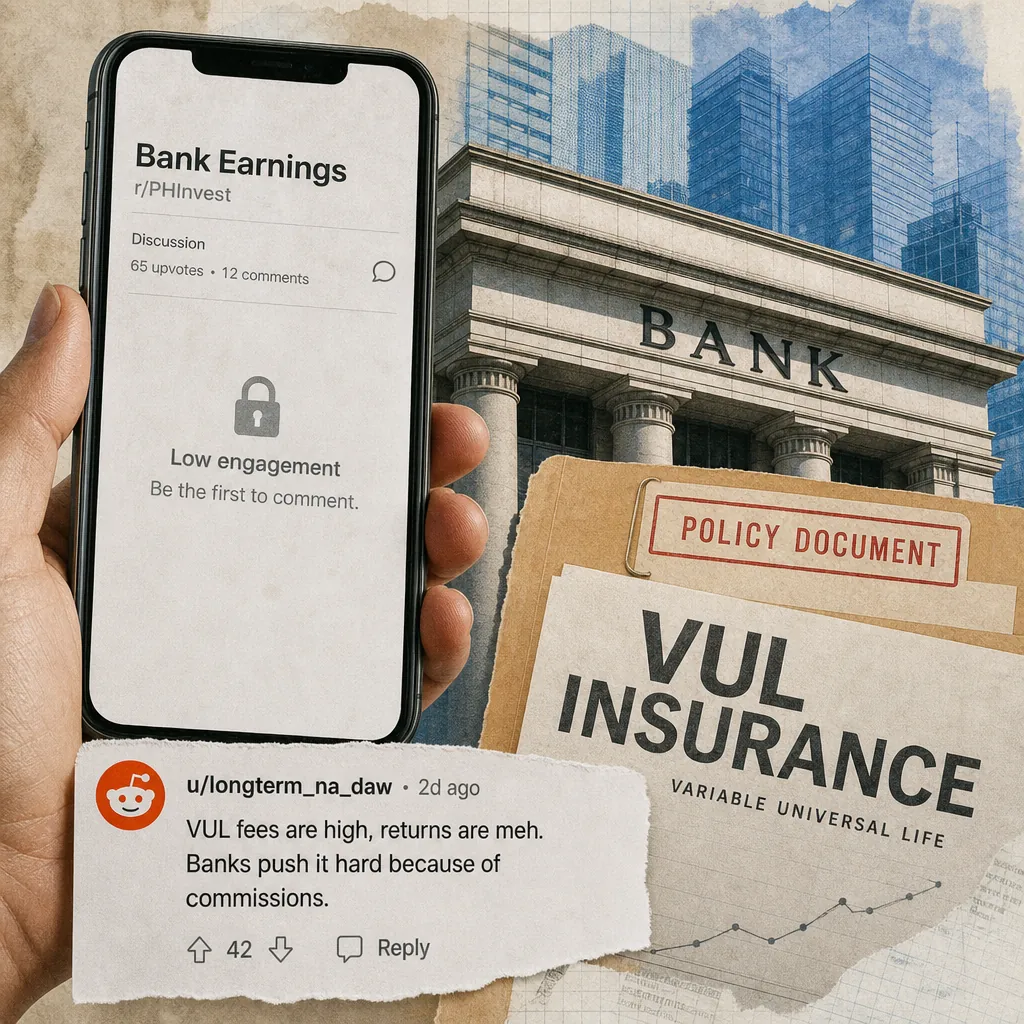
The financial conversation on August 5, 2026, was a study in contrasts. On one hand, a deeply personal Reddit post about a fully paid variable unit-linked (VUL) insurance policy sparked a 41-comment discussion that laid bare consumer distrust of insurance agents and bancassurance products. On the other, institutional announcements—like China Bank Savings' first-half profit of P1.19 billion—drew views but zero engagement, underscoring a disconnect between what banks broadcast and what consumers actually care about. Meanwhile, the broader economic narrative was dominated by inflation easing to 6.2% in July, still above the central bank's target, and signals that the Bangko Sentral ng Pilipinas (BSP) may hike rates again, keeping the peso under pressure and investors cautious.
This snapshot captures a sector navigating a delicate balance: banks are reporting resilient earnings and rolling out digital innovations like Apple Pay and AI chatbots, yet they face a simmering trust deficit among retail consumers, particularly around insurance-linked investment products. The day's news also included regulatory developments—the suspended Insurance Commission chief defending his accreditation decisions, the PDIC pushing for expanded deposit insurance, and the BSP finalizing bond pricing reforms ahead of a potential JPMorgan index inclusion. Together, these threads paint a picture of an industry that is financially stable but communicatively challenged, where the loudest voices are not the banks themselves but the skeptical consumers they serve.
Key themes
- VUL Skepticism and Agent Distrust: A Reddit thread about a fully paid VUL policy ignited a broader critique of agent incentives and product transparency, with commenters questioning whether agents prioritize commissions over client welfare.
- Institutional Silence vs. Consumer Noise: Bank earnings announcements, like China Bank Savings' P1.19 billion profit, generated minimal engagement on social media, highlighting a gap between corporate communication and public interest.
- Inflation Eases but Remains Sticky: July inflation slowed to 6.2%, the third consecutive monthly decline, but remains well above the BSP's 2-4% target, fueling expectations of further rate hikes.
- Rate Hike Bets and Market Caution: The BSP's term deposit auction saw weaker demand and higher yields, reflecting investor expectations of tighter monetary policy, while the stock market dipped as investors awaited GDP data.
- Digital Banking Innovations: UnionBank launched Apple Pay and EastWest introduced an AI chatbot for business clients, signaling a push toward digital convenience and customer engagement.
- Regulatory and Legislative Moves: The PDIC proposed expanding deposit insurance coverage, and the BSP worked on bond pricing reforms, both aimed at strengthening financial stability and consumer protection.
- Brand Name Collateral: An unrelated post about a rescued dog named "Tala" highlighted how brand names can surface in unrelated contexts, complicating sentiment analysis and brand monitoring.
- Corporate Earnings Mixed: While China Bank Savings saw a slight profit dip, Globe Telecom reported record revenues but lower net income, reflecting cost pressures across sectors.
How the narratives stack
Dominant: The dominant narrative of the day was the consumer distrust of VUL insurance products, as exemplified by the Reddit thread. This story, though originating from a single personal anecdote, resonated deeply with the community, generating 41 comments and 28 likes—a high engagement relative to its modest visibility. The thread evolved from a specific family situation into a systemic critique of bancassurance, with commenters sharing their own experiences of agent pressure and fund-switch recommendations. This narrative is significant because it exposes a reputational risk for banks offering similar products, and it highlights a communication gap that institutions have yet to address. Within the captured set, this story dominated social conversation, while on the news side, inflation and rate-related stories drew the most coverage.
Counter-narrative: A counter-narrative emerged from the institutional side: banks are financially resilient and innovating. China Bank Savings reported a slight profit dip but attributed it to a challenging environment, while Globe Telecom posted record revenues. UnionBank's Apple Pay launch and EastWest's AI chatbot signaled a forward-looking industry. This narrative, however, struggled to gain traction on social media, as evidenced by the zero engagement on the China Bank Savings profit post. The counter-narrative is that banks are stable and customer-focused, but it is not resonating with the public, who are more concerned about fees, transparency, and agent conduct.
Emerging: An emerging narrative is the regulatory push for greater consumer protection. The PDIC's legislative agenda to expand deposit insurance coverage and the BSP's bond pricing reforms are steps toward a more robust financial safety net. These developments, while not yet generating widespread conversation, could reshape the sector's relationship with consumers if they lead to tangible benefits like faster claims and better protection. The Insurance Commission suspension story also fits here, as it raises questions about oversight and accountability in the insurance industry.
Suppressed: The under-covered story is the potential impact of the BSP's rate hike trajectory on ordinary borrowers. While inflation and rate bets dominated business pages, the human cost of higher borrowing costs—on mortgages, auto loans, and business credit—was largely absent from the conversation. The Reddit thread touched on financial anxiety, but the broader implications of monetary tightening for household budgets were not explored in the captured media. This is a story that could gain traction as rate decisions approach.
Platform insights
- Reddit: The VUL thread was the anchor of the day's conversation, with 41 comments and 28 likes. Reddit's format allowed for a slow-burn evolution from personal anecdote to systemic critique, as users shared their own experiences and questioned agent incentives. This platform proved to be the most reliable barometer for authentic consumer sentiment, with high emotional investment evident in the comment-to-like ratio.
- Twitter: Institutional announcements dominated but failed to resonate. The China Bank Savings profit post drew 1,627 views but zero engagement, while a post about a rescued dog named "Tala" drew 2,042 views and 13 likes. Twitter functioned as a news ticker rather than a conversation space for financial topics, with users passively consuming but not interacting with corporate updates.
- Facebook: A single unpopulated post with zero engagement and no content offered no conversational value, serving as a reminder that not all social data points are meaningful. Its presence was negligible but highlighted the need for robust filtering in monitoring.
Key voices and communities
- Retail Insurance Policyholders and Investors: This group, exemplified by the Reddit poster, is the most influential in the conversation. They are everyday consumers with long-term insurance products, concerned about fund performance and agent motives. Their engagement is active and peer-driven, as seen in the 41-comment thread. They directly influence the reputation of banks offering VUL products, and their skepticism is a significant reputational risk.
- Financial News and Business Media Audiences: This group follows mainstream financial news outlets for corporate earnings and sector performance. They are interested in institutional banking performance, as evidenced by attention to China Bank Savings' profit announcement. While their engagement is low, they establish credibility signals for the broader market narrative and shape the reputational context for banks.
- Local News and Community Interest Voices: Regional outlets and community accounts generate conversation around non-financial topics that occasionally intersect with brand keywords, like the "Tala" dog rescue. Their influence is more about creating noise than shaping financial narratives, but they require monitoring to avoid false positives in brand tracking.
- Inactive or Low-Engagement Observers: A segment of the dataset consists of posts with no discernible content or engagement, adding no analytical value but highlighting the need for filter rules to exclude empty records from client-facing analytics.
Narrative streams
VUL Skepticism: A Trust Deficit in Bancassurance
The Reddit thread that anchored the day's social conversation began with a simple family story: a brother who had just finished paying his Variable Universal Life (VUL) insurance policy after ten years. His agent advised a fund switch, citing poor market performance and warning that the funds might be "maubos" (depleted). The poster's frustration was palpable, quipping that whenever the agent calls, "parang isang malaking peso sign daw ang nakikita nya"—a sentiment that resonated with the community's collective skepticism.
VUL policies are a hybrid of insurance and investment: a portion of premiums goes toward life coverage, while the rest is invested in funds whose value fluctuates with the market. The thread's core anxiety was whether the insurance payout survives if the investment component is depleted. Commenters shared anecdotal accounts of agents downplaying risks during the sales process, and the discussion quickly broadened into a critique of the bancassurance model, where banks sell insurance products through their branches, often with commission-driven incentives.
The engagement metrics—28 likes and 41 comments—indicate a moderate level of resonance, enough to influence undecided readers. The thread's staying power suggests that VUL-related grievances are not isolated but part of a larger, simmering dissatisfaction that could resurface during policy renewals or market downturns. For banks offering VUL products, this represents a tangible threat to trust in financial advisors and insurance-linked investment products. The absence of any official response in the conversation leaves a window of vulnerability—and an opportunity for a bank or insurer to position itself as a transparent leader by clarifying how paid-up policies typically retain some death benefit even if investment value drops.
Inflation and Rate Hikes: The Macro Backdrop
On the news side, the day's biggest story was the inflation print. The Philippine Statistics Authority reported that inflation eased to 6.2% in July, down from 6.4% in June, marking the third consecutive monthly decline after peaking at 7.2% in April. The slowdown was driven by easing transport costs and stable food prices, but rice and electricity rates continued to pressure household budgets. Year-to-date inflation averaged 5%, well above the BSP's 2-4% target.
The BSP's response was cautious: "The BSP will continue to monitor recent developments and their potential impact on inflation and growth. The BSP is prepared to take further monetary action as needed to ensure price stability." This language, coupled with the term deposit auction results, signaled that rate hikes are likely on the table. The BSP's term deposit facility (TDF) saw weaker demand, with bids at P129.6 billion against P150 billion offered, and accepted yields rose, reflecting investor expectations of tighter policy.
For ordinary Filipinos, this means borrowing costs could rise further, affecting mortgages, auto loans, and business credit. The peso strengthened slightly to P60.751 per dollar, its strongest close in nearly three weeks, but Metrobank warned that potential rate cuts next year could limit gains. The stock market dipped as investors took profits ahead of the Q2 GDP release, with the PSEi closing at 6,286.31.
This macro narrative is critical context for the banking sector: higher rates can boost net interest margins, but they also dampen loan demand and increase default risks. Banks like China Bank Savings, which reported a slight profit dip despite higher revenues, are navigating this delicate balance.
Digital Banking Innovations: Bridging the Engagement Gap?
Amid the trust deficit, banks are rolling out digital tools to enhance customer experience. UnionBank launched Apple Pay for its cardholders, allowing contactless payments via iPhone, Apple Watch, iPad, and Mac. President and CEO Ana Aboitiz Delgado emphasized the focus on "making everyday banking and payments simpler, safer, and more intuitive." This move aligns with the global trend of banks integrating with mobile wallets to stay relevant at the point of sale.
EastWest Bank introduced an AI-powered chatbot named ECHO (EastWest CMS Help Officer) to help entrepreneurs understand cash management services. The chatbot is designed to provide quick, reliable access to information as businesses increasingly turn to digital channels. These innovations are part of a broader push to meet customers where they are, but they also highlight a gap: while banks invest in technology, they may be neglecting the human element of trust that the VUL thread exposed.
The low engagement on corporate announcements suggests that digital tools alone won't bridge the communication gap. Banks need to pair these innovations with consumer-relevant narratives that address concerns like fees, transparency, and agent conduct.
Regulatory and Legislative Moves: Strengthening the Safety Net
The Philippine Deposit Insurance Corp. (PDIC) is pushing for legislative changes to expand its coverage to nonbank financial institutions and cooperatives, increase insurance limits for accounts with high social value like payrolls and retirement, and enable quicker verification of deposit records to speed up claims. The PDIC also wants authority to implement a temporary blanket guarantee during systemic crises to prevent bank runs. These proposals, if enacted, would strengthen consumer protection and financial stability.
Meanwhile, the BSP is finalizing a regulation to align bond pricing practices with global standards ahead of the Philippines' potential inclusion in JPMorgan's government bond index. The shift, targeted for September 15, would eliminate the price adjustment between gross and net principal, a convention dating back to the 1990s. Banks have warned that this could reduce the value of government securities they hold, but the move is seen as necessary for international integration.
These regulatory developments are largely invisible to the general public, but they have significant implications for the banking sector's stability and competitiveness. They also offer an opportunity for banks to communicate their commitment to consumer protection, countering the negative narratives from the VUL thread.
Corporate Earnings: Mixed Signals
China Bank Savings reported a net income of P1.19 billion for the first half of 2026, slightly lower than the P1.2 billion record profit in the same period last year. The bank attributed its resilient performance to continued expansion in its core lending business, with net interest income climbing 16% to P5.49 billion. Total assets reached P225.58 billion, and the bank nearly doubled its loan-loss reserves, reflecting prudent risk management.
Globe Telecom, on the other hand, posted an 11% decline in net income to P11 billion despite record service revenues of P85.4 billion. The drop was attributed to lower gains from the dilution of its stake in Mynt (GCash's operator) and higher operating costs. These earnings stories, while routine, are important signals for investors and the broader market, but they generate little organic conversation on social media, as evidenced by the zero engagement on the China Bank Savings post.
Conversation trajectory
Over the next 4-6 weeks, the VUL skepticism narrative is likely to expand beyond Reddit into mainstream social platforms, particularly as more policyholders reach maturity milestones and share similar experiences. The BSP's next rate-setting meeting, anticipated within 4-6 weeks, will spur commentary on loan costs and deposit rates, potentially amplifying consumer anxiety. The Q3 earnings season, starting in about 8 weeks, will renew focus on bank profitability and may intensify skepticism toward financial advisors. Any new Insurance Commission circular on VUL disclosures could convert the current grumbling into a mainstream policy discussion.
Trigger events to watch: the BSP's monetary policy decision, the release of Q2 GDP data (which could influence rate expectations), and any developments in the Insurance Commission suspension case. Each of these could reshape the conversation, either validating or complicating the emerging narratives around consumer financial protection.
Response guidance
For communicators in the banking and insurance sector, the key takeaway is the urgent need to address consumer distrust in wealth management products. Develop a proactive educational campaign that clarifies how VUL policies work after full payment, addressing the specific question of whether insurance payouts survive fund depletion. Use plain-language explainers on social media and within mobile banking apps to counter misconceptions.
Monitor insurance and bancassurance conversations closely for the next 30 days, tracking mentions of agent conduct and fund performance complaints. If similar threads gain traction, respond directly from verified customer care accounts rather than leaving misinformation unchallenged.
For banking clients, leverage routine earnings announcements as opportunities to communicate customer-centric achievements, such as digital banking improvements or fee transparency. Pair financial results with human-centric stories to shift the narrative from "bank profits" to "bank value." Engage with consumer-led platforms like Reddit to participate in organic conversations, and consider collaborating with licensed insurance educators to provide authoritative explanations.
Sensitive topics to navigate include the perception that agents prioritize commissions over client interests. Validate consumer concerns while emphasizing that ethical advisors exist and how to identify them. Avoid overpromising outcomes; instead, direct readers to policy documents and official disclosures. Focus on structural explanations rather than market forecasts to reduce anxiety.
See the full picture behind today's signals.
This report draws from Media Meter's MediaWatch, our real-time monitoring engine tracking 2,470+ Philippine sources across print, broadcast, digital, and social. Explore how the platform turns raw coverage into decision-grade intelligence, then see how it's configured for teams like yours — whether you're in PR agencies, corporate comms, government, or marketing.
Want more? Browse our Report Library for sector and crisis intelligence, or request a demo and we'll have your brand set up before the call.
Want this kind of intelligence on your brand?
This brief is built on the same MediaWatch methodology that runs continuously across every brand we monitor. See your competitive landscape, Impact Score, and narrative trajectory in a 30-minute demo.