Inflation hits 7.8% as bank lending runs hot
Philippine inflation climbed to a 44-month high of 7.8 percent in October on fuel and transport costs, even as bank lending grew at its fastest pace in four months and Metrobank and Chinabank reported nine-month earnings. The peso and stock market rallied on the US midterm results.
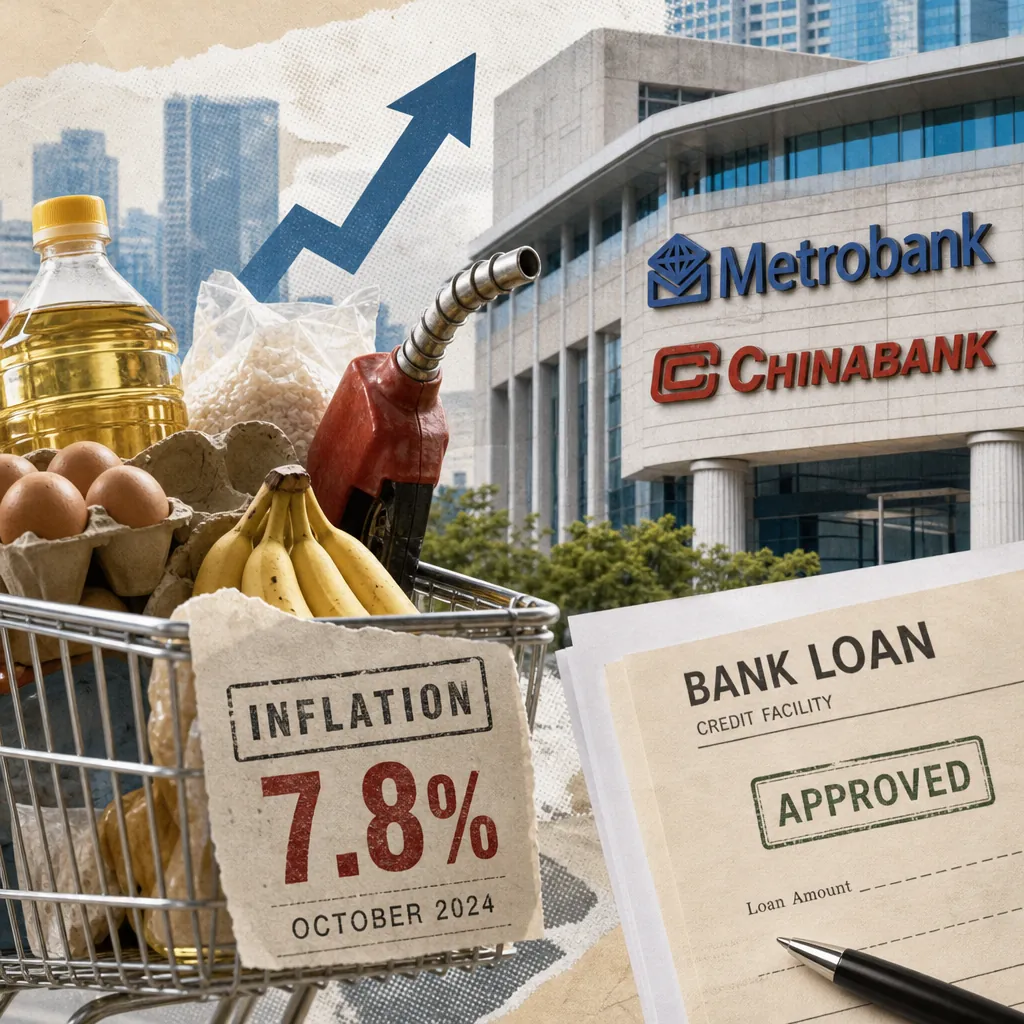
October inflation in the Philippines reached 7.8 percent, the fastest annual rise in consumer prices since February 2023, the Philippine Statistics Authority (PSA) reported on Thursday3459. The same morning, the Bangko Sentral ng Pilipinas (BSP) — the country's central bank — released data showing that loans from the country's largest banks grew 11.4 percent year-on-year in September, the quickest pace in four months861. Two of the country's biggest lenders, Metropolitan Bank & Trust Co. (Metrobank) and China Banking Corp. (Chinabank), reported nine-month profits within hours of each other210. The coverage in this set ran across broadsheets, tabloids and online news, and the inflation story carried the heaviest weight: the Manila Standard's front-page report on the 7.8 percent print drew an estimated ₱486,000 in advertising-equivalent value, the cost of buying the same space as paid advertising, and the highest figure among the day's business stories in this set1.
The inflation number is the one that reaches households directly. The 7.8 percent figure measures the annual change in the prices of goods and services typically bought by Filipino families, and it compares with 7.2 percent in September and 1.7 percent in October 202559. Transport costs rose fastest, at 20.1 percent year-on-year, up from 14.6 percent in September, driven by higher domestic fuel prices and fare increases5435. Rice remained the largest single contributor to overall inflation, and housing, water, electricity, gas and other fuels accelerated to 9.3 percent from 8.4 percent154. Core inflation, which strips out volatile food and energy items to show underlying price pressure, quickened to 5.4 percent from 4.8 percent, the highest since September 20235948.
The banking numbers tell a different story. Lending growth of 11.4 percent in September compares with 11 percent in August and 12.1 percent in May, and brought outstanding loans to ₱15.27 trillion from ₱13.70 trillion a year earlier61. Business loans, which make up the bulk of bank portfolios, grew 11 percent to ₱12.8 trillion, while consumer loans rose 16.2 percent, helped by credit card and motor vehicle lending81. Metrobank's net income slipped 2.6 percent to ₱36.33 billion in the first nine months from ₱37.28 billion a year earlier, as weaker trading gains and higher provisions offset an 11.9 percent rise in net interest income to ₱102.7 billion260. Chinabank's profit climbed 12 percent to ₱22.6 billion from ₱20.2 billion, on net interest income of ₱60.7 billion and a non-performing loan ratio of 1.5 percent1032.
Key themes
- Inflation reached 7.8 percent in October, the highest in 44 months. The PSA's consumer price index rose from 7.2 percent in September and 1.7 percent a year earlier, with transport inflation at 20.1 percent and rice the largest single contributor5954. The reading exceeded the 7.6 percent median estimate of 19 economists surveyed by the Inquirer but stayed inside the BSP's 7.1 to 8.1 percent forecast range34.
- Core inflation at 5.4 percent points to broader price pressure. Stripping out food and energy, prices still rose at their fastest pace since September 2023, which a former BSP deputy governor said justifies a half-percentage-point rate increase at the December policy meeting4859.
- Bank lending grew 11.4 percent in September, the fastest in four months. Outstanding loans reached ₱15.27 trillion, with consumer lending up 16.2 percent and business lending up 11 percent, even as the BSP's policy rate sits at 5.5 percent after four hikes this year6131.
- Metrobank's nine-month profit fell 2.6 percent to ₱36.33 billion. Higher lending income was offset by a ₱4.75-billion decline in trading, securities and foreign exchange gains, plus higher provisions and operating costs260.
- Chinabank's profit rose 12 percent to ₱22.6 billion. Net interest margin of 4.73 percent and a 1.5 percent non-performing loan ratio kept it among the market's most profitable lenders1032.
- The peso strengthened to 62.97 per dollar and the stock index rose 1.46 percent. The Philippine Stock Exchange index closed at 5,778.14 as Democratic gains in the US midterm elections pushed US Treasury yields, oil prices and the dollar lower362.
- Businesses are turning cautious on expansion despite improved sentiment. The Management Association of the Philippines said firms now favor productivity and cost efficiency over large outlays, even as the BSP's business confidence index improved to -8.4 percent from -10.9 percent47.
- A former BSP official called for a 50-basis-point hike in December. Diwa Guinigundo told BusinessMirror that "this is no longer simply a supply-side inflation story," citing the acceleration in core inflation48.
How the narratives stack
Dominant. Inflation at 7.8 percent dominated the business pages in this set. It ran on the front page of the Manila Standard, carried an estimated ₱486,000 in advertising-equivalent value there, and was picked up by Philstar, the Manila Times, Inquirer Plus, Head Topics and the Daily Guardian15938343554. The story's dominance rests on both consequence and breadth: it is the single number that touches every household budget, and it arrived with a clear policy implication — the BSP's next rate decision in December. The bank earnings and lending data ran alongside it but below it, as supporting context about how credit is still expanding into a slowing price environment.
Counter-narrative. The peso and stock market rally cut against the inflation story. The peso gained 56.5 centavos to close at 62.97 per dollar, its strongest close since October 14, and the PSE index rose 1.46 percent to 5,778.14362. Trading volume topped $2 billion, up from $1.3 billion the previous session3. COL Financial analyst Denise Joaquin attributed the gains to easing US Treasury yields after the Democratic Party's midterm gains, which raised expectations of fiscal gridlock in Washington, and to falling oil prices on hopes of de-escalation in the US-Iran conflict1. The rally is a bet on cheaper fuel and lower global borrowing costs ahead, not evidence that domestic price pressure has eased.
Emerging. Business caution is forming as a distinct story. The Management Association of the Philippines reported that companies are becoming more selective about capital spending, favoring operational efficiency and cash flow over expansion that requires larger outlays and additional hiring47. A Philstar column argued that the BSP's forward-looking business optimism — 20.9 percent for the next three months and 26.5 percent for the next 12 — reflects corporate planners projecting growth to justify budgets rather than confidence in fundamentals63. The tension between still-strong credit growth and hesitant investment decisions is the one to watch: if lending keeps expanding while businesses defer spending, the credit is going into working capital and consumption rather than new capacity.
Under-covered. The clearest under-covered story in this set is the peso's vulnerability. The currency's rally was driven by external events — the US midterm result and oil prices — not by any improvement in Philippine fundamentals, and the same report noted the peso had touched an intraday high of 62.90 before closing at 62.973. With inflation at a 44-month high and the policy rate at 5.5 percent, the peso's strength depends on the US dollar staying weak. None of the items in this set examined what happens to the currency if the Middle East conflict re-escalates or if the US Federal Reserve changes course.
Platform insights
- Facebook. The day's most-shared business content in this set was the inflation explainer format — the Daily Guardian's household-focused piece on how 7.8 percent inflation squeezes low-income families, which framed the number around food, transport and essential goods rather than the policy rate54. The Manila Times' podcast-style headlines post, which led with the Duterte impeachment witness list and carried the inflation story second, drew the kind of engagement that comes from bundling several stories into one morning update16.
- X. The peso and stock market rally drove the fastest-moving conversation, with the 62.97 close and the 1.46 percent index gain circulating as discrete data points362. The inflation number also spread as a standalone figure — 7.8 percent, 44-month high — with users comparing it to the 1.7 percent reading a year earlier59. The comparison format, two numbers side by side, travelled further than the full policy context.
- Reddit. Discussion in this set centered on the practical question of what the BSP does next. The BusinessMirror interview with former deputy governor Diwa Guinigundo, who called for a 50-basis-point hike, drew the kind of thread-level debate that asks whether the central bank is behind the curve48. The Philstar column questioning the sincerity of business optimism also circulated among readers skeptical of official sentiment surveys63.
- YouTube. The Manila Times' daily headlines episode, which led with the Duterte defense witness list and carried inflation and the stock market as secondary items, drew views from an audience that consumes news in bundled audio format rather than by story16. The format favors the political story over the economic one: the impeachment trial led, and the 7.8 percent inflation figure came second.
Key voices and communities
The Bangko Sentral ng Pilipinas. The central bank's statement that inflation is "likely to remain elevated in the coming months" and its pledge to assess "the impact of the latest developments in the Middle East and ongoing El Niño conditions" set the frame for the December policy meeting38. The BSP's forecast range of 7.1 to 8.1 percent, which the October print fell inside, gave it room to describe the number as expected rather than a surprise34. Its next move — a hike of 25 or 50 basis points — is the single decision the banking sector is now waiting on.
Former BSP deputy governor Diwa Guinigundo. His call for a 50-basis-point increase, made to BusinessMirror, is the most specific policy recommendation in the set. "This is no longer simply a supply-side inflation story," he said, arguing that the acceleration in core inflation shows price pressures are becoming broader48. His view matters because it represents the hawkish end of the policy debate and gives the December meeting a concrete benchmark.
Bank economists and analysts. BPI lead economist Emilio Neri Jr. projected third-quarter GDP growth of 3.2 percent, up from 2.3 percent, but said the rebound depends on government spending and exports rather than domestic demand4. COL Financial's Denise Joaquin explained the market rally as a response to external factors — US Treasury yields and oil prices — rather than domestic strength1. Philstocks Financial made the same point about the oil price drop and the peso's appreciation62. The consensus among them is that the improvement is borrowed from abroad.
Business groups. The Management Association of the Philippines, through president Donald Patrick Lim, put words to the caution that the lending data only hints at: firms are prioritizing efficiency and cash flow over expansion47. This group's framing matters because it explains why credit growth can stay strong while investment decisions slow — the money is going to working capital, not new capacity.
Narrative streams
Inflation reaches 7.8 percent, the highest since February 2023
The PSA's October reading of 7.8 percent is the fastest annual increase in consumer prices since February 2023, when inflation hit 8.6 percent in the aftermath of Russia's invasion of Ukraine3459. National Statistician Dennis Mapa identified higher transport and fuel costs as the primary drivers, with the transport index rising to 20.1 percent from 14.6 percent in September3554. Rice remained the largest single contributor to overall inflation, and the government's Department of Economy, Planning and Development said it was strengthening agricultural production and logistics while providing targeted assistance to sectors affected by higher energy costs1.
The number matters for ordinary households because it measures the annual change in the prices of the goods they buy most. A 7.8 percent reading means a basket of typical purchases costs 7.8 percent more than a year ago, and the burden falls hardest on low-income families who spend a larger share of their earnings on food and transport54. The reading also marked the eighth consecutive month that inflation exceeded the BSP's target range of 2 to 4 percent34.
For the banking sector, the read is that the BSP's policy rate of 5.5 percent, already raised four times this year, is likely to go higher. The central bank's benchmark rate guides the interest rates banks charge on housing and car loans, so a further increase raises borrowing costs for households and businesses alike3134. The question for lenders is whether loan demand holds up as rates rise. September's 11.4 percent credit growth suggests it has so far, but consumer loans growing 16.2 percent while inflation runs at 7.8 percent means real borrowing costs are still low — a combination that historically precedes a sharper slowdown once the central bank catches up.
Bank lending accelerates even as rates rise
The BSP's September data showed outstanding loans from universal and commercial banks rising 11.4 percent year-on-year to ₱15.27 trillion, the fastest pace since May's 12.1 percent61. Loans to resident borrowers grew 11.7 percent, with business lending up 11 percent led by electricity, gas, steam and air-conditioning supply, manufacturing, real estate, transportation and storage, and wholesale and retail trade1. Consumer loans to residents climbed 16.2 percent, supported by credit card and motor vehicle lending1.
The expansion came despite slower growth in the money supply. M3, the broadest measure of money in the economy, grew 9.3 percent to ₱20.7 trillion in September, down from 10.8 percent in August831. Credit growing faster than the money supply means banks are lending out a larger share of their deposits, which is sustainable only as long as deposit growth keeps pace.
The read for the sector is that Philippine banks are still finding borrowers willing to pay higher rates, but the mix matters. Corporate lending growing 14.2 percent at Metrobank and 11 percent across the industry suggests businesses are borrowing for working capital and existing operations rather than new investment — consistent with the caution the Management Association of the Philippines described247. If that holds, the credit growth is a sign of resilience in current operations, not a bet on expansion.
Metrobank and Chinabank report diverging nine-month results
Metrobank's net income fell 2.6 percent to ₱36.33 billion in the first nine months from ₱37.28 billion a year earlier, and in the third quarter alone profit dropped 8 percent to ₱11.43 billion260. Net interest income rose 11.9 percent to ₱102.7 billion and the net interest margin — the gap between what a bank pays depositors and earns from borrowers — improved to 3.9 percent from 3.7 percent2. But a ₱4.75-billion decline in net trading, securities and foreign exchange gains, plus higher provisions and operating costs, pulled the bottom line down2. President Fabian Dee said the bank would "continue to invest in our capabilities to better serve our customers, while managing risks prudently" amid an uncertain economic landscape60.
Chinabank moved the other way. Its profit climbed 12 percent to ₱22.6 billion from ₱20.2 billion, with net interest income up 14 percent to ₱60.7 billion and a net interest margin of 4.73 percent1032. Its non-performing loan ratio — the share of loans borrowers are not repaying on time — held at 1.5 percent, and it booked ₱1.9 billion in impairment and credit loss provisions, giving it a coverage ratio of 102 percent, above the industry average32.
The divergence is instructive. Metrobank's trading losses reflect a volatile market for securities and foreign exchange, while Chinabank's stronger margin reflects a consumer and small-business lending mix that benefits from higher rates. For the sector, the read is that profitability now depends more on the lending book than on trading gains, and banks with a consumer tilt are better positioned while the BSP keeps rates high. The two results also show that the 11.4 percent industry credit growth is not translating evenly into earnings.
Peso and stocks rally on US midterm results and oil prices
The peso strengthened 56.5 centavos to close at 62.97 per dollar on Thursday, its strongest close since October 14, after touching an intraday high of 62.903. The PSE index rose 1.46 percent, or 83.22 points, to 5,778.14, and the broader All Shares index gained 1.39 percent to 3,229.4762. Trading volume exceeded $2 billion, up from $1.3 billion the previous session3.
The trigger was external. A sweeping Democratic victory in the US midterm elections sent the dollar, oil prices and US Treasury yields lower, on expectations that a Democratic-leaning Congress would challenge the US war against Iran and block further spending362. Philstocks Financial said the local market extended its rally "fueled mainly by the drop in global oil prices," and COL Financial's Denise Joaquin said improved risk appetite spurred buying across index heavyweights621.
The read for the sector is that the rally is a relief, not a recovery. The peso's strength depends on the dollar staying weak and oil staying cheap, both of which hinge on the Middle East conflict and US fiscal policy rather than on Philippine fundamentals. Domestic inflation at 7.8 percent and a policy rate of 5.5 percent are the conditions the currency is rallying against. Banks and importers benefit from a stronger peso in the short term because it lowers the peso cost of dollar-denominated fuel and goods, but the same external events that produced the rally can reverse it.
Business sentiment improves while investment decisions tighten
The BSP's Business Expectations Survey showed the overall confidence index rising to -8.4 percent from -10.9 percent in August, meaning pessimism among businesses eased but remained negative47. The forward-looking components were positive: 20.9 percent for the next three months and 26.5 percent for the next 1263. Yet the Management Association of the Philippines reported that firms are becoming more selective about where they put their money, favoring operational efficiency, profitability and cash flow over aggressive expansion47.
A Philstar column argued that the optimism in the survey reflects corporate planners projecting growth to justify budgets and protect stock prices rather than confidence in fundamentals, and noted that the survey only captures companies still actively operating63. BPI's Emilio Neri Jr. made a related point about the broader economy: growth may improve to 3.2 percent in the third quarter from 2.3 percent, but the rebound depends on government spending and exports rather than stronger domestic demand4. The PSA is scheduled to release third-quarter GDP figures on Monday, November 94.
The read for the sector is that the gap between what businesses say and what they do is the signal to watch. If the GDP release on November 9 confirms the 3.2 percent projection, it will show an economy growing on public spending and exports while household demand stays weak. For banks, that means corporate lending will keep growing where government infrastructure and export industries borrow, while consumer lending faces a harder test as inflation eats into disposable income.
A former central bank official calls for a 50-basis-point hike
Diwa Guinigundo, a former deputy governor of the BSP, told BusinessMirror that the three-year-high core inflation in October should prompt a "stronger move" at the December rate-setting meeting. "I would lean toward a 50-bps increase," he said, adding that "this is no longer simply a supply-side inflation story" and that the acceleration in core inflation suggests price pressures are becoming broader48.
The BSP's policy rate currently sits at 5.5 percent after a half-percentage-point increase last month, the fourth hike this year31. A 50-basis-point increase in December would take it to 6 percent, the highest level in years, and would raise the cost of housing and car loans for households and working capital for businesses. The BSP has said it will remain "vigilant and guided by incoming data" and will assess the impact of Middle East developments and El Niño conditions on the inflation outlook38.
The read for the sector is that the December meeting is now the focal point for every lender and borrower. A 25-basis-point hike would signal the central bank sees inflation as contained within its forecast range; a 50-point move would signal it is behind the curve. Banks pricing loans for the first quarter of 2027 need to decide now which outcome to assume, and the cost of guessing wrong falls on borrowers.
Conversation trajectory
The November 9 GDP release. The PSA is scheduled to publish third-quarter gross domestic product figures on Monday, November 94. BPI projects growth of 3.2 percent, up from 2.3 percent in the second quarter, but attributes the improvement to government spending and exports rather than domestic demand4. If the figure comes in at or above 3.2 percent, it will support the view that the economy is growing despite inflation; if it falls short, the case for a sharper rate hike in December weakens. Watch the household consumption component specifically, since that is where inflation's effect on spending would show up.
The December BSP policy meeting. The central bank's next rate-setting meeting is the single most consequential scheduled event for the banking sector. The October inflation print of 7.8 percent and core inflation of 5.4 percent have put a 50-basis-point hike on the table, according to former deputy governor Guinigundo48. The BSP's own statement that inflation is "likely to remain elevated in the coming months" suggests it is preparing the ground for further tightening38. Watch the November inflation release, due in early December, as the last data point before the decision.
Oil prices and the Middle East conflict. The peso's rally and the stock market's gain both depend on falling oil prices, which in turn depend on hopes of de-escalation in the US-Iran conflict362. Any re-escalation would reverse the currency gain and push transport inflation higher, since transport costs are already rising at 20.1 percent year-on-year54. The BSP has explicitly named Middle East developments as a factor in its outlook38. Watch weekly fuel price adjustments and any diplomatic signals from the region over the next four to six weeks.
Bank earnings and the fourth-quarter lending picture. Metrobank and Chinabank have now reported nine-month results, and the divergence between them — trading losses at one, margin strength at the other — will be tested in the fourth quarter210. If the BSP raises rates again in December, banks with consumer-heavy loan books will benefit from wider margins while those with large trading operations face further volatility. Watch the next round of earnings releases in January for whether the third-quarter pattern holds.
Business investment decisions. The Management Association of the Philippines' report that firms are favoring efficiency over expansion is a leading indicator for capital spending47. If the caution persists into the first quarter of 2027, it will show up in slower corporate loan growth and weaker GDP investment figures. The BSP's next Business Expectations Survey, due in late November or early December, will show whether the improved sentiment reading of -8.4 percent translates into actual spending plans.
Response guidance
Inflation messaging. Lead with the household impact and the specific categories driving it — transport at 20.1 percent, rice as the largest contributor, housing and utilities at 9.3 percent — rather than the headline figure alone541. Audiences comparing 7.8 percent to last year's 1.7 percent will draw their own conclusions about the trajectory; give them the context that the BSP's forecast range was 7.1 to 8.1 percent and that the reading was expected34. Avoid presenting the number as a surprise.
Rate expectations. Prepare customers for the possibility of a December rate increase without committing to a specific size. The BSP's own language — "vigilant and guided by incoming data" — gives room to describe the decision as data-dependent38. For mortgage and auto loan customers, explain that the policy rate guides but does not set their rates, and that existing fixed-rate loans are unaffected until repricing.
Lending communications. The 11.4 percent credit growth figure is a positive story about access to credit, but it sits alongside 7.8 percent inflation61. Frame lending growth around what it enables — working capital for businesses, consumer purchases for households — rather than as a sign of economic strength. The distinction matters because real borrowing costs are falling as inflation rises, and customers who borrow now at variable rates will face higher payments if the BSP hikes in December.
Peso volatility. The peso's rally to 62.97 per dollar is driven by external events, and the same events can reverse it3. For importers and exporters, the guidance is to hedge dollar exposure rather than assume the currency will stay strong. For retail customers, explain that a stronger peso lowers the cost of imported goods with a lag, and that fuel prices are the fastest channel through which currency moves reach household budgets.
Business caution. The Management Association of the Philippines' observation that firms are prioritizing efficiency over expansion is a signal for how to talk to corporate clients47. Products that help businesses manage costs — cash flow tools, working capital lines, hedging — will find more demand than products built around expansion. The BSP's improved sentiment reading of -8.4 percent is not yet translating into investment, and communications should reflect that gap rather than assume optimism means spending.
Sensitive topics. The December rate decision will draw political attention because it raises borrowing costs for households already squeezed by 7.8 percent inflation. Avoid framing the BSP's independence as a political question; describe the rate decision as a response to core inflation at 5.4 percent and the risk that price pressures become broader48. On the peso, avoid predicting a direction; describe the external drivers — US midterm results, oil prices, Treasury yields — and note that they can move in either direction362.
See the full picture behind today's signals.
This report draws from Media Meter's MediaWatch, our real-time monitoring engine tracking 2,470+ Philippine sources across print, broadcast, digital, and social. Explore how the platform turns raw coverage into decision-grade intelligence, then see how it's configured for teams like yours — whether you're in PR agencies, corporate comms, government, or marketing.
Want more? Browse our Report Library for sector and crisis intelligence, or request a demo and we'll have your brand set up before the call.
Want this kind of intelligence on your brand?
This brief is built on the same MediaWatch methodology that runs continuously across every brand we monitor. See your competitive landscape, Impact Score, and narrative trajectory in a 30-minute demo.