PLDT Shelves P24.2-B VITRO IPO; GCash Opens Mynt Shares
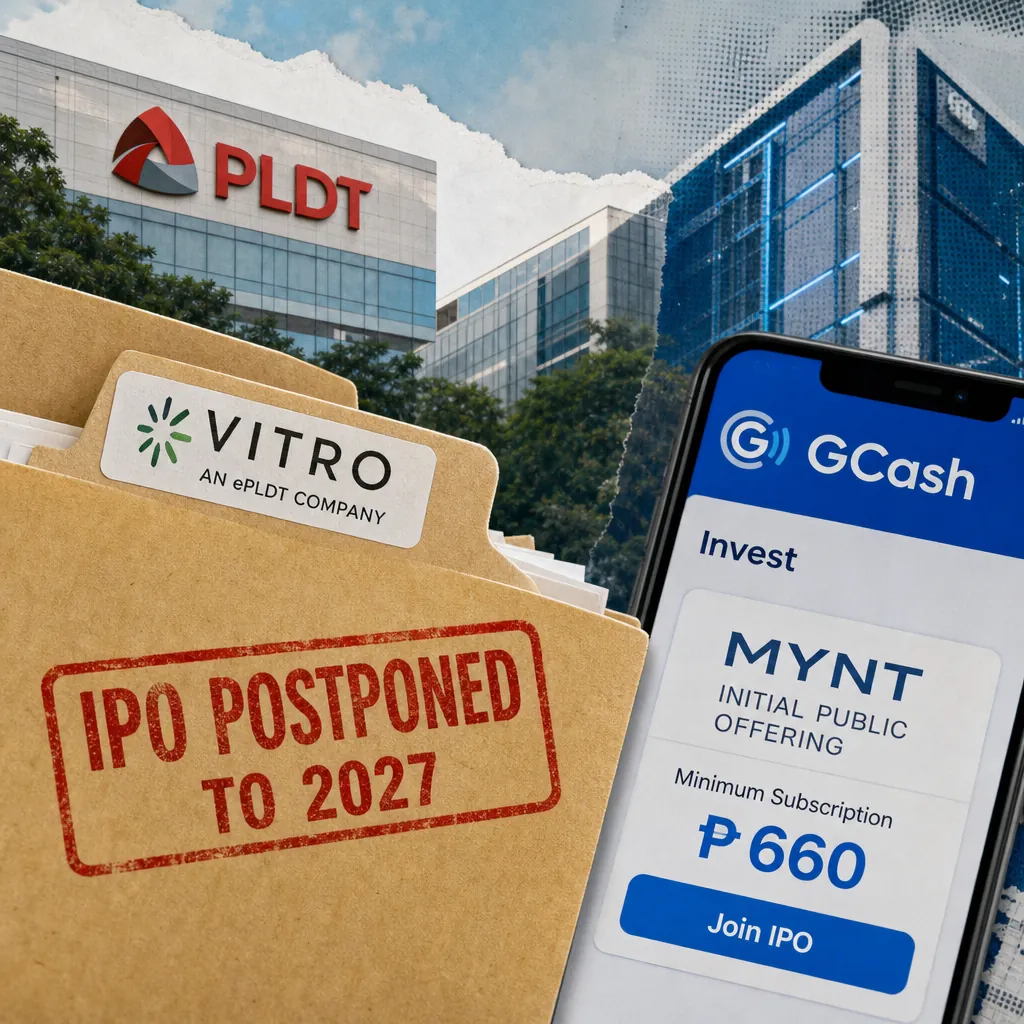
PLDT postponed the P24.2-billion listing of its data center arm VITRO to 2027, while GCash users gained access to Mynt's initial public offering at P660 minimum. Both moves reshaped the Philippine capital markets calendar on the same day.
The Conversation
PLDT Inc. told the Philippine Stock Exchange on Tuesday that it was deferring the initial public offering of VITRO REIT Inc., its data center arm, to 2027, shelving what would have been the country's first listing of a digital infrastructure asset and up to P24.2 billion in proceeds.391135 The disclosure landed the same day Mynt Inc., the parent company of GCash, opened its own offering to retail buyers at P6.60 per share, with a minimum order of 100 shares — P660 — available directly inside the GCash app through GStocks PH.2 One company pulled back from the market; the other pushed ownership into the hands of people who have never held a brokerage account. Together they set the tone for a day in which the Philippine capital markets were the main subject of technology-sector coverage.
The PLDT decision drew the widest pickup across the items reviewed here, appearing in four separate outlets — DealStreetAsia, The Manila Times, the Inquirer's business desk, and Philstar — each carrying the same core disclosure but framing it differently.391135 The Inquirer and Philstar both led on the P24.2-billion figure and the interest-rate rationale; DealStreetAsia added that PLDT shares had fallen about 13% over the year to date and were trading at P1,101 on Tuesday, close to a 52-week low, and that the Philippine benchmark index was among the weakest-performing gauges in emerging Asia.3 The Mynt offering, by contrast, appeared in a single item in this set, from Daily Guardian, but it carries the larger potential consequence for ordinary Filipinos: it is the first time a mass-market e-wallet has been used as a distribution channel for a Philippine IPO, and the offering could become the largest in the country's history.2
Away from the markets, the day's technology-adjacent coverage was thinner but not empty. PLDT also picked up a Silver Award at the 2026 UiPath AI Breakthrough Awards for deploying artificial intelligence agents across enterprise sales, risk management, and lead generation, a story carried by the technology blog Tech Sabado.8 The House of Representatives passed on second reading a bill that would bar children aged 13 and below from creating social media accounts, a measure reported by the Inquirer and by the tabloid Abante Tonite.720 And the Metropolitan Manila Development Authority moved against text scams impersonating its no-contact apprehension policy, filing a complaint with the Department of Information and Communications Technology.34 The rest of the captured items — on the impeachment trial of Vice President Sara Duterte, on teachers' allowances, on entertainment and sports — sit outside the technology sector and are noted here only where they intersect with digital platforms or the attention economy.
Key themes
- PLDT postponed the P24.2-billion VITRO data center listing to 2027. The company cited "current market conditions and rising interest rates" in its disclosure to the Philippine Stock Exchange, deferring what would have been the country's first real estate investment trust built on data center assets.91135
- GCash opened Mynt's IPO to retail buyers at a P660 minimum. Verified GCash users can buy shares in the parent company of the country's dominant e-wallet directly in the app, with no maximum order limit subject to share availability.2
- The two announcements point in opposite directions for the same market. PLDT's retreat reflects caution about valuations and borrowing costs; Mynt's retail channel reflects an attempt to widen the investor base beyond the small pool of existing brokerage clients.23
- PLDT shares were down about 13% for the year to date at P1,101. DealStreetAsia reported the stock was trading near its 52-week low, with the Philippine benchmark index among the weakest performers in emerging Asia.3
- The House passed a bill banning social media accounts for children 13 and under. House Bill No. 11566, the Safe and Friendly Environment for Kids in Digital Spaces Act, consolidates more than 40 proposals and would require parental consent for users aged 13 to 18.720
- PLDT won a Silver Award at the UiPath AI Breakthrough Awards. The company reported that its in-house AI agent Ellie reclaimed an estimated 18,000 to 25,000 hours of work annually and cut proposal development time by 40% to 60%.8
- The MMDA filed a complaint over text scams impersonating its no-contact apprehension policy. Chairman Romando Artes said the agency lacks the power to catch scammers and has asked the DICT and the Credit Information Corp. for help.34
- The PLDT disclosure was the most widely picked-up technology story in this set. Four outlets carried it, while the Mynt offering and the AI award each appeared once, a distribution that reflects the news value of a shelved billion-peso listing.391135
How the narratives stack
Dominant: PLDT's decision to defer the VITRO REIT listing dominated the technology-sector items captured here, appearing in four of the outlets reviewed.391135 The story's dominance within this set rests on both the scale of the transaction — up to P24.2 billion, which would have been the largest data center-related listing in Philippine history — and the clarity of the company's stated reason. PLDT told the exchange that "in light of current market conditions and rising interest rates, VITRO REIT has decided to defer the IPO to 2027."9 The company had planned to sell 1,913,043,500 secondary common shares with an over-allotment option of 286,956,500 shares at an offer price of up to P11 each, with an offer period originally targeted for Sept. 25 to Oct. 1 and a listing on Oct. 12.911 VITRO will continue working with the Securities and Exchange Commission and the Philippine Stock Exchange to complete regulatory requirements for a 2027 offering.9 The coverage value of the PLDT story across the items reviewed here was substantial: the Inquirer's business item carried an estimated P427,140 in advertising-equivalent value, Philstar's P299,125, The Manila Times' P155,008, and DealStreetAsia's P53,100.391135
Counter-narrative: Mynt's IPO, by contrast, appeared in only one item in this set, but it carries the more consequential structural change.2 The offering puts stock ownership within reach of millions of GCash users who have never held a bank or brokerage account, a group largely absent from the local stock market. The minimum order of 100 shares at P6.60 per share means a buyer can participate for P660, with no maximum order limit subject to share availability.2 The shares are available through GStocks PH, powered by AB Capital Securities Inc., and the offer period runs from Oct. 6 to 12, 2026.2 The item notes that the offering could become the largest IPO in Philippine history, and that the access comes with the same risks any shareholder carries, including the possibility of losing part of the money invested.2 The counter-narrative here is not that Mynt is more important than PLDT — it is that the two stories describe different halves of the same market: one issuer retreating because the cost of capital is too high, another pressing forward by lowering the barrier to entry.
Emerging: The House's second-reading approval of House Bill No. 11566 signals that digital platform regulation is moving through the legislative process with unusual speed.720 The bill, known as the Safe and Friendly Environment for Kids in Digital Spaces Act, consolidates over 40 legislative proposals and would prohibit children aged 13 and below from creating social media accounts while requiring parental consent for those aged 13 to 18.720 The measure aligns the Philippines with a global shift toward digital guardrails for minors, and it follows a push by authorities for content restrictions after a spate of school shootings and stabbings by students.7 The bill passed by voice vote after interpellation, with Pasig Rep. Roman Romulo, chairman of the House Committee on Basic Education, sponsoring it.720 If enacted, it would obligate digital platforms to enforce age verification and parental consent — a compliance burden that would fall on the same companies now competing for Philippine users.
Under-covered: Two technology-adjacent stories received minimal attention in this set. PLDT's Silver Award at the 2026 UiPath AI Breakthrough Awards, reported by the blog Tech Sabado, documents the company's deployment of AI agents across enterprise sales, risk management, and lead generation.8 The company said its AI system, called Ellie (Enablement & Intelligence Engine), integrates enterprise knowledge and live customer relationship management data to help sales teams generate proposals, reclaiming an estimated 18,000 to 25,000 hours of work annually, cutting proposal development time by 40% to 60%, reducing proposal error rates by 40% to 50%, and increasing upsell rates by 20% to 50%.8 Separately, the MMDA's complaint against text scams impersonating its no-contact apprehension policy was carried by Philstar but drew no other pickup in this set.34 The no-contact apprehension policy is a scheme that uses traffic cameras to issue violation notices without stopping motorists; scammers have been sending text messages posing as alerts about it. MMDA Chairman Romando Artes said he wrote to the Department of Information and Communications Technology and the Credit Information Corp., noting that the MMDA has no power to apprehend scammers and must rely on law enforcement.34 The police Anti-Cybercrime Group is investigating.34
Platform insights
Facebook: The day's most-shared technology-adjacent content on Facebook was likely the Mynt IPO announcement, given that GCash is a mass-market consumer app with tens of millions of Philippine users and the offering is distributed inside the app itself.2 The Daily Guardian item frames the offer in terms of accessibility — "Filipinos with a verified GCash account can buy into the parent company of the country's dominant e-wallet for as little as P660" — a framing that travels well on a platform where financial-inclusion content tends to circulate among OFW and small-business communities.2 The PLDT deferral, by contrast, is a business-page story that generates commentary from investors and analysts rather than broad consumer engagement.
X: The PLDT deferral drew the kind of commentary that clusters on X around market news: investors and finance-focused accounts discussing what the postponement says about interest rates and the Philippine Stock Exchange's pipeline.391135 The DealStreetAsia framing — that PLDT shares had fallen about 13% this year and were near a 52-week low, with the Philippine benchmark among the weakest gauges in emerging Asia — is the kind of comparative data point that circulates quickly among market watchers.3 The Mynt IPO generated discussion about whether buying shares through an e-wallet is a sound idea, with the Daily Guardian item explicitly noting the risk of losing part of the money invested.2
Reddit: Philippine personal-finance and investing communities on Reddit are the most likely venue for extended discussion of the Mynt offering's mechanics — the P660 minimum, the GStocks PH channel, the absence of a maximum order limit, and the question of whether the IPO price of P6.60 per share represents fair value.2 These communities tend to produce detailed threads comparing the offering to previous Philippine IPOs and debating whether retail access through an e-wallet lowers or raises the risk for first-time investors. The PLDT deferral is also likely to surface in these threads as a signal about the broader market's appetite.
YouTube: Technology and business channels on YouTube are the most likely venue for explainer content on both stories — what a real estate investment trust is, why PLDT would list its data center arm as one, and what it means that the listing was deferred.91135 The Mynt IPO is likely to generate similar explainer content aimed at GCash users who have never bought a stock, with creators walking through the GStocks PH interface and the P660 minimum.2 The PLDT AI award, reported by Tech Sabado, is the kind of enterprise-technology story that occasionally surfaces on YouTube through vendor case-study videos rather than independent commentary.8
Key voices and communities
PLDT and its investors: PLDT Inc., led by Manuel V. Pangilinan, is the country's largest telecommunications company and the parent of VITRO Inc., the data center builder whose REIT listing was deferred.91135 The company's disclosure to the Philippine Stock Exchange is the primary source for the deferral, and its statement that it "remains committed to the proposed VITRO REIT IPO as an important part of the Group's asset monetization and deleveraging plans" is the framing that will shape how investors read the postponement.11 The company's shares, down about 13% for the year to date at P1,101, are the market's running verdict on its near-term prospects.3
Mynt Inc. and GCash: Mynt is the parent company of GCash, the dominant Philippine e-wallet, and its IPO is being distributed through GStocks PH, powered by AB Capital Securities Inc.2 The company's decision to set a P660 minimum and to make shares available inside the app positions it as a test case for whether retail distribution through a consumer finance app can broaden the Philippine investor base. The offering period runs from Oct. 6 to 12, 2026.2
The House of Representatives and digital platform regulators: The passage of House Bill No. 11566 on second reading puts the House Committee on Basic Education, chaired by Pasig Rep. Roman Romulo, at the center of the debate over minors' social media access.720 The bill's consolidation of over 40 proposals and its alignment with global digital-guardrail trends make it the most significant platform-regulation development in this set. Digital platforms would be obligated to enforce the age restrictions if the bill becomes law.20
The Metropolitan Manila Development Authority and anti-scam agencies: MMDA Chairman Romando Artes has filed a complaint over text scams impersonating the agency's no-contact apprehension policy, writing to the Department of Information and Communications Technology and the Credit Information Corp.34 The police Anti-Cybercrime Group is investigating, and Artes said the agency would coordinate with the Bangko Sentral ng Pilipinas and the Anti-Money Laundering Council to halt payments to scammers.34 The episode illustrates the difficulty of policing SMS-based fraud in a market where text messaging remains a primary channel for official notifications.
Technology and business media: The PLDT deferral was carried by DealStreetAsia, The Manila Times, the Inquirer, and Philstar, while the Mynt offering was covered by Daily Guardian and the PLDT AI award by Tech Sabado.23891135 The distribution of coverage across these outlets — with the deferral drawing four pickups and the IPO one — reflects the news value of a shelved billion-peso transaction relative to a retail offering that is still in its offer period.
Narrative streams
PLDT defers P24.2-billion VITRO REIT listing to 2027
PLDT Inc. suspended its plan to list VITRO Inc. as a real estate investment trust, deferring the offering to 2027 because of "current market conditions and rising interest rates."91135 The listing would have raised up to P24.2 billion and would have marked the country's first listing for a data center operator.35 A real estate investment trust, or REIT, is a company that owns income-producing real estate and distributes most of its taxable income to shareholders as dividends; listing VITRO as a REIT would have allowed PLDT to monetize its data center assets while retaining operational control. VITRO had submitted a registration statement and REIT plan with the Securities and Exchange Commission, planning to sell 1,913,043,500 secondary common shares with an over-allotment option of 286,956,500 shares at an offer price of up to P11 each.9 The original timetable called for an offer period from Sept. 25 to Oct. 1 and a listing on Oct. 12.11
The company said it would continue coordinating with the SEC and the Philippine Stock Exchange to complete the offering requirements for next year, and that it remains committed to the IPO as part of its asset monetization and deleveraging plans.911 The proceeds were intended to fund additional data centers and settle debts.35 DealStreetAsia reported that PLDT shares had fallen about 13% this year and were trading at P1,101 on Tuesday, not far from a 52-week low, and that the Philippine benchmark index was among the weakest-performing gauges in emerging Asia.3 Rising rates have added to the caution; the US Federal Reserve raised rates by 25 basis points, a move that influences borrowing costs and valuations in the Philippines.3
The read for the sector is that Philippine data center operators and their backers now face a higher bar for public-market listings. PLDT's decision to wait rather than accept a lower valuation signals that the company believes the market's current pricing would not reflect the value of its data center assets. For other infrastructure and digital-asset owners considering similar listings, the deferral is a data point about the cost of capital and the depth of demand for large offerings. The company's stated commitment to the 2027 timetable means the assets remain in play, but the delay pushes the monetization — and the debt reduction it was meant to fund — further out.
GCash opens Mynt IPO to retail buyers at P660 minimum
Mynt Inc. opened its initial public offering on Oct. 6, setting the offer price at P6.60 per share and making shares available directly in the GCash app through GStocks PH, powered by AB Capital Securities Inc.2 The minimum order is 100 shares, or P660 at the offer price, with no maximum order limit subject to share availability.2 The offer period runs from Oct. 6 to 12, 2026, and the offering could become the largest IPO in Philippine history.2
The significance of the offering lies in its distribution channel. GCash is the country's dominant e-wallet, and its user base includes millions of Filipinos who have never held a bank or brokerage account — a group largely absent from the local stock market.2 By making shares available inside the app, Mynt is testing whether a consumer finance platform can serve as a primary distribution channel for equity ownership. The Daily Guardian item notes that the access comes with the same risks any shareholder carries, including the possibility of losing part of the money invested.2
The read for the sector is that the Philippine retail investing market may be on the verge of a structural expansion — or a structural test. If the Mynt offering draws significant participation from first-time investors, it would demonstrate that e-wallets can function as brokerages for a mass market, a model that other consumer finance apps and issuers would likely copy. If participation is weak or if first-time buyers suffer losses, the model could face regulatory scrutiny and reputational damage. The offering's size and its timing — in the same week that PLDT deferred a much larger listing — make it a bellwether for whether retail demand can absorb what institutional investors are reluctant to price.
House passes bill banning social media for children under 13
The House of Representatives passed on second reading House Bill No. 11566, the Safe and Friendly Environment for Kids in Digital Spaces Act, which would prohibit children aged 13 and below from creating social media accounts and require parental consent for those aged 13 to 18.720 The bill consolidates over 40 legislative proposals and passed by voice vote after interpellation, with Pasig Rep. Roman Romulo sponsoring it.720 The measure aligns the Philippines with a global shift toward digital guardrails for minors, and it follows a push by authorities for content restrictions after a spate of school shootings and stabbings by students.7
The bill's passage on second reading is a procedural step, not enactment; it must still pass a third reading in the House and then move through the Senate before it can become law. But the consolidation of over 40 proposals into a single measure, and its approval by voice vote without recorded opposition, indicate broad legislative support for restricting minors' social media access. If enacted, the law would obligate digital platforms to enforce age verification and parental consent — a compliance burden that would fall on the same companies competing for Philippine users, including the platforms that carry the political and entertainment content that dominates the country's social media usage.20
The read for the sector is that platform regulation in the Philippines is moving from debate to drafting. Digital platforms operating in the country should expect to invest in age-verification systems and parental-consent mechanisms if the bill becomes law, and they should expect the compliance requirements to be enforced by a government that has already shown willingness to regulate online content. The bill's focus on violence — it cites school shootings and stabbings as part of its rationale — gives it a political constituency that cuts across the usual divides.7
PLDT wins AI award for enterprise deployment
PLDT received a Silver Award at the 2026 UiPath AI Breakthrough Awards for deploying artificial intelligence agents across enterprise sales, risk management, and lead generation, the companies announced Oct. 5.8 The award recognizes PLDT's use of in-house AI agents built with UiPath's Agent Builder, Integration Service, and Robots, designed to reduce manual work and support employees in sales and other business functions.8 In enterprise sales, PLDT's system, called Ellie (Enablement & Intelligence Engine), integrates enterprise knowledge and live customer relationship management data to help sales teams generate proposals and presentations.8
The company reported that Ellie has helped reclaim an estimated 18,000 to 25,000 hours of work annually, that sales teams have reported a 40% to 60% reduction in time spent developing standard proposal and presentation materials, that proposal error rates declined by 40% to 50%, and that upsell rates increased by 20% to 50%.8 These figures are company-reported and describe internal operational metrics rather than audited financial results; they measure time saved and error reduction within PLDT's sales processes, not company-wide productivity.
The read for the sector is that large Philippine enterprises are moving beyond piloting AI tools into measuring their operational returns. PLDT's decision to publicize specific time-savings and error-reduction figures — and to accept an award for the deployment — signals that the company sees AI adoption as a competitive differentiator worth communicating to investors and customers. For other large Philippine firms, the case study provides a template for how to frame AI investments: not as experimentation, but as measurable reductions in manual work and error rates.
MMDA moves against text scams impersonating no-contact apprehension policy
The Metropolitan Manila Development Authority filed a complaint over text messages posing as alerts about the no-contact apprehension policy, with Chairman Romando Artes writing to the Department of Information and Communications Technology and the Credit Information Corp.34 The no-contact apprehension policy uses traffic cameras to issue violation notices without stopping motorists; scammers have been sending text messages that impersonate these alerts, presumably to extract payments or personal information from motorists.34 Artes said at a press briefing that the MMDA has no power to apprehend scammers and must rely on law enforcement agencies, and that the police Anti-Cybercrime Group is investigating.34 He also said the agency would coordinate with the Bangko Sentral ng Pilipinas and the Anti-Money Laundering Council to halt the payment system, and warned motorists about the scams.34
The read for the sector is that SMS-based fraud remains a persistent vulnerability in the Philippine market, and that government agencies are being forced to coordinate across jurisdictions — telecommunications, banking, and law enforcement — to address it. For digital platform operators and financial institutions, the episode is a reminder that consumer trust in official text notifications is a shared asset that fraud erodes. The MMDA's admission that it lacks enforcement power also highlights the gap between the agencies that issue official communications and the agencies that can act against those who impersonate them.
Conversation trajectory
Over the next one to two weeks: The Mynt IPO offer period closes on Oct. 12, 2026, and the listing date will follow.2 The level of retail participation — and the first-day trading performance — will determine whether the e-wallet distribution model is judged a success. Watch for disclosures from Mynt or its underwriters about oversubscription or undersubscription, and for commentary from first-time investors about their experience with the GStocks PH interface. The PLDT deferral will continue to generate analyst commentary about the Philippine Stock Exchange's listing pipeline and the cost of capital for infrastructure assets.391135
Over the next four to six weeks: House Bill No. 11566 will move to third reading in the House, and if it passes, to the Senate.720 Watch for amendments that would specify how age verification would work and what penalties platforms would face for non-compliance. The bill's progress will also test whether the Senate shares the House's appetite for platform regulation, or whether the measure stalls in the upper chamber.
Over the next quarter: PLDT's 2027 VITRO REIT timetable will depend on interest-rate movements and the Philippine Stock Exchange's overall performance.3911 If rates stabilize or decline, the company could revive the offering earlier than 2027; if rates continue to rise, the deferral could extend. Watch for PLDT's next quarterly disclosure for any update on the data center business and the REIT plan. The MMDA's anti-scam complaint will depend on action from the DICT, the Credit Information Corp., and the Anti-Cybercrime Group; watch for arrests or takedowns of the scam operations.34
Trigger events: The Mynt listing date and first-day trading performance; the House's third reading vote on House Bill No. 11566; PLDT's next quarterly earnings disclosure; any announcement from the Securities and Exchange Commission or Philippine Stock Exchange about the VITRO REIT registration; and any enforcement action by the Anti-Cybercrime Group against the NCAP text scammers.237934
Response guidance
For issuers considering public listings: The PLDT deferral and the Mynt offering describe two different responses to the same market conditions. Issuers that can wait should weigh whether current valuations reflect the value of their assets, as PLDT did; issuers that need to raise capital should consider whether retail distribution channels — e-wallets, mobile apps, or other consumer platforms — can broaden demand beyond institutional investors. The Mynt offering's outcome will provide the first real evidence on whether retail distribution through a consumer finance app can absorb a large offering.
For digital platform operators: House Bill No. 11566 would impose age-verification and parental-consent obligations on platforms that serve Philippine users.720 Platforms should begin assessing what compliance would require — whether existing age-gating mechanisms are sufficient, what documentation would be needed for parental consent, and how enforcement would be audited — before the bill becomes law. The measure's broad legislative support suggests that opposition to the principle of restricting minors' access is unlikely to succeed; the debate will be about implementation.
For financial institutions and telecommunications companies: The MMDA's anti-scam complaint highlights the reputational risk that SMS fraud poses to any institution whose official communications are impersonated.34 Banks, e-wallets, and government agencies that send text notifications should coordinate on authentication standards — such as sender-ID registration or in-app verification — and should communicate clearly to customers about what official messages do and do not contain. The Anti-Money Laundering Council and the Bangko Sentral ng Pilipinas are the agencies with the authority to halt payments to scammers, and institutions should have escalation paths ready.34
For enterprises deploying AI: PLDT's reported results — 18,000 to 25,000 hours reclaimed annually, 40% to 60% faster proposal development, 40% to 50% lower error rates — provide a template for how to measure and communicate AI returns.8 Companies should track comparable metrics before and after deployment, and should be prepared to explain what the figures measure and over what period. The figures are company-reported and describe internal processes, not audited financial outcomes, and should be presented as such.
For communicators covering the technology sector: The day's news was concentrated in capital markets and platform regulation, with the PLDT deferral drawing the widest coverage in this set and the Mynt offering carrying the larger potential consequence for ordinary Filipinos.2391135 Communicators should be prepared to explain the difference between a real estate investment trust and an initial public offering, what interest rates have to do with listing decisions, and how retail access through an e-wallet differs from traditional brokerage distribution. The audience for these stories includes first-time investors who may not know what a REIT is or how an IPO price is set.
See the full picture behind today's signals.
This report draws from Media Meter's MediaWatch, our real-time monitoring engine tracking 2,470+ Philippine sources across print, broadcast, digital, and social. Explore how the platform turns raw coverage into decision-grade intelligence, then see how it's configured for teams like yours — whether you're in PR agencies, corporate comms, government, or marketing.
Want more? Browse our Report Library for sector and crisis intelligence, or request a demo and we'll have your brand set up before the call.
Want this kind of intelligence on your brand?
This brief is built on the same MediaWatch methodology that runs continuously across every brand we monitor. See your competitive landscape, Impact Score, and narrative trajectory in a 30-minute demo.