PSEi Hits 2026 Low as Peso Slips, Inflation Bites
Philippine shares closed at their lowest level of the year as the peso weakened and a growth downgrade landed, while the central bank defended its inflation mandate and the Treasury prepared a retail dollar bond sale.
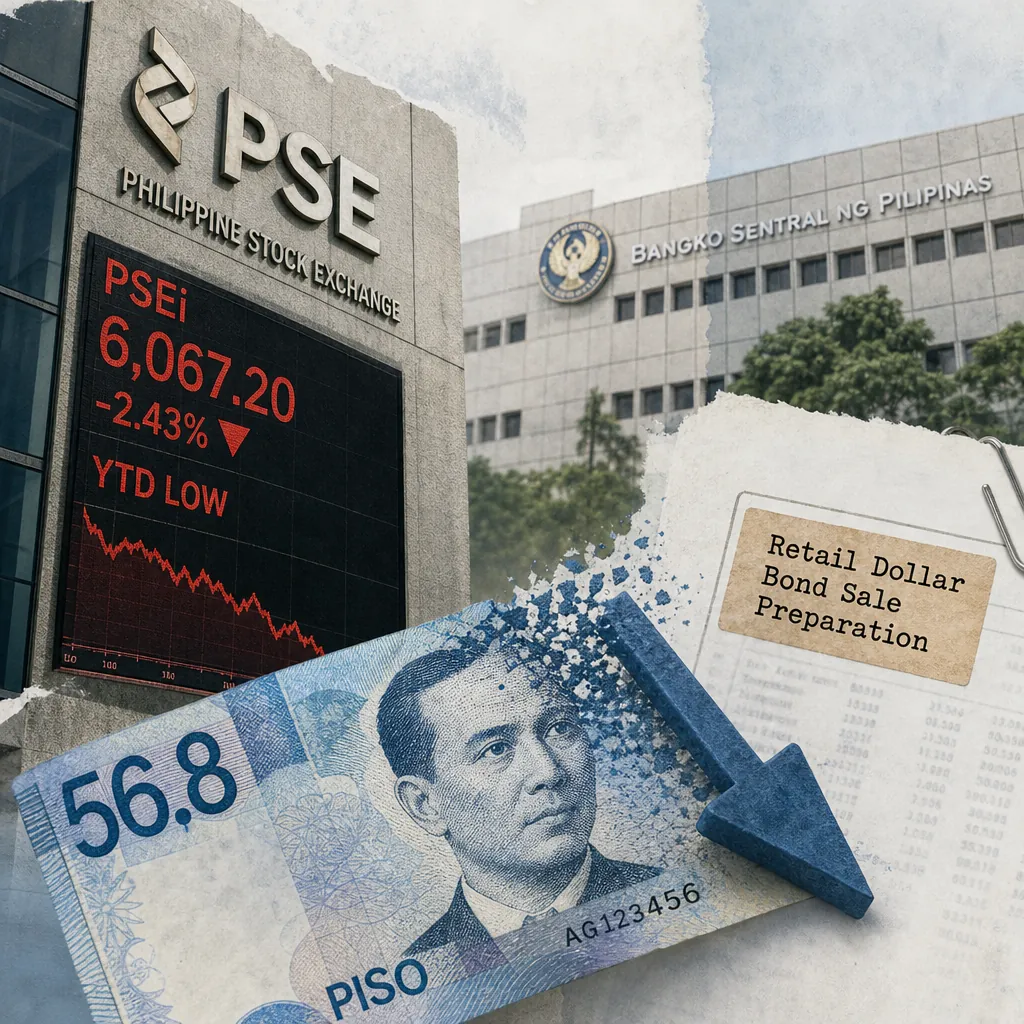
The Philippine Stock Exchange index (PSEi) — the benchmark gauge of the country's 30 largest listed companies — fell 1.18 percent, or 67.06 points, to close at 5,593.49 on Friday, its lowest finish so far in 2026 and its third straight session of losses3369. The peso weakened for a third trading day to ₱63.72 against the US dollar from ₱63.70 on Thursday, a weekly decline of about 1 percent that nearly erased the 1.1-percent appreciation of the previous week, according to RCBC chief economist Michael Ricafort30. The two moves together framed a day of financial news in which the cost of money, the direction of prices, and who gets access to safe savings instruments all drew attention.
The stock decline had several named causes. Philstocks Financial Inc. said investors kept taking profits as they worked through recent corporate earnings reports, and Fitch Solutions BMI cut its growth forecast for the Philippines33. First Metro Securities described a sharp afternoon breakdown after the index held near flat through the morning, with sentiment hit by "a resurgent dollar and rising Fed hike bets"69. The peso's slide followed the latest US inflation data, which strengthened expectations of a Federal Reserve rate increase — a US central bank move that would pull capital toward dollar assets and away from emerging-market currencies like the peso33. Investors also stayed cautious ahead of next week's Association of Southeast Asian Nations (Asean) Leaders Summit in Manila, where regional leaders will discuss economic and geopolitical issues33.
On the same day, the Bangko Sentral ng Pilipinas (BSP) — the country's central bank, which sets interest rates with the aim of keeping inflation within a target band — published a statement reaffirming its price-stability mandate "in the face of a difficult combination of elevated inflation and slowing economic growth."11 The BSP said monetary policy cannot control the direct inflationary effect of recent global supply shocks, so it focuses on "second-round effects" — the way an initial price increase spreads into wages, transport fares and expectations. It also said it is "mindful of the need to prevent the de-anchoring of inflation expectations," meaning the risk that households and businesses stop assuming prices will settle and begin pricing in permanent inflation11.
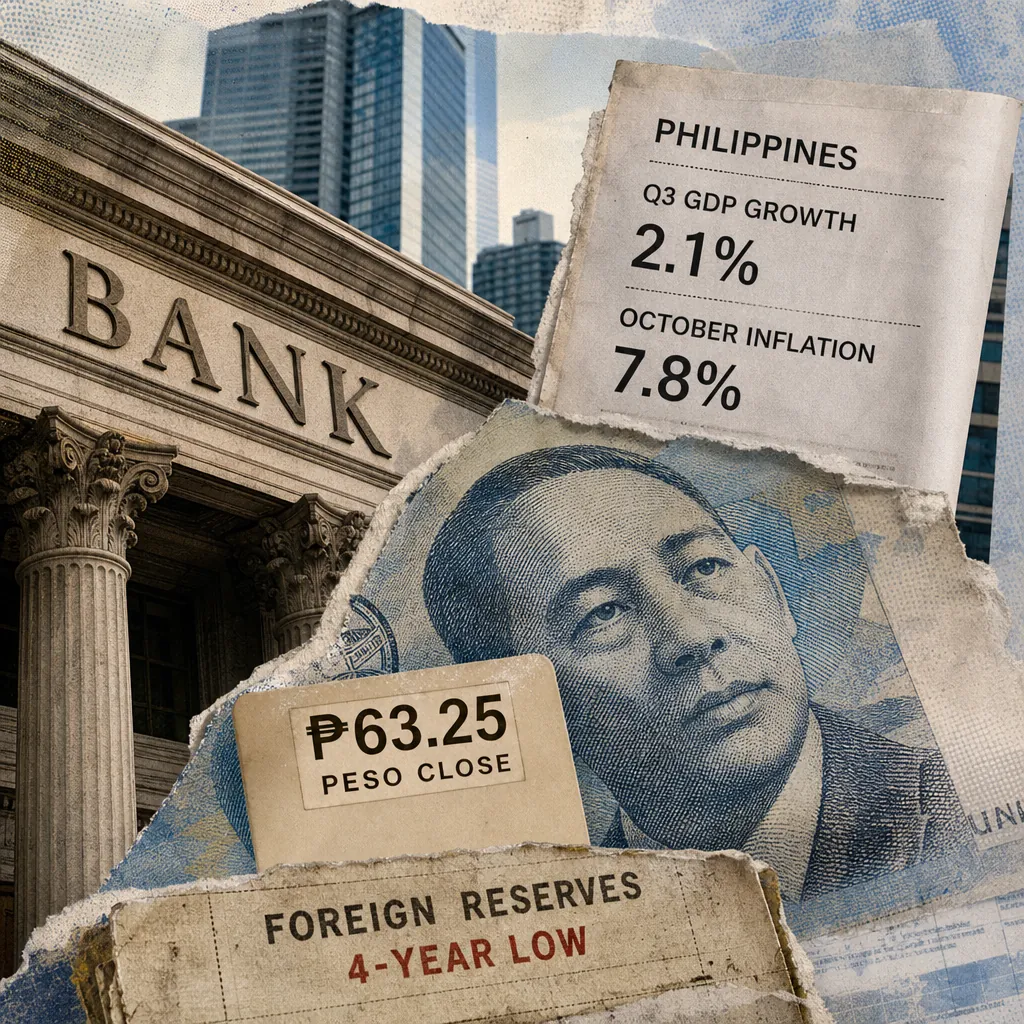
A Manila Bulletin column put numbers to the strain: consumer price inflation accelerated to 7.8 percent in October, the fastest in nearly four years and roughly double the central bank's target ceiling, while economic growth slowed to 2.1 percent in the third quarter, a post-pandemic low. It also cited 2.86 million adults out of work in September, a 5.4-percent jobless rate63. The column followed a multinational investment bank's declaration that the Philippines had entered stagflation — the combination of stagnant growth and rising prices63.
Separately, the Bureau of the Treasury (BTr) — the government arm that sells state debt — said it will offer three-year dollar-denominated retail bonds due 2029 from November 19 to 24, aiming to raise at least $200 million, or about ₱12.75 billion68. The Philippine Digital Asset Exchange (PDAX), a licensed local crypto and digital-asset trading platform, said it will make the same Retail Dollar Bonds Tranche 3 available through its app with a minimum investment of just $200, lowering the entry point from what banks typically require2742. PDAX founder and chief executive Nichel Gaba said: "Filipinos should not need substantial wealth or a private banker to access dollar investments."27
Key themes
- The PSEi closed at 5,593.49, its lowest level of 2026, down 1.18 percent on the day. The index has now fallen for three consecutive sessions, with the broader All Shares index down 0.66 percent to 3,154.9369. The drop came as third-quarter earnings failed to lift sentiment and a growth-forecast cut from Fitch Solutions BMI added to concerns33.
- The peso closed at ₱63.72 to the dollar, down about 1 percent for the week. Ricafort said the currency nearly gave back the 1.1-percent gain it made the week before, pressured by a stronger dollar, higher US Treasury yields and expectations of a Federal Reserve rate hike30.
- Inflation reached 7.8 percent in October, roughly double the central bank's target ceiling. Growth slowed to 2.1 percent in the third quarter and unemployment stood at 5.4 percent in September, with 2.86 million adults out of work63.
- The BSP said it will keep pursuing price stability and is watching for second-round effects. The central bank said it is assessing how the latest growth data affect the inflation outlook and that future decisions will be guided by incoming data on inflation, inflation expectations and economic activity11.
- The Treasury will sell at least $200 million in three-year retail dollar bonds from November 19 to 24. The issue date is November 27, and the final interest rate will be set through a Dutch auction among Government Securities Eligible Dealers68. This is the third retail dollar bond offering, after $1.6 billion raised in 2021 and $1.26 billion in 202368.
- PDAX will offer the same bonds with a $200 minimum through its app. The platform said the lower threshold lets more Filipinos diversify savings into dollar-denominated government securities during the primary offering period2742.
- Security Bank posted ₱9.2 billion in net income for the first nine months, up 1 percent year on year. Revenues rose 8 percent to ₱52.5 billion while operating expenses grew 4 percent, cutting the cost-to-income ratio to 56.4 percent from 58.1 percent2866.
- The Securities and Exchange Commission (SEC) marked its seventh Investor Protection Week from November 9 to 12. The event, under Proclamation No. 846, came as the BSP reports that half of Filipino adults held a formal financial account by the end of 2025 and 85 percent of households owned at least one36.
How the narratives stack
Dominant: The stock market's slide to a 2026 low and the peso's third straight decline dominated the day's financial coverage in the items reviewed here. At least four separate outlets — Inquirer, Philstar, Manila Times and Daily Tribune — carried versions of the PSEi story, and the Manila Times and Philstar both led their business pages with it303369. The coverage value attached to these items reflects how heavily the business press treated the story: the Inquirer's market report carried an estimated ₱210,168 in advertising-equivalent value, the Philstar version ₱235,941, and the Manila Times market wrap ₱211,060303369. That figure estimates what it would cost to buy the same column space as paid advertising; it does not measure how many people read the stories. The dominance is a property of the items captured here, which skew toward business-section reporting.
Counter-narrative: The BSP's statement and the Manila Bulletin column on stagflation offered a different frame from the market-wrap stories. Where the market reports described a bad day for investors, the BSP statement described a central bank managing a supply shock it cannot directly control, and the column described households already living with the result1163. The column's argument was that the debate over whether the Philippines has technically entered stagflation misses what consumers already know: "Economists and government officials may debate definitions and thresholds, but from sari-sari stores to conglomerate boardrooms, the reality has been clear for months."63 The BSP statement, meanwhile, framed the central bank's task as protecting purchasing power and rebuilding confidence11.
Emerging: The retail dollar bond offering and PDAX's $200 minimum put a specific, dated opportunity in front of small savers at a moment when the peso is weak. The Treasury's offering runs November 19 to 24, with settlement on November 2768. PDAX's pitch is that dollar investments should not require "substantial wealth or a private banker."27 The story is emerging rather than dominant because the offering has not yet opened and no subscription figures exist. The SEC's Investor Protection Week, held November 9 to 12, sits alongside it: the commission used the week to warn about illegal investment schemes at a time when more Filipinos than ever hold financial accounts36.
Under-covered: The connection between the peso's weakness and the cost of the government's own dollar borrowing received little direct treatment in the items reviewed. The Treasury is selling dollar bonds while the peso sits near ₱63.72, which affects both the appeal of dollar assets to savers and the government's peso-equivalent proceeds. The BSP's statement on second-round effects and the Treasury's bond sale are two halves of the same inflation story, but they ran as separate items1168.
Platform insights
The day's financial conversation ran almost entirely through published news items rather than social posts; the monitoring writeup for this window contained no social-media engagement data. What follows describes how the story moved across the outlets captured, not across social platforms.
- Business broadsheets and their online editions: Inquirer, Philstar and Manila Times each ran the PSEi story with the same core numbers — 5,593.49, down 1.18 percent — but framed the causes differently. Philstar emphasized disappointing third-quarter earnings and the GDP outlook69; Inquirer emphasized the peso and the Fitch Solutions BMI downgrade33; Manila Times emphasized renewed peso weakness and economic concerns30. The repetition of the same closing figure across outlets is what made the market story dominant in the set.
- Column and opinion pages: The Manila Bulletin's stagflation column and its guest column on the continuing importance of physical payment counters carried the household-level argument that the straight news stories did not6364. The payment-counter column asked whether the financial system is "moving toward a financial system that works for everyone, or simply one that works best for those who are already connected."64
- Corporate disclosure and press-release channels: Security Bank's nine-month results, PNB Holdings' earnings, LT Group's record profit and UnionBank's governance award all moved through company statements picked up by business desks2866397056. These items carried substantial coverage value — the UnionBank governance release alone was valued at an estimated ₱199,296 in advertising-equivalent terms — but they describe company performance, not market direction56.
- Digital-asset and fintech platforms: PDAX's bond offering reached readers through both the Manila Times and a secondary aggregator, Head Topics, which republished the story with a focus on the lowered minimum2742. The dual pickup suggests the $200 threshold was the detail editors judged most newsworthy.
Key voices and communities
The Bangko Sentral ng Pilipinas. The central bank's statement was the day's most authoritative voice on policy, and it was careful: it acknowledged elevated inflation and slowing growth, said monetary policy cannot control the direct effect of global supply shocks, and committed to watching second-round effects and inflation expectations11. For readers, the BSP's framing matters because it sets expectations for the next rate decision.
Market analysts and economists. Ricafort of RCBC supplied the peso's weekly arithmetic and the external causes — a stronger dollar, higher US Treasury yields, Fed hike bets30. Luis Limlingan of Regina Capital Development Corp. commented on the peso's weakness30. Philstocks Financial and First Metro Securities supplied the equity-market read3369. These voices translate daily price moves into causes, and their named explanations are what let a reader connect a US inflation print to a Manila trading session.
The Bureau of the Treasury and PDAX. The Treasury set the terms of the retail dollar bond sale, and PDAX set the retail entry point6827. Together they are the day's most concrete offer to ordinary savers: a dollar-denominated government security, three years to maturity, available for as little as $200.
The Securities and Exchange Commission. The SEC's Investor Protection Week positioned the regulator as a guide for new investors, with activities on consumer rights, capital market investments and the warning signs of illegal schemes, joined by the Philippine Stock Exchange, GCash, Maya and COL Financial36. The BSP data it cited — half of Filipino adults with a formal account by end-2025 — explains why the commission is investing in investor education now36.
Columnists writing for households. The Manila Bulletin's stagflation column and Lawrence Ferrer's guest column on payment counters spoke to readers who experience the economy as grocery bills and queue times rather than index levels6364. Ferrer's point was that digital adoption is accelerating but not everyone has reliable internet, a smartphone, or the confidence to transact online, so the physical counter still matters64.
Narrative streams
The PSEi closes at its 2026 low as earnings and the peso weigh on sentiment
The benchmark index fell 67.06 points, or 1.18 percent, to 5,593.49, slipping below the 5,600 mark for the first time this year33. The broader All Shares index lost 0.66 percent, or 20.83 points, to 3,154.9369. Net value turnover reached ₱5.19 billion33. First Metro Securities said the main gauge held near flat through the morning before a sharp afternoon breakdown, with sentiment hit by "a resurgent dollar and rising Fed hike bets."69 Philstocks said investors continued to book profits as they digested recent corporate earnings, and noted that Fitch Solutions BMI had cut its growth forecast for the Philippines33.
The earnings backdrop explains why profits were there to take. Security Bank reported ₱9.2 billion in net income for January to September, up 1 percent from ₱9.1 billion a year earlier, with pre-provision operating profit up 12 percent to ₱22.9 billion and revenues up 8 percent to ₱52.5 billion66. Its net interest margin stood at 5.93 percent, service charges and fees contributed ₱6.1 billion, and its gross nonperforming loan ratio — the share of loans borrowers are not repaying on schedule — was 3.17 percent at end-September, with reserves covering 84 percent of those bad loans28. LT Group Inc. reported record nine-month attributable net income of ₱25.82 billion, 14 percent above the prior year's ₱22.57 billion, with Philippine National Bank contributing ₱11.95 billion, or 46 percent of the total, and Fortune Tobacco contributing ₱9.35 billion, or 36 percent70. PNB Holdings grew net income 16 percent to ₱317.02 million on revenues of ₱940.35 million, helped by adding dining, retail and wellness tenants at PNB Makati Center39.
For companies raising and lending money, the read is that earnings growth is not enough to lift share prices when the currency and the rate outlook are moving against them. A bank posting a 1-percent profit increase while its cost-to-income ratio improves is operating well by its own measures; the market's reaction reflects what investors expect the peso and US rates to do next, not what the banks reported last quarter. The peso's move matters to anyone with dollar obligations, imported inputs or plans to travel, because a weaker peso raises the peso cost of anything priced in dollars.
The central bank defends its inflation target as prices outrun it
The BSP's statement was a careful piece of expectation management. It acknowledged "a difficult combination of elevated inflation and slowing economic growth," said monetary policy cannot control the direct inflationary effect of recent global supply shocks, and described its focus as the second-round effects of those shocks11. It also said it takes "important account of the weakness in aggregate demand" — meaning it is weighing the fact that demand is soft, which normally argues against raising rates — and is "mindful of the need to prevent the de-anchoring of inflation expectations."11
The numbers behind the statement are stark. Inflation hit 7.8 percent in October, the fastest in nearly four years and roughly double the central bank's target ceiling63. Growth slowed to 2.1 percent in the third quarter, a post-pandemic low and well below market expectations63. Unemployment reached 5.4 percent in September after peaking at 6 percent in July, with 2.86 million adults out of work63. The Manila Bulletin column argued that the definitional debate over stagflation is beside the point for households already paying higher prices for rice, electricity and transport63.
For borrowers and savers, the read is that the central bank is caught between two obligations: bringing inflation down and not deepening a slowdown. Every signal about which way it will move affects loan rates, deposit rates and the peso. The BSP said future decisions will be guided by incoming data on inflation, inflation expectations and economic activity, which means the next inflation print and the next growth release are the events that will move expectations11.
The Treasury opens a $200-million retail dollar bond sale with a $200 entry point
The Bureau of the Treasury will offer three-year retail onshore dollar bonds due 2029 from November 19 to 24, aiming to raise at least $200 million, or about ₱12.75 billion, with an issue date of November 2768. The final interest rate will be set through a Dutch auction among Government Securities Eligible Dealers — a format in which dealers bid the yield they will accept and the auction clears at a single rate68. The government has used this instrument twice before, raising $1.6 billion in its maiden 2021 sale and $1.26 billion in a 5.5-year tranche in October 202368.
PDAX will make the same tranche available through its app with a minimum of $200, a threshold it says bypasses the requirements banks traditionally impose on sovereign debt access42. Gaba framed the offer around access: "Filipinos should not need substantial wealth or a private banker to access dollar investments."27 The platform said investors can buy directly through the app and earn regular dollar income27.
For small savers, the read is that a dollar-denominated government security is now available at a size that fits a modest emergency fund, at a moment when the peso is weak and dollar assets are in demand. The trade-off is real: buying dollar bonds with pesos at ₱63.72 locks in the current exchange rate, so a saver gains dollar income but gives up the benefit if the peso strengthens later. The offering period is short — six days — and the final yield will not be known until the auction.
Investor protection moves to the center of a newly banked population
The SEC held its seventh Investor Protection Week from November 9 to 12 under Proclamation No. 846, opening its Makati headquarters to activities on consumer rights, capital market investments and the warning signs of illegal schemes, joined by the Philippine Stock Exchange, GCash, Maya, COL Financial and others36. The timing reflects a change in who invests: the BSP reports that half of Filipino adults held a formal financial account by the end of 2025 and 85 percent of households owned at least one36. Each new account is a new investor, and each new investor is a potential target for fraud36.
The week's argument, as the Daily Tribune put it, is that "guarding investors and growing the market are one work, not two."36 That framing matters because investor education is often treated as a brake on market growth. The SEC's position is that trust is the precondition for participation.
For first-time investors, the read is that the same phone and e-wallet that make investing easy also make them reachable by schemes that promise returns the market cannot deliver. The regulator's warning signs — and the participation of the major platforms in distributing them — are the practical defense.
Corporate results and governance awards fill the business pages
Beyond the market story, the day's corporate news was a run of nine-month results. Security Bank's ₱9.2 billion profit came with a cost-to-income ratio down to 56.4 percent from 58.1 percent66. LT Group's record ₱25.82 billion was driven by banking, tobacco and liquor70. PNB Holdings' 16-percent profit increase came with a net income margin of 34 percent, up from 30 percent, and an EBITDA margin of 54 percent39. UnionBank of the Philippines received Four Golden Arrows for corporate governance from the Institute of Corporate Directors for the third consecutive year, scored under the Asean Corporate Governance Scorecard, which assesses shareholder rights, disclosure, risk management and board oversight56.
For depositors and investors, the read is that governance scores and cost ratios are the measures that predict how a bank behaves when conditions tighten. A bank that cuts its cost-to-income ratio while growing revenue has more room to absorb higher credit costs, which is what Security Bank's 3.17-percent nonperforming loan ratio and 84-percent reserve cover describe28.
Conversation trajectory
The retail dollar bond offering, November 19 to 24. The offering period opens in less than a week and closes in six days, with the issue date on November 2768. Watch for the auction-determined interest rate and for any announcement of oversubscription or undersubscription. A strong take-up would suggest savers are moving toward dollar assets as the peso weakens; a weak one would suggest the $200 minimum did not overcome the exchange-rate risk.
The next inflation print and the next growth release. The BSP said future decisions will be guided by incoming data on inflation, inflation expectations and economic activity11. The October inflation figure of 7.8 percent is the current baseline; the next monthly release will show whether price pressures are easing or spreading into second-round effects. The next quarterly growth release will show whether the 2.1-percent third-quarter figure was a trough.
The Asean Leaders Summit in Manila next week. Investors stayed cautious ahead of the summit, where regional leaders will discuss economic and geopolitical issues33. Watch for any announcement on investment rules or regional payment linkages that affects the Philippines' standing with foreign investors.
The peso's level against the dollar. The peso closed at ₱63.72, down about 1 percent for the week30. Ricafort said lower crude oil prices and seasonal dollar conversions from overseas Filipino workers, exporters and business process outsourcing firms for holiday spending and 13th-month pay could provide support30. Watch whether those seasonal inflows reverse the recent slide or whether Fed expectations keep the dollar strong.
The Federal Reserve's next move. Expectations of a Fed rate hike, reinforced by the latest US inflation data, are the external driver behind the peso's weakness and the PSEi's decline3369. Any signal from the Fed about the pace of tightening will transmit directly to Philippine markets.
Response guidance
Market communicators: lead with causes, not just closing numbers. When the index falls, audiences want to know why. Name the peso, the Fed expectations and the earnings backdrop in the same breath as the closing level, and state what each figure measures. A closing index level is a price, not a verdict on the economy.
Banks and lenders: explain what a weaker peso does to loan and deposit rates. Customers with dollar-denominated obligations or imported inputs will feel the peso's move before they read about it. Plain-language guidance on how exchange-rate movements pass through to monthly payments is more useful than a general statement of confidence.
Investment platforms: make the exchange-rate trade-off explicit in retail dollar bond marketing. The $200 minimum is a genuine access improvement, but a saver buying dollar bonds at ₱63.72 is taking a currency position. State that clearly alongside the yield, and do not present dollar denomination as a guarantee against peso weakness.
Regulators and investor-education teams: keep the fraud warnings specific. The SEC's Investor Protection Week reached audiences through the platforms where new investors actually transact36. Continue naming the warning signs — promised returns that exceed market rates, pressure to act quickly, unregistered entities — and keep the message in Filipino and English.
Corporate communicators: pair profit figures with the ratios that show resilience. A net income number alone does not tell a depositor or investor how a bank will weather a downturn. Cost-to-income ratios, nonperforming loan ratios and reserve cover are the figures that answer the question audiences are actually asking2866.
All financial communicators: avoid treating the stock index as the economy. The PSEi measures the prices of 30 large listed companies. Inflation, employment and growth measure what households experience. When both are in the news on the same day, keep the two distinct and say which one each figure describes.
See the full picture behind today's signals.
This report draws from Media Meter's MediaWatch, our real-time monitoring engine tracking 2,470+ Philippine sources across print, broadcast, digital, and social. Explore how the platform turns raw coverage into decision-grade intelligence, then see how it's configured for teams like yours — whether you're in PR agencies, corporate comms, government, or marketing.
Want more? Browse our Report Library for sector and crisis intelligence, or request a demo and we'll have your brand set up before the call.
Want this kind of intelligence on your brand?
This brief is built on the same MediaWatch methodology that runs continuously across every brand we monitor. See your competitive landscape, Impact Score, and narrative trajectory in a 30-minute demo.