BSP Holds Rate Path as GDP Slows to 2.1%
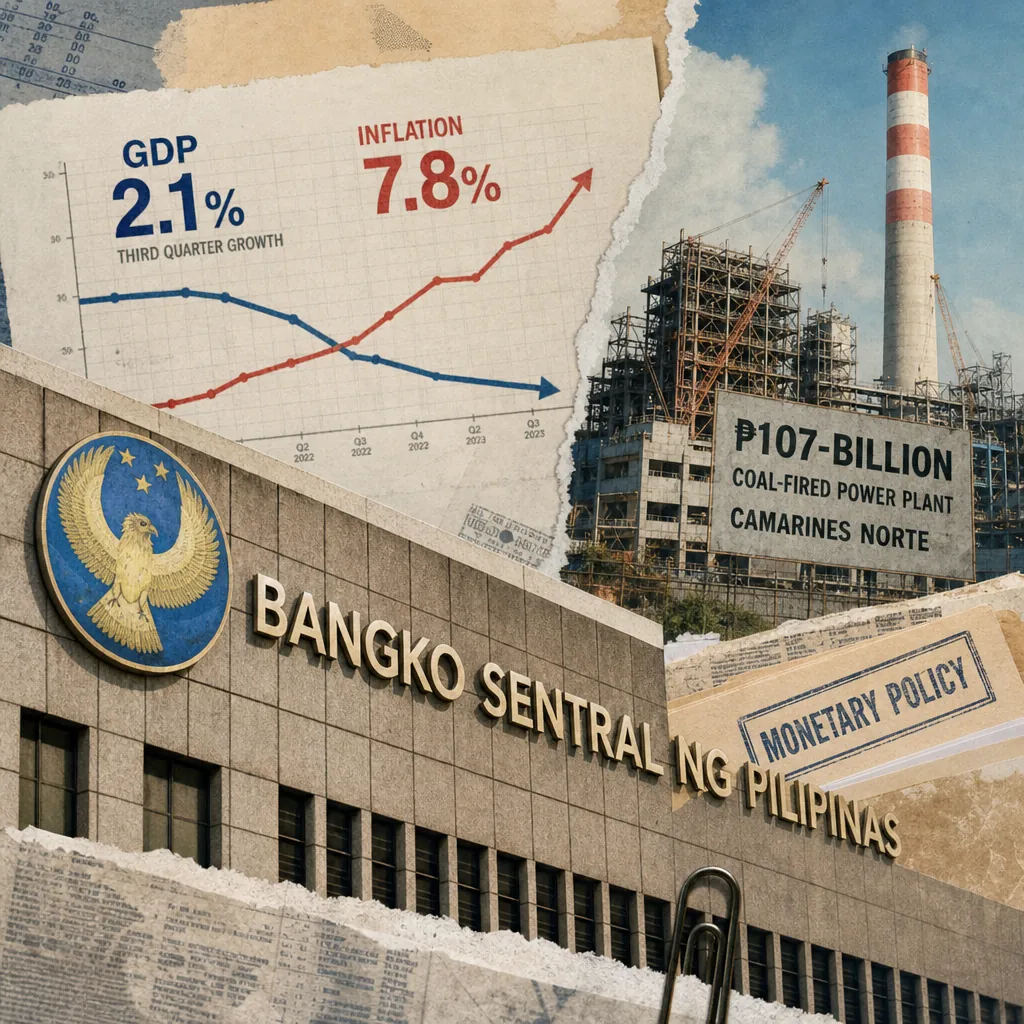
The Bangko Sentral ng Pilipinas faces pressure to keep raising rates as third-quarter growth falls to 2.1 percent and inflation runs at 7.8 percent, while a ₱107-billion coal plant in Camarines Norte advances and banks adjust to the ASEAN summit holiday.
The Bangko Sentral ng Pilipinas (BSP), the country's central bank, is being told to keep tightening monetary policy even as the economy posts its weakest growth in more than a decade and a half. Bank of the Philippine Islands (BPI) lead economist Emilio Neri Jr. warned in a commentary that pausing interest-rate increases now could push inflation expectations higher and set off a wage-price spiral, the cycle in which workers demand higher pay to keep up with rising prices, which in turn pushes prices up further7. His argument ran across the business pages on Sunday and Monday, carried by the Manila Times, the Inquirer, and aggregators, and it landed the same weekend the Philippines opened the 49th Association of Southeast Asian Nations (ASEAN) Summit in Manila5.
The numbers behind the warning are stark. Gross domestic product (GDP), the total value of goods and services the economy produces, grew 2.1 percent in the third quarter compared with the same quarter a year earlier, down from 4.0 percent a year before and the slowest expansion since the fourth quarter of 2009 outside the pandemic224. Consumer prices rose 7.8 percent last month from a year earlier, and the central bank expects inflation to stay elevated in the coming months2. The combination of weak growth and high inflation is what analysts call stagflation, and it has left the BSP's policymaking Monetary Board, the seven-member body that sets the benchmark interest rate, with few good options.
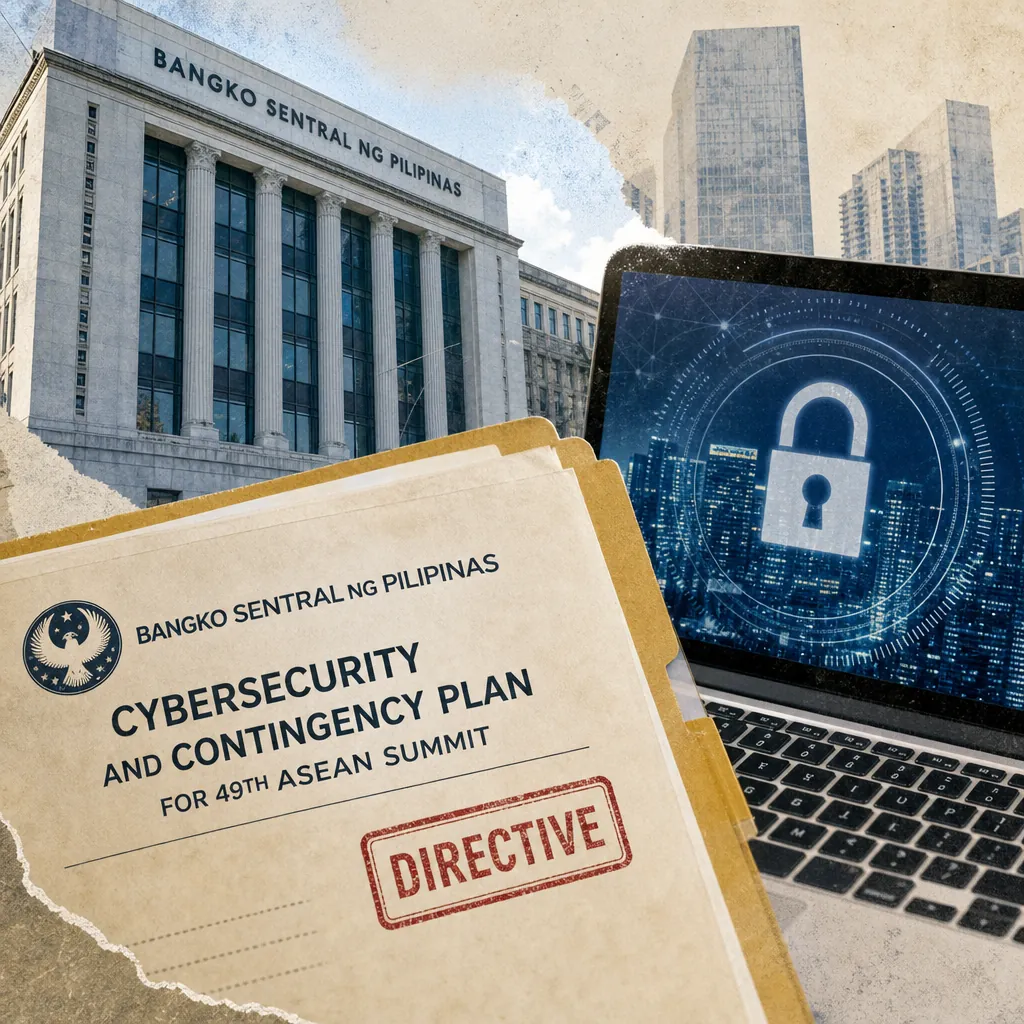
A second cluster of stories concerned the mechanics of money rather than its price. The BSP suspended until Jan. 31, 2027 the rule requiring banks to apply enhanced due diligence, the extra checks used to verify that large transactions are legitimate, to cash withdrawals above ₱1 million3910. It kept its 3-percent monthly cap on credit-card finance charges while raising the ceiling on installment add-on rates to 1.5 percent from 1 percent and the maximum cash-advance processing fee to ₱300 from ₱20031. PhilRatings, the Philippine Rating Services Corp., said it had launched a service to rate small and medium enterprises so they can borrow from the bond market8. And PBCOM extended a ₱500-million credit facility to the consumer-lending platform Billease19.
Elsewhere, a long-stalled coal project moved forward. H&WB Asia Pacific Corp. filed a public scoping submission with the Department of Environment and Natural Resources (DENR) for a 700-megawatt coal-fired plant in Jose Panganiban, Camarines Norte, at a cost of ₱107 billion366. The filing is an early step toward an environmental compliance certificate, the permit a project needs before construction, and no certificate has been issued25. The developer argues the project is exempt from the moratorium the Department of Energy placed on new coal plants in October 202036.
Key themes
- BPI tells the BSP to keep raising rates despite 2.1-percent growth. Neri argued that "pausing monetary normalization prematurely carries far greater long-term risks" and recommended a "calibrated" increase rather than a pause27. The BSP's benchmark rate decision is due Dec. 17, and the market expects a 25-basis-point increase, a quarter of a percentage point41.
- Third-quarter growth of 2.1 percent is the weakest since late 2009 outside the pandemic. The figure compares with 4.0 percent a year earlier and came in below the market forecast range of 2.3 to 2.7 percent241. Household spending growth slowed to 2.9 percent while public spending contracted 2.4 percent from the previous quarter41.
- Inflation at 7.8 percent keeps household budgets under pressure. The rate measures the year-on-year change in consumer prices and is well above the BSP's 2-to-4-percent target range2. The central bank expects it to stay elevated in the coming months.
- The BSP lifted the ₱1-million scrutiny threshold on cash withdrawals until Jan. 31, 2027. The suspension, approved by the Monetary Board on Nov. 12 and effective Nov. 13, is meant to ease legitimate cash transactions during the Christmas season3910. Banks must still file suspicious transaction reports and apply enhanced checks where risk warrants10.
- Credit-card charges stay capped at 3 percent a month, with higher ceilings on installment and cash-advance fees. The BSP raised the monthly add-on rate ceiling for installment loans to 1.5 percent from 1 percent and the maximum cash-advance processing fee to ₱300 from ₱200 under Circular No. 124231. The changes apply only to new transactions after the circular takes effect.
- A ₱107-billion coal plant in Camarines Norte advances toward environmental clearance. The project would run two 350-megawatt supercritical pulverized coal units on about 58.23 hectares in Barangay Osmeña3625. A public briefing is scheduled for December36.
- PhilRatings opens credit ratings to smaller companies. PhilRatings president Angelica Victoria Viloria said the service has launched and the firm is looking for its first SME client, aiming to let companies smaller than Ayala or SM tap the bond market8.
- Banks adjusted branch schedules for the ASEAN summit holiday. Metro Manila was declared a special non-working holiday from Nov. 16 to 18 for the summit, and BPI said all its Metro Manila branches would stay open while UnionBank kept 12 open and closed the rest in the capital region40.
How the narratives stack
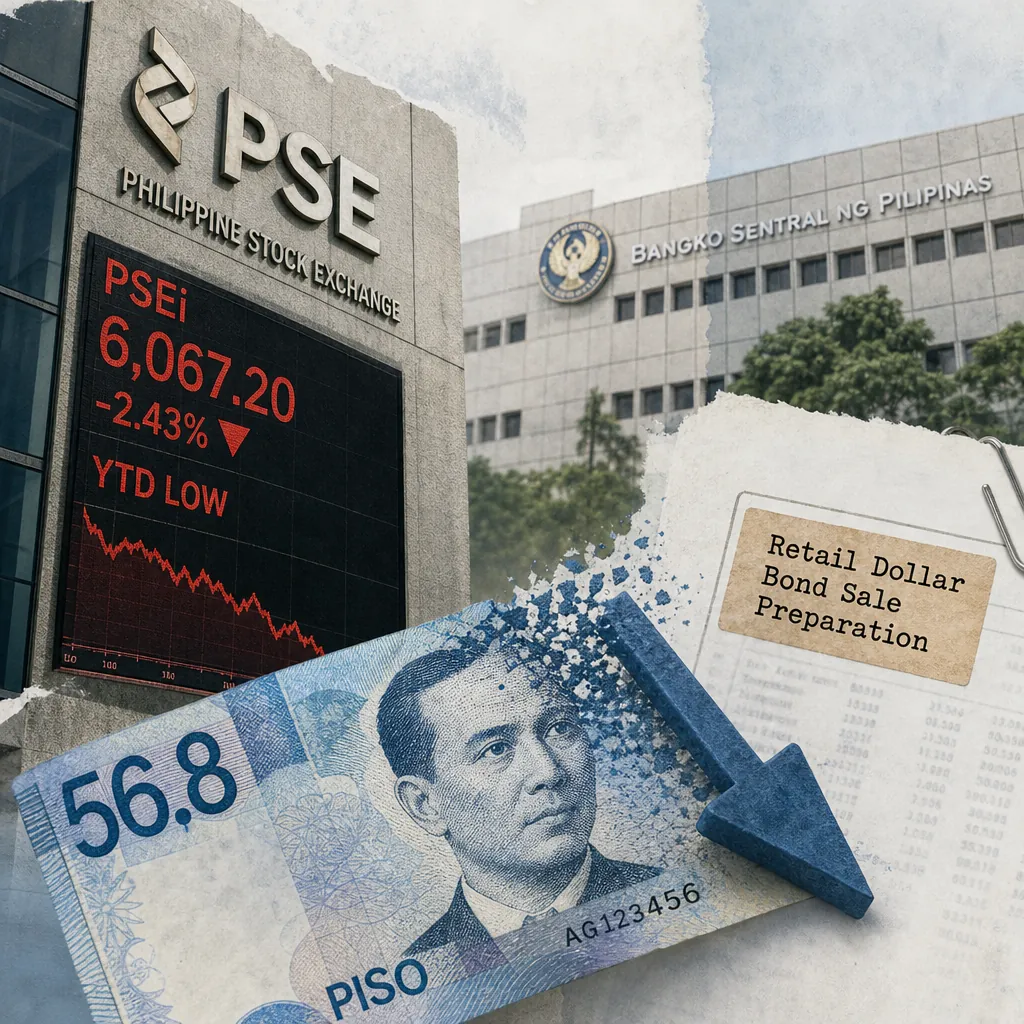
Dominant: The BSP's rate dilemma dominated the business coverage in this set. The Manila Times, the Inquirer, Head Topics, and Manila Standard all carried versions of the same story: growth at 2.1 percent, inflation at 7.8 percent, and an economist urging the central bank not to blink272441. The Manila Standard's market story tied the two together, reporting that Philippine shares are expected to stay under pressure on stagflation fears and that the market expects a 25-basis-point BSP increase on Dec. 17 after an expected U.S. Federal Reserve rate hike on Dec. 941. The Philstar market preview struck a similar note, reporting the Philippine Stock Exchange index closed at 5,593.49 on Friday, down 2.92 percent week-on-week, with the peso's weakness and MSCI deletion-related selling weighing on sentiment41. MSCI is the index provider whose rebalancing forces funds tracking its benchmarks to buy or sell shares, and its Nov. 27 rebalance is expected to intensify positioning41.
Counter-narrative: The BSP's own actions told a different story from the tightening message. In the same week Neri urged caution on pausing, the central bank suspended the ₱1-million enhanced due diligence threshold on cash withdrawals until Jan. 31, 2027, explicitly to support holiday spending3910. It also kept the 3-percent cap on credit-card finance charges in place while allowing modest increases in installment and cash-advance fees31. The BSP's framing was consumer protection and holiday convenience, not restraint. The two positions are not contradictory in the central bank's logic, since the withdrawal suspension is a temporary operational accommodation rather than a policy loosening, but they read differently to a household trying to work out whether money is getting easier or harder to move.
Emerging: The coal plant in Camarines Norte is the clearest emerging story in the set. The project has been delayed since 2015, and the developer did not state the reasons for the delays, though industry players cite lengthy permitting and land acquisition problems6. The 2020 moratorium on new coal plants was meant to cut carbon emissions and support a shift to clean energy, and H&WB Asia Pacific says its project qualifies for an exemption36. The filing is a public scoping submission, an early consultation step, and no environmental compliance certificate has been issued25. A public briefing is scheduled for December36. The story matters beyond Bicol because it tests whether the moratorium holds when a developer with a pre-existing claim pushes against it.
Under-covered: Two stories with real consequences for ordinary workers drew little attention in this set. The recruitment sector is opposing a proposed border security fee under the Bureau of Immigration modernization project, warning it could raise travel costs for as many as 2 million overseas Filipino workers (OFWs) a year29. Loreto Soriano of the Migration and Development Center cited Section 35 of Republic Act 8042, the Migrant Workers and Overseas Filipinos Act of 1995, as amended, which exempts migrant workers from travel taxes and airport fees29. Separately, ASEAN adopted a declaration on fair and ethical recruitment of migrant workers at the summit, aimed at tightening regulation of recruitment agencies and preventing excessive recruitment fees13. Both stories concern the same population, and neither drew the coverage the rate story did.
Platform insights
- Facebook: The day's most-shared business content in this set was the BSP rate story as carried by mainstream outlets, with the Manila Times and Inquirer versions circulating widely27. The comments on these posts tended to focus on household budgets rather than monetary theory, with readers connecting the 7.8-percent inflation figure to the price of rice and transport. The BSP's own announcement on the cash-withdrawal suspension drew a smaller but more practical response, with users asking whether the change would speed up bank transactions during the holidays39.
- X: The rate debate played out in short bursts, with economists and finance accounts quoting Neri's "delicate tightrope walk" line and the 2.1-percent growth figure2. The coal plant filing generated a smaller but sharper thread, with energy analysts noting the 2020 moratorium and asking how an exemption could be claimed2536. The ASEAN summit produced the day's highest-volume political traffic, but most of it concerned the South China Sea code of conduct rather than business40.
- Reddit: Discussion on Philippine business and personal-finance communities focused on the credit-card changes, with users working through what the 1.5-percent installment ceiling and the ₱300 cash-advance fee mean for existing balances31. The BSP's clarification that the new ceilings apply only to new transactions after the circular takes effect was the most-quoted detail. A separate thread on the coal plant drew comments about the country's energy mix and the reliability of renewable sources during typhoons36.
- YouTube: Business commentary channels carried the rate story in explainer format, with the 2.1-percent growth and 7.8-percent inflation figures as the visual anchors2. The Manila Times' daily headlines podcast, which led with the ASEAN summit and Marcos's call for regional solidarity, drew steady listening5. The coal plant story appeared mainly as a segment within broader energy roundups rather than as a standalone video6.
Key voices and communities
BPI and the economist community. Neri's commentary was the most-cited analysis of the day, and his framing set the terms of the debate: the BSP has "limited policy space, making complementary supply-side action mandatory," and a pause would carry "far greater long-term risks"2. His argument that the central bank should not bear the burden of taming prices alone is a call for fiscal and supply-side measures, such as food imports or transport subsidies, to share the load7.
The BSP and its Monetary Board. The central bank's communications ran on two tracks: a tightening bias in its rate messaging and a consumer-relief posture in its operational circulars3931. Governor Eli Remolona Jr. has pushed to make the corporate bond market more accessible to smaller borrowers, a priority PhilRatings cited in launching its SME service8.
Small and medium enterprises. SME owners were the subject of two separate stories: PhilRatings' new credit-rating service, which aims to let companies smaller than the conglomerates borrow from the bond market8, and UnionBank's UB Negosyante BOOSTcamp, a six-week program that graduated 27 SME founders in artificial intelligence, digital marketing, and financial management27. UnionBank chief marketing and experience officer Albert C. Cuadrante told the graduates: "We see you guys not just as business owners, but as builders of the future."27
Overseas Filipino workers and migration advocates. The proposed border security fee under the Bureau of Immigration modernization project drew opposition from the recruitment sector, with Soriano arguing that OFWs must be excluded under RA 804229. The ASEAN declaration on migrant worker recruitment, adopted at the summit, gave the issue a regional frame13.
Energy and environmental communities. The coal plant filing drew attention from energy analysts and environmental groups, who noted the 2020 moratorium and the project's supercritical technology, which burns coal at higher temperatures and pressures to extract more energy per ton and produce fewer emissions than older designs, though it remains a coal plant3625.
Narrative streams
The BSP is told to keep tightening as growth falls to 2.1 percent
The case for further rate increases rests on a simple fear: if the central bank pauses now, Filipinos will come to expect higher inflation and adjust their behavior accordingly, demanding higher wages and raising prices preemptively7. Neri called this a "toxic wage-price spiral" and argued that a "calibrated" increase would be more appropriate than deferring further hikes7. The BSP's benchmark rate is the interest rate it charges banks for short-term borrowing, which in turn influences the rates banks charge households and businesses; raising it makes borrowing more expensive, which is meant to cool spending and slow price growth.
The case against further increases rests on the growth figure. GDP growth of 2.1 percent in the third quarter was the slowest since the fourth quarter of 2009 outside the pandemic, and it came in below the market forecast range of 2.3 to 2.7 percent41. Household spending growth slowed to 2.9 percent, and public spending contracted 2.4 percent from the previous quarter41. Higher rates would make it more expensive for businesses to invest and for households to borrow, which could push growth lower still.
The market has already picked a side. Analysts expect the BSP to raise its benchmark rate by 25 basis points on Dec. 17 to support the peso, following an expected U.S. Federal Reserve rate hike on Dec. 941. The peso's weakness has been a factor in the stock market's decline, with the Philippine Stock Exchange index closing at 5,593.49 on Friday, down 2.92 percent week-on-week41. AB Capital Securities said the 5,580 level is a critical support, and a break would expose pandemic-era lows as MSCI-related positioning intensifies ahead of the Nov. 27 rebalance41.
For households, the practical effect is that borrowing costs are likely to stay high or rise further, even as the economy slows. For businesses, the squeeze is on margins: 2TradeAsia.com noted that most companies reporting weaker earnings were hit by margin pressures and non-operating items rather than a collapse in sales41. The read for the sector is that banks and lenders should expect demand for credit to soften while loan-loss provisions stay elevated, and that the BSP's December decision will be the single most important signal for borrowing costs into the first quarter of 2027.
The BSP suspends the ₱1-million cash-withdrawal scrutiny until Jan. 31
The BSP's Monetary Board approved the temporary suspension of the enhanced due diligence threshold for large cash transactions through Resolution No. 1086 dated Nov. 12, 2026, and the suspension took effect upon issuance of the memorandum on Nov. 1339. Under the rule, banks and other BSP-supervised financial institutions had been required to apply extra checks to cash withdrawals above ₱1 million, verifying the legitimacy of the transaction and assessing money-laundering risk39.
The central bank said the move was meant "to facilitate legitimate transactions and support the public's cash requirements during this period," citing anticipated higher economic activity and cash demand during the holidays39. Banks must still comply with anti-money-laundering and counterterrorism-financing laws, conduct enhanced due diligence when customer or transaction risks warrant it, monitor transactions, and file suspicious transaction reports10.
For bank customers, the change means large legitimate withdrawals, such as a business paying holiday bonuses in cash or a family funding a Christmas purchase, should move faster. For banks, the operational burden eases temporarily but the compliance obligation does not disappear; they must still document and report suspicious activity10. The read for the sector is that banks should use the window to streamline their large-cash processes without loosening their monitoring, because the threshold returns on Feb. 1, 2027, and any backlog of unverified transactions will need to be reconciled then.
Credit-card charges stay capped at 3 percent, with higher ceilings on installment and cash-advance fees
The BSP kept the 3-percent monthly cap on finance charges for credit-card loans, the maximum interest a card issuer can charge on unpaid balances31. It raised the monthly add-on rate ceiling for credit-card installment loans to 1.5 percent from 1 percent, and the maximum one-time cash-advance processing fee to ₱300 from ₱200, under Circular No. 1242 issued on Nov. 1031. The circular takes effect 15 calendar days after publication in the Official Gazette or a newspaper of general circulation, and the adjusted ceilings apply only to new transactions starting on the effectivity date31.
The BSP said the adjustments aim to balance consumer protection with giving card issuers more flexibility to set charges amid rising operating costs31. For cardholders, the practical effect is that existing installment plans keep their agreed terms, while new plans may carry a higher add-on rate31. For card issuers, the higher ceilings offer some relief on the cost of funding installments, but the 3-percent cap on finance charges remains the binding constraint on profitability. The read for the sector is that card issuers should expect the BSP to keep the cap in place through the holiday season, and that competition for cardholders will shift toward fee waivers and rewards rather than rate.
A ₱107-billion coal plant in Camarines Norte moves toward environmental clearance
H&WB Asia Pacific Corp. filed a public scoping submission with the DENR for a 700-megawatt supercritical pulverized coal-fired power facility in Barangay Osmeña, Jose Panganiban, Camarines Norte3625. The project would cost ₱107 billion, occupy about 58.23 hectares, and run two 350-megawatt supercritical pulverized coal boiler units3625. A public briefing is scheduled for December36.
The project has been delayed since 2015, and the company did not state the reasons for the delays, though industry players cite lengthy permitting processes and land acquisition problems6. The Department of Energy imposed a moratorium on greenfield coal-fired power projects in October 2020 to accelerate the shift toward cleaner energy, and H&WB Asia says the facility qualifies for an exemption36. The filing is an early step in securing an environmental compliance certificate, and no certificate has been issued25.
For the energy sector, the project tests the durability of the coal moratorium. If the exemption is granted, it would signal that pre-existing proposals can still move through the permitting system, which could encourage other developers with dormant coal plans. If it is denied, the moratorium's deterrent effect strengthens. For consumers in Bicol, a 700-megawatt plant would add significant generating capacity to the grid, which could ease supply concerns, but it would also lock in decades of coal-fired generation and associated emissions. The read for the sector is that renewable developers should watch the December public briefing closely, because the precedent set there will shape how the DENR treats other fossil-fuel projects that predate the moratorium.
PhilRatings opens credit ratings to small and medium enterprises
PhilRatings launched a service to help SMEs obtain credit ratings and gain access to the debt market, part of efforts to deepen the country's capital markets8. PhilRatings president Angelica Victoria Viloria said the service has already launched and the company is looking for its first SME client to rate8. "If you notice, our current ratees are more of the conglomerates, the blue chip companies," Viloria told the Inquirer. "We want to move in the direction wherein even a company that's not as big as Ayala or SM can tap the market."8
The initiative aligns with BSP Governor Eli Remolona Jr.'s push to make the corporate bond market more accessible to borrowers with lower credit quality8. A credit rating is an independent assessment of a borrower's ability to repay, and it is what allows investors to price the risk of buying a company's bonds. Without a rating, most SMEs cannot sell bonds to institutional investors, which leaves them dependent on bank loans.
For SMEs, the service could open a new funding channel beyond bank credit, which is especially relevant when lending rates are high and likely to rise further. For investors, it adds a new asset class with different risk and return characteristics. The read for the sector is that banks should expect competition for SME lending from the bond market over time, and that the first SME rating will be a test of whether investors will buy paper from companies without a conglomerate's balance sheet.
PBCOM extends a ₱500-million credit facility to Billease
PBCOM signed a ₱500-million credit facility with Billease to support its consumer lending operations, secured by a pool of consumer loans19. The agreement was signed in Manila by Billease co-founder and CEO Georg Steiger and PBCOM President and CEO John Cary Ong19. PBCOM joins RCBC and PNB among the Philippine banks financing the company, according to Billease's Nov. 12 announcement19.
The facility is secured by a pool of Billease consumer loans, with security interests registered through the Personal Property Security Act, a law that allows movable assets such as loan receivables to be used as collateral19. The announcement does not change individual borrowing terms19.
For Billease, the facility adds another domestic funding source, reducing reliance on any single bank. For PBCOM, it is a way to earn interest on a secured pool of consumer loans without building a consumer-lending operation itself. The read for the sector is that consumer-lending platforms are becoming a recognized asset class for Philippine banks, and that more banks are likely to follow PBCOM, RCBC, and PNB in extending secured facilities as demand for small-ticket consumer credit grows.
ASEAN summit produces a migrant-worker declaration and a missed code of conduct deadline
The 49th ASEAN Summit opened in Manila on Sunday under the theme "Navigating Our Future, Together," with President Ferdinand Marcos Jr. calling for regional solidarity amid "geopolitical tensions, economic uncertainty, new technologies, climate change, and transnational threats"5. ASEAN adopted the Declaration on Fair, Ethical, and Sustainable Recruitment for Empowered Migrant Workers, which seeks to ensure accountability and tighter regulation of recruitment agencies, prevent excessive recruitment fees, promote equal employment opportunities, provide protection and justice for workers, and strengthen international cooperation13.
Foreign Affairs Secretary Ma. Theresa Lazaro said ASEAN and China have completed negotiations for a Code of Conduct in the South China Sea by 77 percent to about 80 percent, missing the Philippines' goal of concluding a legally binding code during its chairship40. The code is the proposed set of rules governing behavior in the disputed waters, and the failure to conclude it leaves the region without a binding framework.
For Filipino workers, the migrant-worker declaration could mean stronger protections against excessive recruitment fees, though its practical effect depends on how each member state implements it. For businesses, the summit's economic integration agenda, including digital transformation and inclusive growth, could open larger markets for micro, small, and medium enterprises33. The read for the sector is that the declaration's value will be measured by whether recruitment agencies face actual penalties, and that the missed code of conduct deadline leaves maritime risk unresolved for shipping and logistics operators.
Banks adjust branch schedules for the ASEAN summit holiday
Metro Manila was declared a special non-working holiday from Nov. 16 to 18 for the ASEAN summit, and banks announced adjusted branch schedules40. BPI said all its branches across Metro Manila would remain open, though operations may be adjusted due to road closures, traffic restrictions, and security measures40. UnionBank kept 12 Metro Manila branches open from Nov. 16 to 18 and temporarily closed its other branches in the capital region, while its branches outside Metro Manila remained operational40.
For customers, the practical effect is that branch access in Metro Manila is reduced but not eliminated, and digital channels remain available. For banks, the holiday tests their ability to maintain service with reduced staffing and disrupted logistics. The read for the sector is that banks should communicate branch schedules clearly and push customers toward digital channels during the summit, because the holiday falls in the middle of the holiday shopping season when transaction volumes are rising.
Conversation trajectory
Over the next 24 to 48 hours: Watch for reactions to the BSP's cash-withdrawal suspension from bank customers and compliance officers. The suspension took effect Nov. 13 and runs to Jan. 31, 2027, so the first test is whether banks report faster processing of large withdrawals without a rise in suspicious-activity reports3910.
Over the next week: The ASEAN summit concludes Nov. 18, and the market will look for signals on regional economic integration and the South China Sea code of conduct40. The Philippine Stock Exchange index's 5,580 support level is the key technical marker, and a break would expose pandemic-era lows41. The MSCI rebalance on Nov. 27 is expected to intensify selling pressure41.
Over the next two to four weeks: The BSP's Dec. 17 rate decision is the single most important scheduled event for borrowing costs41. The U.S. Federal Reserve's Dec. 9 meeting will set the context, and a Fed hike would increase pressure on the BSP to follow41. The December public briefing on the Camarines Norte coal plant will test the moratorium's durability36.
Over the next quarter: The BSP's credit-card circular takes effect 15 days after publication, so cardholders will see the new ceilings on new transactions by early December31. The cash-withdrawal threshold returns on Feb. 1, 2027, and banks will need to reconcile any backlog39. Aznar Shipping's planned Dec. 18 initial public offering, which could raise up to ₱670 million, is waiting only for Philippine Stock Exchange clearance after the Securities and Exchange Commission approved its registration42.
Trigger events to watch: A surprise inflation print above 7.8 percent would strengthen the case for a larger BSP increase2. A GDP revision or a weaker fourth-quarter forecast would strengthen the case for a pause. A DENR decision on the coal plant's environmental compliance certificate would settle the moratorium question25. A government announcement on the border security fee would determine whether OFWs face higher travel costs29.
Response guidance
Banks and lenders: Prepare customer communications explaining the cash-withdrawal suspension in plain terms, including what changed, what did not, and when the threshold returns. Customers who were previously asked for documentation on large withdrawals will notice the difference, and they should be told that suspicious-transaction reporting continues3910.
Card issuers: Update disclosure materials for the new installment and cash-advance ceilings before the circular takes effect, and make clear that existing installment plans keep their agreed terms31. Customers will compare the old and new rates, and confusion about which transactions are covered is the most likely source of complaints.
SME lenders and development banks: Use the PhilRatings SME service as a conversation starter with larger SME clients who have outgrown bank credit8. Explain what a credit rating involves, what it costs, and what it allows a company to do that a bank loan does not.
Energy developers and investors: Track the December public briefing on the Camarines Norte coal plant and the DENR's treatment of the moratorium exemption3625. The precedent will shape permitting timelines for other projects, and developers with dormant coal proposals should review whether their claims are similarly positioned.
Recruitment agencies and migration advocates: Prepare for scrutiny of the border security fee proposal and the ASEAN migrant-worker declaration2913. The exemption for OFWs under RA 8042 is the strongest legal argument against the fee, and agencies should be ready to explain it to workers.
Communicators across the financial sector: Expect the rate debate to dominate business coverage through the Dec. 17 BSP decision41. The most credible messages will connect the central bank's decisions to household budgets, not to abstract policy, because that is how readers are already discussing the story2.
See the full picture behind today's signals.
This report draws from Media Meter's MediaWatch, our real-time monitoring engine tracking 2,470+ Philippine sources across print, broadcast, digital, and social. Explore how the platform turns raw coverage into decision-grade intelligence, then see how it's configured for teams like yours — whether you're in PR agencies, corporate comms, government, or marketing.
Want more? Browse our Report Library for sector and crisis intelligence, or request a demo and we'll have your brand set up before the call.
Want this kind of intelligence on your brand?
This brief is built on the same MediaWatch methodology that runs continuously across every brand we monitor. See your competitive landscape, Impact Score, and narrative trajectory in a 30-minute demo.