Peso hits record ₱64.17 as rice import timing probed
The peso closed at a record low of ₱64.17 to the dollar on October 27, drawing Palace blame on geopolitical conflict and oil prices, while Senator Francis Pangilinan questioned why rice imports keep arriving during the local harvest. Cebu tightened hog border controls against African swine fever and a ₱3.2-billion waste-to-energy plant was proposed in Pangasinan.
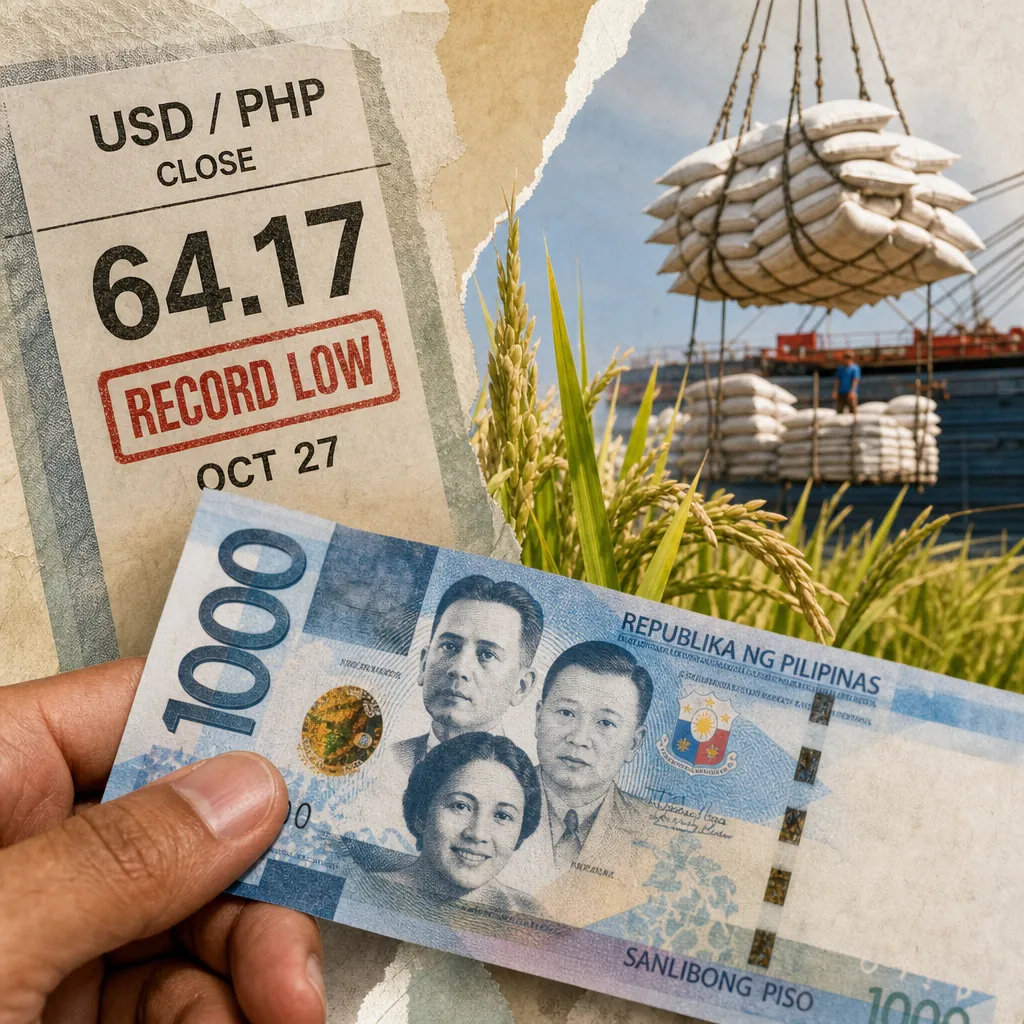
The peso closed at ₱64.17 to the US dollar on Tuesday, October 27, the weakest level on record, according to data from the Bankers Association of the Philippines (BAP), the industry group that publishes the daily interbank reference rate3. It was the second record in two trading days: the currency had already closed at an all-time low of ₱63.95 on Monday, and Tuesday's intraday trading broke through ₱64 before settling372. The Philippine Star's Filipino-language column counted Monday as the fifth straight trading day of decline and the 32nd time this year the peso has closed at a fresh record low72.
At a Palace press briefing the same day, Presidential Communications Office (PCO) Undersecretary and Palace Press Officer Claire Castro attributed the weakness to "geopolitical conflict," pointing to higher crude oil prices and a volatile exchange rate3. The government's response, as she described it, is to lean on stable supplies of basic goods, fuel subsidies and livelihood assistance rather than to defend the currency22. The Bangko Sentral ng Pilipinas (BSP), the central bank, does not currently see a need to intervene, Governor Benjamin Remolona Jr. said the previous week: "We have estimates of how much the peso has to move before it becomes inflationary, and that's when we tend to intervene"72.
A separate thread ran through the business pages: Senator Francis "Kiko" Pangilinan, who chairs the Senate Committee on Agriculture, Food and Agrarian Reform, said he would investigate why rice and other agricultural imports keep arriving during the local harvest season, when farm-gate prices are already at their weakest2728. He tied the question to two shipments of allegedly smuggled rice worth an estimated ₱700 million intercepted at the ports of Davao and Limay, Bataan, last month, with a hearing likely in the first week of November27. The two stories connect at the household level: a weak peso makes imported fuel and food more expensive in pesos, and imports landing at harvest time push down the price farmers receive for their own crop.
Key themes
- The peso closed at ₱64.17 to the dollar, a record low, after breaking ₱64 during trading. The previous record was ₱63.95, set the day before, and Monday was the fifth consecutive trading day of decline372. The peso has now set a new all-time closing low 32 times in 202672.
- The Palace blames geopolitical conflict and oil prices, not domestic policy. Undersecretary Castro said the government does not want a weak peso but that conflict abroad is keeping crude prices and the exchange rate volatile3. The administration's cushion is stable supply of basic goods, fuel subsidies and aid to farmers and drivers22.
- The central bank is holding off on intervention. BSP Governor Remolona said the bank intervenes only when peso movement threatens to become inflationary, and it has estimates for that threshold72. No figure for that threshold was disclosed.
- Senator Pangilinan questions rice imports arriving during harvest. The Senate agriculture committee chair called the recurring timing a possible scheme and said imports should not enter during harvest season2728. He will investigate two intercepted rice shipments worth an estimated ₱700 million27.
- Cebu tightened hog border controls to protect a ₱20-billion industry from African swine fever. Governor Pamela Baricuatro signed Executive Order No. 55, requiring shipments to pass designated ports with veterinary quarantine officers and carry shipping permits, health certificates and negative ASF test results23.
- A ₱2.5-billion to ₱3.2-billion waste-to-energy plant is proposed for Pangasinan. North Maharlika Energy Corp. filed with the Department of Environment and Natural Resources for a 12-megawatt facility in Urdaneta City that would process more than 650 tons of municipal waste a day, targeting commercial operation by the second quarter of 203011244952.
- The Board of Investments approved ₱900.06 billion in investments from January to September, up 53 percent from a year earlier. That is 90 percent of the agency's ₱1-trillion target for the year, across 207 projects expected to generate 21,524 jobs63.
- Ayala Corp. retained the highest distinction at the Golden Arrow Awards for corporate governance. The Institute of Corporate Directors gave Ayala five Golden Arrows for the second straight year, scored against the Asean Corporate Governance Scorecard, with nine other Ayala group companies also recognized10215.
How the narratives stack
Dominant. The peso's record close is the day's lead story by consequence and by breadth of coverage in this set. It appeared in a Manila Bulletin online report quoting the Palace3, a tabloid item in PM noting the intraday break and the BSP's reluctance to defend the currency, a Philippine Star news story with the BSP governor's quote72, a Star opinion column arguing the pain outweighs the benefit to dollar earners65, and a companion column on weekly oil price increases69. The Manila Standard's business pages carried the Palace's supply-side response22. The story matters beyond the foreign-exchange desk because the Philippines imports most of its crude oil and a large share of its food, so a weaker peso raises the peso cost of everything bought abroad, from fuel to medicine to wheat.
Counter-narrative. The Palace's framing that the weakness is imported — driven by conflict and oil — competes with a domestic explanation that the peso's slide is partly a confidence story. The Star column made the household case directly: for Filipinos on local salaries and daily budgets, the pain of a weak peso is felt more than the gain to overseas Filipino workers and dollar-earning companies65. The oil column pressed the same point from the transport side, noting that fuel subsidies do not cover the full increase in diesel costs and that every peso added at the pump feeds through to fares and food prices69. Neither column disputes the Palace's facts; they dispute the emphasis.
Emerging. The rice-import timing story is the clearest emerging thread. Pangilinan's committee has not yet held its hearing, and the two intercepted shipments have not been adjudicated27. The senator cited the Department of Agriculture's 60-day rule, which requires agricultural products to leave their port of origin within 60 days and bars their release during the local harvest, and said the pattern of imports arriving anyway suggests the rule is not being enforced28. The BusinessMirror's editorial page connected the thread to the Philippine Competition Commission's onion cartel case, where a ₱1.76-billion bill remains unpaid, as evidence of how hard it is to pursue traders who game the system51.
Under-covered. Two stories with real consequences for specific sectors drew little attention in this set. Cebu's Executive Order No. 55 on hog shipments appeared in a single broadsheet brief, despite protecting a ₱20-billion industry and the island's food supply23; a separate Inquirer report noted that the same province had eased controls for lechon producers, allowing live hogs in for immediate slaughter under protocols6. The two moves are not contradictory — one tightens border controls generally, the other creates a supervised channel for lechon — but the distinction was not explained in either item. The waste-to-energy proposal in Pangasinan drew four separate items across Inquirer, BusinessWorld, Manila Standard and BusinessMirror11244952, a sign of genuine interest in the project, but no coverage of whether the financing is in place.
Platform insights
- Facebook. The peso story travelled through Facebook-native news pages: Manila Bulletin's Balita and Philippine Star's Pilipino Star Ngayon both pushed Tagalog-language versions of the record low, which is where the household-level framing — gasolina, pagkain, gamot — reached readers who do not follow the business pages372. The Tagalog treatment matters because the peso's effect on daily budgets is easier to explain in the language people use at the market.
- X. The Pangilinan rice-import story circulated through the senator's own committee messaging and through broadcaster Ted Failon's radio interview, which BusinessMirror quoted50. The 280-character format suits the "modus" framing — a short, accusatory question — better than the policy detail, which is why the 60-day rule got less play than the allegation.
- YouTube. The poisoning of 13 children in Koronadal City after eating tuba-tuba fruit was traced by investigators to a YouTube channel showing people eating the fruit, which the children copied66. The city government's response was aimed at parents and guardians, asking them to watch what their children see on social media. This is a case where the platform is part of the causal chain, not just the distribution channel.
- Reddit and forums. No substantive discussion of the peso or rice-import stories surfaced in the items reviewed here. The day's online conversation was driven by news pages and columnists rather than by user-generated threads.
Key voices and communities
The Palace communications office. Undersecretary Claire Castro is the government's most quoted voice on the peso, and her framing — geopolitical conflict, volatile oil, stable supply — sets the official line that other outlets react to322. She also used the same briefing to address the ICC warrant against Senator Ronald dela Rosa, telling him not to become an example for fugitives34, which kept the PCO in the news on two fronts.
The Senate agriculture committee. Pangilinan's committee is the institutional counterweight to the Palace on food prices. His framing — that imports during harvest benefit traders at the expense of farmers — gives the rice story a named villain and a scheduled hearing, which is why it has legs beyond a single press conference272850.
The central bank. Governor Remolona's public explanation of when the BSP intervenes is the technical anchor for the peso story. By saying the bank has an inflation threshold in mind, he gave markets and households a framework for judging future moves, even without disclosing the number72.
Columnists and opinion writers. The Star's Tagalog columns on the peso and on weekly oil increases translated the exchange-rate story into household terms6569. The Daily Guardian's blog on food insecurity made the same move from a different angle, citing a figure that 52.6 million Filipinos could not afford a healthy diet in 202555. These voices shape how the public reads the official numbers.
Business and industry groups. The Institute of Corporate Directors, which ranks Philippine companies against the Asean Corporate Governance Scorecard, and the Board of Investments, which approves investment projects for incentives, both put out positive numbers on the same day1063. Their framing — governance excellence, investment confidence — sits alongside the peso story as a competing signal about the economy's direction.
Narrative streams
The peso breaks ₱64 and the central bank stays out
The peso opened at ₱63.93 on Tuesday, two centavos weaker than Monday's close of ₱63.95, then broke through ₱64 during intraday trading before closing at ₱64.17723. The BAP reference rate is the benchmark banks use for interbank transactions; a record low there means every dollar-denominated obligation — foreign debt, imported fuel, imported rice — costs more in pesos than at any point in the country's history. The peso has now set a new closing low 32 times in 2026, a pattern of steady depreciation rather than a single shock72.
The BSP's position is that it intervenes only when peso movement threatens to feed into inflation. Governor Remolona said the bank has estimates of how far the peso can move before that happens, but did not disclose the threshold72. The practical effect is that the central bank is allowing the currency to absorb external pressure rather than spending reserves to defend a level. For importers, that means the cost of goods bought abroad will keep rising in peso terms; for exporters and overseas Filipino workers, the peso value of dollar earnings rises, which is the offset the Star column acknowledged before arguing it does not help most households65.
The Palace's response is supply-side: the Department of Trade and Industry has assured the government that prices of basic necessities and prime commodities will not increase through the end of the year, and fuel subsidies and livelihood assistance are meant to cushion farmers, drivers and other workers22. Castro acknowledged that higher global oil prices and exchange-rate fluctuations remain challenges, citing the effect of geopolitical conflicts on a country that imports much of its crude22. The Star's oil column noted that fuel subsidies do not cover the full increase in diesel costs and that transport cost increases pass through to the price of goods69.
For households, the read is direct: a record-low peso raises the peso cost of imported fuel, food and medicine, and the government's cushion is a promise of stable supply and targeted subsidies rather than a stronger currency. For businesses that import, the read is to expect continued peso-cost inflation on dollar-denominated inputs through the rest of the year, with the BSP unlikely to intervene unless inflation forces its hand. For the BSP, the read is that its credibility now rests on the undisclosed threshold: if inflation accelerates past it, the bank will have to act, and the market will judge it on whether it acted early enough.
Rice imports arrive during harvest and a senator calls it a scheme
Pangilinan said on Tuesday that government agencies appear to be allowing rice and other agricultural imports into the country during the local harvest season, when farmers are bringing their crops to market and prices are already low27. "What is clear is that these imports should not enter during the harvest season. We will look into the details," he said27. In a radio interview with broadcaster Ted Failon, he put the mechanism plainly: "Imported rice should not have been allowed to enter during the harvest season because whenever that happens, the price of rice drops. They buy it, and it's sold at a loss. Traders buy it for a pittance, and they're the ones raking in the huge profits"28.
The policy he cited is the Department of Agriculture's 60-day rule, which requires agricultural products to leave their port of origin within 60 days and bars their release during the local harvest28. The rule exists to keep imports from competing with domestic farmers at the moment they are most vulnerable — when the crop is in and the farmer needs cash. Pangilinan's committee will investigate two shipments of allegedly smuggled rice worth an estimated ₱700 million intercepted at the ports of Davao and Limay, Bataan, last month, with the inquiry likely to begin in the first week of November27. He recalled a March hearing on imported onions entering despite guidelines prohibiting imports during harvest27.
The BusinessMirror editorial page connected the thread to the Philippine Competition Commission's onion cartel case, where a ₱1.76-billion bill remains unpaid and growing, as evidence of how difficult it is to pursue traders who game the system51. The editorial noted that the onion price spike in late 2022, when a kilo cost as much as a Metro Manila worker's daily minimum wage, first drew national attention to the problem51.
For farmers, the read is that the timing of imports determines whether they sell at a profit or a loss, and the Senate inquiry is the first formal test of whether the 60-day rule is being enforced. For traders and importers, the read is that the hearing will put their shipment timing on the record. For consumers, the read is that the same imports that lower prices at the market may be depressing farm-gate prices, which affects whether farmers plant the next crop.
Cebu tightens hog borders against African swine fever
Cebu Governor Pamela Baricuatro signed Executive Order No. 55 on October 24, imposing stricter border controls on live hogs, pork and pork products entering the province to protect its ₱20-billion hog industry and secure the island's food supply23. The order requires all shipments to pass through designated ports with veterinary quarantine officers and carry valid shipping permits, veterinary health certificates and laboratory results showing negative ASF RT-PCR tests23. "One case is already one case too many," Baricuatro said23.
African swine fever is a viral disease that is lethal to pigs and has no vaccine; it spreads through contaminated meat, feed and equipment, and outbreaks have forced culls across Asia since 2018. The province had earlier contained an isolated ASF case in southern Cebu, but outbreaks continue to be reported in Negros Island and other parts of the country23. A separate Inquirer report said the province had also allowed the shipment of live hogs intended for lechon production, subject to protocols and biosecurity requirements, under Executive Order No. 55 issued October 266. That order allows lechon producers to source live hogs from outside Cebu, subject to government clearance, provided the pigs go straight to accredited slaughterhouses and are not kept for breeding or resale6.
The two moves fit together as a controlled opening: general border controls tighten, while a supervised channel lets the lechon industry — a signature Cebu product and a significant part of the local food economy — keep sourcing hogs. The distinction was not spelled out in either item, which is why the story reads as contradictory at first glance.
For hog raisers in Cebu, the read is that the province is prioritizing disease control over volume, which may raise input costs for lechon producers who now must source from outside and comply with testing. For consumers, the read is that pork supply and prices in Cebu will depend on whether the supervised channel holds. For other provinces with ASF outbreaks, the read is that Cebu's model — designated ports, negative tests, no breeding or resale — is a template they may be asked to follow.
A ₱3.2-billion waste-to-energy plant is proposed for Pangasinan
North Maharlika Energy Corp. has proposed a 12-megawatt waste-to-energy plant in Urdaneta City, Pangasinan, with an estimated investment of ₱2.5 billion to ₱3.2 billion, according to documents submitted to the Department of Environment and Natural Resources1124. The facility would occupy a 36,948-square-meter site and process more than 650 tons of municipal solid waste per day from Urdaneta City and nearby areas, diverting waste from sanitary landfills and extending their operational life2449. It would supply 12 megawatts of baseload renewable energy to the Luzon grid and is targeted to begin commercial operations by the second quarter of 2030, with groundbreaking planned by 20292449.
The company's filing argues that "the province of Pangasinan and Urdaneta City face mounting solid waste management challenges due to rapid urbanization, shrinking landfill capacity, and the risks of leachate contamination from open waste facilities"1124. Construction is expected to generate 350 to 500 jobs at peak buildout and 80 to 120 permanent operating positions, with priority given to local hiring49. BusinessMirror noted that waste-to-energy is an emerging renewable technology in the Philippines and that Metro Manila alone generates an estimated 9,000 metric tons of municipal solid waste daily; based on Department of Energy estimates, the metropolis's waste stream could support around 200 megawatts of waste-to-energy capacity52.
The project is at the permitting stage, and the filings do not disclose whether financing is committed. The Department of Energy has raised its waste-to-energy target to 400 megawatts, according to an Inquirer reference11.
For Pangasinan residents, the read is that the plant would reduce landfill pressure and add jobs, but only if it clears permitting and financing and reaches operation by 2030. For the power sector, the read is that waste-to-energy remains a small slice of capacity — 12 megawatts against a 400-megawatt target — and each project depends on local government cooperation and waste supply contracts. For investors, the read is that the project's economics rest on tipping fees and energy sales, neither of which has been disclosed.
Investment approvals and governance awards put a positive frame on the same day
The Board of Investments approved ₱900.06 billion worth of investments from January to September, up 53 percent from the same period a year earlier and equal to 90 percent of its ₱1-trillion target for the year63. The approvals cover 207 projects expected to generate 21,524 jobs, and approved projects can enjoy fiscal and non-fiscal incentives including income tax holidays63. Domestic investors accounted for 90 percent of the total, or ₱808.96 billion, a 61 percent increase from ₱503.95 billion in the same period last year63.
Separately, the Institute of Corporate Directors gave Ayala Corp. its highest distinction of five Golden Arrows for the second consecutive year at the Golden Arrow Awards, scored against the Asean Corporate Governance Scorecard10. The awards recognize publicly listed companies and insurance companies for ethical management, board accountability and stakeholder transparency215. Ayala President and CEO Cezar Consing said: "At Ayala, culture is set at the very top. Our principal shareholders, independent directors, and business leaders share the responsibility for upholding good governance across the group. We do not take this recognition for granted. Whatever our history, we must earn our stakeholders' trust every day"10. Nine other Ayala group companies were also recognized10.
The two stories sit alongside the peso and rice-import news as a competing signal: investment approvals and governance scores suggest institutional strength, while the currency and food stories suggest household stress. Both can be true at once, and the coverage in this set did not attempt to reconcile them.
For investors, the read is that the Board of Investments is on track to hit its target and that incentives remain available for approved projects. For listed companies, the read is that governance scores are now a public benchmark, and Ayala's retention of the top score sets the standard competitors will be measured against. For households, the read is that neither story changes the price of rice or fuel this quarter.
A poisoning traced to a YouTube video raises a platform-safety question
Thirteen children were hospitalized in Barangay Topland, Koronadal City, on Monday afternoon after eating the fruit of the tuba-tuba plant, which investigators said they had seen being eaten on a YouTube channel and copied66. The children reported numbness, vomiting, headache and diarrhea hours after eating the fruit, which they said tasted like peanuts. Some were sent home by Monday morning while others remained under observation. The city government advised parents and guardians to monitor what their children watch on social media, and noted that the tuba-tuba fruit contains a toxin.
The story is a reminder that platform content can cause direct harm when it depicts risky behavior without warning. It also illustrates the limits of platform moderation: the video was apparently not flagged, and the children's parents were not aware of what they were watching.
For platforms, the read is that food-related content depicting wild plants needs warning labels or removal, particularly in markets where foraging content is popular. For parents, the read is that supervision of what children watch is the first line of defense. For local governments, the read is that public health advisories about toxic plants need to reach households before viral content does.
Conversation trajectory
The peso's next close, over the next five trading days. The peso has set a record low 32 times this year, and the pattern of steady depreciation suggests further records are likely unless the BSP intervenes or the dollar weakens72. Watch the BAP reference rate each afternoon and any BSP statement on its inflation threshold. If the peso moves past the undisclosed threshold, the central bank has said it will intervene, which would be the first concrete signal of where the line sits72.
The Senate agriculture committee hearing, first week of November. Pangilinan said the inquiry into the two intercepted rice shipments worth an estimated ₱700 million will likely begin in the first week of November27. The hearing will put the Department of Agriculture's enforcement of the 60-day rule on the record and may produce names of importers and agencies. Watch whether the committee subpoenas shipment documents and whether the Department of Agriculture defends or concedes the timing issue28.
The Michelin Guide's second Philippine selection, October 29. The guide will unveil its Manila and Environs & Cebu 2027 selection at an invitation-only ceremony at the Manila Marriott Hotel61. The announcement is a culinary-tourism signal and will draw coverage of restaurants, chefs and food entrepreneurs; it is a scheduled event with a clear date.
The Board of Investments' full-year target, through December. The agency has approved 90 percent of its ₱1-trillion target in nine months63. Watch the fourth-quarter approvals for whether the target is met and whether the domestic-investor share holds at 90 percent.
Cebu's ASF controls, over the next four to six weeks. The province's Executive Order No. 55 took effect in late October, and the lechon channel opened under a separate order623. Watch for reports of new ASF cases in Cebu or Negros and for whether lechon producers report supply shortages or price increases. A single new case would test whether the border controls are working.
The waste-to-energy project's permitting, over the next several months. North Maharlika Energy Corp. is securing permits and government approvals, with groundbreaking planned by 2029 and commercial operation by the second quarter of 20304952. Watch for the environmental compliance certificate and for any local government opposition or support in Urdaneta City.
Trigger events. A BSP rate decision or explicit intervention would reset the peso story. A new ASF outbreak in Cebu would test the border controls. A formal complaint or subpoena in the rice-import inquiry would raise the stakes for named importers. A Michelin star for a Cebu or Manila restaurant would extend the culinary-tourism story beyond the announcement itself.
Response guidance
Peso and household prices. Lead with what a record-low peso does to the cost of imported fuel, food and medicine, and give the peso cost of a specific basket rather than the exchange rate alone. Avoid framing the weak peso as a benefit to overseas Filipino workers without acknowledging that most households earn in pesos; the Star column made that point and it will be the test readers apply65.
Rice-import inquiry. Prepare for questions about the 60-day rule and about which agencies approved the two intercepted shipments. Have the shipment dates, port of origin and consignees ready before the hearing, and do not rely on the Department of Agriculture's general assurances that rules are followed28.
Central bank communication. If the BSP intervenes, explain the inflation threshold in plain terms and give the number if possible. The governor's statement that the bank has estimates but will not disclose them leaves markets guessing, and guessing produces volatility72.
Cebu ASF response. Explain the difference between the general border controls and the supervised lechon channel in one sentence, because the two orders read as contradictory in the coverage623. Emphasize the testing requirement and the no-breeding, no-resale condition, and give lechon producers a clear contact for permits.
Waste-to-energy project. Disclose the financing plan and the waste supply agreements before the environmental compliance certificate is issued. The filings describe the benefits — 650 tons of waste diverted daily, 12 megawatts of baseload power, 350 to 500 construction jobs — but not who is paying for the plant49.
Platform safety. For content platforms, add warning labels to videos depicting the consumption of wild plants and tuba-tuba in particular, and surface a public health advisory when such content trends. For local governments, issue plant-toxicity advisories in the languages parents use at home, not only in press releases.
Investment and governance messaging. Use the Board of Investments' 53-percent increase and Ayala's five Golden Arrows as evidence of institutional strength, but do not present them as a rebuttal to the peso story. The two coexist, and audiences will notice if the positive numbers are used to change the subject1063.
See the full picture behind today's signals.
This report draws from Media Meter's MediaWatch, our real-time monitoring engine tracking 2,470+ Philippine sources across print, broadcast, digital, and social. Explore how the platform turns raw coverage into decision-grade intelligence, then see how it's configured for teams like yours — whether you're in PR agencies, corporate comms, government, or marketing.
Want more? Browse our Report Library for sector and crisis intelligence, or request a demo and we'll have your brand set up before the call.
Want this kind of intelligence on your brand?
This brief is built on the same MediaWatch methodology that runs continuously across every brand we monitor. See your competitive landscape, Impact Score, and narrative trajectory in a 30-minute demo.