AMLC Report on P6.7B Duterte Accounts Heads to Senate
The Anti-Money Laundering Council is expected to present its report on P6.7 billion in transactions linked to Vice President Sara Duterte and her husband to the Senate impeachment court, drawing heavy engagement on Facebook and sustained discussion on Reddit. The same day, the central bank reported a wider current account deficit and record external debt.
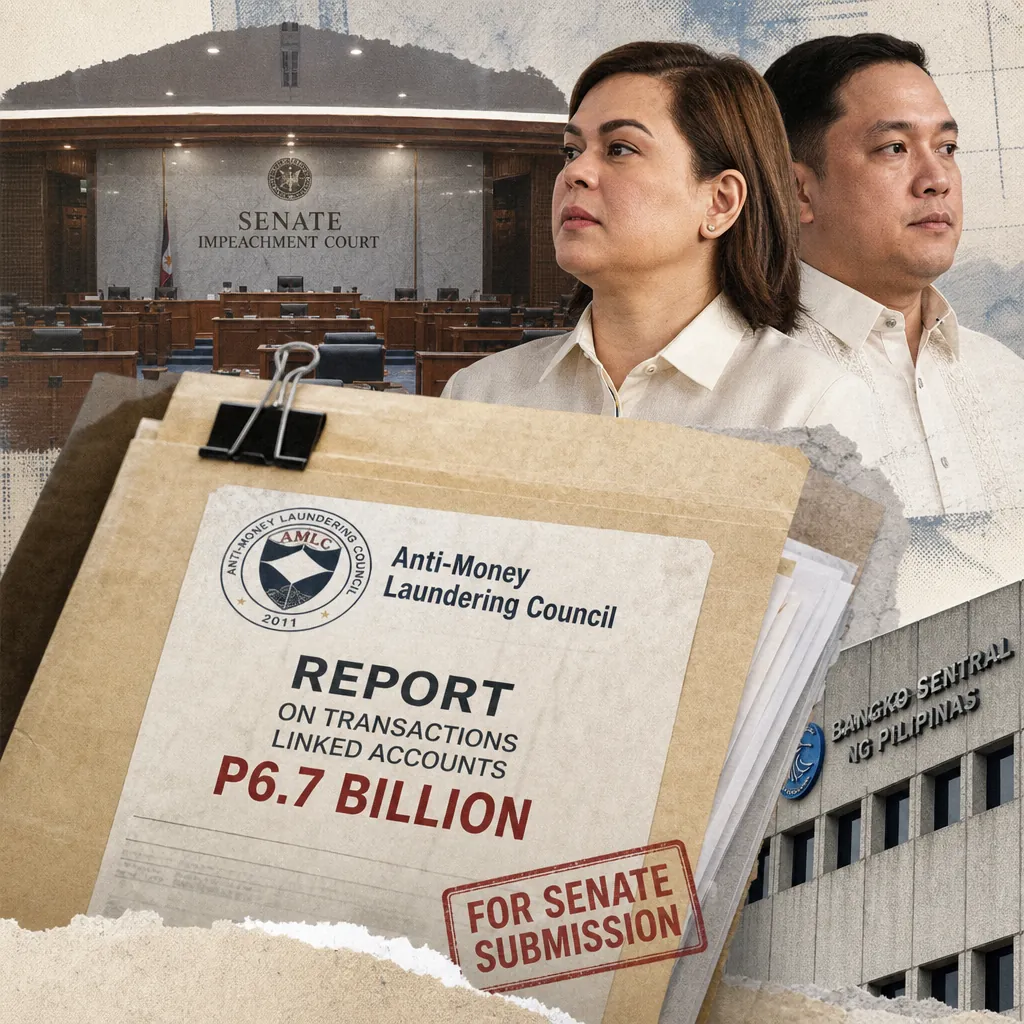
The Anti-Money Laundering Council (AMLC) is expected to present to the Senate impeachment court its report on P6.7 billion in transactions linked to the bank accounts of Vice President Sara Duterte and her husband, lawyer Manases Carpio, in the unexplained wealth case against her.9 The figure was announced by Bicol Saro Party-list Rep. Terry Ridon, a House prosecutor, in a Sunday interview on DZRH radio, and it was picked up across a news publisher's social channels and a political forum within the same day.913 The AMLC is the government body that investigates suspicious money movements and enforces the country's anti-money laundering law; its findings carry institutional weight that ordinary political accusations do not, which is why the story moved quickly from a lawmaker's claim to a quasi-legal proceeding.2
The engagement data shows the story was consumed very differently depending on where it landed. On Facebook, a post reporting the expected AMLC presentation drew 425 likes, 30 shares and 197 comments — but 305 of the reactions were "haha" against only 4 "angry," 19 "love," 18 "wow" and 1 "sad."2 That distribution is the day's most telling signal: an audience treating a story about P6.7 billion in unexplained wealth transactions as mockery rather than outrage. On Twitter, the same storyline reached 3,553 views on the initial breaking-news post but converted to only 54 likes and 9 shares, and a follow-up identifying the AMLC reached 1,501 views with just 2 likes and 1 share — high visibility, low amplification.1 On Reddit, a post crediting Ridon for the confirmation claim drew 114 upvotes and 15 comments, a higher engagement-to-reach ratio than any other platform that day.3
The news coverage that accompanied the social conversation added detail the posts did not carry. Prosecutors have more than 1,800 bank, tax and financial documents covering Duterte, her husband and the companies linked to them, and they plan to narrow their presentation to key reports to avoid dragging the trial beyond the year.36 The first witnesses expected to appear include retired Sandiganbayan Presiding Justice Amparo Cabotaje-Tang, an official from the Office of the Ombudsman's records division, and a director from the Securities and Exchange Commission's company registration and monitoring department.76 Ridon also argued that the constitutional protection against self-incrimination, which Duterte has invoked to refuse attending her trial, would not necessarily shield her husband if prosecutors call him to explain financial records.6 The coverage of the AMLC story across the items captured here carried substantial advertising-equivalent value — the estimated cost of buying the same space as paid advertising — with the Inquirer's report on Ridon's challenge to Duterte alone valued at ₱268,380 and the AMLC confirmation story at ₱225,288.89
Key themes
- AMLC report framed as confirmation before it is presented. Rep. Terry Ridon's statement that the AMLC report "will confirm" the P6.7 billion in transactions set the expectation ahead of the evidence, and that framing was repeated almost verbatim across Twitter, Facebook and Reddit.123 The AMLC itself has not publicly released the report.
- Facebook reaction data shows mockery, not civic anger. A post about P6.7 billion in unexplained wealth transactions drew 305 "haha" reactions against 4 "angry" reactions, a ratio that indicates the dominant audience response was derision rather than concern.2 This matters because delegitimizing frames do not generate the corrective pressure that outrage frames do.
- Prosecution has 1,800+ documents and plans a narrow presentation. Ridon said prosecutors must be "very precise" with witnesses and documents because presenting all the bank, tax and corporate records would take months of trial time.36 The first three witnesses are a retired Sandiganbayan presiding justice, an Ombudsman records official and an SEC registration director.76
- Self-incrimination protection may not extend to Carpio. Ridon argued that if Duterte insists on her right against self-incrimination, her husband cannot necessarily raise the same point if called to explain financial records.6 Prosecutors have said they are considering Carpio as a possible hostile witness.
- Current account deficit widened 51.7% to $15.44 billion in H1. The Bangko Sentral ng Pilipinas (BSP) reported that the gap between what the country earned and spent on foreign goods, services and transfers grew from $10.18 billion in the same period last year, driven by imports growing faster than exports.1041 The deficit was equivalent to 5.6% of gross national income, up from 3.7% a year earlier.10
- External debt hit a record $154.93 billion at end-June. The National Government's global bond issuances and loan availments drove the 4.1% year-on-year increase from $148.87 billion, and the debt rose to 31.6% of GDP from 30% the previous quarter.5075 The BSP said repayment capacity remained adequate.
- Peso is the weakest currency in ASEAN-6, down 5.9% year to date. DBS Bank reported the depreciation, compared with the Indonesian rupiah's 4.8% fall and the Thai baht's 4.2% drop, as surging oil prices and dampened investor appetite for Philippine assets weighed on the currency.77
- BSP profit more than doubled to P53.8 billion on forex gains. Net income in the first two months of 2026 rose 128.9% from P23.5 billion a year earlier, driven mainly by P45.2 billion in realized foreign-exchange gains, even as total revenue fell 13% to P33.5 billion.2782
How the narratives stack
Dominant: The AMLC report on the P6.7 billion in Duterte-Carpio transactions dominated the day's conversation across every platform captured. It was the only story that generated simultaneous activity on Twitter, Facebook and Reddit, and it produced the single highest-engagement post of the day — the Facebook news share with 425 likes, 30 shares and 197 comments.2 Within the captured set, the news coverage of this story was also the most heavily covered, with multiple Inquirer items, a Philstar report and a BusinessMirror story all addressing the impeachment proceedings and the AMLC report.97445 The dominance is a property of the items gathered here; the monitoring scope shapes what appears.
Counter-narrative: The Facebook reaction data carries a counter-narrative that the headlines do not. While the news framing presented the AMLC report as a decisive evidentiary development, the audience response — 305 "haha" reactions against 4 "angry" — suggests a significant segment consumed the story as political theater rather than accountability.2 This is not a counter-narrative in the sense of an opposing factual claim; it is a divergence between how the story was framed by media and how it was received by the public. The absence of any visible skeptical pushback on the AMLC report's substance or timing in the captured data is itself notable.2
Emerging: The broader economic picture formed a second narrative layer that ran alongside the political story. The BSP's reports on the widening current account deficit, record external debt and the peso's weakness as the worst-performing currency in ASEAN-6 all pointed to mounting external pressures.105077 Analysts quoted in the coverage linked these to elevated oil prices from the Middle East conflict and slowing remittance growth.30 The BSP also hinted it could begin easing policy in 2027 if inflation falls faster than expected, even as it kept further rate hikes on the table for 2026.33 This economic storyline was covered extensively in the business press but generated no comparable social engagement.
Under-covered: Several stories in the captured set received minimal attention relative to their potential significance. The Financial Action Task Force's new red-flag indicators for money laundering in gaming operations — covering complex cross-border ownership structures and the rapid expansion of online gambling — appeared in a single BusinessMirror report with no follow-up.47 The higher capital requirement for stockbrokers, which brokerage executives said could prompt consolidation or exits, was covered once.48 The ASEAN Digital Economy Framework Agreement, which President Marcos highlighted in his state of the nation address as part of the country's response to economic shocks, drew one analytical piece on the need to strengthen supply chains.15 These stories placed low in the day's conversation but carry implications for the sectors they touch.
Platform insights
- Facebook: The platform was the engagement layer, where the AMLC post's 425 likes, 30 shares and 197 comments dwarfed Twitter's interaction volume despite a much smaller apparent reach.2 The reaction mix — 305 "haha" against 4 "angry" — turned the story into a participatory spectacle rather than a policy discussion. The comment volume indicates active participation, but the emotional register was mockery, not concern.
- Twitter: The platform functioned as the distribution layer, with the initial breaking-news post reaching 3,553 views but converting to only 54 likes and 9 shares, and the AMLC-specific tweet reaching 1,501 views with just 2 likes and 1 share.1 The audience consumed the headline without amplifying it, a pattern consistent with broadcast-mode consumption rather than community engagement.
- Reddit: The platform hosted the most concentrated discussion relative to its reach, with 15 comments on a single post and a 114-upvote approval rate that signaled community-level acceptance of the Ridon framing without the emotional volatility seen on Facebook.3 The thread format suggests deeper examination of regulatory and compliance angles than character-limited platforms allow.
Key voices and communities
House prosecutors led by Rep. Terry Ridon. Ridon, a Bicol Saro Party-list representative, was the single most consistent voice across all platforms, anchoring both the original tweet and the Reddit post title.13 He co-leads the prosecution of the second impeachment article with Akbayan Party-list Rep. Chel Diokno.8 His framing — that the AMLC report "will confirm" the transactions — set the expectation ahead of the evidence and created a verification gap that will matter if the formal presentation does not match the pre-announced figure.9
Financial sector observers and analysts. This group, more active on Reddit and Twitter, focused on the institutional and regulatory implications of the AMLC report — particularly how it may affect banking sector compliance expectations and whether the transactions were properly flagged by covered institutions.3 Their interpretation of AMLC enforcement trends can influence market expectations around compliance costs and reputational exposure.
News media and amplification networks. Media organizations served as the primary content originators, with political news reports seeding downstream engagement across platforms.2 The convergence of mainstream and alternative outlets on similar framing reduced narrative fragmentation, making the core message more durable.2
Engaged citizens and political publics. Rank-and-file social media users constituted the largest volume of engagement, with the dominant tone leaning toward skepticism and partisan derision as evidenced by the disproportionate use of the "haha" reaction.2 Their propensity for satirical engagement may mask genuine concerns that could surface in different forms, such as distrust in banking institutions or regulatory bodies.
Economic analysts and central bank watchers. A separate community engaged with the BSP's reports on the current account deficit, external debt and monetary policy outlook, with analysts from Pantheon Macroeconomics, Moody's Analytics and Oxford Economics providing commentary on the country's external position and the central bank's forward guidance.3063
Narrative streams
AMLC report on P6.7 billion in Duterte-Carpio transactions
The AMLC is expected to present to the Senate impeachment court its report on P6.7 billion in aggregate transactions linked to the bank accounts of Vice President Sara Duterte and her husband, Manases Carpio, under Article II of the impeachment complaint, which accuses Duterte of unexplained wealth and inaccurate asset declarations.974 The figure represents aggregated transactions over the years and is not by itself equivalent to the couple's net worth, making the underlying bank records important to establishing what the transactions actually represent.74 Of the P6.7 billion, P4.4 billion was in inflows involving the couple.9
Ridon announced the expected presentation in a Sunday interview on DZRH radio, saying the revelation is not covered by the sub judice rule — a legal principle that restricts public comment on ongoing judicial proceedings — because the figures had already been mentioned during House proceedings on Duterte's impeachment.9 The AMLC report was previously discussed during those House proceedings, which is how the P6.7 billion and P4.4 billion figures entered the public record.9
Prosecutors have more than 1,800 bank, tax and relevant financial documents covering Duterte, her husband and the companies linked to them, according to Ridon.36 He said the presentation must be "very precise" because "there are really a lot of documents being discussed," and that presenting all of them could take months of trial time.36 The first three witnesses expected to appear are retired Sandiganbayan Presiding Justice Amparo Cabotaje-Tang, Atty. Karen Batu of the Office of the Ombudsman's records division, and Atty. Gerardo del Rosario, director of the SEC's company registration and monitoring department.76
For banks, the operative risk is that any coverage drifting from "AMLC process" toward "which banks handled these accounts" pulls reputational exposure into their lane. The AMLC reporting obligations apply uniformly across institutions, and the system functions as designed — but that framing only holds if no covered bank is subsequently named in connection with the accounts. The story is best understood as a slow-bleed threat rather than a spike event: the transaction figure is large enough to anchor headlines, and the involvement of an impeachment court gives the story institutional legitimacy that sustains coverage cycles longer than the initial news day.1
Prosecution strategy and the self-incrimination question
Ridon challenged Duterte to attend her impeachment trial on Monday as prosecutors began presenting evidence on her alleged unexplained wealth, saying she should have no reason to stay away if she believed there was no evidence against her.8 Duterte had claimed Friday that the impeachment case against her lacked evidence and accused her opponents of using Congress to build a case for her removal.8
Ridon also offered a legal view on the self-incrimination question: the constitutional protection against self-incrimination, which Duterte has been invoking for refusing to attend her Senate impeachment trial, will not necessarily allow her husband to take the same position if prosecutors call him to explain financial records.6 "So, if the vice president, for example, will insist on her right against self-incrimination, I don't think Attorney Carpio can actually raise that same particular point," Ridon said during the "Saturday News Forum" in Quezon City.6 His position adds a legal dimension to the prosecution's earlier disclosure that it is considering Carpio as a possible hostile witness under the second impeachment article.6
Former Rep. Robert Ace Barbers, House prosecution adviser and spokesperson, said corporate earnings and property acquisitions linked to Duterte and Carpio will be checked against Duterte's statements of assets, liabilities and net worth (SALN) — the annual declaration of a public official's assets, liabilities and net worth required by the Constitution.4 The SEC is among the government agencies whose records will figure in the evidence presentation for the second impeachment article, and the prosecution has lined up an SEC official to authenticate corporate documents.4
For government-sector stakeholders, the Senate impeachment court setting means the story will be refreshed each time the AMLC report is formally presented or referenced in proceedings. The practical implication is that monitoring should be indexed to the legislative calendar rather than to organic social activity alone.2
External accounts deteriorate as oil prices and peso weakness bite
The BSP reported that the current account deficit widened by 51.7% to $15.44 billion in the first half of 2026 from $10.18 billion in the same period last year, driven mainly by a larger trade-in-goods deficit as imports grew faster than exports.1041 The current account covers the Philippines' transactions with the rest of the world involving goods and services, income earned from and paid to other countries, and transfers such as remittances and grants.10 It was equivalent to 5.6% of gross national income in January to June, compared with 3.7% a year earlier.10 Historical data showed the current account has been in deficit for five consecutive years and 22 consecutive quarters since the fourth quarter of 2020.41
Separately, the country's outstanding external debt — borrowings owed by Philippine residents to creditors abroad — climbed to a record $154.93 billion at end-June 2026 from $148.87 billion a year earlier, driven by the National Government's global bond issuances and loan availments for budgetary and development financing.50 External debt rose to 31.6% of GDP from 30% in the previous quarter as foreign obligations expanded faster than economic output.44 The BSP said the country retained sufficient foreign-exchange buffers to meet near-term obligations, and its liquidity and solvency indicators showed repayment capacity remained adequate.44
The peso depreciated by 5.9% year to date, making it the weakest-performing currency among the ASEAN-6 economies, according to DBS Bank.77 The Indonesian rupiah fell 4.8% and the Thai baht dropped 4.2%, while the Singapore dollar appreciated 1.7%.77 Miguel Chanco, chief Emerging Asia economist at Pantheon Macroeconomics, said the current account deficit may reach around -4.0% of GDP this year, blaming the jump in oil prices since the Iran war started and slowing remittance growth.30
For households and businesses, the relevant risk is that a sustained rise in external debt and a widening current account gap could leave the economy more exposed to exchange-rate swings and external financial shocks. Sustained import demand, particularly for fuel and production inputs, can increase exposure to global energy-price shocks, while services exports, tourism receipts and remittances remain important sources of foreign exchange.51
BSP holds the line on rates while hinting at 2027 easing
The BSP kept further rate hikes on the table amid lingering price pressures but hinted it could begin easing next year if inflation falls faster than expected.33 In its August Monetary Policy Report, the central bank said its "low-inflation scenario," where inflation falls below its central projections, could create room for policy rate cuts to support economic growth.33 "Some policy tightening in 2026 is still necessary to contain high inflation, although a policy reversal in 2027 could become possible in response to weakening economic prospects," the BSP said.33 Under this scenario, inflation will move closer to its 3% target by the second quarter of next year.33 The BSP's central projections show inflation could breach its target for three straight years at 6.1% this year, 5.4% in 2027 and 3.3% in 2028.33
Sarah Tan, assistant director and economist at Moody's Analytics, said the BSP should continue to take a medium-term, data-dependent approach, "recognizing that monetary policy is less effective in addressing temporary, supply-driven inflation shocks."63 Jun Hao Ng, assistant economist at Oxford Economics, said the central bank must maintain transparency and clarity in conveying its policy stance as this contributes to credibility, which influences consumer and business expectations.63
The BSP's own finances reflected the volatile environment. Its net income more than doubled to P53.8 billion in the first two months of 2026 from P23.5 billion a year earlier, driven mainly by P45.2 billion in realized foreign-exchange gains — earnings from exchange-rate fluctuations during the execution and settlement of its foreign-currency-denominated transactions.2782 Total revenue fell 13% to P33.5 billion, with interest income declining 16% to P31.5 billion, while total expenses dropped 32.7% to P24.9 billion.27
For businesses and consumers, the BSP's stance means borrowing costs are likely to stay elevated through 2026, with the possibility of relief in 2027 if inflation cooperates. The central bank's credibility in communicating its policy path matters because it shapes expectations that feed into wage and pricing decisions across the economy.63
Banks hold steady amid shocks, but property exposure stays low
Philippine banks are well positioned to deal with challenging macroeconomic conditions, armed with ample risk buffers to help them deal with slower loan demand, potential loan losses and higher credit costs, according to a BSP presentation to Congress in August.62 Banks' assets grew by 10.3% as of June, deposits rose 8.3%, and the sector's combined profit was up 5.2% in the first semester.62 The BSP said the banking system is supported by strong fundamentals despite a corruption scandal late last year that soured sentiment and choked public and private investment, and hostilities in the Middle East that led to a global energy shock.62
Banks' exposure to the real estate sector slid to its lowest in nearly seven years at the end of June, with the real estate exposure ratio falling to 18.72%.29 Marco Antonio C. Agonia, an economist at the University of Asia and the Pacific, said banks' real estate exposure will hover around current levels for the rest of the year due to ongoing challenges for the real estate market and somewhat stronger credit appetite in other sectors.29 "Cautious developer sentiment, weak mid-market condo demand, elevated construction costs, and tight financing conditions may keep real estate exposure at similar levels for the foreseeable future," he said.29
Property consultants said industrial assets and regional housing are key growth areas as tighter lending standards and selective buyer demand weigh on the broader residential market. Claro Cordero Jr., director for research at Cushman & Wakefield Philippines, said demand remains firm among end-users with both the conviction to buy and access to financing but is thinning in other segments.64 "That is actually a healthier signal. Price growth anchored in genuine occupier demand tends to be far more durable than growth fueled by cheap credit and investor churn," he said.64
For banks, the combination of strong buffers and low property exposure means the sector is positioned to absorb shocks, but the shift toward quality-focused lending also means less credit is flowing to speculative or overly leveraged ventures — a change that affects developers reliant on bank financing for mid-market condominium projects.29
Capital markets activity: IPOs, higher broker capital and new REIT rules
Cebu-based Aznar Shipping Corp. filed a registration statement with the SEC for an initial public offering of up to 1 billion primary common shares at an indicative maximum price of P0.67 each, plus an overallotment option of up to 100 million secondary shares, bringing the potential total offer size to P737 million.59 The company plans to use the proceeds to expand its fleet and shipyard facilities as roll-on/roll-off traffic in the Visayas is projected to grow faster than the national rate.59 "As economic activity across the Visayas continues to grow, we want Aznar Shipping to grow with the region," said President and CEO Kyle Alexander C. Aznar.59 The offer period is scheduled for Dec. 1-8, with listing on the Philippine Stock Exchange's SME Board by Dec. 18.13
The IPO of Mynt Inc., the operator of GCash, could find a more balanced valuation at P8 per share, while a price closer to the P10 ceiling would require stronger confidence in the fintech giant's earnings growth, analysts said.19 Ron Acoba, chief investment strategist at Trading Edge, said P8 per share represented a more balanced entry point as Mynt's earnings growth began to normalize.19 At P8 apiece, Mynt would trade at around 24.7 times annualized 2026 earnings.19 Mynt's net income climbed from P6.38 billion in 2023 to P17.25 billion in 2025, but the momentum of earnings growth has moderated.19
Higher capital requirements for stockbrokers may prompt some firms to reassess their business models, including whether to raise additional capital, pursue consolidation or continue operating, brokerage executives said.48 Maria Concepcion Y. Fernandez, president of Unicapital Securities Inc., said smaller or lower-volume brokerages may need to evaluate their long-term business models if capital requirements are raised.48 COL Financial Group Inc. Chairman Edward K. Lee said some brokers could decide to discontinue operations.48
The Philippine Stock Exchange, in partnership with the Financial Executives Institute of the Philippines and the Investment House Association of the Philippines, hosted a briefing on the new REIT framework under SEC Memorandum Circular No. 1, Series of 2026, which broadens the Philippine Real Estate Investment Trust landscape by modernizing eligible asset classes and adding structural flexibilities.65 A REIT is a company that owns income-generating real estate and distributes most of its earnings to investors as dividends, giving ordinary investors a way to hold property without buying it directly.
For retail investors, the expansion of digital platforms is widening access to capital markets. Arthaland Corp.'s upcoming Series G and H preferred share offering, priced at P500 each with dividend rates of 7.3260% and 7.8105% per annum respectively, can be accessed through GStocks PH, offered by broker AB Capital Securities Inc. in the GCash app.18 Preferred shares typically pay fixed dividends and give holders priority over common shareholders in receiving dividends.18
Digital payments expand as Maya enables tap-to-pay on wallet cards
Filipinos holding Maya wallet cards can now tap their phones to pay at stores, on public transport and at tourist sites after Visa Inc. and Maya enabled the cards for Google Wallet and Google Pay.40 The rollout means Google Pay is now available across the entire Maya Visa portfolio — credit and wallet, physical and virtual — closing the gap left by the earlier phase of the partnership that began in November 2025 for credit cardholders.40 The transactions run on Visa's tokenization technology, which replaces actual card numbers with unique digital tokens.40
Pay&Go marked its 11th anniversary, operating more than 4,500 self-service payment kiosks nationwide that allow users to cash in and cash out, pay bills, purchase e-load and access other services.66 This year, Pay&Go rolled out its Cash Out service, expanding the function of its kiosks beyond payments and cash-in transactions.66
For consumers, the expansion of contactless payments and self-service kiosks means more ways to transact without carrying cash or visiting a bank branch. For merchants, the widening base of users who can pay digitally nudges them toward accepting digital payments, which reduces the cost of handling cash but requires investment in payment terminals and staff training.40
Investment promotion and trade logistics
The Philippine Economic Zone Authority (PEZA) is confident of exceeding its P300-billion investment approvals target this year amid growing interest from Japanese and Chinese investors, with approvals as of end-August nearly three-fourths of the full-year target.39 PEZA Director-General Tereso O. Panga said the agency could breach its historical high of P312 billion in 2012.39 "We're getting a lot of heightened interest, because this time, not only are investors coming from China, there's also from Taiwan," he said.39 PEZA is the government agency that administers special economic zones — designated areas where businesses receive tax incentives and streamlined regulations to attract investment.
The Bureau of Customs, the Association of International Shipping Lines Inc. and the World Shipping Council held a dialogue-conference on the Draft 2026 Joint Administrative Order, seeking policies that are balanced, practical and responsive to Philippine trade.17 The conference brought together senior customs officials, a Department of Finance representative, and executives from shipping lines including MSC, Maersk, CMA CGM, ONE, Evergreen, PIL, RCL, Fesco and Kanway Lines.17
A World Trade Organization review noted that trade in goods and services generally represented more than 60% of GDP during 2018-2025, and the average wage for workers in export-oriented sectors in 2024 exceeded the national average by at least 50%.57 However, the Philippines faces high trade costs, particularly in logistics, estimated to account for 27% of retail prices, with trade costs 20% higher than the ASEAN average due to inadequate infrastructure and regulatory inefficiencies.57
For businesses dependent on imports and exports, the combination of high logistics costs and regulatory uncertainty remains a barrier to competitiveness. The government's push to attract foreign investment hinges on addressing these bottlenecks, as Trade Secretary Maria Cristina A. Roque said the country is positioning itself as the region's premier hub for globally competitive, innovative and sustainability-driven industries.55
Consumer spending shifts toward essentials as inflation persists
Filipino households are focusing on essentials, seeking better value and cutting discretionary purchases as higher prices, elevated borrowing costs and economic uncertainty force changes in spending behavior, according to TransUnion's Q2 2026 Consumer Pulse Study.61 The study found that 74% of Filipinos expect their income to improve over the next 12 months, but 55% reported cutting discretionary spending.61 "Filipino households are entering the second half of the year optimistic but clear-eyed," said Weihan Sun, senior director of research and consulting for Asia-Pacific at TransUnion.61
For consumer-facing businesses, the shift toward essentials and value-seeking means discretionary categories — dining out, entertainment, non-essential retail — face continued pressure. The optimism about future income suggests households are not in distress but are managing budgets carefully, which means businesses that offer clear value and essential goods are better positioned than those reliant on discretionary spending.61
AI governance and cybersecurity concerns
Think tank Stratbase Institute urged the government to strengthen its cybersecurity amid cyberattacks, saying concerned agencies must coordinate to properly implement the country's first artificial intelligence governance framework.52 The Department of Economy, Planning and Development recently announced it is eyeing to release the framework this September after presenting the final plan to President Ferdinand Marcos Jr.52 Stratbase said the framework is a "timely and important step" that can provide government agencies "with a common direction for using AI while protecting rights, maintaining human oversight and ensuring accountability."52
The AI governance discussion also played out globally. Anthropic CEO Dario Amodei called on artificial intelligence firms to slow down the development of the technology, amid mounting worries over the risks of "superintelligent" computer systems.65 His comments came after AI researcher Jacob Coxon left the industry, accusing US companies of "gambling with our lives" in the race to develop models capable of self-improvement.65 OpenAI boss Sam Altman and Elon Musk, who owns xAI, quickly chimed in to say they agreed with Amodei's assessment.65 US President Donald Trump dismissed the calls, saying the United States is leading China in AI and that "negative forces" should not be raising such concerns.72
For Philippine businesses and government agencies, the AI governance framework will set the rules for how artificial intelligence can be used in public services and regulated industries. The cybersecurity concerns raised by Stratbase point to the need for coordination across agencies, as cyberattacks can target both government systems and private companies.52
FATF red flags for gaming money laundering
The Financial Action Task Force, the Paris-based global standard-setter for anti-money laundering rules, identified red-flag indicators to guide regulators in monitoring suspicious money transactions in gambling operations.47 In a report titled "Risks of Gaming and Gambling," the FATF said gaming and gambling "had become part of a broader, interconnected value-transfer ecosystem involving numerous participants, some of which sit outside national anti-money laundering and counter-terrorist financing frameworks."47 The red flags include complex and often cross-border platform ownership structures that obscure beneficial ownership.47 The rapid expansion of online gambling, digital payments and cross-border platforms is changing the illicit-finance risks facing the global gaming industry, with casinos and sports betting remaining particularly exposed to money laundering.47
For Philippine regulators and gaming operators, the FATF guidance adds pressure to strengthen monitoring of money flows through casinos and online betting platforms. The Philippines has a significant gaming industry, and any perception that it is not adequately policing money laundering could affect its standing with the FATF, which assesses countries' compliance with anti-money laundering standards.47
Conversation trajectory
AMLC report presentation before the Senate impeachment court (observation window: 48-72 hours). The formal submission or testimony is the single largest narrative trigger. If the report's contents match the pre-announced P6.7 billion figure and scope, the story will consolidate around the prosecution's framing. If the formal presentation does not match, expect a sharp counter-narrative cycle. The first 48-72 hours after presentation will be a period of maximum narrative fluidity where early framing hardens quickly.3
Any statement or denial from the named parties or their counsel (observation window: 1-2 weeks). A response from Duterte or Carpio would open a competing narrative track and likely double conversation volume. The self-incrimination question raised by Ridon suggests the legal strategy on the defense side is still developing.6
Follow-on reporting that names specific banks, accounts or transaction channels (observation window: 2 weeks). This is the highest-priority risk signal for banking clients. If any covered institution is named in connection with the accounts, the story shifts from political controversy to direct institutional exposure. Media queries attempting to localize the story by asking which institutions processed the transactions should be anticipated.1
BSP policy meeting and inflation data releases (observation window: next scheduled releases). The BSP's next policy decision and the release of inflation data for the coming months will test whether the central bank's projections hold. If inflation falls faster than expected, the possibility of a 2027 policy reversal becomes more concrete.33
US Federal Reserve policy decision on Sept. 15-16 (observation window: this week). Futures markets priced in roughly a 55-60% probability of a policy rate hike at the upcoming FOMC meeting, driven by elevated US yields and hawkish central bank commentary.83 A hike would exacerbate capital outflows from emerging markets and add pressure on the peso, limiting the BSP's room to maneuver.83
GCash IPO pricing announcement (observation window: coming weeks). The final price for Mynt's initial public offering will signal investor confidence in the Philippine fintech sector. A price at the lower end of the P8-P10 range would suggest caution about earnings growth; a price closer to P10 would indicate stronger confidence.19
Aznar Shipping IPO offer period and listing (observation window: Dec. 1-18). The offer period runs Dec. 1-8, with listing on the PSE's SME Board by Dec. 18. The reception of this IPO will indicate appetite for smaller regional listings.13
Response guidance
Banking sector communications teams: prepare holding statements on AMLC-related inquiries now. The first mover among covered institutions will set the tone others are measured against, and late or evasive responses in a Senate-adjacent story carry outsized reputational cost. Holding statements should affirm compliance with AMLC reporting requirements without commenting on specific accounts or customers.1
Monitor for any mention of client institution names in transaction-chain reporting. The reputational risk for bank clients materializes only at the moment of naming. Monitoring should be indexed to the impeachment court calendar and to any mention of specific covered institutions, not organized around topic alone.2
Avoid earnest-sounding defenses of the anti-money laundering framework in venues where the dominant mode is ridicule. The dismissive reception pattern on Facebook suggests that technical defenses will be repurposed as evidence of deflection rather than absorbed as reassurance. Maintain a passive monitoring posture on political impeachment content unless directly named.2
Prepare FAQ-style internal briefings for client PR teams on AML compliance, bank secrecy and disclosure limits. Financial institutions cannot confirm or deny specific account details regardless of public speculation, and messaging should emphasize legal constraints on disclosure rather than appearing evasive or defensive.3
For government-sector stakeholders, monitor how institutional credibility framing around the AMLC develops. The AMLC's institutional credibility — not just the political figures — is now entering the reputational frame, and any perception of politicization at the Council could spill over into coverage of anti-money laundering enforcement more broadly.1
For businesses with exposure to oil prices and foreign exchange, prepare for continued cost pressure. The peso's weakness and elevated oil prices are feeding into import costs and domestic prices. Companies reliant on imported inputs should factor continued currency and energy volatility into their planning.7730
For consumer-facing businesses, adjust to the shift toward essentials and value-seeking. The TransUnion study found 55% of Filipinos cutting discretionary spending. Businesses in discretionary categories should emphasize value and essential positioning rather than premium offerings.61
For fintech and digital payments companies, the expansion of contactless payments and self-service kiosks represents an opportunity to reach unbanked and underbanked consumers. The Maya-Visa rollout and Pay&Go's kiosk network both expand access to digital financial services. Companies should ensure their communications emphasize the convenience and security of these channels.4066
For companies in the gaming sector, review anti-money laundering controls against the FATF's new red-flag indicators. The guidance on complex cross-border ownership structures and online gambling risks adds pressure to strengthen monitoring. Proactive compliance messaging can help mitigate reputational risk.47
See the full picture behind today's signals.
This report draws from Media Meter's MediaWatch, our real-time monitoring engine tracking 2,470+ Philippine sources across print, broadcast, digital, and social. Explore how the platform turns raw coverage into decision-grade intelligence, then see how it's configured for teams like yours — whether you're in PR agencies, corporate comms, government, or marketing.
Want more? Browse our Report Library for sector and crisis intelligence, or request a demo and we'll have your brand set up before the call.
Want this kind of intelligence on your brand?
This brief is built on the same MediaWatch methodology that runs continuously across every brand we monitor. See your competitive landscape, Impact Score, and narrative trajectory in a 30-minute demo.