Carpio Complaint Dismissed as Bank Records Enter Trial
Quezon City prosecutors dismissed Manases Carpio's complaint over the release of his and Vice President Sara Duterte's bank records, clearing the way for the House prosecution to present 1,800-plus financial documents and up to 25 witnesses starting September 14. The BSP separately told banks to prepare for a 2027 international anti-money-laundering evaluation.
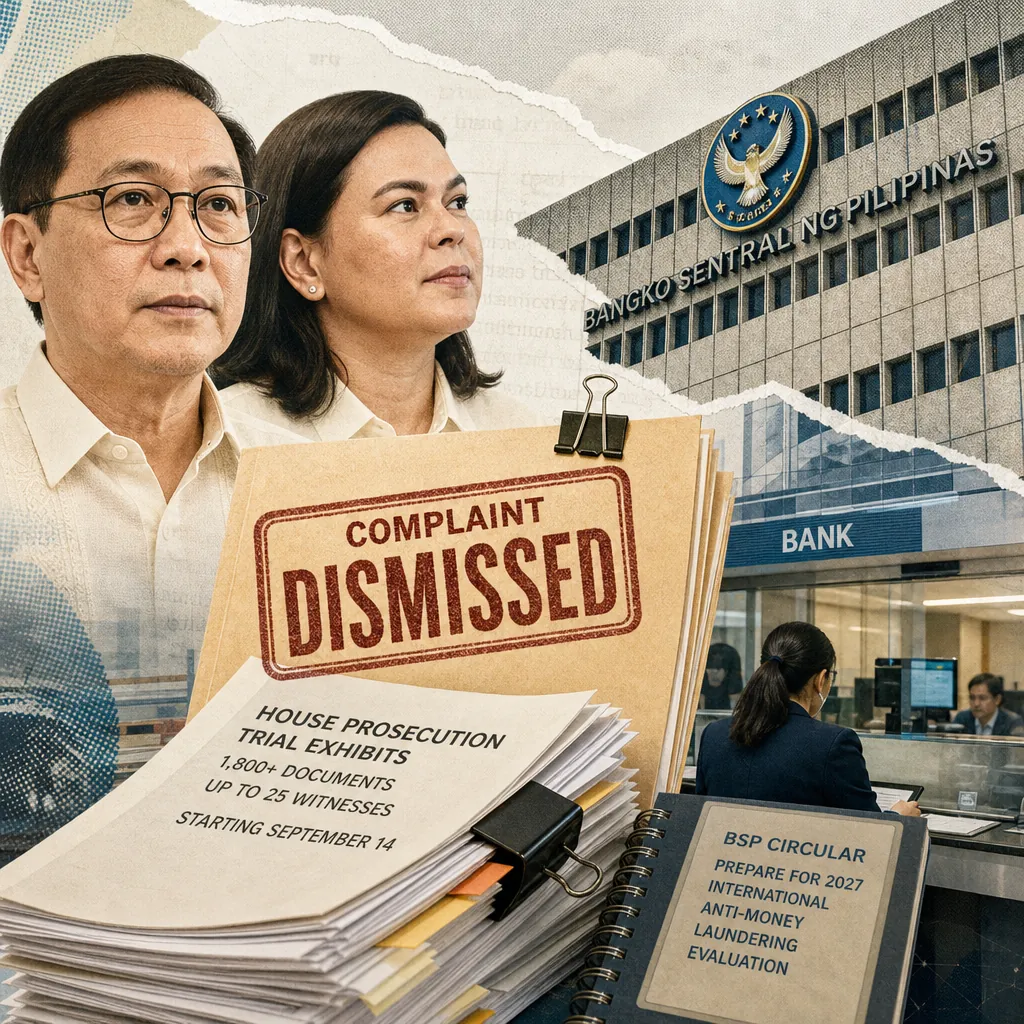
The Quezon City Prosecutor's Office recommended the dismissal of the complaint filed by Manases "Mans" Carpio, the husband of Vice President Sara Duterte, over the release of the couple's bank records — a decision that removes the last procedural obstacle before the House prosecution begins presenting financial evidence in her impeachment trial on September 14.712 The 23-page resolution, dated September 7, held that the acts complained of — the House subpoena for Anti-Money Laundering Council reports and the lawmakers' statements during the impeachment proceedings — were performed in connection with the respondents' official duties and "are not inherently immoral."12 The prosecutor's office said it had no jurisdiction because the respondents are public officials holding Salary Grade 28 or higher, and that the proper forum is the Office of the Ombudsman.26
Carpio's lawyer, Atty. Peter Paul Danao, said the dismissal was "without prejudice," meaning it did not resolve the allegations on their merits, and that the camp was still awaiting the official copy of the resolution before deciding its next legal move.7 House prosecutors welcomed the outcome. Manila 3rd District Rep. Joel Chua, a member of the prosecution panel, said the timing was opportune because the panel is shifting to Article II of the impeachment complaint, which covers the allegation of unexplained wealth.20 Rep. Terry Ridon called the complaint baseless and part of a pattern of harassment against legislators carrying out the impeachment proceedings.20
The decision landed on the same day the prosecution disclosed the shape of its coming case. Chua said the panel is preparing to present more than 1,800 financial documents and up to 25 witnesses, a lineup that could shrink to about 10 if the defense agrees to stipulate the authenticity of the records.24 Among the potential witnesses are former senator Antonio Trillanes IV, who first publicized allegations about the Duterte family's bank accounts, and Ombudsman Jesus Crispin Remulla.1666 Officials from the Anti-Money Laundering Council, the Bureau of Internal Revenue, the Securities and Exchange Commission and several banks are also on the list.24 Chua said 15 bank accounts belonging to Duterte and Carpio "matched" the details the AMLC had identified.10
Key themes
- A prosecutor's office declines jurisdiction over a bank-secrecy complaint against lawmakers. The Quezon City Prosecutor's Office said the respondents' acts were tied to their official duties and that the case belongs before the Ombudsman, dismissing Carpio's complaint without resolving its merits.1226 The ruling means the bank records at the center of the dispute stay in the impeachment record.
- The prosecution will present more than 1,800 financial documents starting September 14. House prosecutors are moving to Article II, the unexplained-wealth charge, after finishing their presentation on the alleged misuse of confidential funds under Article I.24 Rep. Joel Chua said not all bank records will be laid out, to keep the trial from running long.16
- Fifteen bank accounts were cross-checked against AMLC records and matched. Chua said the prosecution will lean on the authenticity of the AMLC documentary evidence rather than on any single witness's testimony.10 The AMLC had earlier flagged P6.7 billion in transactions in Duterte's bank accounts.24
- The Bangko Sentral ng Pilipinas told banks to prepare for a 2027 international evaluation. In a circular dated September 2, the central bank enjoined BSP-supervised financial institutions to cooperate with the Financial Action Task Force's mutual evaluation of the Philippines' anti-money-laundering and counterterrorism financing framework.3085 The evaluation will assess both technical compliance with global standards and how effectively the measures work in practice.85
- Bad loans rose in July as borrowers fell behind on credit cards and car payments. Nonperforming loans — debts unpaid 90 days past due and at risk of default — accounted for 3.35 percent of banks' total loan portfolio, up from 3.29 percent in June, with P585 billion of the industry's P17.4-trillion loan book classified as sour.32
- BSP Governor Eli Remolona Jr. earned an "A-" grade for a third straight year. Global Finance's annual central banker report card grades governors on inflation control, growth, currency stability, interest-rate management and political independence.33 Remolona was among 15 governors to receive an "A-".29
- A state bank's P2.74-billion loan to Valencia City drew little social response. The Land Bank of the Philippines finalized the loan for a new city hall, hospital expansion, evacuation centers and equipment, but the announcement generated only 1,201 views on X and 2 likes on Facebook.284
- A personal Reddit post about a family member's unauthorized GCash use drew 13 comments. A nursing student on a mental-health break described her mother secretly linking her GCash account to an online gambling site and using about P180 without permission.1 The post raised questions about e-wallet account controls in shared households.
How the narratives stack
Dominant. The dismissal of Carpio's complaint and the prosecution's evidence plan dominated the day's coverage across the items captured here. The story ran on television and radio — GMA 7, DZMM, DZMM Teleradyo, DZRH, Net 25, UN TV — and in online news from the Philippine Star, the Inquirer, the Daily Tribune and Bombo Radyo.7121620242635 The coverage carried substantial advertising-equivalent value: the Philippine Star's report on the 15 matched accounts was valued at an estimated P434,291 in ad space, and the Inquirer's report on the prosecution's evidence and witnesses at P595,728.1024 On social media, the Facebook post on the dismissal drew 38 likes, 6 love reactions, 12 "haha" reactions and 1 angry reaction, while the Senate's photo documentation of the marked exhibits drew 22 likes and 17 "haha" reactions.34 The reaction pattern — more laughter than anger — suggests audiences treated the proceedings as political theater rather than a financial scandal.
Counter-narrative. The Bangko Sentral ng Pilipinas' push for banks to prepare for the 2027 mutual evaluation ran against the grain of the day's political coverage. The central bank's circular, reported by BusinessWorld and the Manila Times, framed the Philippines' anti-money-laundering regime as a matter of international standing rather than domestic politics.3085 The mutual evaluation is an in-depth assessment by the Financial Action Task Force, the global body that sets anti-money-laundering standards and can place non-compliant countries on a watchlist that raises the cost of cross-border transactions. The BSP's message to banks — cooperate fully, provide data, show that supervisory frameworks work — is a reminder that the same AMLC records at the center of the impeachment fight are also the raw material for an international assessment of the country's financial system.85
Emerging. Two consumer-finance stories surfaced in the captured set. UnionDigital Bank became the first participating financial institution to offer SSS LoanLite, a microloan program of the Social Security System, through its mobile app, with a focus on overseas Filipino workers.828 The loan is the first SSS facility for employed members that lets qualified private-sector employees apply through a bank's app without the employer certification normally required.28 Separately, EastWest Bank's financial-literacy platform held a session on responsible credit-card use, citing data showing that while 85 percent of Filipino households now have financial accounts, only 74 percent demonstrate basic financial literacy and just 30 percent have enough savings to weather a financial shock.13 Both stories point to the same gap: more people have accounts than have the knowledge or cushion to use them safely.
Under-covered. The Reddit post about the unauthorized GCash use drew only 13 comments and 1 like, and no news outlet in the captured set picked it up.1 The story is small in volume but specific in detail: a family member connected the poster's GCash account to an online gambling platform and spent about P180 without permission. The amount is trivial; the mechanism is not. It describes a category of loss — unauthorized access by someone the account holder knows — that sits outside the fraud patterns banks typically publicize, and it went unaddressed in the day's institutional coverage.
Platform insights
- Facebook. The platform carried the day's most engaged posts. The Inquirer's post on the dismissal of Carpio's complaint drew 38 likes, 6 love reactions, 12 "haha" reactions and 1 angry reaction, while the Senate Public Relations and Information Bureau's photo post of the marked financial exhibits drew 22 likes and 17 "haha" reactions.34 The "haha" reactions outnumbered the angry ones on both posts, indicating that audiences responded to the bank-record disclosures with derision rather than alarm. The LandBank loan post drew 2 likes and 1 share.2
- X (formerly Twitter). One post appeared in the captured set: the Inquirer's announcement of the Valencia City LandBank loan, which drew 1,201 views but no likes, shares or comments.2 The near-zero engagement suggests the content functioned as a public record rather than a conversation starter.
- Reddit. The r/Philippines thread on family financial obligations drew 13 comments and 1 like, an intimate advice-seeking format rather than a broad public discussion.1 The poster's question — whether she is obligated to give her earnings to her parents — anchored the thread, and the GCash detail surfaced as part of a family conflict rather than as a consumer-protection complaint.
Key voices and communities
House prosecutors. Rep. Joel Chua, Rep. Terry Ridon, Rep. Paolo Ortega V and their colleagues are driving the impeachment case and shaping how the bank records enter the public record. Chua's statements on the 15 matched accounts and the 1,800 documents set the terms of the coming hearings.1024 Ortega called the coming presentation "exciting" and "explosive."16
Carpio's legal team. Atty. Peter Paul Danao is contesting the disclosure of his client's bank records and has signaled that the camp may refile the complaint with the Ombudsman or seek reconsideration.720 His framing — that the dismissal was jurisdictional, not a ruling on the merits — keeps the legal challenge alive.
The Bangko Sentral ng Pilipinas. Governor Eli Remolona Jr. and Deputy Governor Lyn Javier are positioning the central bank as the steward of the country's anti-money-laundering compliance ahead of the 2027 mutual evaluation.293085 The BSP's circular to banks is an attempt to marshal the private sector behind a national assessment.
Financial-literacy advocates and consumer-finance providers. UnionDigital Bank, EastWest Bank and the Social Security System are addressing the gap between account ownership and financial capability through microloans and education programs.81328 Their framing — access plus knowledge — treats financial inclusion as a two-part problem.
Reddit's r/Philippines community. Young adults and students navigating family financial pressures are using the forum to negotiate obligations that have no clear institutional answer.1 The community's response to the GCash post shows how personal-finance questions get worked out in public, with the platform serving as an advice channel rather than a complaint desk.
Narrative streams
The Carpio complaint is dismissed on jurisdictional grounds
The Quezon City Prosecutor's Office recommended the dismissal of Manases Carpio's complaint against several House members and ex-officio members of the Anti-Money Laundering Council over the release of his and Vice President Sara Duterte's bank records.26 The 23-page resolution, dated September 7, said the respondents' acts — including the House subpoena for AMLC reports and statements made during the impeachment proceedings — were performed in connection with their official duties.12 Because the respondents hold Salary Grade 28 or higher, the prosecutor's office said it lacked jurisdiction and that the case should go to the Ombudsman.26 Carpio's lawyer, Atty. Peter Paul Danao, said the resolution "does not constitute a final determination on the merits of the allegations raised in the complaint" and that the camp would review its options.7 The Anti-Money Laundering Council is the government body that receives and analyzes reports of suspicious transactions from banks and other covered institutions; the Bank Secrecy Law generally prohibits the disclosure of bank deposits, with exceptions for certain legal proceedings. Carpio had accused the respondents of violating the Anti-Money Laundering Act, the Bank Secrecy Law and the Data Privacy Act.20 The dismissal means the bank records stay in the impeachment record and the prosecution can proceed. For banks named in the exhibits, the practical effect is that their client data remains part of a public political proceeding, and their compliance with lawful disclosure requests is now the subject of a prosecutor's finding rather than an open complaint.
The prosecution prepares 1,800 documents and up to 25 witnesses
House prosecutors will begin presenting evidence on Vice President Duterte's alleged unexplained wealth on September 14, shifting to Article II of the impeachment complaint after completing their presentation on the alleged misuse of confidential funds under Article I.24 Rep. Joel Chua said the panel has more than 1,800 financial documents and up to 25 potential witnesses, a number that could fall to about 10 if the defense stipulates to the authenticity of the records.24 Former senator Antonio Trillanes IV is expected to testify about his own investigation into the family's finances; Chua said Trillanes was the first to publicize evidence against the Vice President and her family.6683 Ombudsman Jesus Crispin Remulla, officials from the AMLC, the Bureau of Internal Revenue, the Securities and Exchange Commission and several banks are also on the list.24 Chua said 15 bank accounts belonging to Duterte and Carpio matched the details the AMLC had identified, and that the prosecution will rely on the authenticity of the AMLC documentary evidence rather than on any witness's word.10 The AMLC had earlier flagged P6.7 billion in transactions in Duterte's bank accounts.24 Rep. Ortega called the coming presentation "exciting" and "explosive," and urged the public to follow the hearings.16 For banks, the stream matters because their records are the evidence. Every document entered into the record carries an institution's name, and the prosecution's reliance on AMLC-certified records puts the council's data-handling and the banks' reporting systems on public display. The read for the sector: banks should expect questions about how they handle subpoenas and what they tell customers about disclosure, and they should have factual answers ready before the hearings begin.
The BSP tells banks to prepare for a 2027 international evaluation
The Bangko Sentral ng Pilipinas has enjoined BSP-supervised financial institutions to participate actively in the Financial Action Task Force's mutual evaluation of the Philippines next year.3085 In a circular dated September 2, the central bank said the institutions' data and insights will be vital to the assessment, which will examine both the country's technical compliance with global anti-money-laundering standards and the effectiveness of its measures.85 Deputy Governor Lyn Javier said the evaluation will look at how adequate the BSP's supervisory frameworks are and how well banks are implementing anti-money-laundering and counterterrorism and proliferation financing measures.30 The Financial Action Task Force is the intergovernmental body that sets global standards against money laundering and terrorist financing; a poor evaluation can lead to increased scrutiny of a country's cross-border transactions and higher compliance costs for its banks. The BSP's circular is a signal that the central bank wants the private sector to treat the evaluation as a shared national exercise. For banks, the read is that the same reporting systems that feed the AMLC's records in the impeachment case will be assessed by international evaluators, and that gaps in suspicious-transaction reporting or customer due diligence could carry consequences beyond any single political controversy.
Bad loans rise as consumers fall behind
The share of bad loans on Philippine banks' lending books rose in July, with nonperforming loans — debts unpaid 90 days past due and at risk of default — accounting for 3.35 percent of lenders' total loan portfolio, up from 3.29 percent in June.32 In peso terms, P585 billion of the industry's P17.4-trillion loan book turned sour, more than 9 percent higher than a year earlier.32 Banks slightly reduced their cushion against potential losses, setting aside nearly P541 billion in provisions for credit losses.32 The rise in bad loans points to strain among consumers, particularly on credit cards and motor vehicle payments, as inflation remains elevated. For banks, the read is that credit quality is deteriorating at the margin, and that the provisions they hold against losses will be a focus of earnings reports and regulatory reviews in the coming quarters. The story ran in the Inquirer and carried an estimated P324,324 in advertising-equivalent value.32
Remolona earns a third straight "A-" grade
Bangko Sentral ng Pilipinas Governor Eli Remolona Jr. was named one of the world's top central bank chiefs for a third consecutive year in Global Finance magazine's central banker report card, earning an "A-" grade.2933 The magazine, which has published the report annually since 1994, grades governors on inflation control, economic growth, currency stability, interest-rate management and political independence.33 Remolona was among 15 governors to receive an "A-".29 In a statement posted on Facebook, he said the recognition would "inspire us to work even harder to serve the Filipino people."29 The grade is a reputational asset for the central bank at a time when the peso has been weak and inflation has been persistent. For the sector, the read is that the BSP's leadership retains international credibility, which matters for investor confidence and for the country's standing in the 2027 mutual evaluation.
A state bank's P2.74-billion loan to Valencia City
The city government of Valencia in Bukidnon finalized a P2.74-billion loan from the Land Bank of the Philippines on Wednesday, earmarked for a new city hall, the expansion of the Valencia City Good Samaritan General Hospital, improvements to evacuation centers and community facilities, and the purchase of heavy and medical equipment.84 Mayor Amie Galario said the projects support the city's growth and its aspirations to accommodate a rising population and economy.84 The announcement was shared on X and Facebook but drew minimal engagement: 1,201 views on X with no likes or shares, and 2 likes and 1 share on Facebook.2 The low response suggests the story functioned as an institutional record rather than a conversation starter. For LandBank, the read is that development lending to local government units generates little controversy but also little visibility, and that the bank's communications will need to focus on project outcomes if it wants the work to register with the public.
A Reddit post about a family member's unauthorized GCash use
A nursing student on a mental-health break posted on r/Philippines asking whether she is obligated to give her earnings to her parents, describing how her mother secretly connected her GCash account to an online gambling site and used about P180 without permission.1 The post drew 13 comments and 1 like, an intimate advice-seeking thread rather than a broad discussion.1 The poster's question — "obligasyon ko ba talagang give them my hard-earned money?" — framed the conversation around filial obligation and financial autonomy.1 The GCash detail surfaced as part of a family conflict, not as a consumer-protection complaint, but it describes a category of loss that e-wallet providers rarely address: unauthorized access by someone the account holder knows. For digital wallet providers, the read is that account-security messaging built only around external fraud misses a real source of consumer harm, and that guidance on transaction alerts, device controls and account-sharing boundaries would reach users who are already worried about it.
UnionDigital and SSS launch a microloan through a mobile app
UnionDigital Bank, the digital banking arm of Union Bank of the Philippines, became the first participating financial institution to offer SSS LoanLite, the Social Security System's microloan program, through its mobile app.828 The program provides qualified SSS members — with a focus on overseas Filipino workers — with short-term financial assistance, and it is the first SSS loan facility for employed members that allows qualified private-sector employees to apply through a bank's app without the employer certification normally required.28 UnionDigital President and CEO Danilo "Bong" Mojica II said the product is "about giving Filipinos, especially our OFWs, a practical way to move forward when they need it most."8 The Social Security System is the state-run pension and social insurance program for private-sector workers. For banks, the read is that the digital channel is becoming the default for government-linked lending, and that institutions that integrate public programs into their apps can reach members who would otherwise not apply.
EastWest points to a financial-literacy gap
EastWest Bank's financial empowerment platform, EastWest WAIS (Wise Approach to Income and Savings), held a session on responsible credit-card use, citing data from the 2025 National Strategy for Financial Inclusion Annual Report showing that 85 percent of Filipino households now have financial accounts, but only 74 percent demonstrate basic financial literacy and just 30 percent have enough savings to weather a financial shock.13 The session focused on how credit cards work and how responsible use can turn them into financial tools rather than sources of debt.13 For banks, the read is that account ownership is no longer the binding constraint on financial inclusion; the gap is in knowledge and buffers, and institutions that address it can differentiate themselves while reducing credit risk.
Conversation trajectory
The impeachment hearings resume September 14. The prosecution will begin presenting evidence on the unexplained-wealth charge, with more than 1,800 documents and up to 25 witnesses in its lineup.24 Watch for the defense's response to the stipulation offer: if it agrees to the authenticity of the records, the witness list could shrink to about 10, which would shorten the proceedings and reduce the number of bank officials called to testify.24 Observation window: the week of September 14.
Carpio's camp may refile with the Ombudsman. His lawyer said the dismissal was without prejudice and that the camp would review the resolution before deciding its next move.7 A refiling would keep the bank-secrecy question alive and could produce another round of coverage naming the same institutions. Observation window: the next two to four weeks.
The BSP's mutual-evaluation preparation will produce more guidance. The central bank's circular asks banks to cooperate with data-gathering for the Financial Action Task Force's 2027 assessment.3085 Expect follow-up circulars, industry briefings and possibly public statements from the BSP as the evaluation approaches. Observation window: the coming months, with the evaluation itself in 2027.
Bad-loan data will be watched for a trend. The July rise in nonperforming loans to 3.35 percent of the loan book was the latest in a series of increases.32 The next monthly release from the Bangko Sentral ng Pilipinas will show whether the deterioration is accelerating. Observation window: the next BSP banking-sector data release.
Trigger events. The September 14 start of the Article II presentation is the near-term trigger for the bank-records story. The release of the next monthly nonperforming-loan data is the trigger for the credit-quality story. Any Ombudsman action on a refiled Carpio complaint would reopen the bank-secrecy question.
Response guidance
Bank communications teams: prepare factual answers on disclosure before September 14. The prosecution's evidence presentation will put bank records and AMLC-certified documents into the public record.24 Banks named in the exhibits should have clear, non-political statements ready on how they handle lawful requests from regulators and courts, and on the confidentiality obligations they owe customers. The message should be procedural: institutions comply with lawful orders within established legal frameworks, and they cannot comment on specific cases.
Digital wallet providers: address unauthorized access by known parties. The Reddit post described a family member connecting the poster's GCash account to an online gambling site and spending about P180 without permission.1 Consumer-education content on transaction alerts, device controls and account-sharing boundaries would reach users who are already worried about this category of loss. The tone should be practical rather than alarmist, and it should avoid shaming legitimate shared-use arrangements.
Banks preparing for the 2027 mutual evaluation: treat the BSP's circular as a work plan. The central bank has asked institutions to provide data and insights for the Financial Action Task Force's assessment.3085 Compliance teams should review suspicious-transaction reporting, customer due diligence and record-keeping now, and should be ready to explain how their systems work to evaluators.
Lenders watching credit quality: monitor consumer segments. The rise in nonperforming loans to 3.35 percent of the loan book was driven by credit card and motor vehicle payments.32 Banks should watch delinquency trends in those segments and be prepared to explain their provisioning decisions to investors and regulators.
Financial-literacy programs: focus on the gap between access and capability. The data cited by EastWest — 85 percent of households with accounts, 74 percent with basic financial literacy, 30 percent with enough savings for a shock — describes the market that microloans and credit products are serving.13 Programs that address budgeting, credit management and emergency savings can reduce risk while building customer relationships.
Communicators covering the impeachment: keep bank names out of political framing. The Facebook reaction pattern — more "haha" than angry reactions on the bank-record posts — suggests audiences are treating the disclosures as political theater.34 Banks should avoid any public positioning on the impeachment itself and should respond only if their specific institution is mischaracterized.
See the full picture behind today's signals.
This report draws from Media Meter's MediaWatch, our real-time monitoring engine tracking 2,470+ Philippine sources across print, broadcast, digital, and social. Explore how the platform turns raw coverage into decision-grade intelligence, then see how it's configured for teams like yours — whether you're in PR agencies, corporate comms, government, or marketing.
Want more? Browse our Report Library for sector and crisis intelligence, or request a demo and we'll have your brand set up before the call.
Want this kind of intelligence on your brand?
This brief is built on the same MediaWatch methodology that runs continuously across every brand we monitor. See your competitive landscape, Impact Score, and narrative trajectory in a 30-minute demo.