BSP Holds 3% Card Cap, Raises Installment Fees
The Bangko Sentral ng Pilipinas kept its 3-percent monthly ceiling on credit card finance charges while raising the caps on installment loan add-on rates and cash advance fees. The same day brought a 2.1-percent third-quarter growth reading, a weaker peso, and mixed corporate earnings.
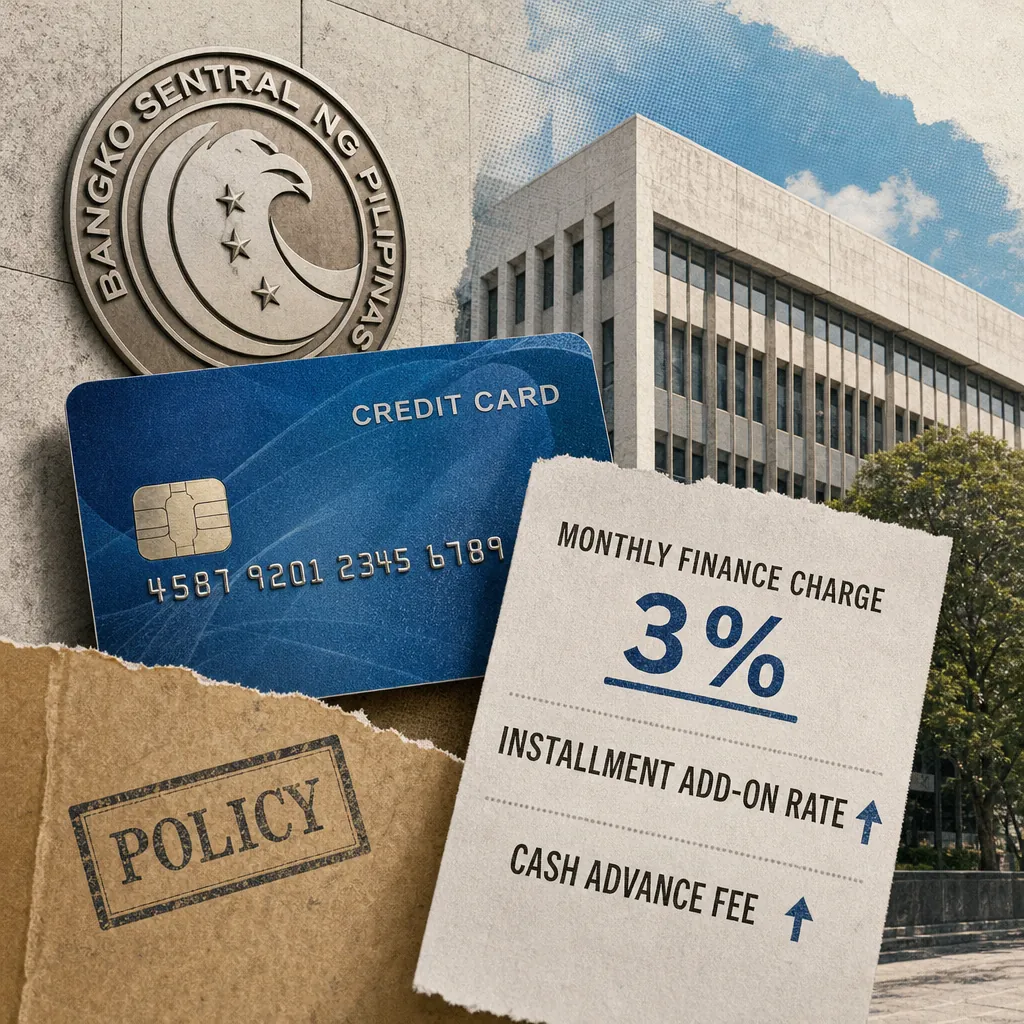
The Bangko Sentral ng Pilipinas (BSP), the country's central bank, kept the 3-percent monthly ceiling on credit card finance charges in place and raised the caps on two other card charges, according to Circular No. 1242 dated Nov. 10 and reported on Thursday2611. The monthly add-on rate ceiling for credit card installment loans rises to 1.5 percent from 1 percent, and the maximum one-time processing fee for a cash advance goes to ₱300 from ₱200 per transaction1177. The central bank said the adjustments "aim to balance consumer protection with access to credit" and give card issuers "more flexibility in setting charges as operating costs rise"11. The ceilings are limits, not mandated prices, so issuers may charge less77.
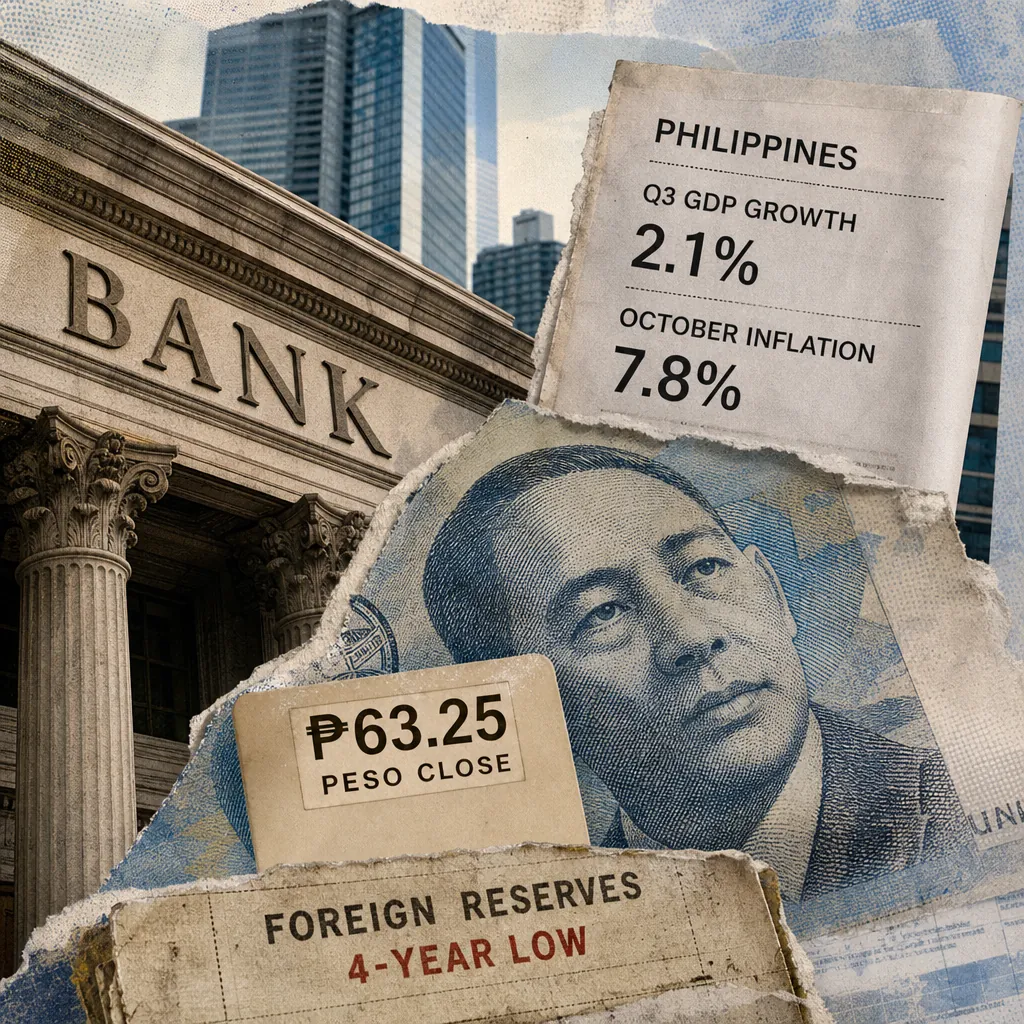
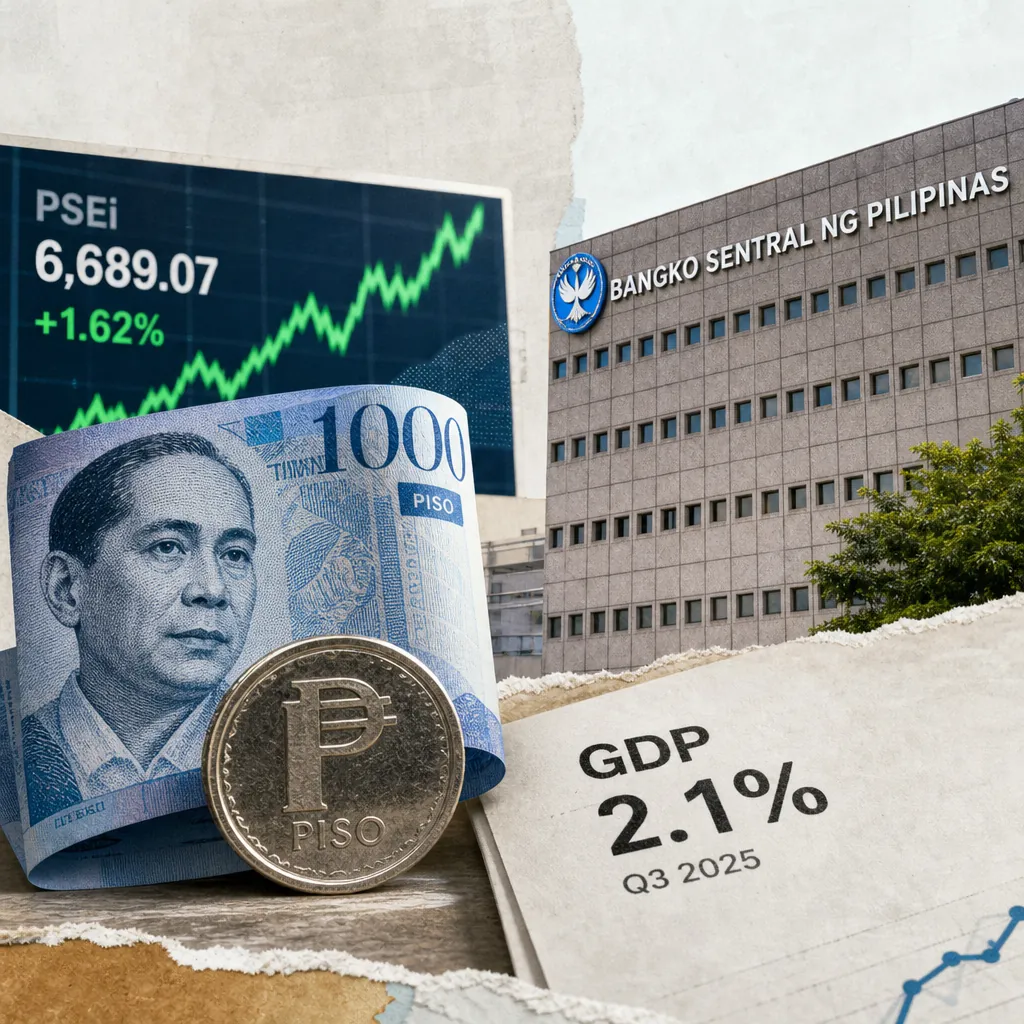
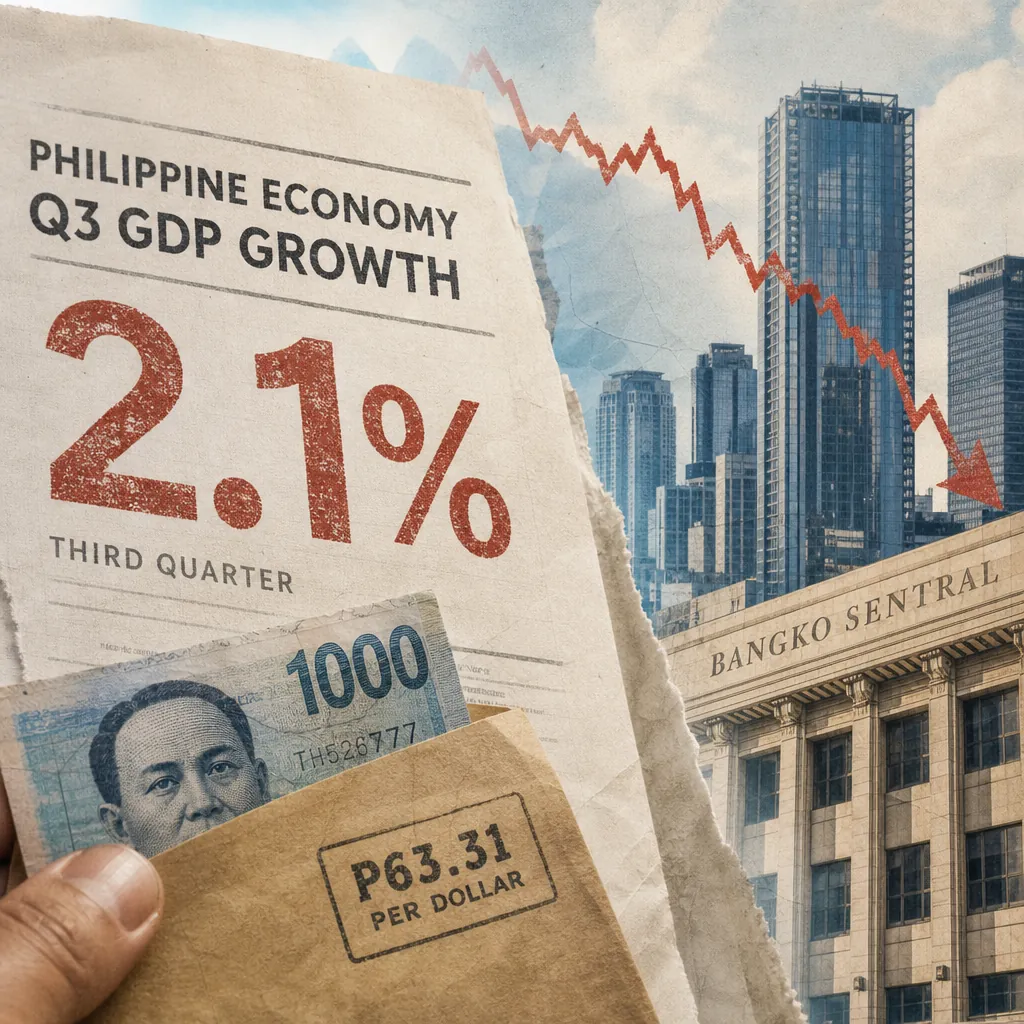
The decision landed on a day when the broader economic picture was deteriorating. Third-quarter gross domestic product (GDP) — the total value of goods and services produced in the country — grew 2.1 percent from a year earlier, down from 4.0 percent in the same quarter of 202514. On a quarter-on-quarter basis, seasonally adjusted, the economy expanded just 0.1 percent85. October inflation hit 7.8 percent, a 44-month high, bringing the year-to-date average to 5.6 percent8. The peso closed at ₱63.7 to the dollar on Thursday, weaker by 45 centavos from Wednesday's ₱63.2513. The Philippine Stock Exchange index (PSEi) fell 0.57 percent, or 32.65 points, to 5,660.554390.
The BSP said it was "carefully assessing the implications of the latest growth data for the inflation outlook" and would remain guided by incoming data on inflation, inflation expectations and economic activity14. It described the situation as "a difficult combination of elevated inflation and slowing economic growth" but stopped short of using the term "stagflation," which economists have increasingly applied to the country's predicament25.
Key themes
- BSP keeps the 3-percent card cap and raises installment and cash advance ceilings. The monthly finance charge ceiling stays at 3 percent, the installment add-on rate ceiling rises to 1.5 percent from 1 percent, and the cash advance processing fee cap goes to ₱300 from ₱2002611. The BSP first introduced these ceilings in 2020, when the pandemic recession battered household finances26.
- Third-quarter GDP growth of 2.1 percent is the slowest since 2009 outside the pandemic years. Quarter-on-quarter growth was 0.1 percent, and household consumption — which normally drives up to 70 percent of the economy — grew just 0.4 percent from the previous quarter8570. The Philippines' 2.1 percent was the lowest among reporting Southeast Asian economies, against Vietnam's near-10 percent and about 5.5 percent for Indonesia, Malaysia and Singapore70.
- The peso closed at ₱63.7 to the dollar, and the stock index fell for a second day. The peso lost 45 centavos from Wednesday, and the PSEi shed 32.65 points to 5,660.55 as investors weighed corporate earnings and a downgrade to the country's growth outlook1343.
- Conglomerate earnings reflected the slowdown. GT Capital Holdings Inc. reported a 10-percent decline in nine-month net income to ₱23.3 billion889. Ayala Corp.'s core net income fell 6 percent to ₱34.5 billion on softer banking and property results2484. Bank of Commerce grew net income 15 percent to ₱3.17 billion on higher interest earnings22.
- First Philippine Holdings is selling its 90.74-percent stake in Rockwell Land for ₱15.9 billion. The buyer is Crème Investment Corp., a family holding firm representing the branch of the Lopez family descended from Eugenio "Geny" Lopez Jr.35.
- The Philippines will sign its first free trade agreement with a Latin American country on Nov. 19. The Philippines-Chile Comprehensive Economic Partnership Agreement (CEPA) will be signed at the Asia-Pacific Economic Cooperation (APEC) Summit, Trade Secretary Cristina Roque said12.
- The Department of Justice launched an anti-scam campaign citing 84 percent exposure among Filipino adults. Justice Secretary Fredderick Vida cited the 2026 State of Scams in the Philippines report by the Global Anti-Scam Alliance, which found 84 percent of Filipino adults encountered a scam attempt in the past year, up from 77 percent in 2025, with 15 percent reporting financial losses65.
- Digital payments reached 64.7 percent of retail transaction volume in 2025. The BSP figure was cited in a report on payment security ahead of the 11.11 and 12.12 shopping events, noting the BSP's July 2026 call for stronger authentication and cyber-threat monitoring51.
How the narratives stack
Dominant. The BSP's credit card circular was the most consequential regulatory decision in the captured set, and it drew the widest pickup across outlets. The Manila Times led its business section with the retained cap11, the Inquirer ran a detailed breakdown of Circular No. 124226, and Daily Guardian explained the effective date and the distinction between ceilings and actual charges77. The story's dominance within this set reflects both its direct effect on household borrowing costs and the breadth of coverage it attracted. The BSP's separate statement on growth and inflation, reported by The Manila Times14, the Inquirer25 and Philstar87, formed a second strand of the same institutional story: the central bank managing a difficult combination of high inflation and weak growth.
Counter-narrative. The GDP growth figure of 2.1 percent and the quarter-on-quarter 0.1 percent told a story that cut against the government's framing of the slowdown as a global phenomenon. BusinessMirror columnist Alvin P. Ang noted that peer economies facing similar energy prices and imported inflation grew much faster, and that "the difference lies primarily in domestic demand, investment conditions, export competitiveness, and economic structure"70. A Philstar opinion piece described the economy as being "at a standstill," citing a 7.7-percent quarter-on-quarter contraction in agriculture and a 0.4-percent crawl in services85. These analyses challenged the official explanation without disputing the headline number.
Emerging. The peso's slide past ₱64 to the dollar, reported by ManilaNews.PH with a satirical edge about the BSP's reluctance to defend the currency55, and the stock market's second straight loss90 pointed to a currency and capital-flow story that may grow. The peso's close at ₱63.7 on Thursday was already weaker than the ₱63.19 rate cited in a blog aggregation67, and the ManilaNews.PH piece noted the currency had logged its 32nd record-low close of the year55. Separately, the government's planned signing of the Philippines-Chile free trade agreement on Nov. 1912 and the questions surrounding the Pax Silica hub after a leadership reshuffle at the Bases Conversion and Development Authority (BCDA)32 are forward-looking items worth tracking.
Under-covered. The peso's record lows and the BSP's stated reluctance to defend the currency received less sustained coverage in this set than the credit card circular, despite the peso's direct effect on import costs and inflation. The ManilaNews.PH piece was the only item to focus squarely on the currency's slide and the central bank's intervention philosophy55. The regional inflation picture — Bacolod City at 8.7 percent and Negros Occidental at 6.7 percent in October, both well above the national 7.8 percent and the BSP's 2-to-4 percent target range — appeared in a single provincial report81.
Platform insights
- Facebook. The credit card circular and the GDP slowdown were the most shared items in the set, with the BSP's consumer-protection framing drawing the most engagement. Daily Guardian's explainer on the effective date and the ceilings-versus-actual-charges distinction was formatted for sharing77, and the LionhearTV pieces on credit scores and planned holiday borrowing circulated among consumer-finance audiences4445.
- X. The peso's slide and the stock market's decline drove the most discussion, with the ManilaNews.PH satire on the BSP's "secret worry number" circulating among finance and policy accounts55. The GDP figure and the BSP's statement on growth were quoted and debated, with users comparing the Philippines' 2.1 percent to peer economies70.
- Reddit. Threads on the credit card circular focused on whether the higher installment and cash advance ceilings would actually cost borrowers more, with users parsing the difference between the retained 3-percent cap and the raised add-on rate2611. The peso's slide and its effect on remittances and travel drew discussion, with the exchange rate cited at ₱63.19 in one aggregation67.
- YouTube. Business commentary channels covered the GDP slowdown and the BSP's policy dilemma, with the "difficult combination" phrase from the central bank's statement serving as a hook2587. The anti-scam campaign and the 84-percent exposure figure also drew explainer-style content65.
Key voices and communities
The Bangko Sentral ng Pilipinas. The central bank was the most authoritative voice in the set, issuing the credit card circular1126 and a separate statement on growth and inflation142587. Its framing — balancing consumer protection with access to credit, and committing to price stability — set the terms of the debate. Governor Eli Remolona Jr. signed the circular11.
Business journalists and columnists. Alvin P. Ang's BusinessMirror column provided the sharpest comparative analysis, placing the Philippines' 2.1 percent growth against Vietnam's near-10 percent and the 5.5 percent of Indonesia, Malaysia and Singapore70. A Philstar opinion piece dissected the quarter-on-quarter standstill85. These voices shaped the counter-narrative on the growth slowdown.
Consumer-finance educators. LionhearTV published pieces on credit scores44 and on planned holiday borrowing, citing a TransUnion Q2 2026 Consumer Pulse Study finding that 45 percent of Filipino consumers expect difficulty paying at least one bill45. The BDO Foundation held a three-day financial literacy seminar in Tagbilaran with the BSP and the city government72. These voices addressed the household side of the credit story.
Government economic managers. Trade Secretary Cristina Roque announced the Philippines-Chile free trade agreement signing12, and Finance Secretary Frederick Go appeared at a news conference on the BCDA's ₱8.4-billion remittance amid questions about the Pax Silica hub32. Their statements framed the government's forward-looking trade and investment agenda.
Anti-fraud and law enforcement agencies. Justice Secretary Fredderick Vida launched the anti-scam campaign with the 84-percent exposure figure65, and the Anti-Money Laundering Council (AMLC) testified in the Romualdez bail hearing about bank transactions and a civil forfeiture case6606286. These voices connected financial crime to the broader banking and payments landscape.
Narrative streams
BSP holds the 3-percent card cap and raises installment and cash advance ceilings
The central bank's Circular No. 1242, dated Nov. 10 and reported on Thursday, kept the 3-percent monthly cap on finance charges for credit card loans while raising the monthly add-on rate ceiling for installment loans to 1.5 percent from 1 percent and the maximum one-time cash advance processing fee to ₱300 from ₱2002611. The BSP said the adjustments "aim to balance consumer protection with access to credit" and "provide credit card issuers more flexibility in setting charges as operating costs rise"11. The ceilings are maximums, not required charges, and the circular takes effect 15 calendar days after publication in the Official Gazette77.
The BSP first introduced these ceilings in 2020, when the pandemic-induced recession battered households26. The decision to keep the 3-percent cap while raising the other two ceilings reflects a judgment that the core consumer protection — the monthly finance charge — should stay, while issuers get room to recover rising operating costs on installment and cash advance products. For cardholders, the practical effect depends on what issuers actually charge within the new ceilings; the higher caps do not automatically raise anyone's bill77.
The read for the sector: banks and credit card issuers gain flexibility on installment and cash advance pricing, but the retained 3-percent cap keeps the most visible consumer charge unchanged. Lenders weighing whether to raise installment add-on rates toward the new 1.5-percent ceiling will be watching competitors and the BSP's periodic review, which Remolona said would continue11. Consumer-finance educators and debt-counseling groups will need to explain the difference between the retained cap and the raised ceilings, since the headline "BSP raises credit card caps" can be misread as a general increase in borrowing costs77.
GDP growth of 2.1 percent and the quarter-on-quarter standstill
The 2.1-percent third-quarter GDP growth figure, down from 4.0 percent a year earlier, was the slowest since 2009 outside the pandemic years1470. On a seasonally adjusted quarter-on-quarter basis, the economy grew just 0.1 percent85. Agriculture, forestry and fishing contracted 7.7 percent from the previous quarter; services grew 0.4 percent; industry grew 1.5 percent85. Household consumption, which normally drives up to 70 percent of the economy, grew 0.4 percent quarter-on-quarter85.
Alvin P. Ang's BusinessMirror column noted that the Philippines' 2.1 percent was the lowest among reporting Southeast Asian economies, against Vietnam's near-10 percent and about 5.5 percent for Indonesia, Malaysia and Singapore70. He argued that the government's explanation of a global phenomenon did not hold, since peer economies faced similar energy prices and imported inflation but grew faster, and that "the difference lies primarily in domestic demand, investment conditions, export competitiveness, and economic structure"70. A Philstar opinion piece put it plainly: "We are at a standstill"85.
The BSP said it was "carefully assessing the implications of the latest growth data for the inflation outlook" and would remain guided by incoming data14. It described the situation as "a difficult combination of elevated inflation and slowing economic growth" but stopped short of the term "stagflation"25. The central bank said monetary policy could not directly control inflation caused by recent global supply shocks but would focus on preventing those price increases from spreading through the economy and dislodging inflation expectations87.
The read for the sector: banks and lenders face a slowing economy with elevated inflation, a combination that pressures loan demand and asset quality simultaneously. The BSP's refusal to use "stagflation" while describing the same conditions gives it room to keep policy tight without formally acknowledging the trap. For corporate borrowers and consumers, the practical effect is that credit stays expensive even as growth stalls.
The peso closes at ₱63.7 and the stock index falls for a second day
The peso weakened 45 centavos to close at ₱63.7 to the dollar on Thursday, from ₱63.25 on Wednesday13. Rizal Commercial Banking Corp. chief economist Michael Ricafort attributed the slide to a stronger US dollar against major global currencies, which "increased the odds of future US Fed rate hike"13. The PSEi fell 32.65 points, or 0.57 percent, to 5,660.55, its second straight loss4390. The broader all-shares index lost 24.86 points, or 0.78 percent, to 3,175.7643.
Luis Limlingan, head of sales at Regina Capital Development Corp., said BMI's lower growth forecasts for the Philippines added to investor caution during earnings season: "The weaker growth outlook further weighed on market sentiment, prompting investors to reassess their positions amid concerns over the country's economic trajectory"43. COL Financial Group research analyst Denise Joaquin noted that the November MSCI rebalancing will remove Meralco from the MSCI Philippines Standard Index and downgrade PLDT to the Small Cap Index90. MSCI indices are benchmarks that global fund managers use to decide where to allocate money, so a removal or downgrade can trigger selling by funds that track them.
ManilaNews.PH reported that the peso had touched ₱64 to the dollar, the weakest level in its history, after logging its 32nd record-low close of the year, and that the BSP governor had said the central bank did not see a need to defend the peso, explaining that it keeps estimates of how much the currency has to move before it becomes inflationary55. A blog aggregation listed the USD-to-PHP rate at ₱63.19 for Nov. 1267.
The read for the sector: a weaker peso raises the local cost of imported goods and fuel, feeding back into the inflation the BSP is trying to contain. Banks with foreign-currency exposure and import-dependent corporates face higher hedging costs. The BSP's stated reluctance to defend the currency suggests it is willing to let the peso absorb some adjustment rather than spend reserves, which shifts the burden onto importers and consumers.
Conglomerate earnings reflect the slowdown
GT Capital Holdings Inc. reported a 10-percent decline in nine-month net income to ₱23.3 billion, citing slower economic growth and high inflation889. President Carmelo Maria Luza Bautista said the group's operating companies "stayed resilient and in line with expectations" and that its "solid balance sheet, diversified portfolio and prudent financial management" gave it capacity to manage "these headwinds"89. The company noted third-quarter GDP growth of 2.1 percent and October inflation of 7.8 percent8.
Ayala Corp.'s core net income fell 6 percent to ₱34.5 billion on softer results from its banking and property businesses and lower non-operating income2484. Stable earnings from Globe Telecom Inc., higher contributions from AC Energy and Infrastructure Corp. and narrower losses from emerging businesses cushioned the decline24. Reported net income fell 22 percent to ₱36.3 billion, reflecting a high 2025 base that included a one-off remeasurement gain84.
Bank of Commerce, an affiliate of San Miguel Corp., grew unaudited net income 15 percent to ₱3.17 billion in the first nine months as higher interest earnings offset a drop in non-interest income22. Gross revenue rose 15 percent to ₱10.70 billion, net interest income climbed 21 percent to ₱9.59 billion, and net interest margin reached 4.88 percent22. Non-interest income fell 20 percent to ₱1.11 billion on trading and investment securities losses and weaker foreign exchange gains22.
First Philippine Holdings Corp. is selling its entire 90.74-percent stake in Rockwell Land Corp. to Crème Investment Corp. for ₱15.9 billion, shifting control of the property developer to the branch of the Lopez family descended from Eugenio "Geny" Lopez Jr.35. The sale covers 5,296,015,375 common shares at ₱3 per share and 2,750,000,000 preferred shares at ₱0.01 per share, based on an independent valuation by BDO Capital & Investment Corp.35.
The read for the sector: the earnings reports confirm that the slowdown is hitting conglomerates unevenly. Banks with strong interest margins, like Bank of Commerce, are benefiting from high rates, while property and consumer-facing businesses are absorbing the hit. The FPH-Rockwell Land sale is a family restructuring that shifts a major property asset between branches of the Lopez family, with no immediate effect on Rockwell Land's operations but a signal that the group is reallocating capital.
The Philippines-Chile free trade agreement and the Pax Silica question
The Philippines will sign the Philippines-Chile Comprehensive Economic Partnership Agreement (CEPA) at the APEC Summit on Nov. 19, Trade Secretary Cristina Roque said12. Negotiations concluded in July, and the pact marks the Philippines' first free trade agreement with a Latin American country12. Roque said the agreement would open Chile's market, with a population of 440 million, to Philippine products12. The CEPA goes beyond tariff liberalization and establishes a framework for trade, investment and digital economy cooperation, with commitments on inclusivity, sustainability and economic resilience12. The Philippines exports electronic products, coconut products and other goods to Chile12.
Separately, questions surround the Philippines' Pax Silica hub after a government reshuffle. Rumors circulated that Bases Conversion and Development Authority (BCDA) President and CEO Joshua Bingcang would be reassigned, and a hastily arranged news conference was called with Finance Secretary Frederick Go, Trade Secretary Roque and Bingcang in attendance32. The occasion was meant to celebrate the BCDA's ₱8.4-billion remittance to the government, but questions about the hub's leadership hung over the event32. The BCDA is the government agency that oversees the conversion of former military bases into economic zones, and Pax Silica is a planned hub for semiconductor and critical-minerals industries.
The read for the sector: the Chile agreement gives Philippine exporters a new market and a template for future trade deals, but its immediate effect on banks and lenders is indirect, through trade finance and investment flows. The Pax Silica leadership question matters more for the investment climate: a reshuffle at the agency overseeing the hub introduces uncertainty for companies considering locating there, and the government's guarded answers at the news conference did little to settle it32.
Anti-scam campaign and payment security ahead of the holiday shopping season
The Department of Justice launched an anti-scam campaign citing the 2026 State of Scams in the Philippines report by the Global Anti-Scam Alliance, which found 84 percent of Filipino adults encountered a scam attempt in the past year, up from 77 percent in 2025, with 15 percent reporting financial losses65. Justice Secretary Fredderick Vida said fighting financial fraud must be a national priority, citing victims who lost lifetime savings to investment scams, overseas Filipino workers tricked into sending money to fraudsters, and young professionals deceived by fake job offers65.
Digital payments accounted for 64.7 percent of retail payment transactions by volume in 2025, according to the BSP, and in July 2026 the central bank urged supervised financial institutions to strengthen authentication, cyber-threat monitoring and incident response51. As retailers prepare for the 11.11 and 12.12 shopping events and the Christmas rush, the challenge is distinguishing legitimate spikes in payment activity from transactions that warrant closer scrutiny51.
The read for the sector: banks, payment providers and merchants face a holiday season in which fraud attempts are more frequent and harder to distinguish from legitimate promotional traffic. The 84-percent exposure figure and the 15-percent loss rate give the DOJ campaign a concrete basis, and the BSP's July 2026 guidance gives regulators a hook to press institutions on authentication. For consumers, the practical advice is to treat unsolicited job offers and investment pitches with suspicion, especially during a season when transaction volumes make anomalies harder to spot.
Financial inclusion, credit scores and planned holiday borrowing
LionhearTV published a piece explaining why Filipinos may receive different credit scores from different providers, noting that a higher score does not automatically mean it is more accurate and that differences stem from scoring models and the credit information available to each provider44. The piece cited CIBI, a credit information provider, which conducts financial literacy workshops under CIBI University44.
A separate LionhearTV piece reported that PeraSure, a digital lending app operated by SEC-registered Sulit Lending Corporation, says Filipino professionals, freelancers and small business owners tend to borrow on calculation rather than impulse, matching each loan to a specific expense and repayment schedule45. The piece cited TransUnion's Q2 2026 Consumer Pulse Study finding that 45 percent of Filipino consumers expect difficulty paying at least one bill45.
The Social Security System (SSS) announced that Rizal Commercial Banking Corporation (RCBC) now offers the SSS Micro Loan Program, also known as SSS LoanLite, through the DiskarTech app to qualified MySSS cardholders78. Qualified members may apply for loans ranging from ₱1,000 to ₱20,000, depending on the average of their 12 latest Monthly Salary Credits, with repayment periods of 60 or 90 days and an interest rate of 8 percent per annum, equivalent to approximately 0.67 percent per month78. SSS President and CEO Victor Alfonso A. Limlingan Jr. said the partnership "marks another milestone in our commitment to making SSS services more accessible and responsive to our members' needs"78.
The BDO Foundation, under a memorandum of agreement with the BSP and the Tagbilaran City Government, conducted a three-day financial literacy seminar in Tagbilaran City, with BSP Deputy Governor Bernadette Romulo-Puyat and BDO Foundation President Mario Deriquito signing the agreement72. The seminar covered loans and other financial services for micro, small and medium enterprises72.
The read for the sector: the holiday season is when household borrowing peaks, and the combination of digital lending apps, SSS micro-loans and bank credit cards gives consumers more options than ever. The credit-score explainer and the financial literacy seminars address the information gap that can lead borrowers to accept unfavorable terms. For lenders, the opportunity is to reach borrowers who are planning rather than panicking, but the 45-percent bill-difficulty figure suggests a large share of households are close to the edge.
Regional inflation and the cost of living outside the capital
Inflation in Bacolod City quickened to 8.7 percent in October from 8.4 percent in September, while the rate in Negros Occidental rose to 6.7 percent from 6.4 percent, as gasoline prices pushed transport costs higher, the Philippine Statistics Authority reported81. Inflation for the bottom 30 percent of income households reached 9.6 percent in Bacolod City and 6.9 percent in the province, with food and non-alcoholic beverages accounting for nearly half of that rate81. Both headline rates are well above the BSP's 2-to-4 percent target range81. In October 2025, inflation stood at 1.2 percent in Bacolod City and 0.5 percent in Negros Occidental81.
The read for the sector: regional inflation running above the national rate means the cost-of-living squeeze is uneven, and lenders with exposure to Negros and other provincial markets face borrowers whose budgets are tighter than the national average suggests. The 9.6-percent rate for the poorest households in Bacolod City is the figure that matters most for microfinance and consumer lending, since it indicates that the households least able to absorb a shock are facing the fastest price increases.
Anti-money-laundering cases and the Romualdez bail hearing
The Anti-Money Laundering Council (AMLC) filed a civil forfeiture case covering the bank accounts of former House Speaker Martin Romualdez, a witness told the Sandiganbayan Third Division on Thursday6. Defense attorney Rashel Ann Pomoy confirmed this with AMLC financial investigator Jan Mark Busa, who testified for the prosecution in Romualdez's bail hearing for his plunder case6. Before the civil forfeiture case, the AMLC had filed for a freeze order against Romualdez's bank accounts and applied for a bank inquiry, both granted by the Court of Appeals6.
Busa testified that no cash inflows of Romualdez were traceable to the Department of Public Works and Highways, former lawmaker Zaldy Co, or contractors from June 2022 to September 202560. He also testified that a Forbes Park property believed to be owned by Romualdez was purchased through companies prosecutors allege served as his financial conduits, with 21 manager's checks totaling about ₱1.5 billion issued by Samchan Foreign Exchange Corp. and forwarded to the Ocampo, Manalo, Valdez and Lim Law Firm, which facilitated the purchase62. A Philstar report in Filipino said bank transactions connected to Romualdez reached ₱4.509 billion while he was Speaker from 2022 to 2025, the second-highest among 35 bank accounts and 1,951 transaction reports reviewed, but the AMLC witness admitted no evidence showed the ₱560.5 million in inflows came from illegal activity or flood control projects86.
The AMLC also secured a freeze order from the Court of Appeals covering bank accounts and other properties owned by a lawmaker and a businessman who previously served as a government official, stemming from an Office of the Ombudsman complaint alleging plunder and violations of the Anti-Graft and Corrupt Practices Act68. The AMLC said its investigation uncovered "extensive" fund transfers between the lawmaker's personal accounts and those of the corporations, indicating a "direct financial connection"68.
The read for the sector: the AMLC's parallel civil forfeiture and freeze-order actions show the agency using asset-preservation tools alongside criminal proceedings, which matters for banks holding the affected accounts. For financial institutions, the cases reinforce the importance of transaction monitoring and suspicious-transaction reporting, since the AMLC's evidence in the Romualdez hearing was built from bank records obtained through court-approved inquiries.
Conversation trajectory
The BSP's next policy meeting and the peso's path. Over the next four to six weeks, the BSP's next rate decision will be the main test of how it weighs 7.8-percent inflation against 2.1-percent growth. The central bank has said it will be guided by incoming data on inflation, inflation expectations and economic activity1487. Watch whether the peso holds below ₱64 to the dollar or breaks further; the ManilaNews.PH report noted the currency had already logged 32 record-low closes this year55. A further slide would raise import costs and complicate the BSP's inflation outlook.
The Philippines-Chile CEPA signing on Nov. 19. The agreement will be signed at the APEC Summit, and the text's details on tariff schedules and digital trade commitments will determine which Philippine exports benefit most12. Watch for the signing and for the first shipments under the agreement, which would give exporters a concrete test case.
The Pax Silica leadership question. The BCDA news conference left unanswered questions about whether Bingcang will be reassigned and what that means for the planned hub32. Watch for an official announcement on the BCDA leadership and for any statements from companies considering locating at the hub.
The holiday shopping season and payment fraud. The 11.11 and 12.12 shopping events and the Christmas rush will test the BSP's July 2026 guidance on authentication and cyber-threat monitoring51. Watch for reports of fraud incidents and for any BSP follow-up guidance to supervised institutions.
The Romualdez bail hearing and AMLC cases. The bail hearing continues, and the AMLC's civil forfeiture case and freeze orders will proceed through the courts668. Watch for rulings on bail and for any expansion of the forfeiture cases to other individuals or entities.
Trigger events. The BSP's next rate decision, the Nov. 19 CEPA signing, the BCDA leadership announcement, the 11.11 and 12.12 shopping events, and court rulings in the Romualdez bail hearing are the checkable dates on the calendar.
Response guidance
Credit card issuers: explain the difference between the retained cap and the raised ceilings. The BSP kept the 3-percent monthly finance charge cap but raised the installment add-on rate ceiling to 1.5 percent and the cash advance processing fee cap to ₱3001126. Issuers should communicate clearly that the ceilings are maximums, not automatic increases, and that actual charges depend on what each issuer sets77. A short, plain-language notice to cardholders explaining which charges changed and which did not will reduce confusion.
Banks and lenders: prepare for a slower-growth, higher-inflation environment. The 2.1-percent GDP growth and 7.8-percent inflation mean borrowers face tighter budgets148. Lenders should review loan-loss provisions and stress-test portfolios against a scenario in which growth stays weak and inflation stays elevated. The BSP's statement that it will be guided by incoming data14 suggests no immediate policy pivot, so the pressure on borrowers will persist.
Payment providers and merchants: tighten fraud monitoring for the holiday season. The DOJ's 84-percent scam-exposure figure and the BSP's July 2026 guidance on authentication make fraud prevention a priority6551. Providers should ensure that promotional spikes in transaction volume do not overwhelm fraud-detection systems, and merchants should train staff to recognize common scam patterns during the 11.11 and 12.12 events.
Financial-literacy communicators: address the credit-score confusion and the holiday borrowing surge. The LionhearTV explainer on why credit scores differ44 and the PeraSure piece on planned borrowing45 show that consumers are actively seeking guidance. Communicators should emphasize that a higher score is not automatically more accurate, and that borrowers should compare offers and understand repayment schedules before taking on holiday debt.
Trade and investment communicators: prepare for the Chile CEPA signing and the Pax Silica announcement. The Nov. 19 signing is a concrete milestone that can be explained in plain terms: a new market for Philippine exports and a template for future trade deals12. The Pax Silica leadership question requires careful handling, since the government's guarded answers at the news conference left the investment climate uncertain32. Communicators should avoid speculation and stick to confirmed details.
Anti-money-laundering and compliance teams: monitor the Romualdez and AMLC cases for precedents. The AMLC's use of civil forfeiture, freeze orders and bank inquiries in the Romualdez case662 and the separate freeze order covering a lawmaker and businessman68 show the agency's toolkit in action. Compliance teams should review their transaction-monitoring and suspicious-transaction-reporting procedures against the patterns described in the testimony.
See the full picture behind today's signals.
This report draws from Media Meter's MediaWatch, our real-time monitoring engine tracking 2,470+ Philippine sources across print, broadcast, digital, and social. Explore how the platform turns raw coverage into decision-grade intelligence, then see how it's configured for teams like yours — whether you're in PR agencies, corporate comms, government, or marketing.
Want more? Browse our Report Library for sector and crisis intelligence, or request a demo and we'll have your brand set up before the call.
Want this kind of intelligence on your brand?
This brief is built on the same MediaWatch methodology that runs continuously across every brand we monitor. See your competitive landscape, Impact Score, and narrative trajectory in a 30-minute demo.