Inflation at 7.8% Tests Banks and Households
October inflation of 7.8 percent, the highest in 44 months, frames a day of Philippine financial news: banks report strong profits and rising bad loans, the peso sits near record lows, and economists debate another rate hike. The Senate impeachment court admits Vice President Sara Duterte's financial records as a baseline.
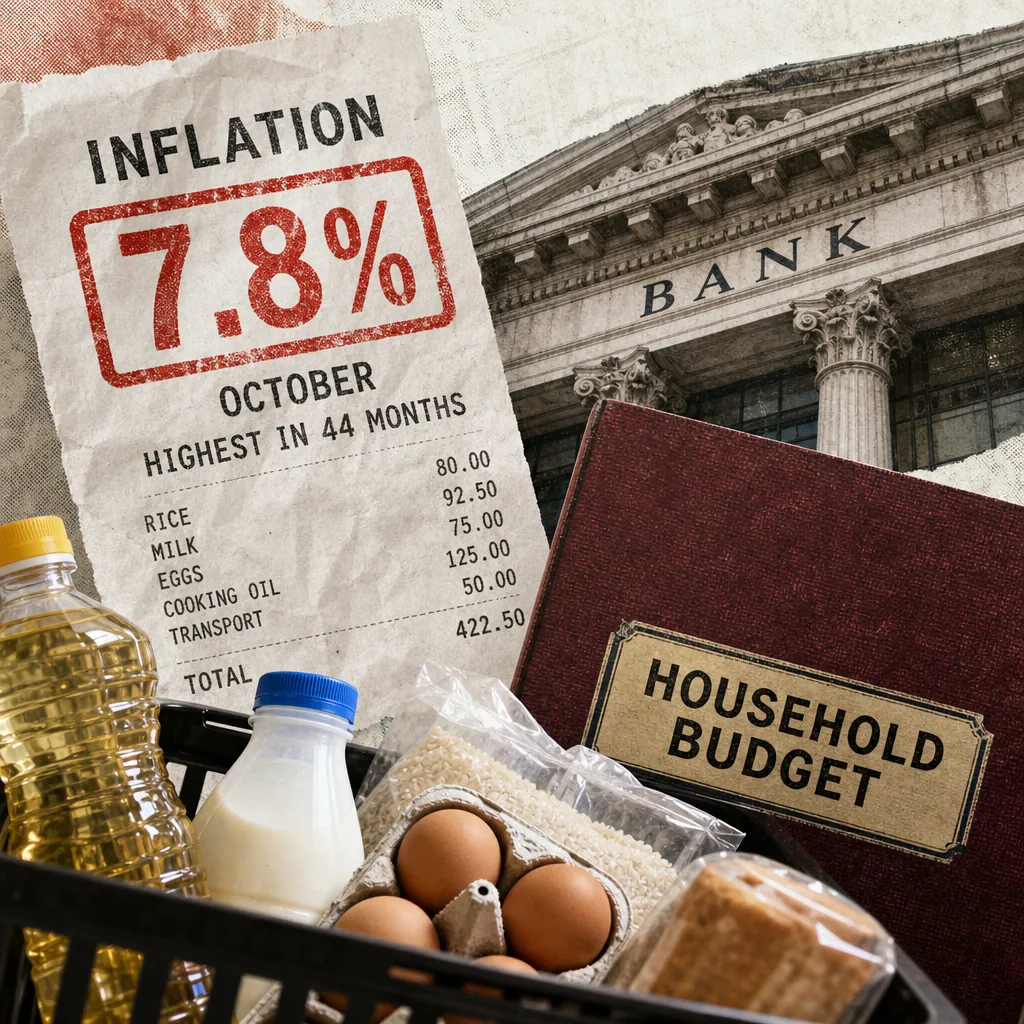
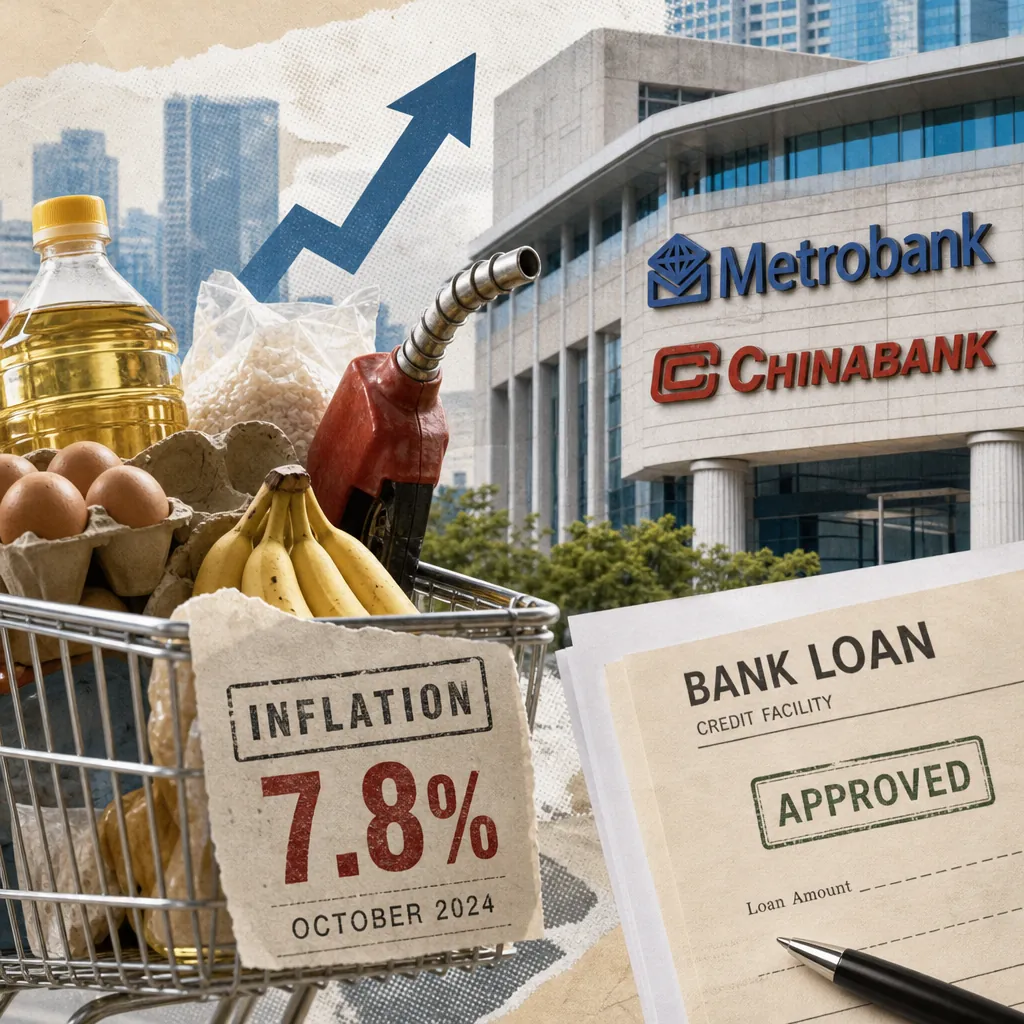
October inflation of 7.8 percent, the highest reading in 44 months, set the terms for a day of Philippine financial news. The Philippine Statistics Authority reported the figure on Thursday, up from 7.2 percent in September and the fastest pace since February 2023, when inflation stood at 8.6 percent16. By Friday the consequences were being priced, argued over and explained in plain terms across the business pages: the stock market closed the week lower, the central bank published a health check on the banking system, and economists split over whether another interest rate increase is coming in December.
The Bangko Sentral ng Pilipinas (BSP), the country's central bank, used the same day to release its Report on the Philippine Financial System for the First Semester of 2026. Banks earned a combined ₱208.5 billion in net profit from January to June, 5.2 percent more than in the same period a year earlier, while total assets grew 10.3 percent to ₱31.1 trillion21. Governor Eli Remolona Jr. said the system "remains in a strong position" to fund households and firms, describing banks as well-capitalized, well-provisioned and flush with liquidity73. The report also showed loans growing faster than deposits, and bad loans rising, a combination that matters more when borrowing costs are climbing.
The peso and the policy rate sit behind much of the day's arithmetic. The currency hit a record low of ₱64.17 to the dollar on October 27, and a BSP deputy governor said on Friday that international reserves and steady inflows from overseas Filipino workers' remittances and business process outsourcing earnings were keeping the foreign-exchange market stable22. The BSP raised its policy rate on November 4, days before the inflation print, and bank lending had already grown 11.4 percent in September as businesses and households borrowed ahead of that decision81.
Key themes
- Inflation reached 7.8 percent in October, the highest in 44 months. The Philippine Statistics Authority figure was up from 7.2 percent in September and compared with 8.6 percent in February 2023, the last time prices rose faster16. For the poorest 30 percent of households, inflation ran at 9.5 percent, well above the headline number79.
- Banks reported ₱208.5 billion in first-half profit while bad loans rose. Net profit for January to June grew 5.2 percent year on year, total assets reached ₱31.1 trillion, and loans rose 11.9 percent to ₱17.8 trillion, faster than the 8.3 percent growth in deposits21. The BSP called asset quality "broadly manageable"73.
- Economists disagree on whether the BSP will raise rates again in December. Security Bank expects a 25-basis-point increase to 5.75 percent, while Deutsche Bank sees little need for another hike because price pressures are concentrated in food, transport and energy rather than spread across the economy8820.
- S&P Global Ratings said the Philippines is already in stagflation. The ratings firm's senior economist, Vishrut Rana, defined the term as growth below the country's long-term trend of 5.5 to 6 percent combined with high inflation, and pointed to second-quarter growth of 2.3 percent89.
- The peso's slide to ₱64.17 to the dollar has not disturbed the BSP's reading of the foreign-exchange market. The central bank cited reserves, remittances and outsourcing revenue as buffers, and said it was watching for inflation effects from the exchange rate22.
- The stock market fell 0.28 percent on Friday to 5,761.95, ending a two-day rally. The Philippine Stock Exchange index lost 16.19 points as investors took profits and tracked weaker global markets; only the financials sub-index gained, rising 1.24 percent1684.
- The Senate impeachment court admitted Vice President Sara Duterte's financial records from 2007 to 2021 as a "starting financial baseline." The court allowed statements of assets, liabilities and net worth, tax documents, bank records and anti-money-laundering council records, but rejected audit reports tied to her confidential funds7090.
- The Bureau of Immigration deported 115 Chinese nationals arrested in October raids on suspected illegal offshore gaming operations. Sixty-two were arrested in Zamboanga Sibugay and 53 in Cubao, Quezon City; all were flown to China on a chartered flight after summary deportation orders860.
How the narratives stack
Dominant. The inflation print and its consequences dominated the items captured here. Of the coverage reviewed, the largest cluster of business stories concerned the 7.8 percent October figure and what it means for interest rates, the peso, bank lending and household budgets. The Manila Bulletin's front-page-style piece put the cost in everyday terms: ₱1 now buys what 72 centavos bought at 2018 prices, and a taxi driver who brought ₱100 to market came home without the carrot and cabbage he had planned to buy79. The Philippine Star reported that economists expect inflation to stay below 8 percent in November and December, with full-year averages of 5.9 percent from both Security Bank and Deutsche Bank88. The Financial District and the Philippine Star both reported the stock market's 0.28 percent decline, with the financials sub-index the only sector to gain1684.
Counter-narrative. The BSP's financial-system report offered a deliberately reassuring counterweight to the inflation story. Banks were described as well-capitalized and profitable, with capital and liquidity buffers above regulatory requirements73. The report's own numbers support the description: net profit up 5.2 percent, total assets up 10.3 percent, capital up 5.3 percent to ₱3.7 trillion21. The counter-narrative is not that inflation is harmless; it is that the banking system has the buffers to absorb it. The same report noted rising bad loans, which is the part of the story that will matter if households and firms start missing payments.
Emerging. Two threads appeared in the day's coverage without yet drawing heavy attention. The first is the BSP's push for central banks worldwide to assess how artificial intelligence could reshape inflation, productivity and financial markets. Governor Remolona raised the issue at the International Monetary Fund-World Bank Group annual meetings, arguing that monetary authorities must prepare for both the opportunities and risks of AI80. The second is the peso's record low and the BSP's insistence that reserves and remittance inflows are sufficient. The peso's level affects the price of imported rice, fuel and other goods, so a sustained weakness would feed directly into the inflation numbers the BSP is trying to bring down22.
Under-covered. The fisheries data released by the Philippine Statistics Authority received a fraction of the attention given to inflation. Fisheries production fell 1.8 percent in July to September to 886,556.6 metric tons, the fourth consecutive year of third-quarter decline, with commercial fisheries down 20.6 percent29. The decline matters for food prices, which are the largest single driver of the inflation the day's coverage was about, but it was reported as a standalone commodity story rather than connected to the cost-of-living narrative.
Platform insights
The day's material is drawn from published news coverage rather than social posts, so platform-level engagement figures are not part of this set. What the coverage does show is how different outlets framed the same numbers for different audiences.
- Business broadsheets and online business desks. The Philippine Star, BusinessMirror, Inquirer's business section and The Financial District carried the analytical layer: rate forecasts, bank balance sheets, and the S&P stagflation call8873208916. These items carried the highest coverage values in the set, with the Inquirer's inflation-forecast story and the Philippine Star's rate-hike story among the most heavily weighted business items reviewed.
- Mass-market and tabloid-style outlets. The Manila Bulletin's "When every peso hurts" and the Daily Tribune's "Yule gloomy with inflated living costs" translated the same inflation figure into household experience, quoting a taxi driver and a chief economist warning that poor households face inflation above 9 percent7947. These pieces are where the cost-of-living story reached readers who do not follow rate decisions.
- Regional and community outlets. Sunstar Davao and Mindanao Daily News carried local business and community news, including the League of Corporate Foundations' launch of a 2027 Davao convention on disaster resilience and Conti's Bakeshop opening three kiosks in Cagayan de Oro3928. These items sit outside the inflation story but show the regional business layer the national outlets did not cover.
- Blogs and promotional content. Two blog items covered Maya's crypto and business products, including a promotion letting users buy cryptocurrency from ₱1 and a contest with a ₱1 million prize469. These are marketing content rather than news, and they illustrate how digital financial services are being promoted to consumers at the same time the central bank is warning about inflation and the peso.
Key voices and communities
The Bangko Sentral ng Pilipinas. Governor Eli Remolona Jr. and Deputy Governor Zeno Abenoja were the day's most quoted officials. Remolona's message was that banks are strong and that AI needs to be on central bankers' radar7380; Abenoja's was that the foreign-exchange market is stable despite the peso's record low22. The BSP's credibility is the anchor for both the banking story and the rate story, and its officials spoke in calibrated, reassuring terms.
Private economists and ratings agencies. Security Bank's Angelo Taningco expects inflation to peak in October and the BSP to raise rates again in December88. Deutsche Bank's analysts see price pressures as concentrated rather than broad-based and expect no further hike20. S&P's Vishrut Rana used the word stagflation and defined it precisely89. These voices disagree on policy but agree on the underlying weakness in growth.
Household-facing commentators. The Manila Bulletin's inflation explainer and the Daily Tribune's holiday-spending piece gave space to the lived experience of high prices, including the observation from Credit Rating and Investors Services Philippines president Noel Leyco that poor households experience inflation above 9 percent even when the headline number is 7.8 percent4779. This framing competes with the official statistics for public attention.
Legal and political communities around the impeachment trial. Prosecution lawyers Lorna Kapunan and Representative Terry Ridon spoke to reporters on Friday about the Senate impeachment court's rulings, with Kapunan attacking the defense's "I don't know" stance and Ridon calling the admission of most evidence a win19. The trial's financial-records ruling connects to the banking story only indirectly, but it kept the country's second-highest official in the news on the same day the central bank was discussing financial stability.
Narrative streams
Inflation hits 7.8 percent and the peso buys 72 centavos
The October inflation figure of 7.8 percent is the highest since February 2023 and the fourth consecutive month above 7 percent16. The Philippine Statistics Authority attributed the increase to higher transport fares, rising energy costs and more expensive rice20. The Manila Bulletin calculated that the peso's purchasing power has fallen to a record low, with ₱1 buying what 72 centavos bought at 2018 prices, and reported that inflation for the poorest 30 percent of households reached 9.5 percent79. The Daily Tribune quoted Noel Leyco saying poor households report inflation above 9 percent and that the burden is heaviest in regions like Bangsamoro47.
For the financial sector, the read is that the BSP's 2 to 4 percent inflation target is far out of reach and the question is no longer whether prices are rising but how long they stay elevated. Deutsche Bank expects inflation to average 7.2 percent in November and December, keeping the full-year average at 5.9 percent20. Security Bank expects the same full-year average and sees October as the peak88. If those forecasts hold, the BSP's policy rate will stay high into 2027, which raises borrowing costs for the firms and households the banking system is lending to.
Banks report strong profits and rising bad loans
The BSP's first-semester report is the most detailed picture of bank health released this year. Net profit rose 5.2 percent to ₱208.5 billion, total assets grew 10.3 percent to ₱31.1 trillion, and capital rose 5.3 percent to ₱3.7 trillion on a 13.5 percent increase in retained earnings21. Loans grew 11.9 percent to ₱17.8 trillion, faster than deposits, which rose 8.3 percent to ₱22.4 trillion21. The BSP said capital and liquidity buffers remain above regulatory requirements and that credit conditions are supportive73.
The same report noted a rise in non-performing loans, the share of borrowings that are overdue or in default. The BSP described asset quality as "broadly manageable," which is central-bank language for a problem that is real but not yet threatening73. For lenders, the read is that profitability is strong enough to absorb higher provisions if borrowers struggle, but the combination of rising rates and rising bad loans narrows the margin for error. Bank lending grew 11.4 percent in September, before the November 4 rate increase, so the next few months of data will show whether higher borrowing costs slow demand81.
Economists split on a December rate hike
The BSP raised its policy rate on November 4, two days before the inflation data was released81. Security Bank's Angelo Taningco expects another 25-basis-point increase to 5.75 percent in December, citing persistent price pressures88. Deutsche Bank's analysts argue the BSP has little need to raise rates again because price increases are concentrated in food, transport and energy rather than spread across the economy20. The disagreement matters because the policy rate sets the cost of borrowing across the economy, from corporate loans to consumer credit.
S&P Global Ratings added a third view: the Philippines is already in stagflation, with second-quarter growth of 2.3 percent far below the 5.5 to 6 percent long-term trend and inflation at 7.8 percent89. A poll of 14 economists by the Inquirer projected third-quarter growth at 2.8 percent, which would end four consecutive quarters of slowing growth but still rank among the weakest expansions in 17 years outside the pandemic19. For businesses, the read is that the cost of money will stay high while demand stays weak, a combination that squeezes margins from both sides.
The peso touches ₱64.17 and the BSP calls the market stable
The peso hit a record low of ₱64.17 to the dollar on October 2722. Deputy Governor Zeno Abenoja said on Friday that adequate international reserves and continued inflows from remittances and business process outsourcing exports were meeting the foreign-currency needs of businesses and households22. Remittances from overseas Filipino workers are one of the country's largest sources of foreign exchange, and outsourcing revenue is another; both help support the peso by supplying dollars to the market.
A weaker peso makes imports more expensive, which feeds directly into the prices of rice, fuel and other goods that drove the October inflation reading. The BSP said it was monitoring the exchange rate's potential inflationary effects22. For importers and consumers, the read is that the peso's level is now part of the inflation problem, and the central bank's ability to defend the currency is limited by its reserves and by the same global conditions pushing the dollar up.
The stock market ends the week lower as financials gain
The Philippine Stock Exchange index fell 0.28 percent, or 16.19 points, to 5,761.95 on Friday, while the broader All Shares index dropped 0.35 percent to 3,218.3184. The Financial District reported that only the financials sub-index gained, rising 1.24 percent, while services fell 1.39 percent on losses in International Container Terminal Services Inc. and Globe Telecom16. Luis Limlingan of Regina Capital attributed the decline to profit-taking after a two-day rally and to weakness in global markets84.
The market's split performance reflects the day's competing signals: banks are profitable and well-capitalized, which supports financial stocks, while the broader economy faces weak growth and high inflation, which weighs on consumer-facing and industrial shares. For investors, the read is that the market is pricing in a slowing economy with a strong banking sector, and the next test will be the third-quarter growth data and the BSP's December meeting.
The impeachment court admits Duterte's financial records as a baseline
The Senate impeachment court, which is trying Vice President Sara Duterte on an unexplained-wealth charge, issued a 21-page order on Thursday admitting her statements of assets, liabilities and net worth, tax documents, bank records and Anti-Money Laundering Council records from 2007 to 202190. The court described the documents as a "starting financial baseline" that may be used only to evaluate assets she held before becoming vice president in June 202270. It rejected audit reports from the Commission on Audit related to her confidential funds, and it barred evidence tied to withdrawn impeachment articles63.
Prosecution lawyer Lorna Kapunan said on Friday that the defense's "I don't know" stance would make Duterte look "dumb" if maintained1. Representative Terry Ridon, a House prosecutor, called the admission of most of the prosecution's evidence a win9. The Vice President traveled to Hong Kong from November 6 to 8 to meet Filipino community groups, a trip the Office of the Vice President said was personally funded and cleared by the court and the President, one day before the trial resumes4635. For the financial sector, the trial's outcome matters less than the precedent: the court is defining how far financial records can be used in an impeachment proceeding, and the Anti-Money Laundering Council's involvement puts bank secrecy rules in the spotlight.
Deportations and crackdowns on illegal gaming and scam operations
The Bureau of Immigration deported 115 Chinese nationals arrested in October raids on suspected illegal Philippine Offshore Gaming Operators, or POGOs, in Zamboanga Sibugay and Quezon City8. Sixty-two were arrested in Zamboanga Sibugay on October 2 and 53 in Cubao on October 12; all were flown to China on a chartered China Southern Airlines flight after summary deportation orders60. Immigration Commissioner Joel Anthony Viado said the deportations reflect the agency's stance against foreign nationals engaged in unauthorized commercial activities and illegal cyber-gambling8.
The crackdown is part of a broader regional effort. The United States imposed sanctions on dozens of companies and individuals linked to an alleged Cambodia-based cyberscam group and a network in Madagascar that targeted Americans77. For the financial sector, the read is that the Philippines is closing a channel through which foreign operators ran unlicensed gambling and scam operations, but the deportation of workers does not address the demand for the services or the money flows that supported them.
Conversation trajectory
Third-quarter GDP release, expected in the coming weeks. The Inquirer's poll of 14 economists projects 2.8 percent growth, up from 2.4 percent in the second quarter19. A print at or below that level would confirm S&P's stagflation call and strengthen the case for the BSP to hold rates rather than raise them. Watch whether the government's spending pickup, which the poll cited as the main driver, shows up in the construction and public-works components.
BSP policy meeting in December. Security Bank expects a 25-basis-point hike to 5.75 percent; Deutsche Bank expects no change8820. The November inflation print, due in early December, will be the deciding data point. A reading below 7 percent would support Deutsche Bank's view; a reading above 7.5 percent would support Security Bank's.
Peso and reserves data. The peso's record low of ₱64.17 to the dollar on October 27 will be tested by the next gross international reserves release and by monthly remittance data22. A sustained move above ₱64 would raise the cost of imported food and fuel and complicate the BSP's inflation forecast.
Senate impeachment trial resumption. The trial resumes after the Vice President's Hong Kong trip, with the prosecution expected to present witnesses on the unexplained-wealth charge46. The court's ruling on the financial records sets the boundaries for what the prosecution can use, and any further rulings on evidence will shape the trial's timeline.
Bank lending and bad-loan data for October and November. The September data showed 11.4 percent loan growth before the November 4 rate increase81. The next two months of data will show whether higher rates slow borrowing and whether non-performing loans continue to rise.
Response guidance
Banks and lenders: prepare customer communication for higher monthly payments. If the BSP raises rates again in December, variable-rate borrowers will see higher interest charges in the first quarter of 2027. Lenders should explain the change in plain language before it appears on statements, and should direct borrowers who anticipate difficulty to restructuring options early rather than after a missed payment.
Financial institutions: separate the bank-strength story from the household-stress story. The BSP's report shows a profitable, well-capitalized banking system, while the inflation data shows households under pressure. Communicators should avoid using the bank-profit figures to argue that consumers are fine; the two facts are both true and should be presented as such.
Consumer-facing financial services: address the peso's effect on imported goods. For companies that sell imported products or services priced in dollars, the peso's record low is a direct cost issue. Explain price changes in terms of the exchange rate and input costs rather than leaving customers to guess.
Employers and business groups: plan for a high-rate, low-growth year. The combination of 7.8 percent inflation, 2.3 percent second-quarter growth and a policy rate that may rise again means borrowing costs will stay elevated while demand stays weak. Budgets for 2027 should assume rates stay at or above current levels through the first half.
Communicators covering the impeachment trial: keep financial and political stories distinct. The trial involves bank records and anti-money-laundering data, but it is a legal and political proceeding, not a banking-sector story. Mixing the two risks confusing audiences about what the financial data actually shows.
All sectors: use the household inflation figure, not just the headline. The 9.5 percent inflation rate for the poorest 30 percent of households is the number that matters for consumer spending and for public patience with economic policy79. Messages that cite only the 7.8 percent headline will miss the audience most affected by the price increases.
See the full picture behind today's signals.
This report draws from Media Meter's MediaWatch, our real-time monitoring engine tracking 2,470+ Philippine sources across print, broadcast, digital, and social. Explore how the platform turns raw coverage into decision-grade intelligence, then see how it's configured for teams like yours — whether you're in PR agencies, corporate comms, government, or marketing.
Want more? Browse our Report Library for sector and crisis intelligence, or request a demo and we'll have your brand set up before the call.
Want this kind of intelligence on your brand?
This brief is built on the same MediaWatch methodology that runs continuously across every brand we monitor. See your competitive landscape, Impact Score, and narrative trajectory in a 30-minute demo.