BSP hikes rates to 5%, peso hits record low
The Bangko Sentral ng Pilipinas raised its key interest rate by 25 basis points to 5%, its third straight hike, citing inflation risks from El Niño and wage hikes. The peso fell to a record closing low of 61.888 per dollar, and AMRO cut its Philippine growth forecasts for 2026 and 2027.
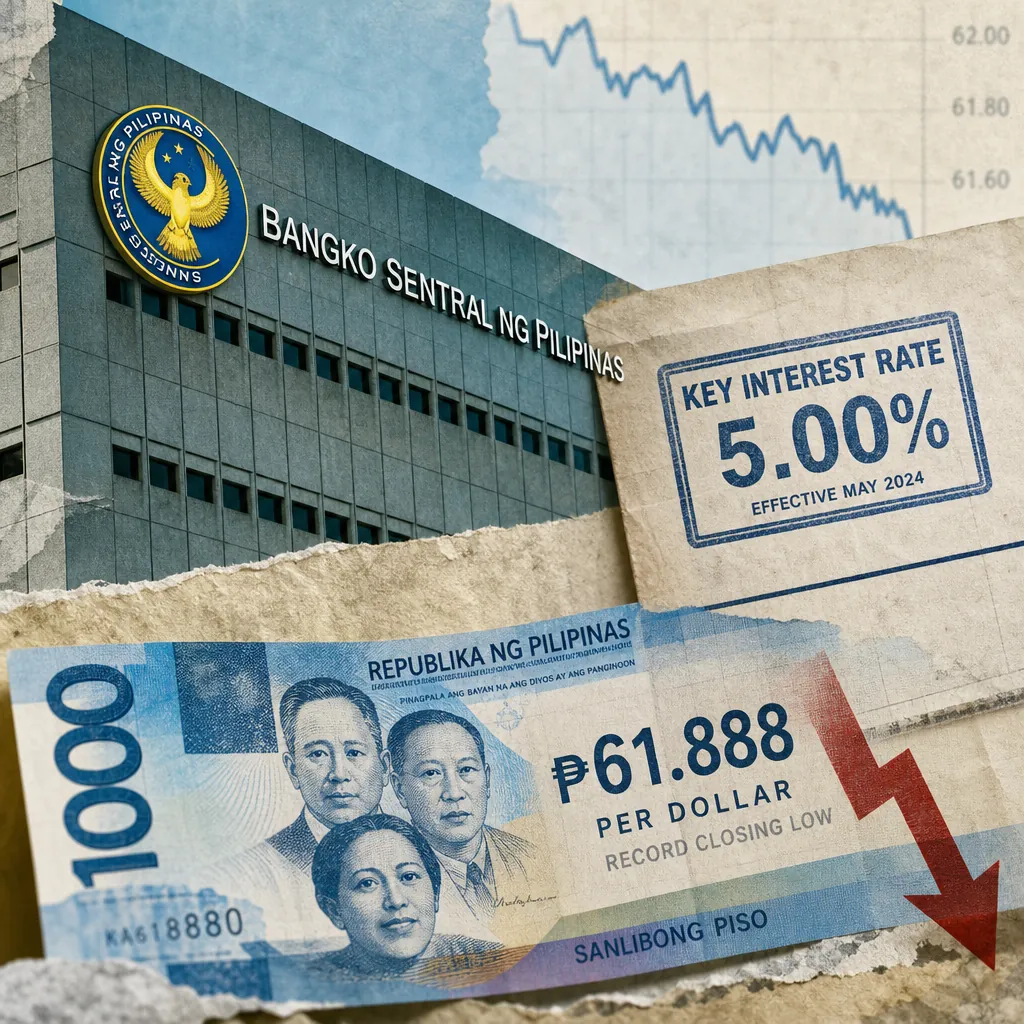
The Bangko Sentral ng Pilipinas (BSP) raised its key interest rate by another quarter of a percentage point on Thursday, pushing borrowing costs to their highest level in over a year and sending the peso to a record low against the dollar. The central bank's Monetary Board, its top policymaking body, lifted the target reverse repurchase rate — the rate that guides bank lending costs — to 5 percent, the third consecutive hike since April and the highest since June 2025. 116 The decision was widely expected, with 19 of 24 analysts polled by BusinessWorld and 11 of 15 surveyed by the Inquirer predicting the move. 116
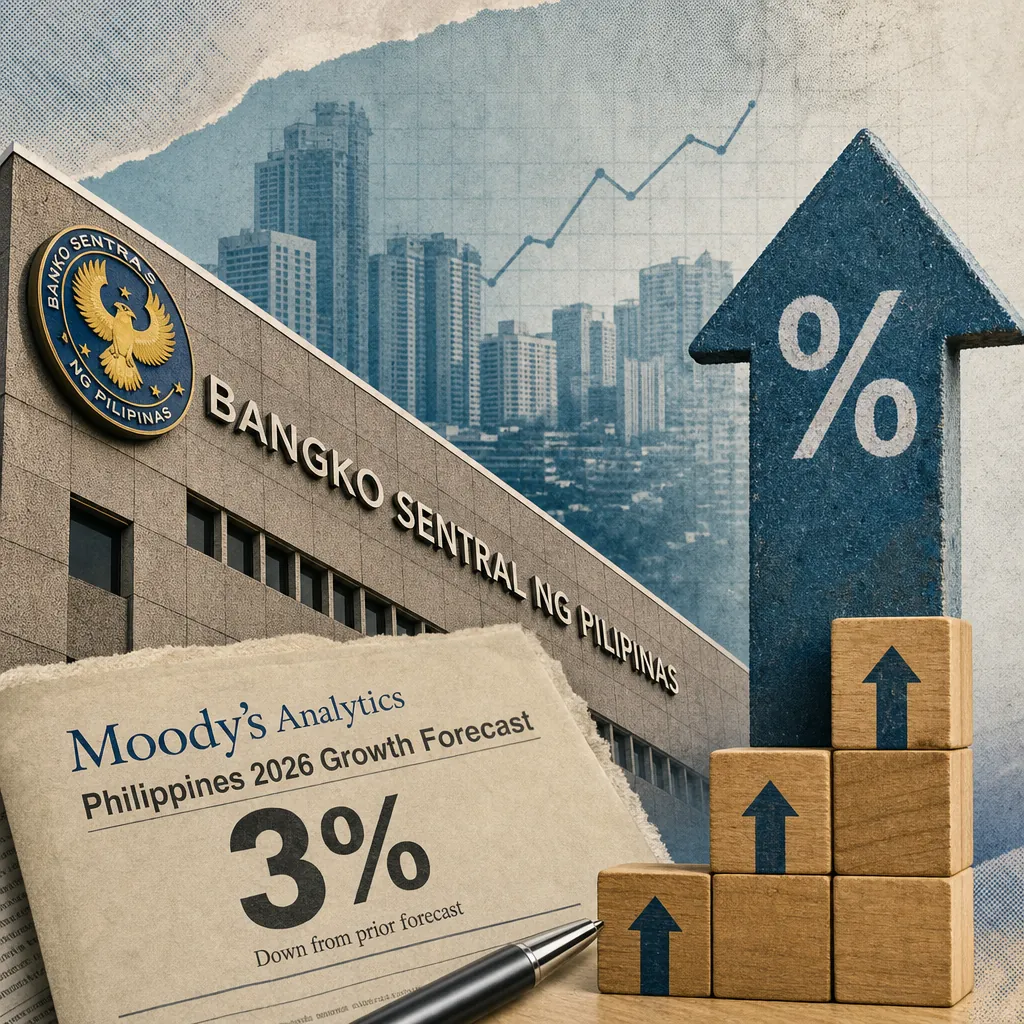
The hike came even as the economy is slowing. The ASEAN+3 Macroeconomic Research Office (AMRO), a Singapore-based regional economic watchdog, on Thursday slashed its Philippine growth forecast for 2026 to 3.4 percent from 4.1 percent, and cut its 2027 projection to 4.8 percent from 5.5 percent. 45 Both figures fall below the government's own targets of 3.5–4.5 percent for 2026 and 5.0–6.0 percent for 2027. 4 The peso reacted immediately, closing at 61.888 per dollar, down 23.8 centavos from the previous session and surpassing its prior record low of 61.847 set on July 24. 4054
The central bank's move was a "preemptive" response to inflation risks that go beyond the volatile oil prices tied to the Middle East conflict, Governor Eli Remolona Jr. said at a press conference. 25 The BSP now sees a potentially severe El Niño weather event and possible minimum wage hikes as the bigger threats to price stability. 46 "This time we judged the two most important inflationary factors to be the El Niño event as well as the minimum wage increases," Remolona said. 46 The central bank raised its 2027 inflation forecast to 5.4 percent from 4.5 percent, while trimming its 2026 projection to 6.1 percent from 6.4 percent. 4229
Key themes
- BSP raises rates to 5%, third straight hike since April — The Monetary Board lifted the target reverse repurchase rate by 25 basis points to 5 percent, the highest since June 2025, extending a tightening cycle that has now added 75 basis points since April. 1156 Rates on overnight deposit and lending facilities were also raised by 25 basis points each to 4.5 percent and 5.5 percent. 11
- Peso sinks to record closing low of 61.888 per dollar — The currency fell 23.8 centavos to close at 61.888 against the dollar, breaking the previous record of 61.847 set on July 24. 4054 Year to date, the peso is down 5.01 percent, or P3.098, from its P58.79 close on Dec. 29. 54
- AMRO cuts Philippine growth forecasts for 2026 and 2027 — The ASEAN+3 Macroeconomic Research Office lowered its 2026 GDP forecast to 3.4 percent from 4.1 percent and its 2027 projection to 4.8 percent from 5.5 percent, citing weaker private consumption and subdued investment. 45 Both are below the government's targets. 4
- Inflation risks shift from oil to El Niño and wage hikes — BSP Governor Eli Remolona Jr. said the central bank now sees a severe El Niño event and potential minimum wage increases as the most significant inflation threats, ahead of volatile oil prices. 46 The BSP raised its 2027 inflation forecast to 5.4 percent from 4.5 percent. 42
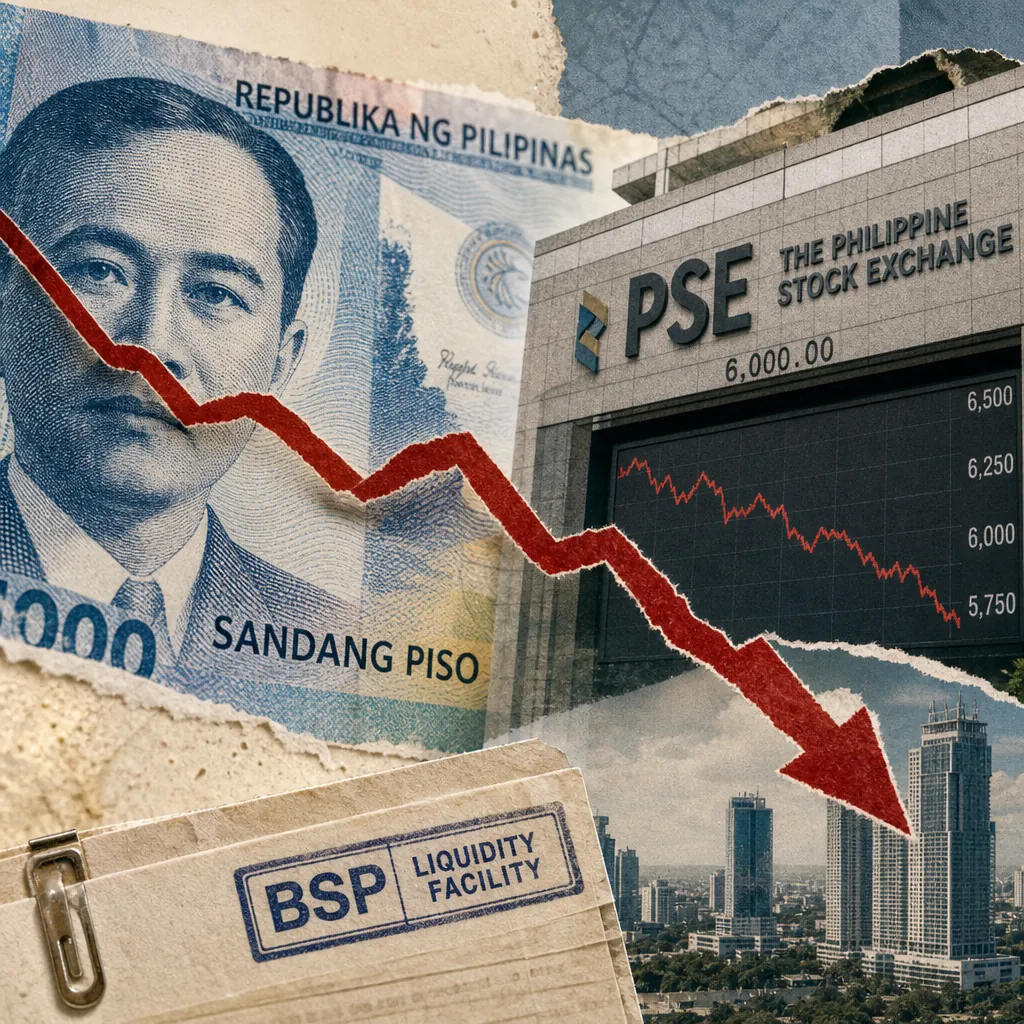
- Stock market skids to two-month low near 6,000 — The benchmark Philippine Stock Exchange Index fell 2.16 percent, or 132.65 points, to close at 6,004.58, its lowest in two months, as investors de-risked following the rate hike. 2359
- Budget deficit widens more than fivefold in July — The national government's fiscal gap ballooned to P106.3 billion in July from P18.9 billion a year earlier, a 461.73 percent jump, as spending rose nearly 20 percent on social assistance and capital projects. 961
- Banks raise capital and expand amid tightening — EastWest Bank announced a P9-billion stock rights offering, Sumitomo Mitsui Finance and Leasing completed a 30-percent stake in RCBC Leasing, and Philippine National Bank backed a P6.2-billion solar project in Iloilo. 13167
- Digital payments hit 64.69% of retail volume in 2025 — Digital payments accounted for 64.69 percent of retail transaction volume in 2025, up from 57.45 percent in 2024, meeting the national target, but a webinar is planned to address the back-office challenges this growth has created. 47
How the narratives stack
Dominant — The BSP's rate hike and its consequences dominated the day's coverage. The decision to raise rates to 5 percent, the peso's record low, and AMRO's growth downgrade were the top stories across the captured set, appearing in multiple outlets including BusinessWorld, the Inquirer, Philstar, the Manila Times, and the Daily Tribune. 11645625 The coverage value of these items was substantial — the BSP rate hike story alone drew an estimated ₱670,000 in advertising-equivalent value across the items captured here, and the peso story another ₱255,000. 1154 This was the day's most significant news by any measure: a policy decision with immediate market consequences and a clear impact on households and businesses.
Counter-narrative — Alongside the tightening, several banks announced expansion moves, suggesting the sector is not uniformly retrenching. EastWest Bank said it would raise P9 billion through a stock rights offering to fund growth and digitalization. 1344 Sumitomo Mitsui Finance and Leasing completed its acquisition of a 30-percent stake in RCBC Leasing, giving the Japanese firm a bigger foothold in the Philippines. 1653 Philippine National Bank backed a P6.215-billion solar power and battery storage project in Iloilo. 7 These stories frame a banking sector that is positioning for growth even as the central bank tightens.
Emerging — The shift in the BSP's inflation concerns from oil to El Niño and wage hikes is a new development that could shape policy for the rest of the year. 46 The central bank's 2027 inflation forecast of 5.4 percent, up from 4.5 percent, signals that price pressures are expected to persist well beyond the current Gulf conflict. 42 This suggests the tightening cycle may not be over, despite Remolona saying he hopes "we won't need another rate hike." 29
Under-covered — The House of Representatives' move to waive transaction fees on 4Ps cash assistance payments received relatively little attention in the captured set, appearing in just one broadsheet item. [^38](https://minio-s3.media-meter.com/mediameter/uploads/archive/Broadsheet/2026/08/28/Manila Standard/News/A-4/27.pdf) The measure would let beneficiaries of the Pantawid Pamilyang Pilipino Program — the government's conditional cash transfer program for poor households — receive their full benefits without deductions for transfer and withdrawal fees, with the Department of Social Welfare and Development shouldering the cost. [^38](https://minio-s3.media-meter.com/mediameter/uploads/archive/Broadsheet/2026/08/28/Manila Standard/News/A-4/27.pdf) This is a direct relief measure for the poorest Filipinos at a time of high inflation, and it deserves more attention than it got.
Platform insights
- Facebook — The BSP rate hike and peso record low were the dominant topics on Facebook, with news outlets' posts drawing thousands of reactions and shares. The emotional resonance of the peso hitting a record low — a tangible sign of economic strain for ordinary Filipinos — generated significant engagement, with users expressing concern about rising prices and the cost of living. The Kim Chiu breadwinner story also performed well, as her remarks about Filipino family obligations resonated with a broad audience. 27
- X (formerly Twitter) — Financial and business accounts drove the conversation on X, with economists, analysts, and market commentators weighing in on the BSP's decision and AMRO's growth downgrade. The peso's record low was a trending topic, with users sharing the exchange rate and debating the implications for imports, overseas Filipino workers' remittances, and the broader economy. The hashtag #BSP and #peso were active throughout the day.
- YouTube — The BSP's press conference, where Governor Remolona explained the rate hike, was covered by financial news channels. The peso's slide and its impact on businesses and consumers were also discussed in analysis videos. The platform's longer-form content allowed for deeper dives into the implications of the tightening cycle.
- Reddit — Philippine finance and economics subreddits discussed the rate hike and its effects on loans, mortgages, and savings. Users shared personal experiences with rising interest rates and debated whether the BSP's preemptive move was justified given the slowing economy. The AMRO growth downgrade was also a topic of discussion, with users expressing pessimism about the economic outlook.
Key voices and communities
- BSP Governor Eli Remolona Jr. — The central bank chief was the day's most prominent voice, explaining the rate hike as a "preemptive move" against inflation risks from El Niño and wage hikes. 2546 His statement that "we will tighten as much as we need to" signaled the BSP's commitment to bringing inflation back to its 3 percent target, even at the cost of slower growth. 50
- AMRO economists — AMRO Mission Chief and Lead Economist Jinho Choi and Chief Economist Dong He provided the regional perspective, warning that the Philippines would likely miss its growth targets until 2027. 562 Their assessment that weaker private consumption and subdued investment would weigh on growth underscored the tension between fighting inflation and supporting the economy.
- Market analysts and traders — Analysts at Philstocks Financial, Regina Capital Development, and First Metro Securities provided commentary on the stock market's decline, attributing the selloff to "de-risking" following the rate hike. 2359 Forex traders explained the peso's weakness as a reaction to the BSP's higher inflation outlook for 2027. 54
- Bank executives — Leaders at EastWest Bank, RCBC Leasing, and Philippine National Bank announced expansion plans, offering a counterpoint to the tightening narrative. 13167 Their moves signal confidence in the sector's long-term prospects despite near-term headwinds.
- Consumer advocates and ordinary Filipinos — On social media, everyday Filipinos expressed concern about rising prices, the weakening peso, and the impact on their household budgets. The Kim Chiu breadwinner story resonated with this group, highlighting the financial pressures many families face. 27
Narrative streams
BSP raises rates to 5%, its third straight hike, citing El Niño and wage risks
The Bangko Sentral ng Pilipinas raised its key interest rate by 25 basis points to 5 percent on Thursday, its third consecutive hike since April, as it sought to preempt inflation pressures from a potentially severe El Niño and possible minimum wage increases. 1156 The Monetary Board's decision brought the cumulative tightening this year to 75 basis points. 56 Rates on the overnight deposit and lending facilities were also raised by 25 basis points each to 4.5 percent and 5.5 percent. 11
Governor Eli Remolona Jr. described the move as "preemptive," noting that headline inflation had eased for three consecutive months to 6.2 percent as of July, but that underlying risks remained. 25 "Posing further risks to inflation is the possible impact of a severe El Niño event and potential minimum wage adjustments. These underlying price pressures require preemptive monetary action," he said. 25 The BSP cut its 2026 inflation forecast to 6.1 percent from 6.4 percent, reflecting lower-than-expected inflation in June and July and declining oil prices, but raised its 2027 projection to 5.4 percent from 4.5 percent, driven by the expected impact of El Niño on rice prices and higher minimum wage increases. 4229
Remolona said the board had considered pausing but decided the hike was necessary. "Yes, we considered the possibility of a pause. We considered all possibilities, but the decision to hike by 25 basis points wasn't so hard," he said. 50 He also signaled that more hikes could come: "We will tighten as much as we need to, to bring the inflation rate down to its target." 50
The rate hike was the most heavily covered story in the captured set, appearing in BusinessWorld, the Inquirer, Philstar, the Manila Times, the Daily Tribune, and Head Topics, with an estimated advertising-equivalent value of over ₱2 million across these items. 11656252935 This reflects the story's importance to the business community and the general public.
Read for the sector: Banks and financial institutions will face higher funding costs, which they may pass on to borrowers through higher loan rates. This could slow credit growth and dampen consumer spending, which is already weak. For businesses, the cost of borrowing will rise, potentially delaying investment plans. The BSP's commitment to fighting inflation, even at the cost of growth, signals that rates may stay elevated for some time.
Peso sinks to record low of 61.888 per dollar
The Philippine peso closed at a record low of 61.888 per dollar on Thursday, down 23.8 centavos from the previous session, as investors weighed the BSP's higher inflation outlook for 2027. 4054 The currency surpassed its previous record closing low of 61.847 set on July 24, and touched an intraday low of 61.89 before paring losses. 40 Year to date, the peso is down 5.01 percent, or P3.098, from its P58.79 close on Dec. 29. 54
Trading volume eased to $1.8 billion from $1.9 billion in the previous session. 40 A trader told BusinessWorld that the peso "depreciated to record lows after the BSP upwardly revised its inflation outlook for 2027 on account of risks from the anticipated El Niño phenomenon and the impact of wage hikes." 54 The trader also said the currency could remain weak on market caution ahead of US Federal Reserve Chair Kevin Warsh's remarks on the outlook for US interest rates. 60
The peso's slide was a major story across the captured set, with coverage in the Inquirer, BusinessWorld, Philstar, and Head Topics. 40546045 The combined advertising-equivalent value of these items was over ₱800,000. 40546045
Read for the sector: A weaker peso makes imports more expensive, which could add to inflation, particularly for fuel, food, and other goods that rely on imported inputs. This could further squeeze household budgets and increase costs for businesses. On the other hand, a weaker peso makes Philippine exports more competitive and boosts the peso value of overseas Filipino workers' remittances. For companies with dollar-denominated debt, the weaker peso increases the cost of servicing that debt.
AMRO cuts Philippine growth forecasts for 2026 and 2027
The ASEAN+3 Macroeconomic Research Office (AMRO), a Singapore-based regional economic surveillance body, slashed its Philippine growth forecasts on Thursday, citing weaker private consumption and subdued investment. 45 AMRO cut its 2026 gross domestic product forecast to 3.4 percent from 4.1 percent, and its 2027 projection to 4.8 percent from 5.5 percent. 45 Both figures are below the government's targets of 3.5–4.5 percent for 2026 and 5.0–6.0 percent for 2027. 4
The downgrade came after AMRO's annual consultation visit to the Philippines. "Growth this year will be weighed down by weaker private consumption amid higher inflation and subdued investment, although a gradual recovery in public construction in the second half of the year and resilient exports should provide some support," AMRO Mission Chief and Lead Economist Jinho Choi told a press briefing in Manila. 5 AMRO Chief Economist Dong He said achieving the new forecast would hinge heavily on a significant rebound in public construction. 62
AMRO also warned that "a timely and balanced response is needed to prevent the adverse effects of external and domestic headwinds from becoming persistent." 4 The 2025 growth of 4.4 percent was already the weakest since the pandemic, dragged down by a flood control scandal. 5
The AMRO downgrade was covered by the Manila Times, BusinessWorld, Philstar, and Head Topics, with an estimated advertising-equivalent value of over ₱1.7 million across the captured items. 45623032
Read for the sector: The growth downgrade confirms that the economy is slowing, which will affect businesses across all sectors. Consumer demand is expected to remain weak as inflation erodes purchasing power. Companies may delay expansion plans and focus on cost control. The government faces a challenge: it needs to boost public investment to support growth, but its budget deficit is already widening, and higher interest rates make borrowing more expensive.
Budget deficit widens more than fivefold in July
The national government's budget deficit ballooned to P106.3 billion in July, a 461.73 percent jump from P18.9 billion in the same month a year earlier, as spending rose nearly 20 percent. 961 The Bureau of the Treasury said expenditures increased to P588.6 billion from P491.2 billion, driven by higher disbursements for social assistance programs and capital projects. 9 Revenue growth was limited to 2.12 percent, reaching P482.3 billion, due to a base effect-driven decline in nontax collections. 934
The spending increase was largely due to the implementation of social assistance programs under the Unified Package for Livelihood, Industry, Food, and Transport framework, which was created to address the impact of the Middle East conflict, as well as projects under the Revised Armed Forces of the Philippines Modernization Program. 934 Month on month, the deficit narrowed by 59.8 percent from the P264.3-billion deficit in June. 9
The budget deficit story was covered by BusinessWorld, Philstar, and Head Topics, with an estimated advertising-equivalent value of over ₱1.3 million across the captured items. 96134
Read for the sector: The widening deficit means the government is spending more than it earns, which could lead to higher borrowing and potentially higher interest rates. This could crowd out private investment and put further pressure on the peso. However, the increased spending on social assistance and infrastructure could provide some support to the economy, particularly for low-income households and the construction sector.
Banks expand despite tightening: EastWest raises P9B, SMFL takes RCBC Leasing stake, PNB backs solar
While the central bank tightened monetary policy, several banks announced expansion moves, signaling confidence in the sector's long-term prospects. EastWest Banking Corp. said it plans to raise about P9 billion through a stock rights offering to fund its next phase of growth, including scaling up its wealth and priority banking propositions, investing in digital technologies, and funding loan growth. 1344 The Gotianun-led bank's board approved the proposed offering on Aug. 27, and major shareholders Filinvest Development Corp. and FDC Ventures Inc. will back the exercise. 13
Sumitomo Mitsui Finance and Leasing Co. Ltd. (SMFL) completed its acquisition of a 30-percent stake in RCBC Leasing and Finance Corp., the leasing arm of Rizal Commercial Banking Corp., after securing the necessary regulatory approvals. 1653 RCBC Leasing President and CEO Jayson Mendoza said the investment would support the company's expansion over the next three to five years, with growth opportunities in manufacturing, construction, information technology, renewable energy, healthcare, logistics, and auto leasing. 1653
Philippine National Bank backed a P6.215-billion co-financing package for a solar power and battery storage project in Iloilo, supporting the buildout of renewable energy capacity in the Visayas. 7 Singapore-based Levanta Renewables reached financial close for its 166-megawatt-peak solar project with an 80-megawatt-hour battery energy storage system in Barotac Viejo, Iloilo, targeted to begin commercial operations by the second quarter of 2027. 7
These stories were covered by the Inquirer, BusinessWorld, and Head Topics, with a combined advertising-equivalent value of over ₱1.5 million across the captured items. 13167445328
Read for the sector: Despite the near-term headwinds of higher interest rates and slower growth, banks are positioning for the long term. The capital raises and strategic investments suggest that the sector sees opportunities in digitalization, renewable energy financing, and underserved segments. This is a signal of confidence in the Philippine economy's medium-term prospects, even as the immediate outlook is challenging.
Digital payments reach 64.69% of retail volume, but back-office challenges emerge
The Philippines reached a major milestone in its digital payments journey, with digital payments accounting for 64.69 percent of retail transaction volume in 2025, up from 57.45 percent in 2024 and within the national target. 47 However, a webinar planned for September 8, 2026, titled "Your payments went digital. Your back office is paying for it," will explore the less visible challenge: while paying digitally has become seamless for consumers, the processes businesses rely on to manage those transactions have not necessarily kept pace. 47 The webinar, hosted by SwiftPay for CFOs, finance heads, and treasury leaders, will address the back-office challenge behind the Philippines' digital payments growth. 47
This story was covered by Head Topics, with an estimated advertising-equivalent value of ₱363,816. 47
Read for the sector: The growth of digital payments is a major opportunity for financial institutions, fintech companies, and businesses, but it also creates operational challenges. Companies need to invest in their back-office systems to handle the volume of digital transactions efficiently and securely. This is a growing market for technology providers and consultants who can help businesses modernize their payment operations.
Conversation trajectory
- BSP policy direction (next 1–2 months): The BSP has signaled it will "tighten as much as we need to" to bring inflation back to its 3 percent target. 50 The next policy meeting is scheduled for late September. If inflation data for August and September remain elevated, or if El Niño conditions worsen, another hike is possible. However, if inflation shows signs of easing and growth continues to weaken, the BSP may pause. The central bank's own forecast of 6.1 percent inflation for 2026 suggests rates will stay elevated for the rest of the year.
- Peso movement (next 1–3 months): The peso is at a record low and could weaken further if the US Federal Reserve signals higher-for-longer interest rates. A trader noted that the currency could remain weak on market caution ahead of Fed Chair Kevin Warsh's remarks. 60 The peso's trajectory will also depend on the BSP's policy stance and the strength of the US dollar. A continued slide could add to inflation pressures by making imports more expensive.
- Economic growth data (next 1–3 months): AMRO's downgrade to 3.4 percent growth for 2026 is a significant revision, and the government's own target of 3.5–4.5 percent may be at risk. The second-quarter GDP data, which showed a new post-pandemic low, was already weak. 5 The third-quarter data, due in November, will be a key test of whether the economy is stabilizing or deteriorating further. Public construction is expected to recover in the second half, which could provide some support. 5
- Inflation data (next 1–2 months): The BSP's 2026 inflation forecast of 6.1 percent is well above the 3 percent target. 42 August inflation data, due in early September, will be closely watched. The impact of El Niño on rice prices is expected to hit in the fourth quarter of 2026, which could push inflation higher. 42 Minimum wage adjustments could also add to price pressures.
- Banking sector consolidation (next 6–12 months): The Philippine Stock Exchange expects the number of stock brokerage firms to decline further if the Securities and Exchange Commission raises capital requirements. 51 PSE President and CEO Ramon Monzon said the number of brokers has already declined to 121 from about 180 previously, and could fall further. 51 This consolidation could reshape the brokerage industry, with smaller players exiting and larger firms gaining market share.
- Trigger events to watch: The BSP's next policy meeting in late September; the release of August inflation data in early September; the release of second-quarter GDP data (already out, showing weakness); the SEC's decision on broker capital requirements; and any escalation of the Middle East conflict that could affect oil prices.
Response guidance
For banks and financial institutions: Emphasize the BSP's commitment to price stability and explain how higher rates protect the value of savings and purchasing power over the long term. Communicate clearly with borrowers about the impact of rate hikes on loan payments and offer guidance on managing higher costs. Highlight any support programs for vulnerable customers, such as loan restructuring or financial literacy initiatives.
For businesses: Prepare for higher borrowing costs and weaker consumer demand. Review pricing strategies to manage input cost increases, particularly for imported goods affected by the weaker peso. Communicate with customers about any price adjustments transparently, and focus on operational efficiency to protect margins. Consider delaying non-essential capital expenditures until the economic outlook clarifies.
For government agencies: Acknowledge the challenges posed by the widening budget deficit and slower growth. Communicate clearly about the purpose of increased spending, particularly social assistance programs, and the expected benefits. Provide regular updates on infrastructure projects and their progress, as public construction is seen as a key support for growth. Be transparent about the fiscal situation and the government's plans to manage the deficit.
For communicators in the sector: The peso's record low and the BSP's rate hike are sensitive topics that affect households directly. Avoid alarmist language and focus on factual, clear explanations of what the changes mean for consumers and businesses. Provide context on the BSP's inflation target and the reasons for the tightening cycle. When discussing the weaker peso, acknowledge the concerns of ordinary Filipinos while explaining the broader economic factors at play. Avoid making predictions about future rate moves or exchange rates, as these are uncertain.
For companies announcing expansion plans: Frame growth initiatives as a sign of confidence in the Philippine economy's long-term prospects, while acknowledging the near-term challenges. Highlight how investments in digitalization, renewable energy, and other areas will create value for customers and support economic recovery. Be specific about the expected benefits and timelines.
See the full picture behind today's signals.
This report draws from Media Meter's MediaWatch, our real-time monitoring engine tracking 2,470+ Philippine sources across print, broadcast, digital, and social. Explore how the platform turns raw coverage into decision-grade intelligence, then see how it's configured for teams like yours — whether you're in PR agencies, corporate comms, government, or marketing.
Want more? Browse our Report Library for sector and crisis intelligence, or request a demo and we'll have your brand set up before the call.
Want this kind of intelligence on your brand?
This brief is built on the same MediaWatch methodology that runs continuously across every brand we monitor. See your competitive landscape, Impact Score, and narrative trajectory in a 30-minute demo.