BSP Sets P1-B Capital Floor for Digital Banks
The Bangko Sentral ng Pilipinas required thrift, rural and cooperative banks moving to digital models to hold at least P1 billion in capital, while Mynt's GCash IPO drew more than 20 cornerstone investors and retail banking complaints piled up on Reddit.
The Conversation
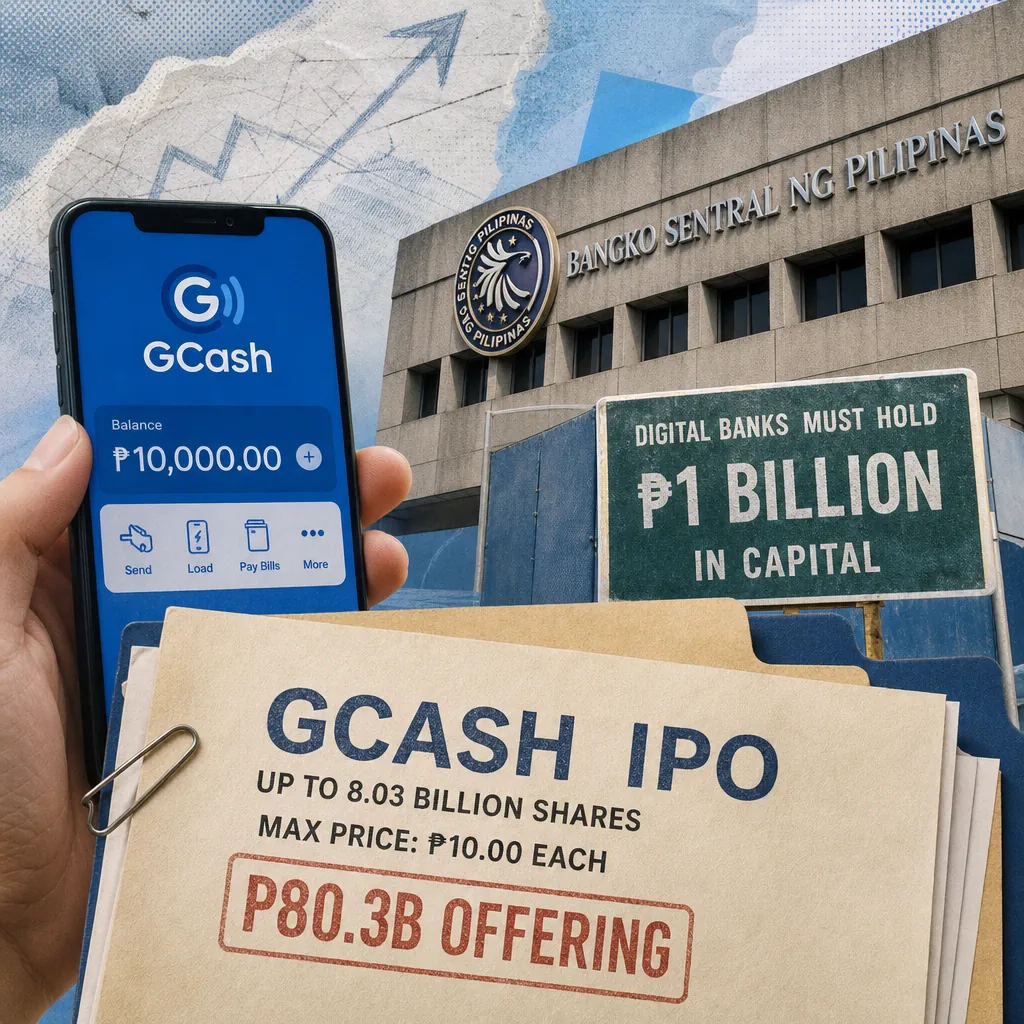
The Bangko Sentral ng Pilipinas (BSP) told thrift, rural and cooperative banks that are shifting toward digital banking models they must hold at least P1 billion in capital, under Circular No. 1240 dated September 21, 2026. The rule, reported across the captured set by the Daily Tribune, Daily Guardian, Panay News and a Davao Plus blog roundup, gives affected lenders six months from receipt of the BSP's notice to comply and applies the same capital floor that already governs fully digital banks.637158 The BSP is the Philippines' central bank; it sets monetary policy, supervises banks, and writes the prudential rules that determine how much capital a lender must hold against the risks it takes. The circular matters because a rural bank with a few hundred million pesos in capital can now run a digital-first business — an app, an e-wallet, automated lending — without ever being classified as a digital bank, and the BSP is closing that gap.
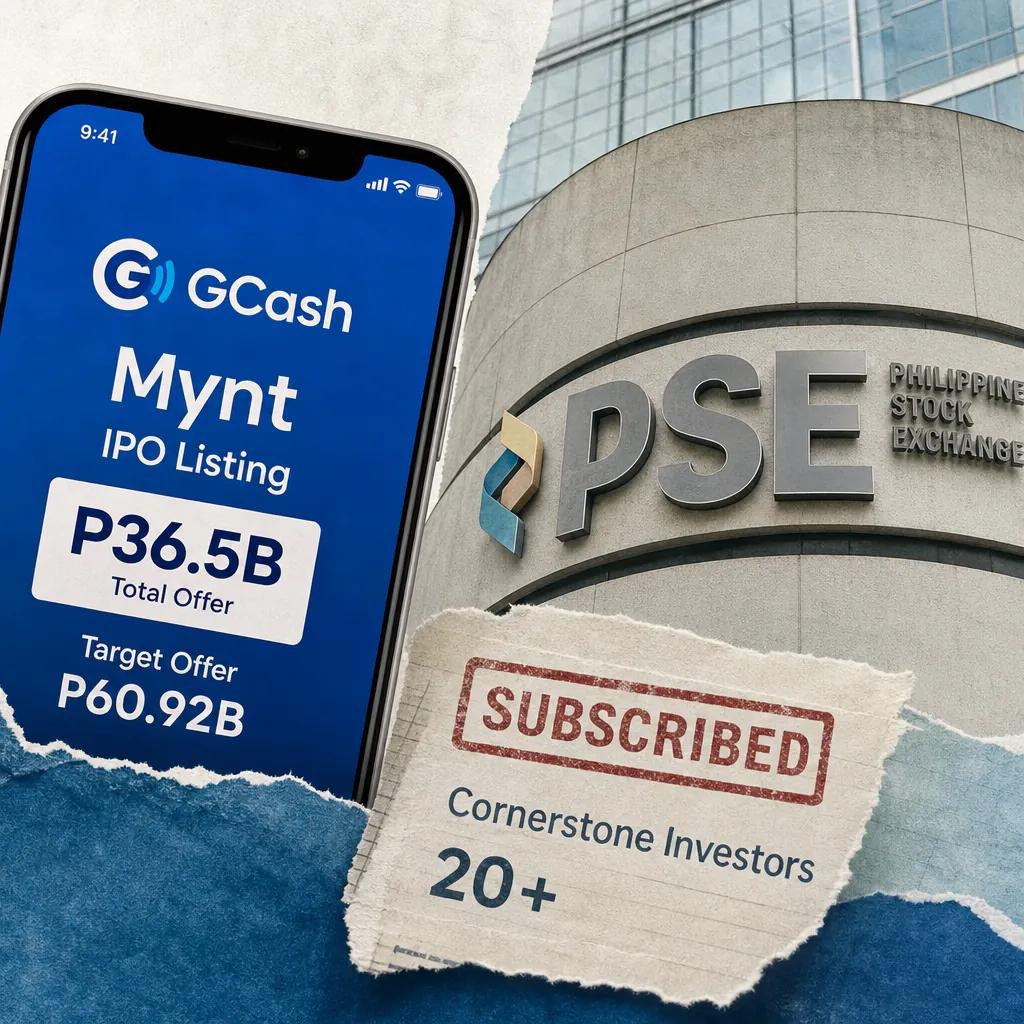
On the same day, Mynt Inc., the parent of e-wallet giant GCash, said more than 20 global and domestic cornerstone investors had committed to its initial public offering (IPO), enough to cover nearly the entire institutional tranche. Cornerstone investors are large institutions that agree in advance to buy a set amount of shares, signalling confidence to other buyers. Mynt's list includes the International Finance Corp., the World Bank's private-sector arm, along with HSBC Global Asset Management, FIL Investment Management (Hong Kong), and domestic names such as ATRAM Trust, BPI Asset Management and Trust, China Bank Capital, Metrobank Trust Banking Group, PhilEquity and RCBC Capital.306961 At a maximum price of P6.60 per share, the offer of 9.23 billion primary and secondary shares would raise up to P60.92 billion, which would make it the largest IPO in Philippine history.61
Underneath those two institutional stories, the day's most human material sat on Reddit, where 16 tracked posts dated September 23–24 described credit card rejections, missing one-time passwords, and statements of account for cards people say they never received. BPI accounted for eight of the posts. Engagement on those threads was thin — most drew zero to two likes — so the volume of complaint is not the story; the recurrence of the same complaint types across different banks is.345678910
Key themes
- BSP imposes a P1-billion capital floor on banks going digital. Circular No. 1240, dated September 21, requires thrift, rural and cooperative banks the BSP judges to be operating like digital banks to meet the same P1-billion minimum capital as digital banks, with six months to comply.6371
- Mynt's GCash IPO draws more than 20 cornerstone investors. The commitments cover nearly the whole institutional tranche, and at P6.60 per share the offer would raise up to P60.92 billion, the largest Philippine listing to date.306961
- BPI draws the largest share of service complaints in the captured posts. Eight of 16 tracked Reddit threads concern BPI, covering a credit bureau dispute open three months, one-time passwords not reaching a non-Philippine number since early September, and a statement of account for a card the user says was never delivered.345
- Credit card rejections span Metrobank, RCBC, UnionBank and LandBank. Applicants report declines online and in branch, including a job-order nurse paid through LandBank who was turned down by RCBC and UnionBank.68
- Maya pushes payroll portability for 1.9 million digital workers. The fintech is working with business process outsourcing companies and the IT and Business Process Association of the Philippines to extend savings and credit access, and backs the Digital Bank Association of the Philippines on bank-agnostic salary disbursement.1
- Inflation is forecast to reaccelerate in September, keeping rate hikes in play. UnionBank's chief economist estimates September inflation at 6.5% year on year, which would be the fastest in four months and the seventh straight month above the BSP's 3% target.46
- The PSEi fell to a 10-month low. The Philippine Stock Exchange Index dropped 1.12% to 5,730.02, its weakest close since November 14, 2025, on weaker growth forecasts and rising US Treasury yields.33
- Insurers and banks published financial-literacy content. FWD Life Philippines explained policy inclusions and exclusions, drawing 84 shares, while Malayan Savings Bank reminded depositors of BSP regulation and deposit insurance up to P1 million per depositor.1314
How the narratives stack
Dominant. The BSP's capital rule for digital-leaning banks is the day's most consequential regulatory development, and it is the story the broadsheet and online business desks led with. The Daily Tribune, Daily Guardian, Panay News and a Davao Plus blog roundup all carried it, and the BusinessWorld opinion page argued the same day that monetary easing would be premature given the BSP's own inflation forecasts of 6.1% for 2026 and 5.4% for 2027.63715870 Within the captured set, the rule drew the widest pickup of any single banking item, though the set itself is a monitored selection rather than a full record of the day's coverage. The rule's consequence is concrete: a cooperative bank with, say, P300 million in capital that has built a mobile-first deposit and lending business must now either raise roughly P700 million or pull back from the model that made it grow.
Counter-narrative. The Mynt IPO story is the counterweight, and it is a genuinely different kind of prominence — not a regulatory constraint but a capital-markets endorsement. More than 20 cornerstone investors, including the World Bank's IFC, agreed to anchor the offering, and at P6.60 per share the deal would raise up to P60.92 billion.306961 Mynt president and chief executive Martha Sazon said the group "reflects confidence in our nation's number one profitable app, our track record of growth, and the significant opportunity that lies ahead."61 The two stories are not in tension so much as they are two halves of the same regulatory moment: the BSP is raising the bar for small digital challengers at the same time the market is rewarding the largest one.
Emerging. The Reddit complaint cluster is the emerging signal, and it is emerging precisely because it is small. Sixteen posts, most with zero to two likes, is not a customer revolt. But the same complaint types recur across banks: a credit bureau dispute unresolved for three months because a closed card still reports as open, a mobile key disabled since the first week of September with no one-time password delivered to a non-Philippine number, a statement of account for a card the user never held, an approved card that cannot be enrolled in the app.345 One user filed a BSP complaint report and asked publicly, "Wala ba kayong maayos na Credit Bureau Report Dispute department BPI?"3 Another said they copied the BSP on an email about a card they never received.5 These are individual accounts with no bank response in the material, so they establish complaint types, not scale.
Under-covered. The MSME lending gap received a single item in the captured set and no visible pickup elsewhere. Bank lending to micro, small and medium enterprises reached P574.8 billion as of end-December 2025, up 5.23% from P546.22 billion a year earlier, but that was only 4.73% of the banking industry's P12.143 trillion total loan book. Micro and small enterprises — the segment an AND Solutions executive described as most misjudged — received P238.45 billion, or 1.96% of all bank loans.64 The story placed low in the set, but the number is the one that most directly explains why the credit card rejection posts exist: a system that lends less than 2% of its book to small enterprises is also a system that turns down a nurse with a payroll account.
Platform insights
- Reddit. Reddit carried nearly all of the day's consumer banking conversation, and its character was diagnostic rather than emotional. Users posted specific failure modes — a P82,000 Lazada gadget purchase declined on a BDO card with credit limit remaining, a GoTyme customer told to drive nearly 20 kilometers to a mall kiosk for a replacement card, a Banko by BPI user locked out after failed login attempts.7919 Engagement was minimal, which is itself the finding: these are people seeking answers, not audiences. The subreddits involved — r/PHCreditCards, r/TradBanksPH, r/DigitalbanksPh, r/phinvest, r/KaskasanBuddies — function as peer support desks for bank customers who have not gotten resolution through official channels.
- Facebook. Facebook hosted the institutional and promotional side of the conversation. FWD Life Philippines' explainer on covered illnesses, policy definitions, exclusions and waiting periods drew 28 likes, 29 love reactions and 84 shares — the highest interaction of any single post in the captured set.13 Malayan Savings Bank posted a financial-planning message citing BSP regulation and Philippine Deposit Insurance Corporation coverage up to P1 million per depositor.14 The Loop advertised a MacBook Neo at P48,990 cash or P2,041.25 per month over 24 months with BPI and UnionBank through September 30, and Dyson promoted 0% interest for up to 12 months on BDO Credit Card purchases from September 25 to December 31.1112 One public complaint also ran here: a post tagging BPI, the BSP and TransUnion Philippines said a second BSP complaint had been filed over a credit bureau dispute open three months.23
- X. No meaningful activity in the captured material.
- YouTube. No meaningful activity in the captured material.
Key voices and communities
Retail banking customers on r/PHCreditCards and r/TradBanksPH. These are the bank customers whose unresolved service issues can surface as public complaints and regulatory escalations. Their framing is procedural: they describe what they applied for, what the bank told them, and what has not happened since. One user working as a job-order nurse paid through LandBank said they were declined by RCBC and UnionBank online and were considering applying in person at Metrobank.6 Another reported a Metrobank application that was not approved and asked which bank is easiest to apply with.8 A third described applying for a Metrobank secured card at account opening, holding out P15,000 for the Vantage card, then wanting a higher-tier card after approval — while noting BPI Signature, BDO Platinum and Security Bank World Mastercard were already in hand.21 The common thread the posts themselves draw is inconsistent approval across banks for the same person.
Digital-first bank and e-wallet users. GoTyme and GCash users raised access and convenience issues. A GoTyme customer complained about the distance to a replacement-card kiosk: "I used to just go to any pnp to do whatever and now I need to drive nearly 20km just to get a new card!"9 A PhilHealth member who moved from employed to voluntary status said a September 2026 GCash contribution payment had not posted to the member portal, which still showed contributions only through August.16 These users represent the segment where service-design decisions get discussed publicly, and where a physical-channel gap in a digital bank is a direct contradiction of the brand promise.
Insurance policyholders and insurer social accounts. A Sun Life policyholder with about P17,000 in fund value after paying P6,000 quarterly asked whether to stop premiums on the variable unit-linked (VUL) component while keeping the insurance.15 A VUL is a life insurance policy whose cash value is invested in funds, so the policyholder bears investment risk; the question of whether the fund value can carry future premiums is a recurring one for holders. FWD Life Philippines ran the clearest insurer-led education content in the set.13
Maya Inc. and the digital payroll policy community. Maya head of corporate affairs Kristoffer Rada framed digital payroll as an entry point to broader financial health: "The future of work should also mean better financial tools for workers. Reliable digital salary disbursement is the starting point."1 The company is working with business process outsourcing companies and the IT and Business Process Association of the Philippines (IBPAP), the industry group for the country's outsourcing sector, to extend savings and credit access to nearly 1.9 million digital workers.1
Analysts and market commentators. UnionBank chief economist Ruben Carlo O. Asuncion estimated September inflation at 6.5% year on year, up from 6.1% in August, which would end four straight months of easing.46 Maybank Securities Philippines head of research Kervin Laurence Sisayan said elevated second-quarter provisions were "mostly pre-emptive in nature" and that non-performing loan ratios remain stable.68
Narrative streams
BSP requires P1 billion in capital from banks moving to digital models
The BSP's Circular No. 1240, dated September 21, 2026, requires existing thrift banks, rural banks and cooperative banks that the central bank determines are operating under a business model similar to a digital bank to meet the P1-billion minimum capital requirement that already applies to digital banks. Affected lenders have six months from receipt of the BSP's notice to comply, and the same requirement applies when a proposed acquisition is intended to transform a thrift, rural or cooperative bank into a technology-driven business.6371 The BSP may also impose additional safeguards, including enhanced supervisory reporting and restrictions on certain activities.71
The rule addresses a supervisory gap. Digital banks in the Philippines have been subject to a P1-billion capital floor since the BSP began licensing them, on the logic that a bank with no branches and rapid deposit growth needs more capital, not less, to absorb the risks of automated lending and fraud. But a rural bank that keeps its rural-bank license while running an app-based deposit and loan business faced no such floor. The circular closes that route. For a cooperative bank with a few hundred million pesos in capital, the choice is to raise capital, merge, or slow the digital build-out.
The read for the sector: smaller banks that have been competing with digital banks on product speed will now compete on capital, and the six-month clock starts when the BSP sends its notice, not when the circular was dated. Lenders that cannot raise the capital will look for partners or acquirers, which creates consolidation pressure in the thrift, rural and cooperative segment. The same day, the BSP's own inflation forecasts of 6.1% for 2026 and 5.4% for 2027, with inflation expected to stay above the 3% target until the third quarter of 2027, mean the cost of that capital will not be falling soon.70
Mynt's GCash IPO draws more than 20 cornerstone investors
Mynt Inc. secured commitments from more than 20 global and domestic cornerstone investors for its proposed listing on the main board of the Philippine Stock Exchange, enough to cover nearly all shares allocated to institutional investors, subject to reallocation between tranches, final pricing and customary closing conditions.3069 The domestic list includes ATRAM Trust, BPI Asset Management and Trust, China Bank Capital, Metrobank Trust Banking Group, PhilEquity and RCBC Capital; the global list includes the International Finance Corp., HSBC Global Asset Management (UK), Amundsen Investment Management and FIL Investment Management (Hong Kong).69 Mynt said this was the largest group of cornerstone investors assembled for a Philippine IPO to date.30
At a maximum price of P6.60 per share, the offer of 9.23 billion primary and secondary shares would raise up to P60.92 billion, which would make it the largest IPO in the country's history.61 The filing followed a pre-effective approval letter from the Securities and Exchange Commission and the filing of a Red Herring Prospectus, the near-final document that sets out a company's financials and risks before a listing.30
The read for the sector: the anchor commitments remove the biggest execution risk in a large Philippine listing — the risk that the institutional tranche does not fill — and they do it at a moment when the broader market is weak. The PSEi fell 1.12% to 5,730.02 on Thursday, its lowest close since November 14, 2025, as rising US Treasury yields and weaker growth forecasts weighed on sentiment.33 A deal of this size pricing into that market tells issuers and their advisers that anchor demand, not index level, is what gets a large offer done. For banks and fintechs watching the payments layer, the listing also puts GCash's economics on the public record for the first time.
Retail banking complaints cluster around BPI service failures
Eight of the 16 tracked Reddit posts concern BPI, and the complaints are specific. One user reported a credit bureau dispute still unresolved after three months because a closed card still shows as open, and said they had filed a BSP complaint report.3 A Facebook post said a second BSP complaint had been submitted over the same kind of dispute, tagging BPI, the BSP and TransUnion Philippines directly.23 Another user reported not receiving one-time passwords on a non-Philippine number and being told by the BPI hotline that the issue has been ongoing since the first week of September, with no estimated resolution time and no alternative transfer method offered.4 A separate poster received a statement of account for a DOS/Robinson's Bank card they say was never physically delivered, and emailed the bank with the BSP copied.5 A Banko by BPI user was locked out after failed login attempts and could not recover the account number.19 One user described a BPI #MySaveUp account closed without a disclosed reason around October of the prior year, followed by an approved credit card this month that cannot be enrolled in the app.3
These are individual accounts with no bank response in the material, and engagement on them was minimal, so they establish recurring complaint types rather than a measured pattern of failure. The one-time password issue is the most reportable item because the user states BPI customer service described it as ongoing since the first week of September with no estimated resolution — if accurate, that is a service continuity problem affecting overseas-linked customers, a segment that depends on one-time passwords to move money.4
The read for the sector: the complaints that reach the BSP are the ones that carry supervisory weight, and two posts in the set say a BSP complaint was filed or copied. Banks that route dispute resolution through slow internal queues are accumulating regulatory-perception risk at exactly the moment the BSP is tightening governance standards for directors and officers.73 The cost of a three-month credit bureau dispute is not the disputed amount; it is the complaint file that lands on a supervisor's desk.
Credit card rejections span four banks and point to inconsistent underwriting
The credit card discussion in the captured material is dominated by first-time applicants working through failed or unclear applications. One user writing as a job-order nurse paid through LandBank described being declined online by RCBC and UnionBank before asking whether Metrobank accepts walk-in applicants without a savings account.6 Another reported a Metrobank application that was not approved and asked which bank is easiest to apply with.8 A third described applying for a Metrobank secured credit card at account opening, holding out P15,000 for the Vantage card, then wanting a higher-tier card after the approval had already gone through — while noting BPI Signature, BDO Platinum and Security Bank World Mastercard were already in hand.21 A separate conversation weighed whether to keep both an RCBC Visa Infinite and a Hexagon Platinum card.22 One user reported a first UnionBank card and confusion over a no-annual-fee promo.24
The common thread the posts themselves draw is inconsistent approval across banks for the same person. A job-order nurse is a government health worker on a short-term contract, which means irregular income documentation — the kind of profile that automated underwriting models handle poorly. The same day, the MSME lending data showed that micro and small enterprises received P238.45 billion, or 1.96% of all bank loans, as of end-December 2025.64 The two facts describe the same underwriting bias: borrowers without formal, standardized income records are declined or under-served, whether they are individuals or small firms.
The read for the sector: banks that want to grow retail lending without loosening credit standards will need alternative data — bank statements, invoices, transaction histories — to score the borrowers their current models reject. An AND Solutions executive made exactly that argument, saying alternative-data underwriting can turn bank statements, invoices, handwritten records and transaction histories into usable credit signals for MSMEs.64 The same logic applies to a contract nurse with a LandBank payroll account.
Maya pushes payroll portability and Open Finance for 1.9 million digital workers
Maya Inc. is working with business process outsourcing companies and IBPAP to extend savings and credit access to nearly 1.9 million digital workers, and backs the Digital Bank Association of the Philippines (DiBA PH) in advocating payroll portability.1 Payroll portability would require bank-agnostic disbursement through interoperable payment infrastructure — meaning an employer could not force a worker to receive salary at one designated bank, and the worker could choose where the money lands. Maya head of corporate affairs Kristoffer Rada said: "Payroll should not end with the disbursement of a salary."1 The same report describes Maya's use of artificial intelligence in onboarding, credit assessment and fraud detection, and a formal AI governance framework begun in 2024, followed by a Board-approved policy covering risk classification, testing, monitoring, security and human accountability.1
The read for the sector: payroll portability is a payments-layer question with a consumer-protection frame, and it puts Maya on the record against the current practice of employers designating a single payroll bank. If the proposal advances, the banks that hold payroll accounts today would compete for deposits they currently receive by default, and the digital banks and e-wallets that win on app experience would gain a direct route to salary inflows. Nothing in the material states the outcome of the proposal or supplies an earlier precedent, so the position is a public stance, not a pending rule.
Inflation forecast to reaccelerate, keeping further rate hikes on the table
UnionBank chief economist Ruben Carlo O. Asuncion estimated September inflation at 6.5% year on year, which would be the fastest pace in four months, or since 6.8% in May, and would end four straight months of easing after August's 6.1%.46 September would also be the seventh straight month that inflation exceeded the BSP's 3% target. The Philippine Statistics Authority will release the September inflation report on October 14.46 ANZ Research said the BSP has been among the most hawkish central banks in the region since the escalation of the Middle East conflict in late February, and that the real interest rate — the policy rate minus inflation — remains in accommodative territory, giving the BSP room for further hikes. ANZ expects another 25-basis-point increase in the fourth quarter, which would take the target reverse repurchase rate above its current 5%.46 The Monetary Board, the BSP's highest policy-making body, has already delivered three quarter-point hikes.46
The read for the sector: borrowers with floating-rate loans, including the thrift and rural banks now facing the P1-billion capital requirement, face a higher cost of funds into 2027. The BSP's own forecasts put inflation at 6.1% for 2026 and 5.4% for 2027, above target until the third quarter of 2027, which is why the BusinessWorld opinion page argued that monetary easing would be premature.70 For consumers, the same dynamic shows up in the Metro Manila minimum wage increase to P755 from P695 for non-agricultural workers starting September 26 — a P60 daily raise that ANZ Research said would have a "limited" impact on consumer spending because rising living costs could prompt households to save the extra income rather than spend it.26
Banks report resilient balance sheets as bad loans edge up
Maybank Investment Banking Group said Philippine banks remain resilient against rising bad loans because lenders maintain high loss buffers, and that higher interest rates are expected to support profitability. Kervin Laurence Sisayan, head of research at Maybank Securities Philippines, said elevated provisions booked in the second quarter were "mostly pre-emptive in nature" and that non-performing loan ratios remain stable with high loan-loss coverage.68 Bad loans rose 9.27% to P585.081 billion in July from a year earlier, according to BSP data, bringing the industry's gross bad loan ratio to a two-month high of 3.35% from 3.29% in June, but below 3.4% a year earlier.68
The read for the sector: the ratio is the number to watch, not the peso total, because the loan book is growing too. A 3.35% bad loan ratio is below where it stood a year ago, which supports the Maybank view that the second-quarter provisions were precautionary. But the same higher interest rates that support bank profitability also raise the repayment burden on borrowers, and the retail complaints in the captured posts — declined transactions, disputed accounts — are the consumer-side edge of that pressure.
Banks and insurers publish financial-literacy content
FWD Life Philippines posted a swipe-through explaining covered illnesses, policy definitions, exclusions and waiting periods, drawing 28 likes, 29 love reactions and 84 shares — the highest interaction of any single post in the captured set.13 Malayan Savings Bank posted a financial-planning message noting BSP regulation and Philippine Deposit Insurance Corporation (PDIC) deposit insurance up to P1 million per depositor.14 The PDIC is the state insurer of bank deposits; the P1-million cap means that if a bank fails, each depositor is reimbursed up to that amount. A Sun Life policyholder with about P17,000 in fund value after paying P6,000 quarterly asked whether to stop premiums on the VUL component while keeping the insurance.15
The read for the sector: the FWD post's share count — 84 shares against 28 likes — shows that insurance explainers travel further than they are liked, which is the pattern of content people forward to family members. The Sun Life thread shows the other side: VUL holders who do not understand how fund value and premiums interact are a persistent source of complaints and surrender requests. Insurers that invest in plain-language policy education reduce the servicing cost of that confusion.
EastWest launches check pickup for small businesses
EastWest Banking Corp. launched a check pickup service that lets businesses have checks collected from customers by an accredited logistics provider and consolidated for deposit into the company's EastWest account. The service is available in major cities nationwide and targets businesses that regularly collect checks from multiple customers. Chief executive Jerry G. Ngo said: "Economic growth is driven not only by major investments but also by improvements in everyday productivity. For many businesses, particularly small and medium enterprises, reducing friction in routine financial transactions can have a meaningful impact on efficiency and resource utilization."67 The announcement came as the bank reported a 32% drop in second-quarter net income to P1.56 billion.39
The read for the sector: check pickup is a low-technology answer to a real problem — small firms spend staff time collecting and depositing checks — and it competes with the digital collections tools that fintechs sell to the same customers. For EastWest, the service is a retention play for business accounts at a time when its earnings are under pressure.
Government retail bond sale marks 25 years of the program
The Bureau of the Treasury (BTr) said it will raise at least P30 billion from its first retail Treasury bond (RTB) offering this year, selling 2.5-year peso-denominated bonds due April 12, 2029. The public offering runs September 29 to October 7, with an issue date of October 12. This is the 32nd RTB issuance and marks 25 years since the government first offered the instrument to small investors in 2001.2527 RTBs are government debt sold in small denominations to individual buyers, as opposed to the large-denomination bonds sold to institutions. This is the second time RTBs will be available on an e-wallet and non-government digital finance platforms.27 National Treasurer Sharon P. Almanza said the government is aiming to raise less than half of the P507.16 billion it raised in its last RTB offer in August 2025.27 The government will also accept offers from holders of five existing securities to exchange their eligible holdings.25
The read for the sector: the smaller target — P30 billion against P507.16 billion last time — reflects the higher rate environment, since the government must pay more to borrow now than it did a year ago. The e-wallet distribution channel is the part that matters for banks and fintechs: it puts a government savings product inside the same apps where consumers hold their e-money, and it normalizes the idea that a retail investor can buy a bond without visiting a bank branch.
PNB Holdings lists on the exchange to unlock property value
PNB Holdings Corp. listed on the Philippine Stock Exchange on Friday, September 25, in a listing by introduction that does not raise fresh capital but gives liquidity to the company's more than 30,000 shareholders. Chief financial officer Ponciano Carreon Jr. said the company is preparing to launch development of an 8,000-square-meter Buendia property in Makati by late next year, and that the site's allowable floor area ratio has increased to 34 from 16, meaning the site could support about 272,000 square meters of floor area.3728 Carreon said the company would disclose within three to six months which properties would undergo adaptive reuse, and that it would not commit large capital expenditure: "It's just a matter for us to optimize them, repurpose them, invest a few hundred million, maybe billions or so, and it will give very good growth."37
The read for the sector: a listing by introduction creates a public share price for a property portfolio without selling new shares, which gives the parent bank a valuation reference for assets that were previously carried at book. For the property market, the higher floor area ratio on the Buendia site is the more consequential detail — it roughly doubles what can be built there, which is why the company is reviewing its master plan rather than proceeding with the original design.28
Conversation trajectory
September inflation report, October 14. The Philippine Statistics Authority will release September inflation data on October 14, and UnionBank's 6.5% estimate is the number to test against it. If inflation comes in at or above that level, the case for a fourth quarter rate hike strengthens, which raises borrowing costs for the thrift and rural banks now facing the P1-billion capital requirement. Watch the October Monetary Board meeting for the decision.46
BSP notices under Circular No. 1240, next six months. The six-month compliance clock starts when the BSP sends its notice to each affected bank, not when the circular was dated September 21. Watch for the first disclosures of which thrift, rural and cooperative banks received notices, and for merger or capital-raising announcements from lenders that cannot meet the floor on their own.6371
Mynt IPO pricing, next several weeks. The cornerstone commitments remain subject to final pricing, completion of the offer and customary closing conditions. Watch the final price against the P6.60 maximum and the P60.92 billion target, and watch whether the deal prices into a PSEi that closed Thursday at a 10-month low of 5,730.02.6133
RTB offering, September 29 to October 7. The Bureau of the Treasury will sell at least P30 billion in 2.5-year retail bonds over that window, with the rate set by Dutch auction. Watch the awarded rate against the August 2025 offer, since the gap is a direct read on how much more the government is paying to borrow from small investors.2527
BPI service complaints, ongoing. The one-time password issue affecting a non-Philippine number has been described by the user as ongoing since the first week of September with no estimated resolution. Watch for a bank response or a BSP acknowledgment, and for whether the credit bureau dispute complaints produce a supervisory action.4323
Trigger events. The October 14 inflation release, the October Monetary Board meeting, the Mynt pricing announcement, and the first BSP notices under Circular No. 1240 are the four dates that will move this sector's narrative next.
Response guidance
Bank communications teams: separate the service issues from the policy issues. The BPI complaints in the captured posts fall into distinct buckets — one-time password delivery, credit bureau disputes, account enrollment — and each has a different resolution path and a different escalation risk. A single holding statement that addresses all of them will read as evasive. Address the one-time password issue first, because the user states it has been ongoing since early September with no estimated resolution, which is the kind of open-ended timeline that invites a regulator's question.4
Digital banks and thrift banks: prepare a capital-plan message before the BSP notice arrives. Lenders that will receive a Circular No. 1240 notice should decide now whether they will raise capital, seek a partner, or slow their digital build-out, and should have a plain-language explanation ready for depositors and borrowers. The message that works is the one that explains what the capital is for — protecting deposits and funding the risk controls that a digital model needs — rather than one that treats the requirement as a compliance cost.6371
Retail lenders: treat the credit card rejection posts as a product-design signal, not a reputational threat. The applicants in the captured posts are not angry at a specific bank; they are confused about why the same person gets different answers from different lenders. Banks that publish clear eligibility criteria and offer a documented path for applicants with irregular income — contract workers, freelancers, small business owners — will convert applicants their competitors turn away. The MSME lending data, at 1.96% of all bank loans to micro and small enterprises, shows how much of the market is currently unserved.64
Insurers: keep publishing plain-language policy explainers, and measure shares, not likes. The FWD post drew 84 shares against 28 likes, which means the content is being forwarded to family members who are the actual decision-makers on insurance purchases.13 The Sun Life VUL thread shows the cost of not explaining how fund value and premiums interact: policyholders who do not understand the product ask whether to stop paying, which is the first step toward a surrender.15
Fintechs and digital banks: expect payroll portability to become a competitive issue. Maya's public position on bank-agnostic salary disbursement, backed by DiBA PH and framed around 1.9 million digital workers, sets a stance that competitors will have to answer. Banks that hold large payroll accounts should prepare a response that explains what workers gain from the current arrangement, because the portability argument is framed as worker choice and is difficult to oppose on its face.1
All lenders: watch the October 14 inflation print before setting fourth-quarter pricing. If September inflation comes in at or above 6.5%, the BSP has room for another 25-basis-point hike, and loan pricing set before that decision will be stale within weeks. The BSP's own forecast that inflation stays above target until the third quarter of 2027 means the planning horizon for rate assumptions should extend well past the next meeting.4670
See the full picture behind today's signals.
This report draws from Media Meter's MediaWatch, our real-time monitoring engine tracking 2,470+ Philippine sources across print, broadcast, digital, and social. Explore how the platform turns raw coverage into decision-grade intelligence, then see how it's configured for teams like yours — whether you're in PR agencies, corporate comms, government, or marketing.
Want more? Browse our Report Library for sector and crisis intelligence, or request a demo and we'll have your brand set up before the call.
Want this kind of intelligence on your brand?
This brief is built on the same MediaWatch methodology that runs continuously across every brand we monitor. See your competitive landscape, Impact Score, and narrative trajectory in a 30-minute demo.