GCash IPO Nears Record P80.3B as BSP Tightens Bank Rules
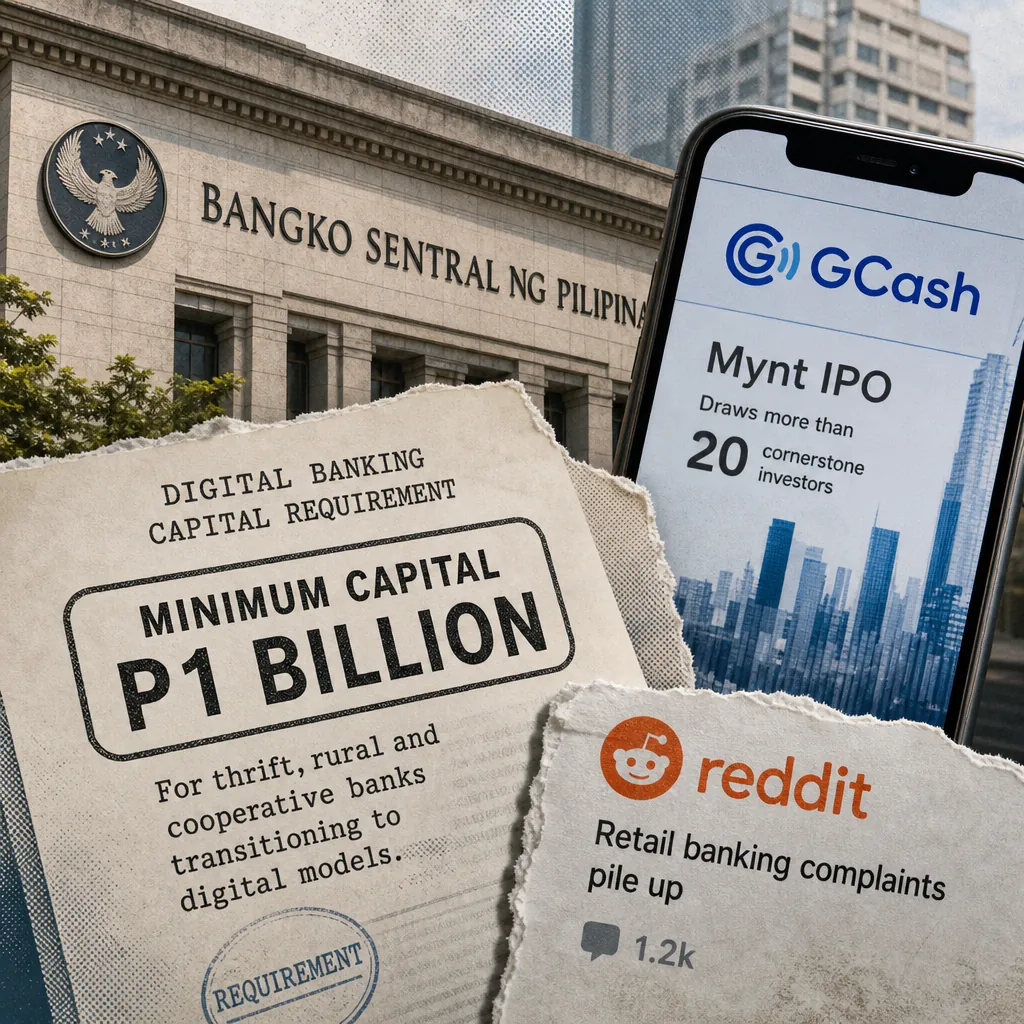
Mynt won Philippine Stock Exchange approval for an offering of up to 8.03 billion shares at a maximum price of P10 each, with the International Finance Corp. disclosing a planned P4.4-billion cornerstone stake. The central bank separately required thrift, rural and cooperative banks moving to digital models to hold P1 billion in capital.
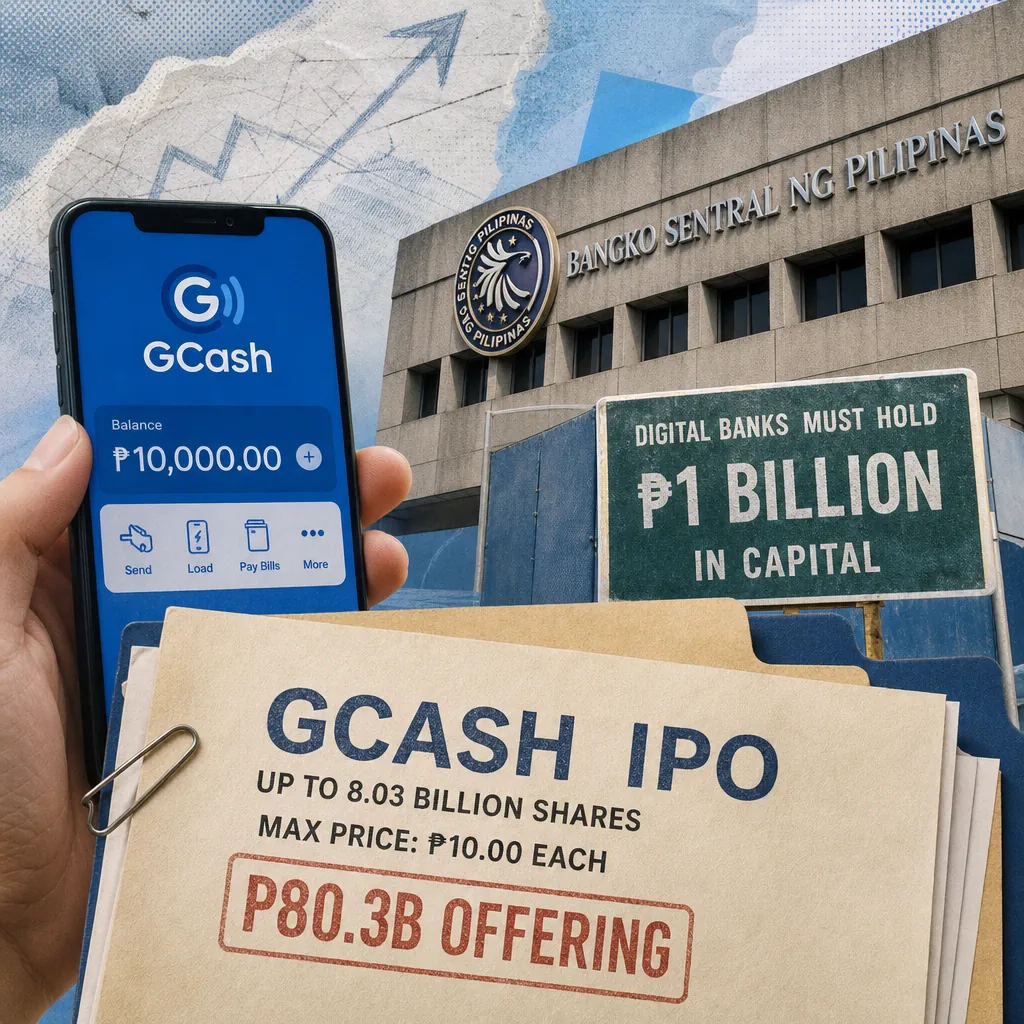
Mynt Inc., the parent company of GCash, cleared the last major regulatory gate before what would be the largest share sale ever mounted on the Philippine Stock Exchange, and the scale of the deal set the terms for nearly everything else in the day's banking and fintech conversation. The exchange approved Mynt's application to list on the Main Board under the ticker "GCASH," covering as many as 8.03 billion shares — up to 1.61 billion newly issued primary shares and 6.42 billion secondary shares sold by existing holders, plus an overallotment option of as much as 1.20 billion more secondary shares 88. At the maximum offer price of P10 a share, the offering would raise roughly P80.3 billion before the overallotment 88. Final pricing is expected on October 1 after book-building, the public offer runs October 6 to 12, and trading is scheduled to begin October 20, subject to final regulatory and listing requirements 88.
The International Finance Corp. (IFC), the private-sector arm of the World Bank Group, disclosed a planned P4.4-billion investment in the offering as a cornerstone investor — a large, pre-committed buyer whose participation is meant to signal confidence to other investors 75. The investment, equivalent to about $70 million, would come from the IFC's own account through the purchase of Mynt common shares under a project identified as "Project Hiraya," and it remains pending approval 75. The IFC said proceeds from the primary portion would expand Mynt's digital financial services business, including its CreditTech operations through Fuse Financing Inc., as well as fund product development and general corporate purposes 75. Mynt's GCash counted 41.5 million monthly active users in the three months ended June 2026, equivalent to about 56% of the Philippine adult population 75.
Interest in the deal extends well beyond the World Bank's investment arm. Bloomberg reported that BlackRock, Capital Group and Schroders are among the institutions looking to secure shares at around P6.50 apiece, below the P10 maximum, ahead of final pricing on October 1 52. Jonathan Ravelas, senior adviser at Reyes Tacandong & Co., called the interest "a major vote of confidence not only in GCash but also in the long-term digital economy story of the Philippines," and said pricing below the maximum suggests management is prioritizing a successful and sustainable market debut over chasing valuation 52. More than 20 cornerstone investors are backing the offering, according to one account of the IFC disclosure 67.
The offering is large enough to move the wider market. The benchmark Philippine Stock Exchange index fell for a third consecutive session on Wednesday, dropping 19.42 points, or 0.33%, to 5,795.14 — its lowest close since May 29, when it ended at 5,768.76 — and brokers attributed some of the selling to investors liquidating positions to prepare for the Mynt IPO 40. The broader All Shares index fell 6.91 points, or 0.21%, to 3,246.44 40.
On the same day, the Bangko Sentral ng Pilipinas (BSP), the country's central bank, moved to tighten the rules for smaller lenders drifting toward digital business models. Under Circular No. 1240 dated September 21, thrift banks, rural banks and cooperative banks that the BSP determines are operating under a business model similar to that of a digital bank must meet the P1-billion minimum capital requirement set for digital banks, along with other prudential standards 4383. Affected banks get six months from receipt of the BSP's notice to comply, and the same P1-billion floor applies when a proposed acquisition is intended to transform a thrift, rural or cooperative bank into a technology-driven business 43. The BSP said the requirements aim to ensure these banks "operate in a safe and sound manner," and it may impose additional prudential requirements — or require a bank to limit activities such as the rollout or marketing of new digital products — if risk management and capital levels no longer match the bank's risk profile 83.
A separate BSP operation drew less attention but carries its own signal on funding costs. The central bank's seven-day term deposit facility, the tool it uses to absorb excess cash from the banking system, drew P114.324 billion in bids against the P120 billion on offer, a bid-to-cover ratio of 0.9527 times, down from 1.1465 times a week earlier 84. The BSP made a partial award of P106.074 billion to cap the rise in rates, and accepted yields of 4.95% to 5.03%, higher than the 4.9% to 5.02% band the previous week; the weighted average accepted rate edged up 0.41 basis point to 4.9965% from 4.9924% 84. That was the fifth straight week the average auction yield rose, with the market anticipating higher borrowing costs after a hawkish turn at the US Federal Reserve and amid lingering inflation risks 84.
Key themes
- Mynt's P80.3-billion offering clears the exchange and sets an October timetable. The PSE approved up to 8.03 billion shares at a maximum of P10 each, with final pricing on October 1, a public offer from October 6 to 12, and a listing targeted for October 20 88.
- The IFC plans a P4.4-billion cornerstone stake. The World Bank Group's private-sector arm disclosed the investment under "Project Hiraya," pending approval, with proceeds earmarked for Mynt's digital financial services and CreditTech operations 75.
- Global asset managers are circling at P6.50 a share. BlackRock, Capital Group and Schroders are reportedly seeking shares below the P10 maximum, a level one analyst read as management prioritizing a durable debut over a top-of-range price 52.
- The BSP extended the P1-billion digital-bank capital floor to small lenders. Thrift, rural and cooperative banks judged to be running digital-style models have six months to comply with the capital and prudential standards written for digital banks 4383.
- A white paper put a P603-billion annual figure on mule-account fraud. IDfy Philippines and CIBI Information estimated that sum — nearly 3% of gross domestic product — is at risk each year from accounts used to receive and move stolen funds 7691.
- The SEC shut an online lender over illegal lending and abusive collection. CredLadder was ordered to stop operating after the regulator found it was unregistered and had imposed excessive interest and sent threatening messages to borrowers 3582.
- A lawmaker moved to widen the SEC's powers over debt collectors. Quezon City Rep. Patrick Michael Vargas filed House Bill No. 9738, which would create a list of prohibited collection actions including harassment, threats of violence and public shaming 36.
- The DSWD began paying cash aid through GCash in Bacolod. The Department of Social Welfare and Development launched digital payouts for its UPLIFT program, with beneficiaries receiving P2,000 grants through the wallet instead of queueing at payout centers 293032.
How the narratives stack
Dominant. The Mynt offering dominated the day's banking coverage in this set, and it did so on consequence rather than volume: a share sale of up to P80.3 billion would be the largest in the exchange's history, it drew a disclosed P4.4-billion commitment from the World Bank's private-sector arm, and it pulled the main stock index to a three-month low as investors repositioned 887540. The coverage spanned the exchange approval, the cornerstone disclosure, the reported interest from BlackRock, Capital Group and Schroders, and the market's reaction, with the largest single item in the captured set — a BusinessWorld report on the IFC investment — carrying an estimated P839,484 in advertising-equivalent value, the notional cost of buying the same space as paid advertising 58. That figure measures the cost of the coverage, not how many people read it.
Counter-narrative. The BSP's capital circular ran against the grain of the day's growth story. While the market was pricing the country's biggest fintech listing, the central bank was raising the capital bar for small lenders that behave like digital banks, requiring P1 billion in minimum capital and giving them six months to comply 4383. The two developments are not in conflict — a maturing digital finance sector invites both more capital and more supervision — but they frame the same shift from opposite directions, and the circular's coverage was steady rather than prominent, appearing across several outlets in near-identical form 437883.
Emerging. Fraud and consumer-protection enforcement produced the day's most concrete regulatory actions. The Securities and Exchange Commission ordered CredLadder to stop lending after finding it unregistered and accusing it of excessive interest charges and humiliating or threatening collection messages, conduct prohibited under the Financial Products and Services Consumer Protection Act 3582. A lawmaker responded with House Bill No. 9738, which would give the SEC more power over rogue online lenders and abusive collectors and create a list of banned practices 36. Separately, a white paper by IDfy Philippines and CIBI Information put a P603-billion annual figure on the losses the economy could suffer from mule accounts — bank or e-wallet accounts used by criminals to receive and move illicit funds — based on P24.74 trillion in combined transactions processed through the PESONet and InstaPay rails in 2025 7691.
Under-covered. The DSWD's shift to digital payouts for its UPLIFT assistance program drew the least attention of the day's substantive banking stories, even though it puts government cash transfers directly into a mobile wallet. The department launched the mechanism in Bacolod City, with 62 beneficiaries in one account and 52 in another receiving P2,000 grants through GCash, and it will continue manual payouts for beneficiaries without e-wallets 3032. The program is the Unified Package for Livelihoods, Industry, Food, and Transport Assistance, and Secretary Rex Gatchalian tied the change to President Ferdinand Marcos Jr.'s directive to deliver aid faster to Filipinos affected by the energy emergency 2930.
Platform insights
- Facebook. The platform carried the day's product and promotional announcements, most of them in near-press-release form. A post from an account identifying itself as LMALaw said Visa and GCash will launch a link-and-pay feature letting consumers fund QR transactions in the GCash app using Visa cards, addressing insufficient wallet balances without a top-up and secured by Visa Payment Passkey, described as biometric authentication using fingerprint, face recognition or PIN 1. Neither Visa nor GCash issued a statement on the feature in the material, and no launch date was given 1. A Data Blitz post promoted a UnionBank credit card with no annual fee forever and a P2,000 eGift, citing DTI Fair Trade Permit Nos. 257635 and 257628 Series of 2026 12. DragonFi announced three institutional funds on its platform from September 23, 2026 — the BPI Global Bond Income Fund with monthly payouts and PIMCO backing, the Manulife Global Equity Diversified Income Feeder Fund, and the ATRAM Global Gold Equity Feeder Fund — with a minimum investment of P1,000 16. A fundraising post for an 8-year-old karate competitor travelling to Osaka in December 2026 listed GoTyme, UnionBank, BPI and Maya accounts, plus a GoTyme SWIFT code, as donation channels 15.
- YouTube. Activity was thin and split between investor education and practical how-to content. A video titled "GCash IPO: REAL TALK!" reported "a lot of buzz" around the proposed offering and said that at its proposed size it could become the biggest IPO in Philippine history, while saying it would separate confirmed information from details that may still change; it carried 1,294 views and 80 likes 2. No pricing, share count, timetable or regulatory filing was cited in the video 2. A separate post described two ways to move money from an UNO Digital Bank account to GCash: instant withdrawal through the GSave feature at no charge, or an InstaPay transfer through the UNO app, with the poster noting that standard InstaPay fees may apply 17.
- Reddit. The platform produced the day's consumer-side material, and it was almost entirely troubleshooting and first-person experience rather than advocacy. A user reported that the BDO Online app and the J&T Philippines app fail over a PLDT 1699 300 Mbps home connection but work on mobile data, on an Android phone, while working on an iPhone on the same Wi-Fi 3. Another asked why cash-in stores have not lowered their pricing after GCash reduced its own transaction fee to P10, drawing 14 comments 4. A third asked whether proof of payment is required for a deed of sale on a P570,000 lot paid via GCash and bank transfer, drawing 11 comments 5. On credit, a user with close to P300,000 outstanding on a BDO credit card said multiple emails requesting lower interest or a payment arrangement produced no workable option 9, while another described a UnionBank Rewards Platinum Mastercard approval with a P20,000 spend requirement within 60 days to qualify for a no-annual-fee-for-life promo 10. A UnionBank cardholder reported a limit that opened at P200,000 about 1.5 years ago, with Metrobank above P300,000 and Maya at P627,000, drawing 47 upvotes and 13 comments 11.
- X. No posts from the platform appeared in the tracked material, so there is nothing to report on how the conversation behaved there.
Key voices and communities
Retail banking and credit card customers. The largest cluster of consumer posts came from cardholders comparing limits, fees and hardship experiences across BDO, UnionBank, Security Bank, Metrobank, RCBC and China Bank. Their framing is practical and bank-specific: what a limit increase required, what an annual fee costs, whether a refund was handled quickly. A UnionBank cardholder's account of a limit rising to P200,000 drew 47 upvotes and 13 comments 11, and a BDO cardholder carrying almost P300,000 in debt asked whether to keep paying the minimum or default and negotiate, saying "I've emailed them several times asking if they could lower the interest/penalties" without a workable response 9. These are the customers the banks' own service and retention teams deal with, and the posts are the raw material for tracking how individual complaints accumulate.
Insurance and investment policyholders. A second group is publicly criticizing variable unit-linked (VUL) insurance — a product that bundles life insurance with an investment fund, so the policy's value rises or falls with the underlying funds. One poster said a Sun Life MaxiLink Prime policy bought in September 2016 had paid in P1.5 million over ten years but showed a fund value of P942,000, a shortfall the poster put at over P500,000, and concluded "never get a VUL insurance if your main purpose is to save for retirement" 7. A separate Facebook post described the same product's structure — a death benefit of at least 200% of the face amount, investments in equity, bond, balanced and money market funds, partial withdrawal and a loyalty bonus it noted is "not guaranteed" 8. A Security Bank client said the bank raised feeder fund fees from 0.5% to 1% and asked what the best local alternative was 6.
Digital bank and e-wallet users. Users of GCash, Maya, GoTyme, UNO Digital Bank and Maribank compared features, fees and transfer routes, and flagged security worries arising from ordinary transactions. A DITO SIM buyer described handing over an OTP to a store staffer during registration and asked whether that gave the staffer access to e-wallets and online banking apps 14. A Canadian planning a two-to-three-year stay described a planned local bank to Wise to GoTyme route for withdrawals and card payments while waiting on an ACR, the alien certificate of registration that foreign residents in the Philippines must hold 18.
Institutional and official voices. The day's most authoritative statements came from institutions rather than individuals. Mynt President and CEO Martha Sazon brought the Philippine financial inclusion story to the UN Global Compact Leaders Summit, citing a rise in formal financial account ownership to 50% of Filipino adults from 29% before the pandemic, and GCash's extension of credit to more than 11 million borrowers; she said formal borrowing penetration remains at 12% 63. The IFC's disclosure, the BSP's circular and the SEC's cease-and-desist order carried the regulatory and capital-markets framing 754335.
Overseas Filipinos and remittance senders. GoTyme Bank launched a campaign aimed at this group, offering a raffle to fly overseas Filipinos home for the holidays in connection with its international remittance services, with five grand prize winners receiving round-trip economy flights for themselves and a companion, supported by partnerships with Cebu Pacific and TapTap Send 85.
Narrative streams
Mynt's record offering moves from approval to pricing
The mechanics of the deal are now public. The PSE approved Mynt's listing application for as many as 8.03 billion shares — up to 1.61 billion primary and 6.42 billion secondary, plus an overallotment option of as much as 1.20 billion additional secondary shares — at a maximum price of P10, implying about P80.3 billion before the overallotment 88. The final price is expected on October 1 after book-building, the public offer runs October 6 to 12, and trading is expected to begin October 20 88. The IFC's planned P4.4-billion cornerstone investment, disclosed under "Project Hiraya" and still pending approval, would come from its own account through the purchase of common shares, with primary proceeds directed to Mynt's digital financial services business, its CreditTech operations through Fuse Financing Inc., product development and general corporate purposes 75. Reported interest from BlackRock, Capital Group and Schroders at around P6.50 a share sits below the P10 maximum 52.
The read for the sector is that the offering gives Philippine fintech a public-market valuation benchmark where none existed, and it changes the funding calculus for every digital lender and e-wallet that has raised private capital on the promise of eventual liquidity. A successful listing at or near the top of the range would validate the growth assumptions behind the sector's expansion; a debut priced well below the maximum would reset expectations for the next candidate in line. The market's own reaction is already visible: the PSE index closed at 5,795.14, its lowest since May 29, with brokers pointing to repositioning ahead of the offering 40.
The BSP raises the capital bar for small banks going digital
Circular No. 1240, dated September 21, requires thrift, rural and cooperative banks that the BSP judges to be operating under a digital-bank-like business model to meet the P1-billion minimum capital requirement set for digital banks, along with other prudential standards, with six months from notice to comply 4383. The same floor applies when a proposed acquisition is meant to transform a thrift, rural or cooperative bank into a technology-driven business 43. The BSP said the requirements aim to ensure these banks "operate in a safe and sound manner," and it may impose additional prudential requirements or require a bank to limit activities such as the rollout or marketing of new digital products if its risk management and capital levels no longer match its risk profile 83.
For the small banks affected, the practical effect is a capital-raising deadline: P1 billion is a multiple of the capital many rural and cooperative banks hold, and six months is a short window to raise it. For depositors, the rule reduces the chance that a small institution scaling up a digital app does so without the buffers the central bank requires of full digital banks. The circular follows a period in which the BSP has publicly flagged profit strain at digital banks, and it extends the same standards to institutions that were not originally licensed as digital banks but have come to resemble them.
Fraud enforcement sharpens around lending and mule accounts
The SEC's cease-and-desist order against CredLadder is the day's clearest enforcement action. The regulator's Enforcement and Investor Protection Department said CredLadder had been operating an unrecorded online lending platform and engaging in unauthorized lending and financing activities, and had continued operating even after the SEC issued an advisory against it in June 3582. The SEC said it received reports that CredLadder imposed excessive interest charges and sent humiliating or threatening messages to borrowers, conduct prohibited under the Financial Products and Services Consumer Protection Act, and that the platform used FlexiFund, FundXpress, QuickPesa and Paymatic as remittance agents while advertising on Facebook and distributing its app through Google Play 82. CredLadder was not in the SEC's database of online lenders or the Department of Trade and Industry's Business Name Registration System 35.
Quezon City Rep. Patrick Michael Vargas responded with House Bill No. 9738, the proposed Fair Debt Collection and Digital Lending Consumer Protection Act, which would empower the SEC and create a list of prohibited actions including harassment of borrowers, threats of violence and public shaming 36. Vargas said the bill is needed to protect Filipinos who "sometimes have no other recourse but to borrow from online lenders just so they could make ends meet" 36.
The scale of the underlying problem came from a separate source. A white paper by IDfy Philippines and CIBI Information, titled "Mule Hunting: Are We Chasing Ghosts?", estimated the economy could lose P603 billion a year to illicit mule account networks — nearly 3% of gross domestic product — based on an analysis of P24.74 trillion in combined transactions processed through PESONet and InstaPay in 2025 7691. The report said about P1.088 trillion of that volume was at risk of digital fraud, with 55.4% of the suspected fraud volume tied to authorized push payment scams and account takeovers, which it said cannot function without a mule account to capture and route stolen funds 7686. Mule accounts are bank or e-wallet accounts used by criminals to receive and move illicit funds, either rented or purchased from willing account holders or taken over without their owners' consent 91. The report attributed the vulnerability to rapid digitalization: the Philippines surpassed its target to digitize 50% of retail payments three years early, reaching 52.8% in 2023 86.
The read for the sector is that the enforcement push and the fraud estimate point at the same gap. Lenders and wallet providers face rising compliance expectations on identity checks and suspicious-activity reporting, and the cost of not meeting them is now quantified in the hundreds of billions of pesos a year. For consumers, the practical consequence is more friction at onboarding and more scrutiny of transactions — the trade-off regulators are explicitly choosing.
Government aid moves into mobile wallets
The DSWD launched digital payouts for its UPLIFT assistance program in Bacolod City, with the city selected as the pilot site for the transition from manual disbursement to direct payments through GCash 32. Secretary Rex Gatchalian, joined by Mayor Greg Gasataya and Negros Occidental 5th District Rep. Emilio Bernardino Yulo, led the launch at the Bacolod City Government Center 32. During the launch, 62 beneficiaries in one account and 52 in another received their P2,000 grants through the wallet, following the distribution of assistance to 2,245 eligible Bacolod residents through the earlier manual system 3032. Gatchalian said the change follows President Marcos Jr.'s directive to deliver cash assistance quickly and easily: "Nakipag-ugnayan kami sa GCash para 'yung mga may GCash account na, hindi na pipila. Simula ngayon hanggang sa December, 'pag kukunin niyo na 'yung P2,000, sa GCash na lang po 'yan" 2930. The department will continue manual payouts for beneficiaries without e-wallets 29.
The read for the sector is that a national agency has now made a private wallet a delivery channel for public money, which raises the stakes on wallet reliability, account verification and fraud controls. For beneficiaries, the change removes the queue and the travel cost of collecting aid in person; for GCash, it adds a recurring, government-scale transaction flow and the operational expectations that come with it.
Consumer friction surfaces in credit, fees and app access
The day's consumer posts describe friction rather than product news. A BDO cardholder carrying close to P300,000 in outstanding balance said repeated emails asking for lower interest, penalties or a fixed monthly arrangement produced no workable option, and asked whether to keep paying the minimum amount due or allow the account to default before negotiating 9. A Security Bank client said the bank raised feeder fund fees from 0.5% to 1% and asked what the best local alternative was 6. A Sun Life MaxiLink Prime policyholder said P1.5 million paid over ten years now shows a fund value of P942,000 7. A user reported the BDO Online app failing over a PLDT home connection while working on mobile data 3. Two posts raised possible fraud: one asked whether two mobile numbers are legitimate RCBC contact numbers after an offer that requested only name, email and contact number 13, and another described buying a buy-one-take-one DITO SIM for P78 at an SM store, where staff registered both SIMs on what appeared to be a company phone and took the user's ID, selfie and OTP, after which the user worried about e-wallet and online banking access 14. Nothing in the material establishes whether any of these incidents were confirmed as fraud, and no bank or regulator statement on them appears in the set.
The read for the sector is that these are individual accounts with single-digit engagement, not a measured trend, but they identify the specific points where customers lose confidence: a fee increase that prompts a question about switching banks, a collection process that offers no path for a borrower in difficulty, and a registration process that asks a customer to hand over an OTP. Banks that monitor these threads get early warning on which service failures are becoming repeatable.
Digital payments expand through partnerships and cross-border links
Visa and GCash will launch a link-and-pay feature that lets consumers fund QR transactions in the GCash app using Visa cards, according to a Facebook post from an account identifying itself as LMALaw 1. The post said the feature addresses insufficient GCash wallet balances by removing the need to cash in or top up before checkout, and that it is secured by Visa Payment Passkey, described as biometric authentication using fingerprint, face recognition or PIN 1. Neither company issued a statement on the feature in the material, and no launch date was given 1. Separately, LANDBANK is exploring cooperation with NPCI International Payments Limited, the international arm of the organization behind India's Unified Payments Interface, on digital payments and interoperability, in meetings held alongside President Marcos Jr.'s participation in the 18th BRICS Summit in India; LANDBANK President and CEO Lynette V. Ortiz led the discussions on cross-border payments, government collections and disbursements, and access for overseas Filipinos and underserved communities 71.
The read for the sector is that card networks and wallets are competing to sit at the point of payment, and the Visa-GCash feature would let a card fund a wallet transaction directly — putting card volume into a channel that competes for the same consumer spending. For banks that issue Visa cards, that is a distribution opportunity and a competitive question at once, since the transaction settles inside a wallet rather than at a card terminal.
Institutional money and new products widen the market
Beyond the IPO, several developments pointed to a broadening set of products and participants. The BSP donated P40 million to three hospitals and the Philippine Red Cross, with the Lung Center of the Philippines, National Kidney and Transplant Institute, Philippine General Hospital and Philippine Red Cross each receiving P10 million at a turnover led by BSP Governor Eli M. Remolona Jr. and Deputy Governor Elmore O. Capule on September 22 70. Former BSP Deputy Governor Eduardo Bobier was elected an independent director of Billease Bank Inc., formerly Rural Bank of Sta. Maria (Ilocos Sur) Inc. and the banking arm of consumer finance and buy-now-pay-later platform Billease, subject to BSP confirmation; he brings more than 30 years of central banking experience, most recently as deputy governor for the Corporate Governance Sector 72. Maya began offering eligible cardholders the option to hold its Landers Cashback Everywhere Credit Card and Maya Black Credit Card under a single shared credit limit, with each card keeping its own statement of account 57. ICTSI, the country's largest listed company, signed a 10-year, $1-billion loan with BDO Unibank to fund expansion projects in the Philippines and abroad, after securing a 25-year extension of its Manila International Container Terminal concession to 2063 92.
The read for the sector is that capital is moving into consumer credit and digital banking from several directions at once — a former regulator joining a digital lender's board, a shared-limit card structure that lowers the cost of holding two cards, and a billion-dollar corporate loan from the country's biggest bank. Each is a small signal; together they show lenders competing for the same retail borrowers and corporate clients with more flexible terms.
The macro backdrop: growth forecasts cut as costs rise
The day's banking news landed against a weaker economic picture. S&P Global Ratings cut its Philippine gross domestic product growth projection for 2026 to 2.9% from 4.1%, with Asia-Pacific senior economist Vishrut Rana saying the revision reflects weaker-than-expected first-half growth and a more gradual recovery, and that "it will take some time for the economy to recover its footing" 5864. The Asian Development Bank trimmed its own 2026 forecast to 3.3% from 3.8%, citing weak public investment, and cut its 2027 projection to 5.1% from 5.3% 5889. If realized, this year's growth would fall below the government's revised 3.5% to 4.5% target and last year's 4.4% 89.
The read for the sector is that slower growth and higher funding costs narrow the margin for lenders expanding into digital products, and they raise the stakes on the Mynt listing as a test of whether public markets will still pay for Philippine fintech growth. The BSP's term deposit auction showed the cost side of that equation: bids fell short of the offer, the central bank capped the rate rise with a partial award, and the average accepted yield rose for a fifth straight week 84.
Conversation trajectory
Watch the October 1 final price and the October 6–12 offer window. The maximum price is P10, but reported institutional interest sits around P6.50, and the final price set after book-building will show how much of the maximum the market is willing to pay 5288. A price near the top would confirm demand; a price near the reported institutional level would signal that buyers are anchoring well below the issuer's ceiling. Checkable on October 1.
Watch the October 20 listing and the first weeks of trading. The PSE index closed at 5,795.14, its lowest since May 29, with brokers attributing selling to repositioning ahead of the offering 40. Whether that repositioning reverses once the shares list, or whether the index stays weak, will indicate whether the offering absorbed liquidity or drew new money into the market. Checkable from October 20.
Watch for the BSP's first notices under Circular No. 1240. The circular gives affected banks six months from receipt of the BSP's notice to meet the P1-billion capital floor, so the first notices will identify which thrift, rural and cooperative banks the central bank considers digital-style operators 4383. The names and the compliance timelines are the next concrete data point. Checkable over the next one to two quarters.
Watch whether House Bill No. 9738 advances. The bill would give the SEC more power over online lenders and abusive collectors and create a list of prohibited practices 36. Its progress through committee is the next signal on whether the enforcement approach taken against CredLadder becomes a broader statutory mandate 3582. Checkable over the next legislative session.
Watch for follow-through on the Visa-GCash feature. The announcement came from a third-party Facebook post with no launch date and no statement from either company 1. A formal announcement, a launch date, or confirmation of the Visa Payment Passkey integration would move it from reported plan to product. Checkable over the next four to six weeks.
Trigger events. The October 1 pricing decision, the October 6–12 offer period, the October 20 listing, the BSP's first Circular No. 1240 notices, and any committee action on House Bill No. 9738 are the scheduled points at which the day's open questions resolve.
Response guidance
On the Mynt offering, prepare for pricing-day questions rather than listing-day ones. The final price on October 1 will be compared against the P10 maximum and the reported P6.50 institutional level, and the comparison will be framed as a verdict on the deal 5288. Communications teams should have language ready that explains the book-building process — how a final price is set from investor demand — so that a price below the maximum is not read as a failure.
On the BSP capital circular, explain the six-month clock in plain terms. Affected banks have six months from notice to meet the P1-billion floor, and the BSP may also require limits on new digital product rollouts 4383. Institutions that may fall under the rule should be ready to describe their capital position and their compliance plan before the first notices go out, since the notices themselves will draw attention.
On fraud and mule accounts, lead with the specific consumer action. The P603-billion estimate is a modelled annual figure, not a record of losses already incurred, and it rests on an analysis of P24.74 trillion in transactions processed through PESONet and InstaPay in 2025 7691. Messaging that turns the number into a concrete instruction — never share an OTP, verify caller numbers through official channels, report suspicious account activity — is more useful than repeating the total.
On the DSWD payout shift, treat reliability as the message. Government aid now moves through a private wallet in Bacolod, with manual payouts continuing for beneficiaries without e-wallets 2932. Wallet providers and banks involved in disbursement should be prepared to answer questions about what happens when a transaction fails, how a beneficiary without a smartphone is served, and how accounts are verified.
On consumer complaints, respond to the specific issue rather than the volume. The credit, fee and app-access posts in this set carry single-digit engagement and are individual accounts, not a measured trend 963. The useful response is a direct answer to the specific problem — a hardship arrangement process, a fee-change explanation, a connectivity workaround — because the posts that draw replies are the ones other customers search for later.
On the Visa-GCash feature, wait for confirmation before positioning. The feature was reported by a third-party account with no launch date and no statement from either company 1. Card issuers and wallet providers should monitor for a formal announcement rather than reacting to the reported plan, and should be ready to explain how card-funded wallet payments would work for their own customers if the feature is confirmed.
See the full picture behind today's signals.
This report draws from Media Meter's MediaWatch, our real-time monitoring engine tracking 2,470+ Philippine sources across print, broadcast, digital, and social. Explore how the platform turns raw coverage into decision-grade intelligence, then see how it's configured for teams like yours — whether you're in PR agencies, corporate comms, government, or marketing.
Want more? Browse our Report Library for sector and crisis intelligence, or request a demo and we'll have your brand set up before the call.
Want this kind of intelligence on your brand?
This brief is built on the same MediaWatch methodology that runs continuously across every brand we monitor. See your competitive landscape, Impact Score, and narrative trajectory in a 30-minute demo.