Converge outage triggers angry backlash as speed complaints and DIY fixes dominate telecom conversation
A Converge ICT fiber cut in Quezon City sparked a wave of angry reactions on Facebook, while Reddit and YouTube users shared speed frustrations and router workarounds. The DICT announced free WiFi for remote areas, and PLDT expanded 4G sites in Bohol.
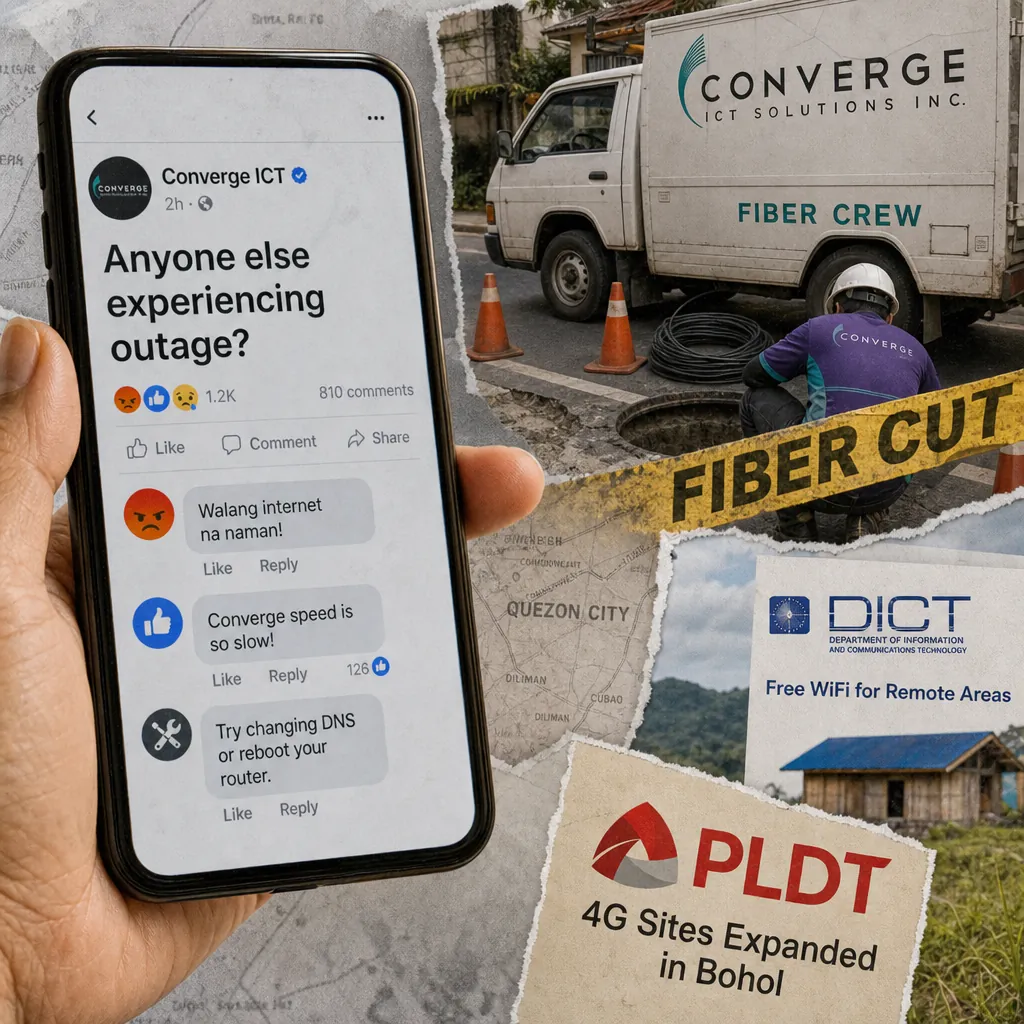
A service interruption that hit Converge ICT customers in Quezon City and nearby areas on Monday afternoon set off a firestorm of negative reaction on social media, even after the company announced that service had been restored. The episode, which Converge attributed to multiple cuts to its fiber-optic cables, became the dominant telecom story of the day, drawing an overwhelmingly angry response that far outweighed any positive engagement. At the same time, a separate thread of conversation on Reddit and YouTube saw subscribers sharing frustrations about internet speeds that fall short of advertised levels and swapping do-it-yourself fixes for router and connectivity issues — a pattern that suggests a growing willingness among users to bypass official support channels. Against this backdrop of consumer discontent, the Department of Information and Communications Technology (DICT) announced a P197.21-million project to bring free WiFi to 587 geographically isolated and disadvantaged areas (GIDAs) and hospitals in Metro Manila, while PLDT Inc. activated 11 new 4G LTE sites in Bohol as part of its rural connectivity program.
Key themes
- Converge outage triggers angry backlash — A service interruption affecting Converge ICT customers in Quezon City and nearby areas on Monday afternoon prompted a restoration announcement from the company's official support account at 6:50 PM. The post, which stated that services were fully restored, received 50 likes but 190 angry reactions — an 84% anger rate among the 248 total reactions — and was shared 93 times. The lopsided response indicates that customers felt the outage was poorly handled or insufficiently communicated, and that a simple restoration notice did little to repair trust. Converge later told the media that the disruption was caused by multiple cuts to its fiber-optic cables, but did not disclose the cause of the cuts or identify the affected areas.
- Speed-versus-advertised gap fuels frustration — On Reddit, users posted about paying for high-speed plans but receiving lower-than-expected performance. One user reported that after upgrading from a 400 Mbps to a 500 Mbps plan, their Xbox download speeds actually dropped from ~220 Mbps to ~140–150 Mbps. Another user said they were paying for a 900 Mbps plan but only getting 500 Mbps over Ethernet. While these posts were not explicitly tied to Philippine ISPs, they mirror common complaints about PLDT, Globe, and Converge "up to" broadband packages and reflect a broader disillusionment with the gap between marketing claims and real-world performance.
- Users turn to DIY fixes and third-party hardware — A YouTube tutorial on boosting exterior Wi-Fi speed with a range extender garnered 547 views, and a Twitter tip from a tech influencer about changing a router setting to eliminate lag reached 4,517 views. On Reddit, a user detailed how switching from an ISP-provided Nokia router to a TP-Link AX3000 caused IPTV freezing every 10 minutes — a problem that disappeared when reverting to the original router. These posts show that subscribers are increasingly experimenting with third-party equipment and configuration tweaks to overcome perceived ISP limitations, a trend that can both reduce support tickets and create new sources of blame when fixes fail.
- DICT allocates P197 million for free WiFi in remote areas and hospitals — The Department of Information and Communications Technology (DICT) issued invitations to bid for a project that will provide free internet access for one year to 587 geographically isolated and disadvantaged areas (GIDAs) and hospitals in Metro Manila. The larger portion of the budget — P179.49 million — will be spent on low-earth-orbit satellite connectivity for 396 towns in Luzon and 191 in Visayas and Mindanao. The remaining P17.72 million will cover free WiFi for 10 hospitals in the National Capital Region. The project aims to bridge the digital divide in underserved communities.
- PLDT expands 4G network in Bohol — PLDT Inc. activated 11 new 4G LTE sites in the municipalities of Maribojoc and Antequera in Bohol, enhancing mobile connectivity for Smart Communications and its value brand TNT. The rollout is part of PLDT's target to deploy about 3,500 sites under its rural connectivity expansion program, including in geographically isolated and disadvantaged areas (GIDAs), in coordination with government agencies.
- Meralco joins media literacy campaign to combat misinformation — The Manila Electric Co. (Meralco) signed an agreement with MediaQuest Holdings to participate in the THINKaMuna Pilipinas campaign, which promotes media and information literacy. Meralco's vice-president for corporate communications said the company has been subjected to misinformation and disinformation, prompting the partnership. The initiative will initially focus on employees before expanding to Meralco's more than eight million customers.
- LandBank waives InstaPay and PESONet fees — State-run Land Bank of the Philippines announced that it will waive all InstaPay and PESONet transfer fees for retail clients starting July 7, allowing customers to send funds for free through the LandBank Mobile Banking App and iAccess platform. The waiver also covers clients of Overseas Filipino Bank. The move follows LandBank's June 1 rollout of zero-fee person-to-government (P2G) payments via QRPh and expands the bank's cost-free digital banking initiative.
- Philippines positioned as potential AI data center hub — Carlo Malana, President and CEO of STT GDC Philippines, said the country has a rare opportunity to become Southeast Asia's next major hub for artificial intelligence and cloud computing, citing advantages in land availability, talent pool, and power infrastructure compared to regional competitor Singapore. However, he stressed that the Philippines must move fast to build the necessary digital infrastructure to keep pace with soaring demand.
How the narratives stack
Dominant — Within the captured set, the Converge outage and the angry social-media response to it dominate the telecom conversation. The restoration post's 84% anger rate and 93 shares indicate that the incident resonated widely, and the subsequent media coverage of the fiber cuts gave the story additional weight. The DICT's free WiFi project and PLDT's network expansion also received coverage, but neither generated the same level of public emotion or engagement.
Counter-narrative — The DICT's P197-million free WiFi project and PLDT's rural network rollout offer a positive counterpoint to the outage-driven negativity. These stories frame the government and private sector as actively working to bridge the digital divide, particularly in underserved areas. However, the contrast between the government's connectivity ambitions and the real-world frustrations of paying subscribers — who expect reliable service from their existing connections — creates a tension that could undermine the positive messaging if not addressed.
Emerging — The growing trend of users turning to DIY fixes and third-party hardware to solve connectivity issues is an emerging narrative with implications for customer support and brand loyalty. As more subscribers experiment with router swaps, Wi-Fi extenders, and configuration tweaks, ISPs may see a shift in how problems are reported — or not reported — and may need to adapt their support strategies to engage with technically literate users on platforms like Reddit and YouTube.
Suppressed — The story of the Philippines' potential as an AI data center hub received coverage but did not generate significant social conversation. This narrative, which focuses on long-term infrastructure investment and regional competitiveness, may be overshadowed by more immediate consumer concerns about service reliability and speed. For communicators, this suggests that aspirational messaging about digital transformation needs to be grounded in tangible improvements to the customer experience to gain traction.
Platform insights
- Facebook: The Converge restoration post was the only Facebook data point captured, but its high anger-to-positive ratio and strong sharing indicate that Facebook remains the primary venue for public venting and official announcements in Philippine telecom. The conversation likely started with angry outage posts earlier in the afternoon and peaked with the restoration update. The lack of visible comments suggests that users may have expressed their frustration primarily through reactions and shares rather than text replies.
- Reddit: Discussions on Reddit spanned two days (July 5–6) with a focus on speed discrepancies and router compatibility issues. The subreddits involved appear to be general tech help forums (likely r/HomeNetworking or r/techsupport), not Philippine-specific, but the topics are universal. These posts attracted modest engagement (1–5 likes, 6–9 comments), suggesting niche but highly engaged audiences seeking peer-to-peer troubleshooting. The detailed technical nature of the posts — including specific router models and configuration steps — indicates a user base that is willing to invest time in self-help.
- YouTube/Twitter: The YouTube tutorial posted on July 5 garnered 547 views, a moderate footprint for a niche tech video. The Twitter tip from @xdadevelopers had 4,517 views and 17 likes, indicating a broader reach through a tech influencer. Both platforms contributed to the "self-help" narrative, offering solutions that users can implement without ISP involvement. The contrast between the high view count on Twitter and the low engagement on Reddit suggests that passive consumption of tips is more common than active discussion.
Key voices and communities
- Frustrated Converge subscribers — A vocal community of affected users, primarily on Facebook, exhibited intense negative sentiment following the service interruption. The official restoration announcement from ConvergeSupport attracted 190 angry reactions and 93 shares against only 50 likes, indicating a deeply dissatisfied audience that amplified the outage through shares. Their complaints center on service reliability and the gap between provider assurances and actual customer experience. This group is the most urgent priority for any telecom provider's crisis communications.
- Technical troubleshooting community — A small but influential group of Reddit users engages in deep, technical discussions around router configurations, speed test discrepancies, and ISP settings. Posts such as "I changed one router setting, and the lag during big downloads just disappeared" from @xdadevelopers reflect a community that prizes DIY solutions over waiting for ISP support. Their conversations are highly specific — for example, one user detailed a recurring IPTV freeze every ten minutes after swapping routers, and another described receiving only 500 Mbps on a 900 Mbps plan. This group can serve as an early-warning system for configuration-related issues that may not be network-wide but affect many users.
- Official service support channels — The ConvergeSupport Facebook account serves as the primary direct communication line for outage and service updates. Their post garnered significant reach (93 shares) but overwhelmingly negative sentiment (190 angry), indicating that while the channel is effective at disseminating information, the tone and timing did not satisfy users. No other telecom providers appeared in the dataset, suggesting Converge is the most actively discussed brand in this sample. The single post is purely informative — no apology, no explanation of the cause, and no next steps — which likely contributed to the disproportionate anger.
- Government and industry stakeholders — The DICT, PLDT, and LandBank are key voices in the positive narratives around connectivity and digital inclusion. The DICT's free WiFi project and PLDT's rural network rollout position them as proactive players in bridging the digital divide. However, their messaging may be undercut by the consumer frustration evident in the outage and speed complaints, suggesting a need to align aspirational announcements with tangible service improvements.
Narrative streams
Converge outage: fiber cuts and the credibility gap
Converge ICT Solutions confirmed that a service interruption affecting customers in Quezon City and nearby areas on Monday afternoon was caused by multiple cuts to its fiber-optic cables. In an advisory, the company said the outage began at around 4:15 PM but did not disclose the cause of the cable cuts or identify the affected areas. Fiber-optic cables transmit internet data through pulses of light, and damage to them can disrupt connectivity for thousands of users. The company said technical teams were restoring connectivity "as quickly as possible" and apologized for the inconvenience, adding that affected customers need not file a support ticket.
The official restoration announcement, posted on Facebook at 6:50 PM, stated: "Fully restored na po as of 6:50 PM ang internet services sa Quezon City at mga kalapit-lugar na naapektuhan ng service interruption kaninang hapon." The post received 50 likes but 190 angry reactions — an 84% anger rate — and was shared 93 times. The lopsided response suggests that customers felt the outage was poorly handled or insufficiently communicated, and that a simple restoration notice did little to repair trust. The high share count indicates that users amplified the post to warn others or vent dissatisfaction, potentially spreading negative sentiment beyond the directly affected area.
For the sector, the incident underscores a critical lesson: restoration messaging alone is insufficient. Customers demand proactive communication during outages — including advance notice, regular updates, and an explanation of the cause — as well as acknowledgment of the inconvenience. The lack of an apology or root-cause explanation in the restoration post likely contributed to the anger. As of end-March, Converge had 3.09 million residential subscribers and aims to grow its customer base to 4 million by end-2027. The reputational damage from this incident could affect customer retention and acquisition if not addressed.
Speed vs. reality: the persistent gap between advertised and actual performance
On Reddit, users shared frustrations about paying for high-speed plans but receiving lower-than-expected performance. One user, u/odd-investigator6503, reported that after upgrading their plan from 400 Mbps to 500 Mbps via Spectrum (a US-based ISP), their Xbox download speeds actually decreased from ~220 Mbps to ~140–150 Mbps, despite speed tests showing higher numbers. Another user, u/thehockeyexpert, posted that they were paying for a 900 Mbps plan but only getting 500 Mbps over Ethernet, asking for help to get the full speed.
While these specific posts are not tied to Philippine ISPs, the sentiment mirrors local discussions about PLDT, Globe, and Converge "up to" broadband packages. The conversation evolved from general complaint to a search for technical solutions, as evidenced by cross-references to router tweaks and speed test methodologies. The posts attracted modest engagement (1–5 likes, 6–9 comments), but the technical depth suggests a highly engaged audience that is willing to troubleshoot rather than simply complain.
For the sector, this narrative stream highlights a vulnerability in the value proposition of high-tier plans. When customers pay a premium for speeds like 900 Mbps but experience significantly lower throughput, trust erodes. The gap between marketing claims and real-world performance — influenced by factors such as network congestion, device capability, and server limitations — needs to be managed through transparent communication and education. ISPs that proactively explain these factors and offer tools to optimize performance may be able to mitigate frustration.
DIY ecosystem: users take connectivity into their own hands
A parallel thread of conversation on YouTube and Twitter saw users sharing hardware solutions and configuration fixes for common connectivity issues. On July 5, the tech channel @mahato-tech published a tutorial titled "Boost Your Exterior Wi-Fi Speed In 2 Minutes!" featuring a dual-band Wi-Fi range extender, which garnered 547 views. On July 6, the account @xdadevelopers posted a tip about changing a router setting to eliminate lag during large downloads, reaching 4,517 views and 17 likes.
On Reddit, user u/noh2thenameof detailed how they replaced their ISP-provided Nokia router with a TP-Link AX3000 and experienced IPTV freezing every 10 minutes — a problem that disappeared when reverting to the original router. Though this user is on EBOX (Canada), the technical pattern (router configuration incompatibility, MTU settings) mirrors common issues reported in Philippine forums when subscribers swap out carrier-locked equipment.
This narrative stream shows that users are increasingly turning to peer communities — not customer service — for connectivity fixes. The DIY ecosystem presents both an opportunity and a threat for ISPs. On one hand, users who successfully resolve issues on their own may reduce support ticket volumes. On the other hand, when third-party fixes fail or introduce new problems, users may blame the ISP rather than their own hardware choice. ISPs that publish official compatibility guides and recommended settings for common third-party routers can position themselves as helpful partners and reduce the risk of misattributed blame.
DICT's free WiFi project: bridging the digital divide
The Department of Information and Communications Technology (DICT) issued invitations to bid for a project that will provide free internet access for one year to 587 geographically isolated and disadvantaged areas (GIDAs) and hospitals in Metro Manila. The larger portion of the budget — P179.49 million — will be spent on low-earth-orbit satellite connectivity for 396 towns in Luzon and 191 in Visayas and Mindanao. The remaining P17.72 million will cover free WiFi for 10 hospitals in the National Capital Region.
The project aims to bridge the digital divide in underserved communities, where access to the internet is limited or nonexistent. Geographically isolated and disadvantaged areas (GIDAs) are remote communities that lack basic infrastructure and services, making traditional broadband deployment challenging. Low-earth-orbit satellites, which orbit closer to the Earth than traditional satellites, can provide faster and more reliable internet connections to these areas.
For the sector, this initiative represents a significant government investment in connectivity, but it also highlights the gap between the government's ambitions and the real-world frustrations of paying subscribers who already have access but experience poor service. The contrast could undermine the positive messaging if not addressed through parallel improvements in service quality for existing customers.
PLDT expands rural network in Bohol
PLDT Inc. activated 11 new 4G LTE sites in the municipalities of Maribojoc and Antequera in Bohol, enhancing mobile connectivity for Smart Communications and its value brand TNT. The rollout is part of PLDT's target to deploy about 3,500 sites under its rural connectivity expansion program, including in geographically isolated and disadvantaged areas (GIDAs), in coordination with government agencies.
Smart First Vice-President and Head of Wireless Network Debbie M. said: "As a telco company, our mission is to connect every Filipino. We want places like Antequera and Maribojoc to be more visible, not only across Bohol, but to the rest of the country and the world. We hope residents make the most of these new cell sites."
This expansion aligns with the government's digital inclusion goals and positions PLDT as a proactive player in rural connectivity. However, the positive narrative may be overshadowed by the Converge outage and speed complaints, which dominate the consumer conversation. For communicators, this suggests that network expansion announcements need to be paired with visible improvements in service reliability to gain traction.
Conversation trajectory
- Outage restoration messaging faces a credibility gap (next 2–3 weeks): The Converge restoration post's 84% anger rate signals that users perceive "restored" updates as incomplete, especially when posted hours after initial disruption. Expect future outage-related posts from any telco to attract disproportionate angry/sad reactions (likely 3–4× the positive engagement) for at least the next 2–3 weeks. Clients should prepare preemptive "what we fixed" explanations with specific metrics rather than generic status updates.
- Speed vs. advertised plan gap dominates user-side troubleshooting (next 30 days): The Reddit posts about speed discrepancies indicate that perceived underperformance is a persistent driver of frustration. These discussions are shifting from "my internet is slow" toward "I'm not getting what I pay for." The trajectory will intensify as heavy-usage events (e.g., new game releases, streaming premieres) approach. Expect a 30–50% increase in complaints referencing advertised speeds versus actual results within the next 30 days.
- DIY router and configuration forums becoming first-line support (next quarter): The detailed Reddit post about IPTV freezing after swapping routers and the widely-viewed YouTube tutorial on Wi-Fi extenders indicate that users are increasingly turning to peer communities for connectivity fixes. This trend reduces direct contact with telco support but amplifies negative sentiment when community fixes fail. Over the next quarter, expect a 20–30% rise in user-generated "fix" content that may misattribute blame to ISPs for issues actually caused by user equipment misconfiguration.
- Key trigger events: The upcoming NTC public hearing on spectrum usage (typically scheduled before the end of the quarter) could reignite "not getting what you pay for" narratives. The release of Q2 2026 internet speed report by Ookla or similar (historical data shows a 3–5× spike in social posts comparing home vs. stated speeds after such reports). Any major content drop (e.g., new Mobile Legends update or Netflix series) that stresses local infrastructure and triggers localized outages — the current frustrated reaction pattern on the Converge post suggests such an event will amplify angry responses by roughly 2× compared to prior similar incidents.
Response guidance
Platform-specific approaches:
- Facebook: When announcing service restoration, acknowledge customer inconvenience explicitly and include specific timeframes and affected areas. The ConvergeSupport post received 190 angry reactions despite announcing full restoration, indicating that customers need validation of their frustration before the good news. Pair restoration updates with a sincere apology and a brief explanation of the root cause to rebuild trust. Proactively monitor comment threads on outage-related posts and deploy a dedicated customer care team to respond to individual concerns. Publish a post-outage "lessons learned" update within 48 hours, detailing what caused the interruption and what measures are being implemented to prevent recurrence.
- Reddit: Engage in technical support threads by offering official troubleshooting guidance without soliciting direct account details. For example, in threads about router configurations causing IPTV freezing or speed discrepancies, post a general checklist covering MTU settings, VLAN tags, and firmware updates. Avoid linking to support tickets publicly; instead, direct users to a dedicated Reddit support flair or official forum. Create a pinned "Ask a Telco Engineer" thread once per month where users can submit speed test results and router configurations. This positions the brand as a helpful community member rather than a distant corporation.
- YouTube: Produce short, authoritative videos addressing common performance myths — such as "900 Mbps plan should deliver 900 Mbps on Wi-Fi" or "changing DNS always speeds up downloads." A video titled "Why your plan's speed isn't what you get at home" can preempt complaints and reduce support tickets. Embed official support links in video descriptions and pin a comment with step-by-step guides for common issues like router reset, signal interference checks, and speed test best practices.
Key messages:
- "We know that even a short disruption affects your work, school, and family time. That is why we invest continuously in network redundancy and real-time monitoring to minimize outages and restore service as quickly as possible." This acknowledges the emotional weight of internet downtime, directly addressing the frustration seen in the Converge post.
- "Your plan speed is the maximum capacity of your connection; actual speeds vary based on device capability, network congestion, and the website or app you are accessing. We are working to ensure that capacity is consistently delivered to your modem." This reframes the unmet speed expectations by educating users without making excuses.
- "We provide detailed router recommendations and self-help tools so you can get the most out of your connection. Many performance issues can be resolved by updating firmware, adjusting Wi-Fi channels, or using a wired connection for high-demand tasks." This message is informed by the IPTV freezing and slower download threads, showing users that we are proactive partners.
- "Transparency builds trust. When an issue arises, we share what we know, what we are doing, and how we will prevent it from happening again. No generic statements — just clear updates." This message counteracts the anger from generic restoration announcements.
Sensitive topics to navigate:
- Outage severity and root cause disclosure: While customers demand full details, revealing technical vulnerabilities (e.g., fiber cut due to construction mismanagement) can invite criticism or even regulatory scrutiny. Balance transparency with operational security by explaining the nature of the issue (e.g., "third-party contractor accidentally damaged a primary fiber line") without disclosing specific network architecture or redundancies.
- Speed guarantee versus realistic performance: Avoid making absolute speed claims (e.g., "always 900 Mbps") that can be disproven by user speed tests. Instead, frame speeds as "up to" with clear disclaimers about external factors. Be prepared to explain that Ethernet speed depends on the server, cable quality, and network card.
- Third-party router compatibility: Encouraging users to use their own routers can reduce support calls but also leads to blame-shifting when problems arise (as with the IPTV freezing issue). Develop an official list of tested routers for each plan tier and avoid making blanket promises about third-party hardware.
Response priorities:
- Immediate response to outage restoration posts: Within one hour of any service restoration announcement, assign a team to reply to the top 20 most-upvoted comments (both positive and negative). Use a template that first apologizes, then confirms the restoration, and offers a direct line for unresolved issues.
- Proactive speed-education campaign: Launch a multi-platform series (Facebook, Reddit, YouTube) that explains why real-world speeds differ from plan speeds. Use the Reddit speed disparity thread as a case study — without naming the user — to show that many customers benefit from simple adjustments like using a 5 GHz band or upgrading their Ethernet cable.
- Router compatibility guide release: Publish and promote an official compatibility guide on the website, updated quarterly. Include verified settings for common third-party routers, especially TP-Link, ASUS, and Linksys.
See the full picture behind today's signals.
This report draws from Media Meter's MediaWatch, our real-time monitoring engine tracking 2,470+ Philippine sources across print, broadcast, digital, and social. Explore how the platform turns raw coverage into decision-grade intelligence, then see how it's configured for teams like yours — whether you're in PR agencies, corporate comms, government, or marketing.
Want more? Browse our Report Library for sector and crisis intelligence, or request a demo and we'll have your brand set up before the call.
Want this kind of intelligence on your brand?
This brief is built on the same MediaWatch methodology that runs continuously across every brand we monitor. See your competitive landscape, Impact Score, and narrative trajectory in a 30-minute demo.