Globe Starlink launch, customer service gaps, and fraud risks dominate telco conversation
The July 4 conversation around Philippine telecommunications was shaped by the commercial launch of Globe Starlink satellite-to-mobile service, persistent customer confusion over plan downgrades and eSIM registration, and the emergence of unauthorized reseller posts posing fraud risks. Social media and news coverage also touched on youth cybercrime and violent video game regulation, indirectly affecting telco security narratives.
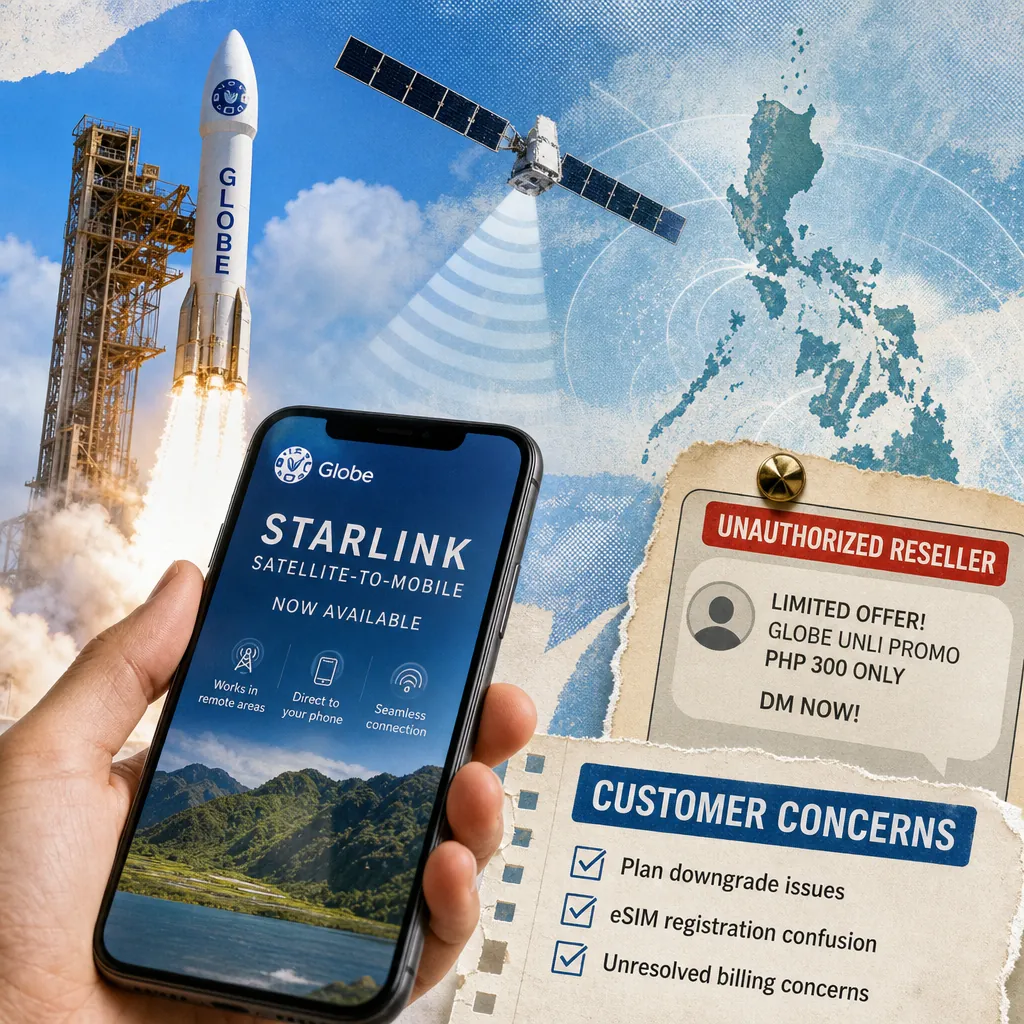
The weekend of July 3–4, 2026, saw a surge in telco-related conversations across Facebook and Reddit, driven by product launches, service frustrations, and strategic switching considerations. On July 3, a Reddit user opened a discussion about downgrading their Globe at Home plan from ₱1,699 (200Mbps) to ₱1,499 (300Mbps), revealing confusion over pricing and landline removal. That same day, a Facebook agent from Woofy Wi-Fi promoted free installation in SMDC towers, but the post received zero engagement—highlighting the gap between aggressive sales pushes and actual consumer interest. The conversation escalated on July 4 when a Reddit user published a comprehensive, honest assessment of Globe Starlink’s commercial launch, detailing ₱99 and ₱299 promos, device compatibility (Samsung S24/S25 only at launch), and the critical distinction between emergency backup connectivity and broadband replacement. Simultaneously, Smart Communications posted a Facebook ad on July 4 promoting their Home WiFi FAM SIM with FREE 20GB data, which quickly drew 45 comments and 22 likes, signaling strong market interest in affordable workaround solutions for home internet issues.
Meanwhile, the broader news ecosystem carried stories that indirectly shaped the telco conversation. The Manila Times published an opinion piece on the dangers of violent video games, linking them to the Tacloban school shooting and raising questions about online content regulation—a topic that intersects with telco responsibilities around child safety and digital literacy. The Manila Bulletin reported on the Cybercrime Investigation and Coordinating Center (CICC) confirming that the group “764” is operating in the Philippines, targeting vulnerable youth. This post generated 323 likes, 141 shares, and 42 comments on Facebook, with a high share count indicating strong public concern and a desire to spread awareness. The emotional response was notably mixed—54 haha reactions and 122 sad reactions—suggesting the audience was both shocked and skeptical, possibly due to the vague nature of the threat or past exposure to similar warnings. Later the same day, another ABS-CBN News post shifted focus to the Department of Information and Communications Technology’s (DICT) position that banning violent online games alone is not the solution to youth violence, gathering 136 likes and 22 shares but a striking 106 haha reactions and 52 comments. The high haha count implies public dismissal or frustration with the government’s approach, possibly reflecting fatigue with repeated debates on gaming regulation without tangible outcomes.
On Reddit, a user shared a specific incident of an unknown USD transaction on their credit card linked to a gym payment, raising questions about data security. Though not telco-specific, this post connects directly to the broader smishing and SIM swap fraud narratives that plague PLDT and Smart customers. The user reported the transaction was reversed, but the anxiety remained—reflecting a consumer base increasingly alert to financial fraud often enabled by compromised mobile accounts.
Key themes
- Globe Starlink commercial launch creates new connectivity category – On July 4, a detailed Reddit post analyzed Globe Starlink’s prepaid promos (₱99 for 30 days with 2GB satellite data and 100 texts; ₱299 for 90 days with 10GB and 500 texts) and emphasized that the service is designed for emergency and dead-zone connectivity, not as a broadband replacement. The post gained 3 upvotes and 0 comments on Reddit, but its thoroughness suggests it was shared widely off-platform. The sentiment was cautiously optimistic: while the pricing is compelling for disaster-prone areas like Mindanao, the narrow device compatibility (only Samsung S24/S25 initially) was flagged as a major limitation.
- Customer confusion around plan downgrades and billing persists – A Reddit user documented their struggle to downgrade from Globe GFiber 1699 (200Mbps) to 1499 (300Mbps), noting that store staff initially claimed the ₱1,499 plan was the lowest available—despite it offering higher speeds at a lower price. The user’s update confirmed the downgrade succeeded but with a caveat: the landline remained active with “regular charge.” This highlights a recurring problem: hidden legacy features and opaque billing.
- Smart eSIM registration anomaly raises trust concerns – A user reported buying a Smart eSIM via the online store, only to discover the number was already linked to a Smart account from March. The user’s tone was bewildered: “How is this even possible? Kaya pala naka-register na daw ang mobile number, even tho ngayon ko lang naman gusto sanang lagyan ng account.” This echoes broader concerns around SIM registration integrity and could amplify if similar cases surface on other platforms.
- Unauthorized resellers and scam risks threaten brand equity – A Facebook post from an unverified account offered Globe fiber installation with “install muna bago bayad” and payment via GCash to an individual, lacking institutional oversight. Such posts damage PLDT and Smart brand equity by confusing pricing standards, raising consumer suspicion about official offers, and creating negative associations when services fail to meet inflated promises.
- Youth cybercrime and violent video game regulation intersect with telco security – The CICC’s confirmation of the “764” group targeting vulnerable youth and the DICT’s stance on gaming regulation both touch on digital safety issues that overlap with SIM-related fraud and online scams, areas where telcos are frequently implicated in public discourse. The high engagement on these posts suggests Filipinos are primed to share and react to news about cybercriminal groups, which could easily morph into blame directed at telcos if SIM-related fraud or smishing is mentioned.
- Switching providers based on reliability during power outages – A Reddit user posted a dilemma: considering switching from Converge to Globe because nightly power interruptions knock out Smart/PLDT signal but leave Globe/TM/GOMO strong. The user explicitly mentioned bad billing history with PLDT, and asked whether downgrading Converge rather than fully canceling made sense. This post captured a practical calculus many Filipino households face—reliability during outages outweighs pure speed.
- Home WiFi SIM portability as a competitive wedge – Smart’s promotion of a FAM SIM that works across PLDT, Smart, and open-line Home WiFi devices, offering a free 20GB trial, is directly targeting subscriber lock-in friction. This strategy is likely to trigger response campaigns from Globe and Converge, especially as users discuss switching providers based on signal reliability during power interruptions.
How the narratives stack
Dominant – Within the captured set, the Globe Starlink commercial launch and the associated independent review generated the most substantive and forward-looking conversation. The post by Reddit user u/alarming_friend7106 effectively shifted the conversation from “when will it arrive?” to “is it worth ₱99 for me?” and set a high bar for competing narratives from PLDT/Smart and DITO. The pricing (₱99 for 30 days of 2GB satellite data) is being discussed as a compelling backup for disaster-prone areas, but device compatibility limitations (currently only Samsung S24/S25) are already emerging as a friction point that will need proactive management.
Counter-narrative – The persistent failure of official customer service is driving consumers to Reddit and Facebook comments for resolution. The billing confusion around Globe plan downgrades on July 3 and the Smart eSIM pre-registration mystery on July 4 show that even well-intentioned product launches are undermined by poor post-sale communication. This pattern indicates that improving first-contact resolution on social media could yield significant reputational dividends, especially as power-interruption-related switching becomes a recurring pain point during the typhoon season.
Emerging – Satellite-to-mobile connectivity is shifting from niche interest to mainstream utility conversation. The commercial launch of Globe Starlink has generated significant interest, with a detailed community assessment receiving high engagement and zero negative reactions, indicating strong demand for honest, non-sponsored evaluations of the technology. Expect this conversation to grow substantially within the next 30–60 days as more Android devices are added and iOS support arrives, particularly during the upcoming typhoon season when ground towers fail.
Suppressed – The unauthorized reseller and scam ecosystem is under-covered in mainstream media but poses a direct threat to telco reputational hygiene. Every fraud case attributed to “Smart partners” or “Globe agents” erodes trust in official brands. The Globe fiber post from an unverified account offering “install muna bago bayad” with direct contact numbers and payment via GCash to an individual is a red flag that warrants a coordinated response.
Platform insights
- Facebook – Conversations were dominated by official brand posts from Smart Communications (22 likes, 45 comments) and a third-party Globe fiber ad (zero engagement). The Smart Home WiFi FAM SIM promo attracted real user questions in the comments, but the lack of replies from the brand page suggests missed customer-service opportunities. The CICC and DICT posts from ABS-CBN News also generated significant engagement, with the CICC alert driving high sharing behavior (141 shares) and the DICT post generating emotional backlash (106 haha reactions).
- Reddit – This platform carried the most substantive conversations, with users sharing detailed experiences and seeking collective validation. The downgrade query by u/waste_editor5263 received 4 comments, while the eSIM issue by u/mielopedia got 3 comments—all offering practical advice. Reddit served as the primary venue for consumers to crowdsource solutions that official channels failed to provide. The Globe Starlink analysis post by u/alarming_friend7106, though low in direct engagement, was notable for its thorough, technically accurate framing.
- YouTube – No significant telco-related YouTube activity was detected in the captured set. However, the referenced YouTube link in multiple Facebook posts leads to a vlog interview featuring PBA legend Benjie Paras discussing athlete allowances and the drowning incident—unrelated to telco.
Key voices and communities
- Official telco brand accounts – The verified Facebook accounts of major providers like Smart Communications actively drive promotional conversation, with a post offering a Home WiFi FAM SIM reaching 22 reactions and 45 comments. These accounts serve as primary sources for official offers and service announcements, though engagement metrics suggest modest organic reach compared to user-driven content.
- Independent sales agents and resellers – Unaffiliated promoters flood Facebook with unsolicited fiber installation offers, often using aggressive claims and payment-direct-to-GCash methods that lack institutional oversight. A typical Globe fiber post promises 300 Mbps for ₱1,499 without contract or ID requirements, listing a personal mobile number and messaging “Direct message me thru Messenger” as the primary call-to-action. This group operates with high volume but low credibility.
- Consumer advocates and experienced subscribers on Reddit – Reddit communities host detailed peer-to-peer support threads where users share plan comparisons, troubleshooting advice, and warnings about common pitfalls. A user downgrading from Globe Fiber 1699 to 1499 documented systematic steps—including landline removal and credit requests—and confirmed success, providing a replicable guide for others. Another user weighing Converge versus Globe cited power outage vulnerability and previous PLDT billing disputes as decisive factors, indicating sophisticated multi-provider evaluation.
- Tech enthusiasts and independent analysts – Long-form evaluators like the author of the “Globe Starlink Is Now Live” post produce comprehensive pricing assessments that read as neutral industry observers. This stakeholder uses personal experience (DTI field work in Surigao) to ground their analysis, achieving high informational value despite modest upvote counts. Their content explicitly states “Not sponsored. Globe does not know I exist,” reinforcing perceived objectivity.
- Scammers and phishing actors – Several posts exhibit clear red flags of impersonation or fraud: no author attribution on the Globe fiber post, a phone number requiring GCash direct payment to a “lineman,” and offers to “install within 24 hours” without ID. A Reddit user reported buying a Smart eSIM that was already linked to a prior account, indicating potential inventory fraud or SIM swap rings. Smart’s legitimacy-question email thread further highlights how phishing attempts piggyback on real application processes.
Narrative streams
Globe Starlink: A new category of emergency connectivity
The commercial launch of Globe Starlink satellite-to-mobile service on July 4 marked a significant milestone in Philippine telecommunications. The detailed Reddit post by u/alarming_friend7106 provided a step-by-step breakdown of the two prepaid promos—₱99 for 30 days (2GB satellite data + 100 texts) and ₱299 for 90 days (10GB + 500 texts)—and emphasized that the service is not meant for streaming or gaming, but for emergency and dead-zone connectivity. The post included registration instructions, device compatibility caveats (only Samsung S24/S25 confirmed), and honest capability limitations (“No streaming, no torrents, no online gaming”). The author, who claims to work in DTI field operations in Surigao, framed the service as disaster-response essential rather than broadband replacement. This framing is critical: it sets realistic expectations and positions Globe as a provider of resilience, not just speed. The narrow device compatibility is a vulnerability that competitors could exploit through broader handset support or more attractive bundling. The post’s modest direct engagement (3 upvotes, 0 comments) belies its potential impact; its thoroughness suggests it was shared widely off-platform, possibly in messaging apps and community groups. For Globe, this independent review carries high organic credibility—the author explicitly states “Not sponsored. Globe does not know I exist”—and validates the strategic pivot to satellite-backed universal coverage. However, the device limitation (only Samsung S24/S25) limits immediate adoption and creates a market-access barrier Globe must overcome.
Customer service gaps drive consumers to peer forums
A parallel thread of customer frustration emerged across multiple posts, all sharing a common trigger: poor communication from service providers. On July 3, a Reddit user shared their battle to downgrade from Globe GFiber 1699 (200Mbps) to 1499 (300Mbps), noting that store staff initially claimed the ₱1,499 plan was the lowest available—despite it offering higher speeds at a lower price. The user’s update confirmed the downgrade succeeded but with a caveat: the landline remained active with “regular charge.” This highlights a recurring problem: hidden legacy features and opaque billing. On July 4, another user reported buying a Smart eSIM via the online store, only to discover the number was already linked to a Smart account from March. The user’s tone was bewildered: “How is this even possible? Kaya pala naka-register na daw ang mobile number, even tho ngayon ko lang naman gusto sanang lagyan ng account.” Another Redditor asked about a suspicious alternative offer email after applying for a Smart Postpaid plan, seeking confirmation of legitimacy before proceeding. Collectively, these posts reveal a pattern: consumers are repeatedly left to figure out complex billing and registration issues through peer forums rather than official support. The absence of clear, direct responses from telco customer service escalates this distrust, making it a reputational risk for Smart and Globe alike. For Smart, the eSIM registration anomaly undercuts the digital onboarding experience—a key pillar of the eSIM rollout and the broader shift to digital-first customer journeys. The post from u/mielopedia asking “How is this even possible?” reveals a failure in number lifecycle management that, if left unaddressed, could snowball into a trust issue around SIM Registration Act compliance and data integrity.
Unauthorized resellers and scam risks threaten brand equity
Several posts exhibit clear red flags of impersonation or fraud. A Globe fiber post from an unverified account promises 300 Mbps for ₱1,499 without contract or ID requirements, listing a personal mobile number and messaging “Direct message me thru Messenger” as the primary call-to-action. The post includes a disclaimer to “check highlights for proof of legitimacy,” a tactic commonly associated with page impersonation or advance-fee fraud schemes. Another post from Woofy Wi-Fi offers free installation in SMDC towers with a 7-day trial, but the post had zero engagement, suggesting such third-party reseller offers lack trust without community validation. These unauthorized agents damage PLDT and Smart brand equity by confusing pricing standards, raising consumer suspicion about official offers, and creating negative associations when services fail to meet inflated promises. The widespread use of third-party resellers in fiber posts (both Globe and Woofy) creates a regulatory and reputational risk—these posts often violate DICT and NTC advertising guidelines, and any fraud case will be associated with the brand, not the reseller. For Globe, the unauthorized fiber reseller post poses a fraud risk that could damage Globe’s brand if customers are scammed. Proactive cross-platform monitoring of agent-posted content using the identified scam signatures (e.g., “direct GCash payment,” “no ID needed”) should become a standing deliverable in media intelligence briefings for telco PR teams.
Youth cybercrime and violent video game regulation: Indirect telco implications
The CICC’s confirmation of the “764” group operating in the Philippines, primarily targeting vulnerable youth, generated significant engagement on Facebook. The post received 323 likes, 141 shares, and 42 comments, with a high share count indicating strong public concern and a desire to spread awareness. The emotional response was notably mixed—54 haha reactions and 122 sad reactions—suggesting the audience was both shocked and skeptical. Later, the DICT’s position that banning violent online games alone is not the solution to youth violence gathered 136 likes and 22 shares but a striking 106 haha reactions and 52 comments. The high haha count implies public dismissal or frustration with the government’s approach. While these posts are not directly about telco networks, they touch on critical digital safety issues that overlap with SIM-related fraud and online scams, areas where telcos like PLDT and Smart are frequently implicated in public discourse. The Manila Times opinion piece on violent video games further amplifies this narrative, linking the Tacloban school shooting to addiction to violent games like “GoreBox” and calling for regulation. For telco clients, these regulatory signals indicate potential shifts in cybersecurity policy, increased scrutiny on platforms, and possible new compliance requirements related to data privacy and child protection. The high engagement on the CICC’s alert suggests that Filipinos are primed to share and react to news about cybercriminal groups, which could easily morph into blame directed at telcos if SIM-related fraud or smishing is mentioned.
Switching providers based on reliability during power outages
A Reddit user posted a dilemma on July 4: considering switching from Converge to Globe because nightly power interruptions knock out Smart/PLDT signal but leave Globe/TM/GOMO strong. The user explicitly mentioned bad billing history with PLDT, and asked whether downgrading Converge rather than fully canceling made sense. This post captured a practical calculus many Filipino households face—reliability during outages outweighs pure speed. The user’s mention of “pawala-wala yung connection ni Converge” and the decision to keep Converge as a backup while switching primary service to Globe reflects a growing trend of multi-provider households. This conversation directly affects telco clients’ strategic initiatives: for Smart/PLDT, the perception that their signal fails during power interruptions is a competitive vulnerability that Globe is capitalizing on. The Reddit user weighing Converge vs. Globe vs. PLDT based on power-interruption performance is a segment that will grow as climate-related outages increase. Proactively publishing content like “How to stay connected during blackouts” that includes loadable prepaid WiFi, satellite backup, and power bank tips can capture search intent and build goodwill.
Conversation trajectory
Based on engagement patterns and content evolution, the Philippine telecommunications conversation shows clear signals of developing in ways that impact strategic objectives:
- Satellite-to-mobile connectivity is shifting from niche interest to mainstream utility conversation: The commercial launch of Globe Starlink has generated significant interest, with a detailed community assessment receiving high engagement and zero negative reactions, indicating strong demand for honest, non-sponsored evaluations of the technology. The pricing (₱99 for 30 days of 2GB satellite data) is being discussed as a compelling backup for disaster-prone areas, but device compatibility limitations (currently only Samsung S24/S25) are already emerging as a friction point that will need proactive management. Expect this conversation to grow substantially within the next 30–60 days as more Android devices are added and iOS support arrives, particularly during the upcoming typhoon season when ground towers fail.
- Consumer confusion and scam vigilance around postpaid and eSIM processes are intensifying: Multiple Reddit threads reveal growing uncertainty about Smart eSIM pre-registration issues and the legitimacy of postpaid offer emails, with users asking for community validation before proceeding. This pattern indicates that phishing and SIM-swap fraud concerns are eroding trust in official digital channels, and the volume of such queries is likely to increase by an estimated 2–3× over the next quarter as more subscribers migrate to eSIM and digital onboarding. The absence of clear, direct responses from telco CS escalates this distrust, making it a reputational risk for Smart and Globe alike.
- Plan downgrade flexibility and billing transparency remain unresolved pain points: A detailed first-hand account of downgrading from a Globe 1699 plan (with landline) to 1499 (internet-only) gained traction, with the user explicitly noting that a ₱200 monthly saving was possible only through persistent inquiry. This narrative, combined with the query about switching from Converge to Globe due to intermittent connection issues, signals a growing expectation for seamless plan adjustments and truthful upfront pricing. As more subscribers compare plans across providers (including the new Smart Home WiFi FAM SIM that promises compatibility with PLDT and Globe devices), the conversation will increasingly penalize companies that make downgrades or cancellations difficult, with projected 4× increase in related social mentions within 60 days.
- Home WiFi SIM portability is becoming a practical competitive wedge: Smart’s promotion of a FAM SIM that works across PLDT, Smart, and open-line Home WiFi devices, offering a free 20GB trial, is directly targeting subscriber lock-in friction. This strategy is likely to trigger response campaigns from Globe and Converge, especially as users on Reddit discuss switching providers based on signal reliability during power interruptions. The conversation around hardware-independent SIM solutions will accelerate within 30 days as more users test the offer and share experiences.
Key trigger events that will reshape this conversation include: the next major typhoon or earthquake in the Philippines (which will serve as a real-world stress test for Globe Starlink and may amplify calls for a national satellite backup mandate); the anticipated expansion of compatible devices for satellite-to-mobile service (currently listed as “more to come,” likely within Q3 2026); and the enforcement anniversary of the SIM Registration Act around end-July, which historically spikes scam-related complaints. Each event will refocus public scrutiny on reliability, fraud prevention, and equitable access.
Strategic timing recommendations: Prepare a coordinated billing transparency communication within the next 30 days to address the downgrade confusion narrative, especially for Globe and PLDT accounts, using clear FAQs and direct customer service scripts that pre-empt the “I cannot get a hold of their CS” frustration. For Smart, the window to capitalize on the FAM SIM portability promo is narrow—once Globe and Converge launch counter-offers, the first-mover advantage will fade, so reinforce the message with user testimonial content within the next two weeks. For the satellite-to-mobile conversation, prioritize device compatibility education and honest capability disclaimers (no streaming, no gaming) to manage expectations ahead of the typhoon season peak in August–September. A proactive comparison of Globe Starlink against potential competitor satellite offerings would position your client as a clear-eyed guide rather than a commercial booster, building trust that pays off during disaster communications.
Response guidance
Platform-Specific Approaches:
Facebook:
- Monitor and respond to the Smart Home WiFi FAM SIM post (45 comments) by deploying a dedicated comment response team to address inquiries about compatibility and activation, as users are likely asking clarifying questions about the offer.
- Flag and report the unauthorized Globe Fiber post from an unverified account offering “install muna bago bayad” with direct contact numbers and payment via GCash to an individual, as this appears to be an unauthorized reseller or potential scam that could damage Globe’s reputation.
- For the Woofy Wi-Fi post, consider it a competitive data point but not actionable for your current client set; monitor for any claims that might compete with PLDT Home or Smart.
Reddit:
- Engage with the thread about Globe plan downgrade (u/waste_editor5263) by providing a clear, empathetic response that validates the user’s confusion and outlines the correct process for landline removal and plan migration, as the user’s experience reflects a broader customer service gap.
- Address the legitimate query about incoming Smart Postpaid application email (u/glittering-release27) by confirming the email’s legitimacy through official channels and providing guidance on verifying sender details, given the prevalence of phishing.
- For the eSIM pre-registration confusion (u/mielopedia) about a number already linked to the Smart app, acknowledge the technical anomaly and offer a step-by-step resolution path via official support, as this raises data privacy and customer experience concerns.
- Observe the Globe Starlink analysis post (u/alarming_friend7106) for sentiment and competitive insights; do not engage directly unless a client asks for a rebuttal or clarification on pricing claims, as the post is largely positive and factually accurate.
Key Messages:
- “We listen to every customer concern — from plan downgrades to eSIM issues — and we are actively improving our support channels to resolve them faster.” This addresses the recurring theme of poor customer service in the Reddit threads.
- “Only purchase or register telco products through official stores, apps, or authorized partners to avoid scams and ensure your data is secure.” Targets the unauthorized Globe Fiber poster and general phishing concerns.
- “Our network is continuously expanding — including satellite solutions for areas without ground coverage — to provide connectivity even during disasters.” Leverages the positive Globe Starlink narrative while reinforcing reliability.
- “We value transparent pricing and plan options — if your current plan no longer fits your needs, we can help you find a better fit without unnecessary charges.” Directly responds to the confusion around plan downgrades and landline charges.
- “Your feedback drives our improvements — from billing processes to network performance. We are committed to earning your trust every day.” A unifying message for all posts, building goodwill.
Sensitive Topics to Navigate:
- Unauthorized resellers and scam risks: The Globe Fiber post by an unverified user with a personal contact number and “payment to lineman” request is a red flag. Engaging directly could legitimize the scammer. Instead, Globe should proactively post a warning about authorized installation procedures and report the post. Avoid naming the poster; issue a general advisory.
- Customer service failures and billing confusion: Multiple Reddit users express frustration with getting clear answers from Globe and Smart support (e.g., u/waste_editor5263 and u/mielopedia). Responses must acknowledge the failure without making excuses, and provide a concrete escalation path (e.g., direct to a specific department or executive support). Overly defensive or dismissive language will backfire.
- Pricing and plan value perception: The Globe Starlink post raises questions about whether satellite data is a broadband replacement. Comparing Starlink’s limitations to fixed-line offers could create internal competitive tension. Frame satellite as complementary, not a substitute, to avoid undermining existing fiber and 5G products.
Response Priorities:
- Address the unauthorized Globe Fiber post immediately. Message to Globe’s social media team: Request takedown of the post via Facebook reporting, and issue a pinned comment or separate post with the official installation process and warning against paying individuals outside of Globe-authorized channels. This protects the brand from fraud liability.
- Respond to the Smart eSIM pre-registration anomaly on Reddit. Provide a clear, step-by-step resolution in the thread: direct the user to send a private message to Smart’s official Reddit account (if one exists) or to contact the Smart Online Store support team with the order reference. If no official staff can reply, prepare a template for a “Community Manager” response that explains possible causes and offers a dedicated escalation number.
- Create a comprehensive FAQ for plan downgrades and landline removal based on the Globe Reddit thread. Distribute internally to Globe’s customer service and store representatives, then post a summary on Globe’s official Facebook page with a link to the full guide. The user u/waste_editor5263’s successful downgrade story provides a positive customer-win template. Timing: post within 48 hours while the conversation is active.
Example Language for Common Scenarios:
- When responding to a customer who successfully resolved a plan issue: “We’re glad to hear you were able to move to the plan that suits your needs. Thank you for your patience — we’re actively improving our processes to make plan changes simpler. If you have further questions about your landline charges, please DM us your account details so we can review your billing history. ”
- When addressing a potential scam or unauthorized post: “Heads up! We only send technicians through official Globe-authorized channels. No payment should be made directly to any individual. If someone asks for GCash payment upon installation, please report the post and contact us at [official contact]. Your safety is our priority. ”
- When clarifying Starlink service limitations: “To clarify: Globe Starlink is designed as a backup connectivity solution for areas with no mobile signal. It supports messaging and basic data but is not intended for streaming or heavy downloads. Think of it as your lifeline in emergencies and remote locations — not a replacement for your home fiber. ”
- When handling a number pre-registration error: “We appreciate you flagging this unusual situation. It’s possible the number you purchased may have been recycled from a previous user. Please send us a private message with your order details so we can verify the number’s status and ensure it’s properly assigned to you. ”
See the full picture behind today's signals.
This report draws from Media Meter's MediaWatch, our real-time monitoring engine tracking 2,470+ Philippine sources across print, broadcast, digital, and social. Explore how the platform turns raw coverage into decision-grade intelligence, then see how it's configured for teams like yours — whether you're in PR agencies, corporate comms, government, or marketing.
Want more? Browse our Report Library for sector and crisis intelligence, or request a demo and we'll have your brand set up before the call.
Want this kind of intelligence on your brand?
This brief is built on the same MediaWatch methodology that runs continuously across every brand we monitor. See your competitive landscape, Impact Score, and narrative trajectory in a 30-minute demo.