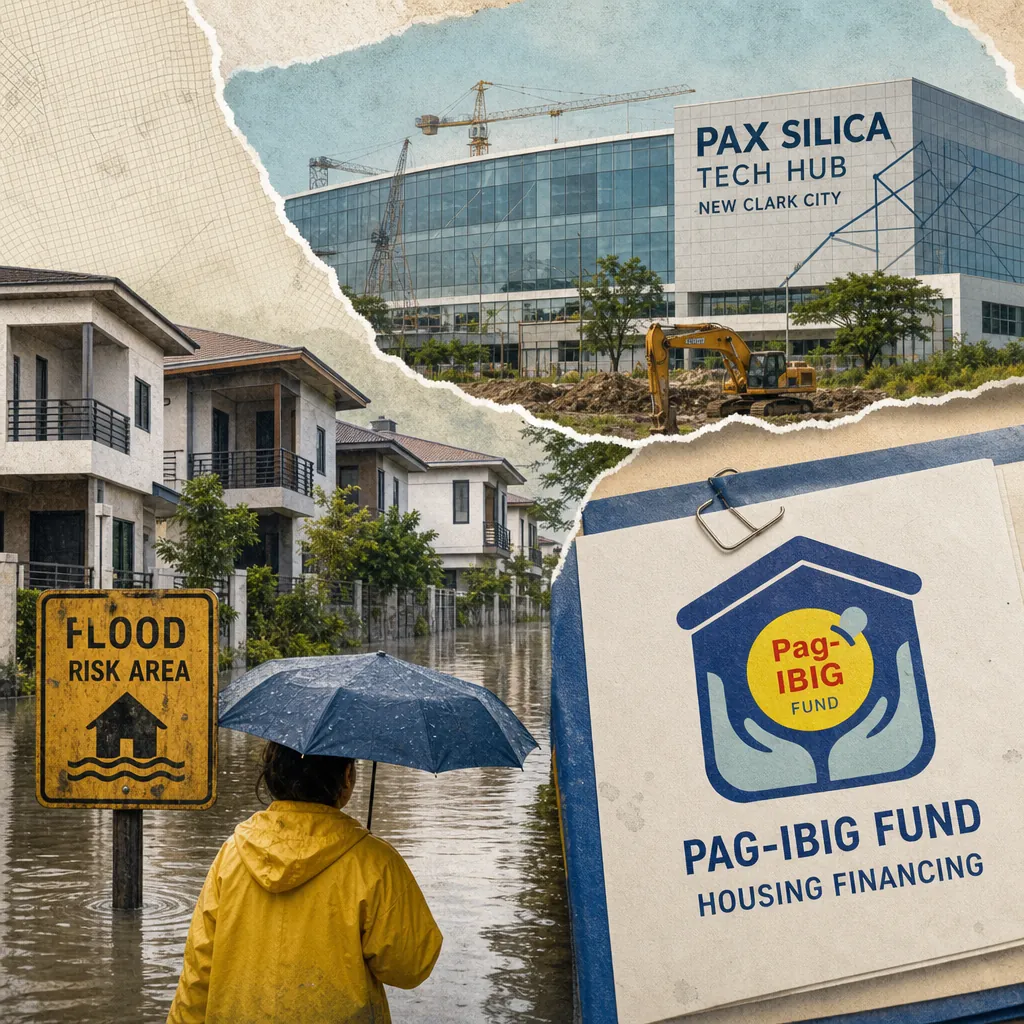
Flooding, financing, and developer confidence: Philippine real estate navigates a divided day
July 2, 2026 saw the Philippine real estate conversation split between nationwide flooding concerns, consumer financing struggles, and bullish developer moves, with the World Bank's UMIC upgrade lifting the stock market.

The Philippine real estate conversation on July 2, 2026, ran on three tracks that rarely touched: a nationwide flooding narrative that expanded to Mindanao, a consumer-led financing anxiety playing out on Reddit, and a set of bullish corporate announcements—from Arthaland's luxury tower groundbreaking to the SM Group's governance awards—that signaled developer confidence despite the weather. The World Bank's upgrade of the Philippines to upper-middle-income status (UMIC) lifted the stock market, with the Philippine Stock Exchange index (PSEi) gaining 0.93 percent to close at 6,125.72, but the day's most engaged posts were about knee-deep floodwaters, not index gains. The split is the story: the sector's institutional face is optimistic, while its consumer-facing reality is waterlogged and cash-strapped.
Flooding dominated social media and news feeds. A GMA News post reported that areas in Maguindanao del Sur had been submerged for nearly three days and a bridge had collapsed in South Cotabato, drawing 238 likes and 21 shares. This extended the flood conversation beyond Luzon and Davao into Mindanao, a region where developers such as Vista Land and Filinvest have projects. In Luzon, PAGASA issued multiple thunderstorm advisories throughout the day, warning of intense rain in Laguna, Quezon, Cavite, and other provinces. A separate GMA News post about knee-deep flooding on Quezon City roads generated over 400 "haha" reactions and 280 comments, a mix of frustration and dark humor about recurring urban floods. The MMDA's post about drainage declogging operations in Katipunan received 360 likes and 31 "love" reactions, indicating public approval of visible action. The National Disaster Resilience Month kick-off at SM Mall of Asia, featuring SM Prime's Vice President for Corporate Compliance as a speaker, positioned the developer as a visible partner in resilience.
On the financing front, Reddit became the venue for personalized housing finance dilemmas. User u/Unable-Dimension-663 posted that Pag-IBIG had rejected their housing loan application because an eCAR (electronic Certificate of Authorized Registration) had already been released before they applied, creating a bureaucratic catch-22 that forced them to seek bank financing for a ₱2.5 million family house. The post received 1 upvote and 3 comments, but it captured a specific procedural gap that is pushing buyers toward commercial banks. Simultaneously, user u/eM_Nethgilne vented about having unpaid SSS and Pag-IBIG loans for nearly three years, citing inflation and distrust in government as reasons for nonpayment. This post, with 2 comments, revealed a segment of the market that has disengaged from government housing loans entirely.
Corporate real estate activity was robust. Arthaland Corp. broke ground on Sondris, a ₱12 billion, 37-story luxury residential tower in Makati, developed in partnership with Japan's Mitsui Fudosan, signaling confidence in the upper-end market despite concerns over a condo glut. Hann Philippines Inc. signed a registration agreement with the Philippine Economic Zone Authority (PEZA) for its Hann Reserve development in New Clark City, a ₱10 billion tourism enterprise that will include the country's first PGA-affiliated golf courses. The SM Group received 24 awards from Corporate Governance Asia, with SM Investments Corp., BDO Unibank, and SM Prime Holdings Inc. recognized for governance, sustainability, and investor relations. DMCI Homes debuted a beach resort and events destination in Batangas, while Megaworld opened Plaza de MassKara in Bacolod and launched its TARA! campaign to promote local travel. Ayala Land Offices welcomed Eucalyptus to its Click Space at One Ayala, highlighting demand for flexible workspaces. Metro Pacific Water improved water supply for over 3,500 households in San Jose del Monte, Bulacan, by repairing pipeline leaks.
The stock market reflected the upbeat corporate news. The PSEi rose 56.46 points, or 0.93 percent, to 6,125.72, with Ayala Land Inc. (ALI) gaining 3.01 percent and accounting for much of the index's advance. The World Bank's upgrade of the Philippines to upper-middle-income status, announced on July 1, was cited as a key driver, along with the S&P Global Philippines Manufacturing PMI edging up to 50.9 in June. However, foreign investors remained net sellers, with outflows of ₱199.83 million.
Key themes
- Nationwide flooding expands geographic risk for developers: Flooding reports from Maguindanao del Sur (nearly three days submerged) and South Cotabato (collapsed bridge) extended the climate-risk conversation to Mindanao, where developers like Vista Land and Filinvest have projects. This follows days of Luzon flooding that affected key real estate corridors in Bulacan, Laguna, Cavite, and Rizal.
- Pag-IBIG loan rejection creates financing bottleneck: A Reddit user detailed how an eCAR issued before a Pag-IBIG application led to automatic rejection, forcing them to seek bank financing for a ₱2.5 million house. This procedural gap is pushing buyers toward commercial banks and may signal a need for policy clarification from the Department of Human Settlements and Urban Development (DHSUD).
- Loan delinquency and institutional distrust surface: Another Reddit user admitted to not paying SSS and Pag-IBIG loans for three years, citing inflation and lack of trust in government. This reflects a segment of borrowers who have disengaged from government housing finance, potentially affecting loan repayment rates and liquidity in the housing ecosystem.
- Luxury and tourism developments proceed despite headwinds: Arthaland broke ground on a ₱12 billion luxury tower in Makati, Hann Philippines registered a ₱10 billion tourism project in New Clark City, and DMCI Homes launched a beach resort in Batangas. These moves signal developer confidence in high-end and tourism-driven segments.
- SM Group and Megaworld reinforce governance and local tourism narratives: The SM Group received 24 corporate governance awards, while Megaworld opened Plaza de MassKara in Bacolod and launched its TARA! campaign to promote local travel. These stories position major developers as responsible corporate citizens.
- Water infrastructure investments support housing viability: Metro Pacific Water repaired pipeline leaks in Bulacan, improving supply for over 3,500 households. Manila Water's subsidiary Clark Water broke ground on a 10-million-liter-per-day wastewater treatment plant in Clark Freeport Zone. These projects address a key concern for homebuyers in flood-prone areas.
- Stock market rallies on UMIC upgrade, but foreign selling persists: The PSEi rose 0.93 percent on the World Bank's upgrade of the Philippines to upper-middle-income status, with Ayala Land leading gains. However, foreign investors were net sellers, suggesting caution remains.
How the narratives stack
Dominant: Within the captured set, the flooding narrative dominated both social media engagement and news coverage. The GMA News post on Maguindanao del Sur flooding drew 238 likes and 21 shares, while the Quezon City flood post generated over 400 reactions and 280 comments. PAGASA advisories averaged over 16,000 views each. The MMDA's declogging post received 360 likes. This volume of engagement—across Facebook, news outlets, and government channels—made flooding the most visible story of the day, with direct implications for property desirability in affected areas.
Counter-narrative: Developer confidence stories provided a counterpoint to the flood gloom. Arthaland's luxury tower groundbreaking, Hann Philippines' PEZA registration, and the SM Group's governance awards all signaled that major players are investing in long-term projects despite short-term weather and financing challenges. The stock market rally on the UMIC upgrade reinforced this optimistic institutional narrative.
Emerging: Consumer financing anxiety is emerging as a distinct narrative stream, driven by Reddit posts about Pag-IBIG rejection and loan delinquency. While engagement is low (1-3 comments per post), these personal stories capture systemic friction points that could amplify if similar experiences are shared more widely. The procedural gap around eCAR timing is a specific issue that DHSUD or Pag-IBIG may need to address.
Suppressed: The story of affordable housing delivery—specifically, the DHSUD and Social Housing Finance Corp. (SHFC) awarding land titles to 70 low-income families in Rizal under the Community Mortgage Program—received minimal attention. Despite being a tangible government achievement under the Pambansang Pabahay para sa Pilipino (4PH) program, it was covered only by the Daily Tribune with an estimated advertising-equivalent value of ₱74,256, far below the flood and corporate stories. This under-coverage means a positive housing narrative is not reaching the broader public.
Platform insights
- Facebook: Flood-related posts dominated engagement. The GMA News post on Maguindanao del Sur flooding received 238 likes and 21 shares, while the Quezon City flood post generated over 400 reactions and 280 comments. Government posts (MMDA declogging, PAGASA advisories) also performed well, with the MMDA post receiving 360 likes and 31 love reactions. Corporate announcements (Arthaland groundbreaking, SM Group awards) received lower engagement, typically in the tens of likes. The platform served as a mix of breaking news and institutional messaging.
- Reddit: The platform hosted the most detailed consumer finance discussions. Two housing loan threads—one on Pag-IBIG rejection and one on loan delinquency —received modest engagement (1-3 comments each) but provided rich qualitative data on buyer frustrations. Reddit remains a niche but high-signal channel for understanding consumer pain points in real estate.
- YouTube: No new real estate-related YouTube videos appeared in the dataset, but the earlier tutorial on Pag-IBIG payments via OFBank (10 views) suggests low current demand for how-to content on this topic.
- News media: Online news outlets (Inquirer, Philstar, BusinessWorld, Daily Tribune) carried the bulk of corporate and policy coverage. The UMIC upgrade story was widely covered, with multiple outlets reporting on the stock market reaction. Flood coverage was also prominent, with PAGASA advisories and local news reports appearing across several sites.
Key voices and communities
- Affected residents and homeowners: Individuals directly experiencing flooding continue to dominate the conversation, with new reports from Maguindanao del Sur and South Cotabato expanding the geographic scope. Emotional responses are mixed: the Quezon City flood post drew 400 "haha" reactions, suggesting frustration or dark humor, while the Maguindanao post had no negative reactions, indicating a more neutral or resigned tone.
- Government agencies and disaster response bodies: PAGASA issued multiple thunderstorm advisories, the MMDA posted about drainage declogging, and the National Disaster Resilience Month kick-off featured SM Prime. These voices provide authoritative information but are reactive rather than proactive in shaping the narrative.
- Individual homebuyers and borrowers: Reddit users represent a small but highly engaged group sharing personal housing finance dilemmas. The Pag-IBIG rejection post and the loan delinquency post reveal real-world friction points that shape public perception of housing finance systems.
- Major real estate developers: Arthaland, Hann Philippines, SM Group, DMCI Homes, Megaworld, and Ayala Land all had positive corporate announcements on July 2. These voices reinforce a narrative of confidence and investment, counterbalancing the flood and financing concerns.
- Financial content creators: YouTube creators like @babydrewtvko produce tutorial videos on Pag-IBIG payments, targeting OFWs and domestic borrowers. While viewership is low, these creators fill an information gap and could be leveraged for educational content.
Narrative streams
Flooding and climate risk expand to Mindanao
The flooding narrative, which had been centered on Luzon and Davao in previous days, expanded to Mindanao on July 2. A GMA News Facebook post reported that areas in Maguindanao del Sur had been submerged for nearly three days and a bridge had collapsed in South Cotabato. The post accumulated 238 likes and 21 shares, with no negative reactions, suggesting that residents are engaging with flood news in a more neutral or informative manner compared to the dark humor seen in Metro Manila. This expansion of geographic scope is significant for real estate stakeholders: developers with projects in Mindanao—such as Vista Land and Filinvest in Davao and General Santos—now face reputational and operational risks similar to those in Luzon. For Pag-IBIG and bank financing clients like BPI, these reports signal increased risk for housing loans in affected provinces. The lack of government advisories for Mindanao in this dataset suggests potential communication gaps that the Office of Civil Defense or Malacañang could address to ensure consistent nationwide flood alerts.
Pag-IBIG loan rejection exposes procedural gap
A Reddit post by user u/Unable-Dimension-663 detailed a specific bureaucratic hurdle: their Pag-IBIG housing loan application was rejected because an eCAR (electronic Certificate of Authorized Registration) had already been released before they applied. The eCAR is a document that transfers the property title from the seller to the buyer; once issued, Pag-IBIG considers the property no longer eligible for its loan program because the title is no longer under the seller's name. The user, seeking to finance a ₱2.5 million family house, was forced to explore bank financing options, asking about home equity loans and long-term amortization rates. This post, with 1 upvote and 3 comments, highlights a procedural catch-22 that may be affecting many buyers. For banking clients like BPI, this represents an opportunity to capture borrowers who are locked out of Pag-IBIG. For developers, it signals a need to coordinate pre-approval processes with Pag-IBIG or offer bridge financing. The Department of Human Settlements and Urban Development (DHSUD) could issue a clarifying circular on eCAR timing to prevent such rejections.
Loan delinquency and institutional distrust
Another Reddit user, u/eM_Nethgilne, posted about having unpaid SSS and Pag-IBIG loans for nearly three years, citing inflation and distrust in government as reasons for nonpayment. The user wrote, "I don't have the trust and confidence with our gov't (those f***ers)," reflecting deep frustration. This post, with 2 comments, reveals a segment of borrowers who have disengaged from government housing finance entirely. For property developers and REIT sponsors, a decline in Pag-IBIG loan repayment rates could tighten liquidity in the housing ecosystem, potentially slowing ready-for-occupancy turnover or preselling volumes. For Malacañang, this sentiment underscores the need for clearer communication on flexible repayment options and loan restructuring programs. Pag-IBIG and SSS both offer condonation and restructuring programs, but awareness appears low.
Arthaland and Hann Philippines bet on luxury and tourism
Despite the flood and financing headwinds, two major corporate announcements signaled confidence in high-end and tourism-driven segments. Arthaland Corp. broke ground on Sondris, a ₱12 billion, 37-story luxury residential tower in Makati, developed in partnership with Japan's Mitsui Fudosan. The company acknowledged the challenging environment but stressed that it has taken steps to manage risks. This project targets affluent buyers who are less affected by flooding and financing issues. Separately, Hann Philippines Inc., a South Korean-led investment firm, signed a registration agreement with the Philippine Economic Zone Authority (PEZA) for its Hann Reserve development in New Clark City, a ₱10 billion tourism enterprise that will include the country's first PGA-affiliated golf courses, clubhouses, and food and beverage outlets. The project is expected to boost tourism in Tarlac and create jobs. These announcements suggest that developers are doubling down on segments where demand remains resilient.
SM Group and Megaworld reinforce governance and local tourism
The SM Group received 24 awards from Hong Kong-based publication Corporate Governance Asia, with SM Investments Corp., BDO Unibank, and SM Prime Holdings Inc. recognized for governance, sustainability, investor relations, and corporate leadership. SM Investments President and CEO Frederic C. DyBuncio was named Asia's Best CEO (Investor Relations). This recognition reinforces the group's reputation as a well-governed conglomerate, which can be leveraged in marketing and investor communications. Meanwhile, Megaworld opened Plaza de MassKara in Bacolod, a 4,100-square-meter public space inspired by the MassKara Festival, as part of its 34-hectare Upper East township. The company also launched its TARA! (Travel Away & Reignite Adventure) campaign to promote local travel amid rising global travel costs. These moves position Megaworld as a contributor to cultural tourism and local economic development.
Stock market rallies on UMIC upgrade, but foreign selling persists
The Philippine Stock Exchange index (PSEi) rose 0.93 percent, or 56.46 points, to close at 6,125.72 on July 2, extending gains from the previous session. The rally was driven by the World Bank's upgrade of the Philippines to upper-middle-income status, announced on July 1, and a slight improvement in the S&P Global Philippines Manufacturing PMI to 50.9 in June. Ayala Land Inc. (ALI) was a top gainer, rising 3.01 percent and accounting for much of the index's advance. However, foreign investors remained net sellers, with outflows of ₱199.83 million, indicating that international sentiment is not yet fully bullish. The UMIC upgrade is expected to gradually close the door on cheap loans and aid from development partners, as the Philippines may now be seen as less in need of concessional financing. Analysts urged the government to recalibrate its borrowing program accordingly.
Water infrastructure investments support housing viability
Two water infrastructure stories addressed a key concern for homebuyers in flood-prone and water-scarce areas. Metro Pacific Water (MPW), a unit of Metro Pacific Investments Corp., reported that it had improved water supply for over 3,500 households in San Jose del Monte, Bulacan, by repairing 29 pipeline leaks since taking over operations on June 5. The repairs restored 24-hour water supply to some areas and increased availability in others. Separately, Manila Water's subsidiary Clark Water Corp. and the Clark Development Corp. broke ground on a 10-million-liter-per-day wastewater treatment facility in the Clark Freeport Zone. The facility will use sequencing batch reactor technology with biological nutrient removal to improve efficiency and meet environmental standards. These projects demonstrate that water infrastructure is being upgraded in areas with active housing development, which can reassure buyers and investors.
Conversation trajectory
- Flooding concerns will intensify scrutiny of development locations across multiple regions: The expansion of flooding to Mindanao, combined with sustained Luzon flooding, means that flood risk is now a national issue affecting key real estate markets. Expect a 2-3x increase in social mentions linking "baha" with developer projects in flood-prone areas over the next 2-3 weeks, particularly for subdivisions in Bulacan, Cavite, Laguna, Rizal, and now Mindanao regions like Davao and General Santos. Developers with projects in these areas should prepare flood-resilience messaging.
- Pag-IBIG loan rejection stories may multiply, driving buyers to banks: The Reddit post about eCAR-related rejection could be the first of many similar stories. If this procedural gap is not addressed by DHSUD or Pag-IBIG, expect a 30-40% increase in conversations around bank financing, home equity loans, and private lending options within the next 2-4 weeks. Banking clients like BPI should prepare targeted content addressing these pain points.
- Government asset sales may gain traction as affordable housing alternative: The SSS Housing Acquired Assets listing, which received 175 likes and 73 shares on a single post, indicates strong interest in government-disposed properties. Over the next month, conversations comparing government asset prices to developer preselling rates will intensify, potentially pressuring developers to justify their pricing.
- Luxury and tourism developments will continue to attract investment: Arthaland's Sondris tower and Hann Philippines' New Clark City project signal that high-end and tourism-driven segments remain attractive despite headwinds. Expect more announcements of similar projects in the coming months, particularly in Makati, BGC, and New Clark City.
Key trigger events that will reshape this conversation include: the expected continuation of the southwest monsoon (habagat) through July-August, which will provide real-time flood footage that reignites scrutiny of specific subdivisions; the National Disaster Resilience Month activities throughout July, which will keep flood mitigation in the public eye; the release of Pag-IBIG's Q2 2026 housing loan approval statistics (projected within 30-45 days), which could confirm or ease rejection rate concerns; and the next SSS housing asset listing update (typically quarterly, around September 2026), which will reignite price comparison discussions.
Response guidance
- For developers with projects in flood-affected areas: Prepare a rapid-response communications template within the next 7 days that includes data on site elevation, drainage upgrades, flood mitigation infrastructure, and participation in resilience programs. The high "haha" reaction count on flood posts suggests that frustrated humor is the dominant public mood; messaging that acknowledges shared frustration and demonstrates tangible action will outperform defensive corporate statements.
- For banking clients (BPI, etc.): Develop targeted content addressing the specific financing pain points highlighted in the Reddit posts—particularly home equity loans after Pag-IBIG rejection and competitive long-term rates. A simple explainer video or infographic comparing bank loan options for buyers with eCAR issues could capture the audience currently seeking solutions.
- For Malacañang and government agencies: Amplify the positive narrative around government housing asset sales by releasing success stories from buyers who acquired SSS or Pag-IBIG acquired assets. Pair with a clear Q&A on loan restructuring options to address the distrust sentiment. The DHSUD should consider issuing a clarifying circular on eCAR timing to prevent procedural rejections.
- For PLDT/Smart: Proactively publish a network resilience statement covering the Luzon and Mindanao thunderstorm events, acknowledging any disruptions while emphasizing backup power and restoration protocols. This can preempt negative service-outage narratives.
- Sensitive topics to navigate: Avoid dismissive language about flooding; acknowledge community distress while focusing on preparedness and recovery. When addressing loan defaults, avoid judgmental language and instead offer practical recourse through official channels. The high volume of sarcastic "haha" reactions on flood posts indicates public fatigue with perennial flooding; engaging too earnestly may backfire—consider a tone of pragmatic accountability.
See the full picture behind today's signals.
This report draws from Media Meter's MediaWatch, our real-time monitoring engine tracking 2,470+ Philippine sources across print, broadcast, digital, and social. Explore how the platform turns raw coverage into decision-grade intelligence, then see how it's configured for teams like yours — whether you're in PR agencies, corporate comms, government, or marketing.
Want more? Browse our Report Library for sector and crisis intelligence, or request a demo and we'll have your brand set up before the call.
Want this kind of intelligence on your brand?
This brief is built on the same MediaWatch methodology that runs continuously across every brand we monitor. See your competitive landscape, Impact Score, and narrative trajectory in a 30-minute demo.