GCash Parent Mynt Prices Record IPO at P6.60
Mynt Inc., the parent of mobile wallet GCash, closed an oversubscribed offer period for the Philippines' largest-ever share sale ahead of an October 20 listing, while the peso closed at a record low of P63.06 to the dollar and a study showed cash-on-delivery still accounts for about 23 percent of Philippine e-commerce value.
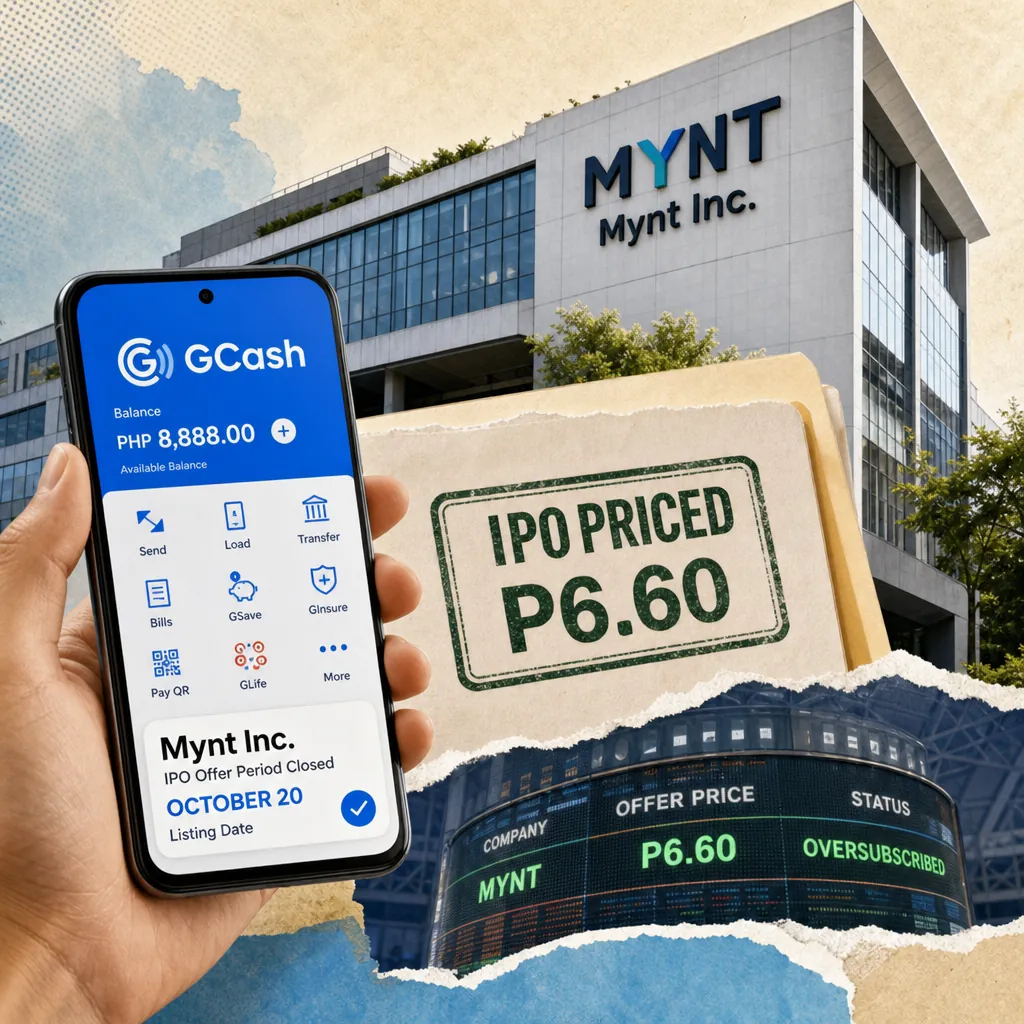
Mynt Inc., the parent company of the mobile wallet GCash, closed the offer period for its initial public offering with brokers reporting demand that exceeded the shares available, and the company is set to begin trading on the Philippine Stock Exchange on October 20 under the ticker GCASH. The shares were priced at P6.60 each, below the P8-to-P10 range the company had earlier advertised, after the Securities and Exchange Commission cleared the sale at up to P92.32 billion — the largest share offering ever mounted in the country.1591011 A business news channel's report on the close of the offer period drew 201 views, 3 likes and 1 comment, a small audience for a transaction of this size.11
The same day, the peso closed at P63.06 to the dollar, its weakest finish on record, after touching an intraday low of P63.15. The currency has now lost P4.08, or 6.49 percent, against the dollar since December 29, 2025, when it stood at P58.79.2223 Trading volume rose to $1.5 billion from $941 million the previous session, a 59.6 percent increase.78 A market analyst's video published on October 13, which discussed inflation at 7.2 percent alongside climbing bond yields and the weakening peso, drew 12,932 views, 218 likes and 8 comments — far more attention than the IPO mechanics drew on the same platforms.13
A third thread ran through the day's business coverage: a study by payments firm Xendit found that cash-on-delivery still accounts for about 23 percent of Philippine e-commerce sales value, the highest share among the six Southeast Asian markets the report covered, against 16 percent in Vietnam and marginal shares in Indonesia, Malaysia, Singapore and Thailand.17 Among shoppers who abandoned an online purchase in the previous three months, 41 percent said their preferred payment method was not available at checkout.67 The three stories — a landmark fintech listing, a currency at a record low, and consumers still paying cash at the door — describe the same market from different angles.
Key themes
- Mynt priced its record share sale at P6.60, below its own advertised range. The final price came in under the P8-to-P10 guidance reported before the offer closed, and the company is targeting an October 20 listing on the Philippine Stock Exchange.456 The offering was cleared by the Securities and Exchange Commission at up to P92.32 billion, which would make it the largest in Philippine market history.123
- The offer period closed oversubscribed, with brokers reporting demand above the shares available. That suggests the lower price did not dampen appetite, though whether the demand carries into the first day of trading is a separate question.11
- Major shareholders are staying in after the listing. Mynt's chief financial officer said none of the strategic shareholders — Globe, Ayala, Ant Group and Mitsubishi UFJ Financial Group — are exiting, and that private equity investors are selling only slightly more than half of their stakes.32
- The peso closed at a record low of P63.06 to the dollar. The currency has weakened 6.49 percent against the dollar since the end of 2025, and trading volume rose 59.6 percent on the day, indicating heavier selling pressure than the previous session.2278
- Cash-on-delivery remains the highest in the region at about 23 percent of Philippine e-commerce value. Xendit's report found the Philippines far ahead of Vietnam's 16 percent and marginal shares elsewhere in Southeast Asia, and 12 percent of respondents said nothing would persuade them to switch to digital payment.1767
- Digital payment alternatives are growing faster than e-wallets. QR Ph and InstaPay transactions rose 198 percent in the 15 months to April 2026, against 3 percent growth for e-wallet payments, according to the same Xendit report.67
- Remittances from overseas Filipinos grew 1.9 percent in August to $3.04 billion in cash terms, the lowest monthly inflow since May. The Bangko Sentral ng Pilipinas expects full-year cash remittances of $36.6 billion, a 2.7 percent increase over 2025.2479
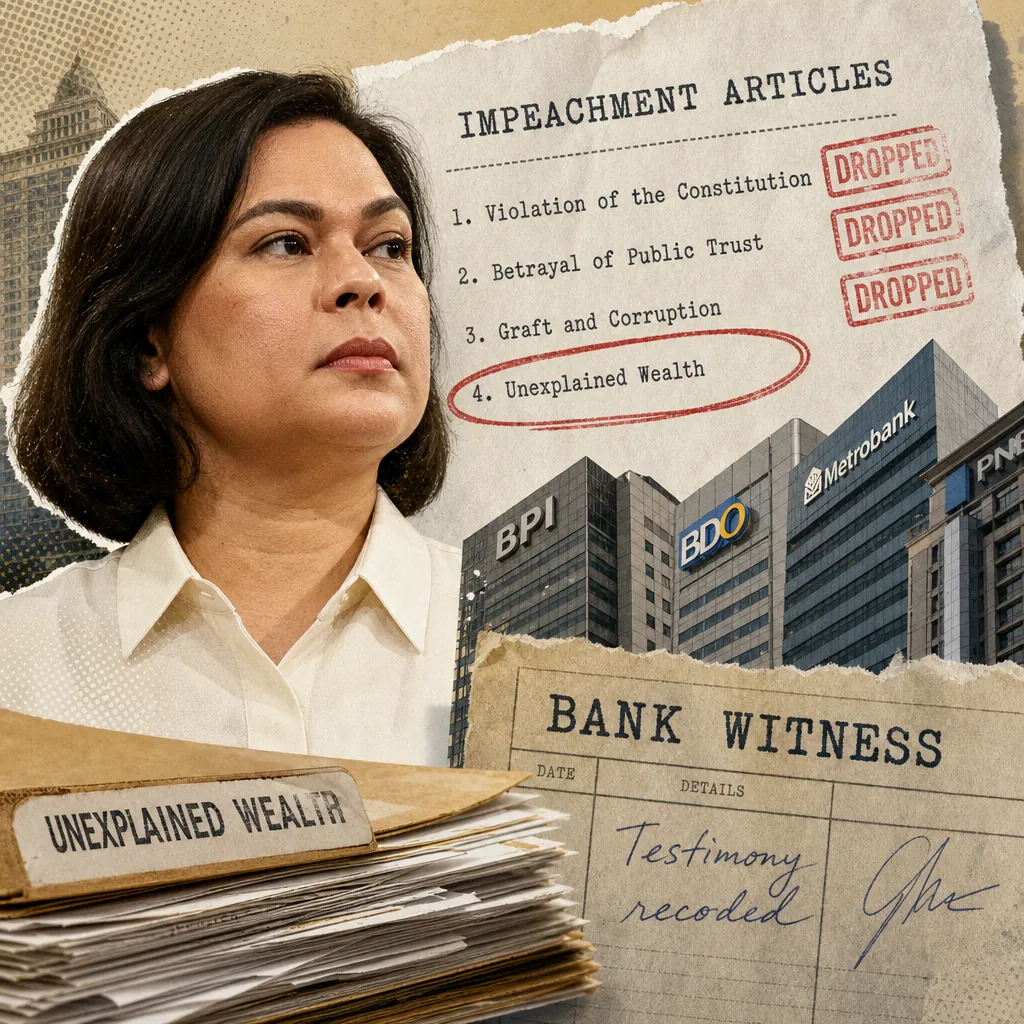
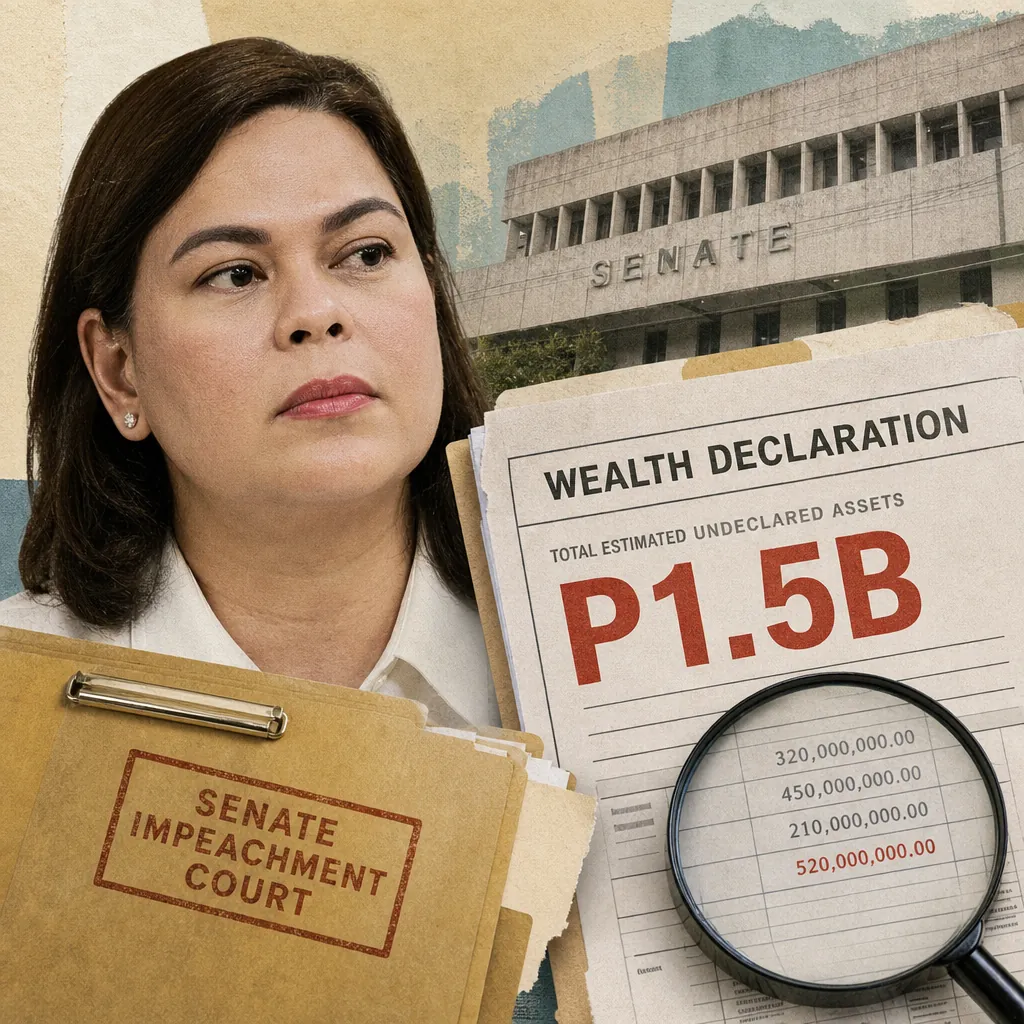
- The Senate impeachment trial of Vice President Sara Duterte is drawing financial-sector witnesses. The prosecution has rested its case, and a survey conducted October 1 to 4 found 44 percent of registered voters expect a conviction against 31 percent who expect an acquittal.7085
How the narratives stack
Dominant: The Mynt initial public offering dominated the business pages in the items captured here. The Securities and Exchange Commission's approval of the sale at up to P92.32 billion, the final pricing at P6.60 per share, the Philippine Stock Exchange's approval of the listing, and the oversubscribed offer period generated coverage across GMA News Online, the Philippine Daily Inquirer, BusinessMirror, The Philippine Star, the Daily Tribune and the Manila Bulletin.1235678910113277 The Manila Bulletin's column reported that Mynt is considering spinning off certain auxiliary services after the listing, describing a "great unbundling" on the drawing board.77 The peso's record low also ran prominently, appearing on the front page of the Manila Standard and in the Inquirer, Philippine Star and Manila Times.222378 Within the captured set, these two stories accounted for the bulk of the business coverage.
Counter-narrative: The Xendit study on cash-on-delivery complicates the picture of a country rapidly moving to digital payments. While the Mynt listing and the growth of QR Ph and InstaPay suggest a maturing digital payments market, the finding that nearly a quarter of e-commerce value still changes hands at the doorstep — and that 41 percent of abandoned purchases failed because the shopper's preferred payment method was missing — shows the transition is uneven.1767 Xendit Philippines head of commercial Ina Gatan said the shift to digital payments is "still a little bit slower than what we're seeing across the region from our neighboring markets."17
Emerging: Tala Philippines, a digital lender, said it is expanding partnerships with businesses, financial institutions and payment networks to reach borrowers with limited credit histories, using artificial intelligence to assess creditworthiness from alternative data.30 The company's Credit-as-a-Service offering lets other businesses plug its credit infrastructure into their own platforms through application programming interfaces, allowing real-time credit decisions.30 Separately, banking regulators in the United States and Europe are intensifying scrutiny of artificial intelligence risks at banks, questioning whether institutions can control increasingly autonomous systems and whether they depend on outside technology providers.58 Both developments point to a financial sector reorganizing around data and automation, with regulators following behind.
Under-covered: The peso's slide to a record low drew front-page treatment in the Manila Standard and coverage in three other outlets, but the consequence for ordinary households — higher prices for imported goods, from fuel to food — received less attention than the exchange-rate number itself. The Philippine Institute for Development Studies senior research fellow John Paolo Rivera said the breach of P63 did not necessarily signal sustained depreciation, but warned of "continued foreign exchange volatility, with a depreciation bias in the near term."22 Manufacturers warned of higher expenses and production costs.22 The peso has been trading above P60 to the dollar since the Middle East war started in March.22
Platform insights
- YouTube: The most-watched item in the captured social material was a market analyst's video published October 13, which drew 12,932 views, 218 likes and 8 comments while discussing inflation at 7.2 percent, climbing bond yields and the weakening peso.13 A separate business news channel's report on the close of the Mynt offer period drew 201 views, 3 likes and 1 comment.11 The gap — roughly 64 times the views — suggests that on video platforms, macro concerns about inflation and the currency drew far more attention than the mechanics of the share sale, even though the IPO was the larger corporate event.
- Facebook: No posts with engagement figures were captured in the monitoring writeup for this window. The platform's role in the day's conversation cannot be assessed from the available material.
- X: No posts with engagement figures were captured in the monitoring writeup for this window. The platform's role in the day's conversation cannot be assessed from the available material.
- Reddit: No posts with engagement figures were captured in the monitoring writeup for this window. The platform's role in the day's conversation cannot be assessed from the available material.
Key voices and communities
Retail investors and IPO watchers: The oversubscribed offer period indicates strong demand from investors who applied for shares through brokers.11 The lower final price of P6.60, against earlier guidance of P8 to P10, was framed by one analyst as a more attractive entry point with potential upside.78 This community's attention is focused on the October 20 listing and whether the shares hold their value once trading begins.
Macro and currency analysts: UnionBank chief economist Ruben Carlo Asuncion attributed the peso's weakness to stronger US inflation and expectations that the Federal Reserve would keep interest rates elevated for longer, which supports the dollar against emerging-market currencies.2278 April Lee-Tan's video on inflation, bond yields and the peso drew the largest audience in the captured social material.13 This group's framing centers on the cost of imported goods and the central bank's room to respond.
Payments and e-commerce operators: Xendit's report and the comments from its Philippines head of commercial, Ina Gatan, and its president, Nazim Ali, put the payments industry's view of consumer behavior into the conversation.1767 Ali said: "If people can't find the option they use, or don't trust the checkout, they leave."67 This community is arguing that merchants lose sales when they do not offer the payment methods shoppers expect.
Digital lenders and financial-inclusion advocates: Tala Philippines president and general manager Moritz Gastl said: "Financial inclusion thrives when different parts of the ecosystem work together."30 The company's expansion of partnerships is aimed at borrowers who cannot qualify for traditional loans because they lack conventional credit records.30
Legal and political observers: The impeachment trial of Vice President Sara Duterte has drawn financial-sector witnesses, including executives from the Anti-Money Laundering Council and bank representatives, who are set to testify on suspicious and covered transactions.1415 A PUBLiCUS Asia survey found 65 percent of respondents expressed strong interest in following the trial.70 This community's attention overlaps with financial regulation because the testimony touches on how banks flag and report unusual transactions.
Narrative streams
Mynt's record share sale moves from approval to pricing to an oversubscribed close
The Securities and Exchange Commission, the government agency that registers companies and approves share sales, cleared Mynt's initial public offering at up to P92.32 billion, which would make it the largest share sale ever on the Philippine Stock Exchange.123 Mynt then set a final price of P6.60 per share, below the P8-to-P10 range that had been reported before the offer closed.456 The Philippine Stock Exchange approved the listing, and the company targeted October 20, 2026, as the first day of trading.910 When the offer period closed on October 13, brokers reported that demand exceeded the shares available.11
The pricing decision is the most consequential detail for anyone considering the shares. A lower price means the company raises less money per share sold, but it also means investors pay less for each unit of earnings — which one analyst described as a more attractive starting point with potential upside.78 Mynt's chief financial officer, Evelyn Ng, said at an investors briefing that none of the strategic shareholders — Globe Telecom, Ayala Corporation, Ant Group and Mitsubishi UFJ Financial Group — are exiting, and that private equity investors are selling only slightly more than half of their stakes.32 That matters because a listing where major owners sell down heavily can signal that insiders see limited future growth; here, the opposite is the case.
The Manila Bulletin reported that Mynt is considering spinning off certain auxiliary services after the listing, describing a "great unbundling" that would move the company beyond transactional volume and back toward its roots.77 The column did not name which services might be separated or on what timeline, so the plan remains unconfirmed.
For the fintech sector, the listing creates a publicly traded benchmark for the value of a Philippine digital wallet. GCash is the country's dominant mobile wallet, and its parent's market debut will give competitors, investors and regulators a daily price signal for the sector. The oversubscribed offer suggests institutional and retail demand was strong enough to absorb the largest share sale in Philippine history, which could encourage other fintech and technology companies to consider listing. Aznar Shipping Corp., a Cebu-based shipping operator, is pursuing its own initial public offering in December, seeking to raise up to P737 million, and may price its shares at a 10 to 15 percent discount to its maximum offer price of P0.67 given market conditions.[^source] The Mynt listing's reception will inform how that and other offerings are priced.
The peso's record low raises the cost of imported goods and complicates the inflation outlook
The peso closed at P63.06 to the dollar on Thursday, its weakest finish on record, after touching an intraday low of P63.15. It opened at P62.83 and traded between P62.75 and P63.15. The previous record closing low was P62.90 on October 8.222378 Trading volume rose to $1.5 billion from $941 million the previous day.78 The currency has depreciated by P4.08, or 6.49 percent, from P58.79 on December 29, 2025.22
UnionBank chief economist Ruben Carlo Asuncion said the peso weakened because of stronger US inflation and expectations that the Federal Reserve would keep interest rates elevated for longer, which supports the dollar.2278 The dollar index, which measures the greenback against a basket of major currencies, slipped from an 18-month peak on Thursday as cautious remarks from a Federal Reserve official tempered expectations.23 Philippine Institute for Development Studies senior research fellow John Paolo Rivera attributed the weakness to global uncertainty, elevated oil prices and sustained demand for the dollar, alongside domestic concerns over inflation and investment inflows. He cautioned that breaching P63 did not necessarily signal sustained depreciation, but said: "We can expect continued foreign exchange volatility, with a depreciation bias in the near term."22
A weaker peso makes imported goods more expensive in peso terms, which feeds into consumer prices. Manufacturers warned of higher expenses and production costs.22 The peso has been trading above P60 to the dollar since the Middle East war started in March.22 The Bangko Sentral ng Pilipinas, the country's central bank, now faces a difficult choice: raising interest rates to defend the currency could slow economic growth, while holding rates steady risks allowing inflation to climb further. The central bank's governor, Eli M. Remolona Jr., said at a research conference in Cebu on October 6–7 that "people think central bankers are in the business of predicting the future. Our job is to actually prepare for different futures."71
For households, the peso's slide means the prices of imported food, fuel and other goods are likely to rise or stay elevated. For businesses that import raw materials or finished goods, it means higher input costs that may be passed on to consumers or absorbed as thinner margins. For the government, it complicates the inflation outlook at a time when the central bank is already monitoring price pressures.
Cash-on-delivery persists at the highest rate in Southeast Asia, slowing the shift to digital payments
Xendit's E-commerce Payments Momentum Report 2026 found that cash-on-delivery accounts for about 23 percent of Philippine e-commerce sales value, the highest among the six Southeast Asian markets covered. Vietnam followed at 16 percent, while the shares in Indonesia, Malaysia, Singapore and Thailand have become marginal.17 Xendit Philippines head of commercial Ina Gatan said the shift to digital payments is "still a little bit slower than what we're seeing across the region from our neighboring markets."17
The report also found that among shoppers who abandoned an online purchase in the previous three months, 41 percent said their preferred payment method was not available.67 Xendit president Nazim Ali said: "If people can't find the option they use, or don't trust the checkout, they leave."67 A stubborn 12 percent of respondents said nothing would persuade them to switch to digital payment.67 Digital alternatives are gaining ground: QR Ph and InstaPay transactions rose 198 percent in the 15 months to April 2026, compared with just 3 percent growth for e-wallet payments.67 QR Ph is the national QR code standard that lets customers pay by scanning a single code across different apps and banks; InstaPay is the central bank's real-time interbank transfer system.
The finding matters for merchants because it shows that offering the right payment options is not just a convenience — it is a sales decision. If 41 percent of abandoned purchases failed because the shopper's preferred method was missing, then adding payment options could recover a meaningful share of lost sales. For digital wallet providers, including GCash, the persistence of cash-on-delivery suggests that the addressable market for digital payments is larger than current adoption rates imply, but also that converting cash-on-delivery users will require addressing trust and habit, not just adding features. For the central bank, which has been promoting digital payments as part of its financial inclusion agenda, the slow shift means the transition will take longer than the growth in QR Ph and InstaPay transactions alone might suggest.
Remittances grew modestly in August, the lowest monthly inflow since May
Cash remittances from overseas Filipino workers rose 1.9 percent to $3.04 billion in August from $2.98 billion a year earlier, matching July's growth pace, according to the Bangko Sentral ng Pilipinas. August inflows were the lowest since May 2026, when remittances totaled $2.71 billion, and fell from $3.24 billion in July.2479 Personal remittances, the central bank's broader measure that includes cash sent through banks and informal channels, remittances in kind and other transfers, rose 2 percent to $3.37 billion from $3.31 billion a year earlier, also lower than July's $3.6 billion.79
Land-based workers sent the bulk of the money at $2.40 billion, while sea-based workers transferred $630 million. The United States remained the top source of remittances, followed by Singapore and Saudi Arabia.[^source] UnionBank chief economist Ruben Carlo Asuncion said the data show remittance inflows remain resilient, but growth is moderating because of weaker deployment and global uncertainties. "While geopolitical risks continue to pose challenges, remittances have historically been among the country's most stable external inflows," he said.[^source] The central bank expects cash remittances to reach $36.6 billion by the end of 2026, a 2.7 percent increase over 2025.24
Remittances are the money that Filipinos working abroad send home to their families. They matter because they underpin household spending, which drives a large share of the domestic economy. The central bank said these inflows "continued to underpin household spending and domestic economic activity, reflecting the resilience of remittance flows as a key source of household income and external financing."24 For the financial sector, the modest growth in remittances means that the flow of foreign currency into the country — which helps support the peso — is not growing fast enough to offset the pressure from other factors. For households that depend on remittances, the slower growth means less additional income to absorb rising prices.
The impeachment trial draws financial-sector witnesses as the prosecution rests
The Senate impeachment trial of Vice President Sara Duterte is set to take testimony from executives of the Anti-Money Laundering Council and bank representatives on suspicious and covered transactions.1415 The Anti-Money Laundering Council is the government body that coordinates the enforcement of laws against money laundering, the practice of disguising the origins of illegally obtained money. Banks are required to report transactions above certain thresholds and any transaction they suspect may be linked to illegal activity. The testimony keeps financial-sector scrutiny in the news cycle at the same time as the Mynt listing, and the two may be conflated in coverage because both touch on finance.15
The prosecution has rested its case after dropping three articles of impeachment, which significantly shortens the proceedings.85 A PUBLiCUS Asia survey conducted October 1 to 4 found that 44 percent of registered Filipino voters expect Duterte's conviction, compared with 31 percent who expect an acquittal, a 13-percentage-point gap, with 25 percent undecided. The survey also found that 65 percent of respondents expressed strong interest in following the trial.70 Between 44 percent and 46 percent of respondents considered the prosecution's evidence — financial documents, government records and witness testimonies presented over nearly four months — to be strong.70
The National Bureau of Investigation, the government's investigative agency, is pursuing its own inquiry into properties linked to the Duterte family. Its director, Melvin Matibag, challenged the Vice President to file a case if she believes the bureau is biased, saying the investigation is backed by official records and evidence.86 The Manila Standard's editorial board wrote that the Duterte family "can no longer dismiss questions about its financial accountability as politically motivated attacks," citing P51 billion in infrastructure appropriations allocated to the congressional district represented by Paolo Duterte from 2020 to 2022 and P7 billion in flood-control contracts in Davao City awarded to a single contractor.[^source]
For banks and financial institutions, the trial's focus on suspicious transactions and undeclared assets puts a spotlight on how they monitor and report unusual activity. The testimony may draw attention to gaps in enforcement or to the volume of transactions that flow through the banking system without being flagged. For the broader financial sector, the trial is a reminder that public trust in financial institutions depends on visible enforcement of anti-money laundering rules.
Conversation trajectory
October 20, 2026 — Mynt's first day of trading. The shares will begin trading on the Philippine Stock Exchange under the ticker GCASH. The key question is whether the oversubscribed offer translates into a strong first-day performance or whether the shares trade below the P6.60 offer price. A first-day decline would raise questions about whether the pricing was too aggressive or whether market conditions — including the peso's weakness — weighed on demand. A first-day gain would validate the decision to price below the advertised range. Watch the opening price and the trading volume in the first hour.
Over the next two to four weeks — the peso's path and the central bank's response. The peso closed at a record low of P63.06 to the dollar. The Bangko Sentral ng Pilipinas has not signaled whether it will intervene in the currency market or adjust interest rates. The next policy meeting and any statements from the central bank will indicate whether it views the peso's weakness as a temporary bout of volatility or a more persistent problem. A further slide toward P64 or beyond would increase pressure on the central bank to act, while a stabilization below P63 would ease concerns. Watch the central bank's next policy announcement and any statements from Governor Remolona.
Over the next four to six weeks — the Senate impeachment trial's financial testimony. The Anti-Money Laundering Council and bank executives are set to testify on suspicious and covered transactions. Their testimony may reveal details about how banks flagged or failed to flag transactions linked to the Duterte family, and whether enforcement gaps exist. The trial's outcome — conviction or acquittal — will be determined by the Senate, but the financial testimony may have a longer shelf life in terms of its implications for banking regulation and enforcement. Watch for any new rules or guidance from the central bank or the Anti-Money Laundering Council following the testimony.
Over the next three to six months — the pace of digital payment adoption. Xendit's report showed that cash-on-delivery remains at 23 percent of e-commerce value, the highest in Southeast Asia, while QR Ph and InstaPay transactions grew 198 percent in the 15 months to April 2026. The next data release from Xendit or the central bank will show whether the growth in QR Ph and InstaPay is accelerating or slowing, and whether cash-on-delivery is declining. Watch for any new payment options or incentives from merchants and payment providers aimed at converting cash-on-delivery users.
Trigger events: Mynt's first day of trading on October 20; the central bank's next policy meeting; the next inflation data release; the next remittance data release; any new testimony in the impeachment trial; and any new guidance from banking regulators on artificial intelligence risks.58
Response guidance
Prepare stakeholders for the October 20 listing. Brief investors, employees and partners on the listing mechanics — the P6.60 final price, the October 20 debut and the oversubscribed offer period — so they can answer questions before trading begins.51011 The first day of trading will draw media coverage regardless of whether the shares rise or fall, and stakeholders should be ready to explain the pricing decision and the company's growth plans.
Separate the Mynt listing from the impeachment trial's financial testimony in messaging. Both touch on finance and may be conflated in coverage.15 Communications should make clear that the listing is a corporate milestone for a payments company, while the trial involves allegations against public officials and their financial affairs. Do not let the two be discussed in the same breath.
Address the peso's weakness in customer-facing communications. The peso's record low means imported goods are more expensive, and customers may be concerned about rising prices.22 Financial institutions and payment providers should be prepared to explain how a weaker peso affects fees, foreign exchange transactions and the cost of imported goods, and what options customers have to manage the impact.
Use the cash-on-delivery finding to make the case for digital payment adoption. The Xendit report shows that 41 percent of abandoned online purchases failed because the shopper's preferred payment method was missing.67 Merchants and payment providers can use this data to argue that adding payment options is a sales decision, not just a convenience. The message should focus on the revenue lost when shoppers cannot pay the way they want.
Monitor regulatory developments on artificial intelligence in banking. Banking regulators in the United States and Europe are intensifying scrutiny of artificial intelligence risks, including whether banks can control increasingly autonomous systems and whether they depend on outside technology providers.58 Philippine regulators may follow with their own guidance. Financial institutions should track these developments and prepare for potential new requirements on cyber recovery, third-party dependencies and AI governance.
Be precise about what the Mynt listing does and does not signal. The oversubscribed offer period indicates strong demand for the shares at the final price, but it does not guarantee that the shares will trade above the offer price once listing begins.11 Communications should avoid implying that the listing's success is assured and should be prepared to address questions about aftermarket performance.
Watch for the "unbundling" plan to take shape. The Manila Bulletin reported that Mynt is considering spinning off certain auxiliary services after the listing.77 If the company confirms or details this plan, it will be a significant development for the fintech sector and for investors trying to value the company. Communications should be ready to explain the rationale and the timeline if the plan is confirmed.
See the full picture behind today's signals.
This report draws from Media Meter's MediaWatch, our real-time monitoring engine tracking 2,470+ Philippine sources across print, broadcast, digital, and social. Explore how the platform turns raw coverage into decision-grade intelligence, then see how it's configured for teams like yours — whether you're in PR agencies, corporate comms, government, or marketing.
Want more? Browse our Report Library for sector and crisis intelligence, or request a demo and we'll have your brand set up before the call.
Want this kind of intelligence on your brand?
This brief is built on the same MediaWatch methodology that runs continuously across every brand we monitor. See your competitive landscape, Impact Score, and narrative trajectory in a 30-minute demo.