Impeachment pre-trial resumes amid public mockery and economic anxiety
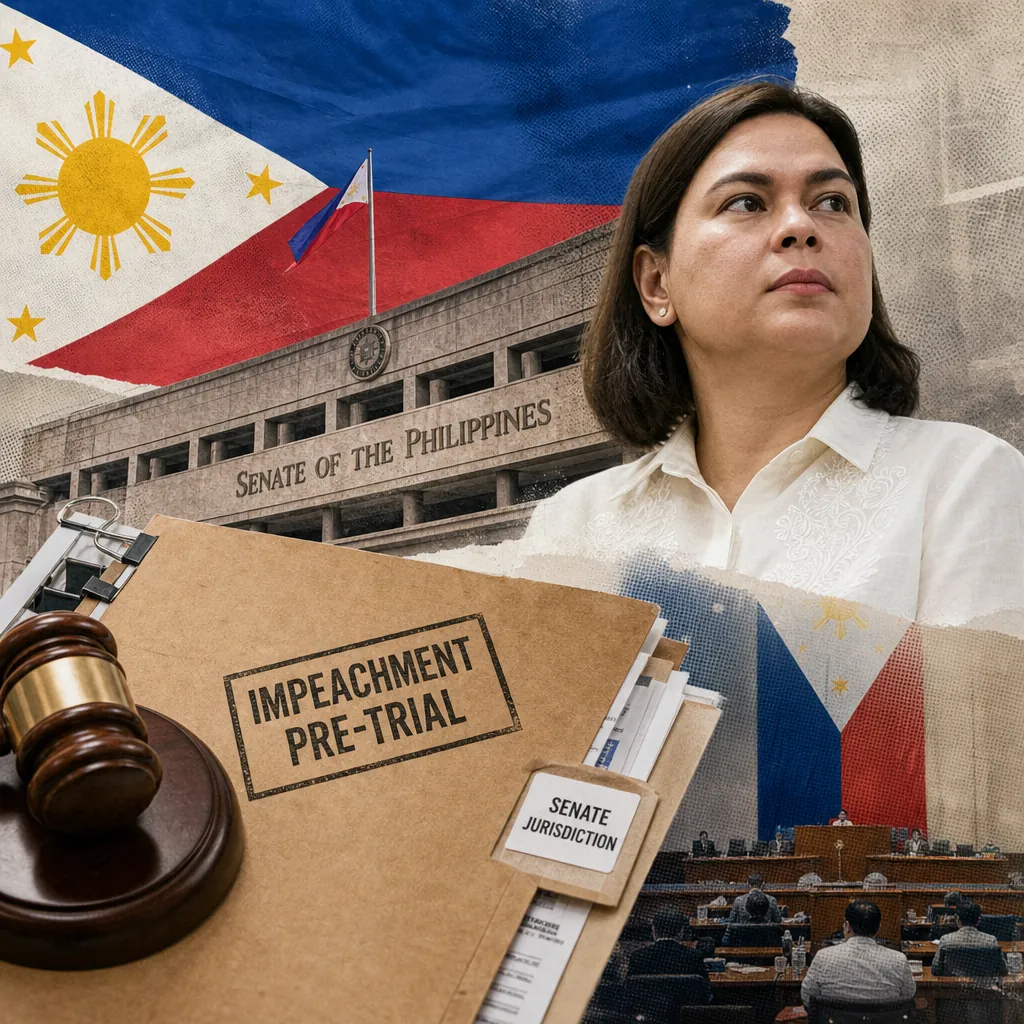
The impeachment pre-trial of Vice President Sara Duterte resumes on June 22, while public sentiment turns to mockery over prosecution performance and economic concerns deepen with inflation and infrastructure spending declines.
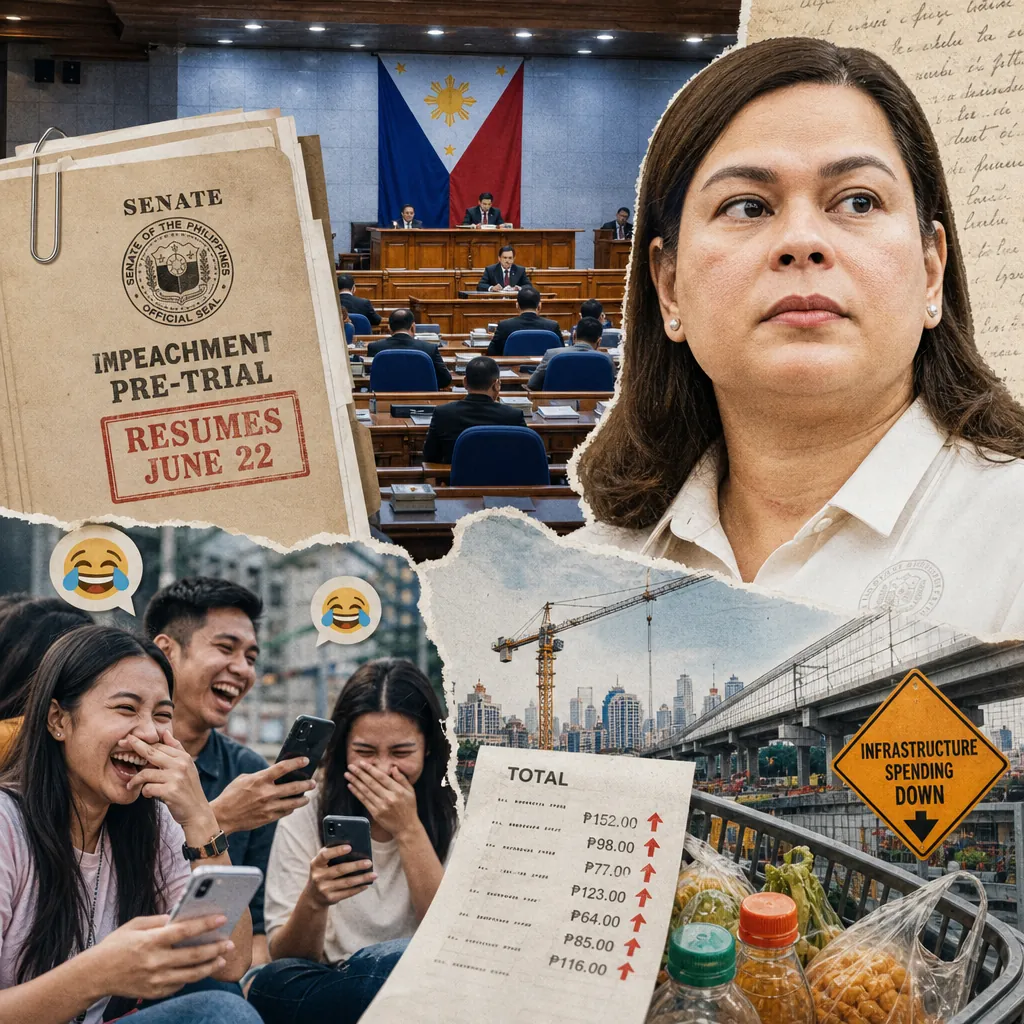
The conversation across Philippine social media and news on June 21–22, 2026, was dominated by the resumption of the impeachment pre-trial conference for Vice President Sara Duterte, which began on June 19 and continued on June 22 with both sides marking documents. The closed-door proceedings sparked a wave of online mockery after reports emerged that the defense had "outmaneuvered" the prosecution, captured by the viral tagline "kinain nang buhay" (eaten alive). House prosecutors denied being overwhelmed, with one joking that only lumpia was consumed. Meanwhile, a separate but parallel conversation emerged around Senator Erwin Tulfo's new bill proposing to dock the salaries of high-ranking officials absent without valid reason, which was widely shared with laughing reactions. The economic backdrop added to the tension: the Bangko Sentral ng Pilipinas (BSP) raised its policy rate to 4.75% on June 18 to combat inflation, and government infrastructure spending plunged 51.7% in April, the fourth consecutive monthly decline. Typhoon Francisco intensified, bringing Signal No. 1 to northern Luzon and raising flood concerns. The combination of political spectacle, economic strain, and weather disruptions created a fragmented but anxious public mood.
Conversation snapshot. The impeachment pre-trial generated the highest engagement. A Facebook post from News5 about the pre-trial received over 2,500 "haha" reactions, while a post from the account eb.jugalbot describing the defense as a "lioness" that "systematically dismantled" the prosecution garnered 405 likes and 114 love reactions. A post from bomboradyophilippines about Senator Tulfo's absenteeism bill accumulated 173 "haha" reactions and 92 comments. On the economic front, a post from @daret0askph about the Philippines' macro risk profile dropping to its worst in a decade received 530 likes and 154 shares. The PNP's statement on school stabbings in Cavite drew 12,787 likes and 7,708 comments, with a mix of sad and angry reactions. Typhoon Francisco updates from PAGASA and news outlets garnered thousands of views, with one YouTube weather briefing reaching 21,000 views.
Key themes
- Impeachment pre-trial resumes amid mockery of prosecution. The pre-trial conference for Vice President Sara Duterte's impeachment resumed on June 22, with both sides marking documents. Reports of the defense dominating the closed-door session spread rapidly, with the phrase "kinain nang buhay" (eaten alive) becoming a meme. House prosecutors denied the claims, but the public response was overwhelmingly mocking, as seen in the high "haha" reaction counts on related posts.
- Senator Tulfo's absenteeism bill taps into public frustration. Senator Erwin Tulfo introduced a bill that would deduct the salaries and allowances of high-ranking government officials absent without valid reason. The proposal received 173 "haha" reactions and 92 comments, indicating that the public sees it as a populist jab at habitual absentees, including those involved in the impeachment trial.
- Economic anxiety deepens with rate hike and infrastructure slump. The BSP raised its policy rate to 4.75% on June 18 to curb inflation, which stood at 6.8% in May. Government infrastructure spending fell 51.7% in April, the fourth straight monthly decline, attributed to weak DPWH spending and stringent payment validations. A DBS Bank report placed the Philippines' macro risk profile at its worst in a decade, sparking anger and linking economic woes to political distractions.
- Typhoon Francisco intensifies, raising flood concerns. Typhoon Francisco (international name Mekkhala) intensified into a typhoon on June 21, with Signal No. 1 raised over Batanes, northeastern Cagayan, and eastern Babuyan Islands. The enhanced southwest monsoon brought heavy rains to Metro Manila, causing flash floods and toppling electrical posts in Malabon. PAGASA warned of continued rainfall and possible landslides.
- School stabbings in Cavite prompt PNP response. Two stabbing incidents in Cavite schools—one on June 16 and another on June 19—prompted the PNP to order intensified police visibility in school zones. The PNP's statement received over 12,000 likes and 7,700 comments, with many expressing fear and frustration. The incidents are being treated as isolated cases.
- OFW repatriation from Russia and Middle East continues. Twenty-four Filipinos detained in Russia for nine months returned home after President Marcos appealed to President Putin. The government also allocated an additional P3 billion for repatriation of OFWs from the Middle East, where conflict continues. The DFA described the swift release as a sign of growing Philippines-Russia ties.
- DPWH completes infrastructure projects ahead of schedule. The DPWH completed the rehabilitation of Calbiga Bridge in Samar and the East Timawa Road in Iloilo City ahead of schedule, part of the administration's push to fast-track stalled public works. However, infrastructure spending data showed a 51.7% decline in April, highlighting execution challenges.
- Civil society mobilizes for White Ribbon Movement rally. A coalition of civil society groups announced the White Ribbon Movement march on June 28 at the EDSA People Power Monument, calling for accountability, anti-political dynasty legislation, and electoral reform. The PNP confirmed security preparations, signaling expected turnout.
How the narratives stack
Dominant narrative — Impeachment as political theater. The dominant story is that the impeachment trial of Vice President Sara Duterte is a political spectacle rather than a serious constitutional process. The "kinain nang buhay" meme and the overwhelming "haha" reactions on prosecution-related posts indicate that the public views the proceedings with amusement and skepticism. The defense is seen as strong and prepared, while the prosecution appears weak and outmatched. This narrative erodes public confidence in the trial's fairness and distracts from the substantive allegations.
Counter-narrative — Accountability and due process. House prosecutors and civil society groups push back, arguing that the trial is a necessary constitutional mechanism for accountability. Rep. Chel Diokno stated that Filipinos are "eager" for Duterte's response, and retired Supreme Court Justice Adolfo Azcuna clarified that 16 votes are needed for conviction. The pre-trial resumption on June 22 is framed as a procedural step toward a fair trial, not a sign of weakness. However, this narrative struggles to gain traction against the dominant mockery.
Emerging narrative — Economic anxiety and governance failures. A growing thread links economic hardship to political distractions. The BSP rate hike, the infrastructure spending slump, and the DBS macro risk report are being woven into a narrative of government mismanagement. Posts explicitly connect the impeachment trial and ICC issues to economic decline, with users accusing the administration of "self-destructing." This narrative could intensify as inflation and interest rates continue to pressure households.
Suppressed narrative — Corruption in flood control projects. The Ombudsman's investigation into flood control anomalies, involving 333 complaints since 2025 and a hold departure order against a former House Speaker, receives relatively low engagement compared to the impeachment spectacle. A critical post from Pressroom Philippines blaming corruption for earthquake casualties gained only 11 love reactions. This under-covered story could resurface if the Senate Blue Ribbon hearing releases damaging testimonies, but for now, it remains overshadowed.
Platform insights
Facebook was the primary battleground for emotional and partisan framing. The impeachment pre-trial posts received high "haha" reactions (over 2,500 on one News5 post), indicating widespread amusement at the prosecution's perceived weakness. The PNP's school stabbing statement drew 12,787 likes and 7,708 comments, reflecting genuine public concern. Senator Tulfo's absenteeism bill post had 173 "haha" reactions, reinforcing the mockery-driven tone. Positive infrastructure posts from DPWH (Naga City road project) garnered over 2,700 likes, showing that localized success stories can cut through the noise.
Twitter served as a real-time news feed for official updates and breaking news. PAGASA and NDRRMC accounts posted typhoon bulletins that were quickly amplified by news outlets, but engagement per tweet was low (mostly double-digit likes). The #FranciscoPH and #WeatherPatrol tags saw consistent updates. Twitter was also used for rapid fact-checking, as Vera Files debunked false claims about the impeachment case being junked. However, the platform did not generate deep discussion.
YouTube provided deeper commentary through news clips and weather briefings. ABS-CBN's video on the pre-trial garnered 564 views, while independent weather channels like @pilipinasweathernow reached 21,000 views for typhoon updates. The comment sections were sparse but contained practical questions about safety. YouTube served as a planning tool for viewers rather than a discussion forum.
Reddit hosted niche but skeptical conversations. A post about Marcoleta's disappointment over Senate factional shifts received 138 upvotes and 51 comments, reflecting deep partisan engagement. A thread about barangay-level corruption had only 3 upvotes, indicating that grassroots issues remain under-discussed. Reddit served as a space for raw grievance rather than breaking news.
Key voices and communities
House Prosecution Panel and Legislative Allies. This group includes lead prosecutor Rep. Gerville Luistro, Rep. Chel Diokno, Rep. Terry Ridon, and Deputy Speaker Paolo Ortega. Their content focuses on procedural preparation and public accountability. One post from Ortega received over 2,000 reactions and 1,000+ comments. Their primary narrative is that the trial must proceed despite VP Sara's likely absence, emphasizing that elected officials have a duty to answer allegations. They are the primary drivers of the impeachment narrative.
VP Sara Duterte's Defense Team and Supporters. Led by counsel Michael Poa and Atty. Sheila Sison, this group leverages procedural technicalities and highlights alleged prosecution weaknesses. The "kinain nang buhay" rumor, though denied, served to project defense strength. A YouTube video from a supporter alleging the prosecution was "outgunned" received over 9,000 views. Their narrative frames the trial as politically motivated and exploits perceived prosecutorial missteps.
Civil Society Coalitions and Monitoring Groups. Groups like Bantay Senado and the 22 organizations that signed a joint statement against Senator Escudero's possible presiding role advocate for transparency and institutional integrity. A Reddit post containing former Senate President Drilon's warning about a "second envelope" crisis received 107 upvotes. These groups are natural allies for those who want a credible, transparent trial.
Economic Analysts and Market Observers. University economics societies and financial news pages provide in-depth analysis of BSP rate hikes, inflation trends, and stock market reactions. Their content receives moderate but targeted engagement from investors and policy watchers. Posts that blend political events with economic indicators draw the most comments, indicating that politically aware investors see governance instability as a market risk.
Mainstream Media and News Outlets. Traditional outlets like ABS-CBN, GMA News, PTV, Inquirer, and Manila Times serve as primary distribution channels for trial updates, weather bulletins, and economic news. Their posts consistently garner hundreds to thousands of reactions. They set the agenda for public discourse by selecting which angles to emphasize, and their coverage of infrastructure milestones and weather events provides the most visible platform for stakeholder communication.
Narrative streams
Impeachment pre-trial resumes amid public mockery
The pre-trial conference for Vice President Sara Duterte's impeachment resumed on June 22, with both the defense and prosecution finishing the marking of documents. The closed-door session, which began on June 19, became the focal point of online discourse after reports of a contentious exchange inside Recto Hall broke into public view. Insiders described the defense's lead counsel, Atty. Sheila Sison, as having "outmaneuvered" and "dominated" the prosecution's lead, Batangas Rep. Gerville Luistro—a phrase captured by the viral tagline "kinain nang buhay" (eaten alive). A detailed Facebook analysis by user eb.jugalbot compared the defense's legal machinery to a lion pride, calling Sison "The Lioness" who "systematically dismantled" the prosecution's 57-witness list. This post garnered 405 likes and 114 love reactions, fueling a wave of mockery.
By June 21, fact-checkers at Vera Files debunked false claims that both the International Criminal Court (ICC) case against former President Rodrigo Duterte and VP Sara's impeachment had been junked. House prosecutors denied being overwhelmed, with Rep. Terry Ridon joking that the only thing consumed was lumpia. That same day, the pre-trial conference was confirmed to resume on June 22, with both sides finishing the marking of documents before the formal Senate trial—a procedural update that underscored the trial's forward momentum even as online mockery continued.
The conversation then shifted to a broader theme of accountability. House Deputy Speaker Paolo Ortega V stated publicly that Duterte was "unlikely to attend" the July 6 trial, citing her prior absences. Ortega's remarks—"Hinalal ka diyan, sagutin mo 'yung taumbayan"—were shared widely across platforms, accumulating 1,596 "haha" reactions and 50 angry reactions on a single Facebook post. The defense's legal counsel, Michael Poa, responded that Duterte would attend "if necessary," but this did little to quell public skepticism. House prosecutor Chel Diokno expressed that Filipinos were "eager for Duterte's response" to the impeachment case, as reported by inquirerdotnet. This sentiment added fuel to demands that Duterte personally address the nation.
Adding a legislative twist, Senator Erwin Tulfo's bill targeting absentee officials—which accumulated 173 "haha" reactions and 56 likes on bomboradyophilippines—was quickly interpreted by commenters as a parallel push for accountability across all government branches, with some users drawing direct parallels to Duterte's own absence. The bill proposes to deduct the salaries and allowances of high-ranking government officials who are absent without a clear and valid reason. The high number of "haha" reactions indicates the proposal is seen as a populist jab at officials perceived as neglectful, rather than a serious legislative priority.
Retired Supreme Court Justice Adolfo Azcuna weighed in on the vote threshold, stating that 16 votes are needed to convict, unless Senator Ronald dela Rosa is declared a fugitive, in which case 15 might suffice. This legal clarification added a layer of procedural debate to the conversation. The continuing confusion over vote mechanics and Senate roles kept procedural fairness at the forefront of analytical discussions.
Economic anxiety deepens with rate hike and infrastructure slump
The Bangko Sentral ng Pilipinas (BSP) raised its policy rate to 4.75% on June 18, the latest in a series of hikes aimed at taming inflation, which stood at 6.8% in May—well above the target range. The San Beda Economics Society broke down the impact on June 21, explaining that higher borrowing costs would affect mortgages, loans, and savings returns. By June 20, Pinaspulse reported the Philippine Stock Exchange index (PSEi) sliding 0.30% to 6,135.35 as investors reacted to elevated inflation forecasts of 6.4% in 2026 and 4.5% in 2027, with the accompanying post warning that Middle East tensions and supply-side challenges would keep fuel and food costs high.
A DBS Bank macro risk analysis released on June 19 showed the Philippines dropping to 13th place among 27 emerging markets—its worst in a decade—sparking anger from users like @daret0askph, who commented "Hala sige LINGAW-LINGAWA gyud sa impeachment and ICC ang mga Pilipino. This administration is self-destructing." This post garnered 530 likes and 154 shares, becoming a rallying point for critics who tied macroeconomic deterioration to political distractions.
Government infrastructure spending plunged 51.7% in April, the fourth consecutive monthly decline, according to data from the Department of Budget and Management (DBM). The contraction was attributed to weak spending performance by the Department of Public Works and Highways (DPWH), as implementation of the current year's budget and completion of prior years' projects are still ongoing, while the processing of payment claims undergoes stringent validation. This decline comes amid a flood control corruption scandal that erupted in the second half of 2025, which has led to tighter review procedures.
Cebu province recorded the highest inflation rate in the country at 13.6% in May, double the national average. For the bottom 30% income households, inflation reached 18.1%, driven primarily by climbing food prices. This has raised concerns about deepening poverty, as the annual per capita poverty threshold jumped about 30% from 2018 to 2023.
The BSP is seen as likely to pause its tightening cycle if inflation reverses faster than expected, according to Citi, which still expects two additional 25-basis point hikes this year. The balance of risks is increasingly tilted to the downside, particularly if easing global oil prices feed through more quickly into domestic costs.
Typhoon Francisco intensifies, bringing flood risks
Typhoon Francisco (international name Mekkhala) intensified into a typhoon on June 21, with maximum sustained winds of 140 kilometers per hour (kph) and gusts up to 170 kph. As of 4 a.m. on June 22, the typhoon was located 715 kilometers east of Tuguegarao City, Cagayan, moving west-northwestward at 30 kph. PAGASA raised Tropical Cyclone Wind Signal No. 1 over Batanes, the northeastern portion of Cagayan (Gonzaga, Santa Ana), and the eastern portion of Babuyan Islands.
The typhoon is expected to remain offshore and not make landfall, but it will enhance the southwest monsoon (habagat), bringing heavy rains to Luzon and Visayas. PAGASA warned of possible flash floods and landslides, particularly in areas already saturated by previous rains. The enhanced monsoon also brought strong to gale-force gusts over several regions, including Metro Manila, CALABARZON, and the Visayas.
On the evening of June 21, heavy downpours caused three electrical posts to topple in Barangay Maysilo, Malabon, closing a portion of M.H. Del Pilar Street. One of the falling posts struck a tricycle owned by a resident who was celebrating his birthday. The incident highlighted the vulnerability of infrastructure to extreme weather.
The typhoon's approach comes as the country is still recovering from a magnitude 7.8 earthquake that struck Maasim, Sarangani on June 8, which affected over 1.59 million individuals, with 65 fatalities and dozens missing. The Office of Civil Defense reported that 17,795 families remain displaced. The combination of earthquake recovery and typhoon preparedness has stretched government resources.
School stabbings in Cavite prompt PNP response
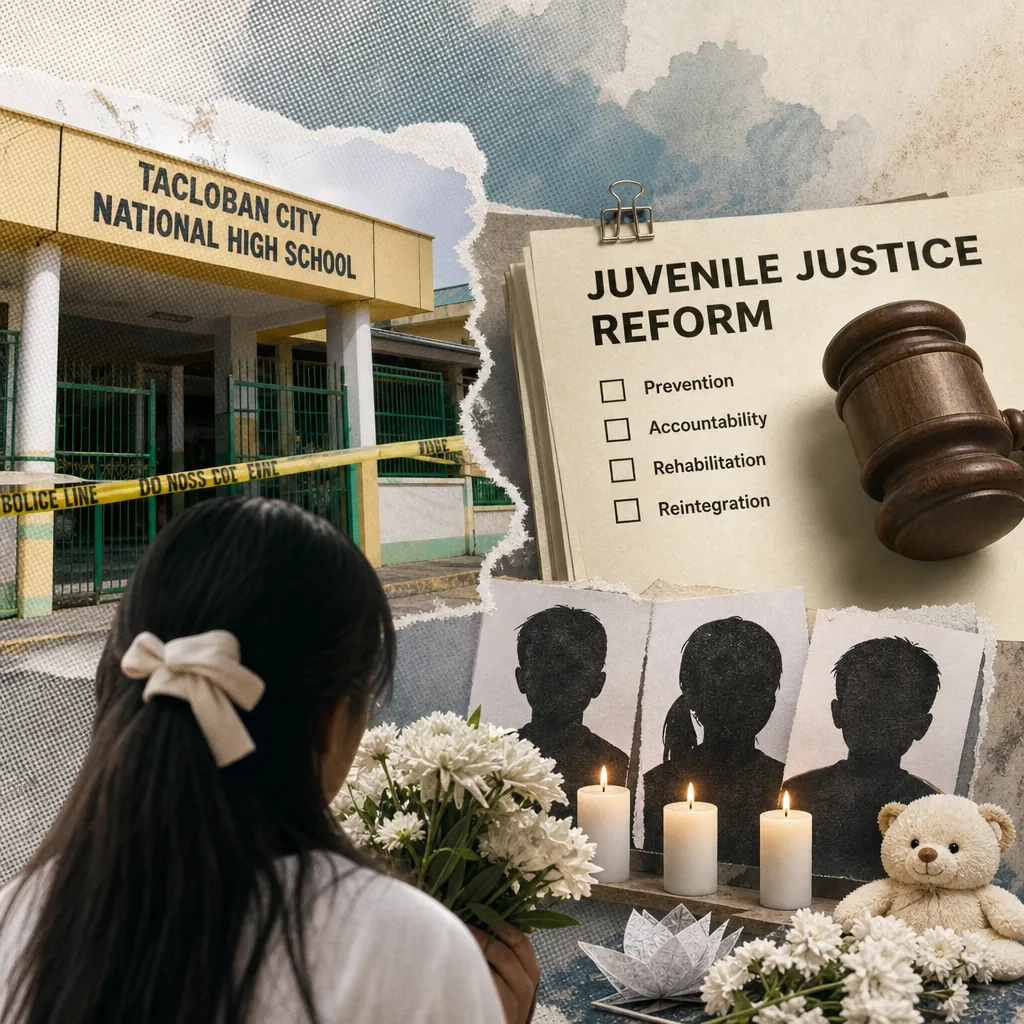
Two stabbing incidents in Cavite schools within one week have raised public alarm about school safety. On June 16, a Grade 5 student was stabbed at a private school in General Trias, Cavite, by a Grade 8 female student who was a newly transferred transferee. On June 19, an 18-year-old Grade 11 student was stabbed by a schoolmate at Cavite National High School.
The Philippine National Police (PNP) released an official statement on June 20 expressing concern, labeling both cases as isolated investigations and directing intensified police visibility around school zones. The post accumulated 12,787 likes and 7,708 comments within 24 hours, reflecting intense public scrutiny. GMA News amplified the PNP's concern with a Facebook post noting two knife attacks in one week, which garnered 1,437 likes but also a notable 605 "Haha" reactions—indicating public frustration with perceived slow institutional response.
The incidents have prompted local government units to mandate metal detector installations in schools. The PNP has ordered sustained preventive patrols in and around school zones, especially during school opening, recess, and dismissal hours. The cases are being treated as isolated, pending the results of ongoing investigations, with due regard for the rights and privacy of all minors involved.
OFW repatriation from Russia and Middle East
Twenty-four Filipino workers detained for nine months in Yakutsk, Russia, returned to the Philippines on June 21 after President Ferdinand Marcos Jr. personally appealed to Russian President Vladimir Putin for their release. The Filipinos—22 women and two men—were detained over immigration issues after being victimized by illegal recruiters. Foreign Affairs Secretary Ma. Theresa Lazaro welcomed the returnees, describing the swift release as a testament to the evolving relations between Manila and Moscow.
The government also announced an additional P3 billion to strengthen the repatriation and reintegration program for overseas Filipino workers (OFWs) displaced by the conflict in the Middle East. Executive Secretary Ralph Recto noted that 10,446 Filipinos have been repatriated through humanitarian flights, including 8,281 OFWs, 1,803 dependents, and 362 stranded citizens. The fund augmentation will cover pre-departure assistance, flights, and reintegration support.
The Department of Migrant Workers (DMW) said it will investigate reports of illegal recruitment that led to the detention of the 24 Filipinos in Russia. The government is also looking into expanding labor opportunities in other countries, as Hungary has suspended its fast-tracked guest worker permit program for Filipinos, though direct-hire employment permits remain available.
DPWH completes projects ahead of schedule amid spending slump
The Department of Public Works and Highways (DPWH) completed two critical infrastructure projects ahead of schedule: the rehabilitation of the first phase of Calbiga Bridge in Samar and the reopening of the long-delayed East Timawa Road in Iloilo City after just two months of work. Public Works Secretary Vince Dizon said the accomplishments come as President Marcos pushes government agencies to accelerate infrastructure projects that directly improve mobility and boost economic activity.
However, the positive news was tempered by data showing that government infrastructure spending plunged 51.7% in April, the fourth consecutive monthly decline. The contraction was attributed to weak spending performance by the DPWH, as implementation of the current year's budget and completion of prior years' projects are still ongoing, while the processing of payment claims undergoes stringent validation. This decline comes amid a flood control corruption scandal that has led to tighter review procedures.
Secretary Dizon also issued Department Order 74, sustaining the power of regional directors and district engineers to disburse funds, disregarding recommendations of the Independent Commission for Infrastructure (ICI) to slash approval levels. This has raised concerns about potential repeat of the large-scale stealing of funds that characterized the flood control scandal.
Civil society mobilizes for White Ribbon Movement rally
A coalition of civil society groups and religious leaders has announced the White Ribbon Movement march set for June 28 at the EDSA People Power Monument, renewing calls for accountability and political reforms. The movement, branded as the White Ribbon March, builds on the earlier Trillion Peso March and specifically targets corruption, the absence of an anti-political dynasty law, and electoral reform.
Kidapawan Bishop Colin Bagaforo framed the event as a continuation of the push for systemic change, stating that "a better future can only be achieved through better politics, politics that serves the people's interests." The PNP has confirmed it is readying full security for the event, signaling that authorities anticipate a sizeable turnout.
The rally comes amid a backdrop of multiple corruption scandals, including the flood control probe and the impeachment trial of Vice President Sara Duterte. The convergence of these narratives could amplify the rally's impact, as citizens link economic hardship and political turmoil to calls for systemic reform.
Conversation trajectory
Impeachment trial to dominate July. The formal trial start on July 6 will mark a critical shift from insider speculation to public spectacle. Livestreamed proceedings will create real-time reaction spikes. The selection of the presiding officer—whether Senator Chiz Escudero or Senate President Win Gatchalian—will be a key flashpoint, as civil society groups have already signaled concerns about Escudero's impartiality. Expect the "kinain nang buhay" narrative to persist, with the defense continuing to project strength. The prosecution will need to counter this perception with strong documentary evidence, particularly around the P6.7 billion in suspicious transactions and Commission on Audit (COA) disallowances. The vote threshold debate (15 vs. 16 votes) will intensify, especially if Senator Ronald dela Rosa is declared a fugitive. Observation window: next 4–6 weeks.
Economic anxiety to persist through Q3. The BSP's rate hike cycle is expected to continue, with Citi forecasting two more 25-basis point hikes this year. Inflation is projected to remain elevated at 6.4% for 2026, keeping pressure on household purchasing power. The infrastructure spending slump is likely to continue as the DPWH grapples with the aftermath of the corruption scandal and stringent payment validations. The release of Q2 GDP data in August will be a key trigger event. If growth disappoints, expect intensified criticism linking economic performance to political distractions. Observation window: next 2–3 months.
Typhoon season to test disaster response. Typhoon Francisco is the first major storm of the season, and its impact will be closely watched as a test of government preparedness, especially in areas still recovering from the June 8 earthquake. The enhanced monsoon is expected to bring continued rainfall, raising the risk of flooding and landslides. The government's response—particularly the coordination between DPWH, MMDA, and local government units—will be scrutinized. Any delays or failures could amplify the corruption narrative, as critics argue that inadequate infrastructure and poor planning exacerbate natural disasters. Observation window: next 2–4 weeks.
School safety to remain a pressing concern. The two stabbing incidents in Cavite have heightened public anxiety about school security. The PNP's intensified patrols and the installation of metal detectors are initial steps, but sustained action will be needed to rebuild trust. The Department of Education (DepEd) may face pressure to implement systemic reforms, such as increased guidance counseling and mental health support. Any further incidents could trigger widespread protests from parents and educators. Observation window: next 4–6 weeks.
White Ribbon Movement rally could amplify accountability demands. The June 28 rally at EDSA has the potential to draw significant crowds, given the convergence of multiple grievances—corruption, inflation, political turmoil. The PNP's security preparations suggest authorities expect a large turnout. If the rally is well-attended and peaceful, it could shift the conversation from impeachment spectacle to broader governance reform. However, if it turns violent or is suppressed, it could deepen polarization. Observation window: next 1–2 weeks.
Key trigger events that would reshape these conversations include: the formal start of the impeachment trial on July 6; the release of Q2 GDP data in August; the next BSP monetary policy meeting (likely in July); the next major typhoon or earthquake; and any new developments in the flood control corruption probe, such as the release of Senate Blue Ribbon committee testimonies.
Response guidance
Platform-specific approaches. On Facebook, communicators should leverage high-engagement positive stories (e.g., DPWH infrastructure completions, DSWD-Mercury Drug partnership) to counterbalance negative narratives. Use photo-rich content and localized captions to humanize government response. For impeachment-related posts, deploy a rapid-response team to correct misinformation and redirect to official statements. On Twitter, use concise threads to aggregate official updates on weather, infrastructure, and economic data. Pin a thread summarizing key facts (e.g., BSP rate, inflation, infrastructure spending) to provide a single authoritative source. On YouTube, produce short explainer videos on complex issues like the impeachment vote threshold or the BSP rate hike rationale, optimized for search queries.
Key messages. "The impeachment trial is a constitutional process that must proceed transparently, with all evidence examined openly to serve public accountability." "The BSP's interest rate adjustments are a necessary step to tame inflation and safeguard the purchasing power of Filipino families." "The government is delivering on its infrastructure commitments, with projects like the Calbiga Bridge and East Timawa Road completed ahead of schedule." "During severe weather, we are on the ground: clearing drains, monitoring flood-prone areas, and providing real-time updates to keep you safe."
Sensitive topics to navigate. The impeachment trial is highly polarizing; avoid amplifying partisan narratives and focus on procedural fairness. The corruption narrative around flood control projects requires transparent, data-driven responses that acknowledge ongoing investigations without prejudging outcomes. Economic hardship should be addressed with empathy, acknowledging the strain on households while explaining the rationale behind policy decisions. School safety concerns require immediate, visible action and clear communication about preventive measures.
Response priorities. First, amplify the positive infrastructure and social service stories (DPWH completions, DSWD-Mercury Drug partnership) to counterbalance negative narratives. Second, proactively address the corruption narrative by publishing a weekly "Accountability Update" summarizing Ombudsman investigations and COA findings. Third, prepare a unified messaging calendar for the impeachment trial, ensuring that all official statements emphasize due process and transparency. Fourth, coordinate with PAGASA and NDRRMC to provide real-time weather updates and safety advisories during typhoon season.
See the full picture behind today's signals.
This report draws from Media Meter's MediaWatch, our real-time monitoring engine tracking 2,470+ Philippine sources across print, broadcast, digital, and social. Explore how the platform turns raw coverage into decision-grade intelligence, then see how it's configured for teams like yours — whether you're in PR agencies, corporate comms, government, or marketing.
Want more? Browse our Report Library for sector and crisis intelligence, or request a demo and we'll have your brand set up before the call.
Want this kind of intelligence on your brand?
This brief is built on the same MediaWatch methodology that runs continuously across every brand we monitor. See your competitive landscape, Impact Score, and narrative trajectory in a 30-minute demo.