Diesel Seen Up P10/Liter as Fuel Subsidy Fund Runs Out
Oil companies project diesel prices rising by as much as P10.50 per liter on Sept. 22, while the Department of Transportation says it has no 2027 funding for fuel subsidies or the EDSA Busway. Separate items cover a P309.57-million coconut trade fair, a P2.12-trillion creative economy, and a US tariff dispute kept off the ASEAN agenda.
The Conversation
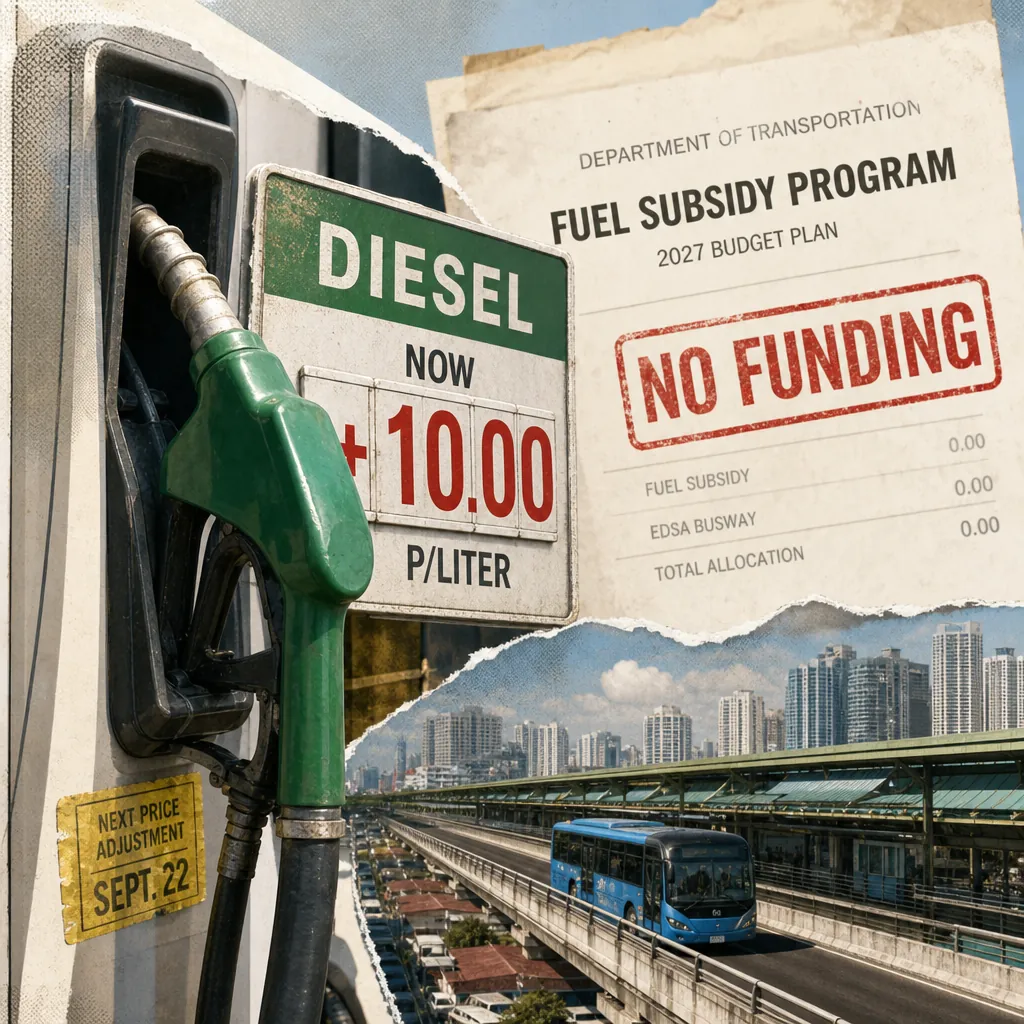
Oil companies expect diesel prices to rise by P10 to P10.50 per liter on Sept. 22, with gasoline up P4.50 to P5 per liter, according to estimates from Jetti Petroleum president Leo Bellas, who based the projection on four days of movement in the foreign exchange rate and the Mean of Platts Singapore, the regional benchmark for refined petroleum products in Asia-Pacific markets.46 The Department of Energy's Oil Industry Management Bureau gave a similar read: Director Rino Abad estimated diesel could climb P9.50 per liter, gasoline P4.50, and kerosene P7.40, and said the agency may ask oil companies to phase in the increase so motorists do not absorb the full amount at once.38 The trigger is the closure of the Petroline oil pipeline in Saudi Arabia, which Abad said could take three to five weeks to assess for damage, alongside attacks in the Strait of Hormuz and the Red Sea.3846
The same day, the Department of Transportation (DOTr) told a Senate budget hearing that it has no funding for fuel subsidies or the EDSA Busway in 2027. Acting Secretary Giovanni "Banoy" Lopez said the department had asked for about P5 billion for fuel subsidies in its budget proposal but did not receive it in the National Expenditure Program, the executive branch's draft budget that Congress uses as its starting point. He also said no funds were allocated for the EDSA Busway, the dedicated bus lane along Metro Manila's main artery, and that the department is seeking P1.7 billion for it.42 Lopez said the subsidy is timely given rising petroleum prices tied to worsening tensions in the Middle East.42
Away from fuel, the day's captured coverage carried several distinct business stories. The Department of Trade and Industry (DTI) reported that its 2026 Coconut Philippines Trade Fair generated P309.57 million in total sales, up from P96.9 million the previous year, with 300 micro, small and medium enterprises participating.24 The DTI also opened the first ASEAN Creative Industries Expo by Malikhaing Pinoy, citing a creative economy worth P2.12 trillion, or 7.6 percent of gross domestic product.35 Trade Undersecretary Allan Gepty said the Philippines is handling its Section 301 concerns with the United States bilaterally rather than through the ASEAN-US dialogue.32 The East Asia Business Council convened the inaugural Regional Comprehensive Economic Partnership (RCEP) Business and Investment Summit in Manila ahead of the trade pact's first General Review.1215 In agriculture, the Philippine Crop Insurance Corporation distributed P4,057,146.53 in indemnity checks to 690 farmers and fisherfolk in Western Visayas.10 Oriental Mindoro tightened border biosecurity after the first African Swine Fever case hit neighboring Occidental Mindoro.30 The US Department of Agriculture projected Philippine chicken imports rising to 780,000 metric tons in 2027.40
Key themes
- Diesel is projected to rise P10 to P10.50 per liter on Sept. 22. Jetti Petroleum's Leo Bellas and the DOE's Rino Abad both attributed the increase to the Petroline pipeline closure in Saudi Arabia and attacks in the Strait of Hormuz and the Red Sea, with Abad saying the damage assessment could take three to five weeks.3846
- The DOTr has no 2027 budget for fuel subsidies or the EDSA Busway. Acting Secretary Lopez told senators the department requested about P5 billion for fuel subsidies and P1.7 billion for the EDSA Busway but received neither in the National Expenditure Program.42
- The DTI's coconut trade fair generated P309.57 million in sales. The Aug. 26–30 event at the SMX Convention Center Manila drew 300 micro, small and medium enterprises and more than tripled the P96.9 million recorded the previous year.24
- The creative economy reached P2.12 trillion, or 7.6 percent of GDP. The DTI cited P320 billion in creative goods exports and P427 billion in creative services exports at the opening of the ASEAN Creative Industries Expo.35
- The Philippines is keeping its US tariff dispute out of the ASEAN-wide agenda. Trade Undersecretary Gepty said the measures were imposed on individual ASEAN member states, not the bloc, and that Manila is engaging Washington bilaterally.32
- The first RCEP Business and Investment Summit opened in Manila. The East Asia Business Council gathered business leaders and policymakers ahead of the trade agreement's first General Review, with chairperson Jay Yuvallos saying the "just-in-time" model is being rethought.1215
- Western Visayas farmers and fisherfolk received P4.06 million in crop insurance. The Philippine Crop Insurance Corporation paid 690 beneficiaries for losses from typhoons, drought, African Swine Fever, and pests.10
- Oriental Mindoro tightened its border against African Swine Fever. The province began inspecting sites for animal quarantine checkpoints after the first case was confirmed in neighboring Occidental Mindoro.30
How the narratives stack
Dominant. The fuel price projection and the DOTr's funding gap dominated the captured set. The diesel estimate of P10 to P10.50 per liter is the largest single-week increase reported in the items reviewed, and it arrived alongside the department's admission that it has no money for the subsidy meant to cushion exactly this kind of shock.4246 The two stories are linked: Lopez cited rising petroleum prices as the reason the subsidy is timely, then said the funding was not in the budget.42 Within the items captured here, this pairing drew the heaviest coverage, including a Filipino-language report on the diesel estimate and a separate English-language story on the same projection.3846
Counter-narrative. The DTI's trade and industry numbers ran against the fuel story's tone. The coconut trade fair's P309.57 million in sales, more than triple the previous year's P96.9 million, and the creative economy's P2.12-trillion contribution to GDP, or 7.6 percent, present a picture of sectors expanding rather than contracting.2435 These are not rebuttals to the fuel story; they are separate developments that happened to land the same day. Their presence in the captured set shows the day's business news was not uniformly about cost pressures.
Emerging. The RCEP summit and the ASEAN Inclusive Business Forum point to a regional trade agenda taking shape ahead of the RCEP General Review and the Sept. 22 forum in Pasay City.122734 The RCEP is a trade agreement among Asia-Pacific economies that reduces tariffs and standardizes rules across member states; its first General Review is the scheduled assessment of how the pact is working. The Inclusive Business Forum, expected to draw around 300 delegates, will focus on bringing micro, small and medium enterprises and smallholder farmers into regional supply chains.2734 Neither has produced a concrete outcome yet, but both signal where regional trade policy is heading.
Under-covered. The Philippine Crop Insurance Corporation's P4.06-million payout to 690 farmers and fisherfolk in Western Visayas received a single item in the captured set.10 The amount is small relative to the fuel and trade stories, but it represents direct compensation for losses from typhoons, drought, African Swine Fever, and pests — the kind of climate-related agricultural risk that affects food supply and rural incomes. Similarly, Oriental Mindoro's border tightening after the Occidental Mindoro ASF case drew one item, despite the disease's history of disrupting pork supply and prices.30
Platform insights
The monitoring writeup for this window did not include social media engagement data, so no platform-level breakdown of likes, shares, views, or comments is available. The items captured here are news and blog articles, and their distribution across outlets and mediums is described in the narrative streams and sources below.
Key voices and communities
Oil industry and energy regulators. Jetti Petroleum president Leo Bellas provided the P10 to P10.50 diesel estimate, and DOE Oil Industry Management Bureau Director Rino Abad gave the P9.50 figure and explained the pipeline closure's role.3846 These are the primary sources for the price projection, and their estimates carry weight because oil companies set pump prices weekly based on import costs.
Government economic agencies. The DTI appears across multiple stories: the coconut trade fair, the creative economy expo, and the ASEAN Inclusive Business Forum.24273435 Trade Undersecretary Allan Gepty spoke on the US tariff issue.32 The DOTr's Lopez addressed the Senate on the fuel subsidy gap.42 These agencies are the main actors shaping the day's business policy news.
Agricultural and rural communities. The Philippine Crop Insurance Corporation's payout to 690 farmers and fisherfolk in Western Visayas, and Oriental Mindoro's response to the ASF case, represent the rural economy's exposure to climate and disease risks.1030 These stories are smaller in the captured set but affect food supply and rural livelihoods directly.
Regional trade bodies. The East Asia Business Council, chaired by Jay Yuvallos, convened the RCEP summit, and the ASEAN Inclusive Business Forum is expected to draw 300 delegates.122734 These gatherings set the framework for how the Philippines and its neighbors approach trade integration.
Narrative streams
Diesel projected to rise P10 to P10.50 per liter on Sept. 22
Jetti Petroleum president Leo Bellas said diesel prices could rise by P10 to P10.50 per liter on Sept. 22, with gasoline up P4.50 to P5 per liter, based on four-day movements in the foreign exchange rate and the Mean of Platts Singapore.46 The DOE's Rino Abad estimated diesel at P9.50 per liter, gasoline at P4.50, and kerosene at P7.40, and said the agency may ask oil companies to phase in the increase so motorists do not feel the full effect at once.38 The cause is the closure of the Petroline oil pipeline in Saudi Arabia, which Abad said could take three to five weeks to assess for damage, along with attacks in the Strait of Hormuz and the Red Sea.3846 The Strait of Hormuz is a narrow waterway through which a large share of the world's oil passes; disruptions there raise the cost of crude for importers like the Philippines, which buys most of its fuel abroad.
For motorists, the increase means a full tank of diesel could cost several hundred pesos more. For transport operators, fuel is a major operating cost, and sustained increases typically feed into fare petitions and the cost of moving goods. The DOE's request that companies phase in the increase is an attempt to spread the shock, but it does not reduce the total amount. The read for the sector: fuel-dependent businesses — transport, logistics, fishing, and agriculture — face higher operating costs from late September, and the government's ability to cushion the impact depends on funding that, as of the budget hearing, is not in place.42
DOTr says no 2027 funds for fuel subsidy or EDSA Busway
At a Senate budget hearing on the DOTr's proposed 2027 budget, Acting Secretary Giovanni "Banoy" Lopez said the department requested about P5 billion for fuel subsidies but did not receive it in the National Expenditure Program, the executive's draft budget.42 He also said no funds were allocated for the EDSA Busway and that the department is seeking P1.7 billion for it.42 Lopez said the subsidy is timely given rising petroleum prices tied to Middle East tensions.42
The fuel subsidy program provides direct cash assistance to public utility vehicle drivers and operators to offset fuel price increases. Without funding, the program cannot operate in 2027. The EDSA Busway is a dedicated lane for buses along Epifanio de los Santos Avenue, Metro Manila's main thoroughfare; its operations depend on funding for enforcement, maintenance, and operations. The read for the sector: public transport operators and commuters face the prospect of higher fares and reduced busway service if the funding gap is not addressed in the congressional budget process. The Senate subcommittee hearing is an early stage; the budget still has to pass both chambers, so the final allocation is not yet settled.
Coconut trade fair generates P309.57 million in sales
The DTI's 2026 Coconut Philippines Trade Fair generated P309.57 million in total sales, up from P96.9 million the previous year, according to the department.24 The Aug. 26–30 event at the SMX Convention Center Manila brought together 300 micro, small and medium enterprises from across the Philippines, compared with 213 businesses the previous year.24 Participating "cocopreneurs" showcased value-added products across food and beverage, health and wellness, personal care, home and lifestyle items, and craft and sustainable non-food materials.24
The sales figure measures the total value of transactions recorded at the fair, not annual industry output. The increase reflects both more participants and higher sales per participant. For coconut farmers and processors, the fair is a channel to reach buyers and test products; the DTI uses it to connect small producers with larger markets. The read for the sector: the coconut industry's value-added segment is expanding, and the trade fair format is producing measurable commercial results. The challenge is whether those sales translate into sustained orders beyond the event.
Creative economy reaches P2.12 trillion, or 7.6 percent of GDP
The DTI opened the first ASEAN Creative Industries Expo by Malikhaing Pinoy at the SMX Convention Center Aura in Taguig City, citing a creative economy worth P2.12 trillion, or 7.6 percent of gross domestic product.35 DTI Secretary Cristina Roque said the sector generated P320 billion in creative goods exports and P427 billion in creative services exports, with digital interactive goods and services, including game development and animation, accounting for a significant share.35 The expo features nine creative domains: audiovisual media, creative services, digital interactive media, design, performing arts, publishing, traditional cultural expressions, and visual arts.35 First Lady Liza Araneta-Marcos, in a video message, praised Filipino artists and said the Malikhaing Pinoy program remains committed to supporting creatives.31
The P2.12-trillion figure measures the creative economy's contribution to GDP, not government spending or export earnings alone. The 7.6 percent share places the creative sector alongside more established industries in economic weight. For creative workers and small studios, the expo is a platform to reach regional buyers and partners. The read for the sector: the creative economy is being positioned as an export driver, and the DTI's focus on digital interactive media suggests game development and animation are seen as the highest-growth segments. Whether the expo produces concrete export deals will depend on follow-through.
Philippines keeps US tariff talks off ASEAN agenda
Trade Undersecretary Allan Gepty said the Philippines is addressing its trade concerns with the United States through bilateral negotiations rather than the broader ASEAN-US dialogue, as Manila awaits Washington's assessment of measures it has adopted on forced labor.32 The Section 301 issue is among the external trade pressures facing ASEAN economies, but Gepty said the regional grouping's response will focus on strengthening cooperation on challenges individual countries cannot address collectively.32 "The measures that were implemented by the United States were not imposed on ASEAN as a whole, but individually on ASEAN member states," Gepty said at a briefing on the 58th ASEAN Economic Ministers Meeting in Pasay City.32
Section 301 is a provision of US trade law that allows the US to impose tariffs or other measures on countries it finds have unfair trade practices. The Philippines has taken steps to address Washington's concerns, and negotiations are ongoing.32 The read for the sector: Philippine exporters facing US tariffs should expect the resolution to come through bilateral channels, not regional ones, which means the timeline depends on US assessment of Philippine measures rather than on ASEAN-wide negotiations. The ASEAN Economic Ministers Meeting provides a venue for coordination, but Gepty's statement makes clear the Philippines is not waiting for a collective approach.
RCEP Business and Investment Summit opens ahead of first General Review
The East Asia Business Council convened the inaugural RCEP Business and Investment Summit in Manila, bringing together business leaders, policymakers, economists, and regional stakeholders ahead of the trade agreement's first General Review.1215 EABC Chairperson Jay Yuvallos said businesses must rethink how they participate in an increasingly interconnected but exposed global economy. "The business model that served us for decades was built around 'just-in-time.' Now, 'just-in-time' m—" he said, according to the report.12 The summit comes as businesses contend with geopolitical tensions, renewed protectionism, tariff disruptions, and vulnerable supply chains.1215
The RCEP is a trade agreement among 15 Asia-Pacific economies that reduces tariffs and standardizes rules on trade and investment. Its first General Review is the scheduled assessment of how the agreement is working, and it gives members a chance to adjust commitments. The read for the sector: Philippine businesses that trade within the region should watch the review for changes to rules of origin, services commitments, and investment provisions. The summit's focus on supply-chain resilience suggests businesses are preparing for a period of higher trade friction, not lower.
Western Visayas farmers and fisherfolk receive P4.06 million in crop insurance
The Philippine Crop Insurance Corporation (PCIC) Regional Office 6 distributed P4,057,146.53 in indemnity checks to 690 farmers and fisherfolk across Aklan, Antique, Capiz, Iloilo, Guimaras, and Negros Occidental.10 PCIC regional manager Eva Ulie Laud said the beneficiaries reported losses from typhoons, drought, African Swine Fever, Red-Striped Soft Scale Insect, and other plant pests and diseases associated with climate change.10 The beneficiaries are registered under the Registry System for Basic Sectors in Agriculture and covered by the government's free crop insurance program.10
The PCIC is a government-owned corporation that provides insurance to farmers against crop and livestock losses. The free crop insurance program covers registered farmers at no premium cost to them. The P4.06-million payout is small relative to the total value of agricultural losses, but it represents direct compensation for climate and disease risks. The read for the sector: the payout shows the insurance mechanism is functioning for registered farmers, but the amounts are modest relative to the scale of losses. Expanding coverage and speeding up payouts would require more funding and more registrations.
Oriental Mindoro tightens border after ASF case in Occidental Mindoro
The provincial government of Oriental Mindoro is stepping up border biosecurity measures after the first African Swine Fever case struck neighboring Occidental Mindoro.30 Provincial Disaster Risk Reduction and Management Officer Vinscent Gahol, Acting Provincial Veterinarian Dr. Alfredo Manglicmot, and Provincial Administrator Atty. Earl Ligorio Turano II led an inspection on Sept. 17 of potential sites for Animal Quarantine Checkpoints along major thoroughfares connecting the two provinces.30 A key entry point identified for a checkpoint lies at the boundary of Magsaysay town in Occidental Mindoro and Sitio Cambayang in Barangay Cabugao, Bulalacao town in Oriental Mindoro.30
African Swine Fever is a highly contagious viral disease that affects pigs and has no vaccine or cure; outbreaks typically lead to culling and movement restrictions, which disrupt pork supply and raise prices. The read for the sector: pork producers and consumers in Oriental Mindoro face the prospect of supply disruptions and price increases if the disease crosses the border. The checkpoints are a containment measure, but their effectiveness depends on enforcement and on the cooperation of traders and transporters.
US Department of Agriculture projects higher chicken imports in 2027
The US Department of Agriculture's Foreign Agricultural Service projected Philippine chicken meat imports reaching 780,000 metric tons in ready-to-cook equivalent in 2027, 14.7 percent higher than the revised 680,000 metric tons estimated for 2026.40 The agency said imports are forecast to trend upward as demand from food manufacturing and food service rises, driven by population growth and better economic performance projected for 2027.40 Brazilian chicken would continue to dominate the import mix.40 Philippine chicken meat production is expected to hit 1.92 million metric tons next year, supported by expanding poultry growers.40
The projection measures the volume of chicken meat the Philippines is expected to buy from abroad, not domestic production. Rising imports can help keep prices stable when domestic supply is tight, but they also expose local producers to competition. The read for the sector: poultry growers face a market where imports are growing faster than domestic production, which could pressure farmgate prices. Food manufacturers and restaurants, meanwhile, benefit from a reliable import supply.
Conversation trajectory
Fuel price movement (next 1–2 weeks). The Sept. 22 price adjustment is the immediate trigger. If diesel rises by the projected P10 to P10.50 per liter, transport groups may file fare petitions, and the DOE's request for phased implementation will be tested. Watch for the DOE's final advisory and any government statement on mitigating measures.3846
Congressional budget process (next 1–3 months). The DOTr's funding gap for fuel subsidies and the EDSA Busway will be taken up in the Senate and House budget deliberations. The final 2027 budget will show whether Congress restores the P5 billion for fuel subsidies and P1.7 billion for the busway. The Senate subcommittee hearing is the first stage; the bicameral conference committee is the last.42
RCEP General Review (next 6–12 months). The first General Review of the RCEP will assess the agreement's implementation and may lead to adjustments in commitments. The Manila summit is a preparatory step. Watch for the review's schedule and any Philippine position papers on rules of origin, services, and investment.1215
ASEAN Inclusive Business Forum (Sept. 22). The forum in Pasay City will advance the ASEAN Framework for Talent and Institutional Development for Inclusive Business and discuss a draft Regional Roadmap for Inclusive Business Capacity Building. Watch for commitments on public procurement and cross-border partnerships.2734
African Swine Fever containment (next 2–4 weeks). The Oriental Mindoro checkpoints will be tested as traders and transporters move goods. If the disease spreads, pork prices in the region could rise. Watch for reports of new cases or containment successes.30
US tariff negotiations (ongoing). The Philippines is awaiting Washington's assessment of its measures on forced labor. A US decision could come at any time. Watch for statements from the US Trade Representative or the Philippine Department of Trade and Industry.32
Response guidance
Fuel price communications. For transport and logistics companies, prepare customer and employee communications on how the Sept. 22 increase affects fares and operating costs. State the projected per-liter increase and what it means for a typical trip or delivery. Avoid predicting future increases beyond the announced adjustment.
Government subsidy messaging. For agencies and legislators, the DOTr's funding gap is a concrete item in the budget debate. Communications should explain what the fuel subsidy does, who receives it, and what happens if it is not funded. Avoid framing the gap as a certainty; the budget process can still restore the funds.
Trade and export messaging. For businesses in coconut, creative industries, and other export sectors, the DTI's trade fair and expo results provide concrete numbers to cite. Use the P309.57-million coconut sales and the P2.12-trillion creative economy figures to show sector momentum, but attribute them to the specific events and periods they measure.
Agricultural risk communications. For agribusinesses and cooperatives, the PCIC payout and the ASF border measures are reminders of the risks farmers face. Communications should explain how crop insurance works, who is eligible, and how to register. For ASF, emphasize biosecurity practices and the importance of reporting suspected cases.
Regional trade messaging. For companies with regional operations, the RCEP summit and the ASEAN Inclusive Business Forum signal where trade policy is heading. Communications should focus on what the General Review means for tariffs and rules of origin, and on how inclusive business models can open procurement opportunities.
Sensitive topics. The fuel price increase and the subsidy funding gap are politically sensitive. Avoid attributing blame to specific officials or companies; report the projections and the budget process as stated. The ASF situation requires careful communication to avoid panic among consumers and producers; focus on containment measures and cooperation.
See the full picture behind today's signals.
This report draws from Media Meter's MediaWatch, our real-time monitoring engine tracking 2,470+ Philippine sources across print, broadcast, digital, and social. Explore how the platform turns raw coverage into decision-grade intelligence, then see how it's configured for teams like yours — whether you're in PR agencies, corporate comms, government, or marketing.
Want more? Browse our Report Library for sector and crisis intelligence, or request a demo and we'll have your brand set up before the call.
Want this kind of intelligence on your brand?
This brief is built on the same MediaWatch methodology that runs continuously across every brand we monitor. See your competitive landscape, Impact Score, and narrative trajectory in a 30-minute demo.