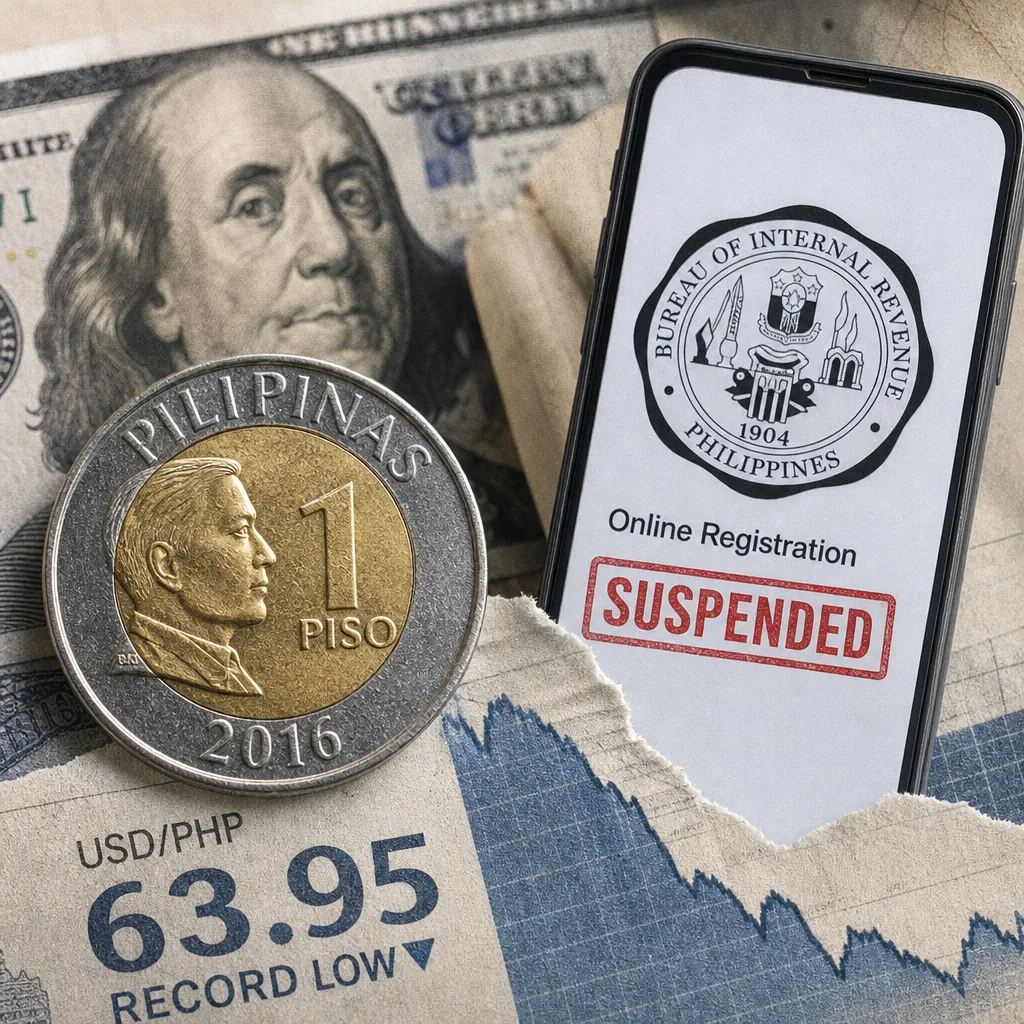
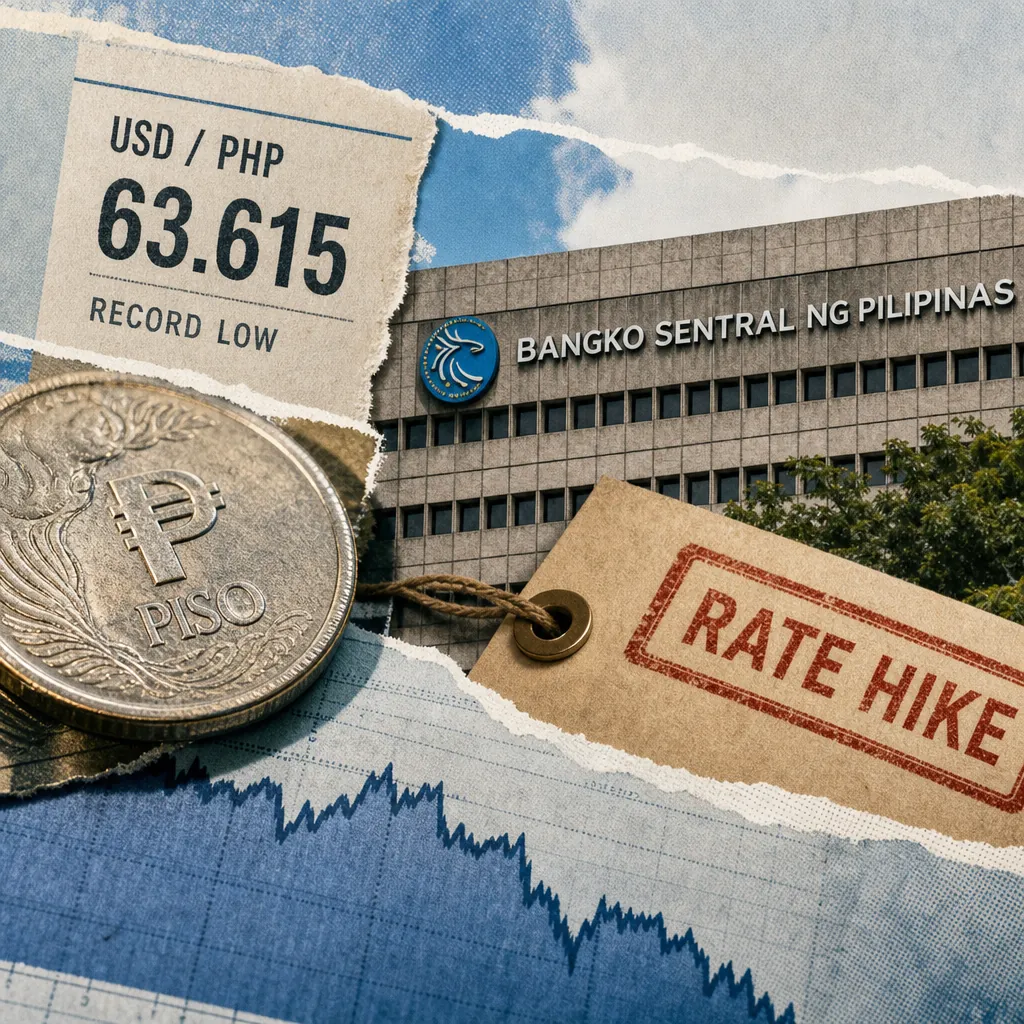
Peso closes at record ₱64.17 per dollar
The peso fell past ₱64 to a record low of ₱64.17 against the dollar on Oct. 27, its sixth straight record close, as the Palace blamed Middle East conflict and oil prices. The day's coverage also carried budget-insertion disputes, the Duterte impeachment case, and a Cabinet reshuffle.
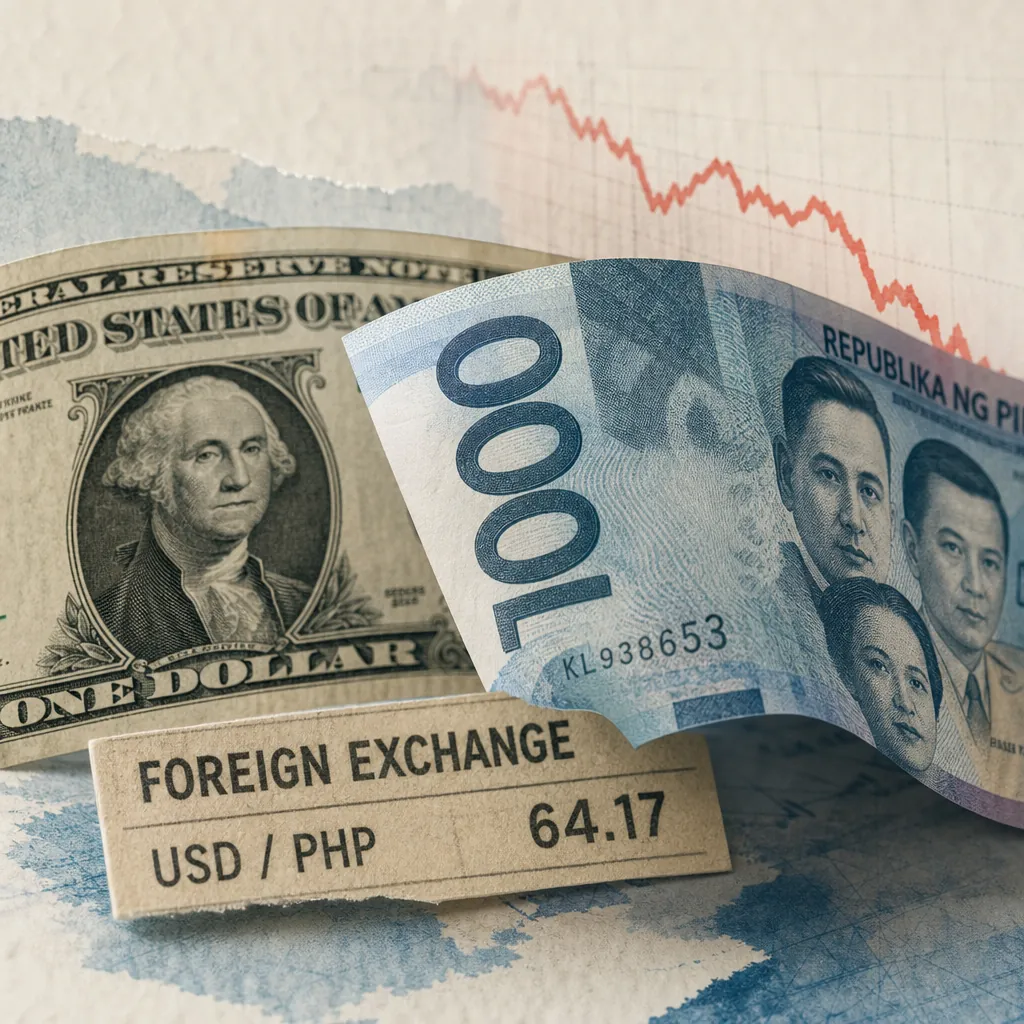
The peso closed at ₱64.17 to the US dollar on Tuesday, Oct. 27, the first time it has ended a trading day above ₱64 and the sixth consecutive session it has set a record low 45. The previous record, ₱63.95, had been set just a day earlier, on Monday, Oct. 26 35. The peso had already traded past ₱64 during the session before settling at the close, according to the Bankers Association of the Philippines (BAP), the industry group whose published reference rate is the market's daily benchmark 35.
Malacañang attributed the slide to fighting in the Middle East, which it said is keeping crude oil prices high and the exchange rate volatile. "This is not what the president wanted. This is not what the government wanted. Who would ever want a crisis, war, or conflict in the Middle East?" Presidential Communications Office (PCO) Undersecretary and Palace Press Officer Claire Castro said at a briefing 45. The peso's fall comes after the central bank, the Bangko Sentral ng Pilipinas, delivered a surprise interest rate hike the previous week, a move markets met with an adverse reaction, according to The Manila Times 45.
The currency story ran alongside a dense set of national political and economic items in the day's coverage: a church-led call to scrutinize ₱190 billion in infrastructure projects added to the 2027 budget 2, a fresh round of testimony in Vice President Sara Duterte's impeachment trial 9, a Cabinet reshuffle that returned Vince Dizon to the transport department 12, and a batch of corporate-governance awards handed out by the Institute of Corporate Directors 29. The peso carried the widest consequence for ordinary households, because it feeds directly into fuel, power, and imported food prices.
Key themes
- The peso set a sixth straight record low at ₱64.17 per dollar. The close was 22 centavos weaker than Monday's ₱63.95, itself a record 45. The peso has now weakened past ₱64 for the first time in its history, a level that makes every imported good — fuel, wheat, medicine, electronics — more expensive in pesos.
- The Palace blamed Middle East conflict and oil prices for the currency's slide. Undersecretary Castro said geopolitical conflict keeps crude prices high and the exchange rate volatile, and that the government has put interventions in place to lower commodity prices 45. She did not name the interventions.
- A weaker peso cuts two ways for the economy. HSBC Global Research senior economist Aris Dacanay argued the depreciation could help revive Philippine manufacturing by making locally made goods cheaper against imports and more affordable to foreign buyers, and would raise the peso value of every dollar sent home by overseas Filipino workers 59.
- The Catholic Bishops' Conference of the Philippines (CBCP) asked the House to explain ₱190 billion in added infrastructure projects. CBCP president Bishop Pablo Virgilio David cited preliminary findings by the People's Budget Coalition (PBC) on nearly 7,000 projects inserted into the House-approved version of the proposed ₱7.2-trillion 2027 national budget without publicly available supporting documents 2.
- Sen. Jinggoy Estrada denied inserting more than ₱7 billion into the 2025 budget. Former Public Works Secretary Manuel Bonoan told the Sandiganbayan, the country's anti-graft court, in written testimony that Estrada had over ₱7 billion in "congressional initiatives" 53. Estrada's camp pointed to the Senate's Legislative Budget Research and Monitoring Office (LBRMO), which told the Ombudsman in March it found no records of such amendments by him 26.
- Prosecutors said their evidence against Vice President Sara Duterte is strong enough to convict. House prosecution spokesman Robert Ace Barbers said the case is "checkmate" and that the defense will have to explain cash and properties not reflected in her statements of assets, liabilities, and net worth (SALNs) when the trial resumes Nov. 9 5 9.
- Vince Dizon returned to the transport department and reported 29 contractors sanctioned at public works. In a joint briefing with incoming Public Works Secretary Giovanni Lopez, Dizon said about 20 contractors had been blacklisted and nine suspended, and more than 80 personnel removed, as part of the government's anti-corruption drive 50. He said he would prioritize an overhaul of the Land Transportation Office (LTO) 12.
- The Institute of Corporate Directors gave out its Golden Arrow Awards for governance. The awards grade publicly listed companies and insurers against the ASEAN Corporate Governance Scorecard (ACGS), a regional benchmark for shareholder rights, transparency, and board accountability 29. Philippine National Bank received four arrows for the fifth straight year 24, and East West Banking Corp. moved up to three arrows from two 27.
How the narratives stack
Dominant: The peso's record close is the day's lead story by consequence. It affects every household that buys fuel, electricity, or imported food, and it is the one item in the set with a direct, measurable effect on prices across the economy. The coverage in this set is consistent: The Manila Times reported the close and the central bank context 45, the Manila Bulletin's Tagalog-language report carried the BAP data and the Palace reaction 35, and the Inquirer's evening roundup led with the peso breaking ₱64 65. The Palace's explanation — Middle East conflict and oil — is the government's official framing and was repeated across outlets.
Counter-narrative: HSBC's Aris Dacanay offered the clearest alternative reading, calling a weaker peso "the bitter pill the Philippine economy eventually needs" because it can revive manufacturing and raise the peso value of remittances 59. That view does not dispute the pain of higher import prices; it argues the depreciation also creates openings. The two positions are not contradictory — a weaker currency hurts consumers and helps exporters and remittance recipients at the same time — and both were reported plainly.
Emerging: The budget-insertion story is building toward a confrontation. The CBCP statement 2 and the Senate's praise for civil-society budget analysis 46 both point to the 2027 budget as the next flashpoint, following the flood-control corruption scandal. The Senate has added a link to an independent BetterGov.ph analysis on its Budget Transparency Portal, and Senate President Sherwin Gatchalian commended the group for releasing its review one day after the General Appropriations Bill passed second reading 46. That is a procedural change that gives outside analysts a formal place in the budget debate.
Under-covered: The peso's effect on specific sectors — power generation, fuel pricing, and food imports — was mentioned but not developed. Sen. Win Gatchalian separately called on the Department of Energy and the Energy Regulatory Commission to penalize non-compliant power generators, noting that spot-market electricity prices averaged ₱4.80 per kilowatt-hour in Luzon but reached ₱18.59 in the Visayas and ₱19.56 in Mindanao, regions that logged over 120 grid alerts 52. The connection between the weak peso and power costs was left implicit.
Platform insights
The day's material is drawn from online news coverage; no social-media monitoring writeup accompanied it, so engagement figures for individual posts are not available. The distribution of attention within the captured set is nonetheless informative.
- Inquirer Online: The Inquirer carried the largest share of national political and economic items, including the peso roundup 65, the CBCP budget statement 2, the impeachment coverage 5 9 16 96, and the Dizon transport and public-works stories 6 12. Its coverage was broad and fast-moving, with multiple updates through the evening.
- Manila Times Online: The Times carried the peso close with the central bank context 45, the Senate budget-transparency story 46, the Dizon exit report 50, and the Golden Arrow Awards supplement 29 24 27. Its peso story was the most detailed on the rate-hike backdrop.
- Manila Bulletin Online: The Bulletin's Tagalog report on the peso 35 and its report on the cyber-libel complaint filed by former National Security Adviser Clarita Carlos 60 reached a different readership than the English broadsheets.
- Regional and community outlets: Negros Now Daily carried a cluster of provincial stories — crop damage from dry conditions 77, a trail closure on Mt. Talinis 72, and local crime reports 81 84 — that show how national economic pressure lands in farming communities.
Key voices and communities
The Palace and economic managers. Undersecretary Castro is the government's public face on the peso, and her framing — external conflict, not domestic policy — sets the terms of the debate 45. The central bank's surprise rate hike the previous week is the policy backdrop the Palace did not emphasize 45.
HSBC Global Research. Economist Aris Dacanay's commentary is the most substantive outside analysis in the set, and it gives the manufacturing and remittance side of the argument a named author 59.
The Catholic Bishops' Conference of the Philippines and the People's Budget Coalition. Bishop David's statement elevates a technical budget finding into a moral appeal, and the PBC's Ken Abante supplied the underlying numbers 2. The coalition's work is the kind of outside analysis the Senate is now formally linking to 46.
The House prosecution panel. Robert Ace Barbers is the most quoted political figure in the set, with statements on the impeachment evidence 5 9 16 96 and on the prenuptial-agreement question 96. His framing — "checkmate" — is designed to shape public expectation ahead of the Nov. 9 resumption.
Senators on the budget and energy. Sen. Jinggoy Estrada 26 53, Senate President Gatchalian 46 52, and Sen. Panfilo Lacson 49 each staked out positions that will shape the coming legislative session.
Narrative streams
The peso breaks ₱64 for the first time
The peso's close at ₱64.17 per dollar on Tuesday was the sixth straight record low and the first close above ₱64 45. The BAP data showed the previous record of ₱63.95 set on Monday 35. The Manila Times reported that the slide followed the central bank's surprise rate hike the previous week, which markets met adversely 45. A rate hike normally supports a currency by making local assets more attractive; in this case the market reaction ran the other way, which suggests investors were reading the hike as a sign of stress rather than strength.
The Palace's response was to point outward. Castro cited "geopolitical conflict" in the Middle East, high crude oil prices, and a volatile exchange rate, and said the government has interventions in place to lower commodity prices 45. She did not specify what those interventions are. The peso's fall matters to ordinary readers because the Philippines imports most of its fuel and a large share of its food and medicine; a weaker peso raises the peso cost of every import before any change in world prices.
HSBC's Dacanay offered the counter-case. A weaker peso, he wrote, "can open new opportunities and, perhaps, be the bitter pill the Philippine economy eventually needs," because it makes locally produced goods more competitive against imports and more affordable to foreign buyers, and because every dollar remitted by an overseas Filipino worker now converts to more pesos 59. The read for the sector: exporters, manufacturers competing with imports, and remittance-receiving households gain from the depreciation, while consumers of fuel, power, and imported food lose. The balance depends on how long the peso stays weak and how fast the central bank's rate path stabilizes it.
The 2027 budget draws church and civil-society scrutiny
Bishop Pablo Virgilio David, president of the CBCP, called on the House to explain nearly 7,000 infrastructure projects worth ₱190 billion that were added to the proposed 2027 national budget without publicly available supporting documents 2. He cited preliminary findings by the People's Budget Coalition, presented by co-convenor Ken Abante before the Senate, on the House-approved version of the ₱7.2-trillion budget 2. David linked the concern to the flood-control corruption scandal, for which he said the country has yet to see full accountability 2.
The Senate's response has been to formalize outside scrutiny. Senate President Gatchalian commended civil-society groups for using technology, artificial intelligence, and coding to speed up their budget review, and announced that the Senate has added a link to an independent study on its Budget Transparency Portal 46. He cited BetterGov.ph's analysis, which was released one day after the General Appropriations Bill passed second reading 46. The read for the sector: civil-society budget analysis is moving from press-conference findings into the official legislative record, which raises the cost of inserting projects without documentation. The next test is the bicameral conference committee, where the House and Senate versions are reconciled.
Estrada disputes Bonoan's ₱7-billion insertion claim
Former Public Works Secretary Manuel Bonoan told the Sandiganbayan Fifth Division in written testimony that Sen. Jinggoy Estrada had over ₱7 billion in "congressional initiatives" in the 2025 budget 53. Estrada's legal team reiterated that he had no insertions and pointed to the Senate's LBRMO, which told the Ombudsman in March that it found no legislative records or official documents showing such amendments by him 26 53. Estrada himself said the official records "will attest to this" 26.
The dispute is a test of documentary evidence against testimony. The LBRMO letter is a Senate record; Bonoan's testimony is a sworn statement before a court. The read for the sector: contractors and agencies named in the flood-control inquiry face a longer legal process, and the outcome will shape how budget insertions are documented in future cycles.
The Duterte impeachment case moves toward Nov. 9
House prosecution spokesman Robert Ace Barbers said the evidence against Vice President Sara Duterte is "checkmate" and hard to refute 5. He presented a review of evidence on her bank accounts, insurance, investments, firearms, business interests, and land, and said prosecutors have five sets of questions for the defense when the trial resumes Nov. 9 9. Barbers challenged the defense to explain the capital and ownership percentages in Metro City Chow Foods, GenCorp, and Cale88, which he said were not clear in her SALN declarations 16. He also said that whether or not there is a prenuptial agreement between Duterte and her husband, Manases Carpio, the evidence is enough to convict 96. His line — "Pangkarinderya ang drama, pero pangbilyonarya ang bulsa" — contrasted the family's public image of a simple lifestyle with the amounts in the financial records 9.
The read for the sector: the Nov. 9 resumption is the next scheduled event, and the defense's presentation will determine whether the prosecution's documentary case holds. For public institutions, the trial is testing whether SALN disclosure rules carry enforceable consequences.
Dizon returns to transport and reports sanctions at public works
Vince Dizon, reappointed transport secretary in a Cabinet reshuffle, said he will prioritize an overhaul of the LTO and continue the programs begun by Giovanni Lopez, who now heads the Department of Public Works and Highways (DPWH) 12. At a joint briefing, Dizon reported that the DPWH had blacklisted about 20 contractors and suspended nine, and removed more than 80 personnel, as part of the anti-corruption campaign 50. He said he and Lopez will conduct joint inspections in the coming weeks and months 6.
The read for the sector: contractors and agency personnel face continued sanctions, and the transport portfolio — particularly the LTO, which handles driver's licenses and vehicle registration — is back under a secretary who has promised reforms. Commuters are the intended beneficiaries, but the measures announced so far are personnel and procurement actions, not service changes.
Corporate governance awards grade listed companies
The Institute of Corporate Directors recognized Philippine publicly listed companies and insurers at the Golden Arrow Awards, based on the ASEAN Corporate Governance Scorecard 29. PNB received four arrows for the fifth consecutive year 24, and EastWest moved to three arrows from two, with chief executive Jerry Ngo saying "trust is especially important in banking, and it is something we must earn through responsible decisions and consistent accountability" 27. The full list of awardees included Ayala Corporation, Bank of the Philippine Islands, and China Banking Corporation at five arrows 23.
The read for the sector: the ACGS score is a regional benchmark that investors and regulators use to compare boards, and the awards give companies a public marker of governance quality. For banks, the score is a signal to depositors and creditors about risk management.
Conversation trajectory
The peso's next close (daily, through the week). The peso has set a record low on six consecutive trading days 45. Watch whether it holds above ₱64 or retreats; a sustained break would push fuel and power prices higher and increase pressure on the central bank to raise rates again.
The central bank's next policy signal (within weeks). The surprise rate hike the previous week is still working through the market 45. Any further tightening would test whether higher rates can stabilize the currency without slowing lending.
The impeachment trial resumption (Nov. 9). The defense is scheduled to present its evidence and witnesses 9. Watch whether the prenuptial-agreement question 96 becomes part of the defense strategy.
The 2027 budget's bicameral stage (coming weeks). The House and Senate versions must be reconciled, and the CBCP and PBC findings 2 will be cited in that process. The Senate's Budget Transparency Portal link 46 gives outside analysts a formal reference point.
The ASEAN defense ministers meeting in Cebu (Oct. 28–29). US Defense Secretary Pete Hegseth is expected in Cebu for the 20th ASEAN Defence Ministers Meeting and the 13th ADMM-Plus, with regional security and military cooperation on the agenda 21. The meeting is a scheduled event that could produce defense-cooperation announcements.
Trigger events: a central bank rate decision, a new record peso close, the Nov. 9 impeachment resumption, and the bicameral budget conference.
Response guidance
Currency-sensitive communicators: Prepare plain-language explanations of how the exchange rate affects fuel, power, and food prices, and avoid attributing the peso's slide to a single cause. The Palace's Middle East framing 45 and HSBC's manufacturing-and-remittance case 59 are both on the record; acknowledge both.
Budget and governance communicators: Expect continued scrutiny of the 2027 budget and the 2025 insertions. Cite documentary records — the LBRMO letter 26, the PBC findings 2, and the Senate's transparency portal 46 — rather than characterizing allegations.
Public-works and transport communicators: The DPWH sanctions 50 and the LTO overhaul pledge 12 will be measured against service outcomes. Report progress in specific, checkable terms: contracts blacklisted, personnel removed, licensing times.
Corporate communicators: Governance awards 29 24 27 are useful third-party markers, but they grade process, not performance. Pair them with concrete disclosures.
Regional communicators: Provincial crop damage 77 and local service programs 88 are the ground-level effects of national economic pressure. Localize national stories with local figures.
See the full picture behind today's signals.
This report draws from Media Meter's MediaWatch, our real-time monitoring engine tracking 2,470+ Philippine sources across print, broadcast, digital, and social. Explore how the platform turns raw coverage into decision-grade intelligence, then see how it's configured for teams like yours — whether you're in PR agencies, corporate comms, government, or marketing.
Want more? Browse our Report Library for sector and crisis intelligence, or request a demo and we'll have your brand set up before the call.
Want this kind of intelligence on your brand?
This brief is built on the same MediaWatch methodology that runs continuously across every brand we monitor. See your competitive landscape, Impact Score, and narrative trajectory in a 30-minute demo.