Peso Hits Record Low 62.90 as PSEi Falls 2.2%
The peso closed at a record low of 62.90 to the dollar and the main stock index fell 2.2% as oil prices and rate-hike expectations weighed on markets. PAGASA also declared the end of the southwest monsoon, closing the rainy season over western Luzon and the Visayas.
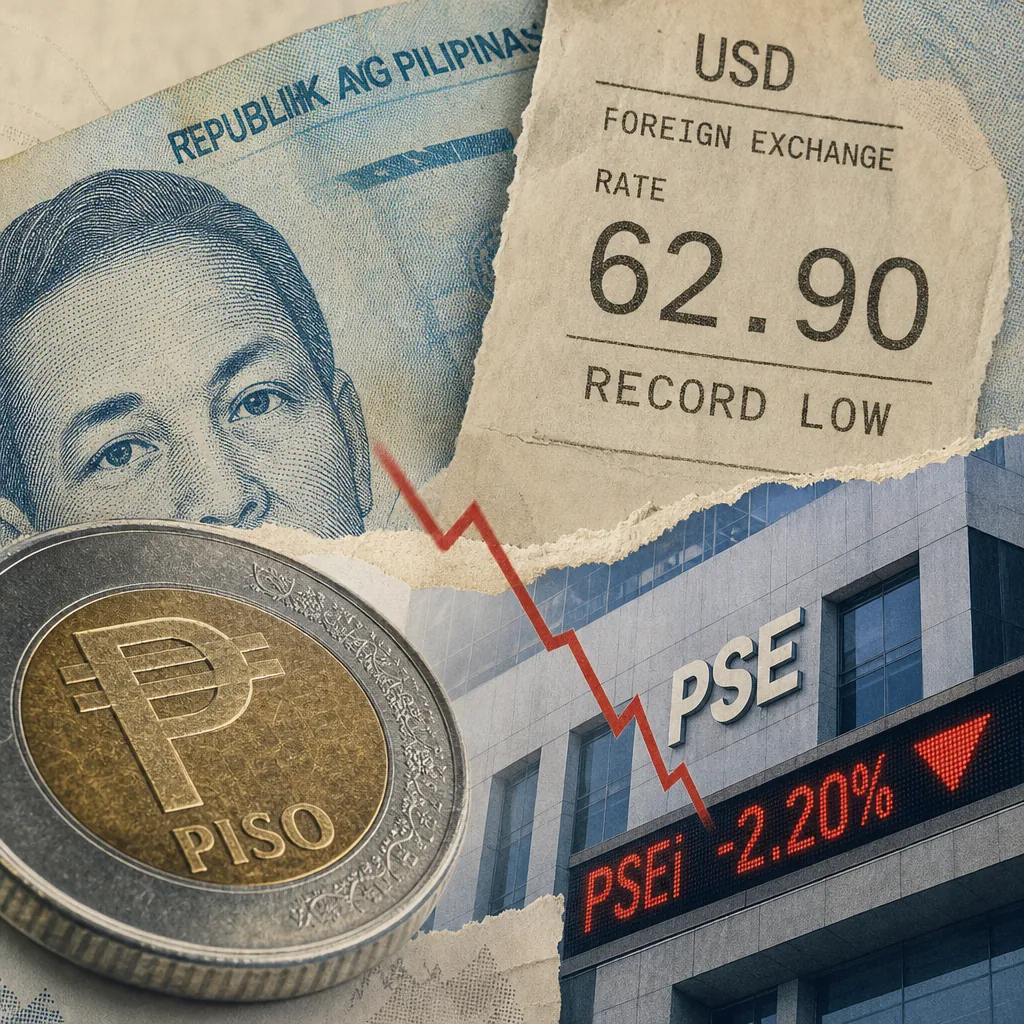
The peso closed at 62.90 to the US dollar on Thursday, October 8, its weakest finish on record, breaking the previous low of 62.86 set on September 14, 2026. The Philippine Stock Exchange index (PSEi) — the benchmark that tracks the 30 largest companies listed on the local bourse — fell 2.2%, or 126.30 points, to 5,610.39, its worst close in almost 11 months, since it ended at 5,584.35 on November 14, 2025. The two moves came from the same set of pressures: a jump in global oil prices on supply fears, political instability in France, and growing expectations that both the US Federal Reserve and the Bangko Sentral ng Pilipinas (BSP) — the country's central bank — will raise interest rates again before the year ends.
The peso's slide has also eaten into the country's dollar reserves. Gross international reserves (GIR) — the central bank's stockpile of foreign currency, gold, and other assets used to defend the currency and pay for imports — fell below $100 billion at end-September for the first time in three years, to $99.997 billion, down 8.31% from $109.06 billion a year earlier. That was the seventh straight month the GIR contracted year on year, and a 4.62% drop from $104.846 billion at end-August. The BSP said the decline came largely from its own foreign exchange operations, as it sold dollars to slow the peso's fall.
On the same day, the weather bureau announced the end of the southwest monsoon, and a separate set of stories tracked the drought that is expected to follow. The Philippine Atmospheric, Geophysical and Astronomical Services Administration (PAGASA) — the government agency that monitors weather and climate — declared the end of the habagat, the seasonal wind pattern that brings the country's heaviest rain, on Monday, October 5, closing the rainy season over western Luzon and the Visayas.2 PAGASA attributed the shift to a stronger high-pressure system over East Asia, the southward movement of the Intertropical Convergence Zone (ITCZ) — the band of clouds and rain that circles the globe near the equator — and weaker habagat winds, and said it expects these conditions to persist in the coming days.4 The announcement drew modest but steady engagement on Facebook, with one post drawing 154 likes, 34 shares, and 15 comments, and a DZMM Radyo Patrol 630 post drawing 56 likes and four shares.23 Reactions were mixed, with some users expressing relief and others sadness, but the declaration did not spark any major controversy or debate online.4
Key themes
- The peso closed at a record low of 62.90 to the dollar. The currency weakened from Wednesday's 62.75 close and breached the previous record of 62.86 set on September 14, 2026. Year to date, it has depreciated by P4.11, or 6.53%, from its P58.79 close on December 29, 2025.
- The PSEi fell 2.2% to 5,610.39, its worst finish in almost 11 months. The index opened at 5,727.76, reached an intraday high of 5,744.40, then sold off to close at its session low. The broader all-shares index fell 1.45%, or 46.44 points, to 3,145.55.
- Dollar reserves fell below $100 billion for the first time in three years. The GIR stood at $99.997 billion at end-September, down 8.31% from $109.06 billion a year earlier, as the central bank sold dollars to support the peso.
- Inflation hit 7.2% in September, and analysts expect the BSP to raise rates further. Core inflation, which strips out volatile food and energy prices, quickened to a near-three-year high of 4.7% from 4.1% the previous month and 2.6% a year earlier. Bank of America Global Research said the concerns "are squarely pointing to the upside."
- PAGASA declared the end of the southwest monsoon, closing the rainy season over western Luzon and the Visayas. The agency cited a stronger high-pressure system over East Asia, the southward migration of the ITCZ, and weaker habagat winds, and said it will continue monitoring conditions.14
- El Niño is forecast to intensify and peak in December, with Angat Dam's water level already declining. The UN's World Meteorological Organization said sea-surface temperatures in the central and eastern tropical Pacific are forecast to reach record levels in October–November–December 2026. Angat Dam, which supplies 90% of Metro Manila's tap water, stood at 207.83 meters as of 8 a.m. Thursday, below its high normal level of 210 meters.
- The government is preparing drought-relief measures for farmers. The Department of Agriculture (DA) plans to tap the Department of Labor and Employment's (DOLE) Tulong Panghanapbuhay sa Ating Disadvantaged/Displaced Workers (TUPAD) program — a short-term emergency employment scheme — to provide temporary jobs to farmers displaced by drought. Isabela province has activated a P1.8-billion mitigation initiative covering over 118,000 farmers across 31,000 hectares.
- The Philippines signed a €212.7-million (around P14.9 billion) loan with the World Bank for water supply and sanitation projects in Bohol, Siargao, and Jolo. The loan agreement, dated October 6, was signed by Finance Secretary Frederick D. Go and World Bank Division Director Zafer Mustafaoğlu. It supports the first phase of the Philippines Accelerated Water and Sanitation Project in Selected Areas.
How the narratives stack
Dominant: The peso's record low and the stock market's 2.2% drop dominated the business pages of the broadsheets captured in this set. The peso story ran on the front page of Manila Standard's business section and in BusinessWorld's banking and finance pages, with both outlets tying the currency's weakness to the same causes: rising oil prices, Middle East tensions, and expectations of further rate hikes from the US Federal Reserve and the BSP. The coverage was heavy — the peso story alone carried an estimated P450,331 in advertising-equivalent value in BusinessWorld and P256,857 in Manila Standard, meaning the space those stories occupied would have cost that much to buy as paid advertising. The stock market story carried P316,021 in BusinessWorld. The two stories are the same story told from two angles: foreign investors are pulling money out of Philippine assets because they can get better returns in the US, and the central bank is spending its dollar reserves to slow the peso's fall.
Counter-narrative: The weather story ran alongside the market story but on a different track. PAGASA's declaration of the end of the habagat was routine seasonal news, picked up by national and regional broadcasters in a single day, with no contested figures and no agency dispute.56 The social media response was modest — the highest-engagement post drew 154 likes and 34 shares — and the tone was mixed, with some users expressing relief and others sadness.2 The more consequential weather story was the drought: El Niño is forecast to intensify and peak in December, Angat Dam's water level is already declining, and the government is preparing relief measures for farmers. That story ran on the front pages of the broadsheets but drew far less social engagement than the monsoon declaration, suggesting that the public's attention is on the immediate weather transition rather than the slower-moving drought risk.
Emerging: The Senate's ratification of the visiting forces agreement (VFA) with France — a pact that allows troops from both countries to operate legally in each other's territories — passed with 17 affirmative votes and no objection, making France the first European nation to have such an agreement with the Philippines. The ratification is part of a broader effort to diversify security ties amid tensions in the South China Sea, where the Armed Forces of the Philippines monitored 101 Chinese navy and coast guard ships in September, nearly double the previous month's 56. President Marcos said in Singapore that negotiations for a Code of Conduct in the South China Sea were making "good progress," but warned that a single mistake could trigger a wider confrontation.14 The VFA ratification and the Code of Conduct talks are both early signals of a shift in the Philippines' security posture, but neither has yet produced a concrete change on the water.
Under-covered: The labor violations found at the shipping company that operated the M/V June Aster, which caught fire off Coron, Palawan, killing more than 70 people on September 9, received comparatively little attention in the captured set. The Department of Labor and Employment (DOLE) found breaches involving more than P600,000, including unpaid overtime, holiday and rest-day pay, night-shift differentials, and wage deficiencies, as well as violations of occupational safety and health standards. The story ran as a single item in Manila Standard's news pages, with an estimated advertising-equivalent value of P46,860 — the lowest of any item in the captured set — despite the death toll. The low coverage value reflects the story's placement, not its significance: a maritime disaster that killed more than 70 people and exposed labor and safety failures at the operator is a story that would normally command more space.
Platform insights
Facebook: The monsoon declaration was the main weather story on Facebook, with multiple posts from national and regional broadcasters. A post from DZMM Radyo Patrol 630 drew 56 likes and four shares, while another post drew 154 likes, 34 shares, and 15 comments.23 The engagement was modest by the standards of a major news event, and the comments reflected mixed sentiments — some users welcomed the end of the rainy season, while others expressed sadness, possibly reflecting the agricultural sector's dependence on rainfall.2 The posts that performed best were those that paired the announcement with practical information about what the shift means for daily life, such as the reduction in Habagat winds and rainfall.3
X: The captured set did not include significant activity on X for this window. The market stories — the peso's record low and the stock market's drop — were covered by the broadsheets and their online platforms, but the monitoring writeup does not record X engagement figures for those stories.
Reddit: The captured set did not include significant activity on Reddit for this window. The platform was mentioned in a BusinessWorld opinion piece about the government's brief ban on Discord and Reddit, but the piece was about the ban, not about the market or weather stories.
YouTube: The captured set did not include significant activity on YouTube for this window. The only YouTube-related item was a showbiz story about the return of the documentary series "Drug War: A Conspiracy of Silence" to the Rein Entertainment YouTube channel, which is not connected to the market or weather stories.
Key voices and communities
Economic analysts and bank economists: The most quoted voices in the market coverage were bank economists explaining the peso's slide. Ruben Carlo Asuncion, chief economist at Union Bank of the Philippines, said the peso's weakness reflected the combined persistence of a strong dollar and rising external price pressures, with the US dollar supported by the Federal Reserve's higher-for-longer policy stance and elevated Treasury yields. Domini S. Velasquez, chief economist at China Banking Corp., commented on the Philippines–European Union free trade agreement, saying the gains "may not be as dramatic as in countries shifting from no preferential access to a full trade agreement" because the Philippines already benefits from substantial market access under the EU's GSP+ scheme. These voices matter because they shape how businesses and consumers interpret the currency's slide and what they expect the central bank to do next.
Government economic managers: Finance Secretary Frederick D. Go signed the €212.7-million World Bank loan for water and sanitation projects, and Trade Secretary Maria Cristina A. Roque issued a statement on the export growth figures. Their public statements are the government's main channel for reassuring markets and the public that the economic fundamentals remain sound.
Weather and climate agencies: PAGASA and the UN's World Meteorological Organization were the main sources for the weather stories. PAGASA's declaration of the end of the habagat and its monitoring of Angat Dam's water level are the official signals that farmers, businesses, and local governments use to plan for the dry season.1 The WMO's forecast that El Niño will peak in December is the international benchmark that Philippine agencies use to calibrate their own projections.
Farmers and agricultural communities: The DA's plan to tap TUPAD for drought-displaced farmers and Isabela's P1.8-billion mitigation initiative are direct responses to the pressure that El Niño is putting on agricultural communities. These communities are the most exposed to the drought, and their experience will shape how the government's relief measures are received.
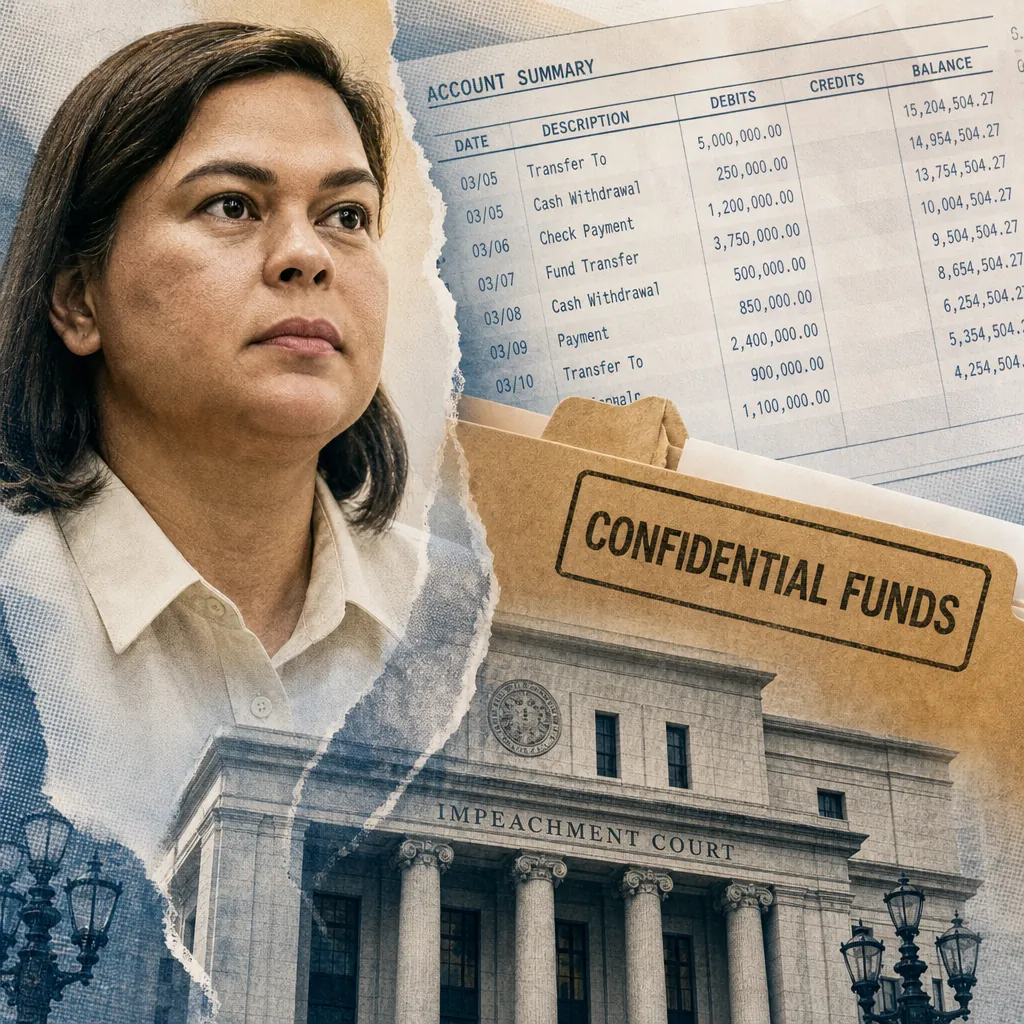
Senators and the impeachment court: The impeachment trial of Vice President Sara Duterte continued on its 36th day, with the prosecution accusing her of violating the Constitution by practicing law and receiving professional fees while serving as vice president, and the defense hinting it may elevate the Commission on Audit's disallowance of her P73-million confidential funds to the Supreme Court. The trial is a separate story from the market and weather news, but it is a major ongoing event that is drawing sustained coverage.
Narrative streams
The peso's record low and the stock market's 2.2% drop
The peso closed at 62.90 to the dollar on Thursday, breaking the previous record of 62.86 set on September 14, 2026. The currency opened the session stronger at 62.65, which was already its intraday high, and its weakest showing was its closing level. Dollars traded rose to $1.45 billion from $1.208 billion the previous day, indicating heavier selling pressure. The PSEi fell 2.2% to 5,610.39, its worst close since November 14, 2025, while the all-shares index fell 1.45% to 3,145.55.
The proximate causes were external and domestic. On the external side, global oil prices jumped on supply fears linked to the re-escalation of the Middle East war, and political instability in France pushed investors toward safer assets. On the domestic side, inflation accelerated to 7.2% in September, and core inflation — which strips out volatile food and energy prices — quickened to a near-three-year high of 4.7% from 4.1% the previous month and 2.6% a year earlier. National Statistician Claire Dennis S. Mapa noted persistent pressures from energy items and said the latest figure still does not account for the recent transport fare hike and the "Super El Niño." Bank of America Global Research said the concerns "are squarely pointing to the upside" and that higher oil price assumptions may prompt the BSP to raise its inflation projections until 2027. Based on forecasts given in August, the central bank sees inflation setting at 6.1% this year before easing to 5.4% next year.
The read for the sector: businesses with foreign-currency debt or imported inputs will face higher costs as the peso weakens, and consumers will see the effect in the prices of imported goods and fuel. The BSP's room to cut rates to support growth is narrowing, because cutting rates while inflation is at 7.2% would risk weakening the peso further. The central bank's dollar reserves, which it uses to defend the currency, fell below $100 billion for the first time in three years, which limits how much it can intervene without drawing down its buffer.
The context: the peso has been weakening for months, and the BSP has been selling dollars to slow the slide. The GIR has contracted year on year for seven straight months. The last time the peso was this weak was in September 2026, when it hit 62.86, and before that in 2023, when the GIR fell to $98.116 billion. The difference now is that inflation is higher and the central bank is expected to raise rates rather than cut them, which is the opposite of what an economy slowing to 2.3% growth in the second quarter would normally need.
The end of the southwest monsoon and the drought ahead
PAGASA declared the end of the southwest monsoon on Monday, October 5, closing the rainy season over western Luzon and the Visayas.2 The agency said the shift was driven by a stronger high-pressure system over East Asia, the southward movement of the ITCZ, and weaker habagat winds, and that it expects these conditions to persist.4 The announcement was widely shared on Facebook, with one post drawing 154 likes, 34 shares, and 15 comments, and a DZMM Radyo Patrol 630 post drawing 56 likes and four shares.23 Reactions were mixed, with some users expressing relief and others sadness.2
The more consequential weather story is the drought. The UN's World Meteorological Organization said El Niño will intensify before peaking in December, with sea-surface temperatures in the central and eastern tropical Pacific forecast to reach record levels in October–November–December 2026. El Niño is a naturally occurring weather phenomenon that warms surface temperatures in the central and eastern equatorial Pacific Ocean, bringing changes in winds, pressure, and rainfall patterns worldwide. It typically occurs every two to seven years and lasts around nine to 12 months. Angat Dam, which supplies 90% of Metro Manila's tap water and irrigates farmlands in Pampanga and Bulacan, stood at 207.83 meters as of 8 a.m. Thursday, below its high normal level of 210 meters. The level peaked at 208.82 meters in September, and the dam hit a record low of 150.6 meters in July 2026, nearly 10 meters below its critical level.
The government is preparing relief measures. The DA plans to tap DOLE's TUPAD program — a short-term emergency employment scheme that pays displaced workers for community work — to provide temporary jobs to farmers who may be displaced by drought. Agriculture Secretary Francisco Tiu Laurel Jr. said the program could provide an income source for farmers in areas where drought or reduced water availability prevents them from tilling their farms. "There are areas that will be severely affected by the drought. That could spell disaster to our farmers who are tilling the land in these areas. We need to provide alternative livelihood for them," he said. Isabela province has activated a P1.8-billion initiative, tapping its Local Disaster Risk Reduction and Management Fund and Quick Response Fund to address damage to over 118,000 farmers across 31,000 hectares. The provincial government and the DA have targeted cloud seeding operations and distributed drought-resistant seeds and agricultural inputs.
The read for the sector: farmers in rain-fed areas will face income losses if the drought peaks as forecast, and the government's relief measures — TUPAD jobs, cloud seeding, drought-resistant seeds — are designed to cushion the blow but will not replace lost harvests. Water utilities and households in Metro Manila will face pressure on supply if Angat Dam's level continues to decline. The DA's decision to tap TUPAD is a recognition that the drought's impact will be felt beyond agriculture, in rural employment and food prices.
The context: the Philippines is a country where the transition from the rainy season to the dry season is a major planning event for farmers, businesses, and local governments. The habagat brings the heaviest rain, and its end marks the start of the dry season. But this year, the dry season coincides with a strengthening El Niño, which is why the government is preparing relief measures earlier than usual. The last time the country faced a strong El Niño was in 2023–2024, when drought conditions affected agricultural production and water supply. The current forecast suggests this El Niño could be stronger, with record sea-surface temperatures.
The Philippines–EU free trade agreement and the limits of trade deals
The Philippines and the European Union are negotiating a free trade agreement (FTA) — a pact that would reduce tariffs and other barriers to trade between the two economies. Economists said the deal could provide only a modest boost to the Philippine economy because longstanding domestic constraints may limit its potential to attract investment, diversify exports, and improve productivity. Domini S. Velasquez, chief economist at China Banking Corp., said the immediate boost from tariff reductions may be limited since the Philippines already enjoys substantial preferential access to the European market under the EU's Generalised Scheme of Preferences Plus (GSP+) — a program that allows developing countries to pay lower duties on their exports to the EU. "The EU-Philippines FTA is likely to provide a positive, though measured, boost to Philippine economic growth," she said. "The gains may not be as dramatic as in countries shifting from no preferential access to a full trade agreement, given that the Philippines already benefits from substantial market access under the EU's GSP+ scheme."
The read for the sector: exporters who already use GSP+ preferences will see limited new benefits from the FTA, while those who do not export to the EU may find it easier to start. The bigger constraint is domestic: poor infrastructure, high energy costs, and regulatory hurdles limit the Philippines' ability to attract investment and diversify exports, and an FTA does not address those. The appointment of Trade Undersecretary Allan B. Gepty — who negotiated FTAs with the EU, the United Arab Emirates, Chile, South Korea, and Canada — as an Associate Justice of the Court of Appeals removes one of the government's most experienced trade negotiators from the trade portfolio at a time when the EU FTA talks are ongoing.
The context: the Philippines has been negotiating trade agreements with several partners, including the EU, the UAE, and South Korea. The EU FTA is part of a broader effort to diversify export markets and reduce dependence on traditional partners like the United States, Japan, and China. But economists caution that trade deals alone cannot overcome domestic constraints, and the Philippines' export growth — merchandise exports rose 14.8% to $64.04 billion in the first eight months of 2026 — has been driven mainly by electronics and minerals, not by new trade agreements.
The impeachment trial of Vice President Sara Duterte
The impeachment trial of Vice President Sara Duterte continued on its 36th day, with the prosecution accusing her of violating the Constitution by practicing law and receiving professional fees while serving as vice president. House prosecutor Erwin Matib said Bureau of Internal Revenue records showed Duterte remained engaged in legal activities and received professional fees and other income aside from her salary. The prosecution cited Article VII, Section 13 of the Constitution, which prohibits the president and vice president from directly or indirectly practicing any other profession, participating in any business, or having a financial interest in government contracts, franchises, or special privileges during their tenure.
Separately, a private prosecutor told the impeachment court that Duterte's net income after tax from 2007 to 2025 does not match the net worth she declared in her statement of assets, liabilities, and net worth (SALN) — the annual disclosure that public officials are required to file. Private prosecutor Erwin G. Matib said the combined net worth of Duterte and her husband, Manases R. Carpio, worth P85 million after taxes over the past 18 years, does not match her 2025 SALN, which declared a net worth of P98,656,131.20. "So, here there is already a gap, there is a difference," he said. Witness Anne Loraine C. Garcia-Marquez, chief of staff for the Bureau of Internal Revenue Office of the Commissioner, affirmed that the couple had a net income from 2007 to 2025 of P85 million.
The defense said it may elevate to the Supreme Court the Commission on Audit's (COA) disallowance of Duterte's P73-million confidential funds disbursements. The COA is the government's audit agency, and a notice of disallowance means it has ruled that the spending was improper and must be repaid. Duterte's defense spokesperson, lawyer Michael Poa, said the defense still has legal remedies available regarding the COA notice. "I don't want to put words into the mouth of the prosecution on how it will affect their case. Again, it's within their prerogative if they would like to include that as part of their evidence for Article 1, which is confidential funds," Poa said.
The read for the sector: the impeachment trial is a political and legal process that will run for months, and its outcome will shape the political environment for the 2027 budget and the remainder of President Marcos' term. For businesses, the trial adds a layer of political uncertainty on top of the economic pressures from inflation, the peso, and the drought. The prosecution's focus on Duterte's income and wealth — the alleged mismatch between her SALN and her actual net worth — is the part of the case that has drawn the most testimony from bank and tax officials, and it is likely to be the most consequential for the public's perception of the trial.
The context: the impeachment trial is the first time a Philippine vice president has been tried by the Senate. The trial began in 2026 and has run for 36 days. The prosecution has presented testimony from the Anti-Money Laundering Council, bank officials, and tax officials. The defense has argued that the existence of Duterte's name on a joint account with her father, former President Rodrigo Duterte, does not prove that she initiated, authorized, or knew about every transaction involving it. The trial is expected to continue into 2027.
Conversation trajectory
The peso and the stock market (next 1–2 weeks): The peso's record low and the PSEi's 2.2% drop are likely to be followed by more volatility in the near term. The next data points to watch are the BSP's policy meeting — where it will decide whether to raise rates — and the release of October inflation data. If oil prices remain elevated and the US Federal Reserve signals another rate hike, the peso could weaken further. The BSP's dollar reserves, which fell below $100 billion, limit how much it can intervene without drawing down its buffer. The trigger events are the BSP policy meeting and the next inflation release.
The drought and El Niño (next 4–6 weeks): El Niño is forecast to peak in December, and Angat Dam's water level is already declining. The next signals to watch are PAGASA's monthly climate outlook, the water level at Angat Dam, and the DA's rollout of TUPAD jobs for displaced farmers. If the drought intensifies as forecast, the government may need to expand its relief measures beyond the current P1.8-billion initiative in Isabela and the DA's TUPAD plan. The trigger events are PAGASA's next climate outlook and the December peak of El Niño.
The impeachment trial (next 2–4 weeks): The trial will continue with more testimony from bank and tax officials. The defense's plan to challenge the COA's disallowance before the Supreme Court could delay the trial or create a separate legal track. The next signals to watch are the prosecution's presentation of its case on Article 2 (unexplained wealth) and the defense's response to the COA ruling. The trigger events are the next scheduled trial days and any Supreme Court action on the COA disallowance.
The Philippines–EU FTA (next 1–3 months): The FTA negotiations are ongoing, and the appointment of Trade Undersecretary Allan B. Gepty to the Court of Appeals removes a key negotiator from the trade portfolio. The next signals to watch are the progress of the negotiations and the government's appointment of a replacement for Gepty. The trigger event is the next round of FTA talks.
Response guidance
For businesses with foreign-currency exposure: Review hedging strategies and stress-test cash flows against a peso that could weaken further. The peso has depreciated 6.53% year to date, and analysts expect continued pressure from oil prices and rate-hike expectations. Companies with dollar-denominated debt should consider locking in rates or accelerating repayments.
For agricultural businesses and food producers: Prepare for the drought's impact on supply chains. El Niño is forecast to peak in December, and Angat Dam's water level is already declining. Farmers in rain-fed areas should take advantage of the DA's drought-resistant seeds and cloud seeding operations, and businesses that depend on agricultural inputs should plan for potential shortages and price increases.
For communicators in the financial sector: Expect continued public interest in the peso's value and the stock market's performance. The peso's record low and the PSEi's 2.2% drop are stories that affect ordinary people through the prices of imported goods and fuel, and the public will look to banks and financial institutions for guidance. Messages should focus on practical steps that consumers and businesses can take, not on predictions about the currency's future direction.
For government agencies and local governments: Coordinate drought-relief efforts with the DA and DOLE. The DA's plan to tap TUPAD for displaced farmers and Isabela's P1.8-billion initiative are models that other provinces can follow. Local governments should also monitor water levels and prepare for potential supply disruptions.
For communicators in the energy sector: The ASEAN Ministers on Energy Meeting and the ASEAN Energy Business Forum, held at the Philippine International Convention Center in Pasay City, are opportunities to highlight regional cooperation on energy security. The DOE's plan to energize 369 unserved and underserved areas across 23 provinces, requiring P20 billion to P27 billion in investments, is a story that affects more than 100,000 unenergized households.
For media and communications teams: The monsoon declaration and the drought forecast are stories that will continue to develop. Prepare standby messaging on seasonal transition, rainfall variability, and water conservation. The same declaration reached audiences through national, regional, and vernacular outlets in one day, so messages should be consistent across platforms.63
See the full picture behind today's signals.
This report draws from Media Meter's MediaWatch, our real-time monitoring engine tracking 2,470+ Philippine sources across print, broadcast, digital, and social. Explore how the platform turns raw coverage into decision-grade intelligence, then see how it's configured for teams like yours — whether you're in PR agencies, corporate comms, government, or marketing.
Want more? Browse our Report Library for sector and crisis intelligence, or request a demo and we'll have your brand set up before the call.
Want this kind of intelligence on your brand?
This brief is built on the same MediaWatch methodology that runs continuously across every brand we monitor. See your competitive landscape, Impact Score, and narrative trajectory in a 30-minute demo.