Peso hits record low 62.40 as BSP policy questioned
The Philippine peso fell to a record low of 62.40 against the dollar, prompting debate over the central bank's inflation fight. Meanwhile, Jollibee announced plans for a Hong Kong listing of its international business, and the stock market rebounded strongly.
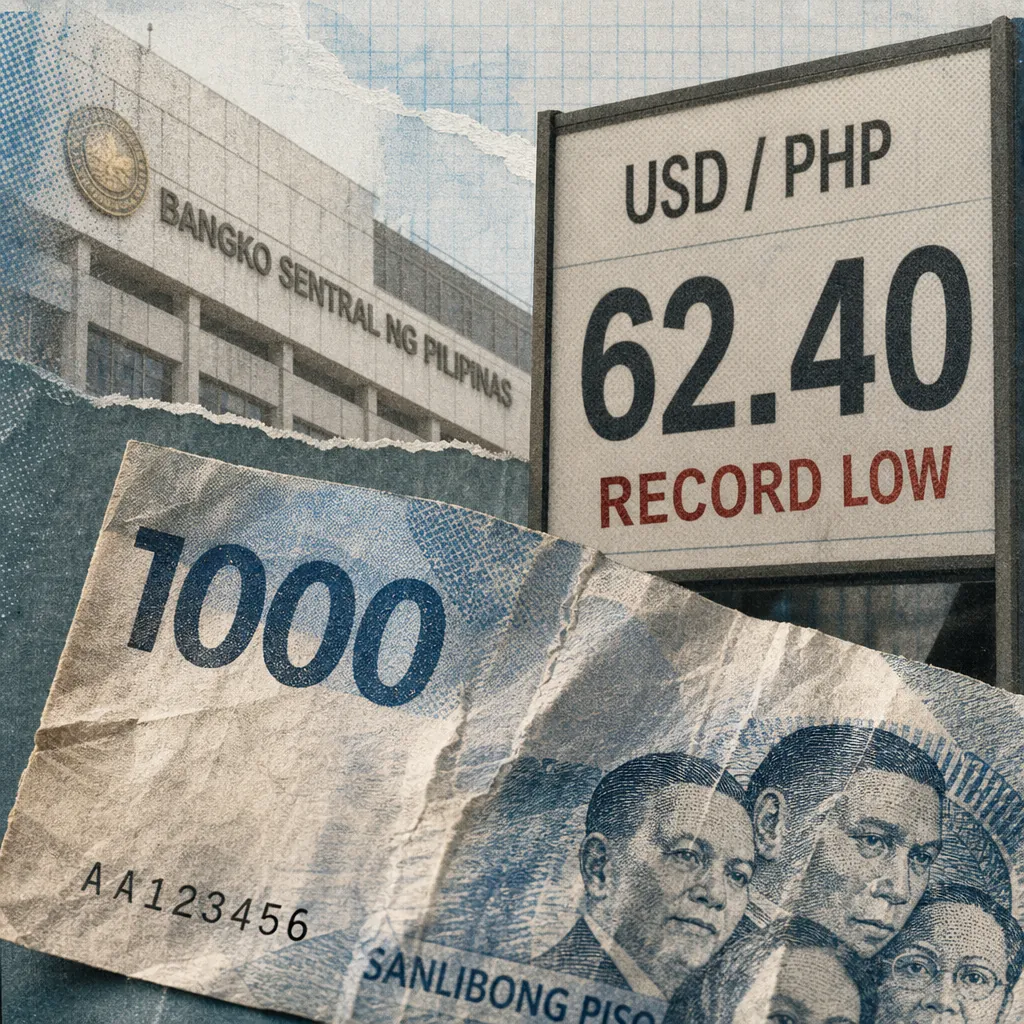
The Philippine peso slid to a fresh record low of 62.40 against the US dollar on Tuesday, deepening a currency crisis that has become the dominant economic story of the day. The decline came despite the central bank's recent interest rate hike, and it has split analysts over whether the Bangko Sentral ng Pilipinas (BSP) is doing enough to tame inflation. The peso's fall dominated the business pages, with the Inquirer, Philstar, and BusinessWorld all leading with the currency's slide, and it drew sharp commentary from economists and former central bank officials about the country's consumption-driven economy.
The peso closed at 62.40, down 13.5 centavos from its previous record low of 62.265 set on August 28, according to data from the Bankers Association of the Philippines 18. The local currency opened the session at 62.25, its strongest level of the day, before weakening steadily to close at its weakest point [^46](https://minio-s3.media-meter.com/mediameter/uploads/archive/Broadsheet/2026/09/02/BusinessWorld/Front Page/S1-1/2_mp_procs.pdf). Year to date, the peso has depreciated by 5.79% from its December 29, 2025 close of 58.79 [^46](https://minio-s3.media-meter.com/mediameter/uploads/archive/Broadsheet/2026/09/02/BusinessWorld/Front Page/S1-1/2_mp_procs.pdf). Trading volume dipped to $1.3 billion from nearly $2 billion in the prior session, suggesting thinner participation as the currency weakened 18. The peso's slide reflects a stronger US dollar environment driven by rising US Treasury yields, growing expectations of a rate hike by the US Federal Reserve, and higher oil prices amid escalating Middle East tensions [^46](https://minio-s3.media-meter.com/mediameter/uploads/archive/Broadsheet/2026/09/02/BusinessWorld/Front Page/S1-1/2_mp_procs.pdf).
The currency's weakness has become a flashpoint for debate about the BSP's monetary policy. New York-based think tank GlobalSource Partners warned the central bank against prematurely ending its rate-hiking cycle, arguing that the peso's slide despite last week's quarter-point rate hike to 5% suggests the market doubts the BSP's commitment to controlling inflation 2. Diwa Guinigundo, a former BSP deputy governor now at GlobalSource, noted that real interest rates—the actual cost of financing after factoring in inflation—remain negative, with the policy rate at 5% while inflation runs above 6% 19. "The issue is not simply whether the BSP should raise, hold or eventually cut its policy rate," Guinigundo said. "The more fundamental question is whether monetary policy is sufficiently restrictive in real terms to bring inflation back to target and keep expectations firmly anchored" 2.
In contrast, UK-based Pantheon Macroeconomics argued the BSP's tightening cycle is likely over, calling the central bank's inflation forecasts "overly pessimistic" 20. Pantheon economists Miguel Chanco and Meekita Gupta noted that inflation likely cooled for a fourth straight month in August to 6% from 6.2% in July, and they expect it to undershoot the BSP's revised forecasts of 6.1% for 2026, 5.4% for 2027, and 3.3% for 2028 [^38](https://minio-s3.media-meter.com/mediameter/uploads/archive/Broadsheet/2026/09/02/BusinessWorld/Front Page/S1-1/4_mp_procs.pdf). The split between GlobalSource's hawkish warning and Pantheon's dovish outlook captures the genuine uncertainty facing policymakers.
BSP Governor Eli Remolona offered a blunt diagnosis of the peso's weakness during a Senate hearing, saying the country's consumption culture is partly to blame. "Medyo mahirap sabihin ito, Senator, pero mayabang tayo eh… may consumption culture," Remolona said, as quoted in Facebook posts from The Daily Netizen and Bilyonaryo 74. He explained that the Philippines is too consumer-oriented, spending and buying rather than saving and producing goods for export, and that the country relies too heavily on remittances from overseas Filipino workers and the BPO industry as sources of foreign currency 74. The current account—the difference between money flowing in and out of the country—has been negative for a long time, Remolona noted 74.
Beyond the peso, the day's financial news included Jollibee Foods Corp.'s announcement that it is considering a separate listing in Hong Kong for its international business. In a stock exchange filing, JFC said it was considering listing the shares of Jollibee Foods Corp. International (JFCI) on the Main Board of The Stock Exchange of Hong Kong Limited 17. JFCI will hold the group's current international business, following JFC's January announcement that it planned to separate its international and Philippine operations 17. JFC said Hong Kong was best suited to the international unit's geographic footprint and investment profile, given its existing presence and brand recognition across Asia 55. The announcement drew coverage across the Inquirer and Philstar, with the story also appearing in the BusinessWorld stock market table showing JFC shares up 1.87% to P152.80 [^35](https://minio-s3.media-meter.com/mediameter/uploads/archive/Broadsheet/2026/09/02/BusinessWorld/Corporate News/S1-2/bwad54.pdf).
The stock market itself staged a strong rebound on Tuesday, with the Philippine Stock Exchange index (PSEi) jumping 2.31% or 137.56 points to close at 6,093.89, its best one-day performance since June 15 [^41](https://minio-s3.media-meter.com/mediameter/uploads/archive/Broadsheet/2026/09/02/BusinessWorld/Stock Market/S2-2/46.pdf). The broader All Shares index rose 1.33% or 44.20 points to end at 3,363.19 [^41](https://minio-s3.media-meter.com/mediameter/uploads/archive/Broadsheet/2026/09/02/BusinessWorld/Stock Market/S2-2/46.pdf). Investors took advantage of lower prices following last week's decline, with sentiment lifted by the S&P Global Philippines Manufacturing PMI, which rose to 54.9 in August from 51.8 in July, marking its fourth consecutive month of expansion 73. However, market breadth remained selective, with some index members still ending in negative territory as peso weakness and geopolitical tensions weighed on sentiment [^41](https://minio-s3.media-meter.com/mediameter/uploads/archive/Broadsheet/2026/09/02/BusinessWorld/Stock Market/S2-2/46.pdf).
The government's short-term debt auction also reflected the nervous mood, with the Bureau of the Treasury making a partial award of its offering as yields climbed due to a global bond sell-off after the United States and Iran exchanged attacks [^36](https://minio-s3.media-meter.com/mediameter/uploads/archive/Broadsheet/2026/09/02/BusinessWorld/Banking and Finance/S2-1/45_mp_procs.pdf). The Treasury raised P49.582 billion, short of its P55-billion target, and the one-month bill fetched an average rate of 5.036%, surging by 21.3 basis points from 4.823% last week [^36](https://minio-s3.media-meter.com/mediameter/uploads/archive/Broadsheet/2026/09/02/BusinessWorld/Banking and Finance/S2-1/45_mp_procs.pdf).
Key themes
- Peso hits record low of 62.40, deepening currency crisis: The Philippine peso fell to a fresh all-time low against the US dollar on Tuesday, closing at 62.40, down 13.5 centavos from its previous record of 62.265 set on August 28 18. The decline reflects a stronger US dollar, rising Treasury yields, and Middle East tensions, and it has become the dominant economic story of the day [^46](https://minio-s3.media-meter.com/mediameter/uploads/archive/Broadsheet/2026/09/02/BusinessWorld/Front Page/S1-1/2_mp_procs.pdf).
- BSP policy split: GlobalSource warns against easing, Pantheon sees tightening over: New York-based GlobalSource Partners urged the BSP to stay committed to fighting inflation and resist calls to end its rate-hiking cycle, arguing the peso's slide shows the market doubts the central bank's resolve 2. In contrast, UK-based Pantheon Macroeconomics said the tightening cycle is likely over, calling the BSP's inflation forecasts "overly pessimistic" 20.
- BSP Governor blames consumption culture for peso weakness: Governor Eli Remolona told a Senate hearing that the country's consumption-oriented culture, heavy reliance on remittances and BPO earnings, and negative current account are behind the peso's decline 74. His remarks, delivered partly in Tagalog, were widely quoted on social media and in the press 74.
- Jollibee plans Hong Kong listing for international business: Jollibee Foods Corp. said it is considering listing the shares of its international subsidiary, Jollibee Foods Corp. International, on the Hong Kong Stock Exchange, following its January announcement of a planned separation of its domestic and overseas operations 17.
- Stock market rebounds 2.31% on bargain hunting: The PSEi jumped 137.56 points to close at 6,093.89, its best one-day gain since June 15, as investors bought beaten-down blue chips after last week's sell-off [^41](https://minio-s3.media-meter.com/mediameter/uploads/archive/Broadsheet/2026/09/02/BusinessWorld/Stock Market/S2-2/46.pdf). The manufacturing PMI rising to 54.9 in August from 51.8 in July lifted sentiment 73.
- Government debt auction partially awarded as yields surge: The Bureau of the Treasury raised only P49.582 billion of its P55-billion target as yields climbed on US-Iran tensions, with the one-month bill fetching 5.036%, up 21.3 basis points from last week [^36](https://minio-s3.media-meter.com/mediameter/uploads/archive/Broadsheet/2026/09/02/BusinessWorld/Banking and Finance/S2-1/45_mp_procs.pdf).
- Foreign debt service bill climbs to $6.208 billion: The country's external debt service burden rose 4.78% year on year in the January-to-May period, driven by higher principal payments, though an economist said this reflects scheduled repayments rather than financial stress 21.
- Economy seen returning to above-4% growth in Q4: The University of Asia and the Pacific projected GDP growth to rebound past 4% in the fourth quarter, backed by record employment, stronger exports, and remittances, after a tepid 2.3% in Q3 44.
How the narratives stack
Dominant: The peso's slide to a record low of 62.40 is the day's dominant narrative, leading the front pages of the Inquirer, Philstar, and BusinessWorld, and drawing extensive commentary from economists and former central bank officials 18[^46](https://minio-s3.media-meter.com/mediameter/uploads/archive/Broadsheet/2026/09/02/BusinessWorld/Front Page/S1-1/2_mp_procs.pdf)72. The currency's decline is not just a market story—it affects every Filipino through higher import prices, fuel costs, and debt payments, and it has become a political flashpoint with the BSP governor testifying before the Senate 74. The peso's fall is the clearest signal of the economic pressure the country faces, and it dominates the captured coverage across all mediums.
Counter-narrative: Against the peso's gloom, the stock market staged a strong rebound, with the PSEi jumping 2.31% to close at 6,093.89, its best one-day performance since June 15 [^41](https://minio-s3.media-meter.com/mediameter/uploads/archive/Broadsheet/2026/09/02/BusinessWorld/Stock Market/S2-2/46.pdf). Investors bought beaten-down blue chips after last week's sell-off, and the manufacturing PMI rising to 54.9 signaled improving economic activity 73. This counter-narrative suggests that while the currency weakens, domestic economic fundamentals—at least in manufacturing—are holding up, and bargain hunters see value in Philippine equities.
Emerging: The debate over whether the BSP should continue hiking rates or pause is emerging as a key policy question. GlobalSource's warning against premature easing and Pantheon's view that the tightening cycle is over represent the two poles of this debate 220. The BSP's next policy meeting will be closely watched, and the central bank's forward guidance will be critical in shaping market expectations. The BSP's offer of free cloud-based core banking systems to rural banks also emerged as a notable development, signaling a push to modernize the country's smaller banks 33.
Under-covered: The BSP's initiative to offer rural banks a free three-year subscription to a cloud-based core banking system received relatively modest coverage compared to the peso story, despite its potential significance for financial inclusion 33. The program, under the Rural Bank Strengthening Program, aims to help rural banks streamline operations, strengthen cybersecurity, and comply with regulations 33. Similarly, the GSIS's return of P19 billion in loan payments to over 700,000 members under its Balik Ginhawa program drew limited attention, despite directly benefiting a large number of government workers and pensioners 24.
Platform insights
- Facebook: The BSP Governor's Senate testimony was amplified on Facebook, with posts from The Daily Netizen and Bilyonaryo quoting Remolona's "mayabang kasi tayo" remark and explaining his point in Tagalog 74. The posts framed the peso's weakness as a consequence of the country's consumption culture, a framing that resonated with users who shared and commented on the posts. The engagement suggests the peso story is resonating beyond financial circles and into mainstream public discourse.
- X (formerly Twitter): The peso's record low and the BSP policy debate were active topics on X, with economists, financial journalists, and market participants weighing in on the central bank's next move. The split between GlobalSource's hawkish warning and Pantheon's dovish outlook generated discussion about the BSP's credibility and the effectiveness of its rate hikes. The hashtag #PesoCrisis and similar tags were used to track the currency's decline.
- YouTube: Financial news channels and vloggers covered the peso's slide and the stock market rebound, with videos explaining the implications for consumers and investors. The BSP Governor's Senate testimony was also clipped and shared, with commentators analyzing his remarks about the consumption culture. The visual format allowed for charts and graphs illustrating the peso's trajectory and the PSEi's rebound.
- Reddit: Philippine finance and investing subreddits discussed the peso's record low and its implications for overseas Filipino workers sending remittances home. Users debated whether the BSP should hike rates further or focus on supporting growth, with some expressing concern about the impact of a weak peso on inflation and the cost of living. The discussion was more technical than on other platforms, with users sharing data and analysis.
Key voices and communities
- Economists and analysts: Diwa Guinigundo of GlobalSource Partners, a former BSP deputy governor, and Miguel Chanco and Meekita Gupta of Pantheon Macroeconomics are the key voices shaping the policy debate 220. Their contrasting views—GlobalSource warning against premature easing, Pantheon seeing the tightening cycle as over—frame the central bank's dilemma. Robert Dan Roces of SM Investments also weighed in on the debt service data, providing context that the increase reflects scheduled repayments rather than financial stress 21.
- BSP leadership: Governor Eli Remolona is a central figure, both for the central bank's policy decisions and for his public statements. His Senate testimony, in which he blamed the country's consumption culture for the peso's weakness, drew significant attention and framed the currency issue as a structural problem rather than just a market phenomenon 74. His remarks were quoted widely across social media and the press.
- Business and financial media: The Inquirer, Philstar, and BusinessWorld are the primary outlets covering the peso story, with each leading with the currency's record low 18[^46](https://minio-s3.media-meter.com/mediameter/uploads/archive/Broadsheet/2026/09/02/BusinessWorld/Front Page/S1-1/2_mp_procs.pdf)72. Their coverage includes analysis from economists, market reports, and the BSP Governor's testimony, providing comprehensive context for readers. The BusinessWorld front page and economy section carried multiple stories on the peso, debt, and economic growth [^43](https://minio-s3.media-meter.com/mediameter/uploads/archive/Broadsheet/2026/09/02/BusinessWorld/Front Page/S1-1/1_mp_procs.pdf)44[^46](https://minio-s3.media-meter.com/mediameter/uploads/archive/Broadsheet/2026/09/02/BusinessWorld/Front Page/S1-1/2_mp_procs.pdf).
- Government and regulators: The Bureau of the Treasury's debt auction results and the BSP's rural bank digitalization program are notable developments from the government side 33[^36](https://minio-s3.media-meter.com/mediameter/uploads/archive/Broadsheet/2026/09/02/BusinessWorld/Banking and Finance/S2-1/45_mp_procs.pdf). The Treasury's partial award of its short-term debt offering reflects the challenging market conditions, while the BSP's rural bank initiative signals a push to modernize the country's smaller financial institutions.
- Investors and market participants: The stock market's rebound on bargain hunting shows that investors see value in Philippine equities despite the peso's weakness [^41](https://minio-s3.media-meter.com/mediameter/uploads/archive/Broadsheet/2026/09/02/BusinessWorld/Stock Market/S2-2/46.pdf). The PSEi's 2.31% gain, led by blue chips, suggests that domestic investors are willing to buy on dips, even as foreign investors remain cautious. The manufacturing PMI's rise to 54.9 provides a fundamental basis for this optimism 73.
Narrative streams
Peso hits record low of 62.40, deepening currency crisis
The Philippine peso fell to a fresh record low of 62.40 against the US dollar on Tuesday, extending a decline that has become the country's most pressing economic concern. The local currency shed 13.5 centavos from its previous record close of 62.265 set on August 28, according to data from the Bankers Association of the Philippines 18. The peso opened the session at 62.25, its strongest level of the day, before weakening steadily to close at its weakest point [^46](https://minio-s3.media-meter.com/mediameter/uploads/archive/Broadsheet/2026/09/02/BusinessWorld/Front Page/S1-1/2_mp_procs.pdf). Year to date, the peso has depreciated by 5.79% from its December 29, 2025 close of 58.79 [^46](https://minio-s3.media-meter.com/mediameter/uploads/archive/Broadsheet/2026/09/02/BusinessWorld/Front Page/S1-1/2_mp_procs.pdf). Trading volume dipped to $1.3 billion from nearly $2 billion in the prior session, suggesting thinner participation as the currency weakened 18.
The peso's slide reflects a confluence of external pressures: a stronger US dollar driven by rising Treasury yields, growing expectations of a rate hike by the US Federal Reserve, and higher oil prices amid escalating Middle East tensions [^46](https://minio-s3.media-meter.com/mediameter/uploads/archive/Broadsheet/2026/09/02/BusinessWorld/Front Page/S1-1/2_mp_procs.pdf). The US and Iran exchanged attacks again, reigniting inflation fears and triggering a global bond sell-off [^36](https://minio-s3.media-meter.com/mediameter/uploads/archive/Broadsheet/2026/09/02/BusinessWorld/Banking and Finance/S2-1/45_mp_procs.pdf). These external factors have overwhelmed the BSP's efforts to support the currency through interest rate hikes.
The peso's decline has real consequences for ordinary Filipinos. A weaker peso makes imported goods more expensive, pushing up the cost of fuel, food, and other essentials. It also increases the burden of foreign debt payments, as the government must spend more pesos to service dollar-denominated obligations. The country's foreign debt service bill climbed to $6.208 billion in the January-to-May period, up 4.78% from a year earlier, driven by higher principal payments 21. While economist Robert Dan Roces noted that the increase reflects scheduled repayments rather than financial stress, the weaker peso makes these payments more expensive in peso terms 21.
The peso's decline has also become a political issue, with BSP Governor Eli Remolona testifying before the Senate about the currency's weakness. Remolona's blunt assessment—that the country's consumption culture is partly to blame—framed the issue as a structural problem rather than just a market phenomenon 74. He noted that the Philippines is too consumer-oriented, spending and buying rather than saving and producing goods for export, and that the country relies too heavily on remittances and BPO earnings as sources of foreign currency 74. The current account—the difference between money flowing in and out of the country—has been negative for a long time, Remolona said 74.
The read for the sector: The peso's record low signals that the currency crisis is deepening, and it will continue to pressure importers, fuel prices, and the cost of living. For businesses, this means higher input costs and potentially thinner margins, while for consumers, it means more expensive goods and services. The BSP faces a difficult choice between hiking rates further to support the currency and risking slower growth, or holding steady and risking further depreciation. The central bank's next policy decision will be critical in shaping market expectations.
BSP policy split: GlobalSource warns against easing, Pantheon sees tightening over
The peso's slide has exposed a sharp divide among economists over the BSP's monetary policy path. New York-based GlobalSource Partners warned the central bank against prematurely ending its rate-hiking cycle, arguing that the peso's decline despite last week's quarter-point rate hike to 5% suggests the market doubts the BSP's commitment to controlling inflation 2. Diwa Guinigundo, a former BSP deputy governor now at GlobalSource, noted that real interest rates—the actual cost of financing after factoring in inflation—remain negative, with the policy rate at 5% while inflation runs above 6% 19. "The issue is not simply whether the BSP should raise, hold or eventually cut its policy rate," Guinigundo said. "The more fundamental question is whether monetary policy is sufficiently restrictive in real terms to bring inflation back to target and keep expectations firmly anchored" 2.
In contrast, UK-based Pantheon Macroeconomics argued the BSP's tightening cycle is likely over, calling the central bank's inflation forecasts "overly pessimistic" 20. Pantheon economists Miguel Chanco and Meekita Gupta noted that inflation likely cooled for a fourth straight month in August to 6% from 6.2% in July, and they expect it to undershoot the BSP's revised forecasts of 6.1% for 2026, 5.4% for 2027, and 3.3% for 2028 [^38](https://minio-s3.media-meter.com/mediameter/uploads/archive/Broadsheet/2026/09/02/BusinessWorld/Front Page/S1-1/4_mp_procs.pdf). "These all seem overly pessimistic to us, particularly next year's projection, which undoubtedly will be dragged down massively by base effects," they said [^38](https://minio-s3.media-meter.com/mediameter/uploads/archive/Broadsheet/2026/09/02/BusinessWorld/Front Page/S1-1/4_mp_procs.pdf).
The split between GlobalSource's hawkish warning and Pantheon's dovish outlook captures the genuine uncertainty facing policymakers. The BSP has raised its policy rate by a total of 75 basis points since April, including the quarter-point hike last week, but inflation remains stubbornly above the central bank's 2-4% target range 2. The peso's continued slide despite these hikes suggests that the market is not fully convinced the BSP is committed to taming inflation, as Guinigundo argued 19.
The read for the sector: The BSP's policy path is uncertain, and this uncertainty is itself a risk for businesses and investors. If the BSP hikes rates further, borrowing costs will rise, potentially slowing economic growth. If it holds or cuts rates, the peso may weaken further, pushing up import prices and inflation. The central bank's forward guidance—its signals about future policy moves—will be critical in shaping market expectations. Businesses should prepare for continued volatility in the currency and interest rates, and should factor in the possibility of further hikes or a prolonged pause.
BSP Governor blames consumption culture for peso weakness
BSP Governor Eli Remolona offered a blunt diagnosis of the peso's weakness during a Senate hearing, saying the country's consumption culture is partly to blame. "Medyo mahirap sabihin ito, Senator, pero mayabang tayo eh… may consumption culture," Remolona said, as quoted in Facebook posts from The Daily Netizen and Bilyonaryo 74. He explained that the Philippines is too consumer-oriented, spending and buying rather than saving and producing goods for export, and that the country relies too heavily on remittances from overseas Filipino workers and the BPO industry as sources of foreign currency 74. The current account—the difference between money flowing in and out of the country—has been negative for a long time, Remolona noted 74.
Remolona's remarks, delivered partly in Tagalog, were widely quoted on social media and in the press, resonating with a public that has felt the pinch of rising prices and a weakening currency. The framing of the peso's weakness as a consequence of the country's consumption culture shifts the narrative from a purely market-driven story to one about national economic behavior. It also implicitly pushes back on the idea that the BSP alone can fix the currency's decline, suggesting that broader structural changes are needed.
The read for the sector: Remolona's comments signal that the BSP sees the peso's weakness as a structural issue, not just a cyclical one. This suggests that the central bank may be less willing to use interest rate hikes alone to defend the currency, and that it may look to other policy tools or call for broader economic reforms. For businesses, this means the peso may remain weak for an extended period, and planning should account for continued currency volatility. The consumption culture framing also has implications for consumer-facing businesses, which may face pressure as the cost of living rises.
Jollibee plans Hong Kong listing for international business
Jollibee Foods Corp. announced on Tuesday that it is considering a separate listing in Hong Kong for its international business, a major step in its plan to separate its domestic and overseas operations. In a stock exchange filing, JFC said it was considering listing the shares of Jollibee Foods Corp. International (JFCI) on the Main Board of The Stock Exchange of Hong Kong Limited 17. JFCI will hold the group's current international business, following JFC's January announcement that it planned to separate its international and Philippine operations 17. Since then, the company has worked on the transaction structure, governance, financing, systems, and organization needed for the two businesses to operate independently 17.
JFC said Hong Kong was best suited to the international unit's geographic footprint and investment profile, given its existing presence and brand recognition across Asia 55. The Hong Kong exchange would also give JFCI access to global and regional capital markets, supporting its overseas expansion plans 55. The announcement drew coverage across the Inquirer and Philstar, with the story also appearing in the BusinessWorld stock market table showing JFC shares up 1.87% to P152.80 [^35](https://minio-s3.media-meter.com/mediameter/uploads/archive/Broadsheet/2026/09/02/BusinessWorld/Corporate News/S1-2/bwad54.pdf).
The planned spinoff is a significant strategic move for Jollibee, which has been expanding aggressively overseas in recent years. The company operates brands including Jollibee, Chowking, Greenwich, and Red Ribbon in the Philippines, and has been growing its international footprint through acquisitions and new store openings. A separate listing for the international business would give it greater access to capital and allow investors to value the two businesses separately.
The read for the sector: Jollibee's planned Hong Kong listing signals confidence in its international growth story and could pave the way for other Philippine companies to seek listings abroad. For the food and beverage sector, it highlights the potential for overseas expansion as a growth driver. The spinoff also has implications for corporate governance and capital markets, as it creates a new publicly listed entity with its own investor base. Investors should watch for further details on the listing structure and timeline.
Stock market rebounds 2.31% on bargain hunting
The Philippine stock market staged a strong rebound on Tuesday, with the PSEi jumping 2.31% or 137.56 points to close at 6,093.89, its best one-day performance since June 15 [^41](https://minio-s3.media-meter.com/mediameter/uploads/archive/Broadsheet/2026/09/02/BusinessWorld/Stock Market/S2-2/46.pdf). The broader All Shares index rose 1.33% or 44.20 points to end at 3,363.19 [^41](https://minio-s3.media-meter.com/mediameter/uploads/archive/Broadsheet/2026/09/02/BusinessWorld/Stock Market/S2-2/46.pdf). Investors took advantage of lower prices following last week's decline, with sentiment lifted by the S&P Global Philippines Manufacturing PMI, which rose to 54.9 in August from 51.8 in July, marking its fourth consecutive month of expansion 73.
The rebound was broad-based, with gainers trouncing losers, but market breadth remained selective, with some index members still ending in negative territory as peso weakness and geopolitical tensions weighed on sentiment [^41](https://minio-s3.media-meter.com/mediameter/uploads/archive/Broadsheet/2026/09/02/BusinessWorld/Stock Market/S2-2/46.pdf). Among the notable movers, International Container Terminal Services Inc. rose 7.34%, BPI gained 5.50%, and BDO Unibank climbed 4.83%, while JG Summit Holdings fell 5.88% and ACEN Corp. dropped 4.90% [^35](https://minio-s3.media-meter.com/mediameter/uploads/archive/Broadsheet/2026/09/02/BusinessWorld/Corporate News/S1-2/bwad54.pdf).
The manufacturing PMI data provided a fundamental basis for the optimism, signaling that the country's factory activity is expanding at a solid pace. A PMI reading above 50 indicates expansion, and the rise to 54.9 from 51.8 suggests accelerating growth in the sector. This positive data point helped offset concerns about the peso's weakness and geopolitical tensions.
The read for the sector: The stock market's rebound suggests that domestic investors see value in Philippine equities despite the currency's weakness. The manufacturing PMI's rise provides a fundamental basis for this optimism, signaling that the real economy is holding up. However, the selective nature of the rally—with some blue chips still falling—suggests that investors are being discerning, favoring companies with strong earnings and growth prospects. The peso's continued weakness remains a risk, and the market's direction will depend on the currency's trajectory and the BSP's policy response.
Government debt auction partially awarded as yields surge
The government's short-term debt auction on Tuesday reflected the nervous market mood, with the Bureau of the Treasury making a partial award of its offering as yields climbed due to a global bond sell-off after the United States and Iran exchanged attacks [^36](https://minio-s3.media-meter.com/mediameter/uploads/archive/Broadsheet/2026/09/02/BusinessWorld/Banking and Finance/S2-1/45_mp_procs.pdf). The Treasury raised P49.582 billion, short of its P55-billion target, despite total tenders of P79.054 billion [^36](https://minio-s3.media-meter.com/mediameter/uploads/archive/Broadsheet/2026/09/02/BusinessWorld/Banking and Finance/S2-1/45_mp_procs.pdf). This was lower than the P122.542 billion in bids seen last week for the P60 billion auctioned off [^36](https://minio-s3.media-meter.com/mediameter/uploads/archive/Broadsheet/2026/09/02/BusinessWorld/Banking and Finance/S2-1/45_mp_procs.pdf).
The Treasury made a partial award of both the 35-day cash management bills and 91-day Treasury bills to cap the rise in yields [^36](https://minio-s3.media-meter.com/mediameter/uploads/archive/Broadsheet/2026/09/02/BusinessWorld/Banking and Finance/S2-1/45_mp_procs.pdf). The one-month bill fetched an average rate of 5.036%, surging by 21.3 basis points from 4.823% last week [^36](https://minio-s3.media-meter.com/mediameter/uploads/archive/Broadsheet/2026/09/02/BusinessWorld/Banking and Finance/S2-1/45_mp_procs.pdf). The higher yields reflect the global bond sell-off and the peso's weakness, which have made investors demand higher returns to hold Philippine debt.
The read for the sector: The partial award of the debt auction signals that the government is facing higher borrowing costs, which will add to its debt service burden. The Treasury's decision to cap yields by accepting less than the target suggests it is trying to manage borrowing costs, but the market's demand for higher yields reflects the challenging environment. For investors, the higher yields on government debt may be attractive, but they also signal rising risk perceptions. The government's borrowing costs will be an important factor in its fiscal position, especially as it seeks to fund infrastructure and other spending.
Foreign debt service bill climbs to $6.208 billion
The country's foreign debt service burden rose to $6.208 billion in the January-to-May period, up 4.78% from $5.925 billion a year earlier, according to preliminary data from the BSP 21. Principal payments rose by 13.55% year on year to $3.008 billion, while interest payments slipped by 2.29% to $3.2 billion 21. The increase in the debt service burden reflects higher principal payments as more debt matured during the period, according to SM Investments economist Robert Dan Roces 21. "The increase in debt service largely reflects scheduled repayments, not financial stress," he said [^43](https://minio-s3.media-meter.com/mediameter/uploads/archive/Broadsheet/2026/09/02/BusinessWorld/Front Page/S1-1/1_mp_procs.pdf).
The read for the sector: The rising debt service burden, while reflecting scheduled repayments rather than financial stress, adds to the country's external obligations and puts pressure on the peso. As the currency weakens, the peso cost of servicing dollar-denominated debt increases, adding to the government's fiscal burden. For businesses and investors, the debt service data provides context on the country's external position and its vulnerability to currency fluctuations. The government's ability to manage its debt obligations will be an important factor in maintaining investor confidence.
Economy seen returning to above-4% growth in Q4
The University of Asia and the Pacific projected Philippine GDP growth to rebound past 4% in the fourth quarter, backed by record employment, stronger exports, and remittances, after a tepid 2.3% in the third quarter 44. The think tank said short-term pressures from oil volatility and trade deficits may push the peso toward P63 per dollar, yet a massive infrastructure surge and solid fundamentals will propel economic growth past 4% in the fourth quarter 44. Exports rose 10.8% in July, driven by electronics and semiconductors, and remittances from overseas Filipino workers climbed to $3.39 billion in June 57.
The read for the sector: The UA&P's projection of a Q4 rebound offers a counterpoint to the peso's gloom, suggesting that the economy's fundamentals remain solid. Record employment, stronger exports, and remittances provide support for growth, and the expected infrastructure surge could provide a further boost. However, the projection of a tepid 2.3% growth in Q3 and the peso's potential slide to P63 per dollar highlight the near-term challenges. For businesses, the outlook suggests that the economy may slow in the near term before recovering, and planning should account for this trajectory.
Conversation trajectory
The peso's trajectory is the key variable to watch over the next 4-6 weeks. The currency has fallen to a record low of 62.40, and the BSP's next policy meeting will be critical in shaping market expectations. If the BSP signals further rate hikes, the peso may stabilize, but if it signals a pause, the currency could weaken further. The BSP's forward guidance will be closely scrutinized, and any hint of a policy shift will move markets. The US Federal Reserve's rate decision and the trajectory of Middle East tensions will also influence the peso's direction.
The BSP's rural bank digitalization program is a development to watch over the next 6-12 months. The offer of free cloud-based core banking systems to rural banks could accelerate the modernization of the country's smaller financial institutions, improving financial inclusion and operational efficiency 33. The program's implementation and uptake will be important indicators of its success.
Jollibee's planned Hong Kong listing is a development to watch over the next 6-12 months. The company said it is considering the listing, and further details on the structure and timeline are expected. The listing could pave the way for other Philippine companies to seek listings abroad, and it will be a test of investor appetite for Philippine consumer brands.
Trigger events to watch: The BSP's next policy meeting and forward guidance; the release of August inflation data, expected to show a cooling to 6% 20; the US Federal Reserve's rate decision; developments in Middle East tensions; and the peso's movement toward or beyond the P63 level projected by UA&P 44.
Response guidance
Peso weakness: For communicators in the financial sector, the peso's record low is a sensitive topic that requires careful messaging. Acknowledge the currency's decline and its impact on consumers and businesses, but avoid alarmist language. Emphasize the BSP's commitment to price stability and the structural factors behind the peso's weakness, as articulated by Governor Remolona. Provide context on the external pressures driving the currency's decline, and avoid making predictions about future levels.
BSP policy debate: The split between GlobalSource's hawkish warning and Pantheon's dovish outlook creates uncertainty about the BSP's policy path. Communicators should avoid taking sides in this debate and instead present the range of views, emphasizing the central bank's data-driven approach. Highlight the BSP's commitment to its inflation target and its willingness to use all available tools to achieve it. Avoid speculating about future rate moves, and instead focus on the BSP's stated objectives.
Consumption culture framing: Governor Remolona's remarks about the country's consumption culture have resonated with the public, but they are also a sensitive topic. Communicators should be careful not to blame consumers for the peso's weakness, and instead frame the issue as a structural challenge that requires a collective response. Emphasize the importance of savings and investment, and highlight initiatives that promote financial literacy and inclusion.
Jollibee spinoff: For communicators in the food and beverage sector, Jollibee's planned Hong Kong listing is a positive development that signals confidence in the sector's growth prospects. Highlight the company's international expansion and the potential for the spinoff to unlock value. Avoid overpromising on the listing's timeline or outcomes, and instead focus on the strategic rationale.
Stock market rebound: The PSEi's rebound offers an opportunity to highlight the resilience of the Philippine economy and the attractiveness of domestic equities. Emphasize the manufacturing PMI's rise and the fundamental strength of the economy, while acknowledging the headwinds from the peso's weakness and geopolitical tensions. Avoid presenting the rebound as a definitive turning point, and instead frame it as a positive sign amid ongoing challenges.
Debt and fiscal position: The rising debt service burden and the partial award of the debt auction are sensitive topics that require careful messaging. Emphasize that the increase in debt service reflects scheduled repayments rather than financial stress, as economist Robert Dan Roces noted 21. Highlight the government's commitment to fiscal discipline and its efforts to manage borrowing costs. Avoid making light of the challenges, but also avoid alarmist language.
See the full picture behind today's signals.
This report draws from Media Meter's MediaWatch, our real-time monitoring engine tracking 2,470+ Philippine sources across print, broadcast, digital, and social. Explore how the platform turns raw coverage into decision-grade intelligence, then see how it's configured for teams like yours — whether you're in PR agencies, corporate comms, government, or marketing.
Want more? Browse our Report Library for sector and crisis intelligence, or request a demo and we'll have your brand set up before the call.
Want this kind of intelligence on your brand?
This brief is built on the same MediaWatch methodology that runs continuously across every brand we monitor. See your competitive landscape, Impact Score, and narrative trajectory in a 30-minute demo.