Habagat Halts Work and Classes Across 14 Areas
Malacañang suspended face-to-face classes and ordered work-from-home arrangements across Metro Manila and 13 provinces as the southwest monsoon brought up to 100 millimeters of rain, while Manila's leptospirosis cases passed 1,000 and coastal erosion warnings resurfaced in Zambales.
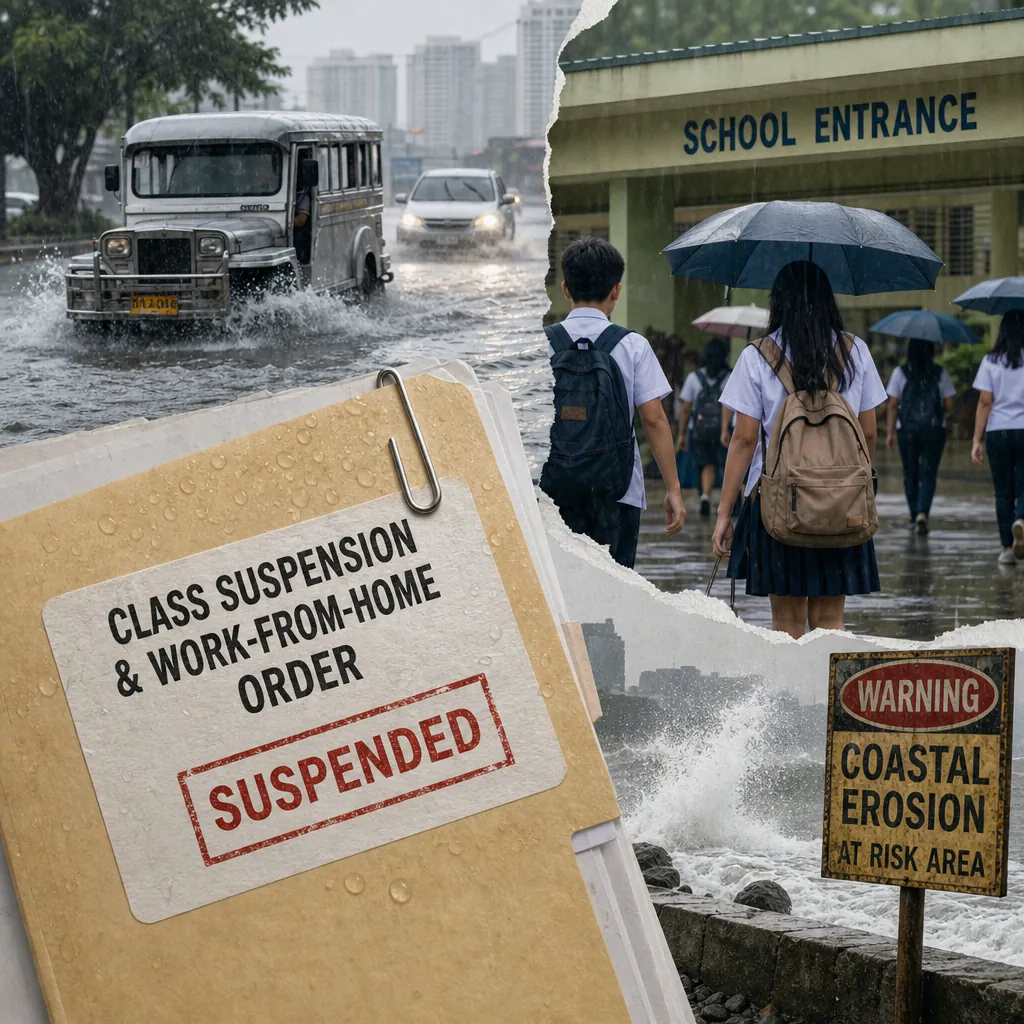
Malacañang suspended face-to-face classes at all levels and ordered work-from-home arrangements in government offices across Metro Manila and 13 provinces for Thursday, September 10, as the southwest monsoon — the seasonal wind system Filipinos call habagat — continued to dump rain on Luzon and the Visayas.40 The order, Memorandum Circular No. 135, was signed by Executive Secretary Ralph Recto and released early Thursday morning, following a recommendation from the National Disaster Risk Reduction and Management Council, the inter-agency body that coordinates the government's disaster preparation and response.663 The covered areas were the National Capital Region, La Union, Pangasinan, Benguet, Bataan, Bulacan, Pampanga, Zambales, Batangas, Cavite, Laguna, Rizal, Occidental Mindoro, and Oriental Mindoro.40 Agencies delivering basic and health services, disaster response, and other essential functions stayed open.63 Contract-of-service and job-order workers placed on alternative arrangements were assured they would still be paid their daily wage.84
The weather itself was the day's most widely carried story. The Philippine Atmospheric, Geophysical and Astronomical Services Administration (Pagasa), the government's weather bureau, raised a yellow rainfall warning over parts of Zambales and Bataan at 5 a.m. and again at 8 a.m.451 A yellow warning means "be alert": rainfall of 7.5 to 15 millimeters per hour is expected and may continue for the next two hours, with flooding possible in low-lying areas.1 In its 4 a.m. bulletin, Pagasa said Zambales would see monsoon rains while Metro Manila, the rest of Central Luzon, Pangasinan, La Union, Benguet, Isabela, Nueva Vizcaya, Quirino, Rizal, Cavite, Batangas, Oriental Mindoro, and Occidental Mindoro would get occasional rains; the Visayas, the rest of Luzon, the Zamboanga Peninsula, and Northern Mindanao would see cloudy skies with scattered rain.54 The agency's heavy rainfall outlook projected up to 100 millimeters of rain over affected areas on Thursday, warning of flooding in urbanized, low-lying, or riverside communities and landslides in highly susceptible terrain.38 As of 2 a.m. Thursday, no low-pressure area was being monitored for tropical cyclone formation — the rain came from the monsoon alone, not a storm.54
The suspension rippled outward into daily life. Radio and television bulletins carried the announcement through the morning, with DZMM and DZMM Teleradyo telling listeners that teachers were to do no work at all so they could rest. The story reached audiences through AM radio, cable television, and online news simultaneously — a distribution pattern that reflects how weather advisories travel in the Philippines, where broadcast remains the fastest way to reach people who may lose power or internet.
Key themes
- Fourteen areas shift to remote work and learning for one day. Memorandum Circular No. 135 covered Metro Manila and 13 provinces, with essential government services exempted and contract workers guaranteed pay.4084
- Pagasa raised yellow rainfall warnings over Zambales and Bataan twice in one morning. The 5 a.m. and 8 a.m. advisories covered Olongapo, Subic, San Marcelino, Castillejos, San Antonio, San Felipe, San Narciso, Dinalupihan, Hermosa, and Morong, among others.451
- Up to 100 millimeters of rain was forecast for Thursday. Pagasa warned of flooding in urbanized and low-lying areas and landslides in susceptible terrain.38
- Manila's leptospirosis cases passed 1,000, with 39 deaths. The Manila Health Department reported 1,094 cases this year and said the city had already declared an epidemic level, adding hospital beds and distributing free doxycycline in barangays and markets.8
- Zambales renewed its warning against building on coastal accretion areas. Governor Hermogenes Edejer Ebdane Jr. said permanent structures remain prohibited on land formed by sand accumulation, a danger zone designated by the environment department and local governments in 2008.9
- A resort in San Felipe, Zambales, blamed large-scale sand dredging for coastal erosion. The resort said portions of its property had collapsed over two months and posted a video appealing for help.29
- Pangasinan stepped up river clearing to reduce flood risk. The provincial government reported clearing about 2.8 kilometers of the Parongking River, removing roughly 5,861.5 cubic meters of vegetation and 7,890 cubic meters of silt and debris.35
- A burst Maynilad pipe flooded parts of Bacoor, Cavite. Mayor Strike Revilla ordered an independent investigation and said the company's permit could be revoked if negligence is proven.83
How the narratives stack
Dominant: The suspension of face-to-face classes and government work dominated the day's coverage across every medium in this set — online news, AM radio, cable television, and broadsheets. The story was carried by at least eight distinct outlets in the items reviewed here, from the Philippine Daily Inquirer and Manila Bulletin to DZMM, DZRH, Bombo Radyo, and Abogado.4063846 The breadth reflects the story's reach: a single memorandum circular touched millions of students, parents, and government workers in the country's most densely populated region. The Inquirer's online report on the order carried an estimated advertising-equivalent value of ₱201,852, and the Manila Bulletin's version ₱125,312 — figures that estimate what it would have cost to buy the same space as paid advertising, not how many people read the articles.4063
Counter-narrative: The health consequences of prolonged flooding formed a second, quieter track. Manila's leptospirosis caseload reached 1,094 for the year with 39 deaths, and the Manila Health Department said the city had already declared an epidemic. The department's city health officer, Dr. Grace Padilla, reminded residents that the bacterial disease — spread through water or soil contaminated by rat urine — can be contracted not only by wading through floods but also from canned goods, tables, or household items touched by rodent urine.8 The department added hospital beds and sent teams to barangays and markets to distribute free doxycycline, an antibiotic used to prevent leptospirosis after exposure.8 This story ran mainly on radio and online news, and it did not draw the same volume of coverage as the work suspension, even though its consequences are more severe.
Emerging: Coastal erosion in Zambales surfaced through two separate items. The provincial government renewed its warning against permanent construction on accretion areas — land formed when sand accumulates along the shore — noting that private resorts had been built on these areas in the years since the environment department and five local governments posted permanent warnings in 2008.9 Separately, a resort in Barangay Liwliwa, San Felipe, said portions of its property had collapsed over two months, with a concrete seawall crumbling into the surf and palm trees toppling into the sea; it attributed the erosion to large-scale sand dredging and posted a video on social media appealing for help.29 The two accounts point in the same direction — a coastline under pressure from both natural wave action and human activity — but neither produced a government response on the day.
Under-covered: The burst Maynilad pipe that flooded parts of Bacoor, Cavite, on September 8 received limited attention in this set. Mayor Strike Revilla said he had ordered the city engineering office to conduct an independent investigation and warned that Maynilad's permit could be revoked if negligence was established.83 The incident — chest-deep flooding in the Southvale and St. Jude subdivisions in Molino — was reported by Manila Bulletin's Balita tabloid site but did not travel as widely as the weather advisories, despite raising a question that affects every household in the service area: who is accountable when water infrastructure fails during a monsoon.
Platform insights
- Facebook: The Zambales resort's video appeal about coastal erosion circulated on Facebook, where it asked residents, tourists, and environmental advocates to help protect what remains of Liwliwa's coastline.29 The Manila Health Department's leptospirosis advisory also ran on rmn.ph, a site whose articles carry Facebook comment threads, indicating the health message was designed for sharing on the platform.8 Facebook remains the primary social channel for community-level disaster and health information in the Philippines, particularly outside Metro Manila.
- X: No posts from X appeared in the items reviewed here. The day's conversation ran through Facebook, radio, and news websites rather than the text-based platform.
- Reddit: No Reddit activity appeared in the items reviewed here.
- YouTube: No YouTube activity appeared in the items reviewed here.
The absence of X, Reddit, and YouTube activity in this set is itself a finding about where this particular story lived: weather advisories and government orders travel through broadcast and Facebook in the Philippines, not through the discussion platforms that dominate technology and finance conversations.
Key voices and communities
Government weather and disaster agencies. Pagasa issued the rainfall warnings and the 4 a.m. bulletin that framed the day's planning.4554 The National Disaster Risk Reduction and Management Council recommended the work and class suspension, and the Office of the President issued the memorandum circular.40 These agencies set the terms of the day: what areas were covered, what warnings were in effect, and what the public should expect.
Local government units. The Manila Health Department drove the leptospirosis response, with Dr. Grace Padilla explaining transmission routes and the city distributing free doxycycline.8 The Zambales provincial government, through Governor Ebdane, renewed the coastal construction warning.9 The Pangasinan provincial government, under Governor Ramon "Mon-Mon" Guico III, reported river-clearing progress.35 Bacoor Mayor Strike Revilla ordered the Maynilad investigation.83 Local executives are the front line for both disaster response and the regulatory decisions that follow.
Broadcast media. DZMM, DZMM Teleradyo, DZRH, DZRH TV, Bombo Radyo, and Net 25 carried the suspension announcement and related advisories to audiences who may not have reliable internet access.84 In a country where AM radio remains a primary information source during storms, these outlets function as the public address system for government orders.
Residents and community organizations. The Liwliwa resort's video appeal represented a resident-led effort to draw attention to coastal erosion.29 The Manila Health Department's barangay and market visits put health workers in direct contact with residents at risk of leptospirosis.8 These are the people absorbing the day's disruptions and, in the resort's case, documenting damage that government warnings had anticipated.
Narrative streams
The monsoon forces a nationwide work and school shutdown
The southwest monsoon is a seasonal wind pattern that blows from the southwest across the Philippines from roughly June to October, carrying warm, moisture-laden air that produces prolonged rainfall. Unlike a typhoon, which has a defined center and a finite path, the monsoon can sustain rain over large areas for days, saturating ground and overwhelming drainage systems. That is what happened this week: by Thursday morning, Pagasa had raised a yellow rainfall warning over Zambales and Bataan, projecting up to 100 millimeters of rain and warning of flooding in urbanized, low-lying, or riverside communities and landslides in susceptible terrain.3845
The government's response was swift and broad. Memorandum Circular No. 135 covered Metro Manila and 13 provinces — an area that includes the country's largest concentration of government offices, schools, and businesses.40 The circular exempted agencies providing basic and health services, disaster preparedness and response, and other vital services, meaning hospitals, police, and disaster response teams remained on duty.63 Contract-of-service and job-order workers — a large share of the government workforce, employed on short-term contracts rather than permanent appointments — were assured of their daily pay even under alternative arrangements.84
The read for the sector: the suspension is a recurring cost of the Philippines' geography. Every day of suspended work and school represents lost productivity, disrupted learning, and income uncertainty for hourly and contract workers, even with the pay guarantee. For government agencies, the decision is a balancing act between safety and continuity, and the NDRRMC's recommendation process is the mechanism that makes it routine rather than ad hoc. The fact that the order was issued Wednesday evening for Thursday — giving families and offices a night to prepare — reflects lessons learned from past monsoon events, when late announcements left commuters stranded.
Manila's leptospirosis outbreak reaches 1,094 cases and 39 deaths
Leptospirosis is a bacterial infection spread through contact with water or soil contaminated by the urine of infected animals, most commonly rats. In the Philippines, cases spike during the rainy season, when flooding forces people to wade through water that may carry the bacteria. Symptoms include fever, headache, muscle pain, and in severe cases, kidney or liver damage. The disease is treatable with antibiotics, and doxycycline can be taken preventively after exposure.
Manila's caseload reached 1,094 for the year, with 39 deaths, according to the Manila Health Department. The city had already declared an epidemic level, a designation that triggers additional resources — in this case, more hospital beds and a wider distribution of free doxycycline. Dr. Grace Padilla, the city health officer, said the disease can also be contracted from canned goods, tables, or other household items contaminated by rat urine, and urged residents not to wait for symptoms to worsen before seeking care at the nearest health center.8 Six hospitals were receiving patients, with 15 requiring dialysis.
The read for the sector: leptospirosis is a preventable disease whose case count tracks directly with flooding. The 1,094 cases and 39 deaths represent a failure of drainage and waste management as much as a health system challenge. For city governments, the lesson is that flood control and public health are the same budget line — every flood that reaches a neighborhood creates exposure, and every rat population sustained by uncollected garbage increases the risk. The Manila Health Department's decision to send teams to barangays and markets is an attempt to meet residents where they are, but the underlying driver is environmental.
Zambales confronts coastal erosion from two directions
The Zambales coast has been losing sand. A resort in Barangay Liwliwa, San Felipe, said portions of its property had gradually collapsed over the previous two months, with erosion beginning in the first week of July. A concrete seawall that once stood several meters from the high-tide line was crumbling into the surf, and palm trees had toppled into the sea. The resort attributed the damage to large-scale sand dredging, saying that before the dredging, no tree had fallen despite typhoons.29 It posted a video on social media appealing to residents, tourists, and environmental advocates.29
Separately, the provincial government renewed its warning against permanent construction on accretion areas — land formed when sand accumulates along the shore. Governor Ebdane said the Department of Environment and Natural Resources, working with the local governments of San Antonio, San Narciso, San Felipe, Cabangan, and Botolan, had posted permanent warnings in these areas in 2008, designating them as danger zones where concrete structures are prohibited. Despite the warnings, private resorts were built on these areas in subsequent years.9
The read for the sector: Zambales is dealing with a slow-moving problem that the day's heavy rains made visible. Accretion areas are inherently unstable — they are, by definition, land that the sea created and can reclaim. Building on them is a gamble that the government warned against 18 years ago. For the province, the challenge is enforcement: the warnings exist, but construction continued. For resort owners and homeowners, the question is who bears the cost when the sea takes back what it built. The resort's video appeal suggests that at least some property owners see dredging, not natural erosion, as the cause — a claim that would require independent study to confirm.
Flood control failures surface in Bacoor and Pangasinan
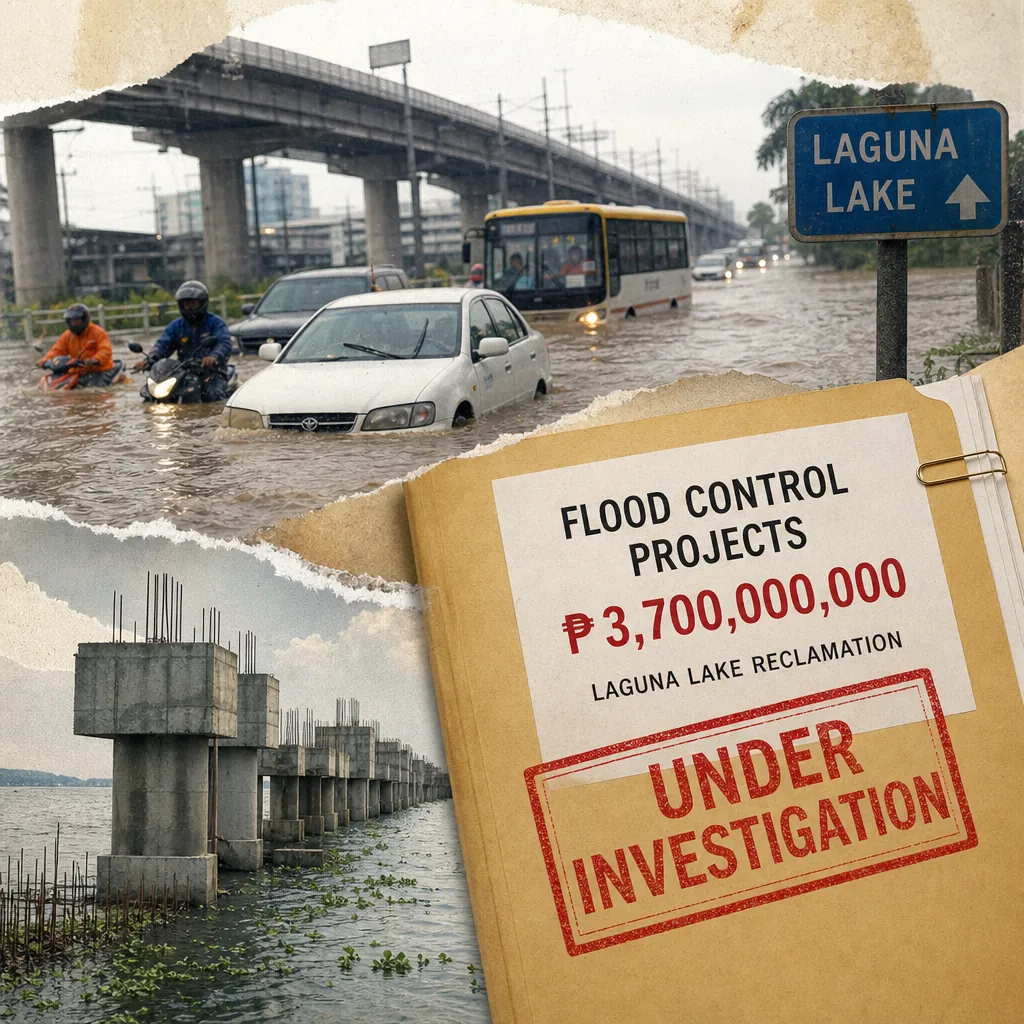
A burst Maynilad pipe flooded parts of Bacoor, Cavite, on September 8, sending chest-deep water into the Southvale and St. Jude subdivisions in Molino. Mayor Strike Revilla said he directed the city engineering office to conduct an independent investigation and warned that Maynilad's permit could be revoked if the investigation established negligence.83 Maynilad is one of the two private concessionaires that supply water to Metro Manila and surrounding provinces; its pipes run through Cavite, and a failure on its network can flood streets independently of the weather.
In Pangasinan, the provincial government under Governor Guico reported progress on river clearing, a low-technology flood mitigation measure that removes vegetation, silt, and debris from waterways to improve flow. The province had cleared about 2.8 kilometers of the Parongking River in Calasiao, removing roughly 5,861.5 cubic meters of vegetation and 7,890 cubic meters of silt and debris. Work continued on the Marusay River, where 740 meters of a 4.3-kilometer target had been cleared.35
The read for the sector: these two stories illustrate the range of flood-control work — from emergency response to infrastructure failure to routine maintenance. The Bacoor pipe burst is a reminder that flooding does not always come from the sky; aging water infrastructure is a separate risk that cities must manage. Pangasinan's river clearing is the unglamorous work that reduces flood risk over time, and its progress — measured in kilometers cleared and cubic meters removed — is the kind of metric that rarely makes headlines but determines whether the next monsoon causes a flood or a nuisance.
Conversation trajectory
Over the next 24 to 48 hours: The monsoon is expected to continue, and Pagasa's next rainfall advisories — issued at 5 a.m. and 8 a.m. daily, with updates as conditions change — will determine whether the work and class suspension extends beyond Thursday.451 Watch for the 4 a.m. and 11 a.m. bulletins on Friday, September 11. If rainfall exceeds 15 millimeters per hour over Zambales and Bataan, an orange warning — the next level up, indicating serious flooding — would trigger additional local government responses.
Over the next one to two weeks: Manila's leptospirosis caseload will continue to climb as long as flooding persists. The 1,094 cases reported this week represent the year to date; the city's declaration of an epidemic level means the health department will report updates as they come. Watch for whether the case count accelerates after this week's rains, and whether other cities in Metro Manila follow Manila's lead in declaring epidemics or distributing prophylactic doxycycline.
Over the next one to three months: The Zambales coastal erosion issue is likely to resurface. The provincial government's warning is a regulatory action, but the resort's video appeal has put a human face on the problem.299 Watch for whether the environment department or the provincial government conducts a new assessment of accretion areas, and whether any enforcement action follows against structures built after the 2008 warnings. The end of the monsoon season, typically in October or November, will provide a window for assessment before the next rainy season.
Trigger events: A tropical cyclone entering the Philippine area of responsibility would compound the monsoon's effects and likely force a wider suspension. The National Disaster Risk Reduction and Management Council's next recommendation on work and class suspensions will signal whether the government expects conditions to improve or worsen. And the Manila Health Department's next leptospirosis update will show whether the epidemic is slowing or accelerating.
Response guidance
For government communicators: Issue work and class suspension announcements as early as possible, ideally the evening before, so families and employers can plan. The Memorandum Circular No. 135 model — a single order covering multiple provinces, released with a clear list of exempted agencies — reduces confusion. Include a plain-language explanation of what "alternative work arrangements" means for contract and job-order workers, including the pay guarantee.84
For health communicators: Leptospirosis messaging should go beyond "avoid wading in floodwater," which is not always possible. The Manila Health Department's approach — explaining that the bacteria can also be contracted from household items contaminated by rat urine, and directing residents to free doxycycline at health centers — gives people actionable steps.8 Distribute this information through barangay health workers, radio, and Facebook, the channels that reach residents during floods.
For local government units in coastal areas: The Zambales case shows that warnings posted years ago do not enforce themselves. LGUs should review whether accretion areas in their jurisdictions have been built on since the 2008 designations, and whether current zoning and permitting practices prevent new construction.9 Where structures already exist, assess the risk and communicate it to owners.
For water utilities: The Bacoor pipe burst is a reminder that infrastructure failures during the monsoon can cause flooding independent of rainfall.83 Utilities should inspect aging pipes before the peak of the rainy season and communicate maintenance schedules to affected communities. When failures occur, a rapid public explanation of the cause and the response reduces the risk of the kind of permit-revocation threat that followed the Bacoor incident.
For broadcast media: Continue carrying Pagasa advisories and government orders in Filipino and local languages. The DZMM and DZRH bulletins that told listeners about the suspension reached audiences who may not have internet access. In a country where AM radio remains a primary information source during disasters, this function is essential.
For community organizations and resorts: The Liwliwa resort's video appeal shows that social media can draw attention to local environmental problems.29 Organizations documenting coastal erosion or other slow-onset hazards should collect dated photographs, video, and measurements to support their claims, and coordinate with local government and the environment department to request assessments.
See the full picture behind today's signals.
This report draws from Media Meter's MediaWatch, our real-time monitoring engine tracking 2,470+ Philippine sources across print, broadcast, digital, and social. Explore how the platform turns raw coverage into decision-grade intelligence, then see how it's configured for teams like yours — whether you're in PR agencies, corporate comms, government, or marketing.
Want more? Browse our Report Library for sector and crisis intelligence, or request a demo and we'll have your brand set up before the call.
Want this kind of intelligence on your brand?
This brief is built on the same MediaWatch methodology that runs continuously across every brand we monitor. See your competitive landscape, Impact Score, and narrative trajectory in a 30-minute demo.