Sara Duterte Trial Puts Bank Records in Spotlight
Senate testimony on P817.87 million in alleged undeclared assets and P319.33 million in China-linked remittances dominated the day, while a BDO cardholder's disputed charge and a Taguig e-wallet scam drew consumer attention.
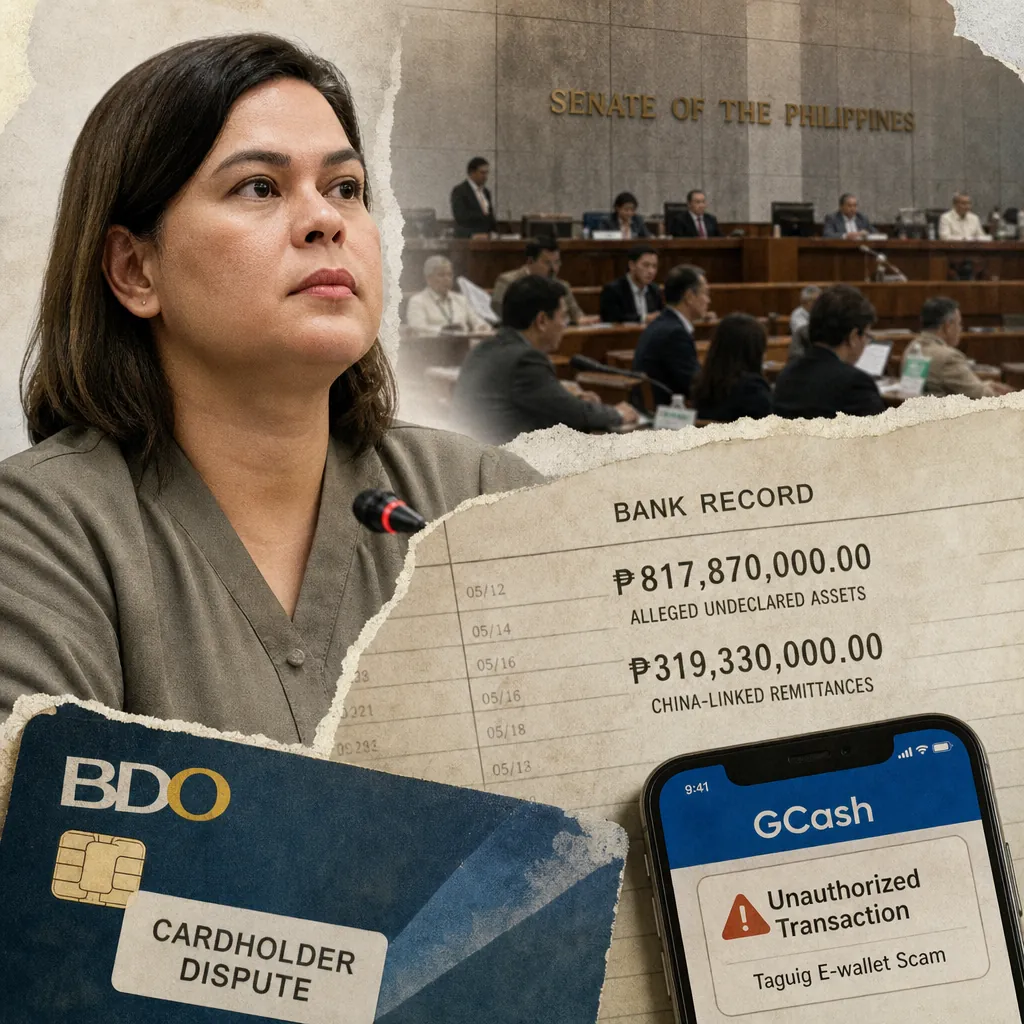
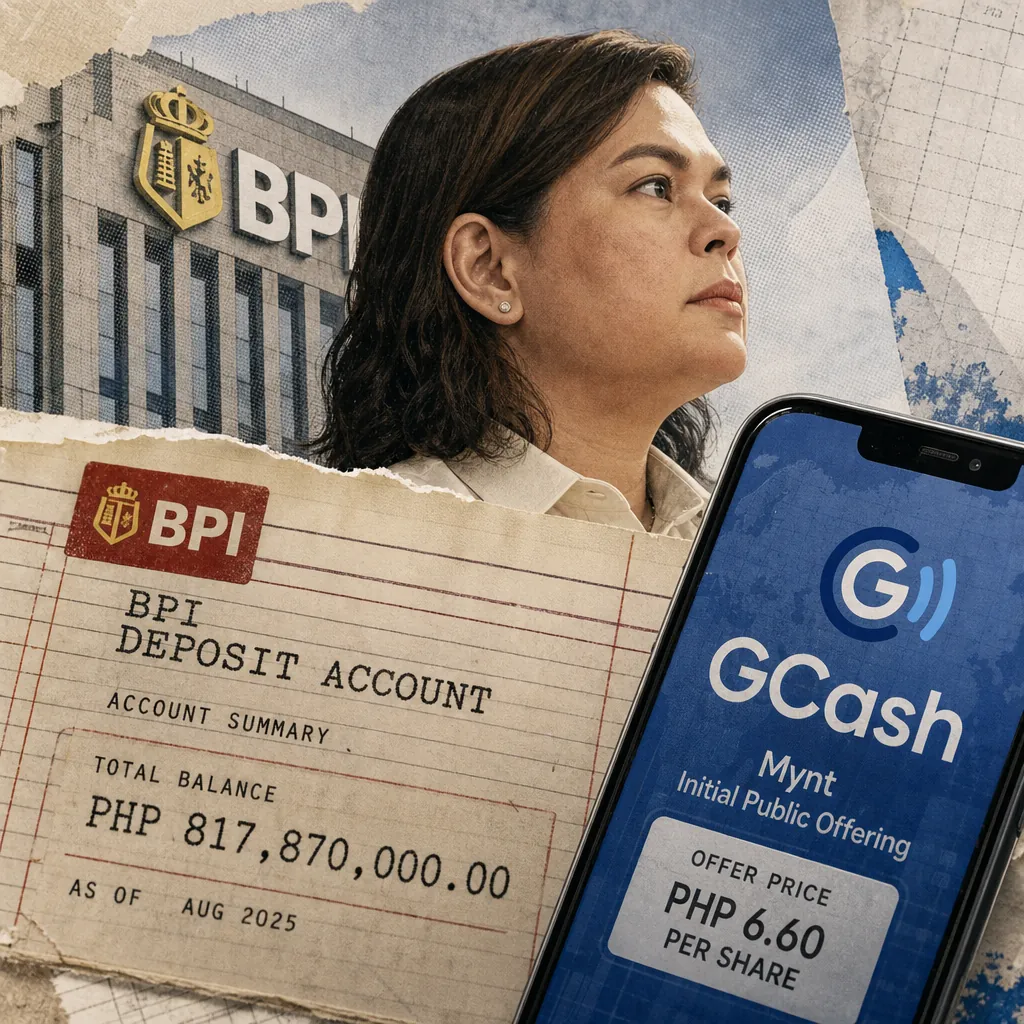
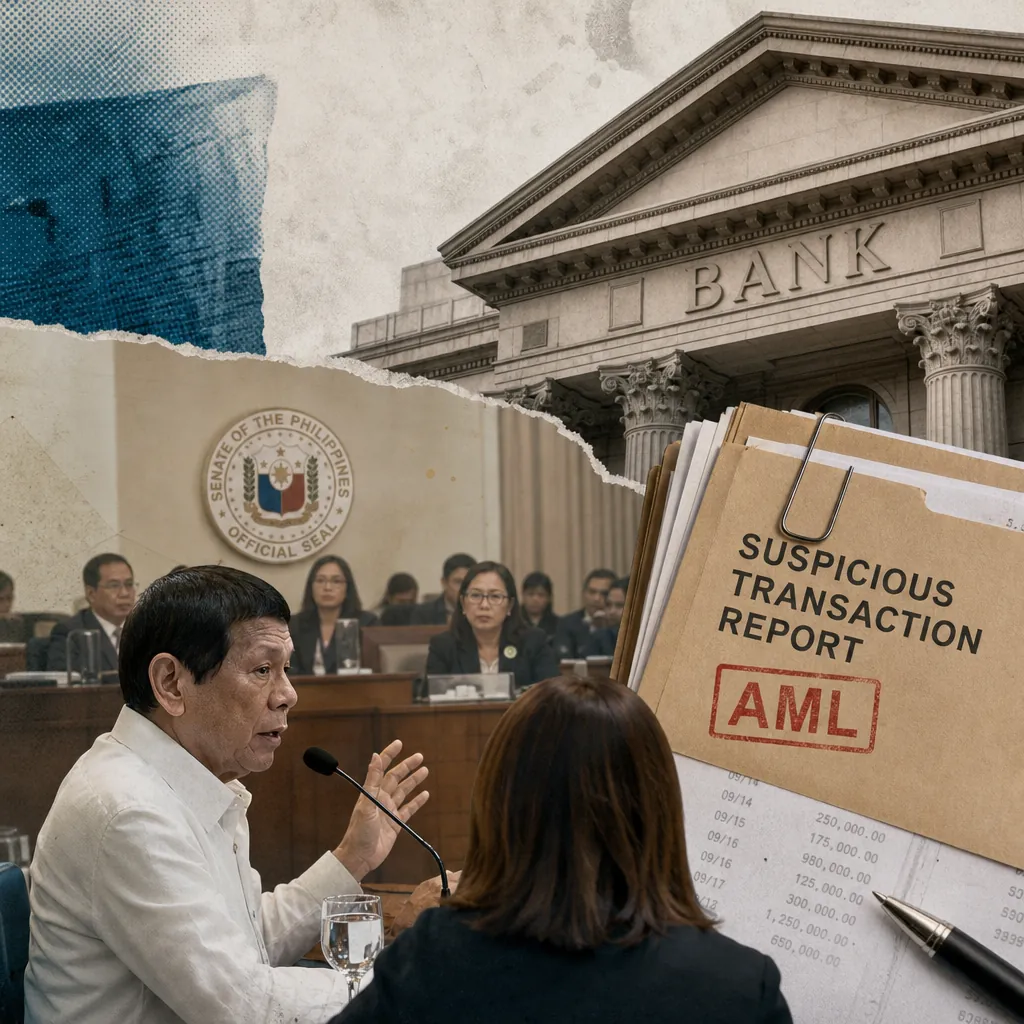
The Senate impeachment trial of Vice President Sara Duterte put Philippine banks at the center of the country's biggest political story on October 11, 2026, as a forensic accountant told the court that Duterte and her husband had P817.87 million in allegedly undeclared assets and unexplained wealth between 2022 and 2025, and the Anti-Money Laundering Council (AMLC) disclosed that a company linked to her husband received P319.33 million from mainland China and Hong Kong.1954 President Ferdinand Marcos Jr., speaking in Singapore, said the alleged Chinese funding could be a national security threat "at the highest level" if proven true.5261 The story ran across broadsheets, television, YouTube commentary channels, and Facebook, and it drew the heaviest coverage of any banking-related item in the day's monitored set.5710
On the consumer side, a BDO cardholder reported an unauthorized charge of P16,250 from "Google Claude by Anth" on a BDO Standard Mastercard, saying the bank directed them to file a dispute online.1 A separate Facebook report described a man who stole P50,000 from a Taguig shop's e-wallet account by posing as a customer, repeatedly giving a wrong cellphone number, then borrowing the shopkeeper's phone to take the funds.4 Both posts circulated on Reddit and Facebook respectively, and neither had drawn a bank or police response as of the reporting.
The day's financial news also included the Bangko Sentral ng Pilipinas (BSP) warning that remittance growth will slow over the next two to three years, data showing foreign "hot money" swung to a net outflow of $315.41 million in August, and Philippine National Bank (PNB) signaling a possible bond issuance early next year.202321 Together, the items captured here show a banking sector managing political scrutiny, consumer fraud complaints, and a tightening macroeconomic backdrop at the same time.
Key themes
- Impeachment testimony puts P817.87 million in alleged undeclared assets on the record. Forensic accountant Alexander Cabrera told the Senate impeachment court that Vice President Sara Duterte and her husband, lawyer Manases Carpio, had P817.87 million in allegedly undeclared assets and unexplained wealth from 2022 to 2025, and that GenCorp Industries Inc., a company in which Duterte declared shares, underdeclared more than P1 billion in income over four years.1954
- AMLC reports P4.4 billion in covered and suspicious transactions involving Duterte and Carpio. AMLC Executive Director Ronel Buenaventura testified that 666 covered transaction reports and 55 suspicious transaction reports involving the couple totaled P4.4 billion, and that Cale88 Foods Corp., linked to Carpio, received P319.33 million in inward transactions from mainland China and Hong Kong.19
- Marcos calls alleged China funding a national security threat if proven. The President said the P319 million in alleged remittances to a company linked to Duterte's husband could be a threat "at the highest level" to the Republic, while Duterte's spokesperson, lawyer Salvador Paolo Panelo, called accusations linking her to China "without basis."5210
- Banks defend trust in the financial system amid the trial. Bank of the Philippine Islands (BPI) president and CEO TG Limcaoco said the issue was not a lack of trust in financial institutions but a broader lack of confidence at the state level, and PNB president Edwin Bautista said transparency in public spending was essential to building public trust.48
- A BDO cardholder disputes a P16,250 unauthorized charge. The cardholder said they contacted BDO and were directed to file a dispute online, and planned to visit a branch the next day; the charge remains disputed with no stated outcome.1
- A Taguig shop lost P50,000 to an e-wallet cash-in scam. A man posing as a customer borrowed the shopkeeper's phone and took the funds, then switched off the phone to delay discovery; he is wanted in connection with similar scams.4
- BSP expects slower remittance growth as global risks weigh on overseas employment. Deputy Governor Zeno Abenoja said remittances will still grow over the next two to three years but at a slower pace, citing weaker labor demand in host economies and geopolitical tensions, particularly in the Middle East.20
- Foreign hot money swung to a net outflow of $315.41 million in August. The BSP data reversed a $2.29-billion inflow a year earlier and a $66.47-million inflow in July, bringing the first eight months of 2026 to a net outflow of $4.25 billion.2358
How the narratives stack
Dominant: The impeachment trial's financial testimony dominated the day's banking coverage. The items captured here include multiple television reports, YouTube recaps, broadsheet front pages, and online news stories on the bank records, the AMLC disclosures, and the President's national security warning.57101952 The story's reach extended from the Senate floor to Facebook and Reddit, where GMA News material on Marcos's statement circulated.1017 Within the captured set, this was the heaviest-covered banking story by a wide margin, though the monitoring's search terms and source mix shape what appears here.
Counter-narrative: Banks pushed back on the idea that the trial had damaged public trust in financial institutions. At the Financial Executives Institute of the Philippines (FINEX) 58th annual conference, BPI's Limcaoco said the fact that people respected the seven banks that testified, and that there was no overlap in their accounts, showed the level of trust in the financial system was very high.48 PNB's Bautista said transparency in public spending was essential to building public trust, which he said can be difficult to assess across political affiliations.48 The counter-narrative is that the trial is a test of state institutions, not of banks.
Emerging: Consumer-level fraud and service complaints are accumulating in social channels. The BDO unauthorized charge and the Taguig e-wallet scam are individual incidents, but they point to a pattern of digital payment risk that banks and wallet providers will have to address as usage grows.14 The BSP's own push for cross-border digital payment connectivity, described in an Asian Development Bank Institute policy brief, adds pressure to get consumer protections right.91
Under-covered: The macroeconomic strain on household finances received less attention than the trial. PNB's Bautista said rising transport costs are primarily driving credit delinquencies among middle-class retail borrowers, with fuel prices consuming a larger share of expenses and eating into money set aside for credit card payments.80 That story ran in business sections but did not generate the same volume of coverage as the impeachment proceedings.
Platform insights
- Facebook: The Taguig e-wallet scam report circulated as a video reel, and GMA News's post on Marcos's national security statement was shared on the platform.410 Facebook served as the main distribution channel for broadcast news clips and local crime reports, with engagement driven by shares rather than comments.
- Reddit: The BDO unauthorized charge post appeared in r/PHCreditCards, where the cardholder asked other customers whether similar disputed charges had been reversed.1 Separate posts in r/DigitalbanksPh discussed GoTyme's removal of reward points for purchases and a Visa P1,500 September cashback credit that had not been received.23 Reddit functioned as a peer-support and complaint forum, with users seeking advice rather than organizing collective action.
- YouTube: Trial coverage and commentary channels drew notably different levels of interaction. A video titled "KIKO PINAHAMAK ANG PROSEC! WALANG ACCOUNT GENCORP SA BDO! PALPAK NANAMAN SI KIKO MATCHING!" had 63,265 views, 1,134 likes, and 141 comments on October 10, framing the issue as a prosecution failure.15 Other channels emphasized alleged unexplained wealth or links to China.1314 The view and like counts show that partisan framing drove engagement, but the numbers are modest relative to mainstream television reach.
Key voices and communities
- Senate impeachment court and House prosecution panel: The prosecution presented bank and financial-company witnesses, including officials from Asia United Bank, Philippine Savings Bank, Metrobank, Security Bank, BPI, Philippine National Bank, BDO Unibank, and FWD Life Insurance.8 Lead prosecutor Batangas Rep. Gerville Luistro called for a full-scale investigation into the P319.33 million in China-linked remittances and for clearer rules defining the AMLC's responsibilities.5786
- Bank executives: BPI's Limcaoco and PNB's Bautista used the FINEX conference to defend the financial system's reputation and to call for transparency in public spending.48 Their framing matters because bank leaders are the sector's most visible voices on trust and governance.
- Financial forensic experts and AMLC officials: Alexander Cabrera, a former chairman of PwC Philippines, provided the P817.87 million figure and the GenCorp underdeclaration finding.1954 AMLC Executive Director Ronel Buenaventura testified that reading covered and suspicious transaction reports alone cannot establish that funds came from unlawful activity, a qualification that defense lawyers have emphasized.9
- Reddit banking communities: Cardholders and digital wallet users in r/PHCreditCards and r/DigitalbanksPh discussed unauthorized charges, reward program changes, and missing cashback credits.123 These communities are small but influential because they surface service problems that banks may not address publicly.
- YouTube commentary channels: Partisan channels packaged trial developments with sharply different headlines, and their videos drew different levels of interaction.131415 They matter because they shape how politically engaged audiences interpret the financial evidence.
Narrative streams
Impeachment testimony details P817.87 million in alleged undeclared assets
Financial forensic analyst Alexander Cabrera testified before the Senate impeachment court that Vice President Sara Duterte had P817.87 million in alleged undeclared assets and unexplained wealth from 2022 to 2025.19 Cabrera, a former chairman of PwC Philippines, also said GenCorp Industries Inc., a company in which Duterte declared ownership of shares in her Statement of Assets, Liabilities and Net Worth (SALN), allegedly failed to declare more than P1 billion in income over four years, an average annual underdeclaration of 87 percent.54 "GenCorp po talaga iyong may pinakamalaking underdeclaration — mahigit isang bilyon," Cabrera said, comparing the company with Cale88 Foods Corp. and Metro Chow.54 He said GenCorp declared only about 10 to 13 percent of its income annually, prompting him to question the reliability of its financial statements.54
The SALN is the annual disclosure form that Philippine public officials must file listing their assets, liabilities, and net worth; it is the baseline against which prosecutors compare bank and tax records. The defense objected to Cabrera's appearance, with lead counsel Sheila Sison arguing that he was granted access to Duterte's confidential records without a subpoena or her consent, and dismissing him as "this stranger."64 Prosecutor Rep. Chel Diokno countered that testimony about Duterte's bank, tax, insurance, and AMLC records had already been heard in open court.64
The read for the sector: banks that hold accounts for public officials and their companies will remain subject to court-ordered disclosure, and the trial is establishing that bank records can be used to reconstruct financial histories years after transactions occur. For compliance and legal teams, the case reinforces the importance of accurate record-keeping and clear audit trails.
AMLC reports P4.4 billion in transactions and P319.33 million from China
AMLC Executive Director Ronel Buenaventura testified that 666 covered transaction reports and 55 suspicious transaction reports involving Duterte and her husband, lawyer Manases Carpio, totaled P4.4 billion.19 He confirmed that Cale88 Foods Corp., linked to Carpio, received P319.33 million in inward transactions from mainland China and Hong Kong.19 Senator Risa Hontiveros noted that some of the Chinese firms involved were state-owned.19
Covered transaction reports are filed by banks for transactions above certain thresholds, while suspicious transaction reports are filed when a bank has reason to suspect money laundering or other unlawful activity. Both go to the AMLC, the government body that receives and analyzes financial reports. Buenaventura said that reading these reports alone cannot establish that funds came from unlawful activity, a qualification that the defense has emphasized.9 A bank witness also said suspicious-transaction reports undergo extensive verification before filing with the council.12
President Marcos said on October 11 that the alleged funds from China and Hong Kong received by a company linked to Duterte and her husband could pose a national security threat if proven true, citing the P319 million amount.10 Duterte's spokesperson, lawyer Salvador Paolo Panelo, called accusations linking her to China "without basis."10 The National Security Council said last week it will investigate the AMLC disclosure as a possible foreign information manipulation and interference activity.61
The read for the sector: banks that file suspicious transaction reports are being drawn into a political fight over what those reports mean. The AMLC's own qualification — that reports alone do not establish unlawful activity — is the key distinction that banks will need to communicate if they are asked about the case. The House prosecution panel's call for clearer rules defining the AMLC's responsibilities and strengthening its coordination with other agencies suggests that the reporting framework itself may be reviewed.57
Banks defend trust as trial testimony continues
At the FINEX 58th annual conference on Friday, BPI president and CEO TG Limcaoco said the issue was not a lack of trust in financial institutions but rather a broader lack of confidence at the state level.48 "I don't think there's a lack of trust in the financial institutions," he said. "I think the fact that people respected the seven banks that came to testify, that there's no overlap shows that the level of trust in the financial system and the players there is very high."48 PNB president Edwin Bautista said transparency in public spending was essential to building public trust, which can be difficult to assess across political affiliations.48
The trial's 34th day, on October 6, included cross-examination of Buenaventura about reports concerning Duterte and Carpio.9 On October 7, Senator-judge Kiko Pangilinan criticized BPI witness Marwin Galvez for what Pangilinan described as inadequate preparation, and Senator-judge Bam Aquino questioned the use of manager's checks, calling it a "scheme" to keep money out of an account's year-end balance, according to ABS-CBN News.67 On October 9, House prosecutors cautioned against displaying Duterte's tax returns, asset declarations, and money-laundering council records during the proceedings.16
A manager's check is a check issued by a bank and drawn on the bank's own funds, which guarantees payment; Aquino's characterization was that using such checks could move money without leaving a large year-end balance in the account. The defense has challenged what the records establish, including whether suspicious-transaction reports prove that money came from unlawful activity.11
The read for the sector: bank executives are using public forums to separate the institution's reputation from the political allegations. For communicators, the message is that the financial system's integrity is being defended on the basis of process — multiple banks, separate accounts, verified reports — rather than on the outcome of the trial.
Consumer fraud complaints surface on Reddit and Facebook
A BDO cardholder reported an unauthorized charge of P16,250 from "Google Claude by Anth" on a BDO Standard Mastercard.1 The cardholder said they contacted BDO and were directed to file a dispute online, and planned to visit a BDO branch the next day to seek clarification, asking other customers whether similar disputed charges had been reversed.1 The charge remains disputed, and the cardholder has not stated whether BDO has reversed it or completed an investigation.1
Separately, a Facebook report described a man who stole P50,000 from a shop's e-wallet account in Barangay Rizal, Taguig City, on October 4.4 The report says he posed as a customer seeking a money transfer, repeatedly gave a wrong cellphone number, then borrowed the shopkeeper's phone and took the funds, switching off the phone after returning it to delay discovery.4 He is wanted in connection with similar cash-in scams targeting shops.4
E-wallet cash-in fraud can put both shop funds and customer transactions at risk when a seller lends out a phone.4 The reported incident in Taguig may prompt sellers to tighten phone-handling practices, but the posts do not establish whether police or the wallet provider has responded.4
The read for the sector: banks and wallet providers face a steady stream of low-value fraud and service complaints that rarely make headlines but shape customer trust. The BDO dispute and the Taguig scam are individual incidents, but they illustrate the operational risks that come with digital payment growth. For consumer-facing teams, the priority is clear dispute processes and merchant education on phone handling.
BSP warns of slower remittance growth as global risks weigh
BSP Deputy Governor Zeno Abenoja said remittances will still grow over the next two to three years but at a slower pace amid global uncertainties.20 "The main risks to remittance growth are weaker labor demand in host economies and geopolitical tensions, particularly in the Middle East," he said.20 Remittances are equivalent to around eight percent of gross domestic product (GDP), helping sustain household spending and providing a steady source of foreign financing.20 Data from the BSP's third-quarter 2026 Consumer Expectations Survey showed that food and other household expenses were the most common uses of remittances, with 98 percent of remittance-receiving households reporting food and other household expenses as a use.20
Remittances are the money sent home by Filipinos working abroad; they are a key source of foreign currency and household income. A slowdown in their growth would affect consumption, which drives a large share of the economy.
The read for the sector: banks with remittance businesses should prepare for slower volume growth and for customers who are more sensitive to fees and exchange rates. The BSP's outlook also signals that monetary policy will remain focused on inflation and currency stability, which affects interest rates on loans and deposits.
Hot money swings to net outflow as Middle East tensions flare
Foreign portfolio investments registered with the BSP through authorized agent banks posted a net outflow of $315.41 million in August, reversing a $2.29-billion inflow a year earlier and a $66.47-million inflow in July.2385 The August result brought the first eight months of 2026 to a net outflow of $4.25 billion, compared with a net inflow of $4.58 billion in the same period in 2025.58 Foreign investors brought $17.436 billion into the country through short-term financial instruments from January to August but pulled out $21.689 billion, with withdrawals rising 54.5 percent year-on-year.58
Hot money refers to foreign investments in financial assets such as government securities, stocks, and peso time deposits that can be moved quickly in response to changes in returns. Rizal Commercial Banking Corp. chief economist Michael Ricafort noted that uncertainty over the Middle East crisis had pushed up global oil prices and local fuel costs, fueling inflation and prompting the central bank to raise interest rates.23
The read for the sector: the outflow reflects global risk aversion rather than a judgment on Philippine banks, but it tightens liquidity conditions and raises the cost of capital for banks and corporates. Treasury and funding teams should plan for continued volatility in foreign portfolio flows.
PNB eyes bond issuance to fund loan growth
PNB President and CEO Edwin Bautista said the bank is considering a bond issuance early next year to support loan expansion, with the timing, size, and currency yet to be determined.21 The bank could issue either peso- or US dollar-denominated bonds, depending on the size of the offering and market conditions, and has about $700 million in remaining capacity for dollar bonds and P35 billion for peso bonds.66 "We can still grow it enough. Our deposits are enough to fund the loan growth," Bautista said.21 PNB shares have climbed more than 35 percent this year to P76.20 as of Friday, and the bank's first-half net income grew 17 percent to P14.6 billion from P12.5 billion a year earlier.66
The read for the sector: PNB's plan signals that some banks see loan demand strong enough to justify new funding, even as the broader market faces outflows and inflation. For investors, the bond issuance will be a test of appetite for Philippine bank debt in a higher-rate environment.
Middle-class borrowers show stress as transport costs rise
PNB's Bautista said surging transport costs are primarily driving credit delinquencies among middle-class retail borrowers, with fuel prices consuming a larger share of expenses.80 "For the middle class, transportation accounts for a significant portion of their expenses. We see this in their complaints about rising gasoline costs, particularly among those who use motorcycles or cars. These higher costs eat into the money they set aside for credit card payments," he said.80 Headline inflation surged to 7.2 percent in September, the highest in more than three years.80
The read for the sector: banks with large consumer loan portfolios should watch delinquency trends in the middle-income segment, where fuel and transport costs are squeezing disposable income. PNB noted that its exposure to consumer loans is the lowest among the country's largest banks, which cushions its asset quality, but other lenders may not have the same buffer.80
Conversation trajectory
Over the next 1–2 weeks: The impeachment trial's defense team is preparing to present its witnesses and evidence after the House prosecution panel concluded its presentation.70 The defense has indicated it will present a financial expert and other witnesses to challenge the prosecution's findings, including the P817.87 million estimate.70 Watch for whether the defense's expert disputes the methodology behind the undeclared-assets figure and whether bank witnesses are recalled. The trial's next session will be a key trigger for further banking coverage.
Over the next 2–4 weeks: The BSP's policy meeting on October 22 is the next scheduled event that will affect banks and borrowers.6282 DBS Bank expects the Monetary Board to deliver another 25-basis-point hike this month and has added another hike in December to its baseline forecast, which would bring the policy rate above its current five percent.82 A rate hike would raise borrowing costs for consumers and businesses and could further pressure loan demand. The release of August remittance data on October 15 and US September inflation data will also shape market expectations.8192
Over the next 1–3 months: The House prosecution panel's call for a review of financial disclosure, tax, anti-money laundering, procurement, and anti-graft laws could lead to legislative hearings or proposed amendments to the AMLC's mandate.57 If the AMLC's reporting framework is revised, banks would face new compliance requirements. The National Security Council's investigation into the China-linked remittances could also produce findings that keep the issue in the news.61
Trigger events to watch: The defense's presentation of evidence at the impeachment trial; the BSP policy meeting on October 22; the release of August remittance data on October 15; US September inflation data; and any AMLC or National Security Council statements on the China-linked remittances.
Response guidance
Consumer dispute handling: Banks should review their online dispute processes to ensure cardholders can file and track unauthorized charge complaints without needing to visit a branch. The BDO cardholder's experience — being directed online but still planning a branch visit — suggests that digital channels are not yet fully replacing in-person resolution for some customers.1
Merchant fraud prevention: Wallet providers and banks that serve cash-in merchants should issue clear guidance on phone handling during transactions. The Taguig scam succeeded because the shopkeeper handed over an unlocked phone; simple rules about never lending a device mid-transaction can prevent similar losses.4
Trial-related communications: Banks named in the impeachment testimony should separate their own documented records from the political allegations. The AMLC's qualification that transaction reports alone do not establish unlawful activity is the key distinction to communicate if asked about the case.9 Avoid commenting on the merits of the allegations; focus on process and compliance.
Macroeconomic messaging: With inflation at 7.2 percent and the BSP expected to raise rates again, banks should prepare customers for higher borrowing costs and adjust their own funding plans accordingly. PNB's bond issuance plan shows that some banks are already positioning for a higher-rate environment.2182
Remittance customers: Banks with remittance businesses should communicate clearly about fees and exchange rates as growth slows. The BSP's outlook for slower remittance growth means competition for remittance customers may intensify.20
Social media monitoring: Reddit communities are surfacing service complaints — unauthorized charges, missing cashback, reward program changes — that can escalate if not addressed. Banks should monitor these forums and respond through official channels where appropriate.123
See the full picture behind today's signals.
This report draws from Media Meter's MediaWatch, our real-time monitoring engine tracking 2,470+ Philippine sources across print, broadcast, digital, and social. Explore how the platform turns raw coverage into decision-grade intelligence, then see how it's configured for teams like yours — whether you're in PR agencies, corporate comms, government, or marketing.
Want more? Browse our Report Library for sector and crisis intelligence, or request a demo and we'll have your brand set up before the call.
Want this kind of intelligence on your brand?
This brief is built on the same MediaWatch methodology that runs continuously across every brand we monitor. See your competitive landscape, Impact Score, and narrative trajectory in a 30-minute demo.