S&P Cuts PH Growth Forecast to 2.4% as Spending Slows
S&P Global Ratings lowered its Philippine growth forecast for 2026 to 2.4 percent, below the government's target, while Deutsche Bank said the central bank will keep rates tight into 2027. Bank earnings, a record-high financial system, and holiday borrowing also drew coverage.
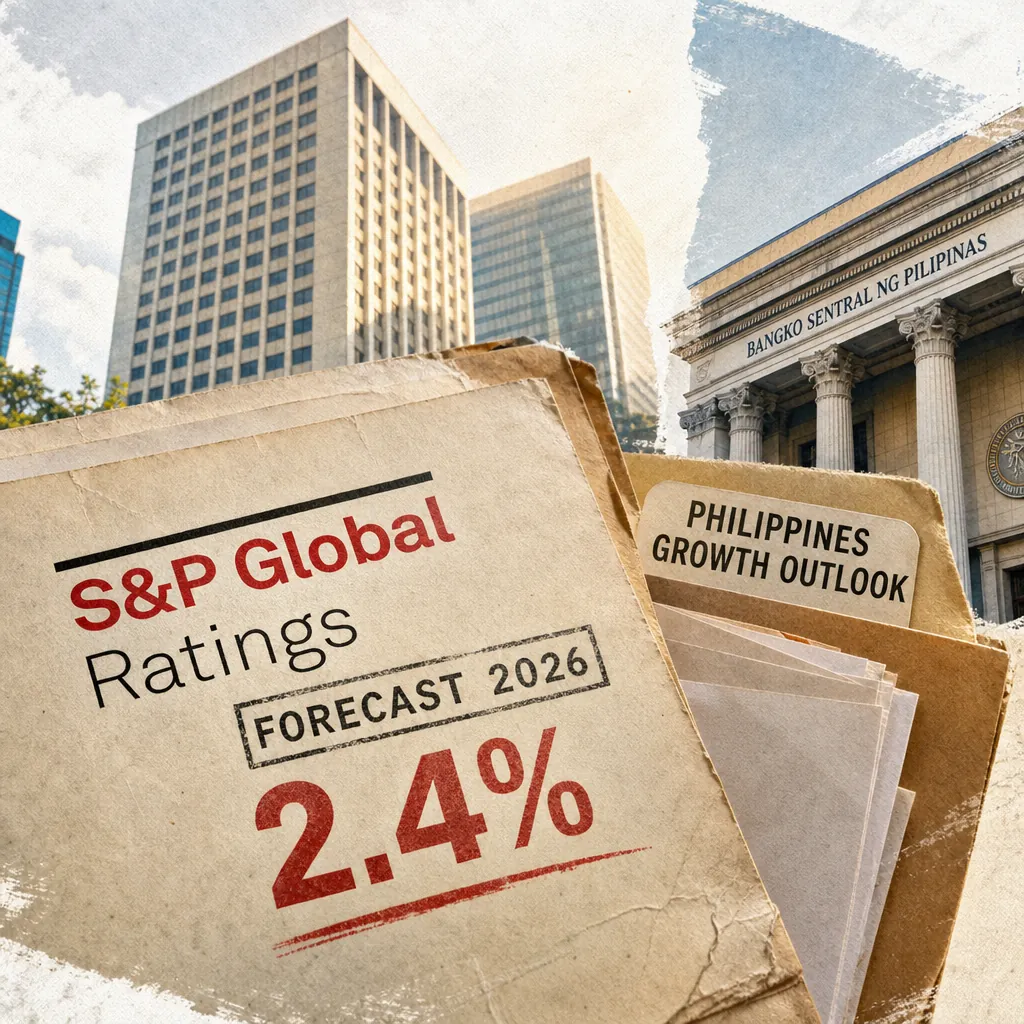
S&P Global Ratings cut its Philippine growth forecast for 2026 to 2.4 percent from 2.9 percent, putting the country below the government's own 3.5- to 4.5-percent target and making it the only Asia-Pacific economy in the agency's outlook to take a significant downward revision1048. The downgrade, reported by The Manila Times and Philstar, landed alongside a Deutsche Bank call that the Bangko Sentral ng Pilipinas (BSP) will hold its policy rate steady at its December meeting and likely resume increases in February, keeping borrowing costs elevated into 202713. Those two items set the frame for a day of financial coverage that otherwise leaned toward institutional strength: a record-high pile of resources in the banking system, a new sustainability bond from Bank of the Philippine Islands (BPI), Sun Life's exit from the trust business, and a rebound in the stock market after a six-year low15141728.
S&P attributed the cut to weak public spending, which it said is now showing up in softer domestic demand10. The agency expects a rebound to 5.0 percent next year and 5.8 percent in 2028 and 202910. Philstar reported that S&P also trimmed its 2027 projection to 5.0 percent from 5.4 percent and its 2028 forecast to 5.8 percent from 6.0 percent, and that the Philippines is projected to post the slowest growth among Southeast Asian economies this year48. Deutsche Bank economist Junjie Huang said the BSP would likely leave its key rate unchanged in December to assess the impact of the half-point increase it delivered in October, then resume with a quarter-point hike in February13. The BSP's elevated inflation outlook for 2027, Huang said, suggests policymakers are not finished tightening13.
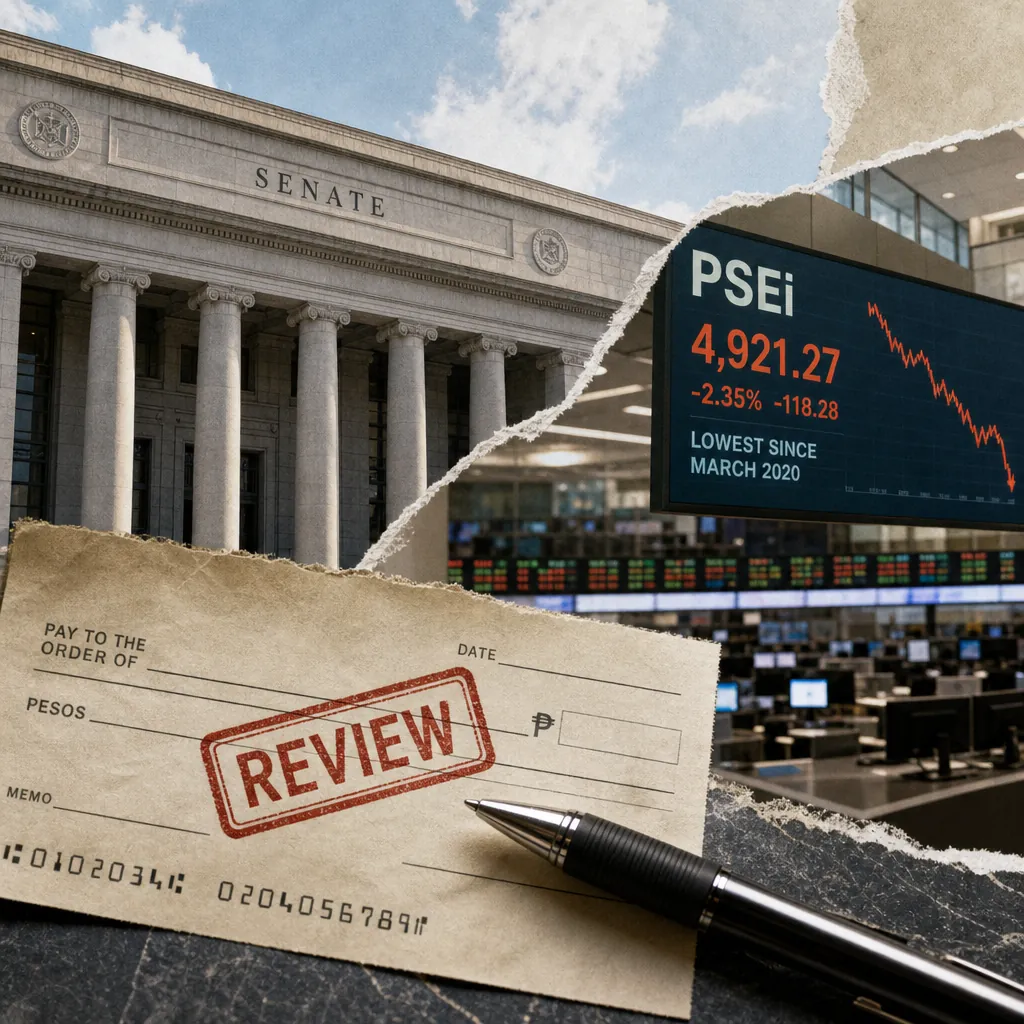
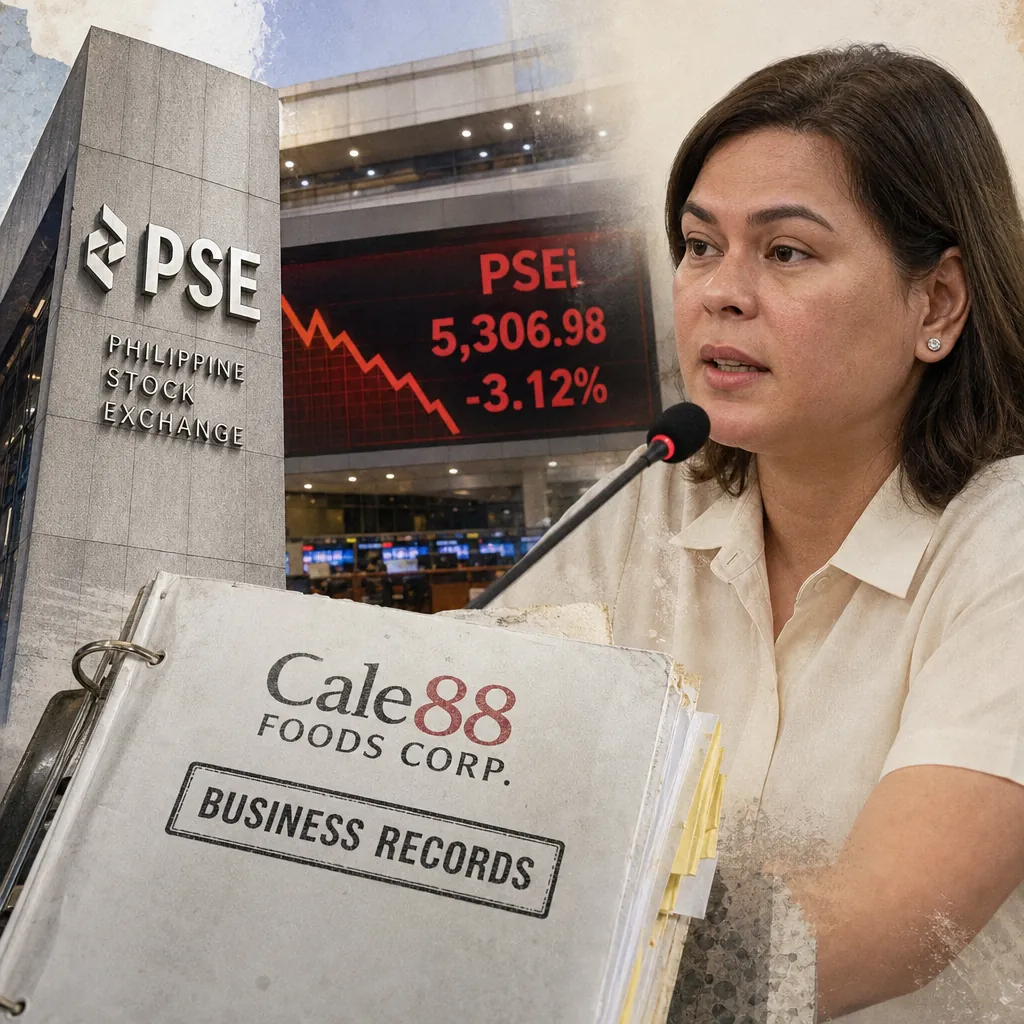
The day's banking and market stories give that macro picture a counterweight. BSP data showed the total resources of the financial system, excluding the central bank, rose 8.6 percent from a year earlier to P38.99 trillion in September, the highest on record since the series began in 197015. BPI opened a P5-billion sustainability bond offer at 7.251 percent annual interest, due 2028, with the public offer running from Nov. 23 to Dec. 4 and listing expected on Dec. 1614. Sun Life of Canada (Philippines) Inc. said it will complete its exit from the trust business by March 2027, returning all money in its trust unit's investment funds to holders17. The Philippine Stock Exchange Index (PSEi) rose 0.87 percent, or 46.09 points, to close at 5,353.07, a technical bounce after last week's sell-off, though it failed to hold above 5,4002849.
Key themes
- S&P cuts 2026 growth forecast to 2.4 percent, below the government's 3.5- to 4.5-percent target. The agency cited weak public spending feeding into softer domestic demand, and projected the Philippines as the slowest-growing economy in Southeast Asia this year1048.
- Deutsche Bank expects the BSP to hold rates in December and hike again in February. The bank said the central bank needs time to assess October's half-point increase, and that a high 2027 inflation outlook points to more tightening13.
- Financial system resources hit a record P38.99 trillion in September, up 8.6 percent year on year. The BSP figure, which excludes the central bank's own assets, covers cash, loans, deposits, capital, investment securities and loss reserves held by regulated institutions15.
- BPI opened a P5-billion sustainability bond at 7.251 percent, with an option to upsize. The bonds mature in 2028, carry quarterly interest, and require a minimum subscription of P500,00014.
- Sun Life will finish returning trust-fund money to holders by March 2027. The insurer is transferring some assets to its parent and others to Sun Life Asset Management Company Inc., while its country CEO said the 2027 outlook remains optimistic1719.
- The PSEi rebounded 0.87 percent to 5,353.07 after falling to a six-year low. Analysts at Philstocks and Regina Capital described the gain as technical, with the 5,400 level that once served as support now acting as resistance2849.
- Holiday borrowing and bonus spending shaped consumer-finance coverage. A digital lender said Filipino professionals, freelancers and small business owners borrow against specific expenses and repayment schedules, while a payments guide urged workers to stretch 13th-month pay and bonuses3637.
- The BSP moved to widen access to the payment system and discussed fraud and AI with regional peers. A draft circular would let smaller institutions clear transactions through larger sponsor banks, and central bank lawyers from five Southeast Asian countries met in Cebu to discuss cross-border fraud and AI risks4142.
How the narratives stack
Dominant. The S&P downgrade and the Deutsche Bank rate call carried the most consequence in the items reviewed here. S&P's cut to 2.4 percent places the forecast a full percentage point below the low end of the government's target, and the agency's projection that the Philippines will grow slowest in Southeast Asia this year gives the number regional weight1048. Deutsche Bank's expectation of a December hold and a February hike extends the period of high borrowing costs for households and businesses into 202713. The two stories ran in the Manila Times and Philstar business pages and were picked up by Head Topics, giving them the widest pickup among the financial items in this set30.
Counter-narrative. The record P38.99-trillion resource base of the financial system tells a different story about the banks themselves: they are larger, better capitalized and more liquid than a year ago, even as the economy they lend into slows15. BPI's ability to price a P5-billion bond at 7.251 percent and hold an option to upsize suggests investors are still willing to lend to well-rated Philippine issuers14. Sun Life's planned exit from trust products is a strategic retreat from one business line, not a withdrawal from the country; its CEO said the company is approaching 2027 optimistically and will push financial literacy1719.
Emerging. The BSP's draft circular on clearing sponsorship and third-party payment initiation would let smaller banks and non-bank players reach payment networks without building their own infrastructure41. If finalized, it widens the field of institutions that can offer digital payments, which matters for competition and for the cost of moving money. Separately, the meeting of central bank lawyers from Indonesia, Malaysia, the Philippines, Singapore and Thailand on financial fraud and AI points to a regional effort to align legal defenses as fraud crosses borders42.
Under-covered. The consumer-finance side of the day drew less attention than the macro headlines. PeraSure, a digital lending app run by SEC-registered Sulit Lending Corporation, said borrowers plan loans around specific expenses rather than borrowing on impulse, citing TransUnion's 2026 Consumer Pulse Study36. A separate guide on using 13th-month pay and bonuses through BDO Pay offered practical budgeting advice37. Both speak to how households are managing the holiday season under higher rates, a question the growth forecasts raise but do not answer.
Platform insights
- Facebook. The Office of the Ombudsman's comments on the plunder case against former House Speaker Martin Romualdez circulated through Facebook-linked news posts, with Assistant Ombudsman Mico Clavano's remarks carried by Inquirer Online1. The platform remains the main distribution channel for Philippine national news, and the Romualdez story's legal detail traveled through shares rather than original posts.
- X. Market and macro commentary concentrated here, with the PSEi's 0.87-percent rebound and the S&P downgrade drawing analyst posts. Traders tracked the 5,400 level as a technical marker, and the S&P cut was discussed alongside the peso and rate expectations2848.
- Reddit. Discussion of the growth downgrade and the impeachment trial ran in Philippine-focused communities, where users compared S&P's 2.4-percent forecast with the government's target and debated what weak public spending means for infrastructure1011.
- YouTube. Business explainers and radio clips on the BSP's rate path and the stock market's six-year low drew views, with Deutsche Bank's forecast of a February hike among the most-shared segments13.
Key voices and communities
Credit rating analysts and economists. S&P Global Ratings and Deutsche Bank set the day's macro frame. S&P's downward revision and Deutsche Bank's Junjie Huang gave markets a clear signal on growth and rates, and their forecasts will be checked against the BSP's December meeting and the next inflation release1013.
Bank executives and insurers. BPI's bond offer and Sun Life's trust exit put corporate strategy in view. Sun Life country head and CEO Jonathan Juan Moreno's optimistic 2027 outlook and his push on financial literacy gave the insurance sector a forward-looking voice141719.
Market analysts. Luis Limlingan of Regina Capital and Philstocks Financial Inc. framed the PSEi rebound as technical, warning that fresh catalysts are needed to sustain gains2849. Their read matters for retail investors deciding whether the six-year low is a buying opportunity.
Consumer-finance providers. PeraSure and BDO Pay spoke to how households are managing holiday expenses, from planned borrowing to budgeting 13th-month pay3637. Their messaging targets the same consumers the rate outlook affects most directly.
Central bank officials. BSP Monetary Board member Jose L. Querubin's remarks on regional legal cooperation and the BSP's draft payment circular position the central bank as both a regulator and a coordinator of cross-border risk4142.
Narrative streams
S&P cuts growth forecast to 2.4 percent, citing weak public spending
S&P Global Ratings lowered its 2026 growth projection for the Philippines to 2.4 percent from 2.9 percent, well below the government's 3.5- to 4.5-percent target10. The agency said the effects of weak public spending are showing up in wider domestic demand, and it expects activity to recover as demand improves, with growth accelerating to 5.0 percent next year and 5.8 percent in 2028 and 202910. Philstar reported that S&P also cut its 2027 forecast to 5.0 percent from 5.4 percent and its 2028 forecast to 5.8 percent from 6.0 percent, and that the Philippines is projected to post the slowest growth among Southeast Asian economies this year48. The Manila Times item carried the same figures and noted the government's target range10.
For households and businesses, the cut matters because it confirms what weak public spending means in practice: fewer government projects moving through the pipeline, slower job creation, and softer demand for goods and services. For the finance sector, a slower economy typically means slower loan growth and more cautious lending, even as banks sit on record resources15. The read for banks and lenders is that the gap between their capacity to lend and the economy's demand for credit will stay wide into 2027 unless public spending picks up.
Deutsche Bank sees the BSP holding in December and hiking in February
Deutsche Bank economist Junjie Huang said the BSP would likely keep its key rate unchanged at the December Monetary Board meeting, citing the need to assess the impact of the half-point increase delivered in October before making another major move13. Huang expects the central bank to resume hiking in February with a traditional quarter-point increase, and said the BSP's elevated inflation outlook for 2027 suggests policymakers are not yet done tightening13. The Inquirer Online report noted the BSP's back-to-back rate hikes and the January inflation release as the next data point13.
The read for borrowers is that the cost of credit will stay high through the first quarter of 2027 at least. For banks, a prolonged tightening cycle supports net interest margins but raises the risk of loan defaults, particularly among households already borrowing to cover holiday expenses36. For the government, higher rates raise the cost of servicing debt, which matters as Congress scrutinizes foreign loan agreements3.
Financial system resources reach a record P38.99 trillion
The total funds and assets held by Philippine financial institutions climbed to a record P38.99 trillion in September, up 8.6 percent from a year earlier, according to BSP data15. The figure excludes the central bank's own assets and covers cash, loans, deposits, capital, investment securities and reserves that regulated institutions hold to absorb potential losses15. The Inquirer Online report said the amount was the highest on record dating back to 1970, and that the expansion suggests financial institutions remain well-positioned to meet the needs of a growing economy15.
The read for the sector is that the banking system has room to absorb shocks and extend credit, which cushions the impact of the growth downgrade. For depositors and borrowers, a larger, better-capitalized system is a stability signal, though it does not by itself lower interest rates. The gap between the system's capacity and the economy's demand for credit is the number to watch in the coming quarters.
BPI prices P5-billion sustainability bond at 7.251 percent
Bank of the Philippine Islands opened a P5-billion sustainability bond offer at 7.251 percent annual interest, with an option to upsize14. The peso-denominated, fixed-rate bonds are due in 2028, carry quarterly interest, and require a minimum subscription of P500,000 with increments of P100,00014. The public offer runs from Nov. 23 to Dec. 4, with listing on the Philippine Dealing & Exchange Corp. expected on Dec. 1614. The offer is the third tranche of BPI's P200-billion bond and commercial paper program approved by its board on Oct. 16, 202414.
The read for investors is that a 7.251-percent yield on a bank-issued peso bond gives a benchmark for what highly rated Philippine issuers must pay in a high-rate environment. For the sector, the bond's sustainability label signals that green and social financing is becoming a standard part of bank funding, not a niche product. For the broader economy, the offer's size and pricing show that capital markets remain open to Philippine banks even as growth forecasts fall.
Sun Life exits the trust business by March 2027
Sun Life of Canada (Philippines) Inc. will complete its exit from the trust business by March 2027, returning all money invested in Sun Life Investment Management and Trust Corp. (SLIMTC) unit investment trust funds and other trust products to holders17. Some assets will transfer to the parent company and others to Sun Life Asset Management Company Inc.17. Sun Life first announced the exit last month after a review of its businesses and strategy in the Philippines, and special adviser Sachi Pang stepped in as SLIMTC president to lead the transition17. Country head and CEO Jonathan Juan Moreno said the company remains optimistic about 2027, citing macroeconomic indicators and new products, and said financial literacy will be a priority19.
The read for trust-fund investors is that their money will be returned or transferred, so they will need to decide where to reinvest. For the asset-management sector, Sun Life's exit opens room for competitors to capture displaced funds. For Sun Life, the move narrows its Philippine business to insurance and asset management, which the company frames as a sharper focus rather than a retreat1719.
PSEi rebounds 0.87 percent after six-year low
The Philippine Stock Exchange Index rose 0.87 percent, or 46.09 points, to close at 5,353.07, after touching an intraday high of 5,419.4928. The broader All Shares index gained 0.24 percent, or 7.09 points, to 3,012.3849. Philstocks Financial Inc. described the gain as a technical bounce and said the close below 5,400 suggested that the level, which served as support before last week's decline, was turning into resistance28. Luis Limlingan of Regina Capital said investors took advantage of lower valuations through selective bargain hunting after the market reached oversold levels, but that the rebound remains largely technical2849.
The read for retail investors is that the market's recovery is fragile and dependent on fresh positive catalysts, which the S&P downgrade and the rate outlook do not provide1013. For listed companies, a sustained low market makes equity financing more expensive and raises the appeal of debt, as BPI's bond offer illustrates14. For the exchange, the six-year low is a reminder that trading volumes remain thin and that foreign investors have not returned in force.
BSP moves to widen payment access and coordinate on fraud and AI
The BSP is seeking feedback on a draft circular that would support clearing sponsorship arrangements and third-party payment initiation services41. Under the first arrangement, smaller financial institutions that hold customer funds but do not directly participate in payment clearing networks could tap larger institutions such as universal banks to process and clear transactions on their behalf41. The smaller firms, known as indirect clearing participants, would partner with clearing sponsor institutions that handle the clearing, letting them offer payment-network access without building their own infrastructure41. Separately, central bank lawyers from Indonesia, Malaysia, the Philippines, Singapore and Thailand met in Mactan, Cebu, on Nov. 17–18 to discuss financial fraud, consumer protection and AI risks42. BSP Monetary Board member Jose L. Querubin said regional resilience requires compatible objectives and protections that work together when risks cross borders42.
The read for smaller banks and fintechs is that the draft circular could lower the cost of entering the payments business, intensifying competition for customer accounts. For consumers, more players in payments could mean lower fees and more choices, though it also raises coordination questions on fraud prevention. For regulators, the regional meeting signals that AI-related fraud is being treated as a cross-border problem that requires shared legal approaches42.
Holiday borrowing and bonus budgeting shape consumer finance
PeraSure, a digital lending app operated by Securities and Exchange Commission-registered Sulit Lending Corporation, said Filipino professionals, freelancers and small business owners tend to borrow on calculation rather than impulse, matching each loan to a specific expense and repayment schedule as year-end bills, holiday traditions and family emergencies collide36. The One News report cited TransUnion's 2026 Consumer Pulse Study during the second quarter36. A separate One News guide urged workers receiving 13th-month pay and bonuses to use digital payment tools such as BDO Pay to budget and protect their accounts during the holiday season37.
The read for lenders is that demand for small, short-term credit will stay strong through December, and that products tied to specific expenses may perform better than general-purpose loans. For households, the guidance points to a practical risk: borrowing to cover holiday costs at a time when interest rates are expected to stay high into 202713. For policymakers, the reliance on planned borrowing is a signal that income growth is not keeping pace with seasonal expenses.
Conversation trajectory
BSP December Monetary Board meeting (observation window: next 2–4 weeks). Deutsche Bank expects the central bank to hold its key rate steady in December before hiking in February13. A hold would confirm the pause-and-assess strategy; a surprise hike would signal that inflation concerns outweigh growth worries. Watch the policy statement for language on the 2027 inflation outlook.
November inflation release (observation window: early December). The January inflation figure was cited as the next data point for the rate path13. A higher print would strengthen the case for a February hike; a lower one would give the BSP room to wait.
BPI bond offer close and listing (observation window: Dec. 4 offer close, Dec. 16 listing). The take-up of the P5-billion offer, and whether BPI exercises its upsizing option, will show how much appetite investors have for Philippine bank paper at 7.251 percent14. Strong demand would encourage other issuers; weak demand would signal that rates are too low for the risk.
Sun Life trust transition (observation window: through March 2027). The return of trust-fund money and the transfer of assets to the parent and to Sun Life Asset Management will unfold over the next four months17. Watch for competitors launching products aimed at displaced investors.
BSP payment circular feedback (observation window: coming weeks). The draft circular on clearing sponsorship and third-party payment initiation is out for industry comment41. The volume and direction of feedback will indicate how quickly the BSP finalizes the rules and whether smaller banks see the arrangement as workable.
Stock market direction (observation window: through year-end). The PSEi's failure to hold above 5,400 leaves the index vulnerable to further declines if no positive catalysts emerge2849. Watch for foreign fund flows and any policy signals from the BSP or the fiscal side.
Trigger events. A surprise BSP rate move, a sharp revision to the government's growth target, a large corporate bond issuance or a bank earnings surprise would shift the narrative. On the consumer side, a jump in holiday borrowing defaults or a new government stimulus measure would change the outlook for lenders.
Response guidance
Macro communicators. Lead with the gap between the S&P forecast and the government target, and explain what weak public spending means for jobs and projects. Avoid framing the downgrade as a verdict on the economy; state the agency's expectation of a rebound to 5.0 percent next year alongside the cut10.
Bank and insurer communicators. Emphasize balance-sheet strength and the record resource base when discussing the growth downgrade15. For BPI, the bond offer's pricing and take-up are the story; for Sun Life, the trust exit should be explained as a strategic focus, with clear timelines for returning investor money1417.
Consumer-finance communicators. Address holiday borrowing directly, with plain guidance on matching loans to specific expenses and repayment schedules36. Avoid encouraging borrowing without showing the cost of repayment at current rates, which are expected to stay high into 202713.
Payments and fintech communicators. The BSP's draft circular is an opportunity to explain how clearing sponsorship could lower costs for smaller players41. Pair that with clear messaging on fraud prevention, given the regional focus on AI-related financial crime42.
Market communicators. Describe the PSEi rebound as technical and avoid implying a sustained recovery2849. Give retail investors the levels that matter, such as 5,400 as resistance, and explain what catalysts would change the picture.
Sensitive topics. The growth downgrade and the rate outlook touch household budgets directly; avoid alarmist language and give concrete numbers. The Sun Life trust exit involves returning other people's money, so clarity on timelines and transfer arrangements is essential17. Any discussion of borrowing should acknowledge that higher rates raise repayment costs for the same principal.
See the full picture behind today's signals.
This report draws from Media Meter's MediaWatch, our real-time monitoring engine tracking 2,470+ Philippine sources across print, broadcast, digital, and social. Explore how the platform turns raw coverage into decision-grade intelligence, then see how it's configured for teams like yours — whether you're in PR agencies, corporate comms, government, or marketing.
Want more? Browse our Report Library for sector and crisis intelligence, or request a demo and we'll have your brand set up before the call.
Want this kind of intelligence on your brand?
This brief is built on the same MediaWatch methodology that runs continuously across every brand we monitor. See your competitive landscape, Impact Score, and narrative trajectory in a 30-minute demo.