Peso hits new low as inflation forecasts rise
The Philippine peso touched another record low against the dollar while analysts raised inflation forecasts, and the central bank pushed back on criticism of the economy. Banks and insurers reported strong earnings from non-lending sources, and GCash's upcoming IPO drew attention.
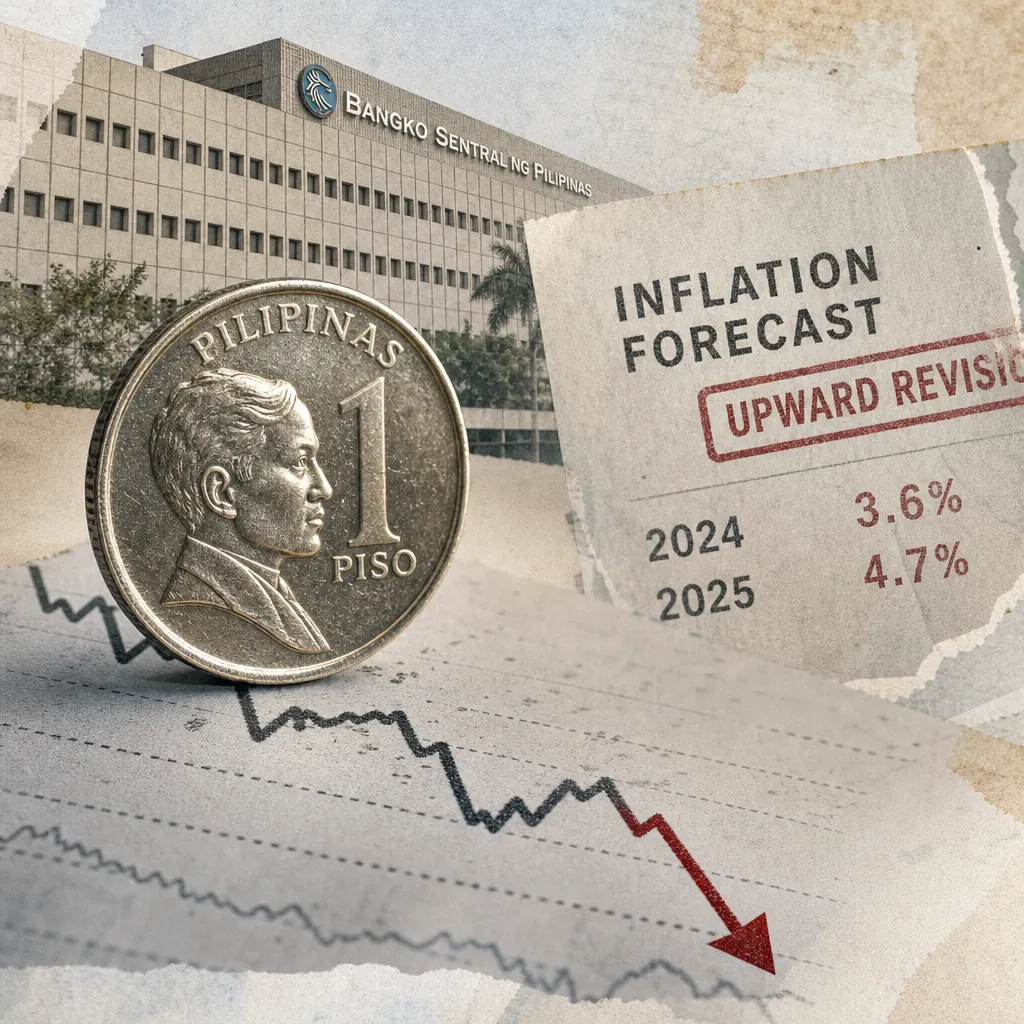
The Philippine peso slid to another record low on Monday, closing at 62.586 against the US dollar after touching 62.775 intraday, as a resilient US currency and expectations of higher US interest rates weighed on the local unit.15 The decline extended a run of record lows that began after the peso weakened from the P58-to-P59 range before the Middle East war, breaching P62 in August.49 Trading volume eased to nearly $1.2 billion from $1.5 billion in the previous session.15 The peso's slide has become a central economic and political issue, drawing criticism from Vice President Sara Duterte and a response from Malacañang defending the government's handling of the economy.29
Analysts and multilateral lenders painted a mixed picture of the Philippine economy on Monday. The Asian Development Bank (ADB) said reaching its 3.8% gross domestic product (GDP) growth forecast for the Philippines this year is possible but hinges on a strong second-half recovery in government spending and household consumption.48 The bank had lowered its forecast from 4.4% in April, reflecting delayed investments and weaker consumption.35 Meanwhile, Maybank and Pantheon Macroeconomics both raised their Philippine inflation forecasts, citing sticky food and oil prices, El Niño-related supply disruptions, and peso depreciation.46 Maybank now projects inflation at 5.5% this year and 5.1% in 2026, while Pantheon sees 5.5% this year and 3.2% in 2027.33 August inflation eased to a five-month low of 6.1% but remained above the central bank's 3% target for the sixth consecutive month.33
Beyond the macro headlines, the day's coverage featured a range of banking and insurance developments. EastWest Bank priced a P9-billion stock rights offer to fund growth plans.58 Citi and German development finance institution DEG arranged a P1.5-billion co-financing facility for microfinance lender OnePuhunan.32 Insurers reported strong earnings from investment income even as premium revenue declined, and InLife said it expects 40% growth in new business this year.45 The much-anticipated initial public offering (IPO) of GCash operator Mynt Inc. drew commentary on its potential to attract first-time retail investors.16
Key themes
- Peso hits another record low, nearing 63 per dollar: The Philippine currency closed at 62.586 against the US dollar on Monday after touching an intraday low of 62.775, extending its run of record lows.15 The decline reflects a strong US dollar and expectations of higher US interest rates following a stronger-than-expected US jobs report.53
- Inflation forecasts raised through 2027: Maybank and Pantheon Macroeconomics both upwardly revised their Philippine inflation projections, citing sticky food and oil prices, El Niño-related supply disruptions, and peso depreciation.46 Maybank now sees 5.5% inflation this year and 5.1% in 2026; Pantheon sees 5.5% this year and 3.2% in 2027.33
- ADB says 3.8% GDP growth still possible but challenging: The Asian Development Bank said the Philippines could achieve at least 3.8% economic growth this year but needs significant acceleration in government spending and a recovery in household consumption.48 The bank lowered its forecast from 4.4% in April.35
- Weak peso seen doing more harm than good: S&P Global Market Intelligence Principal Economist Harumi Taguchi said inflationary pressures from the weaker peso have already surfaced, while export competitiveness has yet to materialize, so short-term costs likely outweigh gains.49
- Banks and insurers diversify revenue beyond lending: Vietnamese banks are expanding into securities, insurance, consumer finance, and other businesses as net interest margins face pressure.1 Philippine insurers reported strong earnings from investment income even as premium revenue declined.2
- GCash IPO seen attracting first-time investors: The initial public offering of GCash operator Mynt Inc. could bring a new crop of retail investors into the Philippine stock market, especially if the fintech firm markets the share sale through its app.16 A successful listing could pave the way for more fintech IPOs.50
- Government borrowing costs rise on inflation fears: The Bureau of the Treasury made a partial award of Treasury bills on Monday as the market asked for higher yields due to fears of elevated inflation, with the Middle East conflict still unresolved.55 The government raised only P38.69 billion from the P45 billion it offered.51
- Business confidence remains below zero: The central bank's Business Expectations Survey revealed a business confidence index at -20.3, remaining below zero for practically all of 2026.56 The survey, held from July 7-31 and covering 506 firms, serves as a barometer of expectations for businesses and the economy.56
How the narratives stack
Dominant: The peso's slide to record lows and its economic consequences dominated the day's coverage. Multiple outlets reported on the currency's decline, with the Inquirer noting the peso touched a new intraday low before paring losses.15 BusinessWorld quoted S&P Global's economist saying the weak peso is likely doing more harm than good to the Philippine economy.49 The peso's weakness has become a political flashpoint, with Vice President Sara Duterte criticizing the government's economic management and Malacañang pushing back.29 Within the captured set, this story drew the most coverage across multiple outlets and formats.
Counter-narrative: Despite the gloomy macro picture, several financial institutions reported strong results. Insurers like Prudential Vietnam and Sun Life Vietnam posted significant profit growth driven by investment income even as premium revenue declined.2 InLife said it expects 40% growth in new business this year, with its president noting that "when times are uncertain, people look for security."57 This counter-narrative suggests that financial institutions can thrive even in challenging economic conditions by diversifying revenue streams.
Emerging: The GCash IPO is emerging as a significant story for the Philippine capital markets. Analysts say the listing of Mynt Inc., the operator of the country's dominant mobile wallet, could attract a new wave of retail investors.16 A successful listing could pave the way for more fintech-related IPOs, potentially transforming the Philippine stock market's retail participation.50 The story is still developing, with the pricing and timing yet to be finalized.
Under-covered: The Philippine Deposit Insurance Corp.'s (PDIC) development of a Risk-Based Assessment System for deposit insurance premiums received relatively little attention despite its importance for financial stability.37 The PDIC is moving toward fairer risk-based premiums, which could affect how banks are assessed and charged for deposit insurance. This story appeared in several Daily Guardian blog posts but drew less coverage than the peso and inflation stories.37
Platform insights
- Facebook: The peso's decline and its impact on prices generated significant discussion on Facebook, where Filipino users shared news articles and expressed concerns about rising costs. The political dimension—Vice President Sara Duterte's criticism and Malacañang's response—also drew engagement, with users debating the government's handling of the economy.29
- X (formerly Twitter): Economists and financial analysts used X to comment on the peso's record low and the implications for inflation and interest rates. The platform saw discussion of the ADB's GDP forecast and the raised inflation projections from Maybank and Pantheon Macroeconomics.33 The GCash IPO also generated interest among retail investors and fintech observers.16
- YouTube: SM Investments' group-wide communication channel, SM In Focus, uses YouTube to provide insights into the conglomerate's operations and impact.36 The platform serves as a channel for corporate storytelling and stakeholder engagement, though it did not feature prominently in the day's news coverage.
- Reddit: While not a major platform for Philippine financial news, Reddit's investing communities occasionally discuss Philippine stocks and economic developments. The peso's decline and its impact on remittances and overseas Filipino workers were topics of interest in relevant subreddits.
Key voices and communities
- Central bank officials: Bangko Sentral ng Pilipinas (BSP) Governor Eli Remolona Jr. has been a central figure in the economic debate, particularly his remarks about the country's "consumption culture" and low savings rate.65 His comments have drawn both criticism and defense, with economists noting his point was about national savings, not individual spending habits.61
- Multilateral lenders and analysts: The Asian Development Bank, through President Masato Kanda, provided a nuanced view of the Philippine economy, saying 3.8% GDP growth is possible but challenging.48 S&P Global Market Intelligence's Harumi Taguchi offered a sober assessment of the peso's depreciation, noting short-term costs likely outweigh gains.49
- Bank and insurance executives: Leaders like InLife President Raoul Littaua provided a counter-narrative of growth despite economic uncertainty, noting that "when times are uncertain, people look for security."57 EastWest Bank's pricing of its P9-billion rights offer and Citi's microfinance facility for OnePuhunan showed continued banking activity.5832
- Government officials and politicians: Vice President Sara Duterte's criticism of the economy and Malacañang's response highlighted the political dimensions of economic management.29 Speaker Faustino Dy III's remarks at the Metrobank Foundation Outstanding Filipinos awards touched on service and excellence, providing a non-economic counterpoint.3
- Financial journalists and commentators: Columnists and reporters across Philippine media provided analysis of the peso's decline, national savings, and business confidence. A Manila Bulletin columnist wrote about business confidence and why it matters, noting the index has remained below zero for practically all of 2026.56
Narrative streams
Peso's record low and its economic consequences
The Philippine peso closed at 62.586 against the US dollar on Monday, touching an intraday low of 62.775 before paring losses.15 The currency has been on a steady decline, weakening from the P58-to-P59 range before the Middle East war to breach P62 in August.49 The decline reflects a resilient US currency and growing expectations that the Federal Reserve could raise interest rates this month following a stronger-than-expected US jobs report.53
S&P Global Market Intelligence Principal Economist Harumi Taguchi said the weak peso is likely doing more harm than good to the Philippine economy. "The impact depends on the scale of depreciation, but in the short term, the costs are likely to outweigh the gains, as price pressures emerge before improved competitiveness can meaningfully boost export volumes," she said.49 This assessment challenges the view that a weaker currency helps exports, noting that inflationary pressures surface before any competitiveness gains materialize.
The peso's decline has become a political issue. Vice President Sara Duterte criticized the government's economic management, prompting Malacañang to respond. Palace Press Officer Claire Castro said the Philippines is not alone in facing currency pressures, as movements depend on global market events, and noted that the BSP is taking steps to maintain stable prices and the financial system.29
Read for the sector: The peso's sustained weakness raises import costs and inflationary pressures, affecting banks' funding costs and borrowers' ability to repay loans. Financial institutions must factor continued currency volatility into their risk assessments and pricing decisions. The political debate around the peso also creates reputational risks for institutions associated with the government's economic management.
Inflation forecasts raised through 2027
Maybank and Pantheon Macroeconomics both raised their Philippine inflation forecasts, citing sticky food and oil prices, El Niño-related supply disruptions, and peso depreciation.46 Maybank now projects inflation at 5.5% this year and 5.1% in 2026, up from its prior estimates of 5.3% and 4.9%.33 Pantheon sees 5.5% this year and 3.2% in 2027, up from 5.3% and 2.7%.46
August inflation eased to a five-month low of 6.1% but remained above the central bank's 3% target for the sixth consecutive month.33 Analysts note core inflation may have already peaked, but disinflation is expected to remain gradual.33 Maybank analysts said "the persistence of elevated inflation across transport, housing, health and services, alongside rising risks from El Niño-related food supply disruptions and peso depreciation, suggests that disinflation is likely to remain gradual."46
The elevated inflation outlook has implications for government borrowing costs. The Bureau of the Treasury made a partial award of Treasury bills on Monday as the market asked for higher yields due to fears of elevated inflation.55 The government raised only P38.69 billion from the P45 billion it offered, with the 91-day T-bill fetching an average rate of 5.214%, up 7.6 basis points from the previous week.55
Read for the sector: Persistent inflation above the central bank's target keeps pressure on the BSP to maintain or raise interest rates, affecting banks' net interest margins and loan demand. Insurers offering fixed-income products may benefit from higher yields, while those with long-term guarantees face challenges. The elevated inflation outlook also affects household purchasing power and savings capacity, with implications for deposit growth and insurance premium affordability.
Banks and insurers diversify revenue beyond lending
Vietnamese banks are expanding their ecosystems into securities, insurance, consumer finance, financial leasing, fund management, and even digital assets as net interest margins face pressure.1 S&I Ratings noted that many banks established new subsidiaries in securities and insurance in 2025, reflecting a clear trend toward completing their ecosystems.1 The motivation is the search for additional profit growth as net interest income comes under pressure.1
A similar trend is visible in the insurance sector. Prudential Vietnam reported premium revenue of 8,490 billion VND in the first half, down nearly 14% year-on-year, but financial revenue rose 44% to 6,078 billion VND, helping the company post after-tax profit of 2,347 billion VND, 3.46 times the same period last year.2 Sun Life Vietnam showed a similar pattern, with net revenue from insurance operations down 10.57% but financial revenue up 33.44%.7
In the Philippines, InLife reported 37% year-on-year growth in new business annual premium equivalent (NBAPE) to P2.7 billion in the first half of 2026.45 President Raoul Littaua said the insurer expects to sustain double-digit growth, noting that "when times are uncertain, people look for security."57 Manulife Philippines launched an upgraded single-payment life insurance plan that guarantees annual payouts, aimed at helping preserve capital and maintain protection.59
Read for the sector: Financial institutions are increasingly relying on non-lending and non-premium revenue sources to sustain profitability. This diversification reduces dependence on interest income but introduces new risks, including market volatility in investment portfolios and operational complexity in managing diverse subsidiaries. Regulators and investors should monitor whether institutions have the risk management capabilities to handle this expanded scope.
GCash IPO seen attracting first-time investors
The initial public offering of GCash operator Mynt Inc. could bring a new crop of retail investors into the Philippine stock market, especially if the fintech firm taps its massive digital reach to market the share sale.16 Juan Paolo Colet, managing director at China Bank Capital Corp., said Mynt has a "good chance" of attracting first-time IPO investors, although much would depend on how the company markets the offering.16
"If they push the IPO on the GCash app, then they could raise retail participation," Colet said. "I think this is something they should aspire to do in keeping with their core identity as a financial super app for Filipinos."16 A successful listing could pave the way for more fintech-related IPOs.50
A Philstar columnist noted that GCash's listing tells a different story from other Southeast Asian tech IPOs: "that financial inclusion itself, long treated as a social mission funded by governments and development banks, can also be one of the most valuable technology businesses in Asia."60 The columnist also noted that an indicative maximum price is only a starting point for negotiation, citing recent IPOs that priced below their initial ceilings.60
Read for the sector: A successful GCash IPO could transform Philippine capital markets by bringing millions of mobile wallet users into the stock market as first-time investors. This would broaden retail participation and potentially support more fintech listings. For the banking sector, GCash's success as a financial super app underscores the competitive pressure from fintech firms and the importance of digital capabilities.
Business confidence remains below zero
The central bank's Business Expectations Survey revealed a business confidence index at -20.3, remaining below zero for practically all of 2026.56 The survey, held from July 7-31 and covering 506 firms, serves as a barometer of expectations and confidence for businesses and the economy.56
A Manila Bulletin columnist wrote that business confidence is not about the feelings of businessmen but about how they view current conditions and their outlook over the coming months and years.56 The columnist expressed concern that the index has remained below zero for most of 2026, suggesting that more needs to be done to shore up confidence.56
The low business confidence reflects the challenging economic environment: elevated inflation, peso weakness, geopolitical tensions, and high borrowing costs. The Philippine Stock Exchange index slipped by 0.11% to close at 6,083.68, with investors remaining cautious amid currency depreciation and geopolitical risks.64
Read for the sector: Low business confidence translates into reduced investment and hiring, affecting loan demand and insurance sales. Financial institutions should prepare for sluggish credit growth and focus on maintaining asset quality. The persistent negative sentiment also suggests that monetary policy alone may not be sufficient to revive the economy; structural reforms to improve the investment climate may be needed.
Conversation trajectory
Peso movement (next 1-2 weeks): The peso is likely to remain under pressure as traders focus on upcoming US inflation data, which could influence the Federal Reserve's interest rate decision.15 If US inflation comes in hot, expectations of a rate hike could strengthen the dollar further and push the peso toward 63 per dollar. The BSP may intervene to smooth volatility, but sustained intervention is unlikely given limited reserves.49
Inflation data (next 1-2 months): August inflation eased to 6.1%, but analysts expect disinflation to remain gradual.33 The September inflation print, typically released in early October, will be a key indicator. If inflation remains above 6%, the BSP may need to maintain or raise rates, affecting borrowing costs across the economy.46
ADB Asian Development Outlook (September 23): The ADB will release its Asian Development Outlook on September 23, which will provide updated GDP forecasts for the Philippines.48 The bank's current 3.8% forecast for 2026 may be revised depending on recent economic data.35
GCash IPO timeline (next 3-6 months): Mynt is moving closer to one of the country's most closely watched listings.16 The pricing and timing will depend on market conditions, with the weak peso and low business confidence potentially affecting investor appetite. A successful listing could trigger more fintech IPOs.50
EastWest Bank rights offer (November 19 record date): EastWest Bank has set November 19 as the record date for its P9-billion stock rights offer, with shares priced at P10.80 to P11.05 each.58 The offer will be backed by major shareholders Filinvest Development Corp., providing a floor for the transaction.58
Trigger events to watch: The US Federal Reserve's interest rate decision this month; the September inflation print; the ADB's Asian Development Outlook release on September 23; any escalation in the Middle East conflict affecting oil prices; and the final pricing and timetable for the GCash IPO.
Response guidance
Macroeconomic messaging: Financial institutions should acknowledge the challenging economic environment—elevated inflation, peso weakness, and geopolitical tensions—while emphasizing their resilience and ability to navigate uncertainty. InLife's framing that "when times are uncertain, people look for security" offers a constructive angle for insurance and savings products.57
Currency risk communication: For banks and insurers with foreign currency exposures, clear communication about risk management practices is essential. Institutions should explain how they mitigate currency risk and protect customer deposits and investments, without downplaying the real economic pressures.49
Product positioning: Given the uncertain environment, financial institutions should highlight products that offer security and guaranteed returns, such as Manulife's Wealth Guarantee Plus with annual payouts and capital preservation.59 Savings and protection products may resonate with customers seeking stability.
Digital engagement: The GCash IPO discussion highlights the power of digital platforms to reach retail investors.16 Financial institutions should leverage their digital channels to educate customers about investment opportunities and financial planning, potentially expanding retail participation in capital markets.
Sensitive topics: The political debate around the peso and the economy requires careful handling. Institutions should avoid taking partisan positions while providing factual information about economic conditions. The "consumption culture" remark by the BSP governor drew criticism, highlighting the need for careful framing when discussing savings behavior.65
Stakeholder communication: SM Investments' approach of using digital platforms and community-based programs to engage customers, investors, and other stakeholders offers a model for comprehensive communication.36 Financial institutions should consider similar multi-channel strategies to build trust and transparency.
See the full picture behind today's signals.
This report draws from Media Meter's MediaWatch, our real-time monitoring engine tracking 2,470+ Philippine sources across print, broadcast, digital, and social. Explore how the platform turns raw coverage into decision-grade intelligence, then see how it's configured for teams like yours — whether you're in PR agencies, corporate comms, government, or marketing.
Want more? Browse our Report Library for sector and crisis intelligence, or request a demo and we'll have your brand set up before the call.
Want this kind of intelligence on your brand?
This brief is built on the same MediaWatch methodology that runs continuously across every brand we monitor. See your competitive landscape, Impact Score, and narrative trajectory in a 30-minute demo.