Peso, Stocks Rebound as GDP Slump Tests BSP
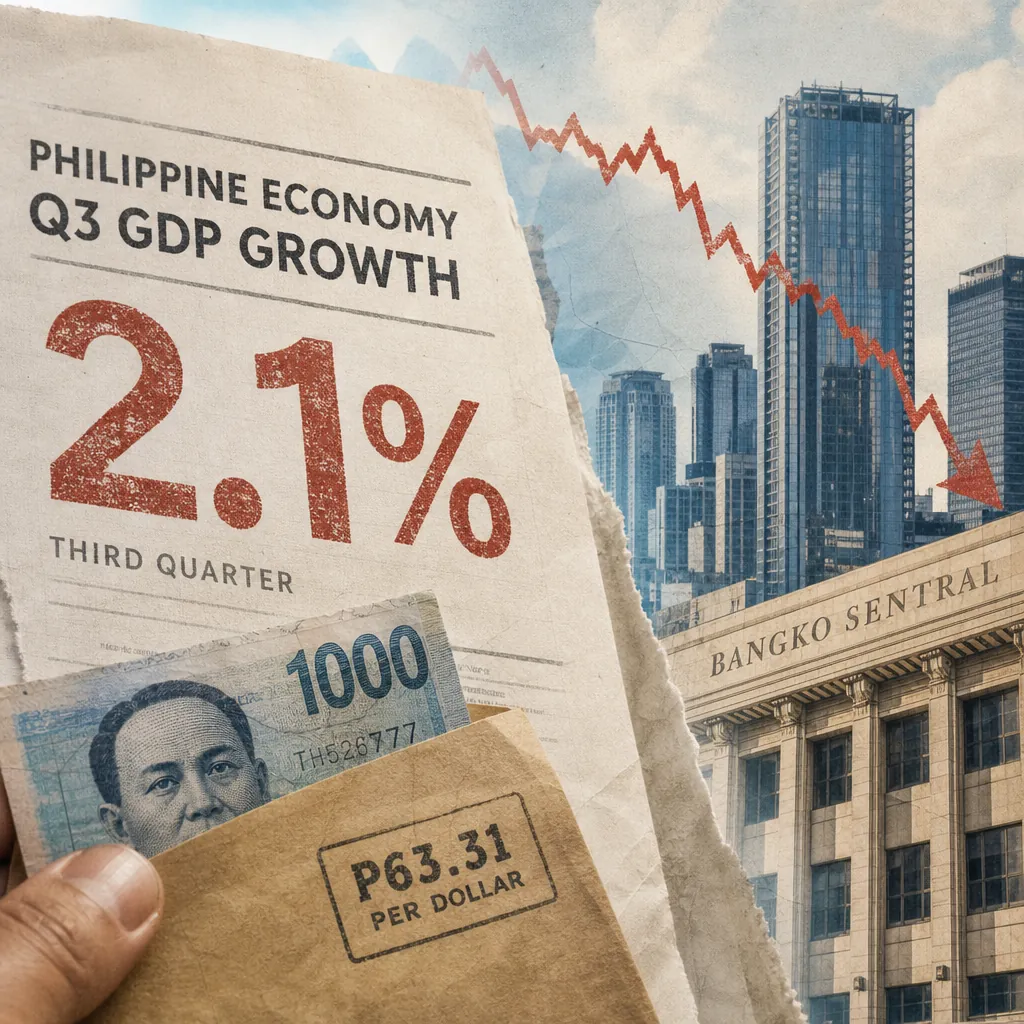
The peso and stock market recovered on November 10 as lower oil prices eased sentiment, while economists debated whether the central bank should keep raising rates after third-quarter growth fell to 2.1 percent. GCash parent Mynt reported a 17.4 percent profit rise in its first results as a listed company.
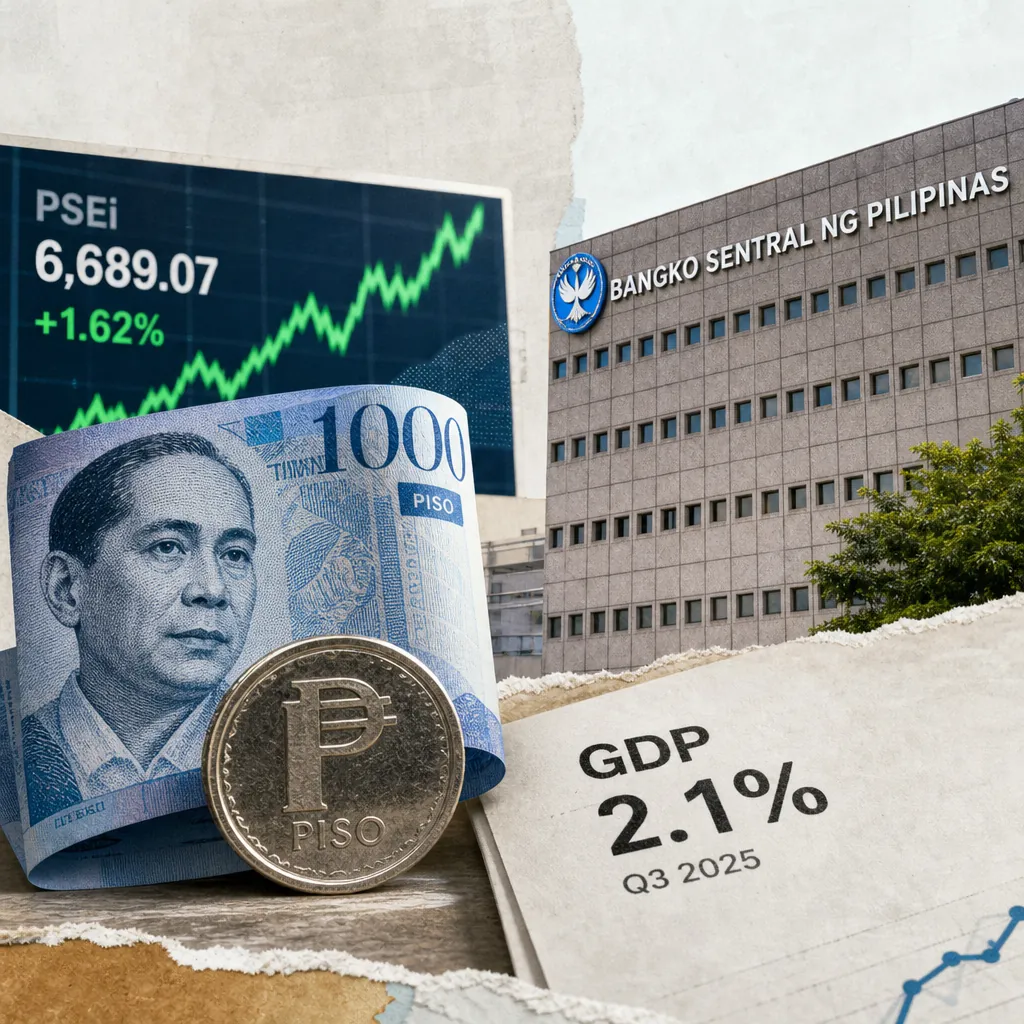
The Philippine peso closed at P62.91 to the dollar on Tuesday, 40 centavos stronger than Monday's P63.31, and the benchmark Philippine Stock Exchange index (PSEi) rose 0.67 percent, or 38.23 points, to 5,716.15 4772. Both moves came a day after the Philippine Statistics Authority reported that gross domestic product (GDP) — the total value of goods and services the country produces — grew just 2.1 percent in the July-to-September quarter, the slowest pace since the pandemic and the fifth consecutive quarter of decelerating growth 7662. The rebound was driven by a drop in global oil prices and easing concerns over Middle East tensions after US President Donald Trump's meeting with Qatar, according to China Banking Corporation group chief economist Domini Velasquez, who described the reaction as "broad-based," with government bonds also drawing strong demand at auction 47.
Underneath the one-day recovery, the day's coverage in this set was dominated by a harder question: what the Bangko Sentral ng Pilipinas (BSP), the country's central bank, should do next. October inflation hit 7.8 percent, the highest since February 2023 and far above the BSP's 2-to-4 percent target band, while growth has collapsed 4562. Economists at HSBC, Bank of America and Bank of the Philippine Islands told Philstar they expect further rate increases despite the slowdown 76. A former BSP deputy governor, Diwa Guinigundo, went further, telling BusinessMirror he would keep his call for a 50-basis-point hike in December — a half-percentage-point increase — arguing that holding back because growth is weak "could risk allowing inflation expectations to become further unanchored" 30. Capital Economics, by contrast, expects the central bank to hold at its December meeting, citing the weak economy 37.
The corporate story of the day was GCash. Mynt Inc., the parent of the country's dominant e-wallet, reported a 17.4 percent rise in net income to P16.45 billion for the first nine months of 2026, its first earnings report since listing on the Philippine Stock Exchange on October 20 2871. Third-quarter profit alone jumped 43.3 percent year on year, and the company said quarterly revenues and net income both hit all-time highs 37. The results landed across broadsheets and online business desks, and the coverage carried real weight: the BusinessWorld report on Mynt's earnings represented an estimated P243,451 in advertising-equivalent value — the notional cost of buying the same space as paid advertising — while Philstar's account carried about P292,727 3771.
Key themes
- GDP growth of 2.1 percent marks a fifth straight quarterly slowdown. The July-to-September figure was below the market's 3.1 percent forecast and well under the government's already-reduced 3.5-to-4.5 percent target for 2026 7662. The Philippines now trails Vietnam (9.95 percent), Malaysia, Singapore and Indonesia, all growing above 5 percent 62.
- Inflation at 7.8 percent puts the BSP in a bind between price stability and growth. October's rate was the highest since February 2023, and Bank of America expects consumer prices to average 6 percent this year and 5.2 percent in 2027, keeping inflation above target until late next year 2645.
- Economists are split on whether the BSP hikes again in December. HSBC, BofA and BPI expect more increases; Capital Economics expects a hold; Guinigundo argues for 50 basis points 763730.
- The peso recovered 40 centavos to P62.91 on lower oil prices. The rebound followed Monday's close of P63.31, itself a 25.5-centavo decline from Friday's P63.055 4737. BMI, a Fitch Solutions unit, still expects the peso to end 2026 at P63.50 to the dollar, weaker than its earlier P63 forecast 36.
- The PSEi rose 0.67 percent to 5,716.15 on late-session buying. The index spent most of Tuesday below its prior close before a late surge lifted it back above 5,700 7237.
- Mynt's profit rose 17.4 percent to P16.45 billion in its first post-listing results. Revenue grew 12 percent to P67.08 billion, with digital financial services up 38 percent to P29.1 billion and the active borrower base reaching 7.8 million 7128.
- Foreign debt service rose 5.2 percent to $8.25 billion in January-to-July. Principal payments climbed 12.9 percent to $3.58 billion while interest payments were flat at $4.67 billion 7844.
- The government will revise its 2026 and 2027 economic targets in December. President Ferdinand Marcos Jr. has asked the Development Budget Coordination Committee (DBCC) — the interagency body that sets the government's macroeconomic assumptions — to meet in early December to review GDP growth, inflation and the peso exchange rate 29.
How the narratives stack
Dominant. The rate-decision debate dominated the business pages in this set. At least six separate items across BusinessWorld, BusinessMirror, Philstar and Inquirer addressed whether the BSP should keep tightening, and the coverage was substantial: the BusinessWorld front-page story on the BSP facing pressure to pause carried an estimated P592,634 in advertising-equivalent value, and the BusinessMirror report on Guinigundo's call for a 50-basis-point hike carried about P630,828 3730. The dominance is a property of the items gathered here, which skew toward business broadsheets and online business desks; it reflects where this monitoring sample was weighted as much as where the story sat.
Counter-narrative. The one-day market recovery told a different story from the growth data. The peso's 40-centavo gain and the PSEi's 0.67 percent rise suggested investors were reacting to oil prices and global risk sentiment rather than to the domestic growth slump 4772. AP Securities noted the index spent most of the session below its prior close before the late surge 72. The recovery does not reverse the trend: the peso hit a historic low of P64.17 on October 27 and remains far weaker than the P58-to-P59 level before the war 36.
Emerging. Mynt's earnings report is the first hard look at GCash's financials as a public company, and the numbers point to lending as the growth engine. Payment solutions revenue actually fell 2 percent to P37.98 billion, offset by a 38 percent rise in digital financial services driven by credit 71. The company's return on average equity stood at 27.3 percent, and its net income margin improved to 24.5 percent from 23.4 percent 37. How the market values a fintech whose payments business is flat but whose lending book is expanding will be the test over the coming quarters.
Under-covered. The peso's slide to a historic P64.17 on October 27 and the BSP's intensified foreign-exchange surveillance drew comparatively little attention in this set relative to the rate debate. BSP Deputy Governor Zeno Ronald Abenoja said in Iloilo City on November 6 that the central bank was "closely monitoring what is happening in the foreign exchange market" 66. The peso's weakness raises the cost of dollar-denominated imports, particularly crude oil, and of external debt obligations — a channel that connects directly to the inflation problem the rate debate is about.
Platform insights
The monitoring writeup for this window did not accompany the article set, so this section draws only on what the published items themselves show about how the story travelled.
- Business broadsheets. BusinessWorld and BusinessMirror carried the analytical weight, with front-page treatment of the BSP's dilemma and the peso forecast 3736. The broadsheet framing was macroeconomic and forward-looking, built around the December policy meeting.
- Online business desks. Philstar, Inquirer and BusinessMirror's online editions moved the same stories quickly, with Philstar running separate items on the rate outlook, the stock rebound, Mynt's earnings and the debt-service data 76727178. The online coverage was more granular and more current than the print versions.
- Corporate disclosure channels. Mynt's results reached the market through a stock exchange disclosure on Tuesday, which the business press then translated into stories within hours 37. The disclosure itself is the primary document; the coverage is the interpretation.
Key voices and communities
Central bank watchers and bank economists. Guinigundo, Velasquez of Chinabank, Michael Ricafort of Rizal Commercial Banking Corp., and analysts at HSBC, BofA, BPI and Capital Economics drove the rate debate 3047447637. Their framing is technical — basis points, inflation expectations, output gaps — but the stakes are plain: every rate decision feeds into loan costs for households and businesses.
The Marcos administration's economic managers. The DBCC's December meeting and the Palace's announcement that targets will be revised signal that the government is recalibrating in public 29. Press Officer Claire Castro said the DBCC will review GDP growth, inflation and the exchange rate 29.
Fintech investors and GCash users. Mynt's first post-listing earnings drew attention to the 7.8 million active borrowers on GCash's credit products, about 19 percent of its user base 71. For ordinary users, the lending push matters because it determines how aggressively the platform markets credit.
Global rating and research houses. BMI's peso forecast of P63.50 and its warning that the Philippines' reliance on food and energy imports will strain the external account give the currency story an outside view 36.
Narrative streams
The BSP faces a December choice between 7.8 percent inflation and 2.1 percent growth
The central bank's final policy meeting of the year in December is the next scheduled decision point, and the case for and against another hike was laid out in detail on Tuesday. Guinigundo, a former deputy governor, argued that a 50-basis-point increase should be viewed "not as an attempt to kill growth, but as an attempt to prevent today's inflation shock from becoming tomorrow's inflation expectation problem" 30. He added that lowering or holding rates too low cannot solve problems of agricultural productivity, food supply or infrastructure bottlenecks 30. Capital Economics senior Asia economist Gareth Leather wrote that the fresh inflation peak "has put increased pressure on the central bank to hike rates again," but that "the weakness of the economy could give the central bank second thoughts, and on balance we expect a hold" 37. BofA expects inflation to average 6 percent this year and 5.2 percent in 2027, and sees GDP growth recovering to 2.5 percent in the fourth quarter and 3.5 percent in 2027 26.
For households and businesses, the practical consequence is the cost of borrowing. A 50-basis-point hike would raise interest payments on variable-rate loans, including many consumer and small-business loans, at a moment when unemployment has risen to 5.4 percent from 3.8 percent a year earlier 45. For banks, the split matters for net interest margins and for loan-loss provisioning if growth stays weak. The BSP's own mandate — keeping prices stable — points toward tightening; the growth data points the other way. The December meeting will resolve which the central bank weighs more heavily.
The peso's one-day rebound leaves it near historic lows
The peso's move from P63.31 on Monday to P62.91 on Tuesday was the largest single-day gain in this set, but it sits inside a longer decline 47. The currency breached P64 in October and hit a historic trough of P64.17 on October 27 after closing at a record low for a seventh straight trading day 36. BMI's Brandon Ong said "near-term fundamentals remain weak for the PHP," citing the Philippines' reliance on food and energy imports and a more hawkish US Federal Reserve 36. The BSP's Abenoja said the central bank was monitoring the market to guard against excessive volatility 66.
For importers and consumers, a weaker peso raises the peso cost of dollar-priced goods, especially fuel, which feeds directly into the inflation the BSP is fighting. For the government, a weaker peso makes foreign debt repayments more expensive in local currency; the debt-service burden already rose 5.2 percent to $8.25 billion in January-to-July, with principal payments up 12.9 percent 78. Ricafort attributed the rise to wider budget deficits and more borrowings since the pandemic, some of which have now matured 44. The one-day gain eases none of that arithmetic.
Mynt's first post-listing results show lending, not payments, driving growth
Mynt's nine-month net income of P16.45 billion, up 17.4 percent from P14.02 billion, came with a sharper third-quarter acceleration: profit rose 43.3 percent year on year in the July-to-September period 7137. Revenue grew 12 percent to P67.08 billion, but the composition matters more than the total. Payment solutions revenue fell 2 percent to P37.98 billion, while digital financial services rose 38 percent to P29.1 billion, and credit revenues alone rose 39 percent to P28.55 billion 71. The active borrower base reached 7.8 million, about 19 percent of users 71.
For GCash's users, the shift toward lending means the platform's growth now depends on how many of them borrow and repay. For competitors and regulators, a fintech with 7.8 million borrowers is a systemically relevant lender, and the quality of that loan book will draw scrutiny as consumer credit conditions tighten. The company's 27.3 percent return on average equity is high by banking standards, and sustaining it will require the lending book to keep growing without a rise in defaults 37.
The government will revise its growth targets downward in December
The DBCC will meet in early December to review macroeconomic assumptions and targets, including GDP growth, inflation and the peso exchange rate, after the 2.1 percent third-quarter print 29. The committee had already cut its 2026 growth target to 3.5-to-4.5 percent from 6-to-7 percent 29. The Inquirer's editorial board called the Philippines a "regional laggard," noting the fifth consecutive quarter of decelerating growth was the longest streak since 2011 62.
For businesses that plan investment against government forecasts, a downward revision resets expectations for demand. For the fiscal position, slower growth means weaker tax collections against a budget deficit that Ricafort already links to higher borrowing 44. The December meeting will be the government's first formal acknowledgment in numbers of how much the outlook has changed.
Foreign debt service rises as more pandemic-era loans mature
The country's external debt service burden — principal and interest payments on foreign obligations — rose 5.2 percent to $8.25 billion in January-to-July from $7.84 billion a year earlier 78. Principal payments climbed 12.9 percent to $3.58 billion, while interest payments were virtually unchanged at $4.67 billion 78. The burden equaled 3 percent of GDP, unchanged from a year earlier, and 20.3 percent of total export shipments, better than 21 percent previously — meaning the country spent about 20 cents of every dollar earned from exports on foreign debt service, down from 21 cents 27.
For the government, the maturity profile matters: loans taken during the pandemic are now coming due, and a weaker peso makes each dollar of repayment costlier in local currency 44. For the BSP, the debt-service data is one more reason the exchange rate is not a side issue in the inflation fight.
Conversation trajectory
December BSP policy meeting — watch the decision and the statement language. The central bank's final meeting of 2026 is the next scheduled event where the rate debate resolves. The split among economists — HSBC, BofA and BPI expecting hikes, Capital Economics expecting a hold, Guinigundo calling for 50 basis points — means the outcome is genuinely uncertain 763730. Watch whether the statement emphasizes inflation expectations or growth risks.
Early December DBCC meeting — watch the revised targets. The committee will publish revised GDP, inflation and exchange-rate assumptions 29. A cut to the 2026 growth target below 3.5 percent would confirm the government expects the slowdown to persist into next year.
November inflation release — watch whether the 7.8 percent October print was the peak. BofA expects inflation to average 6 percent this year, which implies monthly prints falling from October's level 26. A second consecutive month above 7.8 percent would strengthen the case for a December hike.
Mynt's next quarterly report — watch loan growth and credit quality. The third quarter showed lending driving profit; the fourth quarter will show whether the 7.8 million borrower base is growing without a rise in defaults 71.
Peso trading — watch whether P62.91 holds. BMI's P63.50 year-end forecast implies further weakness from Tuesday's close 36. A move back above P64 would test the BSP's tolerance for volatility.
Response guidance
Banks and lenders: prepare customers for the possibility of another rate increase. Variable-rate borrowers should be told plainly what a 50-basis-point hike would do to their monthly payments, with worked examples. The BSP's December meeting is the trigger; communications should be ready before the decision, not after.
Fintech platforms: address credit quality directly in disclosures. Mynt's results show lending is now the growth engine. Investors and regulators will ask about default rates and borrower concentration; answering those questions before they are asked is more credible than responding to them.
Business associations: separate the one-day market recovery from the growth trend. The peso's 40-centavo gain and the PSEi's 0.67 percent rise are real, but they reflect oil prices and global sentiment, not a change in domestic conditions 4772. Members planning investment should work from the 2.1 percent GDP print and the December DBCC revision, not from Tuesday's close.
Government communicators: explain the DBCC revision in plain terms. The December meeting will produce new numbers. Saying what changed and why — slower consumption, weaker agriculture, lower investment — is more useful than presenting the revision as routine.
All financial institutions: treat the peso's weakness as a consumer-cost issue. A weaker peso raises fuel and import costs, which feeds the inflation households already feel. Messages that connect exchange-rate movements to grocery and transport prices will land better than abstract commentary on the external account.
On sensitive topics: avoid predicting a crisis. The data is serious — 2.1 percent growth, 7.8 percent inflation, 5.4 percent unemployment — but economists are not forecasting a contraction, and the market recovered on Tuesday 4547. Communications that describe the situation accurately without alarm will hold up better than either reassurance or alarmism.
See the full picture behind today's signals.
This report draws from Media Meter's MediaWatch, our real-time monitoring engine tracking 2,470+ Philippine sources across print, broadcast, digital, and social. Explore how the platform turns raw coverage into decision-grade intelligence, then see how it's configured for teams like yours — whether you're in PR agencies, corporate comms, government, or marketing.
Want more? Browse our Report Library for sector and crisis intelligence, or request a demo and we'll have your brand set up before the call.
Want this kind of intelligence on your brand?
This brief is built on the same MediaWatch methodology that runs continuously across every brand we monitor. See your competitive landscape, Impact Score, and narrative trajectory in a 30-minute demo.