VAT on power system loss removed; fuel prices jump again
The Bureau of Internal Revenue scrapped the 12-percent value-added tax on the system loss charge in electricity bills, a change the energy department says saves the average household at least ₱20 a month. The same day, another round of fuel price increases hit motorists, and transport groups pressed for a fare hike.
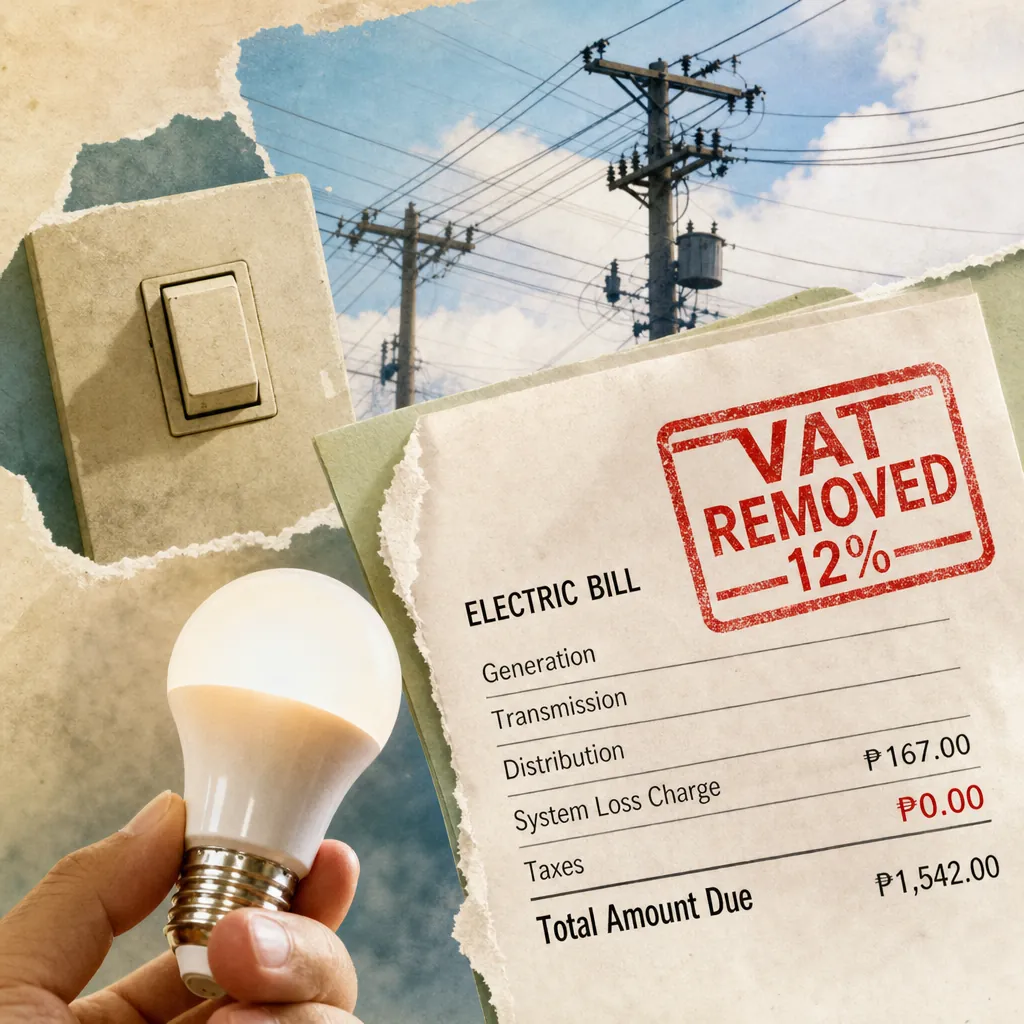
The Bureau of Internal Revenue (BIR) removed the 12-percent value-added tax (VAT) on the system loss charge in electricity bills, effective immediately, under Revenue Memorandum Circular No. 097-2026 published on Monday, September 14.59 The circular confirms that the allowable system loss charge — the portion of electricity that utilities lose in transmission and distribution, which regulators let them pass on to customers — will no longer be treated as part of the gross sales of generation companies and distributors, and so will no longer carry VAT.59 The Department of Energy (DOE) said the change should save the average household consuming 200 kilowatt-hours a month at least ₱20 on its bill, and earlier estimated the removal could cut power costs by about 5 to 10 percent.4259 The announcement drew coverage across television and online news, including a TV 5 report that put the annual savings to consumers at roughly ₱6 billion.50
The same day brought a second, sharper price signal. Oil companies implemented another round of increases on Tuesday, September 15, with diesel rising by as much as ₱4.31 per liter, gasoline by ₱5.68 per liter, and kerosene by ₱4.62 per liter, according to the DOE.7 The increases trace back to the closure of the Strait of Hormuz — the narrow waterway between the Persian Gulf and the Gulf of Oman through which roughly a fifth of the world's oil and liquefied natural gas supply passes — after fighting broke out between the United States and Israel on one side and Iran on the other in February.7 Diesel prices at some stations have climbed to nearly ₱100 per liter.50
Transport groups responded on two tracks. The group Manibela cancelled the second day of its planned transport strike, explaining that fewer students were commuting because of a scheduled wellness break for teachers, while the group Piston pressed ahead with protests in Quezon City, Balintawak, and Alabang, calling on the government to act on fuel prices and scrap the excise tax on petroleum products.50 A tricycle driver interviewed by Bombo Radyo Cauayan made a smaller-scale version of the same complaint, asking for even enforcement of franchising rules against unregistered "kolorum" tricycles that undercut licensed drivers.35
Key themes
- The BIR removed VAT from the system loss charge, cutting household bills by at least ₱20 a month. The charge stays on the bill but is no longer taxed, because the BIR now classifies it as a government-mandated pass-through cost within the cap set by the Energy Regulatory Commission (ERC), the agency that approves what utilities may charge.4259 The DOE said the next step is to remove the system loss charge from bills entirely.50
- Fuel prices rose again, with diesel up as much as ₱4.31 per liter. The increases follow the February closure of the Strait of Hormuz and seven months of sustained oil price pressure, and they landed the same day the power-bill relief was announced.7
- Transport groups split on how to respond. Manibela called off the second day of its strike; Piston staged protests in Metro Manila and renewed its call to scrap the excise tax on fuel.50
- The government is pitching the Philippines as a regional oil storage hub. Energy Secretary Sharon Garin said the DOE is marketing the country to companies that would build storage facilities for the Association of Southeast Asian Nations (ASEAN) region and Asia, on the condition that the Philippines gets priority access during emergencies.25
- The Visayas power grid was placed under red and yellow alerts. The National Grid Corporation of the Philippines (NGCP) said the grid would run short of supply on Tuesday evening, with available capacity of 2,352 megawatts against expected peak demand of 2,492 megawatts, after 12 power plants went offline.71
- The Senate approved a bill barring beneficiaries from selling or renting government housing. Senate Bill No. 2421, the Adequate and Decent Housing Through Usufruct Act, passed on third reading with 18 votes in favor, none against, and no abstentions; it lets poor families live in state housing under a usufruct agreement while the government keeps ownership.4143
- President Marcos turned over 333 housing units in Valenzuela City. The units at Disiplina Village in Arkong Bato are for informal settler families relocated from flood-prone areas along the Tullahan River, part of a project designed to provide 960 units.637
- The first Bangsamoro parliamentary elections were marred by violence and a ballot dispute. Four people were killed and 19 injured in election-related incidents, and pre-shaded ballots found in Maluso, Basilan, prompted the Commission on Elections (Comelec) to extend voting there and threaten an electoral sabotage case.164462
How the narratives stack
Dominant. The removal of VAT on the system loss charge carried the most consequence of anything in the day's captured coverage. It is a national policy change that affects every household and business with an electricity bill, it was announced by the BIR through a formal circular, and it was picked up across television (TV 5, IBC 13, PTV4) and online news (Inquirer, GMA News, Head Topics).505942 The Inquirer framed it as the fulfilment of a promise Marcos made in his State of the Nation Address, when he asked Congress to amend the Electric Power Industry Reform Act (EPIRA) — the 2001 law that restructured the power sector and allowed utilities to pass system loss charges to consumers — to stop the pass-through of both the system loss charge and VAT on it.59 The DOE's estimate that the change could cut power costs by 5 to 10 percent gives the story its scale.59
Counter-narrative. The fuel price increase is the counterweight, and it is not a contradiction of the power-bill relief so much as a separate cost pressure arriving the same day. Diesel rose by as much as ₱4.31 per liter, gasoline by ₱5.68, and kerosene by ₱4.62, per the DOE.7 For jeepney and tricycle drivers, fuel is the single largest operating cost, so an increase of that size can erase a day's margin. Piston's protests and its call to scrap the excise tax — the fixed tax the government levies per liter of fuel — are the visible expression of that pressure.50 The two stories together describe a household budget squeezed from two directions at once: electricity getting marginally cheaper, transport getting more expensive.
Emerging. The DOE's plan to market the Philippines as a regional oil storage hub is early-stage and conditional. Garin said the department is inviting companies to build storage facilities in the country for ASEAN and Asian markets, with the condition that the Philippines gets priority access in an emergency.25 If it materializes, the plan would give the country a buffer against exactly the kind of supply shock that closed the Strait of Hormuz. It would also require significant private investment in port and tank infrastructure, and no company has publicly committed. The NGCP's red and yellow alerts in the Visayas are a related signal: the grid had 2,352 megawatts of available capacity against 2,492 megawatts of expected peak demand, with 12 plants offline, including the large coal plants Therma Visayas Inc. 1 and 2 and Panay Energy Development Corporation 3.71 A red alert means supply is insufficient to meet demand and reserves, so rotating power interruptions are possible.71
Under-covered. The Senate's approval of the usufruct housing bill and the President's turnover of 333 housing units in Valenzuela are the day's most concrete housing developments, and they drew less attention than the energy stories. Senate Bill No. 2421 passed with 18 votes in favor and none against; under a usufruct arrangement, a beneficiary may live in government housing under a written contract registered with the Registry of Deeds, but the state keeps ownership, which bars the beneficiary from selling or renting the unit.4143 Senator Francis "Chiz" Escudero, who sponsored the measure as chair of the Senate Committee on Urban Planning, Housing and Resettlement, said it would let families live in government housing "without the burden of ownership costs."41 Separately, Marcos led the turnover of 333 units at Disiplina Village Arkong Bato, part of a 960-unit project for families affected by the Supreme Court's mandamus to clear Manila Bay and for residents of danger zones; Valenzuela Mayor Wes Gatchalian said 5,549 people now live in Disiplina Villages, with 3,306 informal settler families still along waterways and in danger zones.663 The President said he hopes the program will "begin to lessen the shortfall in housing units."37
Platform insights
Facebook. The day's most engaged social story was not a policy item. Chloe San Jose, the partner of two-time Olympic gold medalist Carlos Yulo, continued a public dispute with Yulo's mother, Angelica, replying to a Facebook comment that defended the older woman.1 "Well why dont you apply that to the 'mother, if she only showed respect i wouldve given her 10x more respect back," she wrote.1 In a separate exchange, she drew backlash for invoking the mother of the late basketball player Rene Baterbonia, with commenters telling her not to drag other families into the dispute.60 The pattern is familiar on Philippine Facebook: a celebrity-adjacent family conflict generates far more comment volume than a tax circular, because it invites moral judgment rather than analysis.
X. Political argument dominated. Vice President Sara Duterte's call for President Marcos to resign, made at a speaking engagement before supporters at Quezon City Hall, was the most-shared political statement of the day, and it was amplified by overseas Filipino workers in Japan who told SMNI News Channel they welcomed it.15 The Palace responded through Press Officer Claire Castro, who said the administration's position on Harry Roque's asylum bid had not changed, and through a separate statement calling the Duterte camp's characterization of the President as "out of touch" delusional.1950
Reddit and forums. Discussion of the power-bill change focused on the arithmetic: how much a household actually saves, and whether the removal of VAT on the system loss charge is a meaningful cut or a rounding error. The ₱20 monthly saving for a 200-kilowatt-hour household was the figure most often cited, and the most common skeptical response was that the DOE's 5-to-10-percent estimate applies to the system loss component, not the whole bill.4259
YouTube. Television clips drove the day's video traffic. The most-watched items in the captured set were the TV 5 and IBC 13 segments on the fuel price increase and the transport strike, followed by the PTV4 and IBC 13 reports on the Valenzuela housing turnover.50763 Video engagement tracked broadcast reach rather than social sharing, which is typical for policy stories that break on television.
Key voices and communities
Energy regulators and the DOE. Energy Secretary Sharon Garin was the day's most-quoted official, announcing both the VAT removal and the oil storage hub plan.4225 The DOE's framing is consumer relief: the VAT removal is presented as a direct saving, and the storage hub as a long-term supply-security play. The ERC's role matters here — it sets the cap on how much system loss a utility may pass through, and only the portion within that cap is now VAT-exempt.59
Transport groups. Piston and Manibela represent jeepney and tricycle operators, the sector most exposed to fuel prices. Their split response — Manibela cancelling its strike, Piston proceeding — reflects different calculations about public sympathy and disruption. Piston's demand to scrap the excise tax is a long-standing position; the excise tax is a fixed per-liter levy that the government has been reluctant to suspend because of the revenue it raises.50
Housing advocates and the Senate. Escudero's usufruct bill and the Valenzuela turnover represent the two arms of housing policy: legal tenure arrangements and physical units. The usufruct model is a departure from outright ownership, and its supporters argue it prevents beneficiaries from selling units they received for free; its critics have not yet been heard in the captured coverage.4143
The Vice President's camp and the Palace. Sara Duterte's resignation call and the Palace's response are the day's sharpest political exchange. The Vice President's statement was her first explicit call for Marcos to step down, and it was made before supporters rather than in an official setting.15 The Palace's reply, delivered through Castro and a separate statement, focused on the asylum issue rather than the resignation call itself.1950
Comelec and Bangsamoro election stakeholders. The commission's handling of the pre-shaded ballots in Maluso, Basilan, and its threat to file electoral sabotage charges — a crime that can carry life imprisonment — put election integrity at the center of the first Bangsamoro parliamentary elections.62 The United Bangsamoro Justice Party asked Comelec to investigate and declare a failure of elections in areas where violence occurred.50
Narrative streams
The BIR removes VAT from the system loss charge
The system loss charge is the amount utilities are allowed to bill customers for electricity that is lost between generation and delivery — through transmission lines, transformers, and distribution. Under the Electric Power Industry Reform Act of 2001, the law that broke up the old state power monopoly and set the rules for the current market, utilities may pass a capped portion of those losses to consumers. The Energy Regulatory Commission sets the cap. What changed on Monday is narrower than it sounds: the charge stays on the bill, but the 12-percent VAT that used to be added to it is gone, because the BIR now treats the charge as a government-mandated pass-through rather than part of a company's sales.59
The practical effect for a household using 200 kilowatt-hours a month is a saving of at least ₱20, according to the DOE.42 The DOE had earlier estimated the removal could lower power costs by about 5 to 10 percent, though that range applies to the system loss component rather than the entire bill.59 TV 5 reported the annual saving to consumers at roughly ₱6 billion.50 The DOE said the next step is to remove the system loss charge from bills altogether, which would require amending EPIRA — the change Marcos asked Congress to make in his State of the Nation Address.5059
For utilities and generation companies, the change removes a small line of VAT liability but does not alter the underlying pass-through mechanism. For consumers, the saving is real but modest, and it arrives in the same week that fuel prices rose. The read for the sector is that the government has begun delivering on the power-cost promise it made in the SONA, but the mechanism it used — a tax circular rather than a law change — leaves the system loss charge itself intact, so the larger reform remains pending in Congress.
Fuel prices rise again and transport groups split
Diesel rose by as much as ₱4.31 per liter, gasoline by ₱5.68, and kerosene by ₱4.62 on Tuesday, per the DOE.7 The increases are the latest in a run that began after the February closure of the Strait of Hormuz, the chokepoint through which about a fifth of global oil and liquefied natural gas passes.7 Diesel at some stations has reached nearly ₱100 per liter.50
Manibela cancelled the second day of its transport strike, saying fewer students were commuting because of a teacher wellness break, while Piston went ahead with protests in Quezon City, Balintawak, and Alabang and renewed its call for the government to scrap the excise tax on fuel.50 A driver interviewed on television put the squeeze plainly: "Nagdagdag na naman ang presyo ng diesel, malaking kapawasan na naman sa kikitayo namin" — another diesel increase, another big cut into what we earn.50 In Cauayan City, a licensed tricycle driver asked for even enforcement against unregistered "kolorum" tricycles that take passengers without a franchise, a reminder that the pressure on transport operators predates the current fuel spike.35
For transport operators, fuel is the largest variable cost, and fare adjustments require approval from local government units and the Land Transportation Franchising and Regulatory Board, which is why the groups are pressing for a fare increase rather than simply raising prices. For commuters, the risk is that a fare hike follows the fuel hike, adding to household costs that the power-bill saving only partly offsets. The read for the sector is that the government faces pressure to either suspend the fuel excise tax or approve fare increases, and either choice carries a cost — lost revenue in the first case, higher commuting costs in the second.
The Philippines pitches itself as an Asian oil storage hub
Energy Secretary Sharon Garin said the DOE is marketing the Philippines as a regional storage hub for ASEAN and the wider Asian community, inviting companies to build storage facilities in the country and stockpile fuel there.25 The condition, she said, is that the Philippines gets priority access in an emergency: "Basta ang condition lang diyan, in case of emergency, dapat 'yung host country, 'yung bansa natin" — the only condition is that in an emergency, the host country, our country, comes first.25
The plan is a response to the supply vulnerability exposed by the Strait of Hormuz closure. If storage capacity exists on Philippine soil, the country would have fuel on hand even when shipping routes are disrupted. The DOE is also pursuing fuel supply agreements with countries outside the Middle East to diversify sources.21 No company has publicly committed to building storage, and the plan would require port access, tank farms, and environmental clearances. For the energy sector, the proposal is a long-term play that would make the Philippines a logistics node rather than just a consumer. The read for the sector is that the DOE is trying to convert a geographic position — the archipelago sits astride major shipping lanes — into strategic leverage, but the plan depends on private capital that has not yet materialized.
The Visayas grid runs short
The National Grid Corporation of the Philippines placed the Visayas grid under red and yellow alerts on Tuesday, with a red alert from 5 to 7 p.m. and yellow alerts from 3 to 5 p.m. and 7 to 8 p.m.71 Available capacity was 2,352 megawatts against expected peak demand of 2,492 megawatts, a shortfall of 140 megawatts.71 Twelve power plants were offline, including the large coal plants Therma Visayas Inc. 1 and 2 and Panay Energy Development Corporation 3; one plant had been down since July, two since June, and seven since May.71
A red alert means supply is insufficient to cover demand plus the reserves the grid needs, so rotating brownouts are possible; a yellow alert means reserves are low but supply still meets demand.71 The alerts are a recurring feature of the Visayas grid, which has fewer large plants than Luzon and depends on a mix of coal, geothermal, and diesel. For households and businesses in the Visayas, the alerts mean possible interruptions during peak evening hours. The read for the sector is that the grid's thin reserve margin makes it vulnerable to plant outages, and the DOE's push for new capacity — including the storage hub plan — is partly a response to that fragility.
Housing: usufruct bill passes the Senate as Marcos turns over units
The Senate approved Senate Bill No. 2421, the Adequate and Decent Housing Through Usufruct Act, on third and final reading with 18 votes in favor, none against, and no abstentions.41 Under a usufruct arrangement, a beneficiary may use and live in government land and housing under a written contract registered with the Registry of Deeds, but the state retains ownership.41 Escudero, the sponsor, said the arrangement gives families "the right to live in government housing without the burden of ownership costs, while ensuring transparency and legal protection through contracts registered with the Registry of Deeds."41 The bill now goes to a bicameral conference committee because the House has passed a similar measure.70
The same day, Marcos led the turnover of 333 housing units at Disiplina Village Arkong Bato in Valenzuela City, part of a 960-unit project for informal settler families affected by the Supreme Court's mandamus to clear Manila Bay and for residents of danger zones.6 Nine buildings have been completed under Phases 1, 2, and 3, and relocation began in April.6 Marcos said the program will continue: "Kayat patuloy ang ating magiging housing program and hopefully we will begin to lessen the shortfall in housing units para sa ating mga kababayan."37 Mayor Gatchalian said 5,549 people now live in Disiplina Villages, with 3,306 informal settler families still along waterways and in danger zones.63
For beneficiaries, the usufruct model offers secure tenure without the cost of ownership, but it also means the unit cannot be sold or passed on as an asset. For the government, it preserves public ownership of housing stock and prevents the resale that has plagued past resettlement programs. The read for the sector is that housing policy is shifting toward tenure without title, and the test will be whether beneficiaries accept a home they cannot sell.
The first Bangsamoro parliamentary elections
The first Bangsamoro Autonomous Region in Muslim Mindanao (BARMM) parliamentary elections were held on Monday, September 14, after four postponements, and the counting extended into Tuesday.56 Four people were killed and 19 injured in election-related violence, including a shooting at a polling precinct in Cotabato City that wounded a police officer and twice delayed voting at Central Pilot Elementary School.16 In Maluso, Basilan, pre-shaded and compromised ballots were found in 36 of 68 precincts, prompting Comelec to extend voting there.4456
Comelec spokesperson John Rex Laudiangco said the commission intends to file electoral sabotage charges against a candidate linked to the pre-shading, a crime that can carry life imprisonment, and to seek the candidate's disqualification.62 The United Bangsamoro Justice Party asked Comelec to investigate and declare a failure of elections in areas where violence occurred.50 Comelec said it expected to proclaim all winning regional political parties and sectoral representatives before midnight on Tuesday, with nearly 99 percent of returns submitted and the Bangsamoro Federalist Party leading.4456
The BARMM is the autonomous region created by the 2019 Bangsamoro Organic Law as part of the peace agreement with the Moro Islamic Liberation Front; its parliamentary elections replace the old regional assembly and are a milestone in the transition. For voters in the region, the violence and the ballot dispute raise questions about whether the new government will have a clean mandate. The read for the sector is that Comelec's handling of the Maluso case will set the standard for how the commission polices electoral fraud in the region's new parliamentary system.
The impeachment trial examines Sara Duterte's SALN
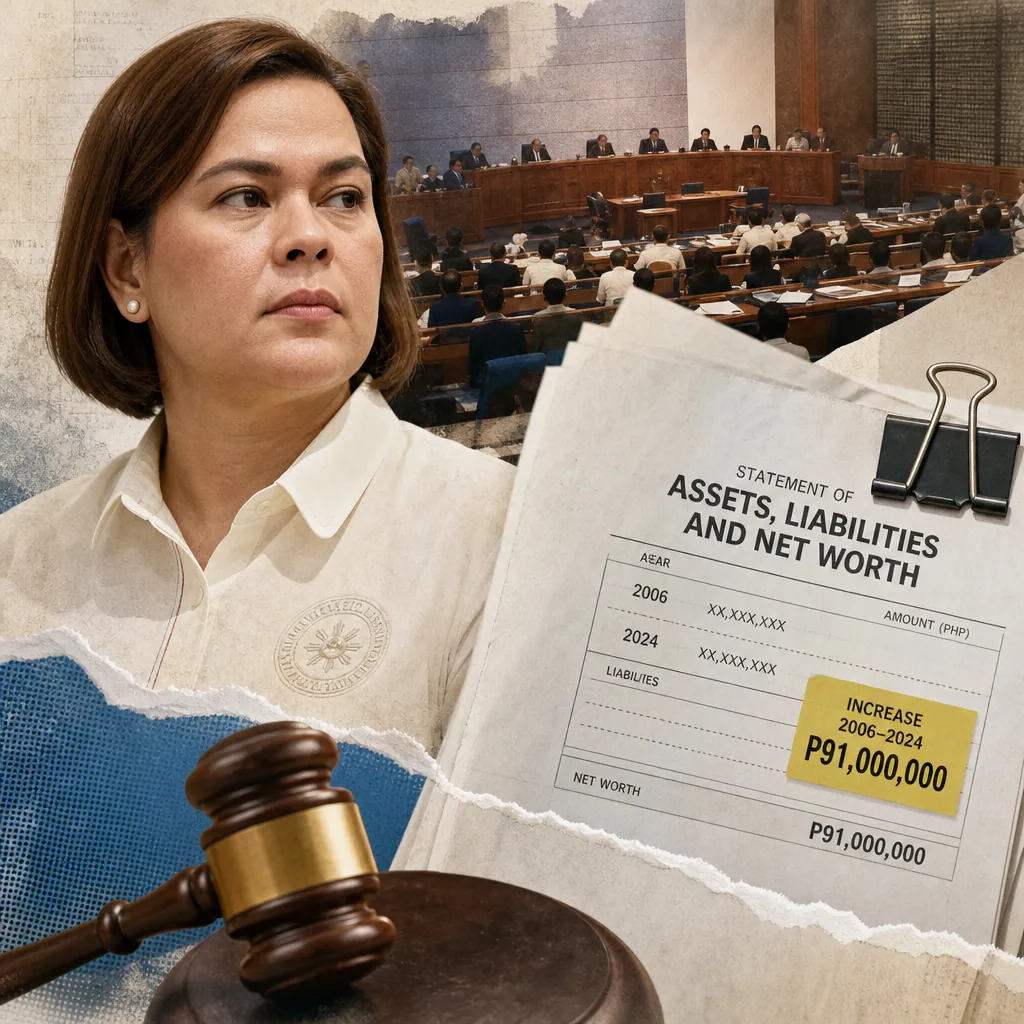
Day 25 of the Senate impeachment trial of Vice President Sara Duterte focused on her Statements of Assets, Liabilities and Net Worth (SALN) from 2007 to 2025, under Article II of the Articles of Impeachment, which alleges unexplained wealth.5355 Atty. Karen S. Batu, officer-in-charge of the Office of the Ombudsman's Central Records Division, testified that Duterte declared ₱16.2 million in "other" personal properties in her 2025 SALN, nearly three times the ₱5.82 million she reported in 2024 — an increase of about ₱10.38 million.53 Batu also said Duterte did not declare cash on hand or cash in bank as separate entries in either year.53 In her 2007 SALN, her first year in elective office, Duterte listed business interests in three companies — Davao Emerging Taipan Corp., Davao Bounty Times Food Corp., and City Hall King Chow Foods Corp. — and identified herself as a stockholder, but declared no shares of stock or acquisition costs.55
The defense objected to the prosecution's use of Duterte's earlier statements, arguing that acts or records from before her impeachable term are outside the court's scope.50 The prosecution also presented former Sandiganbayan Presiding Justice Amparo Cabotaje-Tang as an expert witness on the rules governing impeachment; the defense tried to block her testimony on the ground that she was not on the pre-trial witness list, but she was allowed to testify.50 Senator-Judge Alan Peter Cayetano warned against changing the vote threshold for conviction while the trial is underway; the current requirement is 16 votes, based on an earlier ruling by Presiding Officer Francis Escudero, though the Constitution says conviction requires "two-thirds of all the Members of the Senate."20
For the Vice President, the SALN testimony is the prosecution's attempt to establish a pattern of unexplained wealth. For the Senate, the threshold dispute could determine the outcome: if the requirement is two-thirds of all 24 senators, 16 votes are needed; if it is two-thirds of those voting, the number could be lower. The read for the sector is that the trial's procedural fights may matter as much as its evidence, and the SALN records give the prosecution its most concrete documentary thread.
Harry Roque disputes the denial of his asylum bid
Former presidential spokesperson Harry Roque disputed Interior Secretary Jonvic Remulla's claim that his asylum application in Austria had been denied, saying in a text message to the Inquirer: "Fake news. Sunog na naman sya. No such rule exists. My application for asylum has been submitted for resolution and I continue to await the decision of Austrian asylum authorities."4 He added that "there is no such rule that automatically converts the passage of six months into a denial of an asylum application."4 Remulla had said at a press conference that the bid was denied but that he would need to confirm details.19 Palace Press Officer Claire Castro said she had not been able to speak to Marcos about the development but reiterated the Palace's position that Roque was not politically persecuted.19
Former House Quad Committee lead chairperson Ace Barbers urged Roque to return to the Philippines and face allegations of links to illegal Philippine Offshore Gaming Operators (POGOs), the offshore gambling firms that the government has been shutting down. "Wala na siyang ibang rason kung hindi, he has to face all these charges against him dito sa atin. Wala nang charot-charot," Barbers said.10 He also rejected Roque's claim of political persecution: "Please disabuse yourself from believing youre an important political figure, because youre not."10
For Roque, the dispute is about whether he can remain abroad while facing charges at home. For the government, the case is a test of whether it can secure the return of a former official. The read for the sector is that the asylum question has become a proxy for the broader fight over accountability for the previous administration's officials.
The Vice President calls for Marcos to resign
Vice President Sara Duterte called for President Marcos to resign during a speaking engagement before supporters at Quezon City Hall, the first time she has made the demand explicitly. "Ang pagpaparesign sa isang adik ay tuloy tuloy hanggang pumasok sa sira niyang utak na siya ang problema ng bayan. Patuloy tayong manawagan ng paglayas ng problema ng ating bayan na ang pangalan ay Bongbong Marcos. Resign! Umalis ka dyan!" she said.15 The statement was amplified by overseas Filipino workers in Japan, one of whom told SMNI News Channel: "Ngayon lang po kasi siya nagsalita which is yan po talaga ang hinihintay po namin talaga dito bilang mga OFW."15
The Palace responded through Castro, who addressed the asylum issue rather than the resignation call, and through a separate statement calling the Duterte camp's characterization of the President as "out of touch" delusional.1950 The exchange is the sharpest public break between the two camps since the 2022 election. For the Vice President, the call consolidates her support base ahead of the impeachment trial's outcome. For the Palace, the response avoids elevating the resignation demand. The read for the sector is that the political conflict is now being fought on two fronts — the impeachment trial and the public exchange — and each side is using the other's statements as evidence.
Conversation trajectory
The power-bill saving will be tested against actual bills (next 4–6 weeks). The BIR circular took effect immediately, but consumers will only see the change when their next monthly bill arrives. Watch whether distribution utilities itemize the VAT removal clearly, and whether the DOE's 5-to-10-percent estimate holds against the system loss component alone. If bills show a smaller saving than expected, the gap between the announcement and the household experience becomes a story in itself.
Fuel prices and fare petitions (next 2–4 weeks). The DOE publishes weekly price adjustments every Monday. If diesel stays near ₱100 per liter, transport groups will likely file fare petitions with local government units and the LTFRB. Watch whether Piston's call to scrap the excise tax gains support in Congress, and whether Manibela resumes its strike.
The BARMM proclamation and the electoral sabotage case (next 1–2 weeks). Comelec said it expected to proclaim all winners before midnight on Tuesday. The next signal is whether the commission files the electoral sabotage case against the Maluso candidate and whether the United Bangsamoro Justice Party's failure-of-elections request is granted. Either outcome will shape how the new parliamentary government is received.
The impeachment trial's threshold dispute (next 2–3 weeks). The Senate has not resolved whether conviction requires 16 votes or a different threshold. Cayetano's warning suggests the issue will resurface. Watch for a formal ruling from Escudero, and for whether the defense's objections to the prosecution's SALN evidence are sustained.
The usufruct housing bill in bicameral conference (next 3–4 weeks). The Senate and House versions must be reconciled before the bill goes to Marcos. Watch whether the final version keeps the ban on selling or renting units, and whether the coverage extends to the millions of families the sponsors say could benefit.
Trigger events. The next DOE weekly fuel price adjustment (Monday); the next electricity billing cycle; Comelec's proclamation of BARMM winners and any electoral sabotage filing; the Senate's ruling on the impeachment conviction threshold; the bicameral conference on the usufruct housing bill; and the September 21 protests announced by Bagong Alyansang Makabayan (BAYAN), which include opposition to the Pax Silica framework — a proposed economic and security arrangement with the United States and other countries that the group says would compromise Philippine sovereignty.18
Response guidance
Explain the power-bill change in pesos, not percentages. The DOE's 5-to-10-percent estimate applies to the system loss component, not the whole bill. Communicators should lead with the ₱20 monthly saving for a 200-kilowatt-hour household and state clearly that the system loss charge itself remains on the bill. Overstating the saving invites a backlash when the next bill arrives.
Separate the two cost stories. Electricity is getting marginally cheaper; transport fuel is getting more expensive. Treating them as a single "cost of living" narrative obscures the fact that the two changes affect different budgets. A household that saves ₱20 on power but pays ₱4 more per liter of diesel is not coming out ahead.
Address the fuel price pressure directly. Transport groups are the most visible affected sector, and their demands — fare increases, excise tax suspension — are concrete. Communicators should be prepared to explain what the government can and cannot do about global oil prices, and what it is doing on the supply side, including the oil storage hub plan and the diversification of fuel sources.
On the BARMM elections, focus on the process. The violence and the pre-shaded ballots are the story. Communicators should avoid speculating about winners and focus on Comelec's handling of the sabotage case and the failure-of-elections request, which will determine whether the new government's mandate is seen as clean.
On the impeachment trial, avoid predicting the outcome. The threshold dispute means the arithmetic is unsettled. Communicators should describe the SALN testimony as evidence presented, not as proof of wrongdoing, and note that the defense has objected to its use.
On the housing bill, explain usufruct in plain terms. The key point is that beneficiaries get the right to live in a unit, not to own or sell it. That distinction will determine whether the program is seen as a secure home or a temporary arrangement.
On the Vice President's resignation call, treat it as a political statement with a legal context. The call is not a legal mechanism; removal from office happens through impeachment or resignation. Communicators should place it in the context of the ongoing impeachment trial rather than treating it as a procedural step.
See the full picture behind today's signals.
This report draws from Media Meter's MediaWatch, our real-time monitoring engine tracking 2,470+ Philippine sources across print, broadcast, digital, and social. Explore how the platform turns raw coverage into decision-grade intelligence, then see how it's configured for teams like yours — whether you're in PR agencies, corporate comms, government, or marketing.
Want more? Browse our Report Library for sector and crisis intelligence, or request a demo and we'll have your brand set up before the call.
Want this kind of intelligence on your brand?
This brief is built on the same MediaWatch methodology that runs continuously across every brand we monitor. See your competitive landscape, Impact Score, and narrative trajectory in a 30-minute demo.