Mynt's $956M IPO Leads Southeast Asia Listings
GCash parent Mynt raised $956 million in October, making it Southeast Asia's largest IPO of 2026 and lifting Philippine listing proceeds by about 60 percent. The same day brought central bank scrutiny of agricultural loans as El Niño losses pass P10 billion, and a $1.26-billion retail dollar bond sale.
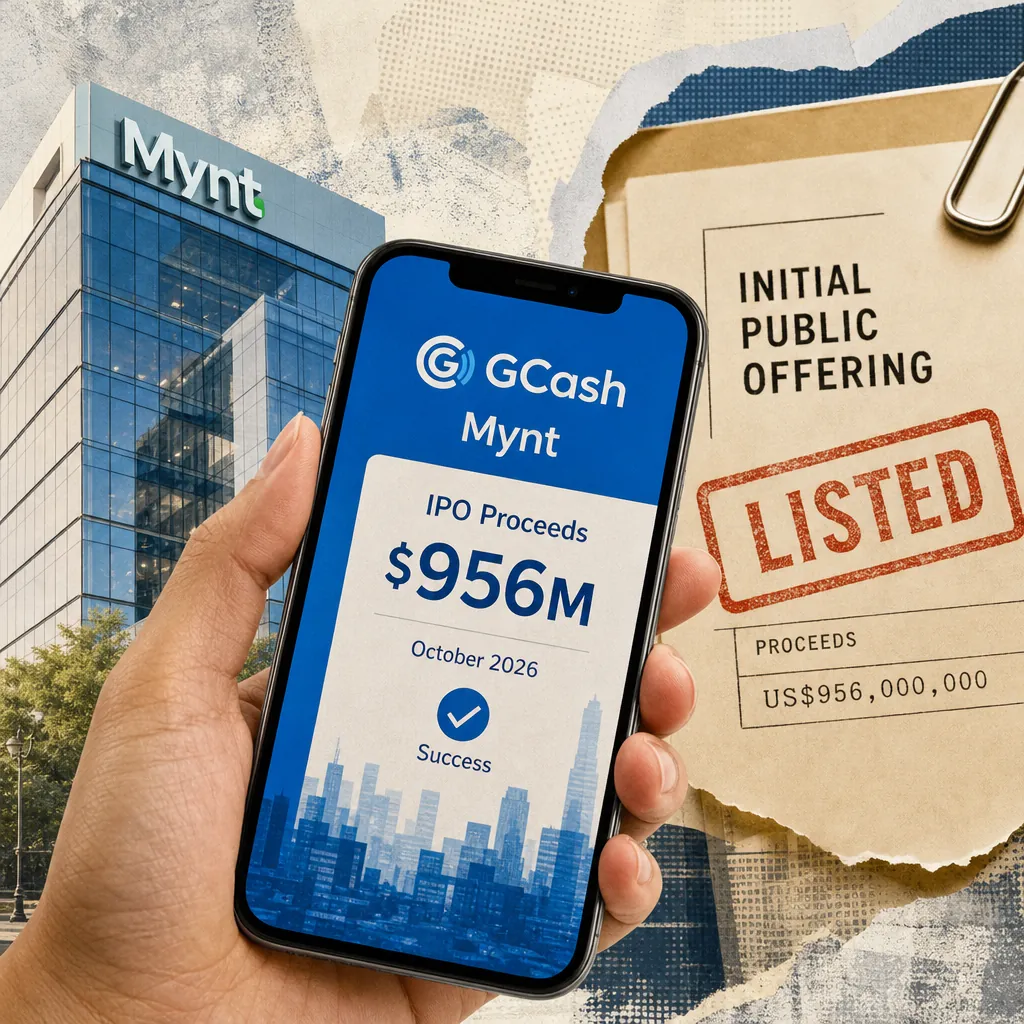
The Philippines produced Southeast Asia's largest initial public offering of 2026, and the company behind it is the one most Filipinos already carry in their phones. Mynt Inc., the parent of the GCash e-wallet, raised $956 million when it listed on the Philippine Stock Exchange on October 20, according to Deloitte Southeast Asia's tally of listings through November 20 1347. That single offering accounted for all the money raised from Philippine listings in the period and nearly a fifth of the regional total, lifting domestic IPO proceeds by about 60 percent even as fundraising fell across Southeast Asia 13. The Philippines finished third in the region behind Malaysia ($1.8 billion) and Singapore ($1.3 billion), and ahead of Vietnam (about $900 million) 47.
The listing drew coverage across the business press on Wednesday, with Inquirer and The Manila Times both carrying the Deloitte figures and the details of the October debut 1347. Mynt's shares were offered at P6.60 each in what The Manila Times described as one of the most heavily oversubscribed IPOs in Philippine history, and the company listed with a market capitalization of $6.93 billion 4713. The only other Philippine listing in the period, PNB Holdings Corp., joined the exchange by way of introduction on September 25 and raised no proceeds; the two companies had a combined market capitalization of $7.8 billion at listing, up from about $2 billion a year earlier 13.
The same day's financial coverage carried a second, quieter story about the central bank and the country's farmers. The Bangko Sentral ng Pilipinas (BSP), the country's central bank, said it is closely monitoring banks' agricultural loan portfolios and keeping regulatory relief measures on standby as a super El Niño — an unusually strong warming of the Pacific that brings prolonged drought to the Philippines — threatens farm borrowers' ability to repay 3565. BSP Deputy Governor Lyn Javier said the central bank is working with the Rural Bankers Association of the Philippines to align lenders' provisioning practices with crop cycles, giving them more flexibility in extending loans to farmers 12. The Department of Agriculture has reported damage and losses from El Niño climbing past P10 billion, and the National Disaster Risk Reduction and Management Council counts at least 109 cities and municipalities that have declared a state of calamity because of drought 1265.
Key themes
- Mynt's $956-million IPO was Southeast Asia's largest listing of 2026. The GCash parent raised the equivalent of about P60.88 billion and accounted for roughly 19 percent of all IPO proceeds in the region, according to Deloitte's Southeast Asia IPO market report covering listings through November 20 4713.
- The Philippines ranked third in Southeast Asian IPO fundraising, up about 60 percent year on year. Malaysia led with $1.8 billion and Singapore followed with $1.3 billion, while the Philippines' total of approximately $956 million came entirely from Mynt, since the only other listing raised no proceeds 4713.
- The BSP is monitoring bank exposure to agriculture as El Niño losses exceed P10 billion. Deputy Governor Lyn Javier said the central bank is assessing lenders' sector exposures and has standby relief measures ready, including temporary grace periods on loan payments for affected borrowers 3512.
- At least 109 local governments have declared a state of calamity because of drought. The count from the National Disaster Risk Reduction and Management Council underlines how widely the dry spell has hit farming communities, which in turn threatens the loan books of banks that lend to them 65.
- The Bureau of the Treasury raised $1.26 billion from retail dollar bonds. The third tranche of the government's Retail Dollar Bonds carried a 5.65 percent annual coupon and matures on November 27, 2029; $453.4 million came from the November 19 auction and $806.09 million from the four-day public offer that followed 3666.
- The peso strengthened and the stock index rose toward 5,500 on lower oil prices and bargain hunting. The peso closed at P63.675 to the dollar, 10 centavos stronger than the previous day, while the Philippine Stock Exchange Index gained 0.68 percent to 5,493.41, helped by buying in index heavyweights and positioning ahead of an MSCI rebalancing 604175.
- The country's external debt service bill rose 5.7 percent to $9.26 billion in the first eight months. Principal repayments climbed 16.9 percent to $4.09 billion while interest payments slipped 1.7 percent to $5.17 billion, according to BSP data for January to August 725817.
- Health maintenance organizations posted a 28.29 percent jump in net income to P3.13 billion in the first nine months. Membership fees rose 17.36 percent to P83.48 billion and accounted for about 97 percent of total revenues, outpacing the 14.17 percent increase in healthcare payouts, the Insurance Commission reported 2162.
How the narratives stack
Dominant. The Mynt listing story dominated the business pages in the items reviewed here, carried by both Inquirer and The Manila Times with the same Deloitte dataset and the same framing: a record Philippine IPO that made the country the region's third-largest fundraising market 1347. The dominance is partly a function of how the coverage was captured — two national business desks picking up one report — but the underlying fact is not in dispute: a single Philippine company raised more than the rest of the region's listings combined in relative terms, and it did so in a year when regional fundraising fell. The story matters beyond the exchange because GCash is the payment rail most Filipino adults already use, and its parent now has public shareholders, quarterly disclosure obligations, and a market value to defend.
Counter-narrative. The BSP's agricultural loan monitoring ran alongside the IPO story and, in the items captured, drew comparable space: Inquirer, The Manila Times, BusinessMirror, and Head Topics all carried versions of Deputy Governor Javier's briefing 12356551. The framing differed by outlet — BusinessMirror emphasized the standby relief for banks, The Manila Times emphasized the super El Niño threat, and Head Topics noted grace periods of up to one year — but the substance was the same. This is the day's more consequential story for anyone with a loan tied to a farm, and it sits in tension with the IPO narrative: one is about a company raising capital at record scale, the other about whether the banks lending to the country's most weather-exposed sector will be repaid.
Emerging. Digital payments infrastructure kept surfacing in smaller items that did not lead anywhere but point in the same direction. Metrobank added Google Pay support for its credit, debit, and prepaid cards, turning Android phones and smartwatches into contactless payment devices 29. GCash promoted its Commute QR and other cashless options for train and bus fares 55. The Philippine Economic Zone Authority began letting registered businesses pay fees through BPI BizLink via the MYEG Philippines government payment platform, with nearly 100 clients using the facility since its May launch 61. Separately, UNICEF Philippines and GCash said they would deepen their collaboration on digital giving and cash aid transfer through the GCash platform 9. None of these is a headline on its own; together they describe a payments layer being extended into transport, government transactions, and humanitarian disbursement.
Under-covered. The human cost behind the online lending and scam stories received far less attention than the institutional finance news. A legal advice column addressed a borrower whose online lending app released only half the loaned amount, counted the other half as interest, and then demanded the full original amount while publicly shaming him on social media — conduct the column said violates BSP Circular 454, which prohibits unfair collection practices 59. In Malaysia, a state service centre chief warned the public about smartphone deals priced far below market value, with scammers using "today only" and "limited stock" slogans and stolen product images to pressure buyers into paying upfront 2. And in Indonesia, a legislator praised the Philippine and Indonesian police for dismantling a cross-border online scam operation based in Pasay City, Metro Manila, and urged authorities to pursue the wider network 4. These are the consumer-facing consequences of the same digital finance expansion the IPO story celebrates, and they drew a fraction of the coverage.
Platform insights
- Facebook. The day's most-shared finance content in the captured set was practical rather than institutional: GCash's cashless commute guide, written in a Filipino-English mix and aimed at students and office workers, walked readers through generating a QR code at the turnstile 55. The format — step-by-step, app-first, no jargon — is the one that travels on Facebook in the Philippines, where the platform remains the default for consumer service announcements. The UNICEF-GCash collaboration item, published on a personal blog, used the same register: accessible donation channels, small amounts welcome, no minimum 9.
- X. The finance conversation on X in the captured items was thin and mostly reactive. The most visible thread was not about Philippine finance at all but about Grand Theft Auto VI, where a user's "Game is garbage, CUCK Simulator" post was quoted in coverage of the backlash against the game's honor system and relationship-focused gameplay 6. The lesson for financial communicators is that X in this market rewards provocation and punishes institutional tone; the Mynt IPO, a genuinely large business story, generated no comparable organic thread in the items reviewed.
- Reddit. No Reddit activity appeared in the captured material for this window. The absence is worth noting only because Reddit is where Philippine personal-finance communities typically dissect lending apps, scam warnings, and bank fees — the same territory the legal advice column and the Malaysia scam warning covered 592.
- YouTube. No YouTube activity appeared in the captured material. The platform's role in this sector is mostly long-form explainers and vlogs about budgeting and investing, none of which surfaced here.
Key voices and communities
The central bank and its regulated banks. Deputy Governor Lyn Javier was the most-quoted official in the day's finance coverage, speaking at a briefing late Monday and setting the tone for how the agricultural loan story was reported 3512. Her framing — continuous assessment, standby relief, coordination with the Rural Bankers Association — is the language of prudential supervision, and it signals that the BSP sees El Niño as a loan-quality problem rather than only a farm-output problem. Banks reading the coverage will note that the relief measures are described as existing and available, not new.
The investing public and retail bond buyers. The Bureau of the Treasury's $1.26-billion retail dollar bond sale is a direct measure of household and small-investor appetite for government paper 3666. The bonds were offered for a minimum of $200 through over-the-counter channels and online platforms, including the BTr Online Ordering Facility accessible through China Banking Corp., LandBank, and First Metro Securities 66. Jonathan Ravelas, senior adviser at Reyes Tacandong & Co., called the take-up a "clear vote of confidence in the government" that "helps pre-fund borrowing needs, broadens the investor base and could reduce pressure on future debt auctions" 36.
Fintech users and the unbanked. GCash's dual appearance — as the parent of the country's largest IPO and as the provider of commute payments and donation channels — places it at the center of how ordinary Filipinos experience digital finance 13559. The company's public listing means its growth is now reported quarterly, and its consumer-facing products will be read by investors as well as users.
Consumer-protection advocates and scam victims. The legal advice column and the Malaysia scam warning represent a persistent counter-voice to the fintech growth story 592. The column's citation of BSP Circular 454 gives borrowers a concrete legal hook: the circular, issued in 2004, prohibits banks, credit card companies, and collection agents from disclosing a borrower's loan online to humiliate them into paying 59.
Policy and legislative figures. In Indonesia, Commission III legislator Martin Daniel Tumbelaka publicly praised the police for dismantling a cross-border online scam syndicate operating in Pasay City and urged them to pursue the network beyond the arrests on the ground 4. His statement is a reminder that Philippine-based scam operations are a regional political issue, not only a domestic law-enforcement one.
Narrative streams
Mynt's listing made the Philippines Southeast Asia's third-largest IPO market
The numbers behind the headline are worth unpacking because they are easy to misread. Mynt raised $956 million, which Deloitte converts to about P60.88 billion, and that figure represents the entire Philippine IPO total for the period through November 20 47. The country's 60-percent year-on-year increase in proceeds therefore rests on one company, not on a broad pipeline of new listings. The only other Philippine listing, PNB Holdings Corp., joined the exchange by way of introduction — a technical listing that raises no new capital — on September 25 13. Mynt's debut on October 20 gave it a market capitalization of $6.93 billion, and the shares were offered at P6.60 each in one of the most heavily oversubscribed offerings in Philippine history 4713.
The read for the sector is that the Philippine capital market now has a fintech bellwether large enough to move the index and visible enough to attract regional attention, and that the country's ability to attract listings in 2027 will be judged against a base that one deal inflated. Bankers and exchange officials will want a second and third large listing to demonstrate the market is not a one-off. For GCash users, the listing changes little in daily use, but it does mean the company's pricing, fees, and expansion decisions are now disclosed to public shareholders and scrutinized quarterly.
The BSP is watching farm loans as El Niño losses pass P10 billion
The central bank's concern is indirect but real: banks do not suffer directly from heat and drought, but they lend to farmers who do, and when harvests fail the loans stop performing 65. Deputy Governor Javier said the BSP is "continuously assessing banks' exposures to the different sectors, including agriculture" and that "we also have existing standby relief measures for banks in the event of calamities or natural disasters, which would also cover the potential impact of the super El Niño phenomenon" 35. Under the BSP's Manual of Regulations for Banks, lenders may grant temporary grace periods of up to six months on loan payments for affected borrowers 35. Head Topics reported the relief could extend to grace periods of up to one year 51.
The scale of the problem is set by the drought's footprint: at least 109 cities and municipalities have declared a state of calamity, and the Department of Agriculture puts damage and losses past P10 billion 6512. The BSP is also working with the Rural Bankers Association of the Philippines to align provisioning practices with crop cycles, so that lenders in farming areas are not forced to set aside reserves on a calendar that ignores when harvest income actually arrives 12.
The read for the sector is that rural banks and agricultural lenders face a testing period through the next planting season, and that the BSP has chosen flexibility over forbearance mandates — giving banks room to restructure loans rather than ordering them to. Farmers who borrow will see grace periods offered, but the decision to grant them sits with each bank. The coverage value of this story within the captured set was substantial: BusinessMirror, The Manila Times, Inquirer, and Head Topics all carried it, and the Manila Times and BusinessMirror items together represent a meaningful share of the day's business-newspaper space 35651251.
The Treasury's retail dollar bonds drew $1.26 billion from small investors
The Bureau of the Treasury's third tranche of Retail Dollar Bonds raised $1.26 billion, split between $453.4 million at the November 19 rate-setting auction and $806.09 million during the four-day public offer that ran through November 24 6636. The three-year securities carry a 5.65 percent annual coupon and mature on November 27, 2029 66. The bonds were pitched at a minimum investment of $200, which is what makes them "retail" — small enough for individual savers with dollar holdings, not just institutions 66.
The read for the sector is that the government has found a reliable channel for dollar funding from its own citizens, which reduces its dependence on foreign creditors and gives it flexibility to pre-fund budget needs. Ravelas's description of the sale as a "clear vote of confidence" is the kind of claim that should be read as an analyst's characterization rather than a measured outcome, but the mechanics support the substance: a government that can borrow dollars from its own households at 5.65 percent has more room to manage its external debt service, which rose 5.7 percent to $9.26 billion in the first eight months of the year 3672.
External debt service rose 5.7 percent as principal repayments climbed
The Philippines paid $9.26 billion in principal and interest on its foreign obligations from January to August, up from $8.76 billion in the same period last year, according to BSP data 7258. The increase came entirely from principal repayments, which rose 16.9 percent to $4.09 billion, while interest payments slipped 1.7 percent to $5.17 billion 72. Inquirer framed the burden as relatively manageable: the amount equaled 3 percent of gross domestic product, unchanged from a year earlier, and 19.5 percent of total export shipments, better than the 21 percent recorded previously — meaning the country spent about 19 cents of every dollar earned from exports on servicing foreign debt, down from 21 cents 17.
Michael Ricafort, chief economist at Rizal Commercial Banking Corporation, attributed the increase in debt servicing to wider budget deficits and other factors 58. The read for the sector is that the country's external obligations remain serviceable by the export-earnings measure, but the rising principal bill means more of each year's dollar inflow goes to creditors before it reaches public spending. For a government that just raised $1.26 billion from retail bonds, the two stories connect: domestic dollar borrowing helps manage the timing of external repayments.
The peso and the stock market gained on cheaper oil and bargain hunting
The peso closed at P63.675 to the dollar on Wednesday, 10 centavos stronger than Tuesday's P63.775, with trading volume of $1.054 billion, down from $1.217 billion the previous day 60. A trader attributed the gain to the continued decline in global crude prices and warned the currency might weaken ahead of a likely strong US personal consumption expenditure report, with a forecast range of P63.50 to P63.80 60. The Philippine Stock Exchange Index rose 0.68 percent, or 37.27 points, to 5,493.41, while the broader All Shares Index added 0.37 percent to 3,053.91 4175.
Luis Limlingan, head of sales at Regina Capital Development Corp., said the index benefited from bargain hunting that brought it closer to the 5,500 level, with positioning ahead of an upcoming MSCI rebalancing supporting selected names that had already fallen significantly 4175. Philstocks Financial research manager Japhet Tantiangco cited lower global bond yields as an additional lift 41. The read for the sector is that the market's recovery is being driven by valuation and index mechanics rather than by a change in earnings outlook; the 5,500 level is a psychological marker, not a fundamental one. The peso's gain is similarly conditional on oil prices staying low, which depends on geopolitical events the Philippines does not control.
Health maintenance organizations grew profit 28 percent as membership fees outpaced payouts
The Insurance Commission reported that the health maintenance organization industry's aggregate net income rose 28.29 percent to P3.13 billion in the first nine months of 2026, from P2.44 billion a year earlier 2162. Total revenues climbed 17.6 percent to P85.99 billion, with membership fees accounting for P83.48 billion, or about 97 percent of the total, up 17.36 percent 62. Healthcare benefits and claims payouts rose 14.17 percent to P62.75 billion, and total expenses increased 17.23 percent to P82.86 billion 21.
The read for the sector is that HMOs are currently pricing their memberships faster than their medical costs are rising, which is why profit is growing faster than revenue. That gap is the industry's cushion, and it is the number to watch: if claims inflation catches up with fee increases, the double-digit profit growth narrows. For employers and members, the figures explain why premiums keep rising even as the industry reports strong earnings — the money is coming in faster than it is going out, and the industry's regulator is publishing the arithmetic.
Digital payments expanded into transport, government fees, and donations
Three separate announcements on the same day extended the reach of digital payments into everyday transactions. Metrobank made its credit, debit, and prepaid cards usable through Google Pay, turning Android phones and smartwatches into contactless payment devices; Ramon Vivencio del Rosario, the bank's head of consumer business sector, said the goal is to make daily banking "simpler, safer, and more convenient" 29. GCash promoted its Commute QR, which lets riders generate a QR code in the app and scan it at station turnstiles on entry and exit, along with other cashless fare options 55. The Philippine Economic Zone Authority, which administers the country's economic zones, began accepting fee payments through BPI BizLink via the MYEG Philippines platform, with nearly 100 clients using the facility since May 61.
UNICEF Philippines and GCash also said they would deepen their collaboration on digital giving and cash aid, exploring the use of Scan to Pay, Bills Pay, WebPay, and Link and Pay for donations and the GCash Funds Disbursement Service to streamline financial support to beneficiaries 9. The read for the sector is that the payments layer is being built out transaction by transaction, and the winners will be the platforms that own the most everyday moments — the commute, the government fee, the donation. For banks, the Google Pay integration is a defensive move: it keeps their cards in the wallet even when the phone is the payment device.
Consumer warnings about lending apps and online scams ran alongside the growth stories
A legal advice column described a borrower whose online lending app disbursed only half the loaned amount, treated the other half as interest, and then demanded the full original amount while shaming him on social media 59. The column said the conduct violates BSP Circular 454, issued September 24, 2004, which prohibits banks, credit card companies, collection agents, and other agents from engaging in unfair collection practices, including disclosing a person's loan online to humiliate them into paying 59. In Malaysia, Perak BN Service and Complaints Centre chief Mohd Rawi Abdullah warned that scammers were using "today only," "limited-time offer," and "limited stock" slogans, along with stolen product images and fake customer reviews, to sell smartphones at prices far below market value 2. In Indonesia, legislator Martin Daniel Tumbelaka praised the police for dismantling a cross-border online scam syndicate in Pasay City and urged them to investigate the full network 4.
The read for the sector is that the same digital rails carrying the growth stories also carry the fraud, and the consumer-protection framework is being tested case by case. Lenders that rely on aggressive collection will face regulatory action under rules that have existed for more than two decades; buyers who chase prices that look too good will keep losing money; and the cross-border scam operations based in the Philippines will remain a regional diplomatic and law-enforcement issue.
Conversation trajectory
Watch the BSP's next policy meeting and any announcement on agricultural loan relief. Over the next four to six weeks, the central bank's public statements will indicate whether the standby relief measures are activated or remain on the shelf. The trigger is a formal BSP announcement of grace periods or provisioning changes for agricultural loans; the signal to watch is whether the Rural Bankers Association of the Philippines endorses the crop-cycle alignment publicly 1235.
Watch the December retail dollar bond settlement and the next external debt data release. The RDB 3 matures in 2029, but the immediate checkpoint is the next BSP external debt service report, which will show whether the 5.7 percent increase in the January-to-August period continued through September and October 7266. A second trigger is any statement from the Bureau of the Treasury on a fourth tranche.
Watch the MSCI rebalancing and the PSEi's hold on 5,500. The index's approach to 5,500 was supported by positioning ahead of the rebalancing, according to Limlingan 41. The checkable horizon is the rebalancing effective date and the trading days around it; if the index holds above 5,500 after the event, the gain has a broader base than index mechanics alone.
Watch the next Insurance Commission quarterly report for the HMO claims ratio. The 14.17 percent increase in payouts against a 17.36 percent increase in membership fees is the gap that produced the 28.29 percent profit growth 62. The next quarterly release will show whether claims inflation is accelerating; a narrowing gap would signal that the industry's pricing cushion is being consumed.
Watch for regulatory action on online lending collection practices. The legal advice column's citation of BSP Circular 454 is a reminder that the rule exists and is being invoked 59. The trigger to watch is any BSP or Securities and Exchange Commission enforcement action against a lending app for public shaming or undisclosed fees, and any congressional hearing on consumer credit.
Watch the cross-border scam investigation in Pasay City. The Indonesian legislator's call to pursue the network beyond the arrests on the ground sets an expectation that Philippine authorities will announce further cases 4. The checkable horizon is the next statement from the Presidential Anti-Organized Crime Commission, which has been prosecuting trafficking cases tied to scam compounds; a life sentence was handed down in the Lucky South 99 case in Porac, Pampanga, in a decision dated November 11 64.
Response guidance
For banks and lenders: prepare plain-language explanations of the agricultural relief measures. Farmers and rural borrowers will hear about grace periods and provisioning changes through news coverage that may not explain who qualifies or how to apply. Lenders should publish a short, specific guide — who is eligible, what documents are needed, how long the grace period lasts — before the next planting season, and brief branch staff in agricultural provinces to answer questions at the counter 3512.
For fintech platforms: treat consumer-protection cases as reputational events, not legal ones. The online lending column and the Malaysia scam warning describe conduct that erodes trust in the entire digital finance sector 592. Platforms should audit their collection practices against BSP Circular 454, publish a clear complaints channel, and respond publicly to shaming complaints within days rather than weeks.
For the Treasury and government financial institutions: build on the retail bond channel with clear, simple follow-up communication. The $1.26 billion raised from small investors is a base of retail buyers who will expect the next offering to be as easy to access 66. A short post-sale note explaining what the proceeds fund and when interest is paid would reinforce the confidence the sale demonstrated.
For HMOs and employers: explain premium increases with the regulator's own numbers. The Insurance Commission's data show membership fees rising faster than claims payouts 62. Employers negotiating renewals should ask HMOs to break down the increase into claims inflation, membership growth, and administrative costs, and HMOs should provide that breakdown proactively rather than waiting to be asked.
For communicators covering the IPO: keep the Mynt story in proportion. The $956 million figure is a genuine record, but it is one company's listing in a year when the region's fundraising fell 1347. Coverage that treats the Philippine market as resurgent without noting the single-deal base will mislead investors and the public; coverage that explains the base gives readers a clearer picture of what 2027 must deliver.
For consumer-protection agencies: use the lending and scam cases to publicize existing remedies. BSP Circular 454 has existed since 2004, and the legal advice column shows borrowers still do not know it applies to them 59. A short public information campaign — what lenders may and may not do, where to complain, what evidence to keep — would reach borrowers through the same social media channels where the shaming happens.
See the full picture behind today's signals.
This report draws from Media Meter's MediaWatch, our real-time monitoring engine tracking 2,470+ Philippine sources across print, broadcast, digital, and social. Explore how the platform turns raw coverage into decision-grade intelligence, then see how it's configured for teams like yours — whether you're in PR agencies, corporate comms, government, or marketing.
Want more? Browse our Report Library for sector and crisis intelligence, or request a demo and we'll have your brand set up before the call.
Want this kind of intelligence on your brand?
This brief is built on the same MediaWatch methodology that runs continuously across every brand we monitor. See your competitive landscape, Impact Score, and narrative trajectory in a 30-minute demo.