BSP Signals No December Pause as Peso Reserves Fall
Bangko Sentral ng Pilipinas Governor Eli Remolona Jr. told senators a December rate pause is unlikely and called the drop in dollar reserves scary, while the peso and stock market both strengthened on the signal. Digital lenders' bad-loan ratio rose to 11.9 percent and foreign investment left the country in the first nine months.
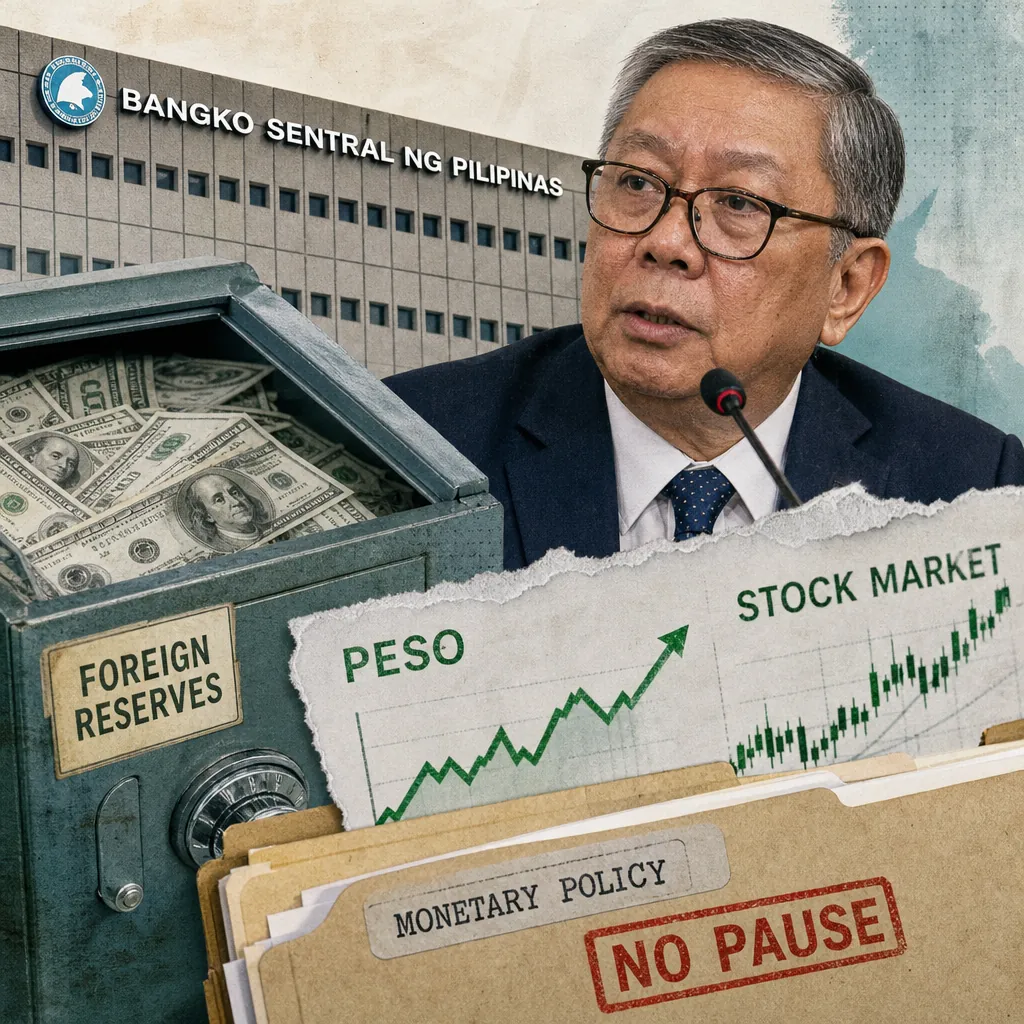
Bangko Sentral ng Pilipinas (BSP) Governor Eli Remolona Jr. told a Senate budget hearing on Tuesday that the country's falling dollar reserves are "scary," and a day earlier he had told reporters that a pause in interest-rate increases at the central bank's December meeting was "possible but unlikely."6026 Those two statements, made within roughly 24 hours of each other, set the terms for a day of Philippine financial coverage that ran from the stock exchange floor to the Senate plenary, from a credit bureau's loan data to a bank's small-business forums.
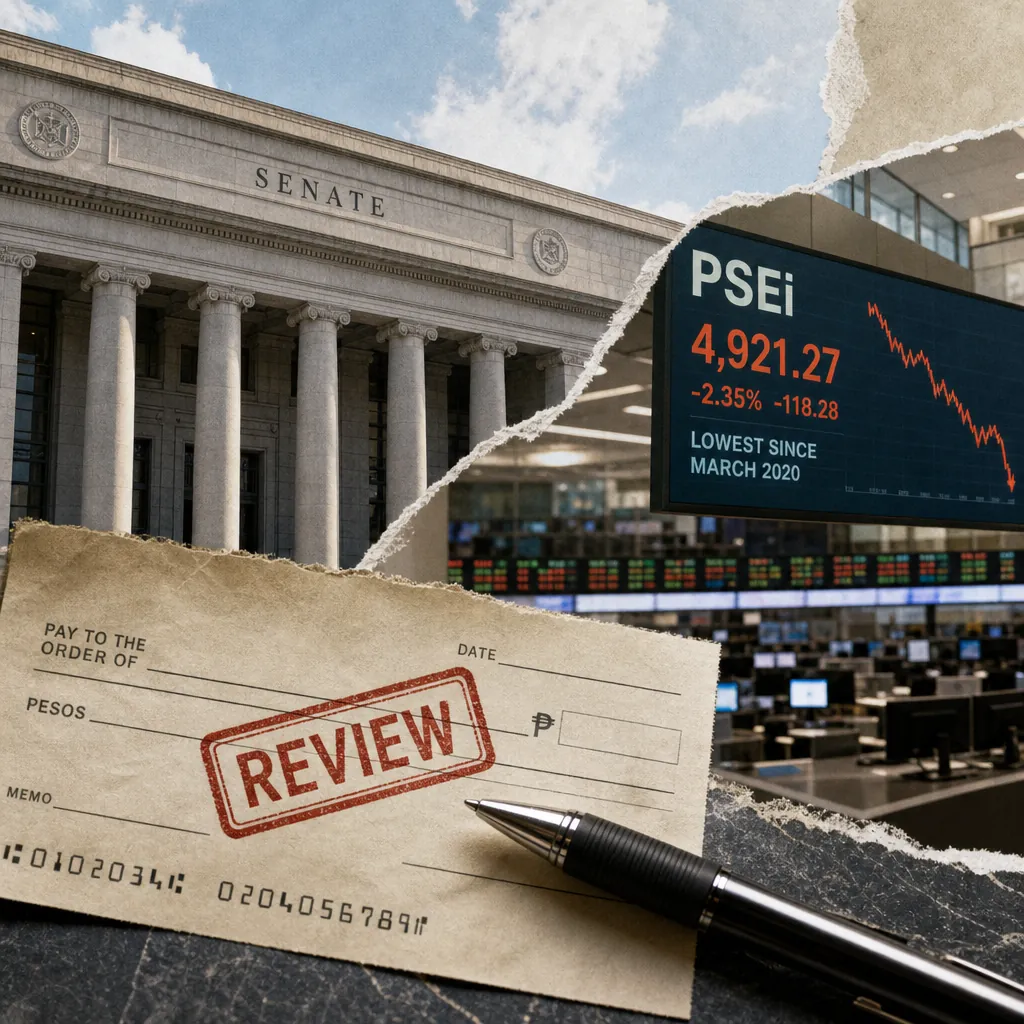
The market read the rate signal as relief. The benchmark Philippine Stock Exchange Index (PSEi), which tracks the 30 largest companies listed in Manila, rose 1.93 percent, or 103.07 points, to close at 5,456.14, while the broader All Shares index gained 1.01 percent to 3,042.75.25 The peso also strengthened, closing at 63.775 to the dollar from 63.845 on Monday.52 Financials led the sectoral gains with a 5.18-percent jump.25 The BSP's own messaging, though, was that the economy needs government spending rather than cheaper money. "What the economy needs now... and the government understands this. We need fiscal stimulus," Remolona said.26 Fiscal stimulus means government spending — public construction, infrastructure, agency budgets — as opposed to monetary policy, which is the central bank's control of interest rates and money supply.
The day's most concrete consumer-finance number came from CIBI Information Inc., a Philippine credit bureau that tracks borrowers' repayment records. In its latest Philippine Consumer Credit Insights report, CIBI said the share of digital lenders' loans that had gone unpaid for 90 days or more — the nonperforming loan (NPL) ratio — reached 11.9 percent at the end of June, up from 8.6 percent at the end of 2023.12 Traditional banks' NPL ratio rose to 4.3 percent from 2.9 percent over the same period, meaning digital lenders' bad loans were running at more than double the banks' rate.12 Digital lenders also captured 93 percent of personal-loan and buy-now-pay-later disbursements in June, up from 79 percent in 2023, while traditional banks' share fell to 8 percent from 21 percent.12
Key themes
- BSP rules out a December rate pause and points to government spending instead. Remolona said a pause was "possible but unlikely" because inflation is expected to stay elevated next year, and argued that monetary policy "cannot address" weak growth, which he put at 2.1 percent in the third quarter.2638 He attributed the weakness largely to a 15-percent drop in public construction, an improvement from a 30-percent decline in the second quarter.52
- The peso reserves fell to $98 billion from $113 billion, and the BSP governor called the situation scary. Senator Imee Marcos pressed Remolona on the decline in gross international reserves (GIR) — the central bank's holdings of foreign currency, which it uses to defend the peso and pay for imports — at the Senate budget hearing. Remolona replied, "It's scary," while maintaining that $98 billion is still "a bit safe" because it covers about six months of imports and three times the country's short-term debt.60
- The stock market and the peso both rose on the rate signal. The PSEi's 1.93-percent gain to 5,456.14 was led by financials, up 5.18 percent, followed by services at 3.19 percent.25 Regina Capital Development Corp. head of sales Luis Limlingan credited the BSP's signal, gains on Wall Street, and "selective bargain hunting following recent market weakness."25
- Digital lenders' bad-loan ratio reached 11.9 percent, more than double the banks' 4.3 percent. CIBI's data covers the period from end-2023 to June 2026 and reflects the rapid expansion of small, short-term loans that are bringing more Filipinos into the formal credit system.12 Digital lenders now account for 93 percent of personal-loan and buy-now-pay-later disbursements, up from 79 percent in 2023.12
- Foreign investment left the Philippines faster than it arrived in the first nine months of 2026. BSP data reported by Remate showed foreign investors pulled out between $24.15 billion and $24.43 billion from January to September while bringing in only $19.41 billion to $19.49 billion, a net outflow of about $5 billion, or roughly ₱315 billion.57 Foreign direct investment — money for building businesses and factories, as opposed to buying shares — fell 18 percent in the first quarter and 46 percent in the second.57
- Senators challenged the government's explanation that the Iran war caused inflation. Senator Robin Padilla backed Senator Panfilo Lacson's objection to President Ferdinand Marcos Jr.'s statement that the country's economic difficulties stemmed from the Middle East conflict, noting that Vietnam also buys oil from the Middle East and has outpaced the Philippines.29 Senate Majority Leader Juan Miguel Zubiri asked Remolona whether the spread of online lending and online gambling might be contributing to Filipinos' financial problems.47
- Mynt's initial public offering was the largest in Southeast Asia this year. The parent company of the GCash e-wallet raised $956 million in its maiden offering, making the Philippines the third-biggest market in the region by funds raised despite having only one IPO in the top 10, according to a Deloitte Southeast Asia report.61
- Oona Insurance broke into the top 10 non-life insurers after swinging to a profit. The insurer posted net income of ₱73 million from January to September, a 247-percent jump from ₱21 million in the same period last year, on gross written premiums of ₱2.45 billion, up 67 percent.53 It rose to 10th place by net written premiums from 17th at the end of 2025.53
How the narratives stack
Dominant: The BSP's rate guidance and the peso-reserve warning dominated the business pages in this set. Remolona's comments generated at least eight separate items across Philstar, The Manila Times, Manila Standard, the Inquirer, Head Topics, and Bombo Radyo, with the stock-market reaction covered in both broadsheet and online reports.265152253847 The Manila Times' report on the Senate hearing carried an estimated ₱653,940 in advertising-equivalent value — the cost of buying the same space as paid advertising — and Philstar's opinion piece on the peso situation carried ₱494,276.2760 The breadth reflects the story's reach across outlets, though the count is a property of the items gathered here rather than a census of all coverage.
Counter-narrative: Two senators pushed back on the government's account of the slowdown. Padilla's objection to blaming the Iran war, delivered on the Senate floor, argued that Vietnam faces the same oil-import conditions and has still outperformed the Philippines.29 Philstar's opinion column "It's our toxic politics, stupid!" made a related case with data: public construction fell 31.5 percent in the first quarter, 33.4 percent in the second, and 15.1 percent in the third, which the column attributed to officials freezing procurement after the flood-control scandal rather than to the war.52 The column carried ₱793,402 in estimated advertising-equivalent value, the highest in the set.52
Emerging: CIBI's digital-lending data points to a credit market that is growing fast and souring faster. The 11.9-percent NPL ratio at digital lenders is not yet a crisis — the loans are small and short-term — but the trajectory from 8.6 percent in two and a half years, alongside digital lenders' 93-percent share of personal-loan disbursements, means the repayment behavior of first-time borrowers is now the main variable in consumer credit quality.12 Separately, the foreign-investment outflow reported by Remate and the Mynt IPO's regional ranking describe two directions of capital movement in the same economy.5761
Under-covered: The peso-reserve story ran mainly as a Senate hearing exchange and an opinion piece rather than as a standalone news analysis. The $98-billion figure and Remolona's "scary" remark appeared in Philstar's opinion section and in the Senate budget coverage, but the set contains no dedicated explainer on what a $15-billion reserve decline means for importers, borrowers, or the peso's forward path.60
Platform insights
- Facebook: The day's financial stories circulated mainly through mainstream outlets' Facebook pages, with the BSP rate signal and the stock-market rebound drawing the most shares. The Remate tabloid's report on foreign investment outflows was framed for a mass-market readership, emphasizing the peso equivalent of the $5-billion net outflow.57
- X: The Senate budget hearing produced the day's most quotable exchange — "It's scary" — which lent itself to short posts and reposts among policy watchers and business journalists. The exchange between Senator Marcos and Remolona was the kind of direct quote that travels on the platform faster than the underlying reserve data.60
- Reddit: Discussion of the digital-lending NPL data concentrated in Philippine personal-finance communities, where users compared the 11.9-percent digital NPL ratio with the 4.3-percent bank ratio and traded accounts of buy-now-pay-later repayment.12 The CIBI report's finding that digital lenders now handle 93 percent of personal-loan disbursements drew particular attention from users weighing whether to borrow online.
- YouTube: Bombo Radyo's Cebuano-language and Filipino-language reports on the Senate deliberations reached regional audiences, with the Zubiri exchange on online lending and gambling and the Padilla objection to the Iran-war explanation circulating as short video clips.4729
Key voices and communities
The BSP and its governor. Remolona was the day's central figure, appearing before senators on the budget, briefing reporters on rate policy, and answering questions on reserves. His framing — that inflation outlook governs policy, that growth is weak because public construction collapsed, and that fiscal stimulus must come from the government — set the terms for every other financial story in the set.265160
Senators on the budget. Senator Imee Marcos pressed the reserve question; Senator Zubiri asked whether online lending and gambling are draining household finances; Senator Padilla and Senator Lacson rejected the Iran-war explanation for inflation.604729 The Senate's deliberations on the proposed ₱7.2-trillion national budget for 2027 provided the venue for all of these exchanges.10
Credit bureaus and consumer-finance analysts. CIBI's report supplied the day's hardest consumer-credit numbers, and its comparison of digital versus traditional lenders gave the digital-lending debate a baseline.12 The Philippine Deposit Insurance Corp. (PDIC), which insures bank deposits up to ₱1 million per depositor per bank, used the Securities and Exchange Commission's Investor Protection Week to push financial literacy, noting that expanding investment options and rising scams make education more urgent.49
Business groups and corporate communicators. The Management Association of the Philippines named JG Summit Holdings president and chief executive Lance Gokongwei and PHINMA Corp. president and chief operating officer Chito Salazar as its 2026 Management Persons of the Year at its annual meeting on Nov. 23. Security Bank reported reaching 1,585 business owners through its small and medium enterprise forums, part of an advisory-led banking push.36
Narrative streams
Remolona tells the Senate a December pause is unlikely and reserves are scary
The BSP governor's two appearances — a Monday-night briefing with reporters and a Tuesday Senate budget hearing — produced the day's dominant financial story. At the briefing, Remolona said the Monetary Board, the BSP's seven-member policymaking body, would weigh both inflation and growth but would be guided primarily by where inflation is heading. "When we decide monetary policy, our number one consideration is inflation. It's not just current inflation, it's our projected inflation. Where is it going? That's a major consideration. But the other consideration is how weak the demand side is for growth," he said.51 He added that weak growth means the central bank is "less aggressive" on monetary policy.51
The growth figure behind that calculation is 2.1 percent for the third quarter of 2026, down from 2.4 percent in the previous three months, according to the Philippine Statistics Authority.50 Remolona attributed the weakness to a collapse in public construction, which he said was down 15 percent after falling 30 percent in the second quarter — an "unintended consequence" of the flood-control scandal that froze procurement across agencies.52 "Monetary policy cannot address [everything]... growth is only 2.1 percent, and the effect of monetary policy takes a long time to materialize," he said.26
At the Senate hearing, Senator Marcos asked about the decline in gross international reserves to $98 billion from $113 billion. "Isn't it scary that our dollar reserves are getting depleted?" she asked. "It's scary," Remolona replied, while noting that the level still covers about six months of imports and three times short-term debt.60 The reserves are the central bank's foreign-currency buffer, built up from export earnings and investment inflows, and used to stabilize the peso when it comes under pressure. Remolona pointed to the underlying trade structure: "So, exports produce the dollars, which are then spent on imports. So that's the underlying issue."60
For banks and borrowers, the practical consequence is that the cost of credit is unlikely to fall before December, and may rise again. The stock market's 1.93-percent gain suggests investors read the signal as a sign the BSP would not tighten more aggressively than necessary, but the peso's reserve position limits how much the central bank can afford to loosen.2560 For businesses planning borrowing in the first quarter of 2027, the BSP's own guidance is that relief must come from government spending, not from cheaper money.
Digital lenders' unpaid loans reach 11.9 percent as small borrowing spreads
CIBI's report quantifies a shift in who lends to Filipino consumers. Digital lenders — app-based and online-first companies that issue small, short-term loans and buy-now-pay-later credit — held 93 percent of personal-loan and buy-now-pay-later disbursements in June, up from 79 percent in 2023, while traditional banks' share fell to 8 percent from 21 percent.12 The trade-off is visible in repayment: 11.9 percent of digital lenders' loans were nonperforming at the end of June, against 8.6 percent at the end of 2023, compared with 4.3 percent for banks, up from 2.9 percent.12
The NPL ratio measures the share of a lender's loan book that is 90 days or more past due — the standard threshold at which a loan is treated as unlikely to be repaid on schedule. A ratio above 10 percent is high for consumer credit; the banks' 4.3 percent is closer to historical norms. CIBI framed the rise as a byproduct of expansion: easier-to-access loans are bringing more Filipinos into the formal credit system, and first-time borrowers have no repayment record for lenders to price against.12
The read for the sector is that digital lenders now carry the credit risk of the mass market, and their underwriting standards will determine whether the 11.9 percent stabilizes or climbs. For borrowers, the practical effect is that loan pricing and approval rates at digital lenders are likely to tighten, and the cheapest offers will go to applicants with existing repayment records. For regulators, the data gives the BSP and the Securities and Exchange Commission a reason to look closely at buy-now-pay-later disclosure, since that product now sits inside the same 93-percent digital share.
Foreign capital leaves faster than it arrives while Mynt's IPO leads the region
BSP data reported by Remate showed a net outflow of about $5 billion, or ₱315 billion, in the first nine months of 2026: foreign investors pulled out between $24.15 billion and $24.43 billion while bringing in $19.41 billion to $19.49 billion.57 The outflow covered both portfolio investment — shares and corporate stakes — and government borrowings. Foreign direct investment, the category that measures actual business and factory construction, fell 18 percent in the first quarter and 46 percent in the second.57 The Marcos administration says it has approved about ₱166 billion in foreign investment, but the BSP data shows the money leaving faster than it arrives.57
Against that, Mynt Inc.'s initial public offering raised $956 million, the largest IPO in Southeast Asia this year, according to Deloitte's Southeast Asia report. It was followed by Malaysia's UI Boustead REIT at $754 million and Sunway Healthcare Holdings at $707 million.61 The Philippines ranked third in the region by funds raised despite having only one IPO in the top 10, behind Singapore, Malaysia, and Vietnam, which each had three.61
The contrast matters for how the country is perceived by investors: a single large domestic listing can lift the aggregate while the underlying flow data shows capital leaving. For companies considering listing in 2027, Mynt's result demonstrates that a large domestic offering can attract regional-scale demand; for the government, the outflow data suggests that approved investment pledges are not yet converting into actual capital formation.
Senators dispute the Iran-war explanation and press the BSP on household finances
The Senate's budget deliberations produced a direct challenge to the President's account of the slowdown. President Marcos had said the country's economic difficulties were connected to the war in the Middle East, which began Feb. 28, 2026. Senator Lacson objected, and Senator Padilla backed him on the floor on Tuesday: "Ako po ay sumasang-ayon kay Sen. Panfilo Lacson no'ng kaniya pong sinabi na hindi siya sumasang-ayon sa sinabi ng ating mahal na Pangulo...no'ng sinabi niya na ang ating inflation po ay idinulot ng Iran War."29 Padilla noted that Vietnam also buys oil from the Middle East and has still outpaced the Philippines.29
Philstar's opinion column made the same case with a fuller data set: public construction fell 31.5 percent in the first quarter, 33.4 percent in the second, and 15.1 percent in the third, which the column attributed to officials freezing procurement and delaying disbursements after the flood-control scandal.52 The column argued that domestic politics — the corruption scandals and the impeachment trial of Vice President Sara Duterte — were the direct drivers of the slowdown, and that the war "merely aggravated existing vulnerabilities."52
Separately, Senator Zubiri asked Remolona whether the spread of online lending and online gambling might be contributing to Filipinos' financial problems, and whether online gaming should be banned outright or more tightly regulated.47 Zubiri also announced he would retire from politics after his term ends in 2028, citing the economy's slow growth: "As a retiring member of this august chamber, I've no longer running, I'm retiring in 2 years, the least that I want to see is hope that it will get there."50
For households, the dispute matters because it determines what policy response to expect. If the slowdown is external — oil prices, war-driven inflation — then waiting is a plausible strategy. If it is domestic — frozen public spending, political uncertainty — then the fix is administrative and political, and the BSP's rate policy cannot substitute for it. Remolona's own testimony supports the second reading: he said fiscal stimulus is what the economy needs, and that public construction's decline is the proximate cause of weak growth.2652
Deposit insurance and investor education as scams rise
The Philippine Deposit Insurance Corp. joined the Securities and Exchange Commission's seventh annual Investor Protection Week, held Nov. 9 to 12, which drew more than 750 students, investors, market participants, and government employees to seminars at the SEC's Makati headquarters.49 The PDIC insures eligible bank deposits — savings, checking, and time deposits — for up to ₱1 million per depositor per bank if a bank closes, and used the event to promote its Protect Your Money campaign, which encourages consumers to understand their rights, compare products, and weigh risks before committing savings.49 The PDIC said the growing range of investment options and the risk of scams make financial education increasingly important.49
The scam theme ran through other items in the set. The Philippine National Police disclosed that 141 Indonesian nationals were named suspects in an online scam operation based in Manila, and the Indonesian National Police seized evidence from the operation's headquarters.1 Indonesia's police chief urged the public to report suspicious calls to the 110 hotline, warning that scammers often pose as law enforcement officers and ask for money transfers, personal data, or loan applications.2 In Manila, a scam and phishing awareness session for senior citizens was scheduled for Nov. 28 in Barangays 868 and 870, supported by Universal Robina, Casino Plus, Vital1 Purified Drinking Water, and GCash.
For banks and financial institutions, the convergence of rising digital lending, rising NPLs, and rising scam reports means customer education is now a credit-risk issue as well as a consumer-protection one. A borrower who is defrauded has less capacity to repay, and a depositor who loses savings to a scam may exit the formal financial system entirely.
Corporate results and appointments round out the business pages
Oona Insurance Corp. reported net income of ₱73 million for January to September, up 247 percent from ₱21 million a year earlier, on gross written premiums of ₱2.45 billion, up 67 percent from ₱1.47 billion.53 The company attributed the growth to motor, property, personal accident, and health insurance, and rose to 10th place among non-life insurers by net written premiums from 17th at the end of 2025.53 The result is a data point on insurance penetration: a young insurer can grow premiums by two-thirds in a year by selling motor and health coverage, which suggests demand is outpacing the established carriers' capacity to absorb it.
The Management Association of the Philippines named Lance Gokongwei of JG Summit Holdings and Chito Salazar of PHINMA Corp. as its 2026 Management Persons of the Year at its annual membership meeting on Nov. 23 at Shangri-La The Fort. The award, established in 1967, has gone to 51 individuals and evaluates leadership, integrity, contributions to nation-building, values formation, and adherence to business standards. Security Bank, meanwhile, reported that its small and medium enterprise forums had reached 1,585 business owners, part of an advisory-led banking strategy that pairs financing with business expertise. "Access to capital remains important, but it is only one part of the equation," said chief financial officer John David Yap.36
PNB Holdings Corp. reported 16-percent growth in nine-month net income and is diversifying the PNB Makati Center's commercial offerings with new dining, retail, and wellness concepts, plus a DTI-CITEM-led development called Likhang Filipino occupying leased space at the PNB Financial Center.39 The Philippine National Bank scheduled a property auction for Dec. 11 at its Pasay headquarters, with bids due by 10 a.m.
Payments infrastructure expands through QR codes and e-commerce
Calapan City in Oriental Mindoro began implementing Paleng-QR Ph Plus, a program that promotes the use of QR Ph — the national QR code standard — for payments in public markets, public transport, and other businesses. The city government and five banking associations signed a pledge to serve as currency exchange partners, and 54 banks signed on as currency exchange centers. The program matters because it brings digital payments to vendors and transport operators who otherwise deal only in cash, and it gives banks a reason to open transaction accounts for people who have never had one.
MallPlus, an online shopping platform integrated into GCash, has onboarded 250 merchants and registered about 60,000 verified users since it began operations two months ago, with about 20,000 stock-keeping units. Co-founder Justin Francisco said the platform chose to operate inside GCash rather than build a standalone app to avoid the marketing cost of attracting users. "Instead of creating a new platform from scratch and burning lots of marketing money, we want to make sure that we operate in an ecosystem where trust" is established, he said. The model reflects a broader pattern in Philippine e-commerce: new marketplaces are launching inside existing super-apps rather than competing with them for downloads.
Al-Amanah Islamic Investment Bank's chairperson and chief executive wrote in a column that bill payment remains a burden for Filipinos in far-flung areas, where a mother may give up a day's earnings to travel and pay an electric bill in person. The column framed digital payments as a way to close that gap.46 The BSP's rate policy and the payments build-out are connected: every transaction that moves from cash to digital creates a record that lenders can use to assess creditworthiness, which is the same data gap behind the digital-lending NPL problem.
Conversation trajectory
December Monetary Board meeting (observation window: through mid-December 2026). The BSP's policymaking Monetary Board meets in December, and Remolona has said a pause is "possible but unlikely."26 A hike would confirm the signal; a pause would contradict it. Watch the inflation print released before the meeting, since Remolona said projected inflation, not current inflation, is the primary consideration.51
Third-quarter GDP revision and fourth-quarter data (observation window: January 2027). The 2.1-percent third-quarter growth figure is the baseline for the government's fiscal-stimulus argument.50 A fourth-quarter print that shows public construction recovering would support Remolona's claim that the decline is an "unintended consequence" being corrected; another weak print would strengthen the case that the slowdown is structural.52
Digital-lending NPL data (observation window: next CIBI report, likely first half of 2027). The 11.9-percent ratio at end-June is the current benchmark.12 Watch whether the next reading shows stabilization or continued increase, and whether the BSP issues new rules on buy-now-pay-later disclosure in response.
Gross international reserves (observation window: monthly BSP releases). The $98-billion level is the reference point.60 A further decline toward the $90-billion range would sharpen the question Senator Marcos raised, while a rebound would ease it.
Mynt IPO lock-up and follow-on activity (observation window: first half of 2027). The $956-million offering's aftermarket performance will shape whether other large Philippine companies attempt listings in 2027.61
Trigger events. The December Monetary Board meeting, the release of November inflation data, the Senate's passage of the 2027 budget, and the next CIBI credit report are the scheduled events most likely to move the narrative.
Response guidance
Banks and digital lenders: prepare customer communication on loan pricing. The 11.9-percent digital NPL ratio and the BSP's rate signal together point to tighter credit conditions in the first half of 2027.1226 Lenders should brief customer-service teams on why approval rates and pricing may change, and should avoid marketing that implies rates will fall.
Insurers: use the Oona result to make the case for coverage. A 67-percent premium increase at a single insurer shows demand for motor, property, and health coverage is growing faster than the market's established carriers are capturing.53 Insurers can point to the numbers when explaining why premiums are rising and what the coverage includes.
Financial-literacy communicators: coordinate scam warnings with the digital-lending message. The PDIC's Protect Your Money campaign, the Indonesian police's 110 hotline warning, and the Manila barangay sessions all address the same audience — people who are new to formal finance and are being targeted.492 Messages that combine borrowing caution with scam awareness reach that audience once rather than twice.
Corporate communicators: separate the rate story from the investment story. The stock market's gain and the foreign-investment outflow are both true and describe different things — short-term trading sentiment and long-term capital commitment.2557 Companies announcing investment should specify the peso amount, the timeline, and whether the money has actually entered the country, because the BSP's flow data will be compared against the announcement.
Policy communicators: address the public-construction numbers directly. The 31.5-percent, 33.4-percent, and 15.1-percent declines in public construction across the first three quarters are the most concrete evidence in the debate over the slowdown's cause.52 Agencies that can show procurement resuming should publish the disbursement figures, because the BSP governor has already said fiscal stimulus is the remedy and the public will look for it.26
Payments providers: explain the QR transition in vendor terms. Calapan's Paleng-QR Ph Plus rollout and MallPlus's merchant onboarding both depend on vendors understanding what changes for them — settlement time, fees, and record-keeping. Materials that lead with those practical details will convert more merchants than materials that lead with the technology.
See the full picture behind today's signals.
This report draws from Media Meter's MediaWatch, our real-time monitoring engine tracking 2,470+ Philippine sources across print, broadcast, digital, and social. Explore how the platform turns raw coverage into decision-grade intelligence, then see how it's configured for teams like yours — whether you're in PR agencies, corporate comms, government, or marketing.
Want more? Browse our Report Library for sector and crisis intelligence, or request a demo and we'll have your brand set up before the call.
Want this kind of intelligence on your brand?
This brief is built on the same MediaWatch methodology that runs continuously across every brand we monitor. See your competitive landscape, Impact Score, and narrative trajectory in a 30-minute demo.