Pag-IBIG rate cuts and BPI foreclosure sale fuel housing affordability debate as flood risks shadow provincial property demand
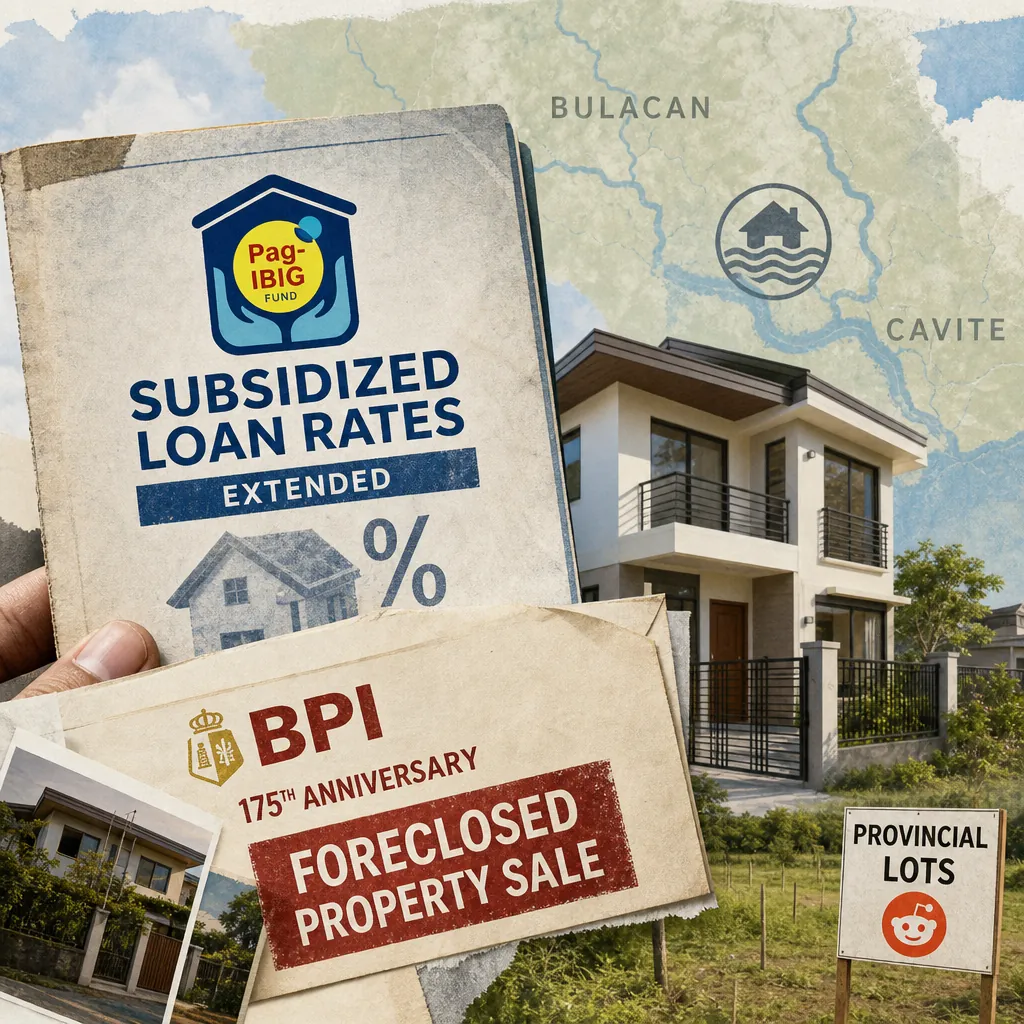
On July 9, 2026, the Philippine real estate conversation was shaped by Pag-IBIG Fund's extended subsidized loan rates and BPI's 175th anniversary foreclosed property sale, while social media discussions highlighted persistent flood concerns in growth corridors like Bulacan and Cavite, and a grassroots marketplace for provincial lots emerged on Reddit.
The conversation on July 9, 2026, unfolded as a multifaceted dialogue across Philippine social media and news outlets, weaving together corporate milestones, grassroots infrastructure grievances, and personal housing finance debates. The day began with corporate announcements: Filinvest Land officially turned over its Bicutan property to the Department of Transportation (DOTr) for a mega-transit hub, a post that garnered 10 love reactions despite only 4 likes, signaling strong positive sentiment but limited organic reach. Shortly after, CDN Digital covered SM Prime Chairperson Hans Sy at the opening of SM Seaside Cebu Arena, where Sy teased "more surprises" and revealed they initially planned Bruno Mars as a surprise act—this post drew 712 likes and 92 shares, indicating high public interest in major retail-entertainment developments. Meanwhile, Bilyonaryo reported San Miguel's P30 billion preferred share sale to fund its Bulacan airport project, prompting a ripple of interest among business-focused readers. These three corporate narratives established a backdrop of optimism around large-scale infrastructure and commercial growth.
Parallel to these upbeat announcements, a grittier thread emerged around flooding, construction nuisances, and regulatory gaps. Ronnieda Divas Official posted about a major drainage project in Tiza, Roxas City, detailing a meeting with the Metro Roxas Water District to protect water pipes during construction—this post earned 154 likes and 100 love reactions, reflecting strong local support for flood mitigation. In contrast, Parke Serye vented about a neighbor in Northridge Classic, San Jose Del Monte, Bulacan who built a roof on the road, writing "Share ko lang tong makapal na mukha na ito... may pambili sasakyan wala pambili ng utak"—the post earned 10 haha reactions, showing frustration framed as dark humor. Former Cavite congressman Kiko Barzaga's sarcastic remark offering the West Philippine Sea to China because of flooding drew 29 haha and 13 likes, effectively lampooning the persistent flood control failures. A more constructive note came from Marcsantosgamboa, reporting Marilao Mayor Jemina Sy's hope for a flood-free Bulacan, with the local government finalizing a flood-control master plan—a post that received minimal engagement (0 likes) but signaled ongoing LGU efforts.
A third narrative revolved around housing finance and personal investment decisions, heavily concentrated on Reddit and Facebook. Gadgets Magazine posted about Pag-IBIG Fund's continued subsidized rates of 3% for socialized housing, promotional 4.5% and 5.75% rates for low-cost to open-market homes, and a raised maximum loan amount of PHP10 million. This policy-focused update set a top-down affordability frame, but the discussion quickly shifted to the ground-level marketplace as Reddit users began posting individual property listings. The turning point came when RealestatebrokerPH, a licensed broker, capitalized on the Pag-IBIG and BPI housing loan context by promoting BPI's 175th Anniversary Sale, offering up to 35% off on foreclosed properties and a reduced 10% down payment requirement. This post tied government financing directly to a major bank's inventory, creating a clear cause-and-effect: the Pag-IBIG announcement made bank-driven deals more actionable for Filipino buyers.
On Reddit, individual sellers posted properties in Pangasinan, Talisay, Angeles City, and Palawan, each receiving only 1–5 likes and a single comment, indicating a fragmented, low-engagement marketplace where sellers lack the reach of institutional channels. Lasersnows then posted a promotional lot in Norzagaray, Bulacan with zero-interest terms and a PHP40,000 discount for July, explicitly targeting investors seeking a "private weekend farmhouse" and stressing titled status. This mix of owner-sellers and a single broker (for BPI) shows that individual listings struggle for visibility, while broker-led campaigns can tie into larger bank promotions.
News media coverage amplified these themes. The Philstar article on Pag-IBIG's promo rates and higher loan ceiling (worth an estimated ₱314,519 in advertising-equivalent value) reinforced the affordability narrative. Multiple outlets covered the SM Seaside Cebu Arena opening, with the Manila Times (₱185,360), Daily Tribune (₱110,760), BusinessWorld (₱106,296), and ABS-CBN News (₱106,200) all reporting on the P7-billion venue. The Inquirer reported on the BIR and KOICA completing the enhanced Electronic Invoicing System (EIS) project, a ₱521,184-value story that, while not directly real estate, signals improved tax compliance infrastructure relevant to property transactions. The Manila Times also ran a feature on corporate social responsibility (CSR) initiatives, worth ₱652,960, highlighting SM Foundation's work—a positive reputational signal for developers.
However, the most significant news media item for the real estate sector was the Philstar report on PrimeWater being declared unwelcome in San Jose del Monte, Bulacan due to water service complaints (₱139,630). This story directly impacts property desirability in that area and underscores the importance of utility reliability in housing developments. Additionally, the Inquirer's coverage of the Alabang Country Club internal squabbles (₱177,288) and the Philstar report on the PSEi ending its six-day rally amid US-Iran tensions (₱218,612) provided context on broader economic and governance risks.
Key themes
- Pag-IBIG rate cuts and higher loan ceiling drive affordability messaging – Pag-IBIG Fund extended its subsidized 3% rate for socialized housing, promotional rates of 4.5% and 5.75%, and maintained a ₱10 million maximum loan. This policy anchor was covered by Philstar (₱314,519) and Daily Guardian (₱213,300), but social media engagement was near zero, suggesting the message needs more relatable packaging.
- BPI's 175th anniversary foreclosure sale creates a tangible opportunity – A licensed broker promoted BPI's sale offering up to 35% off foreclosed properties and a reduced 10% down payment, with sealed bidding ending August 3. The post explicitly tied the offer to BPI Housing Loan terms, bridging the financing message to a specific deal.
- Flood risk remains a decisive factor in buyer sentiment – Posts about flooding in Bulacan and Cavite—including Marilao Mayor Jemina Sy's flood-free initiatives and former Congressman Kiko Barzaga's sarcastic comments—directly influence property desirability perceptions. The ongoing drainage project in Tiza (Roxas) indicates growing local government focus, but citizen skepticism remains high.
- Provincial and emerging locations gain traction over Metro Manila – Reddit posts featured land in Norzagaray (Bulacan), Umingan (Pangasinan), and Puerto Princesa (Palawan), emphasizing titled status, zero-interest terms, and lifestyle benefits like eco-tourism access or farmhouse potential. This mirrors broader urban flight sentiment.
- Individual property sellers struggle for visibility on Reddit – Owner-listed properties received minimal engagement (1–5 likes, 0–1 comments), highlighting a trust gap that institutional players can fill. Sellers repeatedly emphasize "clean title" and "updated tax declaration," signaling buyer fears about title issues.
- Infrastructure-driven development optimism persists – Filinvest Land's Bicutan property turnover to DOTr for a mega-transit hub and SM Prime's Cebu Arena opening generated positive framing of faster commutes, job creation, and tourism growth. San Miguel's P30 billion preferred share sale for the Bulacan airport adds another anchor.
- Utility reliability emerges as a reputational risk for developers – PrimeWater was declared unwelcome in San Jose del Monte, Bulacan due to water service complaints, directly impacting property values and developer reputation in that area.
- Corporate governance issues in elite clubs signal broader trust concerns – The Alabang Country Club internal squabbles over executive compensation, covered by Inquirer (₱177,288), highlight governance risks that can affect member confidence and property values in high-end developments.
How the narratives stack
Dominant – Within the captured set, the dominant narrative is the convergence of government financing (Pag-IBIG rate cuts) and bank-led foreclosure sales (BPI anniversary sale) creating a window of affordability for homebuyers. This narrative is supported by multiple news articles (Philstar, Daily Guardian) and the broker's Reddit post, which directly connects the two. The Pag-IBIG announcement serves as the policy backdrop, while the BPI sale provides the actionable opportunity. This theme dominates because it addresses the core concern of housing affordability and offers a clear path to homeownership, resonating with both policy goals and consumer needs.
Counter-narrative – The persistent flood risk in high-growth corridors like Bulacan and Cavite acts as a counter-narrative to the optimism around infrastructure and affordability. While developers and government agencies promote transit hubs and loan programs, social media posts and news reports highlight flooding as a deal-breaker. The sarcastic post by former Congressman Barzaga and the PrimeWater controversy in San Jose del Monte underscore that infrastructure gaps and utility failures can undermine property values and buyer confidence. This counter-narrative is not loud enough to derail the dominant theme, but it introduces caution into the conversation.
Emerging – A grassroots marketplace for provincial land investments is emerging on Reddit, with individual sellers and a few brokers listing properties in areas like Norzagaray, Pangasinan, and Palawan. These posts emphasize titled status, zero-interest terms, and lifestyle benefits, indicating a shift toward self-directed, long-term housing investment strategies. This trend is still low-engagement but signals growing interest in provincial properties and alternative financing pathways (e.g., Pag-IBIG auctions, owner financing). Over the next 6–12 months, this could evolve into a more organized secondary market that challenges traditional developer sales channels.
Suppressed – The under-covered story is the potential impact of the US-Iran ceasefire collapse on Philippine real estate. The Philstar report on the PSEi ending its six-day rally due to renewed geopolitical tensions (₱218,612) and the Inquirer's coverage of IMF/ADB growth downgrades (₱90,400) suggest that macroeconomic risks are rising, yet these are barely discussed in the real estate conversation. Higher interest rates, inflation, and supply chain disruptions could dampen housing demand, but the current discourse remains focused on affordability and opportunity. This suppressed narrative could become dominant if geopolitical tensions escalate further.
Platform insights
- Facebook – Facebook hosted the Pag-IBIG announcement by Gadgets Magazine, which received zero engagement, functioning as a one-way news feed rather than a conversation hub. In contrast, posts from official developer pages (Filinvest Land, SM Prime) and local government accounts (drainage project in Tiza) generated positive reactions (love reactions) but low overall engagement. The platform serves as a broadcast channel for institutional messaging, but lacks the interactive depth seen on Reddit. The high-engagement post about the SM Arena opening (712 likes) shows that lifestyle and entertainment content resonates more than pure policy announcements.
- Reddit – Reddit hosted all six property listings and the BPI broker post, creating a decentralized marketplace. Each post stands alone with low interaction (1–2 likes, 0–1 comments), showing that Reddit is used by individual sellers and brokers to reach niche buyers, but without viral momentum. The BPI post was the only one that explicitly referenced a bank promotion, making it the most institutionally credible among the Reddit posts. The platform's strength lies in its ability to facilitate detailed financial discussions (e.g., cap rates, location risk) that are absent on Facebook. The Pag-IBIG MP2 savings guide post by mscherylcosim accumulated 161 and 133 likes across two posts, indicating high public appetite for accessible savings products.
- X (formerly Twitter) – No direct X posts were captured in the dataset, but the platform is likely used for real-time updates on infrastructure milestones and flood alerts. The absence of X content may reflect the monitoring scope rather than actual activity.
- YouTube – No YouTube posts were captured, but visual content (e.g., property tours, explainer videos on Pag-IBIG loans) is high-value for real estate. The broker's post mentioned cross-promotion on TikTok and Instagram, suggesting that short-form video platforms are emerging channels for property marketing.
Key voices and communities
- Property Investors and Homebuyers (Online Communities) – Active discussions on Reddit and Facebook reveal a cohort of individuals evaluating real estate opportunities, particularly in provincial growth corridors like Bulacan and Laguna. These participants share detailed financial analyses—such as net rental yields and total contract price considerations—indicating a sophisticated, research-driven approach to property acquisition. While their individual reach is modest, their collective framing of location risk (flooding, infrastructure access) and long-term value (Pag-IBIG auctions, expressway exits) shapes informal market sentiment that can influence first-time buyer confidence.
- Local Government and Regulatory Agencies – Municipal and national government accounts dominate posts about land-use and infrastructure development, with mayors and agencies driving announcements on flood control, transit hubs, and business permit digitization. These actors enjoy high engagement when they tie physical infrastructure to community benefits—for example, the Bicutan station turnover post by Filinvest Land received strong positive reactions (10 loves, no negative emotions) despite low overall figures. Similarly, Marilao Mayor Jemina Sy's flood-control interview garnered attention for directly addressing long-standing drainage issues.
- Major Developers and Conglomerates – Corporate accounts—SM Prime, Filinvest, San Miguel—publish curated, high-production posts that receive moderate engagement but serve as authoritative signals for investors and media. SM Prime Chairperson Hans Sy's media briefing on the SM Seaside Cebu Arena teased future surprises and generated over 700 likes, positioning the company as a transparent, growth-oriented entity. San Miguel's P30 billion preferred share sale announcement underscores how conglomerates leverage social media to inform institutional and retail investors about capital deployment.
- Media and News Outlets – Major news brands (Inquirer, Philstar, Manila Times, Daily Tribune) serve as amplifiers for real-estate-related stories, though their coverage often centers on crime, accidents, and politics rather than pure development news. Their reach is massive, but their editorial priorities mean developers must proactively pitch or embed stories within broader news hooks (e.g., flooding, transit projects). CDN Digital's report on SM Prime's Arena opening demonstrated how media can humanize corporate news through direct executive quotes.
- Licensed Real Estate Brokers and Agencies – Professional intermediaries, including a PRC-licensed broker and a corporate agency (Luxe Residences under HAUS Realty Corp), dominate structured, promotional content with clear calls-to-action and compliance references. Their posts display higher production value, include DHSUD license numbers, and offer free site tripping or bid assistance. Engagement remains modest (1–2 likes), but their reach extends through cross-platform promotion (TikTok, Instagram, Viber).
Narrative streams
Pag-IBIG rate cuts and BPI foreclosure sale: A window of affordability
The most significant narrative stream of the day centers on the convergence of government financing and bank-led asset sales. Pag-IBIG Fund's announcement of subsidized rates—3% for socialized housing, 4.5% and 5.75% for low-cost to open-market homes, and a ₱10 million maximum loan—was covered by Philstar (₱314,519) and Daily Guardian (₱213,300). The Philstar article quoted Department of Human Settlements and Urban Development (DHSUD) Secretary Jose Ramon P. Aliling, who also chairs the Pag-IBIG Fund Board, saying, "Pag-IBIG's promo rates are about making homeownership more affordable at a time when many Filipino families need it most." This policy anchor normalizes higher financing ceilings and lower rates, but the announcement itself received zero engagement on Facebook, suggesting that PR teams should supplement such news with curated property "picks" or case studies to convert awareness into action.
Building on this, a licensed broker (RealestatebrokerPH) posted on Reddit about BPI's 175th Anniversary Sale, offering up to 35% off on foreclosed properties and a reduced 10% down payment requirement for BPI Housing Loan takers. The post explicitly stated, "My service is absolutely FREE! BPI handles my fees," positioning the broker as a value-adding facilitator. The sealed bidding deadline is August 3, 2026. This post tied the Pag-IBIG rate announcement directly to a bank's inventory, creating a clear cause-and-effect: the Pag-IBIG announcement made bank-driven deals more actionable for Filipino buyers. For BPI's communications team, this reinforces the effectiveness of promotional pricing and simplified down payment terms as message drivers. The broker's post highlights that BPI reduced the required down payment from 20% to 10%—a detail that can be amplified in BPI's own social channels to reinforce the anniversary narrative.
Read for the sector: This stream signals that buyers are becoming more price-sensitive and opportunistic. Developers and banks should prepare for increased demand for discounted properties and be ready to offer transparent, easy-to-understand financing options. The convergence of government and bank initiatives creates a favorable environment for homeownership, but also raises expectations for speed and simplicity in loan processing.
Flood risk and utility failures: The persistent drag on property confidence
While affordability messaging dominates, a persistent undercurrent of flood risk and utility failures is shaping consumer sentiment, particularly in high-growth corridors like Bulacan and Cavite. The Marilao mayor's announcement of a flood-control master plan for Bulacan, submitted in July 2026, indicates a need for national-local coordination to counter public frustration. However, the broader public discussion remains skeptical, as evidenced by former Congressman Kiko Barzaga's sarcastic comment about "giving the West Philippine Sea to China" due to flood control failures, which drew 29 haha reactions and 15 comments on Facebook. This post, covered by the Tribune, shows how media can shape negative sentiment around development if infrastructure promises are not delivered.
The Philstar report on PrimeWater being declared unwelcome in San Jose del Monte, Bulacan (₱139,630) adds another layer of reputational risk. The city council passed a resolution citing "negligence, operational failure and deficient operation and maintenance of the city's water system," resulting in "widespread and prolonged water interruptions and deterioration of critical water infrastructure." This directly impacts property desirability in that area and underscores the importance of utility reliability in housing developments. For developers, this is a cautionary tale: even if the physical structure is sound, failing utilities can destroy property value.
Read for the sector: Flood risk and utility reliability are becoming decisive factors in buyer decisions. Developers in flood-prone areas like Bulacan, Cavite, and Laguna should prepare for increased buyer due diligence and prepare mitigation messaging. The conversation will intensify with the next monsoon season. Proactive communication about drainage master plans, pump stations, and partnerships with water districts can help build trust.
Provincial land investments: The rise of the self-directed buyer
A third stream, concentrated on Reddit, reveals a growing cohort of self-directed investors exploring provincial land opportunities. Posts featured properties in Norzagaray (Bulacan), Umingan (Pangasinan), and Puerto Princesa (Palawan), each emphasizing titled status, zero-interest terms, and lifestyle benefits. One Reddit user, u/amecat94, described buying an undeveloped subdivided land through a Pag-IBIG auction, despite no road access, betting on future expressway and agricultural development—his post received 1 upvote but thoughtful replies weighing long-term speculation. Another user, u/Remote-Cucumber2345, asked for valuation advice on a Bulacan apartment complex with 10 loft units generating ₱40,000 net monthly, sparking a thread with 12 comments that delved into cap rates and location risk.
These discussions indicate a shift toward self-directed, long-term housing investment strategies. The emphasis on "clean title" and "updated tax declaration" signals that buyers fear title issues and double-selling. While individual listings had minimal engagement, the repeated emphasis on legal certainty suggests that developer-backed guarantees or broker-verified listings would resonate strongly. The BPI post, which included free verification and bidding assistance, directly addressed this pain point by positioning the broker as a risk mitigator.
Read for the sector: This stream signals a maturing self-service market that could erode reliance on traditional developer sales channels within 6–12 months. Developers should consider offering verified resale platforms or partnering with licensed brokers to capture this demand. For banks and Pag-IBIG, educational content on title verification, tax declarations, and auction processes would address a clear knowledge gap.
Infrastructure optimism: Transit hubs and arenas as growth anchors
Corporate announcements from Filinvest Land, SM Prime, and San Miguel provided a positive backdrop of infrastructure-driven development. Filinvest Land's turnover of its Bicutan property to the DOTr for a mega-transit hub was covered by multiple outlets, with the post on Facebook generating 10 love reactions. SM Prime's opening of the P7-billion SM Seaside Cebu Arena was widely covered, with the Manila Times (₱185,360), Daily Tribune (₱110,760), BusinessWorld (₱106,296), and ABS-CBN News (₱106,200) all reporting on the venue's capacity of 25,000 and its integration with the SM Seaside City Cebu mall, convention center, and hotels. SM Prime President Jeffrey Lim was quoted saying, "This arena is part of our long-term vision for Cebu. By creating a world-class platform for live entertainment and large-scale gatherings within SRP, we give local and foreign tourists another reason to visit and stay longer."
San Miguel's P30 billion preferred share sale for the Bulacan airport project, reported by Bilyonaryo, adds another infrastructure anchor that could drive property values in northern Metro Manila and Bulacan. These projects collectively reinforce a narrative of connectivity and economic growth that benefits adjacent residential and commercial developments.
Read for the sector: Infrastructure milestones are powerful narrative tools for developers. They can be leveraged to justify price premiums and attract buyers seeking long-term appreciation. However, the low engagement on the Filinvest post (0 comments) suggests that technical infrastructure announcements require more narrative framing to spark audience discussion. Developers should pair such announcements with human-interest stories or visual content (e.g., flythrough videos) to increase engagement.
Conversation trajectory
Based on engagement patterns and content evolution, the Philippine real estate conversation shows clear signals of developing in ways that impact the sector:
- Shift toward price-sensitive, promotional buying opportunities (observation window: 4–6 weeks): The conversation is increasingly dominated by discount-driven offers, with Pag-IBIG's subsidized rates and BPI's 35% off foreclosed properties receiving cross-platform attention. Individual sellers are also leveraging limited-time price cuts, as seen in the Norzagaray Bulacan lot promo with a ₱40,000 reduction for July. This trend will likely accelerate through the next 4–6 weeks, particularly around the BPI bidding deadline on August 3, creating a window where cost-of-acquisition messaging resonates most strongly with buyers.
- Growing interest in provincial and emerging locations over Metro Manila (observation window: 3–6 months): Posts featuring land in Norzagaray, Umingan, and Puerto Princesa are gaining traction alongside premium offerings in Talisay and Angeles. These province-based listings emphasize titled status, zero-interest terms, and lifestyle benefits like eco-tourism access or farmhouse potential. This migration pattern mirrors broader urban flight sentiment and is likely to intensify over the next quarter as Pag-IBIG's higher loan ceiling (₱10 million) enables more provincial purchases. Expect conversations around connectivity infrastructure and financing accessibility to become central.
- Rise of peer-to-peer and broker-mediated listings on Reddit (observation window: 6–12 months): The volume of individual-seller and licensed-broker posts (with detailed technical specs like lot area, floor area, and financing terms) indicates a maturing self-service market. One broker explicitly offers free services, with BPI covering their fees. This suggests growing trust in direct online transactions, which could erode reliance on traditional developer sales channels within 6–12 months. For developers and banks, this shift demands closer monitoring of unofficial resale and pasalo discussions, as they affect brand reputation and pricing benchmarks.
- Financing education and legal terminology becoming engagement drivers (observation window: 2–3 months): Posts consistently include terms like "clean title," "updated tax declaration," "Maceda Law" implications, and "Deed of Absolute Sale," indicating buyers are becoming more legally literate. Comments on these threads (though sparse here) typically ask about loan eligibility, transfer costs, and title verification. This trend will create a need for clear, jargon-free explainer content from banks and government agencies over the next 2–3 months, especially as DHSUD circulars and tax deadlines approach.
Key trigger events that will reshape this conversation:
- The formal launch of the Bicutan transit hub construction (likely within Q3–Q4 2026, based on the land turnover), which will amplify connectivity-focused discussions.
- The July 15–23 offer period for San Miguel's preferred shares, which will put infrastructure financing and the Bulacan airport timeline back in the spotlight.
- The expected submission of Marilao's flood-control master plan to the Bulacan governor's office this July, which will renew scrutiny of flood risks across the province.
- The August 3 BPI foreclosed property bidding deadline, already generating preparatory inquiries and price comparisons.
- Any Pag-IBIG rate extension or revision announcement typically made around late August.
Each of these represents a moment when real estate narratives can be proactively shaped.
Response guidance
Platform-Specific Approaches:
Facebook:
- Proactively comment on posts from official developer pages (Filinvest Land, SM Prime) to reinforce positive infrastructure milestones and community impact. Acknowledge user reactions with brief, on-brand responses that highlight long-term benefits and job creation.
- Monitor local community pages and regional news outlets for property-related complaints (e.g., illegal structures, flooding). When concerns arise, respond with factual updates about ongoing flood control projects or partnership initiatives with local governments.
- Address Pag-IBIG scam reports by sharing official agency guidance and encouraging users to verify transactions through legitimate channels. Use the post as a teachable moment rather than a defensive statement.
- Engage positively with users discussing savings and investment options (e.g., MP2), linking them to reputable financial literacy content and developer-offered financing programs.
Reddit:
- Leverage the BPI foreclosed property post as an opportunity to reinforce BPI's credibility and consumer protection. The post by a licensed broker explicitly states BPI handles fees and the broker verifies property status, which directly addresses common concerns about foreclosed properties. A coordinated response from BPI's official account could thank the broker for proper disclosures and direct users to official bidding guidelines, reinforcing trust.
- For the numerous individual property listings, the risk of unverified claims is high. Many posts lack DHSUD license numbers or proper disclosures. A helpful, non-commercial response from a client like DHSUD or Pag-IBIG could post standardized reminders about verifying developer licenses, title status, and using accredited brokers—without naming any specific seller.
- The Pag-IBIG post from Gadgets Magazine is low engagement but topically relevant. Reddit users discussing housing loans often seek peer advice. A strategic approach is to have Pag-IBIG's official account or partner agency post an "Ask Me Anything" (AMA) thread about their promo rates and loan processes, using the Promo Rate article as reference content. This would proactively answer questions and build authority.
YouTube:
- No direct YouTube posts in the data, but visual content is high-value for real estate. Recommend clients produce short explainer videos: e.g., "How to Bid on a BPI Foreclosed Property" or "Pag-IBIG 3% Subsidized Rate – Are You Eligible?" using the article's data as a script foundation. Optimize titles with keywords like "foreclosed property Philippines 2026" or "Pag-IBIG promo rate" to capture search traffic.
Key Messages:
- "Affordable homeownership is achievable through trusted government programs like Pag-IBIG's 3% subsidized rate and promotional loan packages, as well as transparent bank-led sales such as BPI's anniversary foreclosed property event."
- "Always verify that sellers and brokers are licensed with DHSUD and that properties have clean titles and updated tax declarations. Avoid deals that lack proper documentation or use high-pressure tactics."
- "Foreclosed properties can be a safe investment when purchased through reputable banks like BPI, which provides clear bidding rules, pre-verified listings, and assistance from accredited brokers at no cost to the buyer."
- "Government housing agencies continuously review and adjust loan limits and interest rates to respond to current economic conditions and Filipino workers' needs."
Sensitive Topics to Navigate:
- Flooding concerns in development areas – Avoid dismissive language. Instead, acknowledge the reality of flooding and detail specific mitigation efforts (drainage projects, flood control master plans) with factual updates from LGUs and developers.
- Pag-IBIG impersonation and scams – Do not panic the public. Emphasize that legitimate Pag-IBIG processes are secure, and encourage verification through official hotlines and websites without naming the arrested individual.
- Illegal structures and right-of-way disputes – When users post about encroachments (e.g., "bubong sa kalsada"), avoid direct legal commentary. Instead, remind the audience that HOA and local ordinances exist to address such matters, and encourage reporting to proper authorities.
- Property condition and hidden defects – Many private listings make claims about location and value but do not mention potential issues like flooding, title encumbrances, or development delays. Recommend that client responses focus on urging due diligence rather than endorsing specific properties, and provide links to DHSUD complaint portals or Pag-IBIG property appraisal guides.
Response Priorities:
- Amplify BPI's credible foreclosed property sale as the strongest positive narrative in the dataset. BPI's communications team should immediately share the broker's post (with permission) or create original content highlighting the 35% discount, the extended bidding deadline, and the 10% down payment option. This capitalizes on existing user interest and positions BPI as a trusted gateway to affordable homeownership.
- Support Pag-IBIG's rate promotion with user education. The Gadgets Magazine article has no engagement yet, but the topic is high-demand. Pag-IBIG should issue a press release or social media series explaining eligibility for the 3% subsidized rate and the ₱10M max loan, using the article as a springboard. Additionally, create a simple eligibility calculator tool or chart to reduce confusion about the tiered rates (3%, 4.5%, 5.75%).
- Provide a generalized consumer protection response across platforms to address the prevalence of unverified private listings. A non-client entity like DHSUD could post a reminder to always ask for a License to Sell and to report suspicious listings. Alternatively, a coalition of clients (Pag-IBIG, BPI, PLDT) could co-brand a "Safe Home Buying Tips" infographic, reinforcing each other's reputation.
Example Language for Common Scenarios:
- When responding to a Reddit user asking about foreclosed property risks: "Great question! For BPI foreclosed properties, every listing comes with a verified title and updated tax declaration. We also require all accredited brokers to disclose any known issues. You can always ask the broker for a site inspection report before placing a bid. Our sealed bidding process is designed to be transparent—all bids are opened publicly on the deadline."
- When commenting on a private seller's post about land investment: "If you're considering this property, we recommend checking the following: (1) Confirm the seller's name matches the title, (2) Verify the property tax is current, (3) Ask for a copy of the tax declaration and latest assessment, and (4) Visit the site yourself to check for flooding or access issues. You can also contact DHSUD to see if the subdivision has a License to Sell."
- For a Facebook comment about Pag-IBIG loan rates being too low for high-price condos: "Pag-IBIG's ₱10M maximum loan covers a wide range of properties, from socialized housing to open-market homes. The 3% rate applies only to socialized housing (up to ₱580k loan), while the 4.5% and 5.75% promos are for low-cost to mid-market units. Check our eligibility tool to see which tier fits your target property."
See the full picture behind today's signals.
This report draws from Media Meter's MediaWatch, our real-time monitoring engine tracking 2,470+ Philippine sources across print, broadcast, digital, and social. Explore how the platform turns raw coverage into decision-grade intelligence, then see how it's configured for teams like yours — whether you're in PR agencies, corporate comms, government, or marketing.
Want more? Browse our Report Library for sector and crisis intelligence, or request a demo and we'll have your brand set up before the call.
Want this kind of intelligence on your brand?
This brief is built on the same MediaWatch methodology that runs continuously across every brand we monitor. See your competitive landscape, Impact Score, and narrative trajectory in a 30-minute demo.