Peso hits record low as oil prices, US rate fears weigh
The Philippine peso fell to a record low of P62.625 against the dollar on September 8, 2026, as rising oil prices and expectations of a US rate hike pressured the currency. The stock market rebounded slightly on bargain hunting, but concerns over inflation and geopolitical tensions persist.
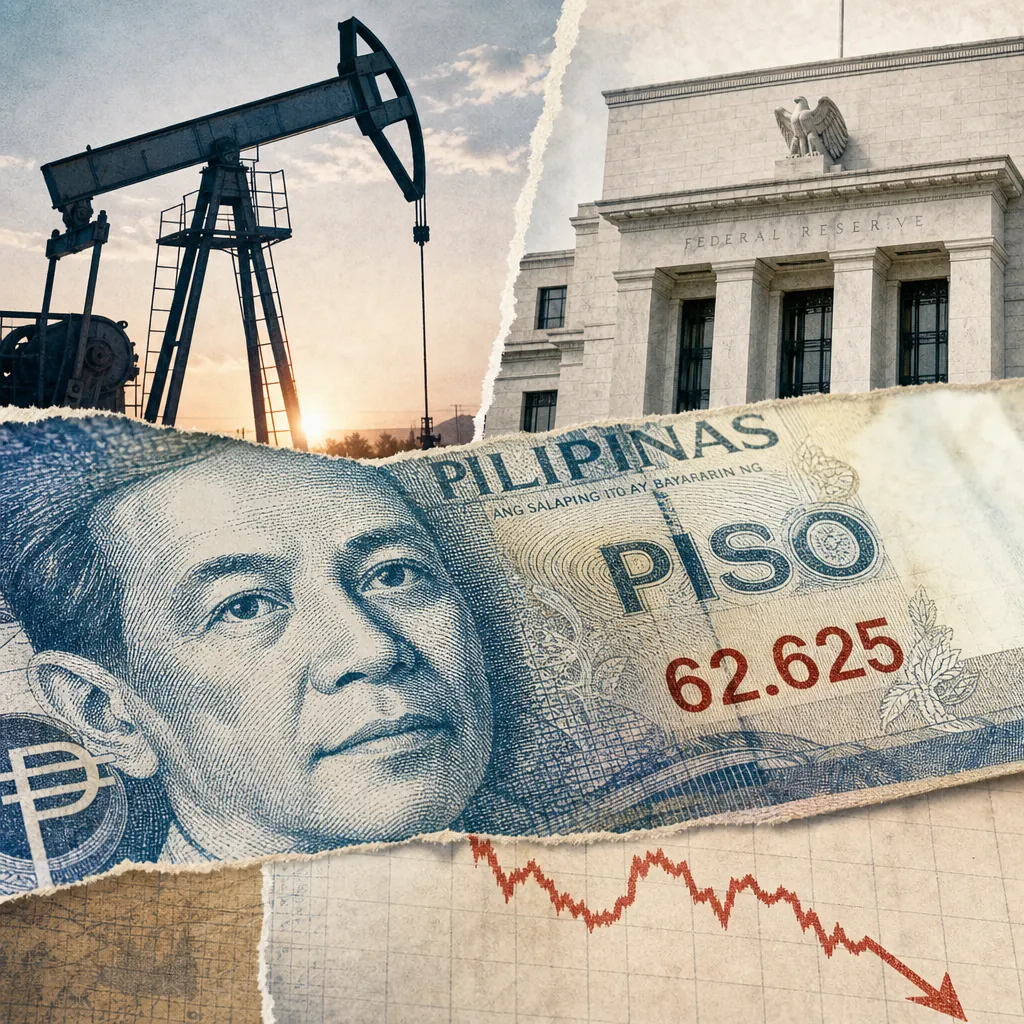
The Philippine peso slid to a fresh all-time low of P62.625 against the US dollar on Tuesday, September 8, 2026, extending a decline that has seen the currency weaken for several consecutive sessions. The drop, which came just two trading days after the previous record of P62.59, was driven by rising global oil prices and growing market expectations that the US Federal Reserve could raise interest rates next week. Union Bank chief economist Ruben Carlo Asuncion noted that as a major oil importer, the Philippines remains sensitive to higher energy prices because of their implications for inflation and the country's import bill. A trader added that the currency fell on expectations of a US policy rate hike, which typically strengthens the dollar and weakens emerging-market currencies like the peso. The peso's slide reflects broader concerns about the Philippine economy's exposure to external shocks, including Middle East tensions and global monetary policy shifts. While the stock market managed a modest rebound on the same day, with the benchmark Philippine Stock Exchange Index (PSEi) rising 0.37 percent to close at 6,105.99, trading volume remained subdued, indicating cautious investor sentiment. The peso's record low is a significant development for the financial sector, as it affects the cost of imports, debt servicing, and overall economic stability. For ordinary Filipinos, a weaker peso means higher prices for imported goods, including fuel and food, which could feed into inflation and erode purchasing power. The currency's trajectory will likely remain sensitive to oil price movements, developments in the Middle East, and the upcoming US inflation report, which could influence the Fed's decision on interest rates. This snapshot examines the day's key developments across the financial and economic landscape, including the peso's slide, stock market performance, corporate moves, and other notable stories that shaped the conversation on September 8, 2026.
Key themes
- Peso plunges to record low of P62.625 per dollar — The Philippine peso weakened by 3.9 centavos to close at P62.625 against the US dollar on September 8, 2026, surpassing the previous record low of P62.59 set just two trading days earlier. Rising oil prices and expectations of a US Federal Reserve rate hike pressured the currency, according to Union Bank chief economist Ruben Carlo Asuncion and a trader quoted by the Manila Times. The peso's decline reflects the country's vulnerability as a net oil importer and its exposure to global monetary tightening.
- PSEi rebounds above 6,100 on bargain hunting — The Philippine Stock Exchange Index (PSEi) rose 0.37 percent, or 22.31 points, to close at 6,105.99 on September 8, 2026, as investors hunted for bargains following the previous day's decline. Buying in index heavyweight International Container Terminal Services Inc. (ICTSI) helped lift the market, with ICTSI emerging as the top index gainer. However, trading volume remained subdued at P4.04 billion net value turnover, and market breadth was slightly negative, indicating cautious sentiment amid macroeconomic and geopolitical uncertainties.
- Philippine stock market second-worst performer in Southeast and East Asia — According to Philstocks Financial's September outlook report, the PSEi was the second-worst performer among Southeast and East Asian markets tracked by the brokerage in the first eight months of 2026. The market was weighed down by the country's high dependence on oil imports, limited participation in the global artificial intelligence rally, and concerns over alleged corruption involving flood-control projects. The PSEi closed at 5,956.33 as of August 28, down 1.6% year-to-date and 3.78% from a year earlier.
- ABS-CBN secures P3.5-billion investment from I&C Holdings — ABS-CBN Corp. announced that I&C Holdings Corp. will acquire a 27.06% stake in the media conglomerate through a P3.5-billion investment, part of a larger P6-billion equity-raising plan. The transaction will make I&C the second-largest shareholder, while the Lopez family's holding company, Lopez, Inc., will see its stake diluted to 44.35% from 78.4%. The move strengthens ABS-CBN's balance sheet and supports future growth initiatives, while keeping the company 100% Filipino-owned.
- Pag-IBIG and SMDC partner to expand housing access — Pag-IBIG Fund and SM Development Corp. (SMDC) signed a memorandum of understanding on September 8, 2026, to expand the range of SMDC homes that qualified members can purchase using Pag-IBIG Housing Loans. The partnership covers preferential pricing on selected units, buyer education, and planned homebuyer programs, supporting the government's Expanded Pambansang Pabahay para sa Pilipino (4PH) Program. DHSUD Secretary Jose Ramon Aliling said the move gives middle-income Filipino workers more housing choices, particularly homes closer to their workplaces.
- Uniqlo expands Philippine retail network with new stores — Japanese apparel retailer Uniqlo announced plans to open three new stores and expand three existing branches in the Philippines for the Fall/Winter 2026 season. The expansion includes the opening of Uniqlo SM City Zamboanga on September 25, marking the brand's eighth store in Mindanao and the first to offer its Modest Wear collection for women, including the AIRism UV Protection Hijab. The retailer will also open stores at Ninoy Aquino International Airport Terminal 3 and in Nuvali, Laguna, and expand outlets in Marikina, Cabanatuan, Cebu, and General Santos.
- Cebu Landmasters deepens Bohol presence with new Tagbilaran project — Cebu Landmasters Inc. (CLI) announced a 5.6-hectare residential development in Tagbilaran City, Bohol, its third project in the province. The development will feature Velmiro, CLI's mid-market housing brand, and its first Mirani mid-rise condominium in Bohol. The expansion follows strong take-up at existing Bohol projects, with Costa Mira Beachtown Panglao reaching a 98% sell-through rate for its 1,056 units. CLI President and CEO Jose Franco Soberano cited Bohol's strong potential and the company's performance there as reasons for deepening its commitment.
- Business leaders urged to pivot toward adaptability amid 'flux' — At the 24th Management Association of the Philippines (MAP) International CEO Conference, business leaders were told to treat economic headwinds as an operating reality rather than a temporary disruption. MAP President Donald Patrick Lim said, "For years, the objective was optimization. Today, the objective is adaptability." The conference highlighted the need for strategies that can withstand structural shifts across industries, as the landscape continues to change.
How the narratives stack
Dominant — The peso's record low and its implications for the Philippine economy dominated the day's financial news. The Manila Times reported the peso closing at P62.625, a new all-time low, with analysis from Union Bank's chief economist and a trader pointing to oil prices and US rate hike expectations as key drivers. This story carried significant weight because it affects inflation, import costs, and overall economic stability. The peso's slide was also linked to the stock market's performance, with the PSEi rebounding slightly but remaining under pressure. Within the captured set, this narrative drew substantial coverage, including multiple articles from the Manila Times and Daily Tribune, reflecting its importance to the financial sector.
Counter-narrative — Despite the peso's weakness, the Philippine stock market managed a modest rebound on September 8, with the PSEi rising 0.37% to close above 6,100. This counter-narrative highlights bargain hunting and foreign fund inflows, suggesting that some investors see value in Philippine equities at current levels. However, the rebound was tempered by subdued trading volume and persistent uncertainties, indicating that the market's recovery is fragile. This narrative provides a nuanced view of the day's financial developments, showing that not all indicators were negative.
Emerging — The expansion of housing and retail sectors, as seen in the Pag-IBIG-SMDC partnership and Uniqlo's store openings, points to continued private-sector investment in the Philippines despite economic headwinds. These developments suggest that businesses are betting on long-term growth, particularly in provincial areas and among middle-income consumers. The ABS-CBN capital raise also signals confidence in the media company's future, with I&C Holdings making a significant investment. These emerging narratives indicate that while macroeconomic challenges persist, specific sectors are still attracting investment and expanding.
Under-covered — The Visayas power outages and the resulting congressional inquiry received relatively less attention in the captured set compared to the peso and stock market stories. The outages, which have led to rotational brownouts and red alerts on the grid, have significant economic and social impacts on households and businesses in the Visayas. Energy Secretary Sharon Garin called the outages "unacceptable" and said the Department of Energy is working to stabilize the grid. This story deserves more coverage given its direct impact on daily life and the economy, but it was overshadowed by financial market news in the day's monitoring.
Platform insights
- Facebook — Facebook posts from news outlets like Abante News and Inquirer generated engagement on flood-related content, with viral videos showing flooding inside homes in Bataan. The Abante News video "BAHA SA LOOB NG BAHAY" captured the impact of heavy rains, drawing reactions from users concerned about the weather. Facebook remains a primary platform for sharing real-time updates and user-generated content during disasters.
- X (formerly Twitter) — X saw discussions around the peso's record low and stock market performance, with financial analysts and traders sharing updates and commentary. The platform is a hub for real-time market news and expert opinions, with hashtags like #Peso and #PSEi trending among finance-focused users. The conversation on X was more analytical, focusing on the implications of the currency's decline.
- YouTube — YouTube hosted longer-form content, such as ABS-CBN News coverage of the Virgin Mary's birthday celebrations and GMA News features on local businesses like the "Bulalot" restaurant in Bulacan. These videos attracted views and comments, reflecting public interest in cultural and human-interest stories alongside hard news. YouTube serves as a platform for in-depth storytelling and community engagement.
- Reddit — Reddit threads, such as those referenced in Yahoo Lifestyle articles, discussed personal finance and homeownership issues, including a viral story about a Michigan homeowner discovering the previous owner had leased solar panels. While not directly related to Philippine finance, these threads indicate broader consumer concerns about financial decisions and property ownership, which resonate with Filipino audiences.
Key voices and communities
- Financial analysts and economists — Experts like Union Bank chief economist Ruben Carlo Asuncion and Philstocks Financial provided analysis on the peso's decline and stock market performance. Their insights are crucial for understanding the macroeconomic factors driving market movements and are widely cited in news coverage.
- Government officials — Energy Secretary Sharon Garin and DHSUD Secretary Jose Ramon Aliling were prominent voices, addressing power outages and housing initiatives, respectively. Their statements shape policy narratives and signal government priorities to the public and investors.
- Business leaders — Executives like Cebu Landmasters President Jose Franco Soberano and MAP President Donald Patrick Lim spoke about corporate expansion and the need for adaptability in a changing economic landscape. Their perspectives highlight private-sector confidence and strategic responses to challenges.
- Media outlets — Publications like the Manila Times, BusinessWorld, and Inquirer played a key role in disseminating news and analysis. Their reporting set the agenda for public discourse on financial and economic issues, with varying degrees of depth and perspective.
- Consumers and residents — Individuals affected by flooding, power outages, and currency depreciation voiced their concerns through social media and community forums. Their experiences ground the macroeconomic narratives in everyday realities, influencing public sentiment and policy responses.
Narrative streams
Peso hits record low as oil prices and US rate fears weigh
The Philippine peso closed at a record low of P62.625 against the US dollar on September 8, 2026, weakening by 3.9 centavos from the previous day's close of P62.59. This marked the second consecutive trading day that the currency set a new all-time low, following the P62.59 level hit last Friday. The decline was attributed to rising oil prices and growing market expectations that the US Federal Reserve could deliver a policy rate hike next week. Union Bank chief economist Ruben Carlo Asuncion explained that as a major oil importer, the Philippines remains sensitive to higher energy prices because of their implications for inflation and the country's import bill. He added that near-term direction will likely remain sensitive to oil prices, Middle East developments, and Friday's US inflation report. A trader also noted that the peso fell on expectations of a US rate hike, which typically strengthens the dollar. The peso's weakness has broad implications for the Philippine economy, including higher costs for imported goods and services, increased debt servicing burdens, and potential inflationary pressures. For ordinary Filipinos, a weaker peso means more expensive fuel, food, and other imported products, which can erode purchasing power and affect living standards. The read for the financial sector is that the peso's trajectory will remain under pressure as long as global oil prices stay elevated and the US Federal Reserve maintains a hawkish stance. Businesses that rely on imports will need to manage currency risks, while exporters may benefit from a weaker peso. The upcoming US inflation report and the Fed's policy decision will be critical in determining the peso's near-term direction.
PSEi rebounds above 6,100 on bargain hunting
Despite the peso's record low, the Philippine Stock Exchange Index (PSEi) rebounded above the 6,100 level on September 8, 2026, closing at 6,105.99, up 0.37 percent or 22.31 points. The rise was driven by bargain hunting, as investors took advantage of lower valuations following the previous day's decline. Buying in index heavyweight International Container Terminal Services Inc. (ICTSI) helped lift the market, with ICTSI emerging as the top index gainer. However, trading volume remained subdued, with net value turnover at only P4.04 billion, and market breadth was slightly negative at 102 decliners against 89 advancers and 54 unchanged. Foreign investors turned net buyers, recording P164.54 million in net inflows. Luis Limlingan, head of sales at Regina Capital Development Corp., said the local index closed higher as market participants engaged in bargain hunting, but investor caution remained evident amid persistent macroeconomic and geopolitical uncertainties. The rebound suggests that some investors see value in Philippine equities at current levels, but the subdued volume indicates that confidence is not yet fully restored. The read for the stock market is that the PSEi may continue to experience volatility as external factors such as oil prices, US monetary policy, and domestic political concerns weigh on sentiment. Investors should monitor these factors closely and consider selective buying opportunities in fundamentally strong companies.
Philippine stock market second-worst performer in Southeast and East Asia
According to Philstocks Financial's September outlook report, the Philippine stock market was the second-worst performer among Southeast and East Asian markets tracked by the brokerage in the first eight months of 2026. The PSEi closed at 5,956.33 as of August 28, down 1.6% year-to-date and 3.78% from a year earlier. The underperformance was attributed to the country's high dependence on oil imports, limited participation in the global artificial intelligence rally, and concerns over alleged corruption involving flood-control projects. Regional markets were affected by the conflict in the Middle East, but the Philippine market lagged due to these domestic and structural factors. Average daily value turnover reached P6.25 billion, up 4.08% year-on-year, while net foreign selling totaled P25.09 billion during the period. This underperformance highlights the challenges facing the Philippine stock market, including its vulnerability to external shocks and lack of exposure to high-growth sectors like AI. The read for investors is that the PSEi may continue to lag regional peers unless structural issues are addressed, such as improving governance and attracting foreign investment. Diversification and selective stock picking will be crucial for navigating this environment.
ABS-CBN secures P3.5-billion investment from I&C Holdings
ABS-CBN Corp. announced that I&C Holdings Corp., an investment firm specializing in majority ownership stakes in Philippine entities, will acquire a 27.06% stake in the media conglomerate through a P3.5-billion investment. This is part of a larger P6-billion equity-raising plan that will dilute current shareholders and reshape the board while keeping the company 100% Filipino-owned. Following the transaction, Lopez, Inc., the holding company of the Lopez family, will remain ABS-CBN's largest shareholder, although its stake will be diluted to 44.35% from 78.4%. I&C will hold 27.06%, making it the second-largest shareholder. Other holding companies, including Crème Investment Corp., Mantes Corp., and Presta Holdings Company, Inc., will own smaller stakes. The move strengthens ABS-CBN's balance sheet and fuels future growth initiatives. This capital raise is significant for ABS-CBN, which has faced challenges since its franchise was not renewed in 2020, forcing it to shift to digital and other platforms. The investment from I&C Holdings signals confidence in ABS-CBN's turnaround and growth prospects. The read for the media sector is that ABS-CBN's strengthened financial position will enable it to invest in content and digital expansion, potentially reshaping the competitive landscape. The entry of a new major shareholder could also bring fresh strategic direction and governance changes.
Pag-IBIG and SMDC partner to expand housing access
Pag-IBIG Fund and SM Development Corp. (SMDC) signed a memorandum of understanding on September 8, 2026, to expand the range of SMDC homes that qualified members can purchase using Pag-IBIG Housing Loans. The partnership covers preferential pricing on selected units, buyer education, and planned homebuyer programs. Participating developments include Coast Residences and ICE Tower in Pasay City, Spring Residences in Parañaque City, selected phases of Hill Residences in Quezon City, and SMDC Cheerful Homes 1 and 2 in Pampanga. SMDC is also gearing up to add more developments in Makati City, Mandaluyong City, and Pasay City, including SMDC Heights, SMDC Nature, and SMDC Symphony Homes. The agreement supports the Department of Human Settlements and Urban Development's (DHSUD) efforts to strengthen private-sector participation in President Ferdinand Marcos Jr.'s Expanded Pambansang Pabahay para sa Pilipino (4PH) Program, which aims to address the country's housing backlog. DHSUD Secretary Jose Ramon Aliling, who also chairs the Pag-IBIG Board of Trustees, said SMDC's participation would give members, particularly middle-income Filipino workers, more housing choices, especially homes closer to their workplaces. The read for the housing sector is that increased private-sector involvement and accessible financing will help more Filipinos own homes, but challenges remain in terms of affordability and supply. The partnership between Pag-IBIG and SMDC is a step toward making housing more accessible, but sustained efforts are needed to address the broader housing deficit.
Uniqlo expands Philippine retail network with new stores
Japanese apparel retailer Uniqlo announced plans to open three new stores and expand three existing branches in the Philippines for the Fall/Winter 2026 season. The expansion includes the opening of Uniqlo SM City Zamboanga on September 25, marking the brand's eighth store in Mindanao and the first to offer its Modest Wear collection for women, including the AIRism UV Protection Hijab. The retailer will also open stores at Ninoy Aquino International Airport Terminal 3 and in Nuvali, Laguna, and expand outlets in Marikina, Cabanatuan, Cebu, and General Santos. This expansion reflects Uniqlo's confidence in the Philippine market and its strategy to increase presence outside Metro Manila. The opening in Zamboanga is particularly notable as it caters to the Muslim-majority population with modest wear options. The read for the retail sector is that international brands continue to see growth potential in the Philippines, particularly in provincial areas and transport hubs. This expansion creates jobs and offers consumers more choices, but also intensifies competition among retailers. Uniqlo's focus on inclusivity and local adaptation may set a trend for other brands entering the market.
Cebu Landmasters deepens Bohol presence with new Tagbilaran project
Cebu Landmasters Inc. (CLI) announced a 5.6-hectare residential development in Tagbilaran City, Bohol, its third project in the province. The development will feature Velmiro, CLI's mid-market housing brand, and its first Mirani mid-rise condominium in Bohol, with commercial spaces serving residents and the surrounding community. The expansion follows strong take-up at existing Bohol projects, with Costa Mira Beachtown Panglao reaching a 98% sell-through rate for its 1,056 units. Its fully completed Velmiro Greens Bohol in Dauis is also undergoing turnover with all 256 units expected to be delivered by the end of 2026. CLI President and CEO Jose Franco Soberano said, "Bohol continues to show strong potential, and our performance here gives us confidence to deepen our commitment to the province." The read for the property sector is that provincial markets like Bohol are becoming increasingly attractive for developers due to strong demand and tourism growth. CLI's expansion indicates confidence in the region's economic prospects, and the introduction of mid-rise condominiums offers more diverse housing options for local residents and investors.
Business leaders urged to pivot toward adaptability amid 'flux'
At the 24th Management Association of the Philippines (MAP) International CEO Conference held in Bonifacio Global City, Taguig City on September 8, 2026, business leaders were urged to treat economic headwinds as an operating reality rather than a temporary disruption. MAP President Donald Patrick Lim said, "For years, the objective was optimization. Today, the objective is adaptability." Alma Rita R. Jimenez, chairman of the MAP CEO Conference Committee, said businesses have no choice but to operate in the age of "flux," driven by major shifts across industries. The conference highlighted the need for strategies that can withstand structural shifts, including geopolitical tensions, technological disruptions, and changing consumer behaviors. The read for the business community is that adaptability and resilience are now essential for survival and growth. Companies must invest in flexible operations, diversify supply chains, and embrace innovation to navigate an increasingly uncertain environment. The conference serves as a platform for business leaders to share insights and collaborate on solutions to common challenges.
Conversation trajectory
- Peso movement (next 1-2 weeks) — The peso is likely to remain under pressure in the near term, with the next key catalyst being the US inflation report due Friday and the Federal Reserve's policy decision next week. If the Fed signals a rate hike, the peso could weaken further, potentially testing new lows. Conversely, any easing of oil prices or a dovish Fed stance could provide some relief. The read is that the peso will stay volatile, and businesses should hedge currency risks accordingly.
- Stock market performance (next 1-3 months) — The PSEi's rebound above 6,100 may be short-lived if external pressures persist. The market's underperformance relative to regional peers suggests that domestic concerns, such as corruption allegations and limited AI exposure, will continue to weigh on sentiment. However, bargain hunting and foreign inflows could support the market in the short term. The read is that the PSEi will likely trade in a range, with upside limited until structural issues are addressed.
- Housing sector developments (next 6-12 months) — The Pag-IBIG-SMDC partnership and other private-sector initiatives under the Expanded 4PH program are expected to increase housing supply and accessibility over the coming year. However, challenges such as the DHSUD escrow rule and financing constraints may slow progress. The read is that the housing sector will see gradual improvement, but the government and private developers must work together to overcome regulatory and financial hurdles.
- Retail expansion (next 3-6 months) — Uniqlo's store openings and expansions in provincial areas signal continued confidence in the Philippine retail market. This trend may attract other international brands to follow suit, increasing competition and consumer choice. The read is that retail growth will be driven by provincial demand and tourism recovery, but brands must adapt to local preferences and economic conditions.
- Corporate investments (next 6-12 months) — The ABS-CBN capital raise and Cebu Landmasters' expansion indicate that companies are investing in growth despite economic uncertainties. These moves suggest that businesses see long-term opportunities in the Philippines, particularly in media, property, and consumer sectors. The read is that corporate investment will continue, but companies will be selective and focus on areas with strong demand and growth potential.
- Trigger events — Key events to watch include the US inflation report on Friday, the Federal Reserve's policy decision next week, and any developments in the Middle East that could affect oil prices. Domestically, the Senate's committee of the whole hearings on the Pax Silica project and the ongoing flood-control corruption cases could influence investor sentiment and political stability. The Visayas power situation and the government's response will also be monitored for their economic impact.
Response guidance
- Financial communicators — When addressing the peso's decline, emphasize the government's measures to stabilize the currency and the resilience of the economy. Avoid speculation and provide factual context on global factors. Key messages should reassure stakeholders that the central bank is monitoring the situation and stands ready to act if needed.
- Corporate communicators — For companies affected by currency fluctuations, communicate proactive risk management strategies, such as hedging and diversification. Highlight any positive developments, such as export opportunities or cost-saving measures. Be transparent about challenges and outline steps being taken to mitigate impacts.
- Housing sector communicators — When promoting partnerships like Pag-IBIG-SMDC, focus on the benefits to Filipino workers, such as affordable financing and more housing options. Use real-life examples and testimonials to make the message relatable. Address any concerns about project delays or regulatory issues by explaining the processes and safeguards in place.
- Retail communicators — For brands expanding in the Philippines, emphasize commitment to local communities and job creation. Highlight product offerings that cater to local needs, such as modest wear in Zamboanga. Use social media to engage with customers and build brand loyalty, especially in new markets.
- Crisis communicators — In light of power outages and flooding, ensure timely and accurate information dissemination. Coordinate with government agencies and provide clear guidance to the public. Use multiple platforms to reach affected communities and address misinformation promptly.
- General guidance — Maintain a tone of transparency and preparedness. Avoid overpromising and provide realistic assessments of challenges. Engage with stakeholders through town halls, social media, and press releases to build trust and demonstrate accountability.
See the full picture behind today's signals.
This report draws from Media Meter's MediaWatch, our real-time monitoring engine tracking 2,470+ Philippine sources across print, broadcast, digital, and social. Explore how the platform turns raw coverage into decision-grade intelligence, then see how it's configured for teams like yours — whether you're in PR agencies, corporate comms, government, or marketing.
Want more? Browse our Report Library for sector and crisis intelligence, or request a demo and we'll have your brand set up before the call.
Want this kind of intelligence on your brand?
This brief is built on the same MediaWatch methodology that runs continuously across every brand we monitor. See your competitive landscape, Impact Score, and narrative trajectory in a 30-minute demo.