Toyota PH Output to Slip Below 2025 Record
Toyota Motor Philippines expects local vehicle production to fall to about 60,000 units this year from a record 63,803 in 2025, as weak demand and high fuel prices weigh on the market. Electrified vehicle sales more than doubled in the first seven months even as the wider industry struggled.
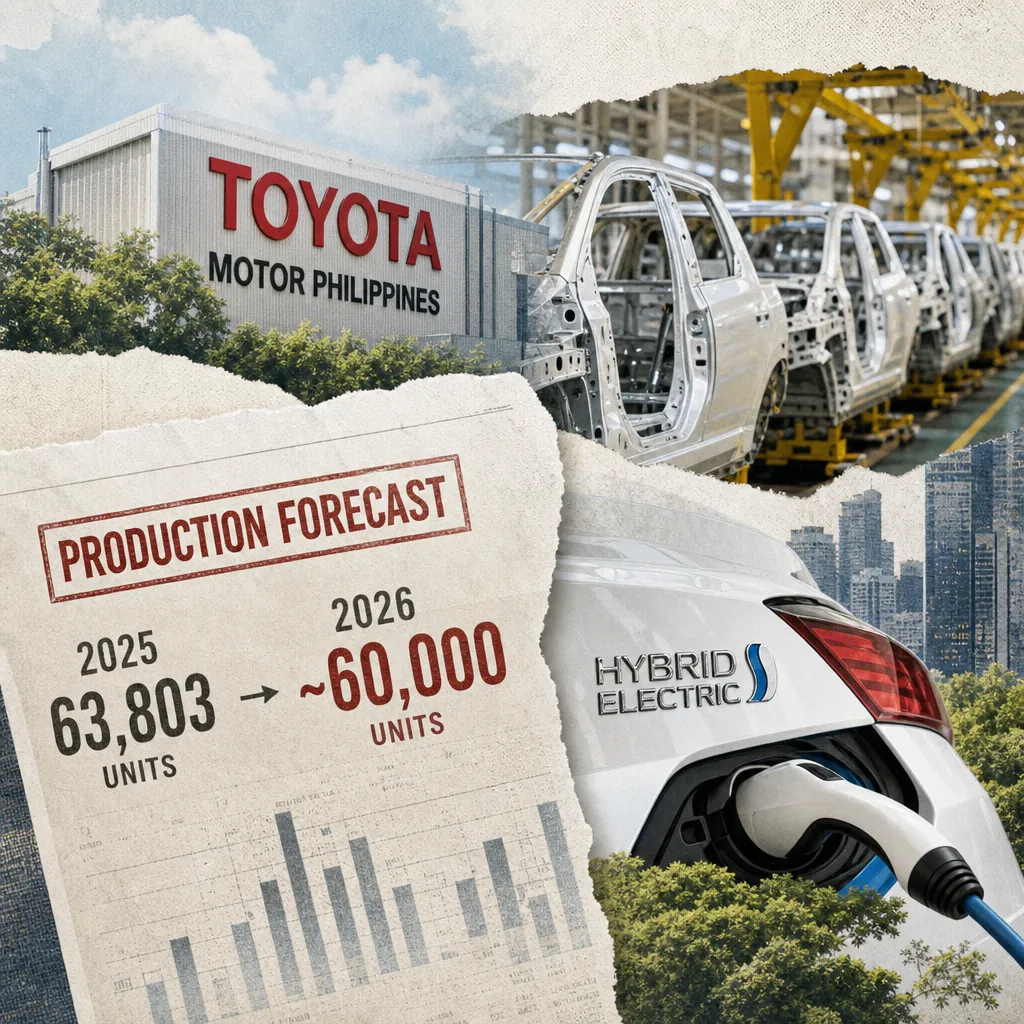
Toyota Motor Philippines Corp. (TMP) expects to assemble close to 60,000 vehicles this year, down from the record 63,803 units it built in 2025, the company's senior vice-president for marketing, Sherwin T. Chua Lim, told a media roundtable on Tuesday 5639. The projection puts the country's largest automaker on course to miss its own banner year by roughly 6 percent, and it lands in a market where the cost of fuel has become the single most-cited drag on demand. TMP's output through August stood at 38,221 units, 10 percent below the 42,469 units assembled in the same eight months of 2025 563. The Vios subcompact accounted for 18,321 units, or 48 percent of that eight-month total; the Tamaraw light commercial vehicle followed with 12,468 units, or 33 percent; and the Innova multipurpose vehicle contributed 7,432 units, or 19 percent 56. All three are built at TMP's 82-hectare Toyota Special Economic Zone in Santa Rosa, Laguna 56. Chua Lim attributed the softer outlook to weak domestic demand tied to macroeconomic pressure, including elevated fuel prices, and noted that production had begun recovering in July after disruptions linked to the US-Iran war 339. TMP's sales had fallen 8.2 percent to 118,706 units by July, according to one account of the same briefing 39.
The production forecast was the most consequential single item in the day's automotive coverage, and it drew the widest pickup across the outlets captured here: BusinessWorld, the Manila Times, the Inquirer's business desk, and the aggregator Head Topics all carried versions of the same roundtable 563139. The Inquirer's online business section alone carried an estimated advertising-equivalent value of ₱334,152 for its report — the notional cost of buying the same space as paid advertising, not a count of readers 1. The Manila Times' version was valued at ₱247,044 and Head Topics' at ₱268,950 339. Against that, the day's other automotive stories — a Chinese brand's marketing award, a hydrogen race truck, a Malaysian police fleet trial — drew narrower audiences and, in the case of the Malaysian items, values in the low tens of thousands of pesos 84020.
The counterweight to the production story sat in the same day's coverage: electrified vehicles are selling faster than the rest of the market. Sales of electrified vehicles — a category that includes hybrids, plug-in hybrids, and battery-electric cars — more than doubled in the first seven months of the year, with 38,286 new units registered from January to July, even as the broader automotive industry had a difficult year 12. A study by BMI, a research unit of Fitch Solutions, projects that momentum continuing through the rest of the decade, with Philippine electrified vehicle sales growing far faster than those of internal combustion engine (ICE) vehicles, which run on gasoline or diesel 12. The two stories are not in conflict: the overall market is contracting while the electrified slice of it expands, which is why a production cut at the country's dominant assembler can coexist with record-setting adoption of the vehicles that are replacing its core product.
Key themes
- Toyota's Philippine output is set to fall about 6 percent from its 2025 record. TMP expects to build close to 60,000 vehicles this year against 63,803 last year, with eight-month output already down 10 percent at 38,221 units 563.
- High fuel prices are the stated cause, and they trace back to the Middle East conflict. TMP's marketing chief tied the soft demand to elevated oil prices stemming from the US-Iran war, which had also disrupted production earlier in the year before a July recovery 393.
- Electrified vehicle sales more than doubled in seven months. Registrations of hybrids, plug-in hybrids, and battery-electric vehicles reached 38,286 units from January to July, defying the wider industry's slump 12.
- The Vios remains the backbone of local assembly. The subcompact made up 48 percent of TMP's eight-month production, ahead of the Tamaraw at 33 percent and the Innova at 19 percent 56.
- The Tamaraw is carrying Toyota's local-manufacturing and sustainability narrative. TMP's 2026 sustainability report said the vehicle took 36 percent of the pure commercial vehicle market in its first full year and ranked first in the light commercial vehicle segment, backed by ₱5.5 billion in production, parts-localization, and conversion investment 10.
- A Chinese challenger is being recognized for brand momentum. GAC Philippines was named "2026 Breakthrough Brand–Automotive" in Kantar's BrandZ Spotlight on Philippine Brands report, sharing the automotive honors with Toyota 8.
- Fuel costs are also driving government transport policy. The Department of Transportation has given the Land Transportation Franchising and Regulatory Board one month to decide on fare-hike petitions, while the government has raised its fuel discount for passenger vehicles to ₱12 per liter 4165.
- The modernization program's financing is under strain. The Development Bank of the Philippines said ₱4.1 billion in loans to jeepney operators who bought modern units are past due, or 55 percent of the ₱7.5 billion it lent for the shift 69.
How the narratives stack
Dominant. Toyota's production forecast is the day's dominant automotive story by consequence and by breadth of pickup. It concerns the country's largest assembler, the plant that builds three of the country's best-selling nameplates, and a supply chain of local parts makers and conversion businesses. The story ran in BusinessWorld, the Manila Times, the Inquirer, and Head Topics, and the Inquirer's version alone carried an estimated ₱334,152 in advertising-equivalent value 563139. Within the items captured here, it is also the only automotive story with a hard forward number attached — 60,000 units against 63,803 — which is what gives it weight beyond the roundtable itself.
Counter-narrative. The electrified-vehicle numbers cut against the gloom. Sales of electrified vehicles more than doubled to 38,286 units in the first seven months, and BMI expects them to keep outpacing conventional cars through the decade 12. This is the story that says the Philippine market is not simply shrinking; it is changing composition, with buyers who can afford to switch moving away from fuel-only cars. The Inquirer's report on the trend carried an estimated ₱425,628 in advertising-equivalent value, the highest of any single automotive item in this set 12.
Emerging. Two threads point to where the market may go next. First, Chinese brands are gaining recognition: GAC Philippines took a "Breakthrough Brand" honor in Kantar's BrandZ report, a signal that the challenger brands are building enough presence to be measured alongside the incumbents 8. Second, hydrogen is being positioned as a long-horizon option: Toyota confirmed a hydrogen fuel-cell Hilux for Europe in 2028, targeting about 400 kilometers of range and 2,500 kilograms of towing capacity, and showed the Dakar-bound DKR GR FC Hilux race truck that will compete in the Dakar Future Mission 1000 experimental category 4240. Neither is a near-term Philippine sales story, but both indicate the technology menu Toyota is preparing beyond hybrids.
Under-covered. The Tamaraw's role in local manufacturing and employment drew only a single blog item in this set, despite the ₱5.5 billion investment behind it and its 36 percent share of the pure commercial vehicle market 10. The same is true of the regional context: Proton's handover of eMAS 5, eMAS 7, and eMAS 7 PHEV units to the Royal Malaysia Police for evaluation, with free charging from Gentari, and Jetour's 2,137 pre-launch bookings for the T2 i-DM plug-in hybrid in Malaysia, both ran on enthusiast and regional outlets with values in the low tens of thousands of pesos 2018. These are not Philippine stories, but they show how quickly electrified fleets and plug-in hybrids are being normalized in a neighboring market.
Platform insights
The monitoring writeup for this window did not capture social-platform activity, so no engagement figures — likes, shares, views, or comments — are available for this snapshot. The conversation as recorded here ran through news and enthusiast outlets rather than social posts, and the prominence signals available are coverage values rather than audience interaction. Where a story's reach into social platforms is not documented, this snapshot does not estimate it.
Key voices and communities
Toyota Motor Philippines' executives. Sherwin T. Chua Lim, senior vice-president for marketing, is the source of the production forecast and the fuel-price explanation 5639. President Masando Hashimoto is the voice behind the Tamaraw's local-manufacturing message 10. Their framing matters because TMP's numbers function as a proxy for the health of Philippine vehicle assembly.
Business and motoring press. BusinessWorld, the Manila Times, the Inquirer's business desk, and Head Topics carried the production story; Top Gear Philippines carried the hydrogen and Hilux items; Zigwheels carried the GAC award 56313942408. This group sets the terms in which the industry's numbers reach the public.
Government transport agencies. The Department of Transportation, the Land Transportation Franchising and Regulatory Board, and the Development Bank of the Philippines are the actors on the policy side, and their decisions on fares, fuel discounts, and modernization loans directly affect the cost of owning and operating a vehicle 416569.
Regional and enthusiast outlets. Paul Tan's Automotive News and Zigwheels Malaysia covered the Proton police trial, the Jetour pre-orders, and Honda's hybrid owner stories, giving a view of how electrification is being adopted in a comparable Southeast Asian market 201835.
Narrative streams
Toyota cuts its Philippine output forecast as fuel prices bite
TMP's expected output of close to 60,000 units this year compares with 63,803 units in 2025, a record year the company will not match 56. The eight-month figure of 38,221 units is 10 percent below the 42,469 units built in the same period of 2025, and the mix is heavily concentrated in one model: the Vios at 18,321 units, or 48 percent of production, followed by the Tamaraw at 12,468 units and the Innova at 7,432 units 56. Chua Lim said weak domestic demand was among the factors, and the company linked the softness to higher oil prices stemming from the Middle East conflict; production had begun recovering in July after war-related disruptions, but demand stayed weak 339. TMP's sales through July were down 8.2 percent at 118,706 units 39. The company also used the briefing to press for a regulatory review of ride-hailing slot allocations that favor battery-electric and plug-in hybrid vehicles over conventional ICE cars, an argument that matters because those allocations determine which vehicles can operate on the country's ride-hailing platforms 39. For parts suppliers, conversion businesses, and the roughly 82-hectare Santa Rosa plant's workforce, a 6 percent cut in output translates into fewer orders and fewer shifts; for buyers, it signals that the market's largest player expects demand to stay soft, which historically keeps incentives and discounts in play.
Electrified vehicles outsell the market's mood
Registrations of electrified vehicles reached 38,286 units from January to July, more than double the same period a year earlier, in a year when the wider automotive industry struggled 12. BMI, the research unit of Fitch Solutions, projects Philippine electrified vehicle sales to keep growing far faster than ICE vehicles through the rest of the decade 12. The category spans hybrids that recharge themselves from the engine and brakes, plug-in hybrids that can run on battery power alone for short distances, and full battery-electric cars. The growth is concentrated among buyers who can afford to switch, and the Inquirer's report framed the shift as driven partly by an oil crisis that has raised the cost of running a fuel-only car 12. For automakers, the read is that the Philippine market's growth is now in electrified powertrains, not in the overall volume — which is why Toyota can cut total output while still needing to defend its position in hybrids. For charging infrastructure and electricity providers, the same numbers are the demand signal that determines where stations get built.
The Tamaraw anchors Toyota's local-manufacturing case
TMP's 2026 sustainability report said the Next Generation Tamaraw captured 36 percent of the pure commercial vehicle market in its first full year and took the top spot in the light commercial vehicle segment 10. The company invested ₱5.5 billion in vehicle production, parts localization, and conversion capabilities for the vehicle, creating work for local designers, engineers, parts suppliers, external body builders, and niche conversion businesses 10. President Masando Hashimoto said the Tamaraw is one of the company's major means of creating and adding new value 10. The commercial-vehicle segment is where local manufacturing has the strongest multiplier effect, because these units are converted into jeepneys, delivery vans, and service vehicles by domestic firms rather than shipped in finished. For the small and medium businesses that buy them, the Tamaraw's local content is also a parts-availability argument: a vehicle assembled and supported domestically is cheaper to keep on the road.
A Chinese challenger enters the brand conversation
GAC Philippines was named "2026 Breakthrough Brand–Automotive" in Kantar's BrandZ Spotlight on Philippine Brands report, sharing the automotive recognition with Toyota 8. The company supports owners through 30 dealerships nationwide, a dedicated parts warehouse, and two years of free roadside assistance, with coverage varying by powertrain 8. Kantar's BrandZ is a brand-equity study that measures consumer perception and brand value rather than sales, so the award is a signal about how quickly a newer entrant has become familiar to buyers. For established brands, the read is that the challenger segment now has enough consumer recognition to be measured alongside the incumbents, which raises the pressure on pricing and feature content in the entry and mid segments where Chinese brands compete hardest.
Fuel costs move from the pump to policy
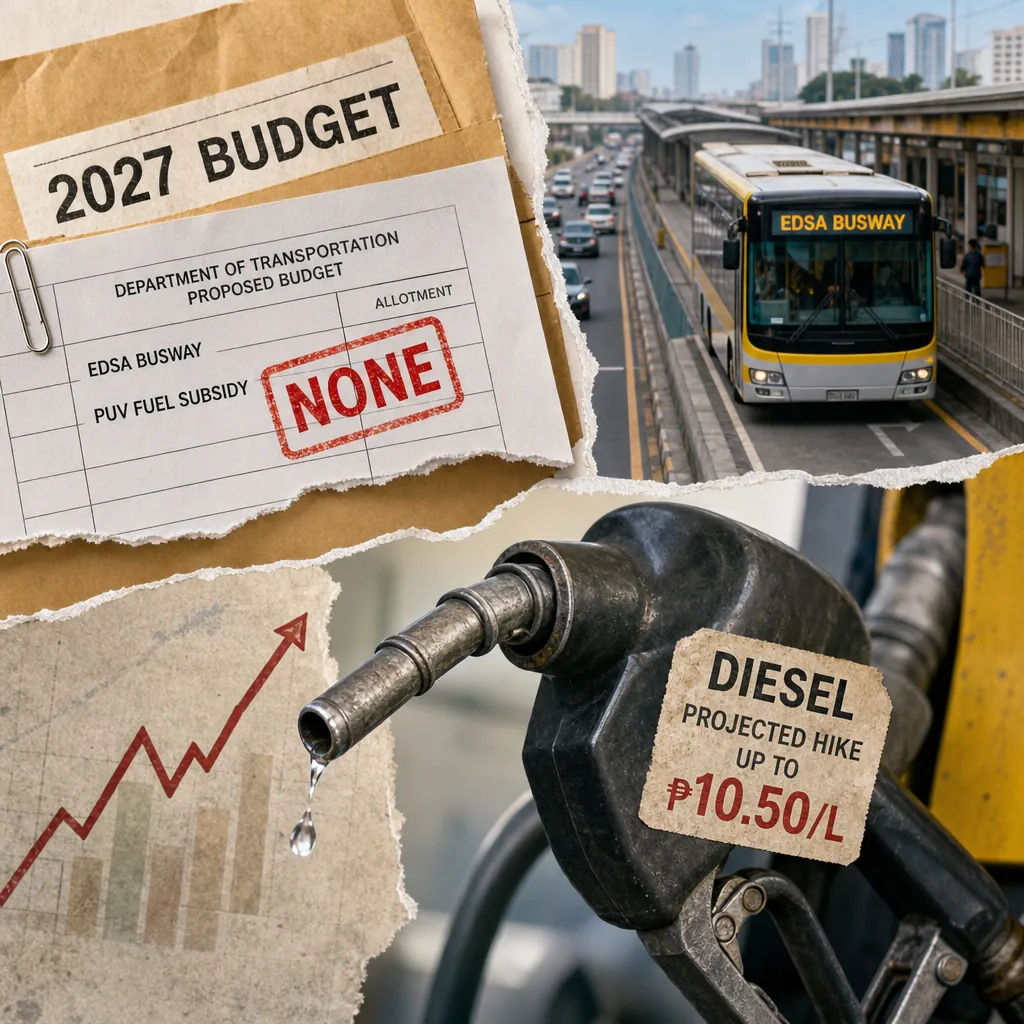
The Department of Transportation has given the Land Transportation Franchising and Regulatory Board one month to decide on fare-hike petitions filed by transport groups, with Transportation Secretary Giovanni Lopez saying a decision is important in October because of continued oil price increases 4165. Lopez said the government is working on a resolution that would benefit workers without burdening commuters, and that expanding the fuel discount is under consideration by including more public utility vehicle operators and petroleum products beyond diesel 65. Select jeepney drivers and operators already receive a ₱12-per-liter fuel subsidy, which the government estimates can save about ₱1,800 a week 41. Separately, Lopez said the department will push for funding for the EDSA busway and other programs in the 2027 national budget, after the National Expenditure Program left the Public Transport Modernization Program, service contracting, and active transport projects with zero funding 66. The modernization program is the government's plan to replace older jeepneys with newer, lower-emission units; its financing is already strained, with the Development Bank of the Philippines reporting ₱4.1 billion in past-due loans, or 55 percent of the ₱7.5 billion it lent for the shift, affecting up to 2,753 of the 3,249 units financed 69. For commuters, the fare decision determines what they pay; for operators, the fuel discount and loan terms determine whether they can keep running; and for the banks, the past-due loans are a live credit problem.
Regional electrification normalizes next door
Proton, through its electric vehicle distribution arm, handed over eMAS 5, eMAS 7, and eMAS 7 PHEV units to the Royal Malaysia Police for evaluation as potential patrol vehicles, with charging provider Gentari offering free public charging during the trial 20. In a separate item, Jetour's T2 i-DM plug-in hybrid SUV had accumulated 2,137 bookings in Malaysia ahead of its launch, roughly 700 a month over three months of pre-orders, at an estimated price of RM168,888 18. Honda Malaysia, meanwhile, marked Malaysia Day by publishing owner testimonials for its City, Civic, and CR-V hybrids 35. None of these are Philippine sales events, but they show a neighboring market where electrified police fleets, plug-in hybrid pre-orders, and hybrid ownership are being treated as ordinary. For Philippine policymakers weighing incentives for electrified vehicles, the regional comparison is the relevant benchmark: adoption next door is being driven by fleet procurement and model availability, not only by consumer choice.
Conversation trajectory
Over the next four to six weeks, watch the LTFRB fare decision. The Department of Transportation has set an October deadline for the board to act on fare-hike petitions, and the outcome will be read as a signal of how the government intends to balance operator costs against commuter fares as fuel prices stay high 4165. A decision to grant an increase would feed directly into transport costs; a decision to hold fares while expanding fuel subsidies would shift the cost to the national budget.
Over the next one to two quarters, watch whether Toyota's 60,000-unit forecast holds. The company's eight-month output of 38,221 units implies roughly 21,800 units in the last four months to reach 60,000, a pace close to its recent monthly average 56. If fuel prices stay elevated or rise further, the forecast could be revised down again; if oil eases, the July recovery in production could extend.
Over the next two to three quarters, watch electrified vehicle registrations against the BMI projection. The first seven months produced 38,286 units, more than double the prior year 12. The next set of registration data will show whether the pace is sustained or whether the growth was concentrated in a few launch months.
Over the next six to twelve months, watch the DBP loan book and the modernization program's budget. With ₱4.1 billion past due and the program carrying zero funding in the 2027 National Expenditure Program, the question is whether Congress restores funding during budget hearings or whether the program stalls for lack of financing 6966.
Trigger events to watch: the LTFRB's October fare ruling; monthly vehicle sales and production releases from the industry's manufacturers' association; the next BMI or comparable electrified-vehicle forecast update; and the congressional budget hearings on the Department of Transportation's 2027 appropriation.
Response guidance
Lead with the number, not the mood. Toyota's forecast is a specific, checkable figure — close to 60,000 units against 63,803 — and communications around it should present the comparison plainly rather than framing it as a downturn narrative. Buyers and suppliers respond to concrete production and sales figures, and the eight-month breakdown by model is the most useful part of the disclosure.
Separate the total market from the electrified segment. The two stories are moving in opposite directions, and conflating them produces a misleading picture. Any message about the industry's health should state which segment it refers to and give the figure for that segment.
Treat fuel prices as the operative variable. TMP, the Department of Transportation, and transport groups all point to the same cause. Communications that address vehicle costs should acknowledge the fuel-price context directly, because it is the factor the public already associates with the issue.
On the fare and subsidy debate, avoid taking a side between operators and commuters. The Department of Transportation has framed its position as balancing the two, and sector communicators are better served by explaining the mechanics — the ₱12-per-liter discount, the pending petitions, the October deadline — than by advocating an outcome.
On the modernization program's loan problems, be precise about what is past due. The ₱4.1 billion figure is the amount unpaid past deadline, not the amount written off, and the distinction matters for anyone discussing the program's viability.
On regional electrification, use the comparison carefully. The Proton police trial and Jetour pre-orders are Malaysian developments and should be presented as regional context, not as evidence about Philippine demand.
On hydrogen and long-horizon technology, keep the timeline explicit. The fuel-cell Hilux is a 2028 European launch and the Dakar entry is an experimental category; presenting either as a near-term Philippine option would misstate what has been announced 4240.
See the full picture behind today's signals.
This report draws from Media Meter's MediaWatch, our real-time monitoring engine tracking 2,470+ Philippine sources across print, broadcast, digital, and social. Explore how the platform turns raw coverage into decision-grade intelligence, then see how it's configured for teams like yours — whether you're in PR agencies, corporate comms, government, or marketing.
Want more? Browse our Report Library for sector and crisis intelligence, or request a demo and we'll have your brand set up before the call.
Want this kind of intelligence on your brand?
This brief is built on the same MediaWatch methodology that runs continuously across every brand we monitor. See your competitive landscape, Impact Score, and narrative trajectory in a 30-minute demo.