ASF hits 2 Catanduanes towns; farmers warn of veggie price hikes
African swine fever has spread to two towns in Catanduanes, drawing quiet concern on social media, while a farmers' group warns that monsoon rains could push up highland vegetable prices. The twin supply-side pressures signal potential food cost increases in the coming weeks.
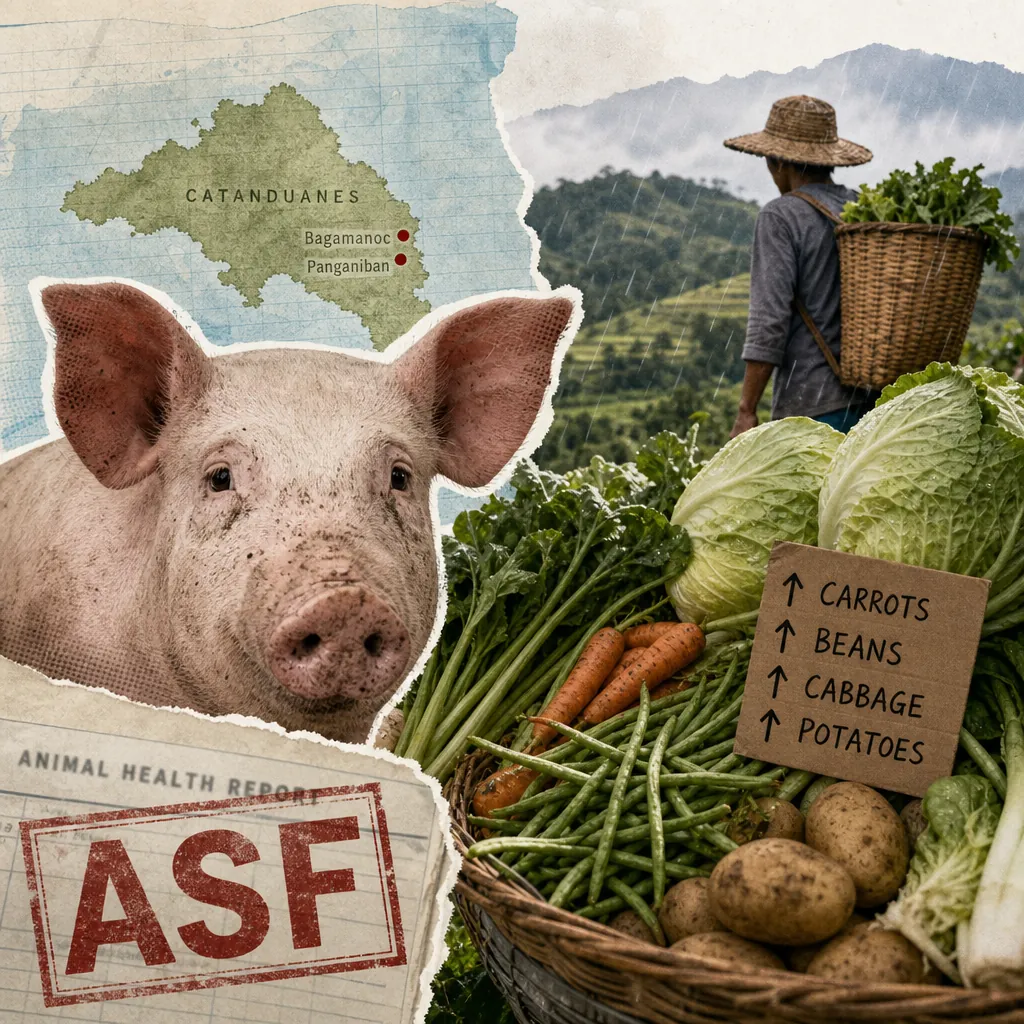
The day's food-supply conversation opened on two fronts: a confirmed African swine fever (ASF) outbreak in two Catanduanes towns, and a farmers' group warning that sustained monsoon rains could raise highland vegetable prices. The ASF report, posted by the Philippine Daily Inquirer on Facebook, drew four sad reactions and one care reaction, with no comments — a quiet, emotional acknowledgment of a familiar threat rather than an active debate.1 The same story on Twitter accumulated 2,117 views but zero engagement, suggesting the news was consumed silently by an audience already conditioned to ASF as a recurring problem.2 Meanwhile, a farmers' group on Twitter explicitly linked the southwest monsoon and typhoon threats to anticipated agricultural losses, warning that highland vegetable prices could rise due to sustained rainfall.3 That post drew 179 views and no interaction, reflecting a broadcast-style communication rather than a conversation starter.
The low engagement across all three posts — one like, one share, and four sad reactions in total — points to a public that is absorbing information without feeling compelled to comment or debate. This is not a story that has reached a tipping point where consumers feel directly affected enough to voice opinions. But the emotional register matters: the four sad reactions on the ASF post indicate worry and resignation, not outrage. Communities in Catanduanes have experienced repeated ASF waves since 2019 and understand the prolonged recovery cycle. The absence of angry reactions suggests that any subsequent pork price hikes may be met with resignation rather than protest, reducing reputational risk for food brands but also limiting urgency for policy intervention.
The farmers' group warning about vegetable prices is equally significant, though it generated even less engagement. The post, which reads in Filipino, "Nababahala ang isang grupo ng mga magsasaka sa posibleng paglala ng pagkalugi sa sektor ng agrikultura dahil sa patuloy na banta ng bagyo at habagat sa bansa" (A group of farmers is worried about the possible worsening of losses in the agriculture sector due to the continuing threat of typhoons and the southwest monsoon in the country), establishes a clear cause-and-effect link between climate events and food inflation.3 The very low engagement on this post — 179 views with no interaction — presents a data gap that warrants verification; it may indicate that the group has a small following rather than that the issue lacks relevance. For food service operators reliant on fresh produce like lettuce, tomatoes, and leafy greens for value meals and salads, this early signal matters because vegetable inputs feed into menu pricing across multiple categories.
Key themes
- ASF outbreak in Catanduanes draws quiet, sad reactions — The confirmed spread of African swine fever to two towns in Catanduanes was reported by the Philippine Daily Inquirer on Facebook and Twitter. The Facebook post drew four sad reactions and one care reaction with no comments, while the Twitter link accumulated 2,117 views with zero engagement.12 The emotional tone is one of resignation and worry, not outrage, consistent with communities that have weathered repeated ASF waves since 2019.
- Farmers' group warns of vegetable price hikes from monsoon rains — A farmers' group on Twitter warned that ongoing typhoons and southwest monsoon rains could worsen agricultural losses and drive up prices of highland vegetables.3 The post drew 179 views and no engagement, reflecting a broadcast-style communication aimed at policymakers and media rather than a conversation starter. The framing connects environmental shocks directly to consumer price expectations.
- Silent consumption dominates food-supply conversation — Across all three posts, total engagement was remarkably low: one like, one share, and four sad reactions across two platforms.123 This suggests that food supply and pricing concerns are being consumed passively, with audiences absorbing information without feeling compelled to comment or debate. The conversation has not yet reached a point where consumers feel directly affected enough to voice opinions.
- ASF news travels further than anticipatory price warnings — The ASF link on Twitter drew 2,117 views, far more than the 179 views on the farmers' group vegetable price warning.23 This suggests that breaking news about disease outbreaks travels further than anticipatory price warnings, though neither generated replies or shares to build momentum. Mainstream media distribution is the primary channel through which this story reaches urban consumers.
- No proactive corporate communication on either topic — The absence of any brand mentions or corporate responses on these topics across both platforms indicates that food companies have not yet perceived reputational risk. This could be a blind spot if supply disruptions begin affecting retail prices, as consumer complaints about price hikes, shrinkflation, or reduced portion sizes could emerge without warning.
- Compound narrative of food inflation is building — The ASF outbreak and the weather-driven vegetable price warning together create a broader "food inflation" story. The overlap between these two trends will likely intensify within 30 days as harvest cycles complete and retail prices adjust, making this a critical window for monitoring consumer sentiment around affordability.
How the narratives stack
Dominant — The ASF outbreak in Catanduanes is the day's lead story, confirmed by the Philippine Daily Inquirer and carrying direct implications for pork supply chains and pricing. Within the captured set, this story drew the most attention: 2,117 views on Twitter and emotional reactions on Facebook.12 The geographic spread of ASF is a leading indicator for pork price movements, which historically feed into broader food price index movements and consumer sentiment around budget meals. The story's dominance rests on its consequence for the sector and its coverage across two platforms, though the engagement is modest.
Counter-narrative — The farmers' group warning about vegetable price increases from monsoon rains offers a second, distinct supply-side pressure point.3 While it drew far less attention — 179 views with no engagement — it establishes a causal narrative that could amplify consumer concerns in the coming weeks. This is a pre-emptive warning issued before actual price changes materialize, leaving audiences waiting for tangible market impacts before reacting. The counter-narrative is that weather disruptions, not just disease, are accumulating supply-side shocks.
Emerging — The linkage between ASF and weather-driven price pressures is an emerging narrative that could merge into a broader food inflation story. Neither post explicitly connects the two, but the conversation trajectory points toward a compounding narrative where disease outbreaks and weather disruptions together create systemic supply chain scrutiny. This could shift from isolated incident reports to questions about government response adequacy, importation policies, and price monitoring within one to two weeks.
Under-covered — The farmers' group warning about vegetable prices is the under-covered story of the day. Despite its direct relevance to food service operators and consumers, it drew only 179 views and no engagement.3 The low visibility may reflect the group's small following rather than the issue's relevance. This story deserves more attention than it received, as weather-related vegetable cost increases are already being telegraphed by organized farming groups and could affect menu pricing across quick-service restaurants and grocery chains.
Platform insights
- Facebook — The ASF announcement appeared here with emotional reactions (four sad, one care) but no comments, indicating that the platform serves as a space for passive emotional expression rather than active discourse on food supply issues.1 The absence of angry reactions suggests resignation rather than outrage. Provincial agricultural communities are the primary voices on this platform, where community-level sharing of news about animal disease outbreaks typically generates concern among affected households.
- Twitter — Both the ASF news and the farmers' group warning were posted on Twitter, with the ASF link drawing far more views (2,117) than the vegetable price warning (179).23 This suggests that breaking news about disease outbreaks travels further than anticipatory price warnings, though neither generated replies or shares to build momentum. Twitter serves as the channel for national news distributors and formalized advocacy groups, with mainstream media distribution being the primary way this story reaches urban consumers.
Key voices and communities
Provincial agricultural communities — Local farming groups and residents in Catanduanes are the primary voices driving this conversation, given the direct impact on their livelihoods and food supply.1 Their presence is concentrated on Facebook, where community-level sharing of news about animal disease outbreaks typically generates concern and discussion among affected households. The limited engagement metrics — one like, one share, and four sad reactions — suggest a small but emotionally affected audience rather than a widespread viral conversation. The central theme is concern over food security and economic stability, with the ASF outbreak signaling potential pork price increases and income losses for smallholder farmers.
Agricultural sector advocacy groups — Organized farmer associations are actively raising concerns about broader agricultural losses, linking weather disturbances to food price volatility.3 Their presence on Twitter indicates a more formalized communications approach aimed at reaching policymakers and media outlets rather than just local networks. The 179 views on their post suggests modest reach, but the news link embedded in their update implies they are amplifying established media coverage. Their messaging directly feeds into the price hike narrative that food and beverage clients must monitor.
National news distributors — Wire services and mainstream media outlets broadcasting the ASF story are amplifying localized news to a national audience.2 The significantly higher view count of 2,117 compared to direct community posts indicates that mainstream media distribution is the primary channel through which this story reaches urban consumers. This group operates primarily on Twitter, where breaking news about disease outbreaks and food safety typically garners rapid attention from business and policy stakeholders. Their reporting is straightforward factual coverage of ASF detection, emphasizing geographic spread and potential agricultural impact without speculative commentary.
Narrative streams
ASF spreads to two Catanduanes towns, reviving pork supply concerns
The Philippine Daily Inquirer reported that African swine fever has hit two towns in Catanduanes, a province in the Bicol region.12 ASF is a highly contagious viral disease affecting pigs, with no cure or vaccine available. It does not infect humans, but outbreaks typically lead to mass culling of herds to contain the spread, which reduces pork supply and drives up prices. The Facebook post drew four sad reactions and one care reaction, with no comments, while the Twitter link accumulated 2,117 views with zero engagement.12
The low engagement suggests that the public has become desensitized to ASF outbreaks as a recurring issue since the first major wave hit the Philippines in 2019. That initial outbreak devastated the hog industry, leading to significant pork price increases and a prolonged recovery cycle. Communities in Catanduanes have experienced repeated ASF waves and understand the pattern: detection leads to movement restrictions, culling, and supply disruptions that eventually translate into higher prices at the market.
The read for the sector is that pork-dependent food businesses — quick-service restaurants, grocery chains, and karinderya (small eateries) — should monitor pork prices over the next two to four weeks for potential cost pressures on menu items. The government may announce movement restrictions that could disrupt distribution. The emotional tone of sadness rather than outrage suggests that consumers are more worried than angry, which means empathy-driven communication from food brands acknowledging supply challenges will be better received than defensive messaging.
Farmers' group warns of vegetable price hikes from monsoon rains
A farmers' group on Twitter warned that ongoing typhoons and southwest monsoon rains could worsen agricultural losses and drive up prices of highland vegetables.3 The post, which drew 179 views and no engagement, explicitly connects climate events to food inflation. The southwest monsoon, known locally as "habagat," brings heavy rains to the Philippines from June to September, often causing flooding and crop damage. Highland vegetables — including lettuce, tomatoes, and leafy greens — are particularly vulnerable to sustained rainfall, which can rot crops and disrupt harvests.
The framing is significant because it establishes a cause-and-effect link between weather events and consumer price expectations. For food service operators reliant on fresh produce for value meals and salads, this early signal matters because vegetable inputs feed into menu pricing across multiple categories. The very low engagement on this post presents a data gap that warrants verification; it may indicate that the group has a small following rather than that the issue lacks relevance.
The read for the sector is that weather-related vegetable cost increases are already being telegraphed by organized farming groups. Food retail and quick-service restaurant clients should review their menu pricing and value meal communications over the next two weeks, as these cost pressures could materialize. Proactive transparency on sourcing or pricing may mitigate backlash. The absence of any proactive corporate communication on this topic indicates that brands have not yet perceived reputational risk, but this could be a blind spot if supply disruptions begin affecting retail prices.
The compound food inflation narrative is building
The ASF outbreak and the weather-driven vegetable price warning together create a broader "food inflation" story that could intensify in the coming weeks.123 Neither post explicitly connects the two, but the conversation trajectory points toward a compounding narrative where disease outbreaks and weather disruptions together create systemic supply chain scrutiny. This could shift from isolated incident reports to questions about government response adequacy, importation policies, and price monitoring within one to two weeks.
The overlap between these two trends will likely intensify within 30 days as harvest cycles complete and retail prices adjust. The Department of Agriculture's next price monitoring bulletin, typically released weekly, will be a key indicator. Any confirmation of ASF spread beyond the initial two towns, or the onset of peak typhoon season in September, could amplify agricultural damage narratives and accelerate conversation velocity.
The read for the sector is that food affordability and availability perceptions are at risk of becoming a systemic concern rather than isolated incidents. For food and beverage stakeholders, this means preparing for potential consumer complaints about price hikes, shrinkflation, or reduced portion sizes. For government clients, this represents both a reputational risk and an opportunity to demonstrate proactive intervention messaging. The emotional tenor of current posts — sadness and resignation — suggests vulnerability to criticism if responses appear delayed.
Conversation trajectory
The ASF conversation is in its early stages, with only three posts surfacing across platforms.123 Expect conversation volume to grow three to four times as the story spreads to mainstream news platforms and downstream price effects become visible. The key window is two to three weeks, when supply constraints from culling and movement restrictions typically materialize into retail price increases. The Department of Agriculture's weekly price monitoring bulletin will be a key indicator of whether pork prices are rising.
The weather-driven vegetable price warning is likely to gain momentum as harvest cycles complete and retail prices adjust. The farmers' group's coordinated advocacy push suggests more media coverage is likely to follow. The overlap between ASF and weather concerns creates a compound narrative that could significantly impact perceptions of food affordability and availability within 30 days.
Trigger events that will reshape this conversation include: the Department of Agriculture's next price monitoring bulletin (typically released weekly), any confirmation of ASF spread beyond the initial two towns, and the onset of peak typhoon season in September which could amplify agricultural damage narratives.23 Each of these will likely accelerate conversation velocity and broaden the scope from localized concerns to national food security discussions.
Response guidance
Monitoring — Establish a two-week tracking window for pork and vegetable price mentions across social platforms, given the ASF confirmation and farmer warnings. This will help food-sector clients anticipate consumer sentiment shifts before they escalate into brand-specific criticism. Track circulation of the Catanduanes ASF report among agricultural journalists and provincial correspondents, and flag any follow-up posts connecting ASF outbreaks to pork price projections in major markets like Metro Manila.
Messaging — The emotional tone of the ASF coverage — predominantly sadness — signals that consumers are more worried than angry. Empathy-driven communication from food brands acknowledging supply challenges will be better received than defensive messaging. Prepare a standby holding statement for clients that references their existing food safety and supply chain protocols, should media inquiries emerge about ASF or vegetable price impacts. Avoid minimizing the impact on livelihoods while emphasizing that food safety protocols remain intact for commercial supply chains.
Pricing transparency — Food retail and quick-service restaurant clients should review their menu pricing and value meal communications over the next two weeks, as weather-related vegetable cost increases are already being telegraphed by organized farming groups. Proactive transparency on sourcing or pricing may mitigate backlash. Do not dispute the farmers' group claims directly, but frame responses around company-level mitigation rather than macro food policy commentary.
Engagement restraint — The low engagement on these posts suggests limited mainstream traction; over-responding could elevate a minor story. Maintain a watching brief rather than launching proactive campaigns. Do not proactively post on this topic across client channels unless directly asked. Monitor regional agriculture-focused community groups and provincial pages for emerging narratives about pork supply, particularly in Bicol and nearby regions.
See the full picture behind today's signals.
This report draws from Media Meter's MediaWatch, our real-time monitoring engine tracking 2,470+ Philippine sources across print, broadcast, digital, and social. Explore how the platform turns raw coverage into decision-grade intelligence, then see how it's configured for teams like yours — whether you're in PR agencies, corporate comms, government, or marketing.
Want more? Browse our Report Library for sector and crisis intelligence, or request a demo and we'll have your brand set up before the call.
Want this kind of intelligence on your brand?
This brief is built on the same MediaWatch methodology that runs continuously across every brand we monitor. See your competitive landscape, Impact Score, and narrative trajectory in a 30-minute demo.