Business confidence hits record low as inflation bites
Philippine business confidence fell to its lowest level on record in July, driven by Middle East tensions, rising oil prices, and inflation. The central bank's survey shows a sharp drop in sentiment, with more businesses pessimistic than optimistic.
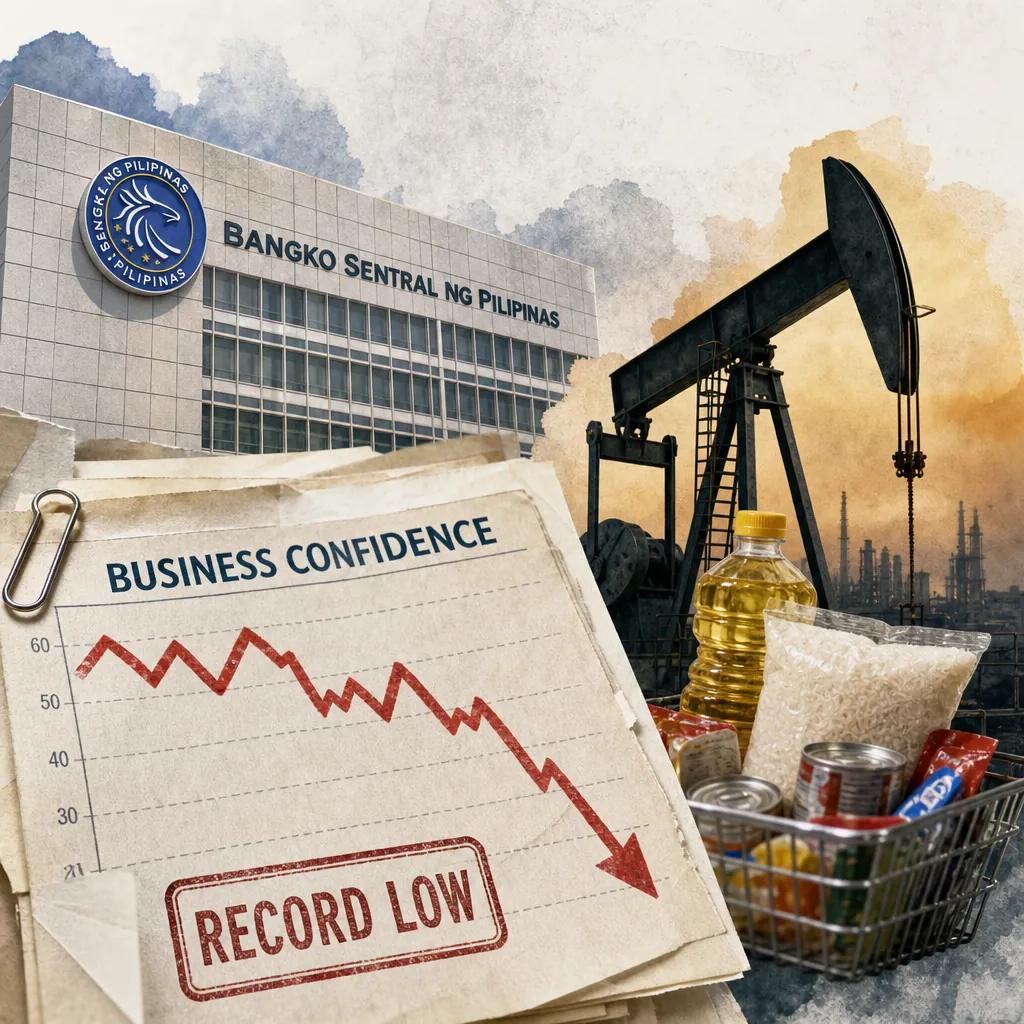
Philippine business confidence has fallen to its lowest level on record, according to the central bank's latest survey, as Middle East tensions, rising oil prices, and persistent inflation weigh on corporate sentiment. The Business Expectations Survey by the Bangko Sentral ng Pilipinas (BSP) — the country's central bank — showed the business confidence index dropped to negative 20.3% in July, meaning far more businesses hold a pessimistic outlook than an optimistic one. That is a sharper decline than during the worst of the COVID-19 pandemic, when the index stood at negative 5.3% in the third quarter of 2020 and negative 5.6% during the Delta variant surge in the third quarter of 2021. The index fell 20.3 percentage points from zero in June, and nearly 20% of businesses that turned pessimistic blamed rising prices and the high cost of fuel. 79
The survey, which the BSP now conducts monthly rather than quarterly, captures the mood of businesses across the country. The record low comes as the Philippine peso trades at record lows against the US dollar, and as the central bank governor has publicly urged Filipinos to save more rather than spend. The findings point to a widening gap between the government's economic narrative and the lived experience of businesses grappling with higher input costs and weaker demand.
Key themes
- Business confidence plunges to record low of negative 20.3% — The BSP's July survey shows more businesses pessimistic than at any point since the survey began, including during the pandemic. Nearly 20% of those who turned negative cited inflation and fuel costs as the main reasons. 79
- Inflation and oil prices drive the pessimism — Businesses blame the surge in oil prices, Middle East tensions, and continued high inflation for their dimming outlook. These factors raise input costs and squeeze margins across sectors. 79
- Peso weakness adds to corporate strain — The currency is at record lows, which the BSP governor attributes to a current account deficit driven by investment outpacing national savings. A weak peso makes imports more expensive, feeding inflation. 100
- Central bank governor's 'boastful' remark sparks debate — BSP Governor Eli Remolona Jr. told lawmakers that Filipinos have a "consumption culture" and like to "show off," comments that drew both criticism and defense. Some argue consumption has kept the economy resilient. 100
- Government rice subsidy program extended through 2028 — The Department of Agriculture says it has funding to sustain the P20-per-kilo rice program until the end of President Marcos's term, providing relief to households facing high food costs. 93
- Farm insurance payouts rise as typhoons take toll — The Philippine Crop Insurance Corporation has set aside P187 million for farmers affected by three typhoons and the southwest monsoon, with rice farmers receiving the largest share. 97
- Quezon City waives fees for nano-enterprises — Newly registered small businesses like sari-sari stores and carinderias will be exempt from barangay clearance fees, and all 142 barangays must adopt electronic payment systems. 21
- Iloilo province to spend P299 million on local rice — The provincial government will buy rice directly from farmers cooperatives to support local producers and provide food assistance to 83,000 vulnerable households. 43
How the narratives stack
Dominant — The dominant narrative in this set is the collapse in business confidence. The BSP survey's record-low reading is the single most consequential economic data point, signaling that the private sector's mood has deteriorated below pandemic levels. This is not merely a statistical curiosity; it reflects real pressures — oil prices, inflation, and geopolitical tension — that affect hiring, investment, and growth. The survey's finding that nearly 20% of pessimistic businesses blame inflation and fuel costs gives it concrete grounding. 79
Counter-narrative — Alongside the pessimism, there is a counter-narrative of government intervention and resilience. The Department of Agriculture's announcement that the P20-per-kilo rice program is funded through 2028, the P187 million in farm insurance payouts, and Iloilo's P299 million local rice purchase all represent state and local efforts to cushion the impact of high prices on vulnerable households. These stories suggest that while business sentiment is weak, the government is actively trying to mitigate the cost-of-living crisis. 93 97 43
Emerging — A quieter but notable thread is the push toward digitalization and easing business registration. Quezon City's ordinance waiving barangay clearance fees for nano-enterprises and requiring electronic payment systems points to a broader effort to reduce the cost and friction of starting and running small businesses. This is a structural reform that could help the informal sector formalize, though its impact will take time to materialize. 21
Under-covered — The BSP governor's "consumption culture" remark and the debate it sparked received coverage but deserves more scrutiny. Remolona's comments touch on a fundamental economic question — whether the Philippines' reliance on consumption rather than savings is sustainable — yet the public discussion has largely focused on whether his phrasing was offensive rather than on the underlying policy challenge. The defense from BDO Capital's Ed Francisco, who said consumption kept the economy resilient, highlights a genuine tension that warrants deeper analysis. 100
Platform insights
- Facebook — Local news outlets and government pages drove the conversation on the BSP survey and rice program, with posts in Filipino and English. The Liloan garbage system story sparked a viral backlash on Facebook, with residents complaining about added costs, prompting the mayor to issue a video explanation. 80
- X (formerly Twitter) — Economic commentators and financial journalists used X to share the BSP survey figures and debate the governor's remarks. The platform saw a mix of data-driven analysis and sharp criticism of Remolona's "mayabang" comment, with some users defending it as a necessary wake-up call about savings.
- YouTube — News channels posted video segments on the business confidence drop and the rice program, with comment sections reflecting public anxiety over rising prices. The format allowed for longer explanations of the survey methodology and its implications.
- Online news portals — The bulk of the coverage appeared on news websites, with Manila Bulletin, Daily Tribune, and Abante Tonite carrying the BSP survey story. These outlets provided the detailed reporting that social media then amplified and debated.
Key voices and communities
- Bangko Sentral ng Pilipinas (BSP) — The central bank is the primary source of the survey data and the institution whose governor sparked controversy. Its monthly Business Expectations Survey is a key barometer of economic sentiment, and its policy responses to inflation and currency weakness are closely watched.
- Business leaders and economists — Figures like BDO Capital's Ed Francisco shape the interpretation of economic data. Francisco's defense of Remolona and his framing of consumption as a source of resilience represent the business community's attempt to contextualize the governor's remarks and reassure markets.
- Government agencies — The Department of Agriculture and its attached agencies, including the Philippine Crop Insurance Corporation, are active communicators of relief programs. Their announcements about rice subsidies and insurance payouts are designed to show the government responding to the cost-of-living crisis.
- Local government units — Quezon City and Iloilo province are implementing their own economic measures, from fee waivers to direct rice purchases. These stories highlight the role of local governments in economic management and their responsiveness to constituent needs.
- Farmers and small business owners — Though not directly quoted in this set, these groups are the intended beneficiaries of the rice program, insurance payouts, and fee waivers. Their lived experience of inflation and weather-related losses is the underlying reality that the policy responses aim to address.
Narrative streams
Business confidence falls to record low as inflation and oil prices bite
The Bangko Sentral ng Pilipinas' Business Expectations Survey for July 2026 recorded a business confidence index of negative 20.3%, the lowest in the survey's history and a sharper decline than during the COVID-19 pandemic. The index measures the difference between the percentage of businesses with a favorable outlook and those with an unfavorable one; a negative reading means pessimists outnumber optimists. In June, the index stood at zero, meaning the drop of 20.3 percentage points in a single month represents a rapid deterioration in sentiment. 79
The survey, which the BSP now conducts monthly, captures the views of businesses across the country on their own prospects and the broader economy. The record low reflects the convergence of several pressures: tensions in the Middle East have pushed up global oil prices, which raises transportation and production costs; inflation remains elevated, eroding consumer purchasing power; and the peso's weakness makes imported goods more expensive. Nearly 20% of businesses that turned pessimistic in July specifically cited inflation and fuel costs as the reasons. 79
The read for the sector is that businesses are bracing for a difficult period ahead. The pessimism is not abstract — it will likely translate into more cautious hiring, delayed investment, and potentially slower growth. For communicators, this means acknowledging the real pressures businesses face while also highlighting any mitigating factors, such as government relief programs or signs of stabilization in global markets.
Central bank governor's 'consumption culture' remark ignites debate on savings
BSP Governor Eli Remolona Jr. told a Senate hearing on August 27 that the Philippines' current account deficit — the gap between what the country earns from abroad and what it spends — largely results from investment outpacing national savings. He added that Filipinos have a "consumption culture" and like to "show off," a remark that drew immediate criticism for being dismissive of ordinary people's economic struggles. 100
The current account deficit is a measure of whether a country is a net borrower or lender to the rest of the world. When a country invests more than it saves, it must borrow from abroad, which puts downward pressure on its currency. The peso is currently at record lows against the US dollar, making imports more expensive and feeding inflation. Remolona's point was that increasing national savings is the long-term solution to this problem. 100
BDO Capital president Ed Francisco came to Remolona's defense, arguing that the governor's comments were taken out of context. Francisco said consumption "was really something to be proud of" because it kept the economy resilient during the pandemic. This defense highlights a genuine tension in economic policy: consumption drives growth, but excessive consumption relative to savings creates external vulnerabilities. 100
The read for the sector is that the savings-versus-consumption debate is not merely academic — it has direct implications for interest rates, currency stability, and the cost of borrowing. For businesses, a weaker peso and higher interest rates raise the cost of capital and imported inputs. Communicators should frame this as a structural challenge that requires both policy action and a broader cultural shift toward savings, without dismissing the legitimate pressures on household budgets.
Government rolls out relief measures as cost-of-living crisis deepens
Amid the gloomy business sentiment, the government is deploying a range of measures to cushion the impact of high prices on vulnerable households. The Department of Agriculture announced that the P20-per-kilo rice program, called "Benteng Bigas, Meron Na!" (Rice Fortress, It's Here!), has funding through June 2028, when President Marcos's term ends. The program sells rice at subsidized prices through government outlets and local government units, and the government says it could reach as many as 60 million Filipinos, or about 15 million households. As of July, more than 12 million Filipinos had benefited, with P20 rice available at about 800 outlets nationwide. 93
The program is a direct response to high food costs, which are a major driver of inflation and a source of hardship for low-income families. Rice is a staple food in the Philippines, and its price is politically sensitive. By committing funding through 2028, the government is signaling that it will maintain this subsidy for the remainder of the current administration, providing some certainty to households.
In a related move, the Philippine Crop Insurance Corporation (PCIC), an agency attached to the Department of Agriculture, has set aside P187 million to pay insurance claims from farmers affected by three typhoons and the enhanced southwest monsoon. The payments cover losses reported from August 1 to 26 across eight regions, mostly in Luzon, and will benefit 24,987 farmers. Rice farmers account for the largest share of claims at P132.9 million, followed by high-value crops at P42.1 million and corn at P9.3 million. 97
The read for the sector is that the government is using fiscal resources to address the immediate symptoms of the cost-of-living crisis, but these measures are reactive rather than structural. The rice subsidy helps households but does not address the underlying causes of high prices, such as supply chain inefficiencies and the weak peso. For communicators, the challenge is to present these relief efforts as genuine help while being honest about their limits.
Local governments take their own economic initiatives
Beyond national programs, local governments are implementing their own measures to support businesses and farmers. Quezon City has passed two ordinances aimed at easing the burden on small businesses. Ordinance No. SP-3525 waives barangay clearance fees for newly registered nano-enterprises, which include sari-sari stores (small neighborhood convenience stores) and carinderias (small eateries). The measure is designed to reduce the cost of formalizing these micro-businesses. 21
A second ordinance, the Electronic Payment Ordinance, requires all 142 barangays in Quezon City to adopt secure electronic payment systems integrated with the city's e-Services platform. This will allow business owners to pay their barangay business clearance fees online, reducing the need for in-person transactions and long queues. Cash payments will still be accepted when electronic payment is unavailable. 21
In Iloilo province, the local government will spend P299 million to buy rice directly from farmers cooperatives and associations. The fund, sourced from the Local Government Support Fund, will provide a government-backed market for local producers while distributing rice to 83,000 vulnerable households across all 42 municipalities and Passi City. The province will procure rice from cooperatives registered under the Farmers and Fisherfolk Enterprise Development Information System, using negotiated procurement allowed under the Sagip Saka Act, a law that permits government agencies to buy directly from farmers. 43
The read for the sector is that local governments are becoming more active in economic management, using their own resources and authorities to address local needs. For businesses, these initiatives can reduce costs and create new market opportunities. For communicators, these stories offer concrete examples of government action that can be highlighted alongside national programs.
Farm insurance payouts highlight climate risk to agriculture
The P187 million set aside by the Philippine Crop Insurance Corporation for farmers affected by recent typhoons underscores the growing toll of extreme weather on agriculture. The payments cover losses from three typhoons and the enhanced southwest monsoon, which brought heavy rains and flooding to much of Luzon in August. Central Luzon, the country's rice bowl, has the largest number of beneficiaries at 9,636, followed by the Ilocos Region with 3,874. 97
The Philippine Crop Insurance Corporation provides insurance to farmers against losses from natural disasters, pests, and diseases. Farmers pay a premium, which is often subsidized by the government, and receive payouts when their crops are damaged. The program is a key tool for helping farmers recover from weather-related losses and continue farming.
The read for the sector is that climate change is increasing the frequency and severity of weather events that damage crops, making insurance an essential part of agricultural risk management. For communicators, the challenge is to explain the insurance program clearly to farmers, many of whom may be unaware of their eligibility or how to file claims. The PCIC's instruction to regional staff to speed up processing is a recognition that timely payouts are critical for farmers who need cash to replant.
Conversation trajectory
- BSP survey trend (next 1–3 months) — The July reading of negative 20.3% is a record low, but the question is whether it marks a bottom or the start of a deeper decline. The BSP conducts the survey monthly, so the August and September readings will show whether sentiment is stabilizing or deteriorating further. If oil prices remain elevated and the peso stays weak, confidence could fall further. Watch for the next survey release, typically in the first week of the following month.
- Inflation data (next 1–2 months) — The Philippine Statistics Authority releases monthly inflation data, and the next readings will show whether price pressures are easing or intensifying. The BSP survey found that nearly 20% of pessimistic businesses blame inflation and fuel costs, so a sustained decline in inflation would likely support a recovery in confidence. The central bank's next policy meeting, where it sets interest rates, will be a key signal of its assessment.
- Peso movement (ongoing) — The currency is at record lows, and its trajectory will depend on global factors like the Middle East conflict and US interest rates, as well as domestic factors like the current account deficit. A continued slide would worsen inflation by making imports more expensive, while stabilization would ease pressure on businesses.
- Government relief programs (through 2028) — The rice subsidy program is now funded through the end of the Marcos administration, providing a degree of certainty. The expansion of outlets from 800 to a targeted 1,500 by year-end will determine how many households can actually access the subsidized rice. Watch for announcements about new outlets and any adjustments to the program.
- Trigger events — A further escalation of the Middle East conflict that pushes oil prices higher would likely deepen business pessimism. Conversely, a ceasefire or de-escalation that brings oil prices down could trigger a recovery in confidence. Domestically, the next BSP policy decision on interest rates and the monthly inflation releases will be key data points.
Response guidance
- Acknowledge the pessimism directly — Do not dismiss the record-low business confidence reading as an anomaly. Businesses are feeling real pressure from inflation, fuel costs, and currency weakness. Communications should validate these concerns before pivoting to any mitigating factors.
- Explain the 'why' behind the numbers — The BSP survey is a useful hook for explaining the economic pressures businesses face. Use plain language to connect the dots between Middle East tensions, oil prices, inflation, and business sentiment. Avoid jargon like "current account deficit" without explaining what it means.
- Highlight relief measures with concrete details — The rice subsidy, farm insurance payouts, and local government initiatives are tangible examples of government action. When communicating these, provide specifics: how many people benefit, how much funding is allocated, and how to access the programs.
- Handle the savings debate with nuance — The BSP governor's "consumption culture" remark is a sensitive topic. Communications should acknowledge the legitimate tension between consumption-driven growth and the need for higher savings, without appearing to blame ordinary Filipinos for the country's economic challenges.
- Use local government stories to show action — Quezon City's fee waivers and Iloilo's rice purchase are examples of local governments responding to economic pressures. These stories can make economic policy feel more concrete and relevant to everyday life.
- Prepare for climate-related communications — With farm insurance payouts rising, communicators should be ready to explain how farmers can access support after weather events. Clear, timely information about filing claims is essential.
- Monitor the peso and inflation narrative — The currency's weakness and inflation are intertwined stories that will continue to dominate economic news. Communications should be prepared to address how these factors affect businesses and households, and what the government is doing in response.
See the full picture behind today's signals.
This report draws from Media Meter's MediaWatch, our real-time monitoring engine tracking 2,470+ Philippine sources across print, broadcast, digital, and social. Explore how the platform turns raw coverage into decision-grade intelligence, then see how it's configured for teams like yours — whether you're in PR agencies, corporate comms, government, or marketing.
Want more? Browse our Report Library for sector and crisis intelligence, or request a demo and we'll have your brand set up before the call.
Want this kind of intelligence on your brand?
This brief is built on the same MediaWatch methodology that runs continuously across every brand we monitor. See your competitive landscape, Impact Score, and narrative trajectory in a 30-minute demo.