Inflation to near 8.2% as banks, lenders push credit
The Bangko Sentral ng Pilipinas projects November inflation of 7.2% to 8.2%, driven by electricity and cooking gas, while banks and digital lenders report loan growth and plan expansion. A milk tea franchise closure and a P319-million remittance case frame the cost-of-living strain.
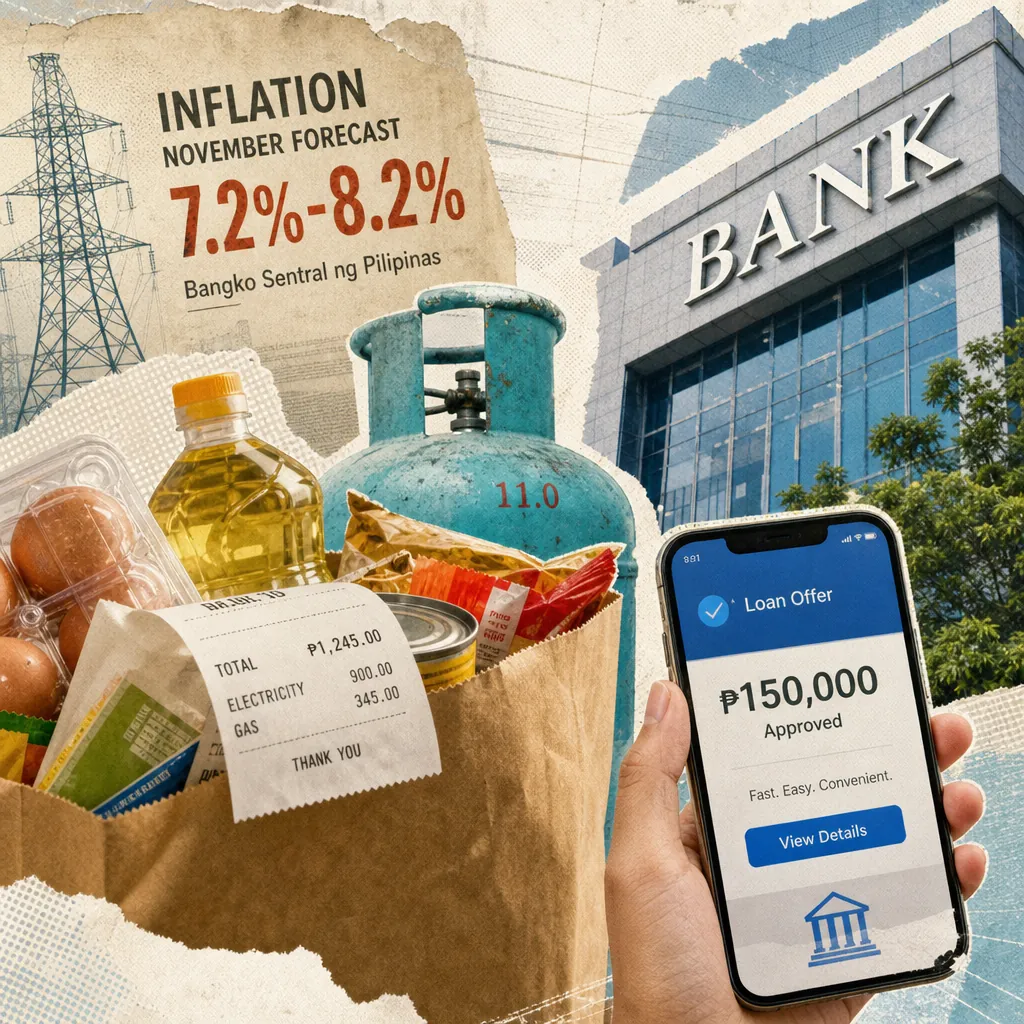
The Bangko Sentral ng Pilipinas (BSP), the country's central bank, said on Friday night, Nov. 27, that consumer price growth likely ran between 7.2 percent and 8.2 percent in November, a range whose midpoint of 7.7 percent would mark a slight easing from October's 7.8 percent but still sit far above the bank's two-to-four percent target band33. The forecast, released ahead of the Philippine Statistics Authority's official November figure on Dec. 4, put electricity rates and liquefied petroleum gas (LPG, the canisters used for household cooking) at the center of the price pressure, with lower pump prices for fuel offering only partial relief26. The same day's business coverage carried the other half of the story: lenders reporting loan growth and planning to expand into exactly the households and small firms now squeezed by those prices. China Bank Savings, the thrift-banking arm of China Banking Corp., booked P1.86 billion in net income in the nine months to September on gross loans that grew about nine percent year-on-year to P165.5 billion31. Fuse Financing Inc., the lending arm of the GCash mobile wallet, said it aims to match or beat the digital lending industry's projected 20 percent annual growth through 203027. Allianz PNB Life said it would chase the country's "protection gap" — the shortfall between the insurance coverage Filipinos need and what they actually hold — with simpler, cheaper life products34.
A single small-business closure gave the price story a face. BusinessMirror reported that Bea Pelayo Laderas, an Infinitea milk tea franchisee since 2013 whose shop had survived the pandemic, gave up her outlet after a year and a half in which rent, utilities, raw materials and wages kept rising while sales stagnated or fell. "Kahit anong marketing mo, pag walang budget ang customer, wala kang magagawa," she said — in English, roughly, no amount of marketing helps when the customer has no budget15. The same column pointed to a separate thread running through the day's news: hundreds of millions of pesos in remittances from mainland China and Hong Kong that the Anti-Money Laundering Council (AMLC, the agency that tracks suspicious money flows) disclosed had gone to Cale88 Foods Corporation, a company linked to Vice President Sara Duterte and her husband15. A lawmaker, Deputy Speaker Jay Khonghun of Zambales, said Saturday that Duterte should personally explain the P319 million in remittances the company received23.
On the policy side, the state pension funds announced holiday disbursements that will put cash into millions of households within days. The Social Security System (SSS) will release P45.26 billion in 13th-month and December 2026 pensions to more than 4.1 million pensioners beginning Dec. 1, in two batches — P25.33 billion to about 2.39 million pensioners on Dec. 1 and P19.88 billion to roughly 1.70 million on Dec. 42429. The Government Service Insurance System (GSIS), which covers government employees, raised its maximum Christmas cash gift for pensioners from P10,000 to P15,000, also payable Dec. 124. The 13th-month pay is a Philippine labor entitlement requiring employers to pay workers one extra month's salary each year; for pensioners the funds release an equivalent year-end amount.
Key themes
- November inflation forecast at 7.2% to 8.2%, with power and cooking gas as the drivers. The BSP's month-ahead range brackets October's 7.8 percent and compares with 1.5 percent in November last year, a base effect that makes the year-on-year figure look severe even if prices barely moved from October33. The official number lands Dec. 4.
- Lenders are expanding into the segment the price data says is under strain. China Bank Savings grew gross loans about nine percent year-on-year to P165.5 billion and lifted net interest income — the gap between what a bank earns on loans and pays on deposits — by about 17 percent to P8.45 billion31. Fuse targets 20 percent annual growth through 203027.
- A milk tea franchise closes after 18 months of rising costs and flat sales. The owner's account — rent, utilities, materials and wages up, revenue down — is a ground-level reading of the same cost pressure the BSP forecast describes15.
- P319 million in China and Hong Kong remittances to a company linked to the Vice President. The AMLC disclosed the flows to Cale88 Foods Corporation; a deputy speaker says only Duterte can explain what the money was for2315.
- P45.26 billion in SSS pensions and a bigger GSIS Christmas gift reach households from Dec. 1. The SSS releases in two batches to more than 4.1 million pensioners; GSIS raises its maximum cash gift to P15,0002429.
- Insurers are selling simplicity as purchasing power falls. Allianz PNB Life's chief executive, Joseph Gross, said the market's growth potential lies in the protection gap and that products must be "affordable, simple and transparent"34.
- A GCash dollar account targets freelancers paid by US clients. The Virtual US Account lets users receive dollars through their own US bank routing numbers (ACH, the US automated clearing house network) with zero wire fees under a promo, a $10 first-deposit bonus and a rate of P64 per $1 until Dec. 31, 202620.
- A US bank failure and a Malaysian fund-governance remark bracket the day's offshore financial news. US regulators seized United Fidelity Bank, the largest US bank failure in more than two years, with First Citizens Bank taking over its deposits and assets6; Malaysia's prime minister said his government would not interfere in the professional management of Permodalan Nasional Bhd, the country's largest fund manager18.
How the narratives stack
Dominant. The inflation forecast carried the most consequence in the items reviewed here. It was covered by two outlets in the set — Manila Bulletin and Philstar — and it sets the terms for everything else: the cost of electricity and cooking gas determines what households have left to spend, which determines whether small businesses like Laderas's milk tea shop survive, which in turn determines whether the loan growth the banks are projecting actually materializes2633. The forecast is a projection, not a result; the confirmed figure arrives with the Philippine Statistics Authority release on Dec. 4.
Counter-narrative. The banking and lending stories run against the inflation story's implication that households are pulling back. China Bank Savings reported loan growth and higher net interest income31; Fuse said demand for consumer and small-business credit is strong enough to support 20 percent annual industry growth through 203027; Allianz PNB Life said the protection gap leaves room to grow34. These are company statements about their own books and plans, not independent measurements of the market, and each firm has an interest in projecting confidence. Read together, they suggest lenders see the squeeze as a chance to lend to borrowers who have been pushed out of formal banking — a bet that pays off only if those borrowers can service the debt.
Emerging. The GCash Virtual US Account is a product launch, but it points at a larger shift: Filipino freelancers earning in dollars can now hold and convert those earnings inside a mobile wallet, with a promotional exchange rate of P64 per dollar locked until the end of 202620. That rate is a marketing decision, not a market rate, and its expiry will test how sticky those users are. The same wallet's lending arm is separately projecting rapid growth27, which means GCash is building both the deposit and the credit side of a freelance economy that sits largely outside traditional payroll and tax structures.
Under-covered. The Cale88 remittance story appeared in two items in this set — the BusinessMirror column and the Manila Times report on Khonghun's statement1523 — and it concerns a sitting Vice President facing questions about P319 million in foreign inflows. In the items reviewed, it drew less attention than the inflation forecast despite its political weight. The AMLC disclosure is a fact; what the money was for is not established in these reports, and Duterte has not answered in them.
Platform insights
The monitoring writeup for this window did not accompany the article set, so this section is limited to what the published items themselves show about where the conversation lived.
- Online news portals. Every item in the set ran online, and the business desks of Philstar, Manila Bulletin and BusinessMirror carried the day's substantive financial reporting. Philstar alone published six business items in the window, including the inflation forecast, the China Bank Savings results, the Fuse interview, the Allianz PNB Life interview and the SSS pension schedule3331273429.
- Community and provincial outlets. The Bohol Tribune carried local news — a P3.72-million drug haul in Ubay and a senator's plan for direct Bohol–South Korea flights — alongside a heritage piece on Baclayon's Wednesday market day25. These items sit outside the finance beat but show provincial outlets carrying national economic effects, such as the senator's tourism push, in local terms.
- Diaspora and overseas Filipino channels. Maharlika News covered an OFW Family Day in Montreal organized by the Philippine Embassy in Ottawa with the Department of Migrant Workers and the Overseas Workers Welfare Administration, where OWWA e-cards were issued on site25. The event's partners included GCash, which ties the diaspora audience to the same wallet launching the dollar account20.
- International wires. The South China Morning Post's report on the United Fidelity Bank seizure and Sinar Harian's report on Malaysia's fund-governance stance gave the day an offshore frame for banking risk and state-fund independence618.
Key voices and communities
The central bank and the statistics agency. The BSP's month-ahead forecast is the single most consequential number in the set, and the PSA's Dec. 4 release will confirm or revise it3326. The BSP's framing — power and LPG up, pump prices down — tells households where to look for relief.
Bank and lender executives. China Bank Savings' results, Fuse president and CEO Tony Isidro's growth target and Allianz PNB Life's Joseph Gross all speak for institutions with an interest in projecting demand312734. Their statements are the clearest available signal of what lenders expect from 2027, and they should be read as such.
Small-business owners. Laderas's account is the only first-person business voice in the set, and it is the one that most directly connects the inflation forecast to a decision — closing a shop — that a reader can picture15.
Pensioners and state funds. The SSS and GSIS releases put P45.26 billion plus the GSIS gifts into household budgets in the first week of December, a scheduled injection of cash that will show up in retail sales data for the month2429.
Legislators pressing the Vice President. Khonghun's demand that Duterte explain the Cale88 remittances keeps a political-legal story attached to a financial one23.
Narrative streams
Inflation forecast puts electricity and cooking gas at the center of the household budget
The BSP's range of 7.2 to 8.2 percent for November compares with 7.8 percent in October and 1.5 percent in November 202533. That last comparison matters: a year ago, prices were rising at roughly a fifth of the current pace, so the year-on-year figure will look dramatic even if month-to-month price changes are modest. The central bank attributed the pressure to higher electricity rates and LPG prices, with lower domestic pump prices easing some of it26. The two-to-four percent target band is the range the BSP considers consistent with stable prices; a print above eight percent would be the highest in nearly four years, since February 2023's 8.6 percent26.
For households, the practical effect is that the cost of turning on a light or cooking a meal is rising faster than the cost of filling a car. That matters because electricity and LPG are consumed by nearly every household regardless of income, while fuel is a smaller line for families without vehicles. For the sector, the read is that consumer lenders face a borrower base whose fixed costs are climbing; the banks reporting loan growth this week are lending into that squeeze, and their provisions for potential losses — China Bank Savings noted higher provisions partially tempered its earnings31 — are the line to watch when full-year results arrive.
Lenders project growth while the cost data says borrowers are stretched
China Bank Savings' nine-month net income of P1.86 billion came on gross loans, excluding interbank loans, of P165.5 billion, up about nine percent year-on-year, with net interest income up about 17 percent to P8.45 billion31. The bank said salary and business loan portfolios drove the expansion. Fuse's Isidro said third-party data projects the digital lending space growing 20 percent annually through 2030 and that Fuse intends to keep pace or exceed it, citing opportunities in consumer and micro, small and medium enterprise (MSME) lending27. MSMEs — micro, small and medium enterprises — account for 99.5 percent of business establishments, 63.2 percent of employment and 35.7 percent of GDP in the Philippines, according to the Manila Times column, which also cited an Asian Development Bank finding that MSME bank loans across the region averaged just 16.9 percent of total bank lending between 2010 and 2019 and actually contracted at a compound annual rate over that period1.
That gap is the commercial opening Fuse and others are chasing. The read for the sector is that the credit gap is real and large, but closing it with digital scoring does not by itself make borrowers able to repay; the Manila Times column makes exactly this point, that better credit scoring does not automatically translate into more lending1. Lenders that grow fastest into the squeezed segment will carry the most credit risk if the inflation print stays above eight percent into 2027.
A franchise closure shows what the price data means for a small shop
Laderas had run her Infinitea franchise since 2013 and operated at its location for seven years, surviving the pandemic15. What ended it was a year and a half of rising rent, utilities, raw materials and wages against flat or falling sales. Her quote — "Kahit anong marketing mo, pag walang budget ang customer, wala kang magagawa" — is the clearest statement in the set of how inflation transmits to small business: the shop's costs rise on schedules it cannot control, while its customers' budgets shrink15.
BusinessMirror paired the closure with the Cale88 remittance disclosure, drawing an explicit contrast between the difficulty of an honest small business and the ease with which large sums moved through a linked company15. For the sector, the read is that food and beverage franchises — a segment built on discretionary spending — are the first to feel a consumer pullback, and their closures reduce the customer base that delivery platforms, payment providers and lenders count on.
P319 million in foreign remittances reaches a company linked to the Vice President
The AMLC disclosed hundreds of millions of pesos in remittances from mainland China and Hong Kong to Cale88 Foods Corporation, a company linked to Vice President Sara Duterte and her husband, lawyer Manases Carpio15. Khonghun said Duterte is in the best position to explain the transactions: "Especially regarding the money, what was it for and why were there transactions from China? Only she herself can answer that," he said in Filipino23. The prosecution in the case against her has presented financial records covering her sworn asset declarations, insurance and investment accounts, and transactions involving companies linked to her and Carpio23.
The AMLC is the agency that receives reports of covered and suspicious transactions from banks and other institutions; its disclosures carry weight because they come from regulated reporting, not from political allegation. What the money was for is not established in the items reviewed. For the sector, the read is that banks and remittance channels handling China and Hong Kong flows face renewed scrutiny of corporate accounts whose beneficial owners are public figures, and compliance teams should expect questions about how such flows were flagged.
P45.26 billion in pensions lands in the first week of December
The SSS will credit P25.33 billion to about 2.39 million pensioners on Dec. 1 and P19.88 billion to roughly 1.70 million on Dec. 4, with a further P28.81 million going to more than 3,798 pensioners through non-PESONet banks and pension checks29. PESONet is the interbank fund-transfer network that lets pensions move electronically between banks. The GSIS raised its maximum Christmas cash gift from P10,000 to P15,000, also on Dec. 124.
For retailers, the timing matters: the releases land before the traditional peak of Christmas spending, and they are concentrated in households with a high propensity to spend. For the sector, the read is that December retail sales will get a measurable boost from pension disbursements even as inflation erodes the real value of each peso; merchants and lenders should expect a short, sharp spending window in the first two weeks of the month rather than a sustained lift.
Insurers and wallets chase the customers banks have not reached
Allianz PNB Life's Gross said the protection gap gives the market growth potential and that the company would push basic protection — death, accidents, critical illness — in products that are "affordable, simple and transparent"34. GCash's Virtual US Account gives freelancers paid in dollars their own US routing numbers, zero wire fees under a promo, a $10 first-deposit bonus and a P64-per-dollar rate until Dec. 31, 202620. Both moves target Filipinos outside formal payroll: freelancers, gig workers and households without employer-provided coverage.
For the sector, the read is that the next phase of financial inclusion will be fought on price transparency and simplicity rather than on product breadth. The P64 rate is a promotional price that will expire; the insurers' "basic" products will be judged on claims payout, not on the sales pitch. Institutions that build trust on those two points will keep the customers after the promos end.
Offshore signals: a US bank failure and a Malaysian fund-governance pledge
US regulators seized United Fidelity Bank, an Evansville, Indiana-based lender with 22 branches in four states and the US Virgin Islands, citing the risk it could not meet depositor demands; First Citizens Bank took over all deposits and assets, making it the largest US bank failure in more than two years6. In Malaysia, Prime Minister Anwar Ibrahim said his government would not interfere in the professional management of Permodalan Nasional Bhd, the country's largest fund manager, citing past episodes involving 1MDB, Tabung Haji and FELDA18.
Neither story is Philippine, but both bear on how local institutions are judged. The US failure is a reminder that deposit insurance and rapid resolution keep failures from becoming panics; the Malaysian statement is a reminder that political interference in state-linked funds is the standard against which the Maharlika Investment Corp., the Philippines' new sovereign fund, will be measured. The read for the sector is that governance at state-linked financial institutions is now a regional comparison, and Philippine officials should expect the same questions Anwar was answering.
Conversation trajectory
Dec. 1–4: pension releases and the inflation print. The SSS and GSIS disbursements land Dec. 1 and Dec. 4, and the Philippine Statistics Authority releases November inflation on Dec. 4242933. Watch whether the official figure lands at the top of the BSP's 7.2–8.2 percent range; a print above eight percent would be the highest since February 2023 and would sharpen questions about the BSP's policy rate path into 2027.
Through December: the P64 promotional rate expires Dec. 31. GCash's dollar-account exchange rate is a promotional price with a stated end date20. Watch how many freelancers keep dollar balances in the wallet after the rate reverts; that will show whether the product won users on convenience or on price.
First quarter of 2027: full-year bank results. China Bank Savings' nine-month figures showed higher provisions tempering earnings31. Full-year results from thrift banks and digital lenders will show whether loan growth into the squeezed consumer segment came with rising bad loans.
Ongoing: the Cale88 case. Khonghun's demand that Duterte explain the P319 million in remittances is a political pressure point with a legal calendar attached23. Watch for a response from Duterte or her counsel, and for further AMLC disclosures.
Trigger events. The PSA inflation release on Dec. 4; the BSP's next policy meeting; the December remittance and retail sales data that will show whether pension money moved through the economy; and any Senate or House hearing on the Cale88 flows.
Response guidance
Banks and thrift lenders: prepare for provisioning questions. The combination of an inflation print near eight percent and loan growth into lower-income segments will draw analyst questions about credit quality. Lead with portfolio composition and delinquency trends rather than growth targets.
Digital lenders: separate promotional pricing from product economics. The P64-per-dollar rate and zero-fee promos have end dates20. Communicate what happens after expiry before users ask, and avoid implying the promotional rate is permanent.
Insurers: define "basic" in claims terms. Allianz PNB Life's simplicity pitch will be tested at the claims stage34. Publish payout ratios and claims turnaround times alongside product simplicity claims.
Retail and food businesses: plan for a short December window. Pension releases on Dec. 1 and Dec. 4 will concentrate spending early in the month29. Staff and stock for the first two weeks, and expect a quieter second half as the cash is absorbed by fixed costs.
Communicators handling the Cale88 story: stick to confirmed facts. The AMLC disclosure of P319 million in remittances is confirmed; the purpose of the funds is not1523. Avoid characterizing the transactions beyond what the records show, and route questions about the Vice President's response to her office.
State-linked financial institutions: expect regional governance comparisons. Malaysia's prime minister made non-interference in fund management an explicit standard18. Philippine institutions with state links should be ready to describe their governance and investment-decision processes in the same terms.
Diaspora-facing brands: treat OFW events as service channels. The Montreal OFW Family Day issued OWWA e-cards on site and listed GCash, LBC and Philippine Airlines as partners25. Brands serving overseas Filipinos should staff these events with people who can complete account openings, not just hand out brochures.
See the full picture behind today's signals.
This report draws from Media Meter's MediaWatch, our real-time monitoring engine tracking 2,470+ Philippine sources across print, broadcast, digital, and social. Explore how the platform turns raw coverage into decision-grade intelligence, then see how it's configured for teams like yours — whether you're in PR agencies, corporate comms, government, or marketing.
Want more? Browse our Report Library for sector and crisis intelligence, or request a demo and we'll have your brand set up before the call.
Want this kind of intelligence on your brand?
This brief is built on the same MediaWatch methodology that runs continuously across every brand we monitor. See your competitive landscape, Impact Score, and narrative trajectory in a 30-minute demo.