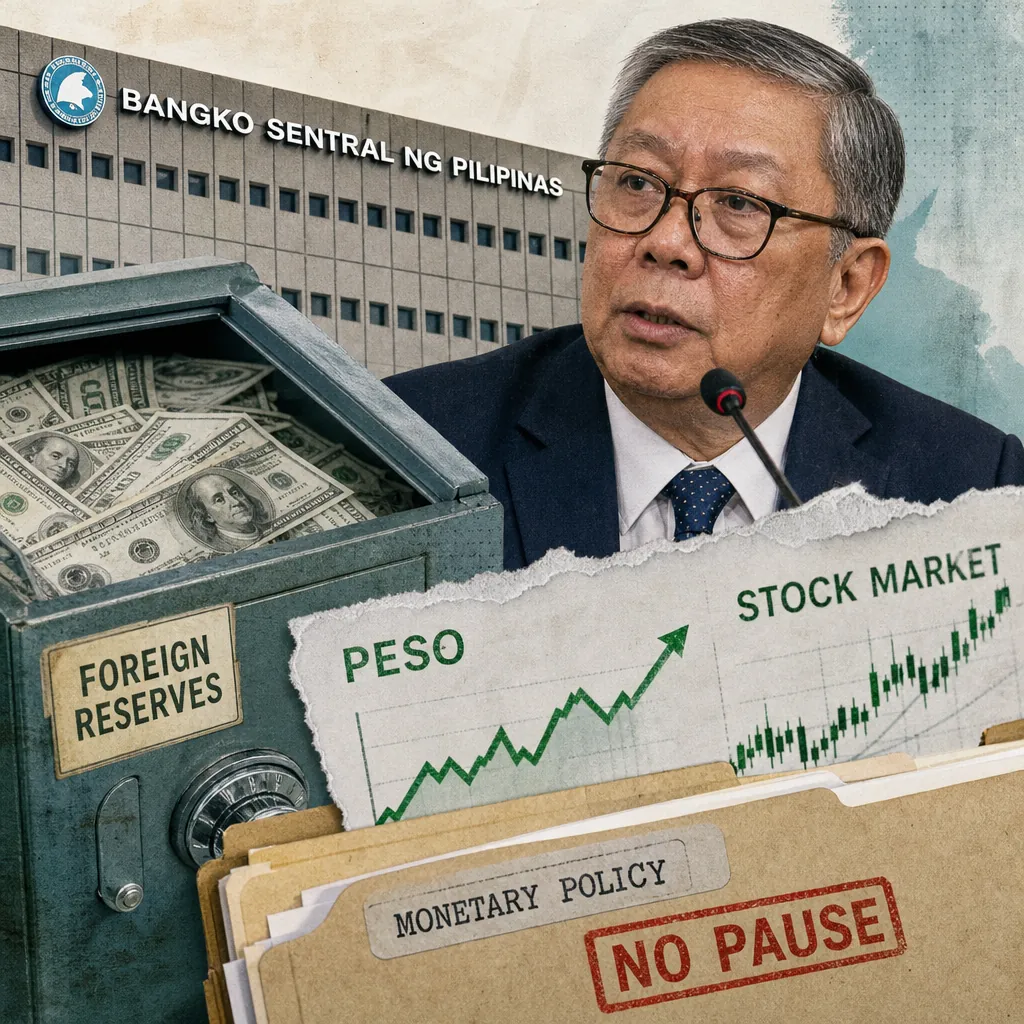
Peso slips to 63.72 as AirAsia cuts PH workforce
The peso closed at ₱63.72 to the dollar and the stock index ended a three-day rally, while AirAsia Philippines cut staff over fuel and foreign-exchange costs. Fitch called Philippine banks the only improving outlook in emerging Asia-Pacific, and the ERC extended a no-disconnection policy for low-usage households through December.

The peso closed at ₱63.72 to the dollar on Thursday, four and a half centavos weaker than Wednesday's ₱63.675, and the Philippine Stock Exchange index (PSEi) — the benchmark for the country's largest listed companies — slipped 0.06 percent, or 3.28 points, to 5,490.13, ending a three-day rally373. The currency move was small, but it landed the same day AirAsia Philippines confirmed it had cut jobs, citing the same two forces behind the peso's slide: expensive fuel and an unfavorable exchange rate5. The airline's president and general manager, Anna Victoria Lu, called it a "very difficult decision" and said "sustained pressure from elevated jet fuel prices and unfavorable exchange rates has significantly increased our operating costs"5.
Those two stories set the tone for a day of business coverage that was mostly about pressure — on household budgets, on corporate cost lines, and on the central bank's room to maneuver. The Bangko Sentral ng Pilipinas (BSP), the country's central bank, is weighing whether to follow its recent half-percentage-point interest rate increase with another one, and a former deputy governor, Diwa Guinigundo, told BusinessMirror that a second straight 50-basis-point move would need "a very strong inflation justification" because weak growth is already doing some of the work of containing prices32. A basis point is one-hundredth of a percentage point. Meanwhile, ANZ Research, the research arm of the Australia and New Zealand Banking Group, grouped the Philippines with India, Indonesia and Thailand as economies especially exposed to rising global borrowing costs and higher energy prices, partly because they import their fuel and have limited stake in the global artificial-intelligence investment boom3.
Not every item pointed the same way. Fitch Ratings, one of the three major global credit rating agencies, said Philippine banks are the only ones among nine emerging Asia-Pacific markets whose outlook is "improving," and projected domestic bank lending to grow 11 percent in 2027 from an estimated 10 percent this year7. The Energy Regulatory Commission (ERC), the agency that regulates electricity prices and distribution, extended its ban on cutting off power to low-consumption households through December14. And the Bureau of Customs (BOC) removed a prior-clearance requirement for some imports, a change it says will cut cargo processing time by three days29. The day's coverage, as captured here, was a mix of broadsheets and online outlets, with the heaviest single item being a Manila Times special feature on its own sustainability awards, worth an estimated ₱2.04 million in advertising-equivalent value — the notional cost of buying the same space as paid advertising.
Key themes
- The peso weakened to ₱63.72 and the stock index ended a three-day rally. The peso closed four and a half centavos weaker than the previous session, and the PSEi fell 0.06 percent to 5,490.13, with traders citing a lack of fresh leads and caution ahead of an index rebalancing373.
- AirAsia Philippines cut jobs over fuel and foreign-exchange costs. The budget carrier's president, Anna Victoria Lu, said the airline had to "optimize our routes and flight frequencies," which affected manpower requirements5.
- Fitch called Philippine banks the only improving outlook in emerging Asia-Pacific. The rating agency expects bank lending to grow 11 percent in 2027, up from an estimated 10 percent this year, helped by government infrastructure spending7.
- A former BSP official said a second straight 50-basis-point hike would need strong inflation justification. Diwa Guinigundo argued the hurdle for another large increase has risen because weak growth is already restraining demand32.
- ANZ Research flagged the Philippines as exposed to higher global borrowing costs and energy prices. The bank grouped the country with India, Indonesia and Thailand because of imported-energy dependence and limited participation in the AI investment boom3.
- The ERC extended its no-disconnection policy for households using 200 kilowatt-hours or less through December. Eligible customers can pay November and December bills in installments instead of facing immediate cutoff14.
- The Bureau of Customs removed a prior-clearance step for some imports. Memorandum Order 124-2026 drops the mandatory Imports Assessment Service clearance when it is required only on the basis of commodity classification or tariff heading29.
- The BSP said the next phase of digital payments is about trust. Deputy Governor Mamerto Tangonan said the central bank wants digital payments "more affordable, accessible, and trusted," tied to stronger fraud prevention and consumer protection30.
How the narratives stack
Dominant: The peso and the stock market. The currency's move to ₱63.72 and the PSEi's 0.06 percent decline to 5,490.13 were the most widely reported business facts in the captured set, appearing in both the Manila Times broadsheet and Philstar Online337. The framing was cautious rather than alarmed: Rizal Commercial Banking Corp. chief economist Michael Ricafort attributed the peso's weakness to Brent crude rising again to around $94 per barrel, and Philstocks Financial described trading as "lethargic," with investors on the sidelines337.
Counter-narrative: Fitch's positive read on Philippine banks. Against the day's cost-pressure stories, the rating agency said the country was an "outlier" among nine emerging Asia-Pacific markets, with an improving outlook, modest slowdown in loan growth, and continued expansion in unsecured lending7. The report also projected credit costs to decline as inflationary pressures cool. That sits alongside, not against, the ANZ warning: one describes the banking sector's resilience, the other the economy's exposure to external financing costs.
Emerging: Labor and household strain. AirAsia's workforce reduction is the clearest corporate signal, but the ERC's extension of its no-disconnection policy tells a parallel story about households that cannot pay their electricity bills on time514. The policy covers only residential customers using 200 kilowatt-hours or less per month, and the ERC explicitly excluded commercial and business customers and higher-usage households. A columnist in the BusinessMirror framed the broader squeeze as a choice between steady prices and a bigger paycheck, noting that the BSP targets 3 percent inflation with a tolerance band of 2 to 4 percent28.
Under-covered: The BOC's import reform. Memorandum Order 124-2026, issued November 25, removes a mandatory prior clearance from the Imports Assessment Service when that clearance is required solely on the basis of commodity classification or tariff heading29. Commissioner Charlito Martin R. Mendoza said the goal is "to bring down the cost of doing business in the country" and that the change could reduce cargo processing time by three days. It drew a single online story in this set, far less attention than the peso or the airline, even though it directly affects importers' logistics costs.
Platform insights
The monitoring writeup for this window did not include social-media engagement data, so this section is limited to what the published items themselves show about how the stories traveled.
- Online news: The peso, stock market, AirAsia and Fitch stories all ran on online news platforms, with Inquirer Online and Philstar Online carrying the bulk of the business items5737. The online versions were short, wire-style reports built around a single figure or quote.
- Broadsheet: The Manila Times carried the peso and stock market story in its Business Times section alongside a separate bancassurance piece on Allianz PNB Life3. The broadsheet treatment added context — the peso's trading range, the volume of dollars traded, and the stock index's intraday recovery — that the online versions compressed.
- Television: ANC ran a profile of Chito Salazar, president and chief operating officer of PHINMA Corporation, focused on education as a route out of poverty. The segment was the only broadcast item in the set and carried the highest advertising-equivalent value of any single item, at an estimated ₱9.44 million.
- Community and regional outlets: Bombo Radyo Cagayan de Oro carried two economics stories in Cebuano — one on business-process outsourcing earnings overtaking overseas Filipino worker remittances, and one on a professor's call for the BSP to focus on interest rates and the investment climate1213. These reached regional audiences that the Manila-based business pages did not.
Key voices and communities
Economic analysts and former officials. Michael Ricafort of Rizal Commercial Banking Corp. provided the day's most-quoted explanation for the peso's move, tying it to Brent crude at around $94 per barrel3. Diwa Guinigundo, former BSP deputy governor, gave the most detailed read on monetary policy, arguing that weak growth has raised the bar for another large rate increase32. These voices shape how markets interpret the central bank's next move.
Corporate executives. Anna Victoria Lu of AirAsia Philippines spoke directly about the cost pressures behind the job cuts5. Joseph Gross, chief executive of Allianz PNB Life, told a briefing that "the Philippines is not as such a bad state as many assume" and that "hedging your risk globally is the best protection against volatility"6. His comments ran in both the Manila Times broadsheet and Inquirer Online.
Government agencies. The ERC, BOC and BSP each issued guidance or statements that directly affect households and businesses: the ERC on electricity disconnections, the BOC on import processing, and the BSP on digital payments and interest rates142930. BSP Deputy Governor Mamerto Tangonan's comments on digital payments set out the central bank's priorities for the next phase of its cashless push.
Regional and community media. Bombo Radyo Cagayan de Oro carried local economists' views on BPO earnings, remittances and interest rates, framing national economic policy in terms of household impact1213. A Daily Guardian opinion piece urged the Iloilo City government to let fishers help assess its four-month river fishing ban, which affects more than 300 fishers33.
Narrative streams
The peso slips to ₱63.72 as oil climbs back to $94
The peso opened at ₱63.64 and traded between ₱63.62 and ₱63.75 before closing at ₱63.72, down four and a half centavos from Wednesday's ₱63.6753. Trading volume reached ₱943.82 million, lower than the previous session's ₱1.054 billion. Ricafort tied the move to Brent crude edging up again to around $94 per barrel, and said the peso exchange rate had been relatively stable against the dollar, with a possible range of ₱63.60 to ₱63.85 in the near term. The PSEi shed 0.06 percent to 5,490.13, and the broader All Shares index declined 0.03 percent to 3,052.9737. First Metro Securities said the market pared intraday losses to finish nearly unchanged as investors consolidated gains ahead of Friday's MSCI rebalancing — a periodic adjustment to the indexes that global funds track, which can move money in and out of local stocks — and month-end positioning37.
For importers and consumers, the peso's level matters because it sets the local cost of dollar-denominated goods, including fuel. A weaker peso makes imported oil more expensive in peso terms, which feeds into transport fares, electricity generation charges and food prices. The day's move was small, but it came on top of a sustained period of peso weakness that has already pushed fuel and import costs higher. For businesses that price in dollars or buy imported inputs, the relevant question is whether the peso holds near ₱63.60 to ₱63.85 or breaks through; Ricafort's range suggests he expects it to hold for now3.
AirAsia Philippines cuts staff as fuel and exchange rates bite
AirAsia Philippines confirmed it had reduced its workforce, with Lu citing "sustained pressure from elevated jet fuel prices and unfavorable exchange rates" that "significantly increased our operating costs"5. She said the airline had to "carefully evaluate and optimize our routes and flight frequencies to keep our operations sustainable, which in effect have a significant effect on our manpower requirements." The statement did not disclose the number of jobs affected. The airline's parent, Capital A, has been restructuring its regional operations, and the Philippine unit has previously said the worst was over for the airline industry.
The read for the sector is that fuel and currency costs are now hitting headcount, not just margins. Jet fuel is priced in dollars, so a weaker peso raises the peso cost of every flight, and airlines cannot easily pass the increase to passengers without losing demand. Route and frequency cuts reduce capacity, which can raise fares on remaining routes and affect tourism and cargo movement. For workers in aviation and related services, the risk is that other carriers facing the same cost structure make similar adjustments. For travelers, fewer frequencies on some routes may mean less competition on price.
Fitch says Philippine banks are the only improving outlook in the region
Fitch Ratings published a report on Thursday calling the Philippines an "outlier" among nine emerging Asia-Pacific markets, with an improving outlook for its banks7. The agency said economic growth, despite showing weakness over the past five quarters, continued to support credit demand, translating into only a modest slowdown in loan growth while unsecured lending continued to expand. Fitch expects domestic bank lending to grow 11 percent in 2027, up from an estimated 10 percent this year, on the back of higher government infrastructure spending. It also expects credit costs to decline as inflationary pressures cool.
The read for the sector is that banks enter a period of tighter monetary policy with more room than their regional peers. Higher interest rates can widen lending margins, but they also raise the risk that borrowers struggle to repay, which is why credit costs matter. Fitch's projection that credit costs will decline assumes inflation cools and growth holds up. If the BSP raises rates again and growth slows further, that assumption weakens. For borrowers, the practical effect is that loan growth continuing at 10 to 11 percent means credit is still available, but the price of it depends on where the BSP takes its policy rate.
A former BSP official says the bar for another 50-basis-point hike has risen
Diwa Guinigundo, former deputy governor of the BSP, told BusinessMirror that a second consecutive 50-basis-point increase would require "a very strong inflation justification" after the third-quarter growth print likely led to a larger negative output gap than previously assumed32. A negative output gap means the economy is producing less than it could, which tends to reduce inflationary pressure. Guinigundo noted that BSP Governor Eli M. Remolona Jr. has acknowledged that weak growth makes the central bank less aggressive, because weak demand is already helping to contain inflation. "So, for me, the more likely interpretation is that the hurdle for another 50-basis-point hike has become higher, not lower," he said. He added that the central bank may still have room to tighten if core inflation and inflation expectations deteriorate further.
The read for households and businesses is that the cost of borrowing is likely to rise more slowly than it did at the last meeting, unless inflation data surprise on the upside. The BSP's next policy meeting and the release of November inflation data are the key checkpoints. For mortgage holders and small businesses with variable-rate loans, a pause or a smaller increase would ease repayment pressure. For savers, a slower pace of hikes means deposit rates may not rise as quickly.
ANZ flags the Philippines as exposed to higher global borrowing costs and energy prices
ANZ Research identified the Philippines, alongside India, Indonesia and Thailand, as particularly exposed to simultaneous pressures from rising global borrowing costs and higher energy prices3. The bank cited dependence on imported energy and limited participation in the global artificial-intelligence investment boom. It said the global investment shift toward the United States had made it harder for emerging Asian economies to attract foreign capital, while higher energy prices were adding to inflation, weakening external balances and straining government finances.
The read for the sector is that the cost of foreign capital is rising at the same time as the country's import bill. That combination puts pressure on the peso and on the government's budget, which must service foreign-currency debt. For companies that borrow abroad or rely on imported inputs, the cost of doing business rises. For the BSP, it narrows the room to cut rates even if growth slows, because cutting would put further pressure on the currency.
The ERC extends its no-disconnection policy through December
The ERC extended its moratorium on power disconnections for residential customers consuming 200 kilowatt-hours or less per month through December 202614. The policy covers November and December bills, allowing eligible households to settle their obligations through staggered installment payments in subsequent billing cycles rather than facing immediate service interruption. The ERC and distribution utilities, including Meralco, reminded consumers that the moratorium applies strictly to qualified low-consumption residential accounts and does not cover commercial or business customers, nor households consuming more than 200 kilowatt-hours per month.
The read for low-income households is that they have until early next year to catch up on electricity bills without losing service. A household using 200 kilowatt-hours per month is a modest consumer — roughly enough to run a refrigerator, lights, a fan and a few appliances — so the cap targets the bottom of the residential market. For distribution utilities, the policy delays collection but does not forgive the debt, which means unpaid balances accumulate and must be recovered later. For the ERC, the extension signals that it expects payment difficulty to persist through the holiday season.
The Bureau of Customs removes a prior-clearance step for some imports
BOC Commissioner Charlito Martin R. Mendoza issued Memorandum Order 124-2026 on November 25, removing the mandatory prior clearance from the Imports Assessment Service when that clearance is required solely on the basis of commodity classification or tariff heading29. The order applies to commodities covered by a previous memorandum, MO 70-2025, which includes automobiles and other motor vehicles, heavy equipment and other machinery, and brand-new and used buses. Mendoza said the goal is "to bring down the cost of doing business in the country" and that the reform could reduce cargo processing time by three days.
The read for importers is that goods in these categories can clear customs faster, reducing storage and demurrage costs. For consumers, faster processing can mean lower prices on imported vehicles and machinery, though the effect depends on how much of the savings is passed through. For the BOC, the change is part of a broader effort to streamline procedures and reduce opportunities for delay.
The BSP says the next phase of digital payments is about trust
BSP Deputy Governor Mamerto E. Tangonan told BusinessMirror that "the next phase of digital payments is about helping more Filipinos and businesses use digital payments more often, with greater confidence and convenience"30. He said the central bank aims to make digital payments "more affordable, accessible, and trusted," citing moves to lower transaction fees, expand interoperability with transit systems such as MRT-2 and LRT-2, and expand merchant acceptance. He also said the reliance on cashless transactions should be tied to stronger consumer protection, fraud prevention and reliable payment systems.
The read for consumers is that the central bank is pushing to make digital payments the default for everyday transactions, but it is also acknowledging that fraud and reliability concerns are barriers. For payment providers and merchants, the priority is to build trust through clear dispute resolution and consistent uptime. For the BSP, the measure of success is not just the share of transactions that are digital but whether users feel safe enough to keep using them.
Allianz PNB Life stays with diversified global investments
Allianz PNB Life chief executive Joseph Gross said the insurer is steering away from concentrated investments in the "Magnificent Seven" — Apple, Microsoft, Nvidia, Alphabet, Amazon, Meta and Tesla — and favoring a multi-country, multi-sector approach6. "Number one is to go multicountry and go multisector. Hedging your risk globally is the best protection against volatility. It's as simple as that," Gross said. He added that "the Philippines is not as such a bad state as many assume" and that market volatility is a global phenomenon, not a Philippine one. The Manila Times ran the comments under the headline "Bancassurance sees expansion amid economic gloom," a reference to the sale of insurance products through bank branches.
The read for policyholders and investors is that the insurer is positioning for a period of market turbulence by spreading risk rather than chasing the stocks that have driven global gains. For the insurance sector, the comments signal that companies see room to grow by closing the country's protection gap — the difference between the insurance coverage people need and what they actually hold — through simpler, more accessible products.
Sun Life's product awards point to demand for income and protection
Sun Life Philippines won the Insurance Asia Awards' product innovation recognition for a third consecutive year, with Sun Peso Maximizer in 2024, Sun Life Secure Income in 2025 and Sun Life EasyLink Protect in 202617. The company said Sun Peso Maximizer has sold over 10,000 policies across 19 tranches since its launch. The products target different priorities: growing and preserving wealth, securing a steady income stream, and combining protection with potential growth.
The read for the insurance sector is that demand is shifting toward products that offer predictable income and protection rather than pure investment returns. For consumers, the range of products reflects a market where buyers have different goals, and the challenge is matching the product to the need. For insurers, the awards are a marketing signal in a competitive market.
The Manila Times honors 15 sustainability champions
The Manila Times recognized 15 companies and institutions at its Sustainability Awards 2026, with ACEN Corp. taking the Grand Sustainability Champion title. The awardees spanned energy, aviation, property development, manufacturing, banking, retail and government, and included Aboitiz InfraCapital, Cebu Pacific, Jollibee Foods Corp., Metrobank Foundation, Pag-IBIG Fund, Philippine Health Insurance Corp., PHINMA Corp., SM Investments Corp. and Wilcon Depot. The paper also launched the second volume of its Sustainability Magazine, themed "Synergizing sustainability: Sectoral best practices," at the same event. The two items carried a combined estimated advertising-equivalent value of about ₱4.05 million, the largest block in the captured set.
The read for the corporate sector is that sustainability reporting is becoming a standard part of corporate communications, and awards programs are one way companies signal compliance to investors and regulators. For the public, the value of such awards depends on whether the practices they recognize translate into measurable environmental or social outcomes.
PHINMA's Chito Salazar frames education as the route out of poverty
ANC aired a profile of Chito Salazar, president and chief operating officer of PHINMA Corporation, focused on his view that education is "the battle ground in order to eradicate, reduce poverty in this country". The segment described PHINMA's education business as focused on providing affordable higher education to students from poor backgrounds, and framed the company's growth in terms of "the number of lives they can reach" rather than numbers alone. The item carried an estimated ₱9.44 million in advertising-equivalent value, the highest of any single item in the set.
The read for the education sector is that private providers are positioning affordable higher education as both a social mission and a business line. For students and families, the availability of low-cost private education expands options beyond state universities, though quality and completion rates remain the measures that matter.
BPO dollar earnings edge past OFW remittances
Bombo Radyo Cagayan de Oro reported that dollar earnings from the business-process outsourcing (BPO) sector have slightly overtaken remittances from overseas Filipino workers (OFWs), according to economist and former vice governor Joey Pelaez12. Pelaez said both remain important as household consumption slows, but argued the country needs to develop agricultural production to reduce imports that drain the Bangko Sentral ng Pilipinas' dollar reserves. He also said the country's exports are very low compared with countries like Vietnam because of a lack of manufacturing.
The read for the labor market is that BPO employment is now a larger source of foreign exchange than the remittances sent home by Filipinos working abroad. That shift matters for policy because BPO jobs are located in the Philippines and are subject to local labor law, while remittances come from workers outside the country. For workers, the growth of BPO employment offers jobs but also ties household income to the global outsourcing market.
A professor says the BSP should focus on interest rates and the investment climate
Ateneo de Davao University professor Ryan Maboloc argued that the BSP should focus on adjusting interest rates and strengthening the investment climate rather than relying on ordinary people to pay the country's debt13. He said that if businesses can borrow more easily and at lower interest, businesses will grow, jobs will increase and economic activity will strengthen. He also cited low public trust in government and political division as obstacles to asking people to contribute.
The read for the central bank is that its decisions are being judged not only on inflation but on whether they support investment and employment. For businesses, the professor's argument aligns with calls for lower borrowing costs, though the BSP's mandate is price stability, which can require higher rates.
Iloilo City's fishing ban draws a call for fisher participation
The Iloilo City government will enforce a four-month fishing moratorium along a 2.7-kilometer stretch of the Iloilo River from December 1, 2026, to March 31, 202718. The ban, now in its second year, covers the stretch from Drilon Bridge to Diversion Bridge and is based on a yearlong study by the Bureau of Fisheries and Aquatic Resources (BFAR) on the breeding season of Asian sea bass, locally known as bulgan. City Agriculturist Iñigo Garingalao said the city has intensified its information campaign, installing signages and distributing leaflets. A Daily Guardian opinion piece urged the city to let fishers help assess the ban, noting that more than 300 fishers depend on the 13-kilometer river33.
The read for fishing communities is that the ban protects breeding stock but restricts income for several months. For the city, the challenge is enforcement and providing alternative livelihoods during the ban. For other local governments, the Iloilo case offers a model for grounding restrictions in scientific study, though the opinion piece argues that fishers' knowledge should be part of the assessment.
A columnist questions a senator's call for voluntary debt donations
Philstar business columnist Jarius Bondoc criticized Senator Alan Peter Cayetano for suggesting Filipinos should help pay the national debt to the tune of ₱170,598 each36. Bondoc calculated that even if 100,000 wealthy Filipinos donated that amount, it would raise ₱17.06 billion, less than 0.09 percent of the ₱19.66 trillion national debt and less than the proposed ₱27.9 billion 2027 budget for Congress alone. He also noted that the government defines wealthy households as those earning at least 20 times the poverty threshold, or roughly ₱277,460 or more per month for a family of five.
The read for taxpayers is that voluntary contributions cannot meaningfully reduce the national debt, which is serviced through tax revenue. For policymakers, the column highlights the gap between the scale of the debt and the size of any voluntary effort.
PNB marks 110 years with a heritage gallery
Philippine National Bank (PNB) marked its 110th anniversary with the inauguration of a heritage gallery at its Makati–Allied Bank Center branch39. PNB president Edwin Bautista said the bank was born out of a promise "to give Filipino agriculture and industry the backing they deserved" when it opened on July 22, 1916, at the Masonic Temple along Escolta, Manila. The branch also houses PNB's private banking office.
The read for the banking sector is that heritage and longevity are being used as branding tools in a competitive market. For customers, the gallery is a reminder of the bank's history, though the more relevant measure is its current service and financial strength.
The Department of Finance reshuffles its investment oversight
Finance Secretary Frederick Go named Undersecretary Catherine Fong to replace Undersecretary Angela Ignacio, who moved to the Maharlika Investment Corp. after Rafael Consing Jr.'s three-year term as president and chief executive ended8. Ignacio previously headed the Government Corporations and Investments Group (GCIG), which oversees the government's investments in and performance of state-run firms. Fong, who headed the Privatization and Partnerships Group (PPG), will take over, and Go said he plans to "reconsolidate" the two groups under one roof.
The read for state-owned firms and investors is that the reorganization centralizes oversight of government investments and privatization. For the Maharlika Investment Corp., the sovereign wealth fund, Ignacio's arrival adds capacity as it builds out its portfolio.
The Manila Times launches its second sustainability magazine
The Manila Times launched the second volume of its Sustainability Magazine at its Sustainability Champions Awards 2026, with Executive Editor Joseph Albert Gamboa presenting the theme "Synergizing sustainability: Sectoral best practices". The publication documents how Philippine businesses, financial institutions and public agencies are translating environmental and social pledges into operational standards. The item carried an estimated ₱2.01 million in advertising-equivalent value.
The read for the media sector is that sustainability content is now a regular part of business publishing, supported by awards and special features. For companies, appearing in such publications is a way to signal commitment to environmental and social goals.
Conversation trajectory
BSP policy meeting and November inflation data (next 4–6 weeks). The central bank's next rate decision and the release of November inflation will determine whether Guinigundo's read holds — that the hurdle for another 50-basis-point hike has risen32. If core inflation and inflation expectations deteriorate, the BSP could tighten again; if they hold, a pause becomes more likely. Watch the peso's reaction: a pause could weaken the currency further, while a hike could slow growth.
Peso range of ₱63.60 to ₱63.85 (next 2–4 weeks). Ricafort's projected range is a checkable horizon3. A break above ₱63.85 would signal renewed pressure from oil prices or capital outflows; a move below ₱63.60 would suggest the pressure is easing. Brent crude at around $94 per barrel is the key input to watch.
AirAsia Philippines route and frequency changes (next 1–3 months). The airline said it optimized routes and frequencies, which affected manpower5. Watch for announcements of specific route cuts or suspensions, and whether other carriers follow with similar adjustments. The number of jobs affected has not been disclosed.
ERC no-disconnection policy expiration (January 2027). The moratorium covers November and December bills14. When it expires, households that have not caught up on payments could face disconnection. Watch whether the ERC extends it again or whether distribution utilities report accumulated arrears.
BOC import reform implementation (next 1–3 months). The removal of prior clearance for some imports takes effect under Memorandum Order 124-202629. Watch for reports from importers on whether processing time actually falls by three days, and whether the BOC extends the reform to other commodity categories.
Fitch's 2027 lending projection (next 6–12 months). Fitch expects bank lending to grow 11 percent in 20277. Watch quarterly loan growth data from the BSP to see whether the projection holds, and whether credit costs decline as expected.
Iloilo River fishing ban enforcement (December 1, 2026–March 31, 2027). The ban takes effect December 118. Watch for reports of violations, enforcement actions, and whether the city provides alternative livelihoods for affected fishers.
Response guidance
Peso and fuel costs: For businesses that import fuel or dollar-priced goods, build the current range of ₱63.60 to ₱63.85 into short-term pricing and hedging decisions, and watch Brent crude at around $94 per barrel as the main driver3. Communicate cost changes to customers with the specific input that moved, not a general reference to "market conditions."
Airline workforce changes: For employers in aviation and related sectors, prepare clear statements on the number of roles affected and the support offered to displaced workers. The AirAsia statement did not disclose the number of jobs cut, which leaves room for speculation5. Providing that figure, even approximately, reduces uncertainty for employees and the public.
Interest rate expectations: For financial institutions and lenders, use Guinigundo's framing — that the hurdle for another 50-basis-point hike has risen — as a scenario, not a forecast32. Prepare customers for the possibility that rates hold or rise more slowly, and explain what that means for variable-rate loans.
Electricity bill payments: For distribution utilities and consumer groups, remind eligible households that the ERC moratorium covers November and December bills and requires installment arrangements, not forgiveness14. The policy applies only to customers using 200 kilowatt-hours or less per month, so communicate the threshold clearly to avoid confusion among higher-usage households.
Import processing: For importers of vehicles, machinery and buses, check whether shipments qualify for the removed prior-clearance requirement under Memorandum Order 124-202629. Document the commodity classification and tariff heading, since the reform applies only when clearance was required solely on that basis.
Digital payments: For payment providers and merchants, focus on fraud prevention and dispute resolution as the BSP pushes for greater trust in digital payments30. Tangonan's comments signal that the central bank will judge progress on confidence, not just transaction volume.
Sustainability reporting: For companies participating in awards and special features, ensure that the practices recognized are backed by measurable outcomes. Awards raise visibility, but investors and regulators are increasingly asking for data.
Regional and community media: For national agencies and companies, use regional outlets like Bombo Radyo to explain how national policies — interest rates, remittances, fuel costs — affect local households1213. The Cebuano-language coverage reached audiences that the Manila business pages did not.
See the full picture behind today's signals.
This report draws from Media Meter's MediaWatch, our real-time monitoring engine tracking 2,470+ Philippine sources across print, broadcast, digital, and social. Explore how the platform turns raw coverage into decision-grade intelligence, then see how it's configured for teams like yours — whether you're in PR agencies, corporate comms, government, or marketing.
Want more? Browse our Report Library for sector and crisis intelligence, or request a demo and we'll have your brand set up before the call.
Want this kind of intelligence on your brand?
This brief is built on the same MediaWatch methodology that runs continuously across every brand we monitor. See your competitive landscape, Impact Score, and narrative trajectory in a 30-minute demo.