Move It Fined P555.75M as BSP Holds Rates
The Land Transportation Franchising and Regulatory Board fined motorcycle-taxi platform Move It P555.75 million for carrying 55,575 riders beyond its authorized allocation, while the central bank signaled no rate cuts and the stock market slipped ahead of October inflation data.

The Conversation
A P555.75-million penalty against the motorcycle-taxi platform Move It, announced by the Land Transportation Franchising and Regulatory Board (LTFRB), drew the day's sharpest public response, with advocacy and transport groups demanding that the company answer for the riders it enrolled beyond its legal ceiling and that regulators shield the livelihoods of those riders from the fallout1. The LTFRB found that Move It had 73,321 active rider-partners as of May 2026 against an authorized allocation of 17,746 across Metro Manila, Cebu City and Cagayan de Oro, and imposed a P10,000 fine for each of the 55,575 excess riders1. The penalty is not final: Move It has filed a motion for reconsideration1.
On the financial side, the day's news ran through the central bank and the market. Bangko Sentral ng Pilipinas (BSP) Governor Eli Remolona Jr. told reporters that the economy may have begun recovering in the third quarter but that interest rate cuts remain some distance away because inflation is expected to stay elevated17. The Philippine Stock Exchange index fell 0.99 percent, or 56.18 points, to 5,624.17 on the market's return from a holiday break, with investors cautious ahead of October inflation data and reacting to a second straight month of contracting factory activity58. DigiPlus Interactive Corp. reported nine-month net income of P8.9 billion, down about 12 percent from P10.11 billion a year earlier, as net gaming revenue after tax fell 17 percent to P16.2 billion418.
The day also carried a cluster of corporate-governance and recognition stories — Union Bank of the Philippines chief executive Ana Maria Aboitiz Delgado on Forbes Asia's 2026 Power Businesswomen list260, SM Investments Corp. taking a third consecutive Five Golden Arrow Award45, Sun Life of Canada (Philippines) winning a Golden Arrow for the eighth straight year9, and the state-owned Development Bank of the Philippines collecting three awards from an international association of development financiers64 — alongside policy signals on retirement savings and sustainable finance. The Department of Finance said it is studying higher annual contribution limits for the Personal Equity and Retirement Account (PERA)1656, and Moody's Ratings said infrastructure spending and the energy transition should keep the country's sustainable bond market growing14.
Key themes
- Move It carried 55,575 riders beyond its cap and faces a P555.75-million fine. The LTFRB found 73,321 active rider-partners against an authorized 17,746 and levied P10,000 per excess rider; the company has asked the board to reconsider1.
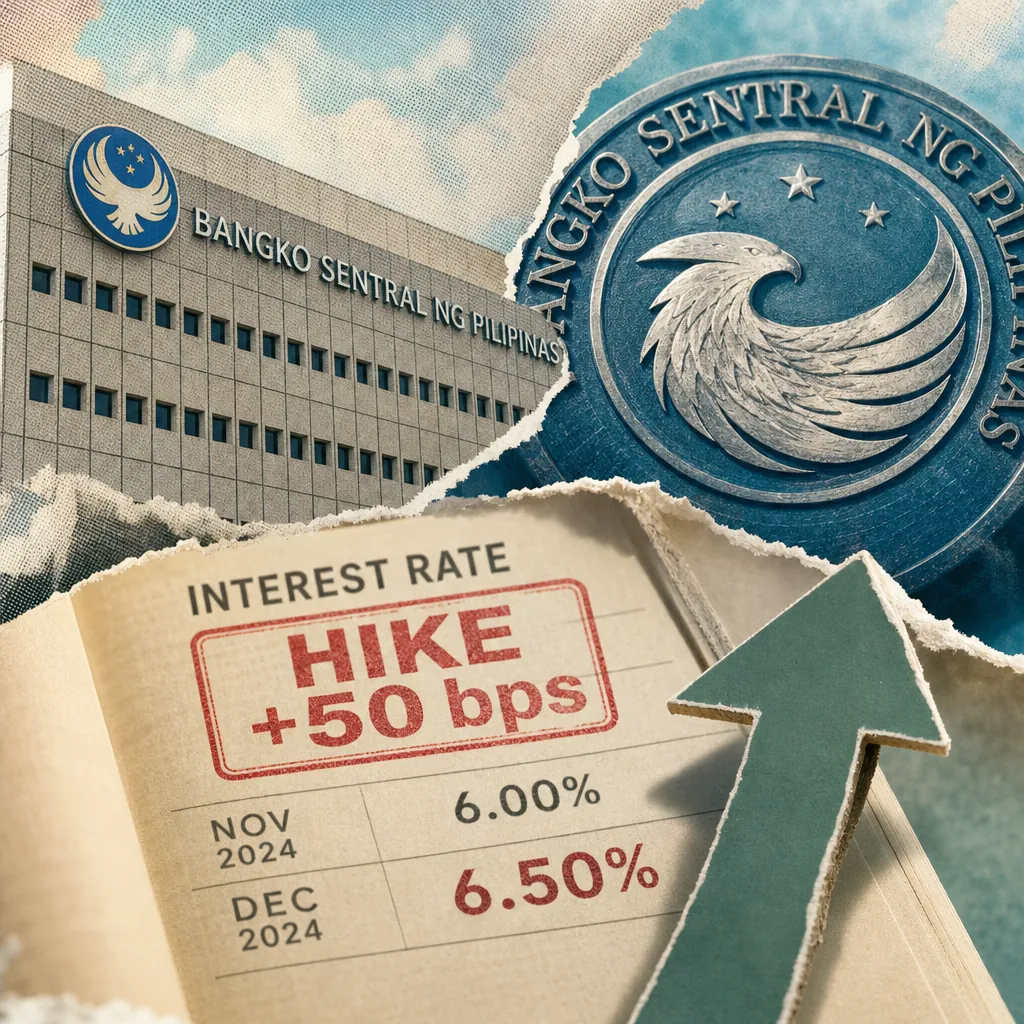
- The BSP is still tightening and will not say when it stops. Governor Remolona said easing is "not yet" in view after the Monetary Board's fourth consecutive 50-basis-point hike on Oct. 22 lifted the benchmark rate to 5.50 percent6517.
- The stock market fell 0.99 percent ahead of the October inflation print. The benchmark index closed at 5,624.17 as a second month of contracting factory activity weighed on sentiment58.
- DigiPlus profit fell 12 percent to P8.9 billion over nine months. Net gaming revenue after tax dropped 17 percent to P16.2 billion, though cost discipline widened the third-quarter margin418.
- The government wants Filipinos to save more for retirement through PERA. The Department of Finance is weighing a uniform, higher annual contribution ceiling to replace the current P200,000 limit for regular contributors and P400,000 for overseas Filipino workers1656.
- Moody's expects the sustainable bond market to keep growing on infrastructure and energy transition. The Philippines holds $23 billion in cumulative sustainable bond issuance, the third-largest market in Southeast Asia14.
- Philippine banks and insurers collected governance awards. UnionBank's chief executive made Forbes Asia's 20-woman list, while SM Investments and Sun Life extended Golden Arrow streaks2459.
How the narratives stack
Dominant. The Move It penalty is the day's dominant story in the items gathered here, and it is dominant on consequence rather than on volume: a regulator has put a peso figure on a platform's breach of its rider allocation, and the affected population — 55,575 rider-partners — is large enough that the dispute touches household income directly1. The story's second half is procedural. Because Move It has filed a motion for reconsideration, the fine is a finding awaiting confirmation, not a collected debt, and the groups pressing for accountability are asking for two things at once: that the company be held responsible and that the riders not be made to pay for its overreach1.
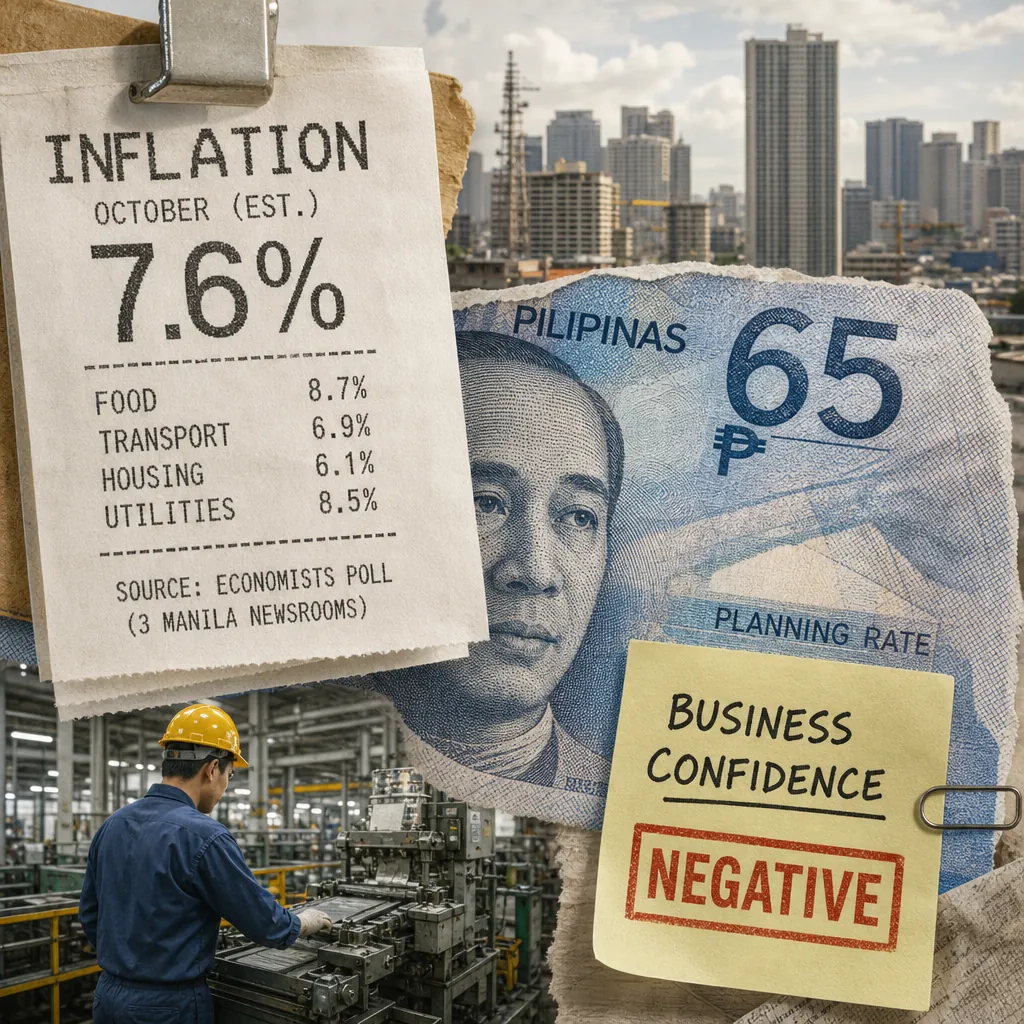
Counter-narrative. Against that, the financial coverage in this set is dominated by caution rather than alarm. The BSP's message is that the tightening cycle is not over and that the timing of any reversal depends on data not yet in hand6517; the market's 0.99 percent decline is modest and explicitly tied to a scheduled data release and a weak factory reading58. DigiPlus's 12 percent profit decline reads as a normalization after a period of rapid growth rather than a collapse, since the company still earned P8.9 billion over nine months and improved its margin by four percentage points to 22 percent in the third quarter418.
Emerging. Two policy threads are forming without yet producing decisions. The PERA review could raise how much Filipinos may set aside tax-advantaged each year and collapse the separate ceilings for domestic and overseas contributors into one1656. Separately, Moody's assessment that sustainable bonds have moved "beyond a supplementary source of capital" points to a market the government wants to use for infrastructure and climate adaptation, with governance and reporting quality named as the conditions for further growth14.
Under-covered. The governance-award items — UnionBank's chief executive on the Forbes Asia list, SM Investments' third Five Golden Arrow, Sun Life's eighth, DBP's three international awards — are recognition announcements that ran as corporate and partnership copy and drew little of the day's argumentative energy26045964. They matter less for what they say about the awardees than for what they signal about how Philippine financial firms are marketing themselves to depositors, investors and overseas partners.
Platform insights
- Facebook. The clearest public-service engagement in the set came from a legislator's Facebook post. Akbayan Party-list Rep. Chel Diokno used the platform to remind consumers of the conditions attached to the Energy Regulatory Commission's extended "No Disconnection Policy" through December 2026, spelling out which bills fall due on Nov. 26 and Dec. 26 and who remains exposed to disconnection7. The post's value is instructional: it converts a regulatory extension into a checklist households can act on, and it is the kind of content that travels through shares rather than likes.
- X. The Move It story's natural home is the fast-reaction platform, where transport and commuter communities trade screenshots of fares, allocations and regulatory notices. The advocacy groups' demand that riders be protected from the consequences of the company's violation is built for reposting in that environment1.
- Reddit. Discussion of the central bank's stance and the market's slide fits the forum pattern of long threaded argument over a single data point — here, whether a 5.50 percent benchmark rate with inflation still rising means borrowers should refinance now or wait6558. The DigiPlus results give the same forums a concrete case of a consumer-facing gaming company absorbing a softer economy4.
- YouTube. Explainer and news-clip traffic around the impeachment trial and the budget debate carries the day's political-financial crossover content, including the prosecution's comments on the evidence against Vice President Sara Duterte4850.
Key voices and communities
Transport and commuter advocates. The groups that responded to the Move It penalty are framing the issue around rider welfare rather than regulatory procedure, arguing that the riders who enrolled in good faith should not lose their livelihoods because the platform exceeded its allocation1. Their leverage is moral and public: the LTFRB's finding gives them a documented number to cite.
The central bank and market analysts. Governor Remolona's remarks set the tone for the financial coverage, and analysts such as Regina Capital's Luis Limlingan translated the factory data into a market narrative about growth prospects1758. This community's framing is conditional — every statement is tied to a data release.
Legislators acting as consumer explainers. Diokno's post on the no-disconnection policy is a model of the genre: a lawmaker using a social platform to translate a regulatory extension into deadlines and eligibility rules for households using 200 kilowatt-hours or less7.
Corporate communications and the awards circuit. The governance and recognition items show financial institutions using third-party validation — Forbes Asia, the Institute of Corporate Directors, the Asian Banker, the Association of Development Financing Institutions in Asia and the Pacific — as a trust signal in a market where depositors are being asked to keep money in the system2459564.
Narrative streams
The LTFRB fines Move It P10,000 for each of 55,575 excess riders
The arithmetic is the story. Move It was authorized to keep 17,746 rider-partners across Metro Manila, Cebu City and Cagayan de Oro; the LTFRB found 73,321 active as of May 2026; the difference, 55,575, was multiplied by a P10,000 per-rider penalty to reach P555.75 million1. Motorcycle taxis are a regulated public-transport mode in the Philippines, and the rider allocation is the mechanism by which the government controls how many operators share each city's streets — a cap on supply that protects incumbent operators and, in principle, keeps the market from flooding with unaccounted riders. Exceeding it means the platform expanded faster than the franchise it was granted.
The advocacy groups' intervention shifts the question from corporate compliance to household exposure. Their demand is that Move It be held accountable while regulators protect the livelihoods of the rider-partners affected by the violations1. That is a real tension: if the remedy for over-allocation is to deactivate excess riders, the people who lose income are the riders, not the executives who enrolled them. The motion for reconsideration means the board's finding is contested and the final shape of any remedy — fine, rider reduction, or both — is unresolved1.
For the ride-hailing and motorcycle-taxi sector, the case sets the price of over-enrollment. A per-rider penalty of P10,000 makes the cost of carrying an unauthorized partner roughly comparable to the revenue that partner might generate in a few weeks, which changes the economics of aggressive recruitment. Platforms that grew by signing riders faster than their allocations allowed now have a worked example of what that costs, and regulators have a template for enforcing allocation caps across the sector.
The BSP holds at 5.50 percent and declines to promise relief
Governor Remolona's remarks on Tuesday were carefully unhelpful to anyone hoping for a cut. He said the economy may have begun recovering in the third quarter, with gross domestic product growth possibly accelerating from the sluggish 2.3 percent expansion in the second quarter on higher government spending, but that it was too early to tell when the central bank could begin reversing its hikes17. Asked directly, he said: "Easing? Not yet. We're still in a tightening cycle, so we don't know"65. The Monetary Board had raised the benchmark rate by 50 basis points to 5.50 percent on Oct. 22, its fourth consecutive increase65.
The mechanics matter for ordinary borrowers. The BSP sets the policy rate that banks use as an anchor for lending; when it rises, variable-rate loans — credit cards, auto loans, some mortgages and business credit — tend to reprice upward with a lag. Remolona noted that inflation typically takes time to respond to tighter monetary policy, which is why the bank is unwilling to declare victory17. He also said the BSP weighs growth alongside inflation, and that further increases would be less likely if the gap between actual output and the economy's potential narrowed17.
For banks and lenders, the read is that net interest margins stay supported for longer while loan demand stays soft, and that the marketing of fixed-rate products becomes more attractive relative to floating ones. For households and small businesses, the practical consequence is that refinancing into a fixed rate now locks in a level that may look high if cuts arrive next year — a bet each borrower has to price.
The stock market slips 0.99 percent as factory activity contracts again
The Philippine Stock Exchange index closed at 5,624.17, down 56.18 points or 0.99 percent, and the broader All Shares index fell 0.58 percent to 3,159.84, on the market's first session back from a holiday break58. Regina Capital's Luis Limlingan attributed the decline to the latest purchasing managers' index data, which showed Philippine factory activity contracting for the second consecutive month in October, and to caution ahead of the October inflation release58. The purchasing managers' index is a monthly survey of purchasing executives at manufacturers; a reading below the neutral threshold signals that output is shrinking rather than growing.
Two consecutive months of contraction is a signal about the real economy that sits awkwardly beside the central bank's talk of a third-quarter recovery5817. Manufacturing is a large employer and a leading indicator for freight, energy demand and bank lending, so a sustained contraction would undercut the case for the growth side of the BSP's mandate and complicate the timing of any rate cut.
For listed companies and their investors, the read is that earnings expectations for the fourth quarter hinge on the inflation print and on whether factory orders recover. For the broader public, a falling index is mostly a signal about sentiment and the cost of capital: companies that need to raise money through share sales get less for the same stake, and pension funds holding equities see paper losses that feed into retirement outcomes.
DigiPlus earns P8.9 billion in nine months as gaming revenue falls 17 percent
DigiPlus Interactive Corp., the Eusebio Tanco-led digital gaming company, reported nine-month net income of about P8.9 billion, down roughly 12 percent from P10.11 billion a year earlier418. Net gaming revenue after tax fell 17 percent year-on-year to P16.2 billion, and the company attributed the decline to weaker gaming revenues and softer macroeconomic conditions4. Earnings before interest, taxes, depreciation and amortization — a rough measure of operating cash profit that strips out financing and accounting effects — reached P8.3 billion over nine months, and in the third quarter edged up 0.3 percent from the preceding quarter to P2.9 billion, with the margin widening four percentage points to 22 percent18.
The company said its earnings included noncash fair value gains from its investment in International Entertainment Corp.'s convertible bonds, which means part of the reported profit reflects the paper value of an investment rather than cash from operations4. The margin improvement came from tighter spending, including more efficient advertising4.
For the digital gaming sector, the results describe a market that grew fast and is now consolidating. A 17 percent decline in net gaming revenue against a 12 percent decline in profit means cost control is doing real work; companies that cannot cut as efficiently will show larger profit drops. The reference to softer macroeconomic conditions ties the sector to the same consumer squeeze the central bank is trying to manage — when households have less discretionary income, online gaming is one of the first lines to shrink.
The Department of Finance studies higher PERA contribution ceilings
The Personal Equity and Retirement Account, created under Republic Act No. 9505, is a voluntary retirement savings program meant to supplement the state pension system and employer plans; contributions are invested in eligible Philippine financial products16. Current rules let regular contributors put in up to P200,000 a year and overseas Filipino workers up to P400,00016. The Department of Finance said it is looking to establish a uniform annual contribution limit to simplify the rules and promote greater equity among contributors, and will study adjustments to determine how higher contributions would work1656.
Finance Secretary Frederick Go is reviewing the reforms, which could let workers and overseas Filipinos set aside larger amounts while removing the separate ceilings that treat domestic and overseas savers differently56. The economic logic runs two ways: higher limits help individuals build retirement funds that keep pace with rising living costs, and the pooled savings give Philippine financial markets more long-term capital to lend56.
For banks, insurers and asset managers, a higher PERA ceiling is a distribution opportunity — the accounts are sold through financial institutions, and a simpler, uniform rule is easier to market than a two-tier system. For workers, the benefit depends on whether the tax advantage is large enough to make locking money up attractive against more liquid alternatives. The review is at the study stage; no new limit has been set.
Moody's sees $23 billion in sustainable bonds and room to grow
Moody's Ratings said infrastructure development and the energy transition will boost the Philippine sustainable bond market, driven by rising investor demand for stronger governance, transparency and clear commitments on how funds are used14. The Philippines has the third-largest sustainable bond market in Southeast Asia after Singapore and Thailand, with $23 billion in cumulative issuance representing 17 percent of the regional total from 2017 through the third quarter of 202614. The country's exposure to extreme weather is making climate adaptation and resilience increasingly important financing priorities14.
Sustainable bonds are debt instruments whose proceeds are earmarked for environmental or social projects; investors accept a slightly lower return in exchange for documented use of funds, which is why governance and reporting quality determine how large the market can become. Moody's said further growth would depend on stronger governance, transparent reporting and clearly defined uses for the proceeds, and noted that the market "has evolved beyond a supplementary source of capital, helping direct long-term funding toward national priorities"14.
For issuers — banks, utilities, infrastructure developers and the government — the read is that the sustainable label is becoming a mainstream funding channel rather than a niche, and that the cost advantage it carries depends on credible reporting. For investors, the risk is greenwashing: a bond labeled sustainable whose proceeds are not traceable to eligible projects damages the market's credibility and invites tighter regulation.
Governance awards extend streaks at UnionBank, SM Investments, Sun Life and DBP
Union Bank of the Philippines president and chief executive Ana Maria Aboitiz Delgado was named to Forbes Asia's 2026 Power Businesswomen list, which recognizes 20 female business leaders across 12 countries and territories260. She is the only Filipina on the list60. Delgado, a fifth-generation member of the Aboitiz family, joined UnionBank in 2003 and took the top post in January 2025, after the bank completed its integration of Citibank's Philippine consumer banking business, which it acquired in 2022 for P72 billion2. UnionBank had 19.5 million customers and P1.2 trillion in assets, making it the country's ninth-largest lender, according to central bank data cited by Forbes Asia2.
Separately, UnionBank won two accolades at the Asian Banker Philippine Awards 2026 for its digital wealth onboarding and digital wealth management platform, recognition the bank is using to market a faster, fully digital account-opening process for wealth clients5. SM Investments Corp. received the Five Golden Arrow Award from the Institute of Corporate Directors for the third consecutive year, the highest rating under a program that assesses how companies protect shareholder rights, disclose material information and provide effective board oversight; SM Prime Holdings and China Banking Corp. also received Five Golden Arrows, while BDO Unibank and Belle Corp. received four45. Sun Life of Canada (Philippines) took a Golden Arrow for the eighth consecutive year based on the 2025 ASEAN Corporate Governance Scorecard9. The Development Bank of the Philippines, a state-owned lender, collected three awards from the Association of Development Financing Institutions in Asia and the Pacific for financial inclusion, local economic development and corporate social responsibility64.
For financial institutions, these awards function as trust advertising. Depositors and policyholders are being asked to leave money with institutions for years, and third-party validation from Forbes, the Institute of Corporate Directors or a regional development-finance association is a cheaper credibility signal than a rate premium. The concentration of such announcements in a single day's business pages reflects how the sector manages reputation between earnings seasons.
Conversation trajectory
October inflation release, within days. The Philippine Statistics Authority's October inflation figure is the single most consequential scheduled data point for the financial story; the stock market's decline was explicitly tied to caution ahead of it58, and the BSP has said its next move depends on incoming data65. A print above expectations would harden the case for holding rates and pressure equities further; a softer print would revive cut expectations. Watch the BSP's public comments in the days after the release for any change in the "not yet" language.
Move It's motion for reconsideration, over the coming weeks. The LTFRB must rule on the company's motion, and the outcome determines whether the P555.75-million penalty stands, shrinks or is withdrawn1. Watch also for any LTFRB guidance on what happens to the 55,575 excess rider-partners — whether they are deactivated, absorbed into other platforms' allocations, or left in place while the fine is settled. Advocacy groups have made rider livelihoods the test of any remedy1.
The 2027 budget and the Supreme Court's budget ruling, through the rest of the year. The Supreme Court has declared unconstitutional specific provisions of the 2024, 2025 and 2026 budget laws, and the 2027 General Appropriations Bill — containing a P7.2-trillion National Expenditure Program — has already passed the House on third reading63. Watch whether the House's amendments to the 2027 bill repeat the practices the Court struck down, which would delay enactment and, with it, the government spending that the BSP is counting on for third-quarter and fourth-quarter growth1763.
PERA reform details, over the next quarter. The Department of Finance has committed only to a study; the shape of a uniform contribution limit and any change to the tax treatment will determine whether the reform meaningfully raises retirement savings1656. Watch for a draft proposal or a Bureau of Internal Revenue circular.
Sustainable bond issuance, over the next two quarters. Moody's growth case rests on governance and reporting quality14. Watch for new Philippine issuance and for any regulatory guidance on use-of-proceeds reporting, which would either confirm or undercut the market's credibility premium.
Trigger events. The October inflation print; the LTFRB's ruling on Move It's motion; the Monetary Board's next scheduled policy meeting; the signing or veto of the 2027 budget; and any DigiPlus disclosure on fourth-quarter gaming revenue trends.
Response guidance
Regulated platforms facing allocation caps: get ahead of the arithmetic. Companies operating under rider or franchise allocations should audit their active-partner counts against their authorized ceilings now and disclose the gap to regulators before it is found. The Move It case shows the penalty is mechanical — a fixed peso amount per excess operator — which means the exposure is calculable in advance and the communications problem is one of timing, not of argument1.
Rider-facing communications: separate the company's liability from the riders' livelihoods. Any statement on the Move It penalty should address what happens to affected rider-partners directly, because that is the question advocacy groups have put at the center of the story1. Messages that discuss only the fine and the legal process will read as indifferent to the people whose income is at stake.
Lenders and deposit-takers: explain rate exposure in pesos, not in policy language. With the benchmark rate at 5.50 percent and the BSP declining to signal a cut, borrowers need plain statements of how a variable-rate loan reprices and what a fixed-rate alternative costs6517. Customer communications that repeat "tightening cycle" without translating it into monthly payments will not answer the question customers are actually asking.
Retirement and wealth products: prepare for a higher PERA ceiling without overselling it. If the Department of Finance raises the contribution limits, the marketing window opens quickly1656. Institutions should have plain-language material ready on what PERA is, how the tax advantage works and what the lock-up means, so that the first wave of customers understands the product rather than just the limit.
Consumer-facing utilities and energy retailers: repeat the no-disconnection deadlines. The Energy Regulatory Commission's extended no-disconnection policy runs through December 2026, with May-to-July bills due by Nov. 26 and August-to-October bills by Dec. 26, and it covers residential consumers using 200 kilowatt-hours or less7. Utilities and retailers should restate these dates in billing statements and on social channels, because the eligibility conditions are narrow enough that many households will assume they are covered when they are not.
Digital gaming and consumer platforms: address the demand side honestly. DigiPlus's 17 percent decline in net gaming revenue was attributed partly to softer macroeconomic conditions4. Operators should expect investors and regulators to ask whether the decline is cyclical or structural, and should prepare disclosure that separates the two rather than attributing everything to the economy.
Financial institutions announcing awards: tie recognition to a customer benefit. Governance and leadership awards are credible only when the institution can say what changed for clients — faster onboarding, clearer disclosure, better risk management5945. Announcements that list trophies without a customer-facing consequence read as self-congratulation and are quickly forgotten.
See the full picture behind today's signals.
This report draws from Media Meter's MediaWatch, our real-time monitoring engine tracking 2,470+ Philippine sources across print, broadcast, digital, and social. Explore how the platform turns raw coverage into decision-grade intelligence, then see how it's configured for teams like yours — whether you're in PR agencies, corporate comms, government, or marketing.
Want more? Browse our Report Library for sector and crisis intelligence, or request a demo and we'll have your brand set up before the call.
Want this kind of intelligence on your brand?
This brief is built on the same MediaWatch methodology that runs continuously across every brand we monitor. See your competitive landscape, Impact Score, and narrative trajectory in a 30-minute demo.