Philippine Banks Post Record P315.5-Billion Nine-Month Profit
Philippine banks booked their highest nine-month profit on record at P315.5 billion, while GCash operator Mynt traded below its IPO price and EastWest set aside P15.9 billion for credit losses. Business coverage also tracked a P555.7-million fine on Move It and a stalled Maharlika-NGCP stake.
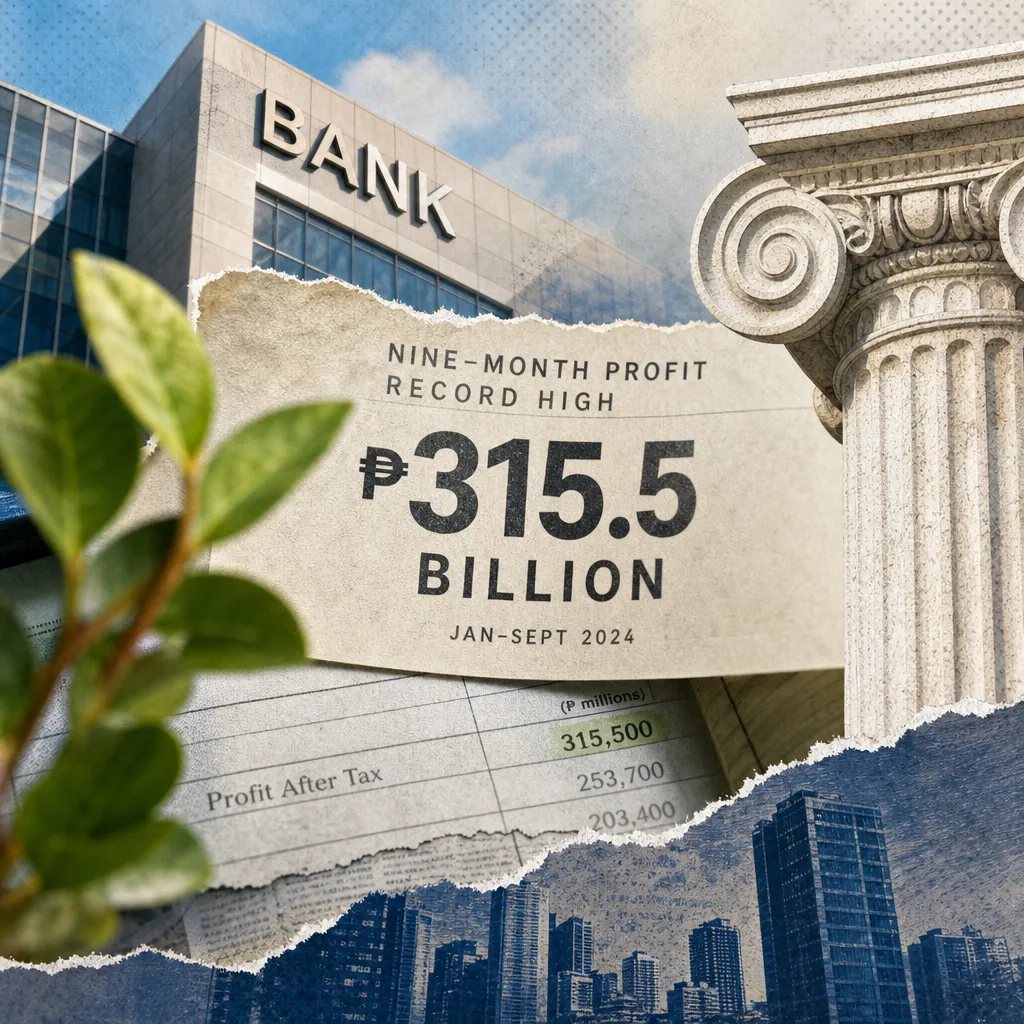
Philippine banks earned a combined P315.47 billion in net profit from January to September 2026, the highest nine-month total since the Bangko Sentral ng Pilipinas (BSP) began keeping comparable records in 2008, according to preliminary central bank data reported by the Inquirer, the Manila Times and Philstar63055. The figure is 4.2 percent above the P302.62 billion booked in the same nine months of 2025, an increase of P12.85 billion55.
The record landed alongside a second, less comfortable banking story. East West Banking Corp. reported a 24.2 percent fall in nine-month net income to P5 billion from P6.6 billion a year earlier, after setting aside P15.9 billion in provisions for expected credit losses52. The same day, GCash operator Mynt Inc. was still trading below its October 20 initial public offering price, and COL Financial's chief equity strategist argued the stock now looks cheaper than when her firm first rated it5.
Around those three items sat a wider set of business and policy stories: a P555.7-million fine on ride-hailing firm Move It for carrying more motorcycle riders than the government allows57; a sovereign wealth fund's stalled bid for a 20 percent stake in the national electricity grid7; a central bank governor warning that spending on artificial intelligence and data centers is crowding out money for climate adaptation33; and a business confidence survey that stayed in negative territory even as firms expected conditions to improve48.
Key themes
- Banks booked a record P315.5 billion in nine months, up 4.2 percent. Net interest income — the gap between what banks earn on loans and investments and what they pay depositors and creditors — rose 13.5 percent to P979.09 billion and carried the result55. Total operating income reached P1.16 trillion, up 10.2 percent from P1.05 trillion a year earlier55.
- EastWest's profit fell 24.2 percent as it provisioned P15.9 billion for bad loans. The consumer-focused lender's revenue grew by double digits, but it set aside far more for expected credit losses in what chief executive Jerry Ngo called a more challenging and uncertain macroeconomic environment52. Its non-performing loan coverage ratio — the share of soured loans already covered by reserves — stood at 90 percent52.
- Mynt shares sit about 5 percent below their IPO price. The GCash operator closed at its P6.60 offer price on its October 20 debut, then ended October 23 and October 26 at P6.27, touching an intraday low of P5.95 on October 265. COL Financial's April Lee-Tan said the fundamentals remain strong and repeated her firm's P8-per-share target5.
- The central bank governor said AI and data-center spending is diverting money from climate adaptation. At the 2026 Green Swan Conference, BSP Governor Eli Remolona Jr. said climate risk is "now a reality we live with" and that a climate event can quickly become an inflation problem and a financial-stability concern33. He cited successive tropical cyclones in the past two months and a coming severe El Niño33.
- Move It was fined P555.7 million for 55,575 riders above its cap. The Land Transportation Franchising and Regulatory Board (LTFRB) found the ride-hailing firm administratively liable for breaching its rider allocation under the Motorcycle Taxi Pilot Program, imposing P10,000 for each excess rider-partner57.
- Maharlika's deal for 20 percent of the national grid has not closed. More than a year after signing, the sovereign wealth fund has not returned to complete the purchase, according to Henry Sy Jr., chair of grid parent Synergy Grid & Development Phils. Inc.7. Synergy's share price has since risen from P10.98 to P25.50, making the original terms far more expensive7.
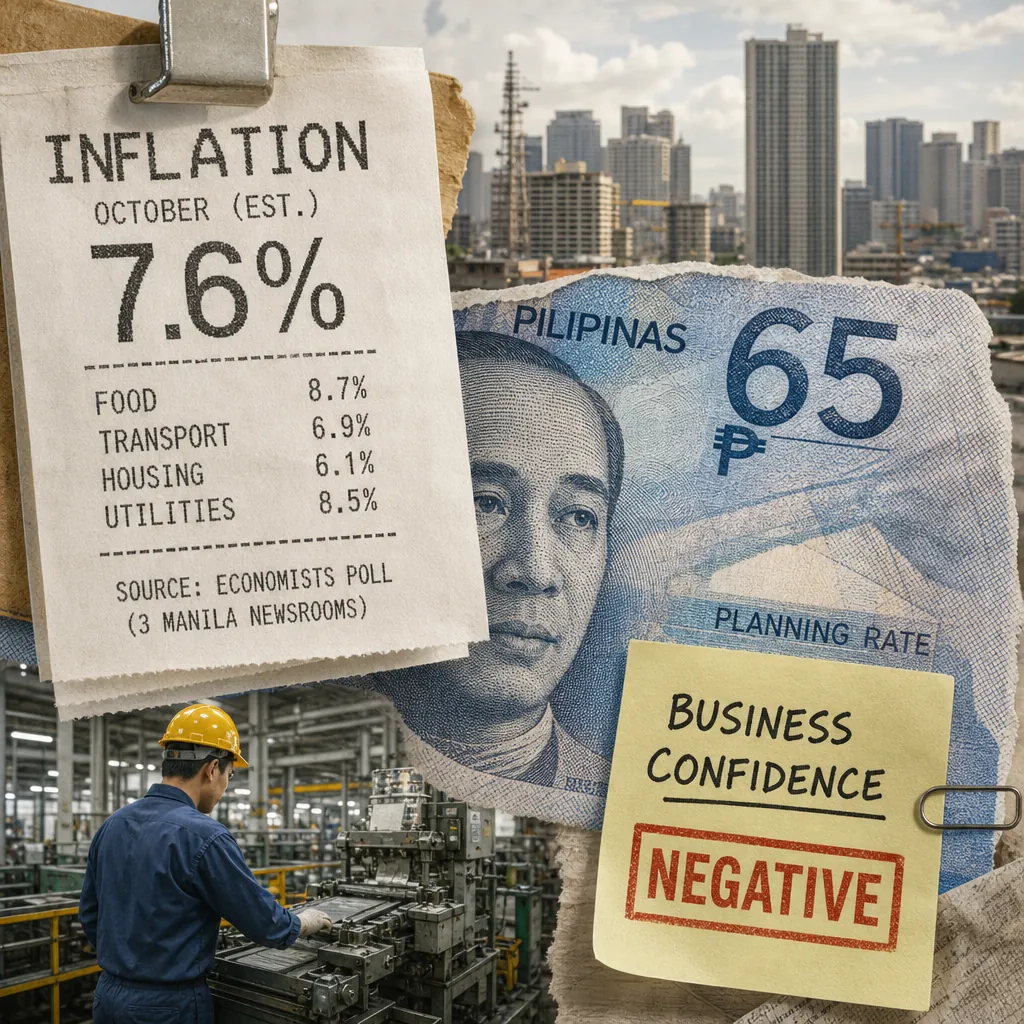
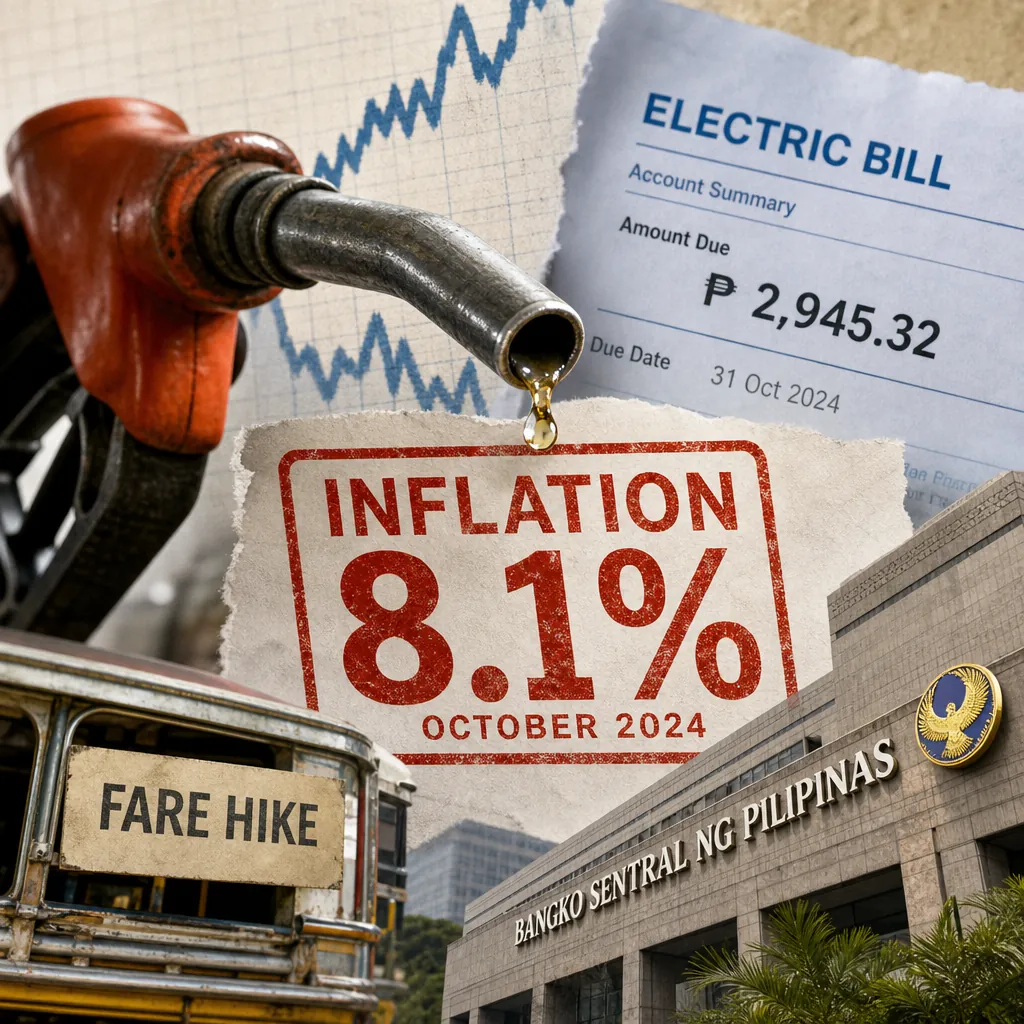
- Business confidence stayed negative at -8.4 percent for the current quarter. The BSP's Business Expectations Survey for September improved from -10.9 percent in August but still showed more firms pessimistic than optimistic, with respondents blaming fuel, energy and other input costs48. Headline inflation hit 7.2 percent that month, from 6.1 percent in August48.
- Moody's cited the Philippines' banks and reserves as buffers, without changing the rating. The assessment, released through the BSP on October 30, pointed to responsive monetary policy, well-managed banks and foreign exchange reserves, while leaving the sovereign's Baa2 rating and stable outlook unchanged47.
How the narratives stack
Dominant. The record nine-month banking profit is the day's lead business story, carried by three separate outlets — the Inquirer, the Manila Times and Philstar — each working from the same BSP preliminary data63055. Within the items reviewed here, it is the only story to draw that kind of repetition, and the numbers are consistent across all three: P315.47 billion in net income, P1.16 trillion in operating income, P979.09 billion in net interest income. The framing is broadly positive, with the Inquirer noting the result came "as elevated rates boosted their margins despite economic headwinds at home and abroad"6. The Philstar version adds the offsetting detail the others play down: foreign exchange losses and higher provisions for potential bad loans trimmed the gain55.
Counter-narrative. EastWest's 24.2 percent profit decline is the clearest counterweight to the record headline, and it comes from inside the same industry data52. A consumer lender that grows revenue by double digits yet earns a quarter less than a year earlier is telling readers that the quality of Philippine consumer credit is deteriorating even as aggregate bank profits rise. The P15.9 billion provision is the specific evidence: that is money the bank has set aside against loans it expects may not be repaid, and it is roughly three times the bank's entire nine-month profit. The 90 percent coverage ratio means reserves already cover nine-tenths of identified bad loans, which limits further provisioning needs but also leaves little cushion if conditions worsen52.
Emerging. Two threads point forward rather than back. The first is the central bank governor's argument that AI and data-center investment is pulling capital away from climate adaptation33. Remolona's warning connects directly to the inflation and credit picture: successive cyclones damage farms and roads, food prices rise, borrowers struggle, and banks provision more. The second is the Mynt share price, which has become a live test of investor appetite for Philippine technology listings5. A stock that cannot hold its offer price three weeks after listing shapes how the next candidate prices its own debut.
Under-covered. The Maharlika Investment Corp. bid for a 20 percent stake in the National Grid Corporation of the Philippines (NGCP) appeared in a single business-gossip column, despite its significance7. The deal was meant to give the state influence over critical electricity infrastructure in which a Chinese entity is a part-owner. Henry Sy Jr.'s account — "They didn't come back to us. Pataas ng pataas presyo" — describes a buyer that walked away as the price rose7. The column's conclusion, that President Marcos will likely finish his term without the state holding a grid stake, is the kind of outcome that would normally draw wider coverage than a single column. The Move It fine, at P555.7 million one of the largest administrative penalties against a ride-hailing operator, likewise appeared in one outlet in this set57.
Key voices and communities
The central bank. The BSP is the source of the day's most important numbers and the most consequential argument. Its preliminary banking data underpins three stories63055; its Business Expectations Survey supplies the confidence reading48; and Governor Remolona's Green Swan speech sets out the climate-finance case33. The BSP's framing matters because it shapes how the market reads the profit record: as evidence of resilience, not of an economy firing on all cylinders.
Bank analysts and equity strategists. April Lee-Tan of COL Financial is the named voice on Mynt, and her argument is a valuation one: at P6.60 the stock was attractive on her firm's P8 target, and at P6.27 it is more so5. She also names the missing ingredient — stronger earnings as the catalyst for a recovery5. Her comments give retail investors a framework for reading the post-IPO slide.
Bank management. EastWest chief executive Jerry Ngo's statement is the day's most carefully worded piece of corporate communication: "Our underlying businesses remain healthy, with strong revenue growth and improving operating efficiency allowing the bank to remain profitable," followed by an acknowledgment that "the current environment" is difficult52. The gap between the two halves of that quote is where the credit story sits.
Business journalists and commentators. The Philstar column by a 56-year veteran of Philippine business journalism, who reports that his phrase "Bobo na, magnanakaw pa" drew 3.7 million views across Bilyonaryo TV and Abante, shows how economic frustration is travelling through broadcast and social channels53. The same commentator's subject matter — the peso's slide and El Niño — overlaps directly with the central bank's climate warning3353.
Firms themselves. The BSP's business survey gives companies a collective voice, and what they said in September was that they remain pessimistic about the current quarter while expecting improvement over three to 12 months48. That split between present and future is the most useful signal in the survey for anyone planning hiring or pricing.
Narrative streams
Banks earn a record P315.5 billion as lending margins widen
The mechanics of the record are straightforward. Net interest income of P979.09 billion accounted for the bulk of P1.16 trillion in total operating income, and it grew 13.5 percent year on year55. That growth reflects the gap between what banks charge borrowers and pay depositors, which stayed wide because the BSP has kept policy rates elevated to fight inflation. The Inquirer puts net interest income growth at 14 percent to P979 billion and notes that noninterest income actually fell nearly 5 percent to P178 billion, with fees and commissions up 7 percent to P144 billion and trading income rising more than fivefold to P31.4 billion6.
The three accounts differ slightly in emphasis. The Inquirer leads on the record and the margin story6. The Manila Times gives the precise P315.47 billion figure and the P302.62 billion year-earlier comparison, and specifies that the data covers universal and commercial banks, thrift banks, rural and cooperative banks, and digital banks30. Philstar adds the drags: foreign exchange losses and higher provisions for potential bad loans55. Read together, they describe an industry earning more from the spread on its existing book while earning less from everything else.
For borrowers, the consequence is direct. Banks earn wider margins when lending rates stay high relative to deposit rates, and those same high lending rates are what households and small businesses pay on loans. The record profit is, in part, a transfer from borrowers to lenders. For the banks themselves, the risk is that the margin advantage fades as the BSP eventually cuts rates, at which point the P178 billion noninterest line and the quality of the loan book become the growth story. The P31.4 billion trading income, up more than fivefold, is the least durable component of the result and should not be read as recurring earnings6.
EastWest provisions P15.9 billion and posts a 24.2 percent profit decline
EastWest's result is the clearest evidence in the day's coverage that the record industry profit conceals divergent performance. Net income fell to P5 billion from P6.6 billion, a 24.2 percent decline, even though revenue grew by double digits52. The cause is the P15.9 billion provision for expected credit losses, which the bank attributes to a more challenging and uncertain macroeconomic environment52.
Provisions are the accounting mechanism by which a bank recognizes that some loans may not be repaid; they are charged against profit in the period they are booked. A P15.9 billion charge against a P5 billion profit means the bank's pre-provision earnings were substantially higher than the bottom line suggests. That is what Ngo means when he says the underlying businesses remain healthy52. The 90 percent non-performing loan coverage ratio tells the other half: for every peso of loans already identified as troubled, the bank holds 90 centavos in reserves52. That is a solid buffer by regional standards but leaves limited room to absorb a sharp deterioration.
The read for the sector is that consumer credit quality is the pressure point. EastWest is explicitly consumer-focused, and its experience is a leading indicator for the thrift, rural and digital banks that lend to similar customers. If inflation at 7.2 percent in September is squeezing household budgets, the first place it shows up is in missed payments on consumer loans48. Banks that lend to consumers should expect provisioning to stay elevated through the fourth quarter, and the industry's record aggregate profit should not be read as evidence that all lenders are equally healthy.
Mynt trades below its IPO price as analysts point to earnings
Mynt Inc., the company behind the GCash payments app, listed on the Philippine Stock Exchange on October 20 at P6.60 per share5. It closed its first day at that price, then weakened to P6.27 on both October 23 and October 26, about 5 percent below the offer, and touched an intraday low of P5.95 on October 26 — as much as 9.85 percent below the IPO price5.
COL Financial's April Lee-Tan frames the decline as an opportunity: "If it was already attractive at P6.60 based on that report, its now more attractive because its cheaper," she said, referring to her firm's P8-per-share target in its initiating coverage5. She adds the condition — stronger earnings could be needed to drive a recovery5. That is the crux. A payments company's valuation rests on transaction volume and take rate, and the market is waiting for evidence that both are growing fast enough to justify the target.
The read for the sector is about the pipeline, not just this stock. Mynt is the highest-profile Philippine technology listing in years, and its aftermarket performance sets the reference point for every company considering a debut. A stock that trades below its offer price three weeks in makes investors more cautious about the next listing and makes issuers more conservative on price. For GCash's tens of millions of users, the share price has no direct effect on the app, but it does affect the company's ability to raise further capital and to use its shares as acquisition currency. The next checkable signal is the company's first earnings report as a listed entity, which will show whether the earnings catalyst Lee-Tan describes is materializing5.
The central bank warns that AI spending is crowding out climate adaptation
At the 2026 Green Swan Conference, BSP Governor Eli Remolona Jr. argued that the Philippines, a rice-dependent economy facing what he called a "Godzilla" El Niño, should prioritize investment in climate change adaptation over pooling funds for artificial intelligence33. "Its now a reality we live with," he said of climate risk, explaining that what begins as a climate event can quickly become an inflation problem, a financial stability concern, and a threat to sustained growth33. He called for resilient infrastructure, insurance that absorbs losses, and financing that supports adaptation33.
The Green Swan Conference takes its name from the Bank for International Settlements' concept of "green swan" events — climate-related shocks that are hard to model and can cascade through financial systems. Remolona's presence there, and his framing, matters because central banks do not normally weigh in on the allocation of capital between technology and adaptation. His argument is that the two compete for the same pool of investable funds, and that the Philippines' exposure to typhoons and El Niño makes adaptation the higher-return use. He noted that the past two months alone saw "unusual successive" tropical cyclones, and that the southwest monsoon caused massive damage to farms and roads33.
The read for the sector is that climate risk is now a credit risk. Banks with agricultural exposure, with mortgages on flood-prone property, or with loans to utilities dependent on stable water supply are carrying risks that standard credit models may understate. The governor's speech is a signal that the BSP expects lenders to price those risks more explicitly. Insurers face the mirror-image problem: the losses Remolona wants absorbed by insurance are precisely the losses that make premiums rise and coverage harder to obtain. The same day's coverage of a P35.014-billion renewable energy financing syndicate, in which LandBank is providing P11.68 billion for five Citicore solar projects in Batangas totaling 900 megawatts-peak of capacity and 120 megawatt-hours of storage, shows the adaptation financing he describes beginning to move38.
Move It is fined P555.7 million for exceeding its rider cap
The LTFRB ordered Move It PH to pay P555.7 million after finding it had 73,321 active riders as of May across Metro Manila, Cebu and Cagayan de Oro, against an authorized allocation of 17,74657. The board imposed P10,000 for each of the 55,575 rider-partners maintained above the cap57. Failure to pay could lead to suspension from the Motorcycle Taxi Pilot Program and revocation of its authority to operate57.
The Motorcycle Taxi Pilot Program is the government's regulated trial framework for motorcycle ride-hailing, which allows a limited number of rider-partners per operator so that regulators can study safety and fare outcomes before deciding whether to make the service permanent. The cap is therefore not a formality; it is the mechanism by which the pilot stays a pilot. Move It's excess of more than four times its allocation is the largest such breach reported in this set.
The read for the sector is that the pilot's economics are being tested. Ride-hailing platforms need rider density to meet demand and reduce wait times, and the cap limits how much density an operator can build. A fine of this size — roughly P7,600 per excess rider, against whatever revenue each rider generates — changes the calculation for every operator in the program. Competitors that stayed within their allocations now face a market where the largest constraint on growth is regulatory rather than competitive. For commuters, the immediate question is whether Move It absorbs the fine, passes it on through fares, or reduces its fleet, each of which affects availability.
Maharlika's bid for a grid stake stalls as the price rises
Maharlika Investment Corp., the sovereign wealth fund created to invest state money in strategic assets, signed an agreement more than a year ago to acquire 20 percent of the National Grid Corporation of the Philippines7. The stake was meant to give the government greater influence over critical electricity infrastructure in which a Chinese entity is a part-owner. It has not closed. "They didnt come back to us. Pataas ng pataas presyo but they didnt come back anymore," said Henry Sy Jr., chair of NGCP parent Synergy Grid & Development Phils. Inc.7.
When the agreement was signed, Synergy shares traded at P10.98; they have since risen to P25.507. If the deal was priced off the earlier share price, completing it now would cost Maharlika more than twice as much, which explains why the buyer may have walked away. The column's assessment is that President Marcos will likely finish his term without the state holding a grid stake7.
The read for the sector is that the ownership question over the transmission network remains open. NGCP operates the high-voltage lines that carry electricity from generators to distributors, and its ownership structure has been the subject of congressional scrutiny because of the Chinese stake. A state stake was one route to resolving that concern; its failure leaves the issue to legislators and regulators. For investors in Synergy and NGCP, the rising share price reflects the value of the asset, but it also makes any future state entry more expensive and therefore less likely.
Business confidence stays negative as inflation runs at 7.2 percent
The BSP's Business Expectations Survey for September put the overall confidence index for the current quarter at -8.4 percent, an improvement from -10.9 percent in August but still negative, meaning more firms were pessimistic than optimistic48. Respondents blamed high fuel and energy costs and rising prices, even as they expected conditions to improve over the next three to 12 months48. The survey landed in a month when headline inflation accelerated to 7.2 percent from 6.1 percent in August, matching April's three-year high48.
A confidence index is a diffusion measure: the share of firms that are optimistic minus the share that are pessimistic. A reading of -8.4 percent means pessimists outnumbered optimists by 8.4 percentage points. The gap between the current-quarter reading and the forward expectation is the useful part — firms are saying the present is bad and the future should be better, which is consistent with an economy absorbing a price shock rather than entering a recession.
The read for the sector is that the same cost pressures squeezing households are squeezing the firms that set hiring, pricing and expansion plans48. Banks should expect loan demand from businesses to stay soft while firms defer expansion, and should expect continued pressure on consumer loan quality while inflation erodes household repayment capacity. The Moody's assessment released the same week offers the counterweight: the ratings agency cited the Philippines' responsive monetary policy, well-managed banks and foreign exchange reserves as buffers, while leaving the Baa2 rating and stable outlook unchanged47. Moody's noted the central bank's "ability to respond to changing economic conditions, easing policy when inflationary pressures were subdued and tightening as higher energy prices increased inflation risks in 2026"47.
Conversation trajectory
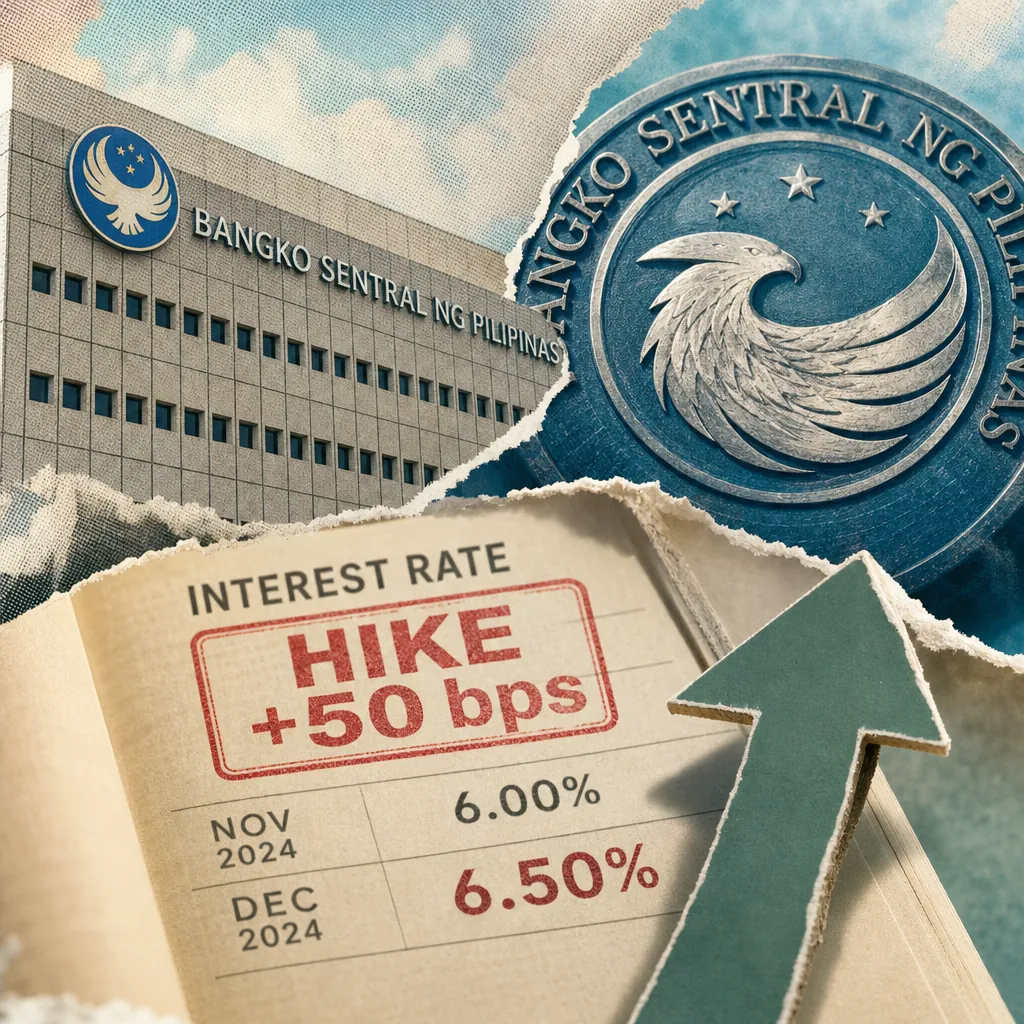
Watch the peso and the next BSP policy meeting (observation window: through the November and December policy meetings). The central bank has already delivered what one Inquirer Plus column calls a "jumbo" rate hike, and the peso has kept losing value43. The column's argument is that a rate hike treats the symptom while the underlying trade deficit and dependence on imported energy and farm inputs drive the currency down43. If the peso stabilizes after the hike, the case for further tightening weakens; if it does not, the BSP faces a choice between defending the currency and supporting growth. Banks' net interest margins depend on which way that goes.
Watch fourth-quarter provisioning at consumer lenders (observation window: January 2027 earnings releases). EastWest's P15.9 billion provision and 90 percent coverage ratio set a benchmark52. If other consumer-focused banks report similar increases, the record industry profit will look increasingly like a story about corporate and trading income rather than broad-based health. If EastWest's provisions prove idiosyncratic, the aggregate picture holds.
Watch Mynt's first post-IPO earnings report (observation window: the company's first results announcement as a listed entity). Lee-Tan's P8 target rests on earnings growth5. The report will show whether transaction volumes and take rates justify it, and will set the tone for the next Philippine technology listing.
Watch the December inflation print (observation window: the next BSP inflation release). September's 7.2 percent matched April's three-year high48. A decline would support the forward-looking half of the business confidence survey; a further rise would put the current-quarter pessimism and the banks' provisioning in the same frame.
Watch whether Maharlika returns to the NGCP table (observation window: through the end of the Marcos administration). Synergy's share price at P25.50 makes the original terms uneconomic7. Any renewed approach would have to be repriced, and any congressional action on the grid's ownership structure would change the calculus.
Trigger events. The BSP's next policy meeting; the release of November inflation data; Mynt's first earnings report; EastWest's and other banks' fourth-quarter results in January; and any LTFRB action on Move It's payment or authority57.
Response guidance
Bank communicators: lead with the loan book, not the profit record. The P315.5 billion headline invites the question of why profits are rising while borrowers struggle. Prepare plain-language explanations of net interest income, provisions and coverage ratios, and be ready to say what share of earnings came from lending margins versus fees and trading. The P31.4 billion trading income, up more than fivefold, is the figure most likely to draw scrutiny if presented as recurring6.
Consumer lenders: address provisioning before it is asked about. EastWest's disclosure sets the terms of the conversation for the sector52. Firms with similar exposure should explain their coverage ratios and the assumptions behind their provisions in language a depositor can follow, rather than waiting for analysts to infer weakness from the numbers.
Fintech and payments firms: separate the share price from the product. Mynt's aftermarket performance will be read as a verdict on Philippine fintech generally5. Communications should keep the distinction clear between the listed entity's valuation and the app's day-to-day service, and should avoid promising a recovery timeline the company cannot control.
Ride-hailing operators: treat the rider cap as a compliance issue with public consequences. The Move It fine shows the LTFRB will enforce the pilot allocation at P10,000 per excess rider57. Operators should audit their active rider counts against their allocations and communicate any adjustments to fares or availability before they happen, since riders experience compliance as longer waits.
All financial institutions: prepare for climate-risk questions from regulators and investors. The governor's Green Swan speech signals that the BSP expects climate risk to be treated as financial risk33. Banks and insurers should be able to describe their exposure to typhoon, flood and El Niño risk in their loan and underwriting books, and should note the adaptation financing already moving, such as LandBank's P11.68 billion commitment to solar projects38.
On inflation and confidence: avoid telling customers the economy is fine. The business confidence index is negative and inflation is at 7.2 percent48. Messaging that emphasizes resilience without acknowledging cost pressure will read as out of touch, particularly when commentators with large broadcast followings are amplifying economic frustration53. Acknowledge the pressure, describe specific relief or forbearance measures, and keep forward-looking claims tied to named data releases.
On the grid and state investment: expect scrutiny of stalled strategic deals. The Maharlika-NGCP column shows that a signed agreement that never closes becomes a story about competence7. Institutions involved in strategic transactions should be prepared to explain, in plain terms, why terms changed and what happens next, rather than leaving the account to the counterparty.
See the full picture behind today's signals.
This report draws from Media Meter's MediaWatch, our real-time monitoring engine tracking 2,470+ Philippine sources across print, broadcast, digital, and social. Explore how the platform turns raw coverage into decision-grade intelligence, then see how it's configured for teams like yours — whether you're in PR agencies, corporate comms, government, or marketing.
Want more? Browse our Report Library for sector and crisis intelligence, or request a demo and we'll have your brand set up before the call.
Want this kind of intelligence on your brand?
This brief is built on the same MediaWatch methodology that runs continuously across every brand we monitor. See your competitive landscape, Impact Score, and narrative trajectory in a 30-minute demo.