Inflation Seen at 7.6% as Peso Tests P65 Planning Rate
Economists polled by three Manila newsrooms put October inflation near 7.6 percent ahead of the November 5 official release, while manufacturers plan around a ₱65 peso and business confidence stays negative. British investors press four pending economic bills.
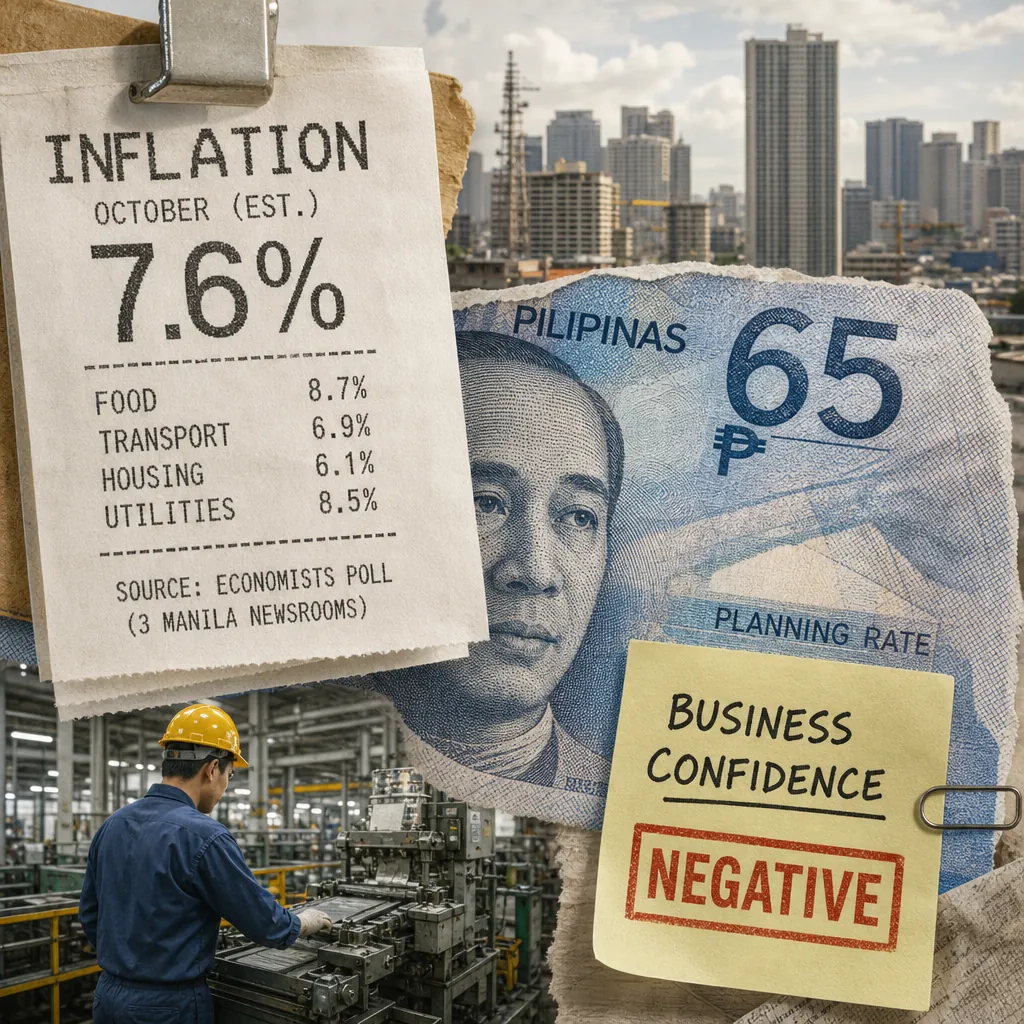
October inflation in the Philippines likely ran at about 7.6 percent, measured as the year-on-year change in the consumer price index, according to separate polls of economists published by the Inquirer, The Philippine Star and the Manila Bulletin on Sunday43840. That would be the fastest pace since February 2023, when the index rose 8.6 percent, and an acceleration from September's 7.2 percent4. The Philippine Statistics Authority (PSA), the government's statistical agency, releases the official October figure on November 5, and the Bangko Sentral ng Pilipinas (BSP), the country's central bank, has already said it expects 7.1 to 8.1 percent32. The peso's slide past ₱64 to the dollar, record-low territory reached on October 27, runs through nearly every item in the day's business coverage: it raises the peso cost of imported fuel and raw materials, feeds into transport fares and electricity bills, and has pushed manufacturers to plan their 2027 budgets around an assumed ₱65202.
The BSP's latest Business Expectations Survey, a nationwide poll of 515 companies, showed the business confidence index at -8.4 percent in September, up from -10.9 percent in August but still negative, meaning pessimists outnumbered optimists527. Firms' expectations for the next three months and the next 12 months both weakened36. The British Chamber of Commerce Philippines (BCCP), a business group representing UK-linked firms, used the same news cycle to press the Senate to pass four pending economic laws covering cybersecurity, digital payments, open finance and the blue economy, warning that delay weakens the case for investing in the country4228.
No social-media monitoring writeup accompanied this window's material, so the picture here rests on the news coverage captured: a set weighted toward online business desks, with a handful of broadsheet items from the Manila Standard and opinion and analysis pieces from provincial and regional outlets. The most consequential single number is the inflation consensus, because it sets up a central bank decision in December; the most revealing detail may be the ₱65 planning rate, because it shows companies have stopped waiting for the currency to settle and are budgeting for a weaker peso.
Key themes
- Three polls converge on roughly 7.6 percent October inflation. The Inquirer's survey of 19 economists produced a 7.6 percent median4; The Star's poll of 12 also landed at 7.6 percent, with estimates from 7.3 to 7.838; the Manila Bulletin's survey of 10 financial institutions put the median at 7.75 percent40. All three sit inside the BSP's 7.1 to 8.1 percent forecast32.
- Manufacturers are budgeting at ₱65 to the dollar. Federation of Philippine Industries chair Elizabeth Lee said local manufacturers use an assumed exchange rate of ₱65 for business planning, which she stressed is neither a forecast nor the current rate but a hedge against uncertainty2. The peso's move from ₱63 to ₱64 made it hard for companies to plan purchases and manage dollar exposure, she said2.
- Business confidence improved in September but stayed negative. The confidence index rose to -8.4 percent from -10.9 percent, with firms citing fuel and energy costs, inflation, the Middle East conflict, peso depreciation and weather disruptions2741. Optimism for the next 12 months fell to 26.5 percent from 36.4 percent36.
- Bank economists expect inflation above 8 percent in November and December. ANZ Research projected October inflation at 8.4 percent and expects the rate to stay above 8 percent through the fourth quarter on higher rice and oil prices, with El Niño's effect on food supply only beginning to show26.
- The peso's record low drew comment from the country's biggest business figures. Manuel V. Pangilinan, chairman of the Pangilinan-led conglomerates, said rising interest rates worry him more than the currency but that the peso's slide means harder times for ordinary Filipinos31. President Ferdinand Marcos Jr. has urged the public not to panic20.
- British investors want four laws passed before they commit further. The BCCP named the Cybersecurity Act, Digital Payments Act, Open Finance Act and Blue Economy Act as priorities, noting some have cleared the House of Representatives and await Senate action4228.
- The stock market is expected to trade sideways ahead of the inflation release. The Philippine Stock Exchange index (PSEi) closed at 5,680.35 on Friday, down 0.84 percent week-on-week, and First Metro Investment Corp. expects it to stay between 5,600 and 5,80034.
- Stricter bank lending is pushing younger borrowers toward fintech credit. Banks tightened underwriting and collections as repayment concerns rose, according to AB Capital Securities, while buy-now-pay-later services and digital lenders use e-commerce and mobile-wallet data to reach borrowers traditional credit bureaus cannot score6.
How the narratives stack
Dominant. The inflation consensus dominates the captured set. Four separate items — the Inquirer poll, The Star poll, the Manila Bulletin poll and the BusinessMirror report on bank economists — carry the same core finding with slightly different medians, and the BSP's own forecast and the PSA release date appear in most of them438402632. The Manila Standard's front-page story tied the inflation expectation directly to the ₱65 planning rate, putting both on the same page2. Within this set, the inflation story is dominant by both item count and consequence: it determines what the central bank does at its December meeting, and that in turn sets borrowing costs for every household and firm in the country.
Counter-narrative. The business confidence survey complicates the inflation story in one direction and reinforces it in another. Sentiment improved in September, which suggests firms are adapting rather than panicking2741. But their expectations for the next three and 12 months worsened, and their own inflation forecast for the coming year rose to 5.7 percent from 5.4 percent5. The improvement is in how firms feel about the present; the deterioration is in what they expect next. Both readings come from the same BSP survey, and the coverage split between outlets that led with the improvement and those that led with the weakening outlook3641.
Emerging. Two stories sit at the edge of the day's coverage but point to structural change. The first is the migration of credit from banks to fintech lenders: as banks tighten standards, buy-now-pay-later services and digital lenders are picking up younger borrowers using alternative data, and the Securities and Exchange Commission's July reopening of online lending licenses could accelerate that shift6. The second is the BCCP's legislative push. Open finance — a framework for sharing financial data securely across institutions with customer consent — would expand credit access for micro, small and medium enterprises, and the digital payments bill would formalize rules for a payments market that has grown faster than its regulation42. Neither story has a decision attached yet, which is why they sit below the inflation coverage.
Under-covered. The peso's effect on ordinary households is discussed mostly through the voices of executives and economists. Pangilinan's remark that the currency's slide means harder times for Filipinos is one of the few items that frames the exchange rate as a household problem rather than a corporate one31. A Panay News column asked why the government seems relatively calm about a peso at ₱64 and whether expensive oil still explains what is happening, but it ran in a regional outlet and did not travel into the national business pages20. The practical question — what a peso at ₱64 to ₱65 does to the price of imported rice, fuel and medicine on a family's weekly budget — is present in the inflation forecasts only as an aggregate number.
Platform insights
No social-media monitoring writeup was supplied for this window, so there is no engagement data — likes, shares, views or comments — to report for Facebook, X, Reddit or YouTube. The conversation captured here ran through news websites and print, and the analysis of how it spread rests on the outlets and items in the set rather than on platform behaviour.
Key voices and communities
Bank and research economists. The forecasters who set the terms of the inflation debate: Metrobank's Nicholas Mapa, Chinabank's Domini Velasquez, Reyes Tacandong & Co.'s Jonathan Ravelas and UnionBank's Ruben Carlo Asuncion all put October inflation at the top of the range, 7.8 percent38. Their consensus becomes the benchmark against which the PSA's November 5 release will be judged, and a miss in either direction will move rate expectations.
The Bangko Sentral ng Pilipinas. The central bank is both forecaster and actor here. Its 7.1 to 8.1 percent projection frames the debate32, its Business Expectations Survey supplies the confidence data27, and its policy rate decision in December is the event the whole inflation conversation is building toward. The BSP has said it will remain vigilant and guided by incoming data, particularly on inflation and growth32.
Manufacturers and the Federation of Philippine Industries. Elizabeth Lee's ₱65 planning rate is the most concrete number in the day's coverage because it shows what companies are actually doing rather than what they expect2. Manufacturers that import oil, energy and industrial inputs carry the peso's movement directly into their cost base, and their planning assumptions feed into the prices they set.
The British Chamber of Commerce Philippines. Executive director and vice chairman Chris Nelson has become a persistent voice on the legislative calendar, arguing that passing the four pending bills would signal to investors that the economy is moving forward2842. The BCCP's position that a separate UK-Philippines free trade agreement is not needed now, because such deals take about three years to negotiate, puts the emphasis on domestic legislation instead28.
Business owners surveyed by the central bank. The 515 firms in the BES are the closest thing to a representative sample of corporate sentiment, and their answers show a business community that has adjusted to a difficult present while bracing for a harder year ahead527.
Narrative streams
Three polls put October inflation at 7.6 to 7.75 percent
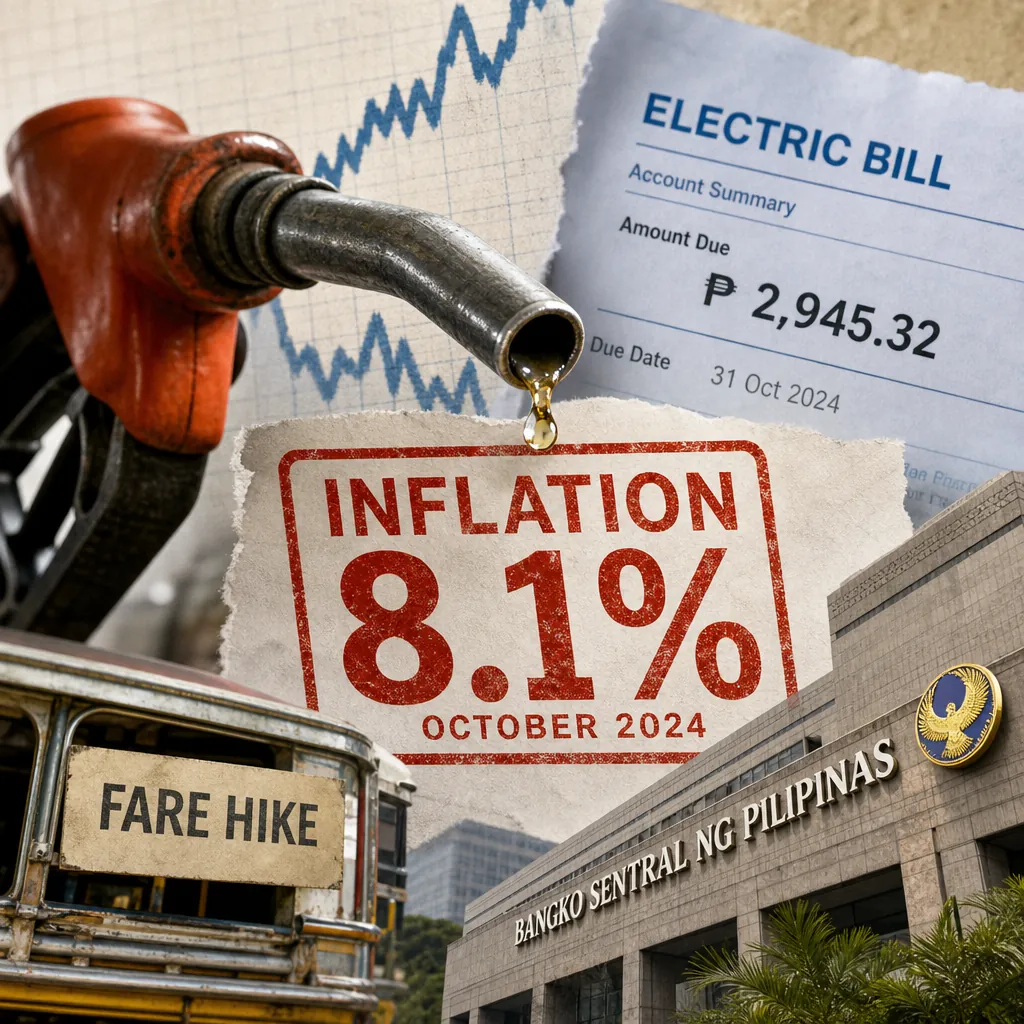
The Inquirer's poll of 19 economists produced a median estimate of 7.6 percent, which would be the fastest since February 2023's 8.6 percent and an acceleration from September's 7.2 percent4. The Star's poll of 12 economists also produced 7.6 percent, with a range of 7.3 to 7.838. The Manila Bulletin's survey of 10 financial institutions put the median at 7.75 percent, with estimates from 7.4 to 7.9, and noted that second-round effects from transport fare adjustments and wage hikes offset relief from falling food prices40. The BSP's own month-ahead forecast, released October 30, projected 7.1 to 8.1 percent, with upward pressure from domestic fuel, electricity and transport fares partly offset by lower prices of rice, vegetables, meat and fish32.
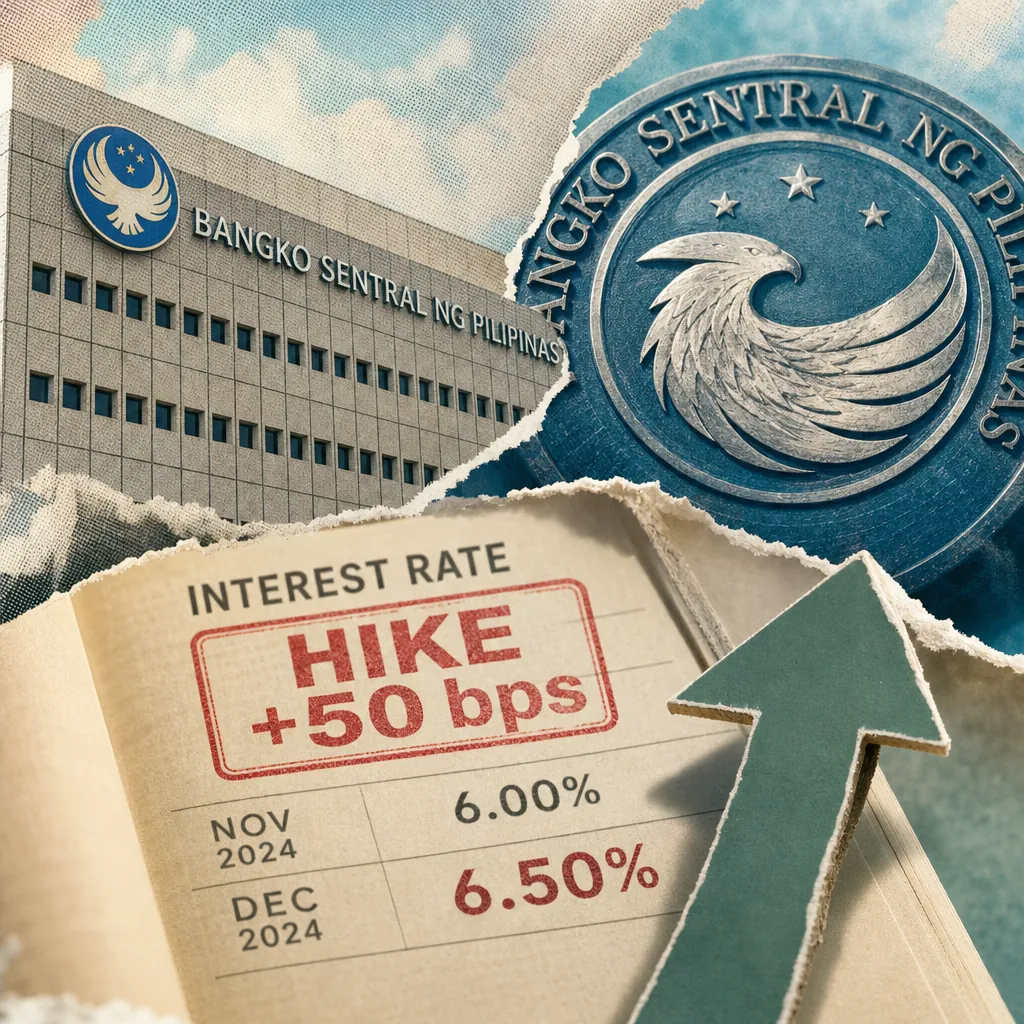
Headline inflation has now stayed above the BSP's 2 to 4 percent target for seven straight months38. That target is the range the central bank considers consistent with price stability; when inflation runs above it, the BSP's main tool is to raise its policy interest rate, which makes borrowing more expensive across the economy in order to cool demand. Economists surveyed by the Manila Times put the October median at 7.7 percent and expect the central bank to raise rates again in December3.
For households, the practical effect is that the prices of the things they buy most — fuel, electricity, transport, food — are rising faster than their incomes, and the relief from cheaper rice and vegetables is being eaten up by fare and utility increases40. For businesses, the effect is higher input costs and higher borrowing costs at the same time. For the central bank, the question is whether to keep tightening into an economy the International Monetary Fund projects will grow 3.4 percent for the full year, after second-quarter growth of just 2.3 percent30.
Manufacturers plan at ₱65 to the dollar as the peso sets a record low
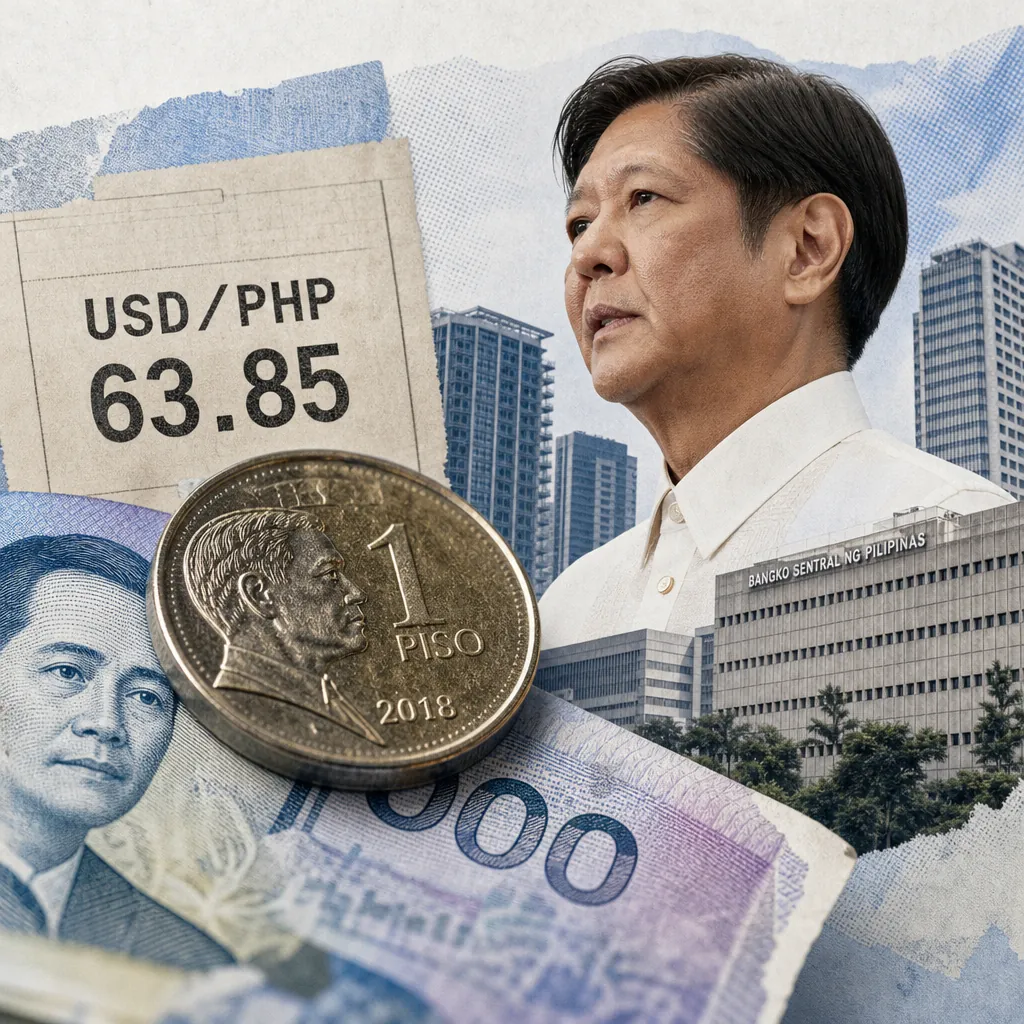
The peso closed at a record-low ₱64.17 against the dollar on October 27 and recovered somewhat afterward, but crossing ₱64 got people's attention20. Elizabeth Lee, chair of the Federation of Philippine Industries, said manufacturers are using an assumed rate of ₱65 for business planning, and stressed that this is neither a forecast nor the prevailing rate but a planning assumption to hedge against uncertainty2. The peso's rapid movement from ₱63 to ₱64 had made it difficult for companies to plan purchases and manage dollar exposure, she said, particularly because the country relies heavily on imported oil, energy and industrial inputs2.
That reliance is the mechanism that connects the exchange rate to the inflation number. The Philippines is a net importer of petroleum, so a weaker peso raises the domestic cost of dollar-priced oil, which feeds into electricity, transport and food prices30. President Marcos Jr. pointed partly to rising oil prices when he told the public not to panic20. Manuel V. Pangilinan, one of the country's wealthiest businessmen, said rising interest rates worry him more than the depreciating peso, but acknowledged that the currency's continued slide could mean tougher times for ordinary Filipinos; many of the companies he manages borrow in pesos, which cushions their own exposure31.
The peso's weakness also showed up in the stock market. The PSEi shed 48.28 points to close at 5,680.35, down 0.84 percent week-on-week, with foreign investors net sellers at ₱323.93 million2334. First Metro Investment Corp. head of research Cristina Ulang expects the index to stay between 5,600 and 5,800 this week, and Unicapital Securities head of research Wendy Estacio-Cruz said trading will remain cautious amid elevated borrowing costs, inflation concerns and oil price pressures34.
For the financial sector, the read is that peso volatility has become a planning variable rather than a temporary shock. Companies that budget at ₱65 will price their goods and contracts accordingly, which means the currency's current level is already being built into future prices even if the peso strengthens. Banks, meanwhile, face borrowers whose repayment capacity is squeezed from two directions: higher rates on their loans and higher costs on their inputs.
Business confidence improves but the year-ahead outlook weakens
The BSP's Business Expectations Survey for September showed the overall confidence index at -8.4 percent, up from -10.9 percent in August27. The index measures the difference between the percentage of firms that are optimistic and those that are pessimistic; a negative reading means pessimists still outnumber optimists36. Firms cited elevated fuel and energy costs, rising inflation, the Middle East conflict, peso depreciation and weather-related disruptions as reasons for their downbeat outlook541. Their financial condition was less tight, with that sub-index improving to -19.8 percent from -24.9 percent27.
Looking forward, the picture darkens. The confidence index for the next three months fell to 20.9 percent from 24.6 percent, and the index for the next 12 months fell to 26.5 percent from 36.4 percent36. Firms' own expectation for inflation over the next 12 months rose to 5.7 percent from 5.4 percent5. The BSP noted that year-ahead optimism reflected growth opportunities in selected sectors, particularly healthcare, education, tourism and financial services36.
For the sector, the split matters more than the headline. A less negative present reading tells banks that their corporate clients are not in distress; a weaker forward reading tells them to expect slower investment and hiring, and to keep loan standards tight. That tightening is already visible: AB Capital Securities noted in an October commentary that banks have tightened underwriting and collections as inflation-driven repayment concerns rose6.
British investors press the Senate on four economic bills
The BCCP asked the government to speed up passage of the Cybersecurity Act, Digital Payments Act, Open Finance Act and Blue Economy Act, with executive director Chris Nelson saying legislation has slowed and that timely approval would signal to companies and investors that the Philippine economy is moving forward28. Some of the measures have passed the House of Representatives but still need Senate action before implementing rules and enforcement can follow28.
Open finance is the most consequential of the four for the financial sector. It sets rules for sharing customer financial data securely across institutions with consent, which would let lenders assess borrowers using records held by other providers and open the market to more competition42. The BCCP argues it would expand access to financing for micro, small and medium enterprises, which employ the majority of Filipino workers42. The Digital Payments Act would formalize rules for a payments market that has grown faster than its regulation, and the Cybersecurity Act would set standards for protecting the data those systems hold42.
Nelson also said the Philippines does not need a separate free trade agreement with the United Kingdom for now, noting that such deals take about three years to negotiate and that the country should focus on existing mechanisms such as the Comprehensive and Progressive Agreement for Trans-Pacific Partnership (CPTPP), a trade pact among 11 Pacific economies that the Philippines is seeking to join, the UK-Philippines Joint Economic and Trade Committee, and the Regional Comprehensive Economic Partnership28.
For banks and fintech firms, the read is that the legislative calendar is now a competitive variable. If the Open Finance Act passes, institutions that already hold customer data — banks, mobile wallets, e-commerce platforms — will have to share it under rules, and new entrants will be able to compete for borrowers on the strength of that data. If it stalls, the current arrangement persists, in which traditional credit bureaus cover only a minority of the population and merchants depend on app-based checkout credit to maintain sales6.
Fintech lenders pick up borrowers the banks are turning away
Stricter bank approval standards are steering younger borrowers toward buy-now-pay-later services, microloans and digital lenders, according to a report from MoneyHero cited by Retail News Asia6. Fintech platforms use alternative data — e-commerce transactions and mobile wallet activity — to approve shoppers bypassed by established lenders, while traditional credit bureaus cover only a minority of the population6. The Securities and Exchange Commission's July reopening of online lending licenses could accelerate the migration as more digital competitors enter the market6.
This is a credit-access story with a risk dimension. Borrowers who cannot get a bank loan are finding credit through apps, often at higher cost and with less disclosure. The alternative data that makes that lending possible also makes it possible to lend to people with no formal credit history, which is a genuine expansion of access. The same data can be used to price risk in ways borrowers do not see.
For the sector, the read is that the tightening cycle is redistributing credit rather than reducing it. Banks are lending less to younger and thinner-file borrowers; fintech lenders are lending more. Regulators will be watching whether the shift produces defaults that the alternative scoring models did not anticipate, and whether the licensing regime can keep pace with the number of new entrants.
The peso's effect on households sits below the executive commentary
A Panay News column asked why the government seems relatively calm about a peso at ₱64 and whether expensive oil still explains what is happening, noting that the question that stayed with the writer was not whether the peso would reach ₱65 or ₱66 but why the official response has been reassurance rather than alarm20. The column ran in a regional outlet and did not travel into the national business pages, where the peso story was framed through forecasts and corporate planning rates.
Pangilinan's remark is the closest the national coverage came to the household view: he said the currency's continued slide could spell tougher times for ordinary Filipinos, even though his own companies borrow in pesos and are cushioned31. The inflation forecasts capture the household effect in aggregate — 7.6 percent year-on-year means a basket of goods that cost ₱100 a year ago costs about ₱107.60 now — but the coverage rarely breaks that down into what it means for a family buying rice, fuel and medicine.
For communicators in consumer-facing sectors, the read is that the gap between official reassurance and household experience is where trust is lost. A message that acknowledges the peso's effect on prices, and explains what the company is doing about it, will land better than a message that repeats the central bank's forecast.
Conversation trajectory
November 5: the PSA releases official October inflation. This is the checkable event the whole week's coverage is building toward. If the official figure lands at or above the 7.6 to 7.75 percent consensus, expect the December rate-hike expectation to harden and the peso to come under renewed pressure43840. If it comes in below 7.4 percent, the economists' second-round-effects argument will be tested. Observation window: one week.
December: the BSP's policy rate decision. The central bank's meeting is the next scheduled decision point, and economists surveyed by the Manila Times expect a rate increase3. Watch the BSP's language on whether it sees the inflation peak in October or in November–December; ANZ Research expects above 8 percent in the last two months of the year26. Observation window: four to six weeks.
November–December: whether inflation breaches 8 percent. ANZ's projection of 8.4 percent for October and above 8 percent through the fourth quarter is the most aggressive in the set26. The drivers it names — higher rice and oil prices, El Niño's effect on food supply — are checkable against the PSA's monthly releases and the Department of Agriculture's supply reports. Observation window: two months.
The Senate's legislative calendar. The four BCCP priority bills have passed the House and await Senate action28. Watch for committee hearings or floor debates on the Open Finance Act and Digital Payments Act in particular, since those carry the most direct consequences for the financial sector. Observation window: the current session.
The peso's level against the ₱65 planning rate. Manufacturers have already built ₱65 into their budgets2. If the peso approaches that level, expect more companies to follow and expect the central bank to intervene more actively. If it strengthens back toward ₱63, the planning rate becomes a buffer rather than a forecast. Observation window: four to six weeks.
Trigger events. The PSA release on November 5, the BSP's December meeting, any announcement on the Senate's schedule for the four economic bills, and any move in the peso past ₱64.50 would each shift the narrative materially.
Response guidance
Inflation communications: lead with the household number. When the PSA releases October data on November 5, translate the headline rate into what it means for a weekly budget before explaining what caused it. A 7.6 percent year-on-year rate means the same basket costs about ₱7.60 more per ₱100 than a year ago; saying that plainly is more useful than repeating the central bank's target range.
Peso exposure: explain the planning rate, not the forecast. Companies that have built ₱65 into their budgets should say so and explain what it means for their prices and contracts. Elizabeth Lee's framing — a planning assumption, not a forecast — is the model: it tells customers and investors that the company is managing uncertainty rather than predicting the currency2.
Business confidence: separate the present from the year ahead. The BES shows firms feeling better about September and worse about the next 12 months2736. Communications that cite the improvement without the forward weakening will read as selective; communications that address both will be more credible with investors and employees.
Legislative advocacy: name the bill and the consequence. The BCCP's approach — naming the four bills, noting where they are in the process, and stating what passage would change for investors — is more effective than general calls for reform2842. For financial-sector communicators, the Open Finance Act is the one to watch, because it changes who can compete for borrowers.
Fintech credit: address cost and disclosure directly. As banks tighten and digital lenders expand, the sensitive topic is the cost of credit to borrowers who have few alternatives6. Companies in this space should be ready to explain their pricing, their data practices and their consumer-protection standards before regulators or journalists ask.
Regional outlets: do not treat them as secondary. The Panay News column on the peso asked the question national coverage largely skipped — why the official response has been calm20. Regional and provincial outlets are where household-level economic anxiety surfaces first, and they are worth monitoring and engaging with directly.
Market commentary: anchor to the data calendar. With the PSEi expected to trade sideways between 5,600 and 5,800 ahead of the inflation release, market communications should tie expectations to the November 5 data and the December BSP meeting rather than to daily index moves34.
See the full picture behind today's signals.
This report draws from Media Meter's MediaWatch, our real-time monitoring engine tracking 2,470+ Philippine sources across print, broadcast, digital, and social. Explore how the platform turns raw coverage into decision-grade intelligence, then see how it's configured for teams like yours — whether you're in PR agencies, corporate comms, government, or marketing.
Want more? Browse our Report Library for sector and crisis intelligence, or request a demo and we'll have your brand set up before the call.
Want this kind of intelligence on your brand?
This brief is built on the same MediaWatch methodology that runs continuously across every brand we monitor. See your competitive landscape, Impact Score, and narrative trajectory in a 30-minute demo.