PEZA Nears Record P320-B Investment Approvals
The Philippine Economic Zone Authority expects to close 2026 with up to P320 billion in approved investments, surpassing its 2012 record, while Moody's warns of slower bank lending and the stock market rebounds ahead of inflation data.
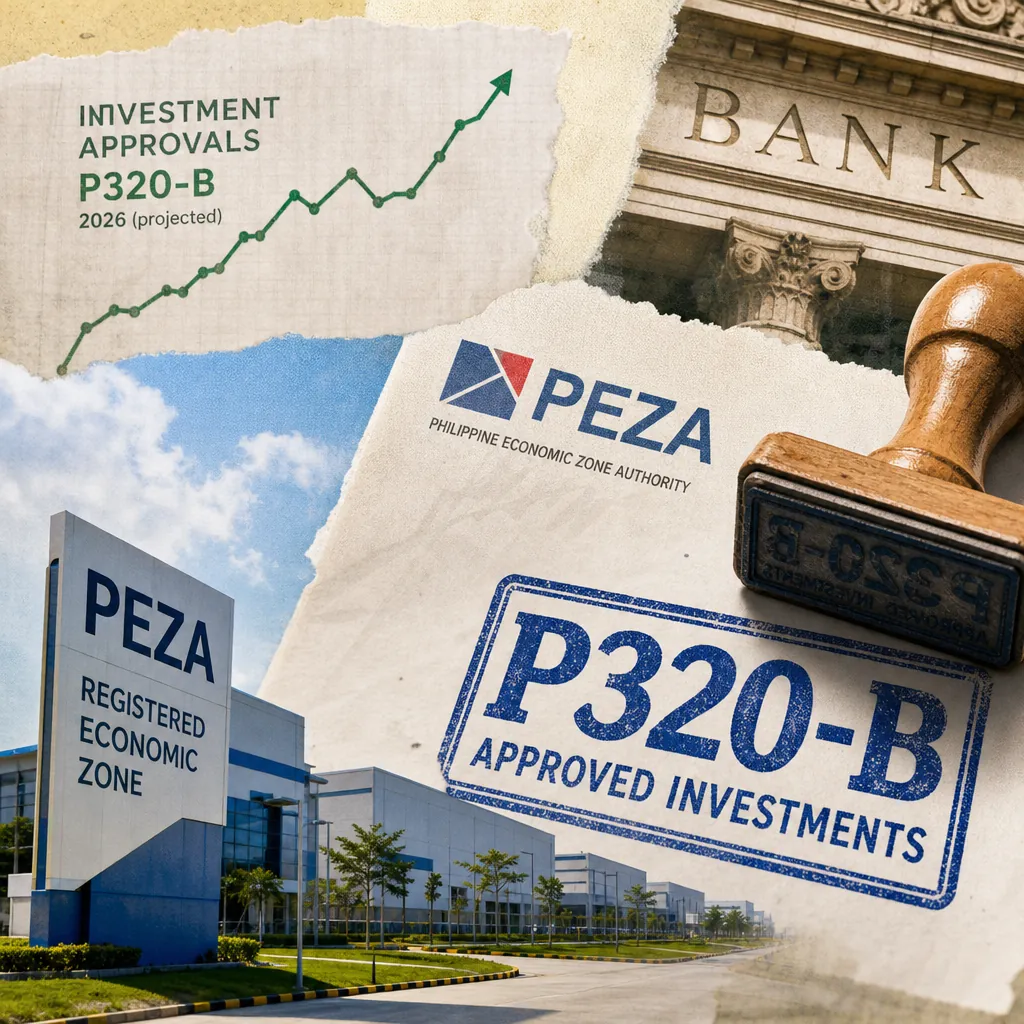
The Philippine Economic Zone Authority (PEZA) has already approved P309.63 billion in investments from January to October, clearing its P300-billion target for the full year with two months to spare, and Director General Tereso Panga now expects the agency to finish 2026 with between P315 billion and P320 billion 4678. That range would beat the P311.9-billion record PEZA set in 2012, the agency's best year for investment approvals in more than a decade 12. The approvals from January to October were 76.56 percent higher than the P175.365 billion recorded in the same ten months of 2025 46.
PEZA is the government agency that grants tax and customs incentives to companies locating inside designated economic zones — industrial parks, information-technology buildings, and tourism or agro-industrial estates — and its approval figures are a leading indicator of the factory, office, and export capacity the country will have in the years ahead. Panga said the agency sees the trend continuing into 2027, when he hopes the Philippines will recover its gross domestic product growth, speaking on the sidelines of a Confederation of Asia-Pacific Chambers of Commerce and Industry event in Parañaque on Wednesday 46.
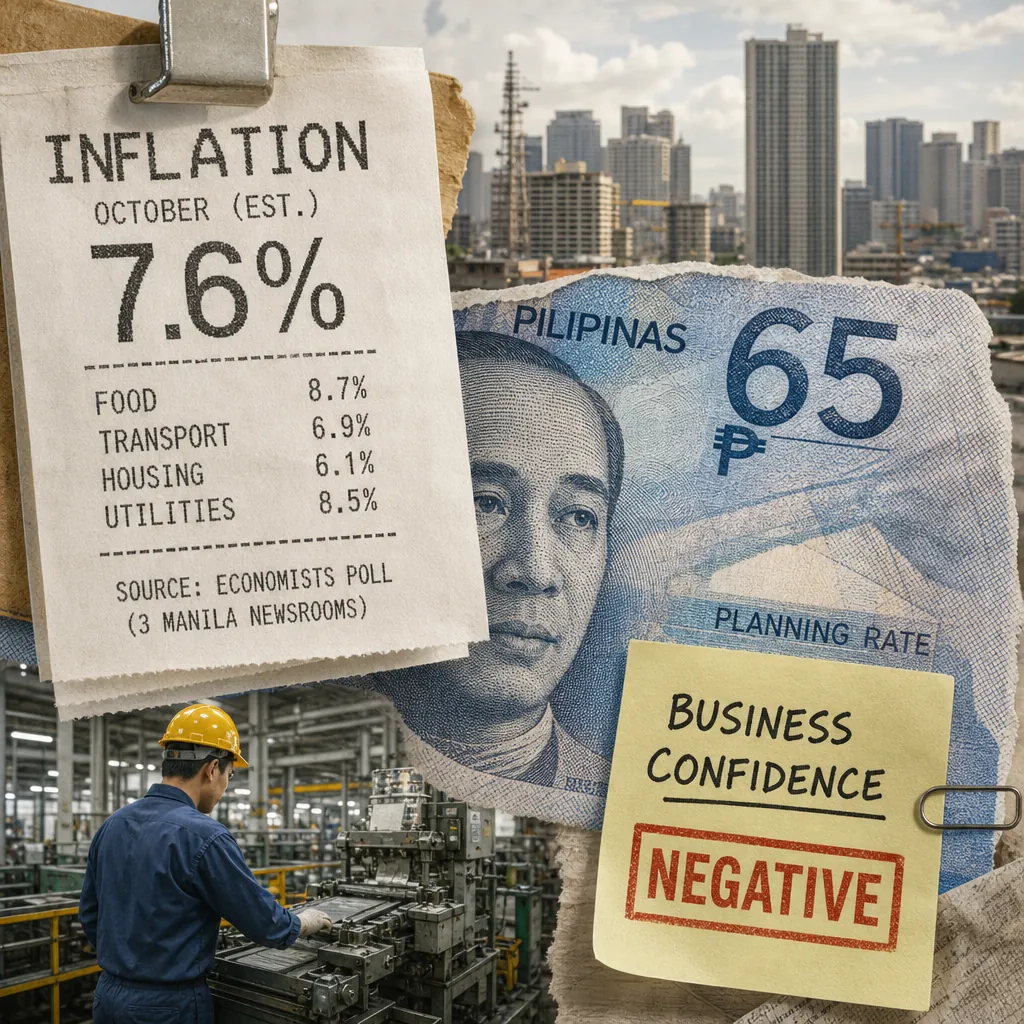
The same day brought a more cautious read on the banking side. Moody's Ratings senior vice president Eugene Tarzimanov told a panel discussion that Philippine banks could see slower loan growth next year as elevated interest rates discourage households and corporations from borrowing 4048. The Bangko Sentral ng Pilipinas (BSP), the country's central bank, has been raising interest rates since the Middle East war pushed inflation to a three-year high of 7.2 percent earlier this year 40. The BSP projects October inflation at 7.1 to 8.1 percent, a figure the market was waiting on when it closed on Wednesday 75.
Key themes
- PEZA clears its 2026 target with two months left and eyes a 14-year record. Approved investments reached P309.63 billion from January to October, up 76.56 percent from P175.365 billion a year earlier, and the agency projects P315 billion to P320 billion for the full year against the P311.9-billion record set in 2012 4678.
- Moody's expects slower bank lending in 2027 as high rates keep borrowers away. The rating agency's financial institutions chief said persistently high borrowing costs would make consumers and corporations more cautious, prompting banks to take a more conservative approach to credit expansion 4048.
- The stock market rebounded 1.26 percent ahead of the inflation release. The Philippine Stock Exchange index (PSEi) closed at 5,694.92, up 70.75 points, with financial stocks leading sectoral gains at 3.82 percent 4175.
- UnionBank said it has the capital to absorb its digital bank whatever the central bank decides. President and CEO Ana Maria Aboitiz Delgado called the bank's request for regulatory capital relief a "procedural item" and said the capital is already allocated within the parent lender 214.
- LandBank's nine-month profit rose 8 percent to P37.53 billion. The state-owned bank's deposits reached P3.11 trillion and loans to agriculture, fisheries and rural development hit P894.41 billion, nearly 55 percent of its gross loan portfolio 66.
- Aboitiz Equity Ventures earned P17.8 billion in nine months, up 2 percent. Power contributed 64 percent of earnings and banking 23 percent, while infrastructure dragged results down 8 percent 57.
- Seventeen Philippine companies made TIME's inaugural Asia-Pacific Best Employers list. United Laboratories led at No. 24, followed by Ayala Corp. at No. 32 and Metrobank at No. 44 7944.
- The BSP governor flagged AI firms' bond-market borrowing as a risk to local yields. Eli Remolona Jr. said heavy borrowing by artificial intelligence companies is crowding out investment and pushing Philippine yields higher than they would otherwise be 63.
How the narratives stack
Dominant. PEZA's investment approvals carried the day in the captured set, appearing in four separate items across three outlets — the Inquirer, BusinessMirror, and Philstar — each reporting the same P309.63-billion ten-month figure and the raised P315-billion-to-P320-billion outlook 124678. The story's dominance here reflects both its genuine weight — a government agency on the verge of a 14-year record — and the breadth of pickup it drew from business desks. The coverage value of the individual items was modest relative to some other stories in the set, but the repetition across outlets signals that business editors treated it as the day's lead economic story.
Counter-narrative. Moody's slower-lending forecast sits directly against the PEZA optimism 4048. Where PEZA measures investment commitments flowing into economic zones, Moody's measures the appetite of banks to lend to households and corporations — and the rating agency sees that appetite shrinking as high interest rates persist. The two stories are not contradictory: factories can commit to build while consumers and small businesses borrow less. But read together, they describe an economy where large capital projects are moving ahead while everyday credit contracts.
Emerging. The BSP governor's warning about AI firms borrowing heavily from bond markets is the day's most forward-looking signal 63. Remolona said these companies moved away from stock markets after the dot-com bubble of the late 1990s and into bond markets, and that their borrowing is pushing up Philippine yields. This connects to the broader global story in the captured set about data centers and AI infrastructure — the same capital flows that are building server farms abroad are affecting borrowing costs in the Philippines.
Under-covered. The deposit insurance deadline for customers of a closed rural bank in Cebu received a single item in the set 52. The Philippine Deposit Insurance Corp. said depositors of Community Rural Bank of Medellin have until Nov. 15 to file claims, and 78 deposit accounts involving P295,642.31 in insured deposits remain unclaimed. The bank was closed in November 2024. This is a small story by value but a consequential one for the depositors involved, and it placed low in the day's business coverage.
Platform insights
The monitoring writeup for this window did not capture social-media activity, so this section is omitted.
Key voices and communities
PEZA and its investment promotion counterparts. Director General Tereso Panga was the day's most-quoted official, appearing in four separate items and framing the approvals record as evidence that the Philippines can recover its growth trajectory by 2027 4678. His comments came at a Confederation of Asia-Pacific Chambers of Commerce and Industry event, placing the story within the regional business-diplomacy circuit.
Moody's Ratings and the credit-rating community. Eugene Tarzimanov's cautious outlook for Philippine bank lending gave the day its counterweight 4048. Rating agency commentary carries weight because it feeds into sovereign and bank credit assessments, which in turn affect borrowing costs for Philippine institutions.
The BSP and its former officials. Governor Eli Remolona Jr. raised the AI borrowing concern 63, while former deputy governor Diwa Guinigundo, now at GlobalSource Partners, argued that the central bank's recent rate hike was aimed at inflation rather than defending the peso 5377. Guinigundo's intervention matters because it pushes back against a common reading that the BSP is spending reserves to prop up the currency.
Bank executives reporting results and plans. UnionBank's Ana Maria Aboitiz Delgado 214, LandBank's Lynette Ortiz 66, and Aboitiz Equity Ventures' leadership 57 all provided concrete figures on earnings, capital, and strategy.
The Philippine business press. The Inquirer, BusinessMirror, Philstar, Manila Standard, Daily Tribune, Manila Times, and Daily Guardian all carried business stories in this set, with several running the same PEZA and Moody's items — a sign that the day's economic news was concentrated in a handful of stories that traveled across outlets.
Narrative streams
PEZA projects P315 billion to P320 billion in approvals, closing in on a 2012 record
PEZA's P309.63 billion in approvals from January to October already exceeds the agency's full-year target of P300 billion, and Panga said two more board meetings before year-end could push the total past the P311.9-billion record set in 2012 78. The ten-month figure was 76.56 percent higher than the P175.365 billion recorded in the same period of 2025 46. Panga said the agency could end the year with P315 billion to P320 billion, supported by big-ticket projects in the pipeline, though some may be carried over to 2027 12.
For the sector, the approvals figure matters because it represents committed capital that will translate into factories, offices, and export capacity over the next two to three years. A 77-percent year-on-year increase in approvals suggests that companies are choosing the Philippines as a production base at a faster rate than last year, which in turn supports employment and export earnings. The record comparison to 2012 is significant because that year marked the peak of the business-process outsourcing and electronics investment cycle; matching it would signal a second investment upcycle.
Moody's sees slower loan growth as high rates keep borrowers cautious
Tarzimanov said the rating agency's view for next year is "a bit cautious," driven by much higher interest rates that are likely to remain the story through 2027 40. He said persistently high borrowing costs would make consumers and corporations more cautious about taking out loans, prompting banks to adopt a more conservative approach to credit expansion 48. The BSP has been raising rates since the Middle East war fuelled inflationary pressures early this year, pushing inflation to a three-year high of 7.2 percent 40.
For banks, slower loan growth means slower growth in interest income, which is the core revenue line for most Philippine lenders. For households and businesses, it means credit remains expensive and harder to obtain, which weighs on consumption and small-business expansion. The Moody's view also implies that the BSP's rate hikes are working as intended — cooling demand — but the cost is borne by borrowers.
The PSEi rebounds 1.26 percent as investors position ahead of inflation data
The Philippine Stock Exchange index rose 70.75 points, or 1.26 percent, to close at 5,694.92 on Wednesday, while the broader All Shares index gained 0.80 percent to 3,185.15 4175. Financial stocks led the sectoral rally with a 3.82-percent gain, followed by services at 1.79 percent and mining and oil at 0.91 percent; property and holding firms declined 41. Luis Limlingan of Regina Capital attributed the rebound to bargain hunting across select index heavyweights after recent losses, and said positioning ahead of the inflation print supported sentiment 75.
The peso weakened by 6.5 centavos to close at P63.535 against the US dollar 41. The market's rebound came despite continuing concerns over the peso, the country's dependence on imports, weak foreign direct investment, and the structural trade deficit 55. For investors, the session was a technical recovery rather than a change in direction: the index briefly touched 5,701.29 before closing below 5,700, and the inflation release the next day was the real test 55.
UnionBank says capital is ready for UnionDigital integration regardless of BSP decision
UnionBank of the Philippines has sufficient capital to absorb its digital banking subsidiary UnionDigital Bank and is prepared to infuse funds even if the BSP rejects its request for regulatory capital relief, according to President and CEO Ana Maria Aboitiz Delgado 214. She described the request as "actually just a procedural item" and said "the capital is fully allocated in UnionBank, so it's more part of the process" 2. The bank had asked the central bank to waive the requirement for an additional capital injection into UnionDigital, arguing that the planned integration would make such a transfer unnecessary 14.
For the digital banking sector, the integration is a test case for how the BSP treats the consolidation of a digital subsidiary into its parent. If the central bank grants relief, it signals flexibility for banks that want to fold digital units back in; if it denies the request, UnionBank has said it will proceed with the capital infusion anyway, which means the integration timeline is not at risk either way 2.
LandBank's nine-month profit rises 8 percent to P37.53 billion on record deposits
Land Bank of the Philippines posted net income of P37.53 billion in the first nine months of 2026, up 8 percent year-on-year, with third-quarter net income of P13.32 billion 66. Total assets reached P3.56 trillion and deposits P3.11 trillion as of end-September 66. Loans to agriculture, fisheries and rural development reached P894.41 billion, up 10 percent from P812.79 billion a year earlier and accounting for nearly 55 percent of the bank's gross loan portfolio 66. Digital transactions rose 29 percent year-on-year 66.
The result marks a turnaround from the first half, when LandBank reported a 4-percent decline in net income to P24.21 billion 66. For the sector, LandBank's performance matters because it is the government's main vehicle for channeling credit to agriculture and rural development; a 10-percent increase in those loans means more financing reaching farmers and fisherfolk, even as the bank maintains profitability.
Aboitiz Equity Ventures earns P17.8 billion in nine months as power and banking carry the load
Aboitiz Equity Ventures Inc. earned P17.8 billion in the first nine months of 2026, up 2 percent from the same period last year, with power accounting for 64 percent of earnings, banking and financial services 23 percent, and food and beverage 21 percent 57. Infrastructure weighed on results with an 8-percent drag 57. Third-quarter net income was P4.1 billion, down from P8.9 billion in the same quarter last year 57. AboitizPower earned P26.2 billion, up 13 percent from P23.3 billion, supported by higher electricity market prices and additional capacity from the Caliraya-Botocan-Kalayaan hydroelectric complex 57.
For the conglomerate's investors, the results show a portfolio where power generation is doing the heavy lifting while infrastructure remains a drag. The sequential decline in third-quarter profit against a stronger nine-month total suggests that the third quarter itself was weaker than the first half, which is consistent with the broader economic slowdown the BSP has been navigating.
The BSP's rate hike was about inflation, not the peso, a former deputy governor says
GlobalSource Partners economist Diwa Guinigundo, a former BSP deputy governor, wrote that the central bank's recent 50-basis-point increase was aimed at addressing mounting price pressures and preventing inflation expectations from becoming unanchored 77. "The BSP did not raise interest rates primarily to defend the peso," he said 77. He argued it was "misleading" to assess monetary policy effectiveness based on the peso's immediate reaction to a rate hike, and noted that the currency's recent recovery from record lows followed President Marcos' pledge to defend it "as hard as we can" 53.
For businesses and consumers, the distinction matters because it tells them what to expect next: if the BSP is fighting inflation rather than the exchange rate, then rate cuts will come when inflation falls, not when the peso stabilizes. The BSP has signalled that rate cuts remain distant amid high inflation 53.
The BSP governor warns that AI firms' bond borrowing is pushing up Philippine yields
Eli Remolona Jr. said artificial intelligence firms are borrowing heavily from the bond market, a recent phenomenon driven by their desire to avoid the stock-market exposure that hurt companies in the late-1990s dot-com bubble 63. "This is affecting us because that means our yields are higher than otherwise," he said, adding: "They're crowding out our investments" 63. He raised the question of whether the market is "getting too bullish about AI" 63.
For Philippine borrowers — the government, banks, and corporations that issue bonds — higher yields mean higher borrowing costs. The AI borrowing boom is a global phenomenon, but it transmits to the Philippines through bond markets, where international capital competes for the same pool of investment. Remolona's comments place the BSP among central banks watching AI-related capital flows as a financial-stability question.
Seventeen Philippine companies make TIME's first Asia-Pacific Best Employers ranking
United Laboratories ranked No. 24 among 500 companies in TIME magazine and Statista's inaugural Asia-Pacific Best Employers 2027 list, leading 17 Philippine companies that made the ranking 79. Ayala Corp. placed No. 32, Metrobank No. 44, San Miguel Corp. No. 55, and Jollibee Foods Corp. No. 89 79. The list is based on employee satisfaction surveys conducted from 2024 to 2026 79. SM Investments Corp., which ranked No. 206, said its inclusion reflects its focus on its workforce: "Our people are central to SM's continued growth. We want employees to feel respected, have the support to do their best work and find opportunities to build their careers here," said president and CEO Frederic DyBuncio 44.
For the companies named, the ranking is a recruitment and retention tool — a third-party validation they can cite when competing for talent. For the broader labor market, the presence of 17 Philippine firms on a regional list of 500 suggests that large Philippine employers are competitive with their Asia-Pacific peers on workplace satisfaction, at least as measured by survey responses.
Metrobank wins a governance award and runs financial-literacy seminars for Luzon businesses
Metrobank received the Four Golden Arrow Award from the Institute of Corporate Directors for the third consecutive year, recognizing governance practices around accountability and stakeholder protection 47. The award assesses publicly listed companies and insurance firms on governance standards 47. Separately, the bank ran EntrepRISE, a financial wellness seminar series introduced this year that held sessions in North Luzon, Metro Manila, and South Luzon, reaching nearly 100 business clients 6871. The program covers financial resilience, cash flow management, and expansion planning 71.
For small and medium businesses, the practical value of the seminar series is access to financial planning advice at a time when borrowing costs are high and cash flow is under pressure — the same conditions Moody's described. For Metrobank, the combination of a governance award and a client-education program supports its positioning as a relationship bank rather than a transactional lender.
The peso's recovery and the inflation outlook frame the market's next move
The PSEi's rebound came as investors positioned ahead of the October inflation release, with the BSP projecting 7.1 to 8.1 percent 75. AP Securities said the benchmark index stayed above its previous close throughout the session and tested 5,700 in afternoon trading 75. The peso closed at P63.535 against the dollar, weaker by 6.5 centavos 41.
For the market, the inflation print is the next catalyst: a figure at the low end of the BSP's range would support the view that rate hikes are near their peak, while a figure at the high end would reinforce Moody's cautious lending outlook. The peso's direction depends partly on the same data, since higher inflation would pressure the central bank to keep rates elevated.
Conversation trajectory
Inflation release, Nov. 5. The October consumer price index report is the single most consequential data point in the immediate window. A print within the BSP's 7.1-to-8.1-percent projection would confirm the central bank's baseline; a print above 8.1 percent would raise questions about whether another rate hike is needed, which would feed directly into Moody's slower-lending scenario 7540.
PEZA's remaining board meetings, November and December. Panga said two more board meetings before year-end will decide on pending investments 78. The approvals announced at those meetings will determine whether PEZA closes at P315 billion, P320 billion, or somewhere in between — and whether it beats the 2012 record. Watch for announcements of specific big-ticket projects.
BSP decision on UnionBank's capital relief request, timing unspecified. The central bank has not indicated when it will rule on UnionBank's request to waive the additional capital injection into UnionDigital 14. A grant would set a precedent for other banks consolidating digital subsidiaries; a denial would trigger the capital infusion UnionBank says it is ready to make 2.
PDIC claims deadline, Nov. 15. Depositors of the closed Community Rural Bank of Medellin have until Nov. 15 to file insurance claims, with 78 accounts and P295,642.31 in insured deposits still unclaimed 52. The deadline is a hard one: under the PDIC Charter, depositors have two years from the bank's takeover to file, and the takeover was in November 2024 52.
Third-quarter GDP release, date to be announced. Economists expect growth of 3.2 percent in the third quarter, up from 2.3 percent in the second, partly on favorable base effects and stronger electronics exports 61. The release will test whether the economy is accelerating out of its four-quarter slowdown, which would affect both the BSP's rate path and bank lending demand.
AI bond-market borrowing, ongoing. Remolona's warning about AI firms crowding out investment is a global trend with local consequences for yields 63. Watch for further BSP commentary on financial-stability risks from AI-related capital flows, particularly if global bond yields continue to rise.
Response guidance
Bank communicators: address the lending slowdown directly. Moody's forecast of slower loan growth will shape how borrowers think about credit availability in 2027 40. Banks should prepare clear messaging on what the outlook means for mortgage, business, and consumer lending rates, and on what borrowers can do to qualify. Avoid framing the forecast as a crisis; it is a moderation, and the BSP's rate path is the main variable.
PEZA and investment promotion agencies: put the record in context. The P309.63-billion ten-month figure is strong, but the comparison to 2012 needs explanation — what kinds of projects drove the 2012 record, and what kinds are driving 2026 46. Investors will want to know whether the pipeline is concentrated in a few large projects or spread across sectors, and whether the approvals translate into construction and hiring within the next year.
Digital banks and fintechs: watch the UnionBank precedent. The BSP's decision on UnionBank's capital relief request will signal how the regulator views the consolidation of digital subsidiaries 14. Digital banks should prepare for either outcome and communicate their capital plans clearly to investors and depositors.
Business journalists and analysts: connect the PEZA and Moody's stories. The two stories describe different parts of the same economy — investment commitments rising while bank lending slows 4640. Coverage that treats them separately misses the tension: large capital projects are moving ahead, but the credit that fuels small-business growth and consumer spending is tightening.
Companies named in the TIME ranking: use it for recruitment, not just publicity. The Asia-Pacific Best Employers list is based on employee surveys, which means it reflects what workers say about their employers 79. Companies should treat the ranking as a retention tool and be prepared to explain what they are doing to maintain workplace satisfaction, not just cite the placement.
Financial-literacy programs: target the borrowers most affected by high rates. Metrobank's EntrepRISE seminars reached nearly 100 business clients 68. With borrowing costs elevated and loan growth slowing, the businesses that benefit most are those deciding whether to expand, refinance, or hold steady — the same decisions Moody's expects to become more cautious 40.
Depositors of closed banks: meet the PDIC deadline. The Nov. 15 deadline for Community Rural Bank of Medellin depositors is a hard cutoff 52. Communicators at the PDIC and in local government units in Cebu should ensure affected depositors know how to file claims online, by mail, or in person before the deadline.
See the full picture behind today's signals.
This report draws from Media Meter's MediaWatch, our real-time monitoring engine tracking 2,470+ Philippine sources across print, broadcast, digital, and social. Explore how the platform turns raw coverage into decision-grade intelligence, then see how it's configured for teams like yours — whether you're in PR agencies, corporate comms, government, or marketing.
Want more? Browse our Report Library for sector and crisis intelligence, or request a demo and we'll have your brand set up before the call.
Want this kind of intelligence on your brand?
This brief is built on the same MediaWatch methodology that runs continuously across every brand we monitor. See your competitive landscape, Impact Score, and narrative trajectory in a 30-minute demo.