PLDT, Smart, DITO sign landmark resource-sharing deal as telcos pivot to collaboration narrative
Philippine telco rivals PLDT, Smart, and DITO formalize a rare infrastructure-sharing agreement, while institutional posts on disaster preparedness and CSR dominate social media with low public engagement.
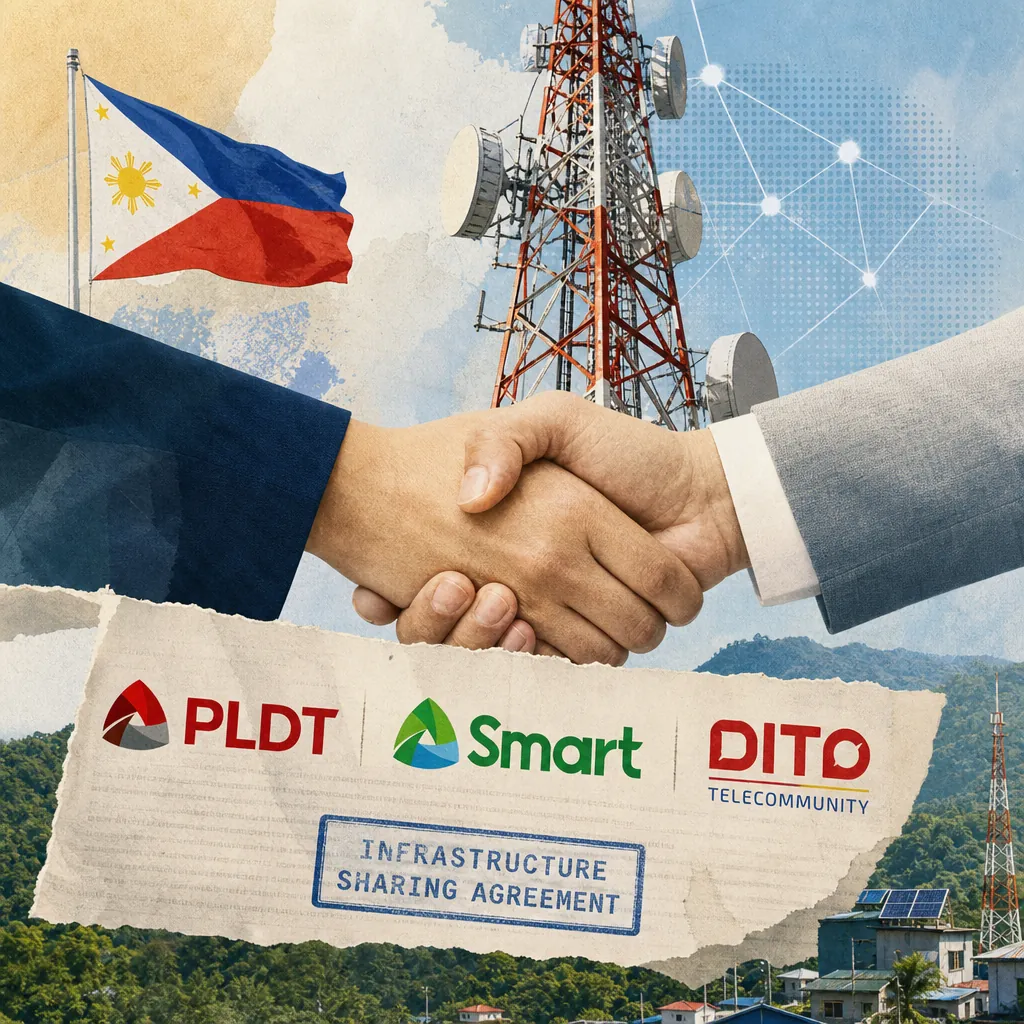
The Philippine telecommunications sector saw a rare moment of public cooperation on July 3, 2026, as PLDT Inc., Smart Communications Inc., and DITO Telecommunity signed a memorandum of understanding (MOU) to share network infrastructure — a deal that drew heavy coverage across multiple online news outlets, worth an estimated combined advertising-equivalent value of nearly ₱780,000 across the captured items. The agreement, which covers sharing of eligible terrestrial cell towers, in-building solutions, and portions of submarine cable systems, was reported by the Manila Times, the Philippine Daily Inquirer, and the Manila Bulletin, among others. PLDT Chairman and CEO Manuel Pangilinan framed the partnership as a recognition that "connecting the country is a responsibility that we all share as Philippine telcos," adding that "even as we compete in the marketplace, we can collaborate where it matters the most, which is accelerating digital inclusion". DITO President and CEO Eric Alberto echoed the sentiment, saying the partnership "allows both companies to deliver much better services for all our respective customers".
The deal marks a significant shift in tone for an industry more accustomed to competitive posturing. DITO, which entered the market in 2021 as the third major player, and PLDT, the country's oldest and largest telco, have historically been rivals. The Inquirer described the agreement as a "rare collaboration between competitors". The Manila Bulletin noted that the deal comes "at no cost to either company" and involves sharing existing infrastructure rather than building new facilities.
On social media, the conversation around the MOU was far quieter. A post from the account ==metropolerofficial== on July 2 announcing the signing received just one comment and no likes or shares. The muted public response stands in contrast to the weight of the news itself, suggesting that the institutional narrative has not yet broken through to a broader audience. The same pattern held for a series of posts from PLDT and Smart's official channels on July 3, which focused on disaster preparedness and corporate social responsibility. A post from ==smartnewsroom== described a three-day National Crisis Management Simulation Exercise (SIMEX) held from June 29 to July 1, involving PLDT, Smart, Globe, Converge, DITO, and SKYCable, aimed at testing crisis-response protocols. That post received zero public engagement. Similarly, a post from ==pldtsmartcommunities== about PLDT and Smart joining the Office of Civil Defense for National Disaster Resilience Month 2026 garnered just one love reaction, and a post about a fire drill at the Smart Regional Office in Cebu City earned two likes and three shares.
The most positively received post in the dataset was a July 3 announcement from ==pldtsmartcommunities== that remote schools in Southern Leyte had received School-in-a-Bag kits sponsored by UNICEF Philippines in collaboration with PLDT and Smart, marking the fourth and largest deployment of the kits. That post received five love reactions — the highest emotional engagement of any telecom-related post in the sample — suggesting that tangible, child-centric community initiatives resonate more strongly with audiences than technical exercises or partnership announcements.
The near-total absence of user-generated critical posts, complaints, or mentions of service outages in the sampled period is notable. The conversation remains entirely top-down and institutional, with no evidence of two-way dialogue between the telcos and their customers. This may reflect a lull in service disruptions, but it also underscores a gap: institutional messages are reaching audiences but not sparking conversation.
Key themes
- Industry collaboration as a strategic pivot — The PLDT-Smart-DITO MOU represents a deliberate shift from competitive posturing toward cooperative language, with all three companies emphasizing shared responsibility for national connectivity. The deal covers sharing of cell towers, in-building solutions, and submarine cable systems, and was widely covered by major online news outlets.
- Disaster resilience as a sustained brand campaign — Multiple posts from PLDT and Smart's official channels highlight fire drills, participation in National Disaster Resilience Month, and a three-day crisis simulation exercise involving all major telcos. This coordinated messaging creates a protective narrative layer that can mitigate backlash during actual service outages.
- Low public engagement on institutional content — Despite the significance of the MOU and the breadth of disaster-preparedness messaging, social media engagement remains minimal. Most posts receive zero to a handful of reactions, and comments are virtually absent. The conversation is one-way.
- CSR and education partnerships generate the most positive sentiment — The School-in-a-Bag deployment with UNICEF received the highest emotional engagement (five love reactions) among all telecom-related posts, indicating that community-oriented digital inclusion content resonates better with audiences than technical or procedural updates.
- Absence of consumer complaints in the sampled period — No posts tagged with common complaint hashtags like #PLDTDown or #GlobeDown appear in the dataset. This may indicate a lull in service disruptions, but it also means the observed conversation is entirely institution-driven.
- Cybersecurity law modernization gains official momentum — Separately, the Cybercrime Investigation and Coordinating Center (CICC) and cybersecurity analysts have publicly called for updates to the Cybercrime Prevention Act of 2012 to address AI-enabled crimes and modern online scams. This legislative push, while not directly tied to the MOU, creates a favorable environment for telco-led initiatives on fraud prevention.
- Customer service gaps surface on Reddit — Two Reddit posts on July 3 highlight unresolved user friction: one user asked for a guide on processing a temporary disconnection with PLDT, and another inquired about changing the PLDT admin page password to fewer than 12 characters. Both posts received no official responses, signaling a lack of accessible support information.
How the narratives stack
Dominant — Within the captured set, the dominant narrative is the PLDT-Smart-DITO resource-sharing agreement, which generated the most news coverage by advertising-equivalent value and was picked up by multiple major outlets. The story positions the telcos as collaborative leaders in expanding connectivity and digital inclusion.
Counter-narrative — A quieter but persistent counter-narrative emerges from Reddit, where users express frustration with PLDT's administrative processes — specifically password policies and temporary disconnection procedures. These posts, while low in engagement, reveal a gap between the institutional narrative of customer-centricity and the actual user experience.
Emerging — The push for updated cybersecurity legislation, driven by the CICC and analysts like Art Samaniego, is an emerging narrative that could intersect with telco interests. If a formal bill is filed, it may amplify calls for telco accountability on fraud prevention and data privacy.
Suppressed — Conspicuously absent from the conversation is any discussion of service quality, outages, or pricing. The dataset contains no consumer complaints about network performance, which may reflect a genuine lull or a monitoring gap. Either way, the lack of negative sentiment is a notable silence that could shift quickly if a major outage occurs.
Platform insights
- Facebook — The dominant platform for institutional storytelling, with multiple posts from PLDT and Smart's official accounts on July 3. Engagement is low (zero to a handful of reactions), and comments are virtually absent. The platform serves as a broadcast tool for CSR and resilience messaging, with no evidence of two-way conversation.
- Twitter — Limited to two posts in the dataset: a breaking news report from ==insiderphdotcom== about the earthquake response (June 8) and a curated corporate stories summary from ==@pldt== (June 12). View counts are modest (1,141 views on the latter), and engagement is minimal. Twitter functions as a real-time alert channel rather than a discussion hub.
- Reddit — The platform hosts user-generated queries about PLDT service issues, with two posts on July 3 receiving no official responses. While engagement is low (1–3 upvotes), the direct, problem-focused nature of these posts reveals a trust gap — users turn to Reddit for peer support rather than official PLDT channels.
Key voices and communities
- Telco executives and official accounts — PLDT Chairman Manuel Pangilinan and DITO President Eric Alberto are the primary voices driving the collaboration narrative. Their statements, quoted in multiple news articles, frame the MOU as a shared responsibility for national connectivity. Official accounts like ==smartnewsroom== and ==pldtsmartcommunities== amplify this message on Facebook, though with low engagement.
- Government agencies and regulators — The Office of Civil Defense, Bureau of Fire Protection, and the National Telecommunications Security Council (NTSC) appear as partners in disaster-preparedness content. Their involvement lends credibility and regulatory weight to the telcos' resilience messaging.
- Cybersecurity policy advocates — CICC Executive Director Atty. Renato Paraiso and cybersecurity analyst Art Samaniego are driving the call for updated cybercrime laws. Their statements, carried by Bilyonaryo News Channel and other outlets, create a policy backdrop that could affect telco operations.
- Development and humanitarian organizations — UNICEF Philippines, PBSP, and the Department of Education are key partners in the School-in-a-Bag program, which generates the most positive sentiment among telecom-related posts. This group frames telcos as contributors to educational equity.
- Consumers on Reddit — Individual users like ==u/ReinRizz== and ==u/Dazzling-Currency329== represent a community of PLDT subscribers seeking peer support for administrative issues. Their posts, though low in engagement, signal unmet needs that could escalate into broader dissatisfaction.
Narrative streams
The PLDT-Smart-DITO resource-sharing agreement
The most significant development of the day is the MOU signed between PLDT, Smart, and DITO, which was covered by the Manila Times, the Philippine Daily Inquirer, and the Manila Bulletin, among others. The agreement allows the three telcos to share eligible terrestrial cell towers, in-building solutions, and portions of their submarine cable systems, with the stated goal of expanding network coverage and improving service reliability. PLDT Chairman Manuel Pangilinan emphasized that the partnership reflects a shared responsibility for connecting the country, even as the companies compete in the marketplace. DITO President Eric Alberto expressed hope that the partnership would "usher and blossom into many more things" for the benefit of customers. The Inquirer noted that the deal comes at no cost to either company and involves existing infrastructure rather than new construction. The Manila Bulletin added that the agreement covers PLDT's wireless unit Smart Communications Inc..
This narrative stream is almost entirely news-media driven; on social media, the announcement from ==metropolerofficial== received just one comment and no likes or shares. The contrast between the breadth of news coverage and the silence on social platforms suggests that the story has not yet captured public attention, but it has established a new frame for the industry: collaboration as a strategic tool for digital inclusion.
Disaster preparedness as a coordinated industry effort
A closely related stream focuses on the telcos' collective efforts to prepare for natural disasters and other crises. The NTSC National Crisis Management Simulation Exercise (SIMEX), held from June 29 to July 1, involved PLDT, Smart, Globe, Converge, DITO, and SKYCable, and tested communication protocols including SMS, email, and radios. The exercise was led by NTSC Chairman LtGen Ramiro Manuel A. Rey (Ret.) and aimed to draft crisis-response protocols for the industry. Separately, PLDT and Smart joined the Office of Civil Defense for National Disaster Resilience Month 2026, under the theme "Naghahanda at Kumikilos Tungo sa Panatag na Bagong Pilipinas" (Preparing and Acting Toward a Secure New Philippines). A fire drill at the Smart Regional Office in Cebu City, conducted in partnership with the Bureau of Fire Protection, emphasized compliance with the Fire Code (R.A. 9514) and the Occupational Safety Act (R.A. 11058).
These posts, all published on July 3, create a cohesive narrative of an industry that is proactively building a culture of readiness. However, the near-zero engagement on these posts — the fire drill post earned two likes and three shares, while the SIMEX post received zero reactions — indicates that the messaging is not resonating with the general public. The stream lives almost entirely on Facebook, with no amplification on other platforms.
CSR and digital inclusion: the School-in-a-Bag program
The most positively received content in the dataset is the announcement that remote schools in Southern Leyte received School-in-a-Bag kits, sponsored by UNICEF Philippines in collaboration with PLDT and Smart, the Department of Education Region VIII, and the Philippine Business for Social Progress (PBSP). This is the fourth and largest deployment of the kits, which provide connectivity tools to students in underserved areas. The post, tagged #KonektedForLearning, received five love reactions — the highest emotional engagement of any telecom-related post in the sample. This suggests that tangible, child-centric community initiatives generate more positive sentiment than technical exercises or partnership announcements. The stream is notable for its humanitarian framing, which positions the telcos as enablers of educational equity rather than just infrastructure providers.
Cybersecurity law modernization
Running parallel to the collaboration and CSR narratives is a push by government and cybersecurity advocates to update the Philippines' cybercrime framework. On July 2, CICC Executive Director Atty. Renato Paraiso publicly urged lawmakers to update the Cybercrime Prevention Act of 2012, calling for expanded investigator powers and a requirement for major tech platforms to maintain local offices. The next day, cybersecurity analyst Art Samaniego reinforced the message on Bilyonaryo News Channel, stating that the 2012 law must address AI-enabled crimes and modern online scams. DZRH TV also posted about the "zero trust" principle, shifting the conversation from reactive punishment to preventive strategy.
This stream is policy-oriented and elite-led, with minimal public engagement on social media. Samaniego's call on Twitter received only 130 views and zero engagement. However, the legislative momentum could have direct implications for telcos like PLDT and Smart, which are primary conduits for digital transactions and frequent targets of SIM swap fraud and smishing. The CICC's advocacy for local jurisdiction over global tech platforms aligns with telco interests in creating a more accountable digital environment.
Consumer friction on Reddit
A contrasting stream emerges from Reddit, where users express frustration with PLDT's administrative processes. On July 3, user ==u/ReinRizz== posted asking for a step-by-step guide on processing a temporary disconnection with PLDT, receiving no replies. Simultaneously, user ==u/Dazzling-Currency329== inquired whether the PLDT admin page password could be changed to fewer than 12 characters after initial setup, highlighting a rigid security policy that frustrates users. Both posts received no official responses from PLDT or Smart representatives.
These isolated help requests point to a pattern where customers feel under-supported by official channels. The password policy post, in particular, reveals a tension between security measures and user convenience: PLDT enforces a 12–32 character password requirement, which users find cumbersome, but the rationale is not clearly communicated. This stream, while low in engagement, signals a gap that could fuel broader dissatisfaction if left unaddressed.
Conversation trajectory
- Industry collaboration narrative to deepen over 60–90 days — The PLDT-Smart-DITO MOU is likely to generate further coverage as implementation details become public. Expect follow-up stories on specific tower-sharing arrangements and coverage improvements in underserved areas. The narrative could shift from a one-time announcement to a sustained theme if the telcos provide regular updates on progress. Trigger events include the release of an implementation roadmap or the announcement of specific shared sites.
- Disaster resilience messaging to intensify through July and into typhoon season — July is National Disaster Resilience Month, and the SIMEX exercise has just concluded. The telcos are likely to continue publishing content on preparedness, potentially with increased frequency. A major weather event would test the credibility of this narrative; if network performance holds up, the resilience messaging will be reinforced. If outages occur, the narrative could backfire.
- Cybersecurity reform to gain traction if a bill is filed — The CICC's call for updated cybercrime laws could lead to a formal bill in the current legislative session. If filed, expect a 3–4× increase in engagement on policy-related content, as seen with past NTC regulatory announcements. The impeachment trial of Vice President Sara Duterte, set to begin July 6, may dominate the news cycle and delay legislative action, but it could also draw in cybersecurity topics if digital evidence or online disinformation becomes relevant.
- Consumer friction on Reddit may escalate if unaddressed — The Reddit posts about PLDT password policies and disconnection procedures are currently low-volume, but they represent a steady stream of unresolved user friction. If a high-profile SIM swap fraud case or data breach emerges, these isolated complaints could coalesce into a larger conversation about telco accountability. Proactive responses from PLDT's official channels could preempt negative viral moments.
Response guidance
- Amplify the collaboration narrative with concrete examples — The MOU story is currently news-driven but lacks public engagement. PLDT and Smart should follow up with content that translates the agreement into tangible benefits for consumers, such as expected coverage improvements in specific underserved areas. Infographics or short explainer videos could help bridge the gap between institutional messaging and public understanding.
- Humanize disaster preparedness content — The low engagement on fire drill and SIMEX posts suggests that procedural updates do not resonate. Featuring employee testimonials, operational footage, or stories of how training directly enabled faster response during the June 8 earthquake could generate higher emotional engagement. The earthquake response, which involved deploying Starlink support and mobilizing teams in Mindanao, provides a recent, credible example to cite.
- Address Reddit pain points proactively — The unanswered queries about temporary disconnection and password policies signal a gap in self-help resources. PLDT should create and promote a dedicated FAQ or support thread addressing common account management issues. A simple response on Reddit within 48 hours could turn a friction point into a demonstration of responsiveness.
- Leverage CSR content for positive sentiment — The School-in-a-Bag program generated the most positive reactions in the dataset. PLDT and Smart should consider bundling this with other CSR initiatives into a "#KonektedForLearning" campaign that ties together education, connectivity, and resilience. This narrative aligns with the National Disaster Resilience Month theme and can attract positive media coverage.
- Monitor the cybersecurity reform conversation — The CICC's push for updated cybercrime laws creates an opportunity for PLDT and Smart to position themselves as proactive partners in national cybersecurity. Publishing a thought leadership piece or joint statement with the CICC on how updated laws would help combat SIM swap fraud could build reputational capital and align with regulatory trends.
See the full picture behind today's signals.
This report draws from Media Meter's MediaWatch, our real-time monitoring engine tracking 2,470+ Philippine sources across print, broadcast, digital, and social. Explore how the platform turns raw coverage into decision-grade intelligence, then see how it's configured for teams like yours — whether you're in PR agencies, corporate comms, government, or marketing.
Want more? Browse our Report Library for sector and crisis intelligence, or request a demo and we'll have your brand set up before the call.
Want this kind of intelligence on your brand?
This brief is built on the same MediaWatch methodology that runs continuously across every brand we monitor. See your competitive landscape, Impact Score, and narrative trajectory in a 30-minute demo.