Zero-fee transfers reshape Philippine banking as BSP circular exposes P1.50 backend cost
A wave of free InstaPay and PESONet transfers, triggered by BSP Circular 1238, has reordered competitive dynamics between traditional banks and e-wallets, while a BPI app outage and rising core inflation add countervailing pressures.
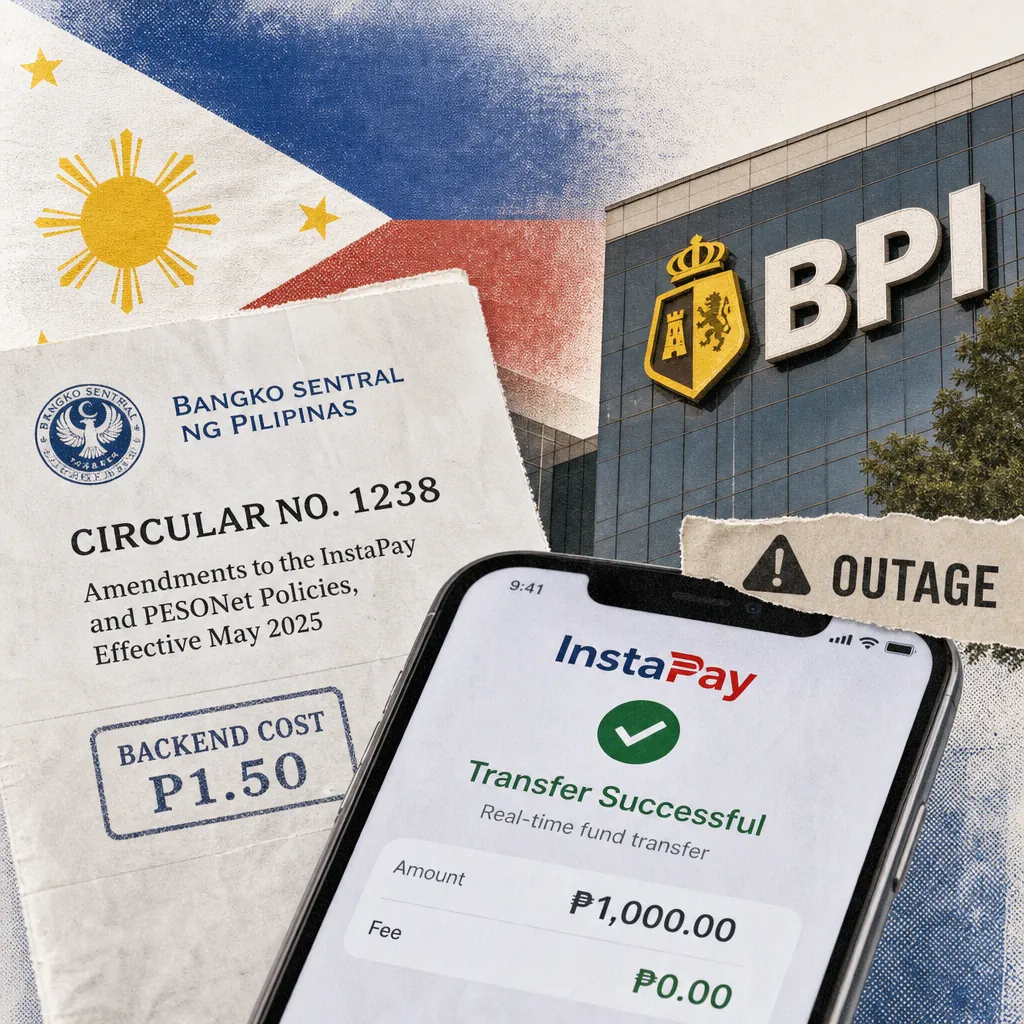
The Philippine banking conversation in mid-2026 was defined by a dramatic shift in digital transfer fees, bookended by a major BPI app outage in June and culminating in a wave of zero-fee announcements by early July. On June 14, BPI suffered a prolonged service disruption affecting its mobile app and online banking, with the bank posting an update on X that their team had been working to restore access. User frustration was immediate and vocal: one OFW tweeted "@TalktoBPI Loyal client of BPI for years, but the recent update of the BPI Mobile App locked me out of my account. As an OFW, SMS verification doesn't work abroad." Another noted the outage stretched past eight hours, asking "What really is going on @TalktoBPI ? i need to access bpi mobile app." The outage generated nearly 20,000 views on BPI's update post alone, and a subsequent June 16 tweet from a user recounting BPI's history of system failures accumulated 1,245 views, highlighting deep-seated trust concerns. This reliability issue set the stage for the next major development: the competitive race to eliminate transfer fees.
Just weeks later, on July 3, RCBC announced it would waive InstaPay fees for Pulz app users starting July 4, offering up to 30 free transfers monthly with a P100 minimum per transaction. The announcement exploded with 78,830 views, signaling intense public interest. A X post from @jekkipascual garnered 8,822 views, while a Filipino-language post noted "Mukhang nagsisimula na ang 'zero transfer fee era' sa Philippine banking." The cascade accelerated rapidly: by July 8, PNB had also committed to free transfers, and by July 11, both GrabPay (reducing its fee from P15 to P10) and ShopeePay (silently removing its P15 InstaPay fee) followed suit. The ShopeePay move was especially viral, accumulating 930 likes, 1,309 loves, and 255 shares; users celebrated the news with a mix of joy and surprise. A comprehensive Facebook post on July 11 compiled a full list of banks and e-wallets now offering free transfers, showing that BDO, BPI, LandBank, Metrobank, and UnionBank had all gone to P0 for both InstaPay and PESONet, while digital-only players like CIMB, GoTyme, and Maya imposed quotas or remained fee-based.
The conversation reached its analytical peak on July 12 with a viral Reddit post titled "The P1.50 Secret: How BSP and the Big Banks Quietly Ended the InstaPay Transfer Tax." The post, which garnered 68 upvotes, explained that BSP Circular No. 1238 forced financial institutions to align fees with the actual backend switch cost of roughly P1.50 per transaction. Because the legacy banks own the BancNet/PNPI consortium, they could absorb that cost, making free transfers a powerful customer-retention tool—while e-wallets like GCash and Maya, which are mere participants, still had to charge P10 per transfer or impose quotas. A duplicate of the same analysis appeared later with 78 upvotes, reinforcing the narrative. This deep-dive reshaped user perspectives: the "zero transfer fee era" was not altruism but a strategic regulatory chess match.
Meanwhile, the broader economic backdrop added pressure. Nomura Global Markets Research trimmed its 2026 inflation forecast for the Philippines to 5.1% from 5.5%, citing easing global oil prices, but warned that core inflation—which strips out volatile food and energy items—continued to accelerate, reaching a 31-month high of 4.4% in June. Analysts said this would keep the Bangko Sentral ng Pilipinas (BSP) on a tightening path, with DBS Bank expecting an additional 50 basis points in rate hikes through the third quarter. The BSP's own open market operations had already absorbed P1.3 trillion in excess liquidity from the financial system as of June 9, according to its Monetary Policy Report.
On the regulatory front, the BSP's Circular 1213, which took effect June 25, is pushing banks and e-wallet providers to shift from text-based one-time passwords (OTPs) to silent and risk-based authentication methods to strengthen fraud safeguards. This transition was highlighted by Sylvain Chaperon, general manager of 8x8 CPaaS, who told The STAR that the industry expects "a shift away from codes the customer has to type and toward signals that are far harder for an attacker to fake or steal."
In corporate news, Security Bank announced it would make fund transfers free for all customers starting July 10, following a warning from the BSP of consequences for non-compliance with Circular 1238. The bank also financed a 17.4-megawatt solar project in Bataan, marking its first partnership with Climate Fund Managers and Norfund. GoTyme Bank crossed the 10-million-user milestone in just over three years, with over P53 billion in customer deposits and more than 600 kiosks nationwide. Cebuana Lhuillier Bank expanded its presence in Western Visayas with a new branch in Iloilo City, bringing its nationwide network to 11 branches.
On the government side, Finance Secretary Frederick Go announced hopes that more government-owned and -controlled corporations (GOCCs) will join the "billionaires club"—those remitting at least P1 billion in dividends—with a target of 20 next year, up from 15 currently. LandBank led the pack with P32.57 billion in dividends, followed by the BSP with P62.39 billion. The government expects P147.15 billion in total GOCC dividends this year, with P140 billion already collected as of July 8.
In a significant appointment, former Budget Secretary Amenah Pangandaman was named chair and CEO of Al-Amanah Islamic Investment Bank of the Philippines, the country's only Islamic bank. The bank has seen its assets grow to P2.6 billion from P1.16 billion in 2024, and gross income improved by 65% to P81.36 million in 2025.
The stock market showed cautious optimism, with the Philippine Stock Exchange index (PSEi) climbing 1.59% week-on-week to 6,286.70, buoyed by bargain hunting and foreign buying. However, analysts noted thin trading volumes and lingering macroeconomic risks, including renewed Middle East tensions and rising core inflation. Converge ICT Solutions shares fell 7.1% week-on-week amid concerns over its possible exclusion from the PSEi.
Key themes
- Zero-fee transfer era reshapes competitive landscape: BSP Circular 1238, which forced banks to align fees with the actual backend cost of roughly P1.50 per transaction, triggered a wave of free InstaPay and PESONet transfers from major banks. Traditional banks that own the BancNet/PNPI consortium—BPI, BDO, Metrobank, LandBank, UnionBank, RCBC—can absorb this cost, while e-wallets like GCash and Maya still charge P10 per transfer or impose quotas. This structural advantage is driving a shift in customer deposits back to legacy banks.
- App reliability remains a trust vulnerability: The BPI app outage on June 14-15, which lasted over eight hours and locked out OFWs due to SMS verification failures, generated significant negative sentiment. Users expressed frustration over lack of customer support and repeated system failures, eroding trust in digital banking reliability. This contrasts with the positive buzz around free transfers and highlights the need for banks to pair cost savings with dependable service.
- Core inflation pressures keep BSP hawkish: Despite easing headline inflation, core inflation accelerated to a 31-month high of 4.4% in June, reflecting second-round effects from earlier energy price spikes. Analysts expect the BSP to continue raising interest rates, with DBS Bank forecasting an additional 50 basis points in hikes through the third quarter. This tightening cycle supports the peso but could dampen economic growth.
- Shift from OTPs to silent authentication: BSP Circular 1213, effective June 25, limits the use of interceptable authentication mechanisms like text-based OTPs. Banks and e-wallets are transitioning to silent and risk-based authentication, which uses device signals and behavioral patterns to verify transactions. This move aims to strengthen fraud safeguards but may require user education and infrastructure upgrades.
- GOCC dividends hit record highs: The government collected a record P147.15 billion in dividends from GOCCs in 2026, with LandBank and the BSP as top contributors. Finance Secretary Go aims to expand the "billionaires club" to 20 firms next year, pushing for higher remittances to fund infrastructure without new taxes. This reflects a broader strategy to maximize non-tax revenues.
- Islamic banking gets new leadership: Former Budget Secretary Amenah Pangandaman's appointment as chair and CEO of Al-Amanah Islamic Bank signals renewed focus on Shariah-compliant banking and financial inclusion in Muslim-majority areas. The bank has shown financial improvement under previous management, and Pangandaman's experience at the BSP and DBM could accelerate its growth.
- Digital banking adoption accelerates: GoTyme Bank reached 10 million users in just over three years, while PERA (Personal Equity and Retirement Account) contributors surged nearly fivefold to 30,055. These milestones indicate growing mainstream acceptance of digital financial services, driven by convenience, competitive features, and regulatory support.
- Consumer credit and BNPL complaints mount: Multiple threads highlighted pitfalls in buy-now-pay-later (BNPL) services like Atome, which automatically converts purchases to interest-bearing installments without clear consent. Users reported surprise charges and abusive collection calls, signaling potential regulatory scrutiny from the Securities and Exchange Commission (SEC).
How the narratives stack
Dominant: The zero-fee transfer era, triggered by BSP Circular 1238, is the most consequential development in the captured set. It fundamentally reorders competitive dynamics between traditional banks and e-wallets, with major banks leveraging their ownership of the payments infrastructure to offer free transfers as a customer retention tool. The narrative is driven by high-engagement social media posts—RCBC's announcement alone garnered 78,830 views—and analytical deep-dives on Reddit that exposed the P1.50 backend cost. This story dominates both social and news media, with multiple outlets covering the fee changes and their implications.
Counter-narrative: App reliability issues, particularly the BPI outage, undercut the positive momentum from free transfers. Users expressed frustration over being locked out of accounts, especially OFWs who rely on SMS verification abroad. This counter-narrative warns that cost savings alone cannot sustain customer loyalty if the digital experience is unreliable. The BPI outage generated nearly 20,000 views on a single post, indicating significant public concern.
Emerging: The shift from OTPs to silent authentication, mandated by BSP Circular 1213, is an emerging trend that could reshape fraud prevention in digital banking. While still in early stages, this transition addresses a key pain point for users who have experienced phishing scams and unauthorized transactions. The move is expected to reduce fraud but may require user education and infrastructure investments.
Suppressed: The impact of rising core inflation on household finances is under-covered relative to its significance. While headline inflation has eased, core inflation—which excludes volatile food and energy items—continues to accelerate, reflecting second-round effects from earlier price spikes. This could erode purchasing power and increase the cost of borrowing, yet the conversation focuses more on fee-free transfers than on the broader inflationary environment.
Platform insights
- Facebook: Served as the primary channel for rapid information dissemination and viral sharing. The ShopeePay fee removal post and the comprehensive transfer fee chart from Digital Banks PH both accumulated hundreds of reactions and shares. User questions such as "Saan po mas ok mag save? Mari bank or Gotyme?" received 455 likes and 487 comments, reflecting a highly engaged community seeking practical advice. Facebook also hosted commercial posts from stores promoting installment payment options via BPI, BDO, and Atome, blending marketing with consumer education.
- Reddit: Became the venue for deep-dive analysis, led by the "P1.50 Secret" post and comparative threads on digital bank savings (Maribank vs. GoTyme vs. Maya). Users shared personal experiences with BPI finance charges, BDO app failures, and Atome auto-installment complaints, driving detailed discussions that often exceeded 50 comments. The platform's upvote system elevated the most informative posts, with the conspiracy-theory-style fee analysis becoming the subreddit's top post of the week.
- Twitter/X: Acted as the real-time complaint and update hub. BPI outages, RCBC announcements, and customer service interactions generated high view counts but limited depth. The platform was used to amplify breaking news, such as the BSP circular impact, but lacked the sustained analytical conversation seen on Reddit.
- YouTube: Personal finance creators produced high-reach educational content comparing digital banks, credit cards, and savings strategies. Channels like "Jax Reyes" (197k views on a single video) and "Tiyo Pilo" (393k views) have built loyal audiences that treat their recommendations as trusted advice. Their influence extends to affiliate sign-ups, with referral codes embedded in nearly every post.
Key voices and communities
- Digital Banking Community (Reddit & Facebook Groups): This highly engaged cluster operates primarily on r/DigitalBanksPh, r/PHCreditCards, and Facebook pages like "Digital Banks PH" and "KasKasan Buddies." They produce detailed fee comparisons, regulatory breakdowns, and personal experience posts that routinely generate hundreds of upvotes and dozens of comments. Their content is data-driven and skeptical of marketing claims, often exposing hidden charges and cross-border fees. This group directly influences customer adoption of digital banks and payment methods.
- Personal Finance Content Creators (YouTube & Facebook Pages): YouTube creators and Facebook page admins produce high-reach educational content comparing digital banks, credit cards, and savings strategies. Channels like "Jax Reyes" and "Tiyo Pilo" have built loyal audiences that treat their recommendations as trusted advice. Their influence extends to affiliate sign-ups, with referral codes embedded in nearly every post. These voices are primary drivers of consumer choice in digital banking.
- Aggrieved Retail Consumers (Twitter & Reddit): Individual users form the loudest segment, using Twitter to tag support handles and Reddit to seek help after failed transfers, app lockouts, or suspected fraud. Posts often go viral when they involve large amounts or widespread outages. The dominant theme is frustration over poor customer service, opaque error handling, and fear of unrecoverable funds. This group directly impacts brand sentiment for banks.
- Government and Regulatory Officials: Finance Secretary Frederick Go and BSP Governor Eli Remolona Jr. are key voices shaping the policy narrative. Go's push for higher GOCC dividends and Remolona's hawkish stance on inflation are covered extensively in business media. Their statements influence market expectations and public perception of economic management.
- Economic Analysts and Bank Economists: Analysts from Nomura, DBS, Metrobank, and RCBC provide expert commentary on inflation, interest rates, and market trends. Their reports are cited by multiple news outlets and shape the analytical framing of economic developments. Their views on core inflation and BSP policy are particularly influential.
Narrative streams
The P1.50 Secret: How BSP Circular 1238 Rewrote Banking Competition
The most consequential narrative stream in the captured set is the revelation, driven by a viral Reddit post, that BSP Circular 1238 forced financial institutions to align their InstaPay fees with the actual backend switch cost of roughly P1.50 per transaction. This regulatory change, which took effect in mid-2026, exposed a structural advantage for traditional banks that own the BancNet/PNPI consortium: they can absorb the P1.50 cost and offer free transfers as a customer retention tool, while e-wallets like GCash and Maya, which are mere participants in the network, must still charge P10 per transfer or impose quotas to protect margins. The Reddit post, titled "The P1.50 Secret: How BSP and the Big Banks Quietly Ended the InstaPay Transfer Tax," garnered 68 upvotes and sparked a 56-comment thread dissecting network costs and bank strategy. A duplicate post later received 78 upvotes, reinforcing the narrative.
The cascade of zero-fee announcements began with RCBC on July 3, which waived InstaPay fees for Pulz app users starting July 4, offering up to 30 free transfers monthly with a P100 minimum per transaction. The announcement exploded with 78,830 views on X, signaling intense public interest. By July 8, PNB had also committed to free transfers, and by July 11, both GrabPay (reducing its fee from P15 to P10) and ShopeePay (silently removing its P15 InstaPay fee) followed suit. A comprehensive Facebook post on July 11 compiled a full list of banks and e-wallets now offering free transfers, showing that BDO, BPI, LandBank, Metrobank, and UnionBank had all gone to P0 for both InstaPay and PESONet, while digital-only players like CIMB, GoTyme, and Maya imposed quotas or remained fee-based.
This stream is significant because it fundamentally reorders competitive dynamics. Traditional banks now have a structural advantage over e-wallets, potentially shifting user deposits back to legacy banks. For consumers, the immediate benefit is cost savings on transfers, but the long-term implication is a more concentrated banking sector where consortium members can leverage their infrastructure ownership to lock in customers. The narrative also highlights the BSP's role in driving financial inclusion through regulatory intervention, a point that Finance Secretary Go and BSP Governor Remolona are likely to emphasize in public statements.
App Reliability: The Achilles' Heel of Digital Banking
While the zero-fee transfer announcements generated positive buzz, the BPI app outage on June 14-15 served as a stark reminder that cost savings alone cannot sustain customer loyalty if the digital experience is unreliable. The outage, which lasted over eight hours, locked out users from their accounts, with one OFW tweeting: "Loyal client of BPI for years, but the recent update of the BPI Mobile App locked me out of my account. As an OFW, SMS verification doesn't work abroad. No customer support, no advisories, yet ads keep coming. Now I can't even pay my credit card on time. Fix this ASAP." Another user noted the outage stretched past eight hours, asking "What really is going on @TalktoBPI ? i need to access bpi mobile app." The outage generated nearly 20,000 views on BPI's update post alone, and a subsequent June 16 tweet from a user recounting BPI's history of system failures accumulated 1,245 views, highlighting deep-seated trust concerns.
This stream is particularly damaging for BPI because it directly contradicts the bank's messaging around digital convenience. The outage also exposed systemic issues for OFWs, who rely on SMS verification for account access but cannot receive texts abroad. This demographic is a key customer segment for remittance and savings products, and their frustration could drive them to competitors like GoTyme or MariBank, which users praise for stability even during maintenance windows. The outage narrative also intersects with the broader conversation about digital bank reliability, with users comparing BPI unfavorably to digital-only players that have fewer legacy system constraints.
Core Inflation and the BSP's Tightening Path
Despite easing headline inflation—which slowed to 6.4% in June from 6.8% in May—core inflation accelerated to a 31-month high of 4.4%, reflecting second-round effects from earlier energy price spikes. Nomura Global Markets Research trimmed its 2026 inflation forecast to 5.1% from 5.5%, but warned that underlying price pressures remain persistent. Metrobank Chief Economist Nicholas Antonio T. Mapa noted that "with headline inflation receding and core inflation heating up, we are witnessing now what the BSP had been warning us about: second-round effects."
This stream is critical for understanding the BSP's policy trajectory. DBS Bank expects an additional 50 basis points in rate hikes through the third quarter, which would bring the policy rate to a level that could dampen economic growth but support the peso. The BSP's own open market operations have already absorbed P1.3 trillion in excess liquidity, indicating a proactive stance against inflation. For consumers, higher interest rates mean increased borrowing costs for mortgages, car loans, and credit cards, which could offset the savings from free transfers. For banks, a tightening cycle typically improves net interest margins but may slow loan growth.
The Shift from OTPs to Silent Authentication
BSP Circular 1213, which took effect June 25, limits the use of interceptable authentication mechanisms such as OTPs sent through text and email. This regulatory change is pushing banks and e-wallet providers to adopt silent and risk-based authentication, which uses device signals, behavioral patterns, and transaction context to verify users without requiring manual input of codes. Sylvain Chaperon, general manager of 8x8 CPaaS, told The STAR that the industry expects "a shift away from codes the customer has to type and toward signals that are far harder for an attacker to fake or steal."
This stream addresses a key pain point for users who have experienced phishing scams and unauthorized transactions. The transition is expected to reduce fraud but may require user education and infrastructure upgrades. For banks, implementing silent authentication can improve the customer experience by reducing friction, but it also requires investment in fraud detection systems and compliance with BSP standards. The shift is particularly relevant for OFWs who have faced SMS verification failures abroad, as silent authentication can work without cellular connectivity.
GOCC Dividends and the Billionaires Club
Finance Secretary Frederick Go announced that the government aims to expand the "billionaires club"—GOCCs that remit at least P1 billion in dividends—to 20 entities next year, up from 15 currently. Total dividend declarations have reached P147.15 billion from 50 state-run firms, with P140 billion already collected as of July 8. LandBank led the pack with P32.57 billion in dividends, followed by the BSP with P62.39 billion. Go said the government would continue encouraging GOCCs to remit at least 75% of their earnings, above the 50% minimum required by law.
This stream reflects the government's strategy to maximize non-tax revenues to fund infrastructure without introducing new taxes. The push for higher dividends has been a consistent theme under the Marcos administration, with GOCCs seen as a key source of funding for the "Build Better More" program. However, critics argue that requiring higher dividends could strain the financial health of state-run firms and limit their ability to invest in modernization and expansion.
Islamic Banking Gets New Leadership
Former Budget Secretary Amenah Pangandaman was appointed chair and CEO of Al-Amanah Islamic Investment Bank of the Philippines, the country's only Islamic bank. The bank, a subsidiary of the state-owned Development Bank of the Philippines, has seen its assets grow to P2.6 billion from P1.16 billion in 2024, and gross income improved by 65% to P81.36 million in 2025. Pangandaman's appointment marks her return to government service after she resigned from the Cabinet last year following a flood control project scandal.
This stream is significant for financial inclusion in Muslim-majority areas, where Shariah-compliant banking products are in high demand. Pangandaman's experience at the BSP (as Assistant Governor) and the Department of Budget and Management positions her to strengthen the bank's operations and expand its reach. The appointment also signals the government's commitment to developing Islamic finance as part of its broader financial inclusion agenda.
Conversation trajectory
Over the next 4–6 weeks, the zero-fee transfer narrative is likely to deepen as non-member digital banks (GoTyme, Maya, CIMB) are forced to either rationalize quotas or lower fees to remain competitive. The BSP's Circular 1238 has created a clear competitive divide, and consumer behavior will shift as users migrate to banks offering free transfers. This trend will be amplified by the upcoming BSP Monetary Board meeting, where Governor Remolona is expected to highlight the circular's success in promoting financial inclusion.
Within 2–3 weeks, expect amplified scrutiny on app reliability as the BSP may issue a circular on minimum uptime standards, given the frequency of outages. The BPI outage has set a precedent, and other banks' service disruptions will be closely watched. Banks that proactively publish uptime statistics and infrastructure investments will gain a competitive advantage.
Over the next quarter, the shift from OTPs to silent authentication will accelerate as the June 25 compliance deadline under Circular 1213 takes effect. This transition will reduce fraud but may create temporary friction for users unfamiliar with the new methods. Banks that invest in user education and seamless implementation will benefit from improved customer trust.
Key trigger events that will reshape this conversation include: the BSP's next policy rate decision (likely a 25–50 bps hike), the SEC's expected moratorium or increased penalties on lending app harassment (within 90 days), and GCash's IPO timeline, as banks' free transfer strategy directly threatens its core revenue model. Each event will drive a wave of media and social conversation that banks can either benefit from or be exposed to.
Response guidance
For communicators in the banking sector, the immediate priority is to pair the positive narrative around free transfers with proactive messaging on reliability. The BPI outage has shown that cost savings alone are not enough; customers need assurance that their accounts will be accessible when needed. Banks should publish post-mortems of any recent outages, detail infrastructure investments, and announce enhanced verification options for OFWs (e.g., token-based authentication). This trust-building content, if released within the next 7–10 days, can preemptively blunt the impact of future downtime.
On the zero-fee front, banks should emphasize the permanence of the offer and clarify any limits (e.g., 30 transfers per month, P100 minimum). Comparison infographics showing how their fees stack up against competitors can drive customer acquisition. For consortium banks, highlighting their ownership of the payments infrastructure can reinforce the message that free transfers are sustainable.
For digital-only banks and e-wallets, the strategic response should focus on non-fee advantages such as higher interest rates, better customer service, or unique features like foreign transaction fee waivers. GoTyme's 10-million-user milestone and PERA's surge in contributors show that there is still room for growth outside the fee-free space.
On the regulatory front, banks should prepare for the BSP's next policy rate decision by stress-testing loan portfolios and communicating clearly with customers about potential rate increases. The shift to silent authentication should be accompanied by user education campaigns to ensure smooth adoption.
Sensitive topics to navigate include app reliability comparisons with digital-only banks, fraud liability in the context of phishing scams, and the potential for free transfer caps to be perceived as misleading. Banks should avoid defensiveness and instead focus on concrete steps taken to address these issues.
See the full picture behind today's signals.
This report draws from Media Meter's MediaWatch, our real-time monitoring engine tracking 2,470+ Philippine sources across print, broadcast, digital, and social. Explore how the platform turns raw coverage into decision-grade intelligence, then see how it's configured for teams like yours — whether you're in PR agencies, corporate comms, government, or marketing.
Want more? Browse our Report Library for sector and crisis intelligence, or request a demo and we'll have your brand set up before the call.
Want this kind of intelligence on your brand?
This brief is built on the same MediaWatch methodology that runs continuously across every brand we monitor. See your competitive landscape, Impact Score, and narrative trajectory in a 30-minute demo.