GCash IPO Debut and BSP Rate Decision Set the Week
Mynt Inc., the operator of GCash, lists on the Philippine Stock Exchange on Oct. 20 while economists expect the Bangko Sentral ng Pilipinas to raise rates again on Oct. 22. Fraud studies and consumer credit data show where household finances are under strain.
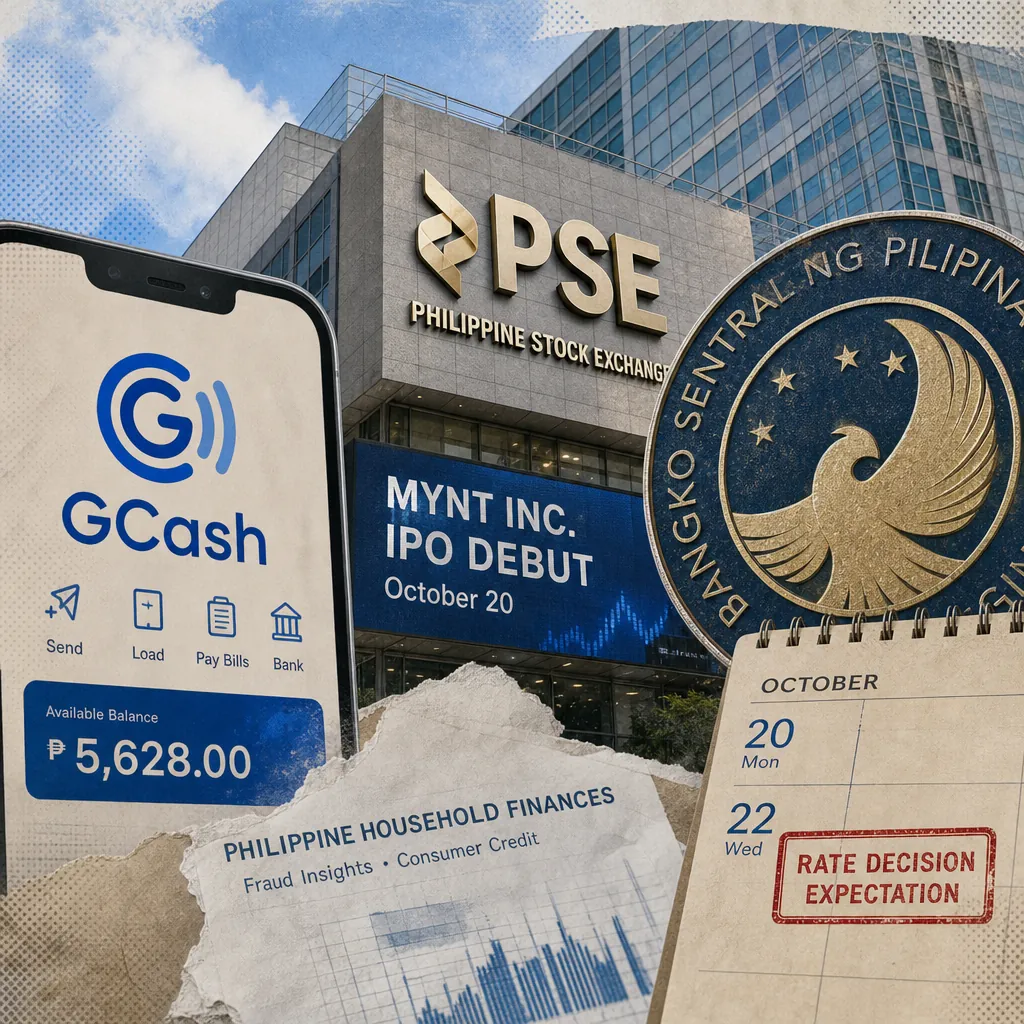
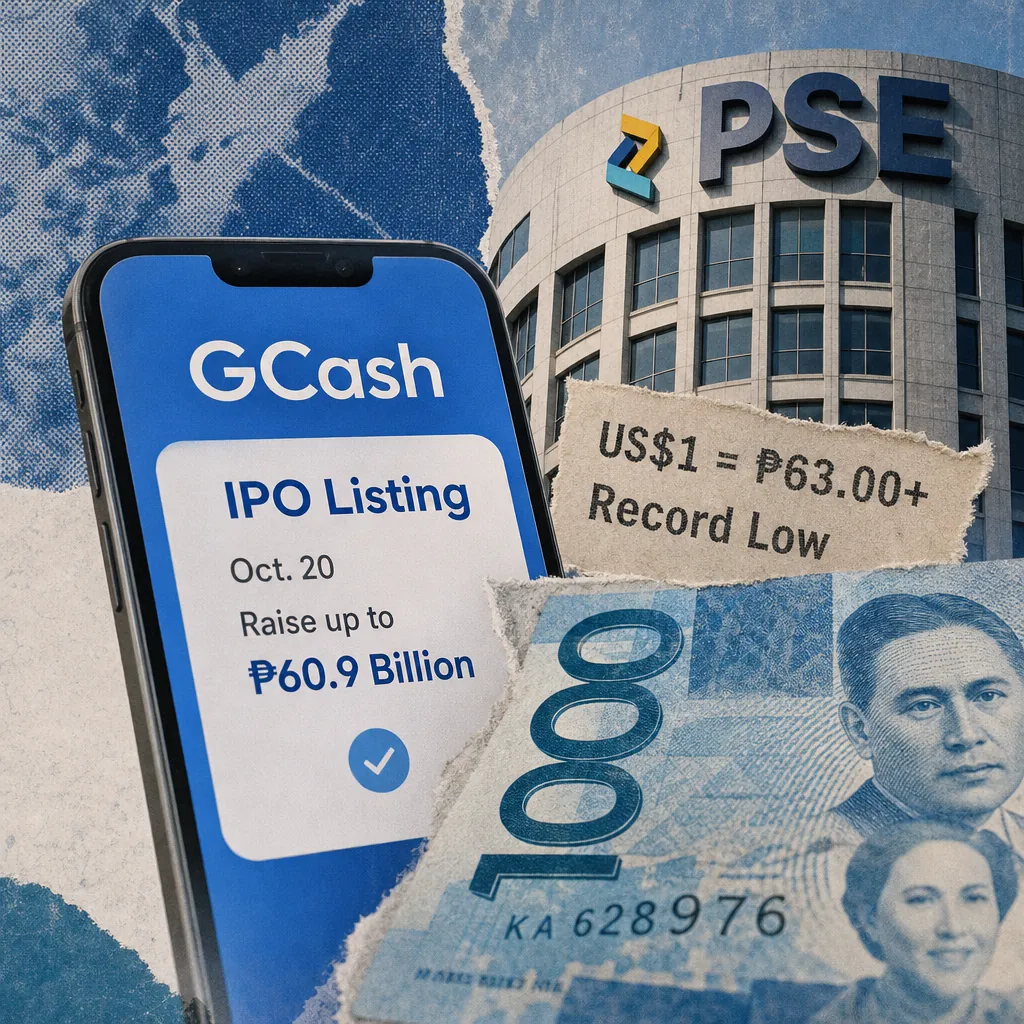
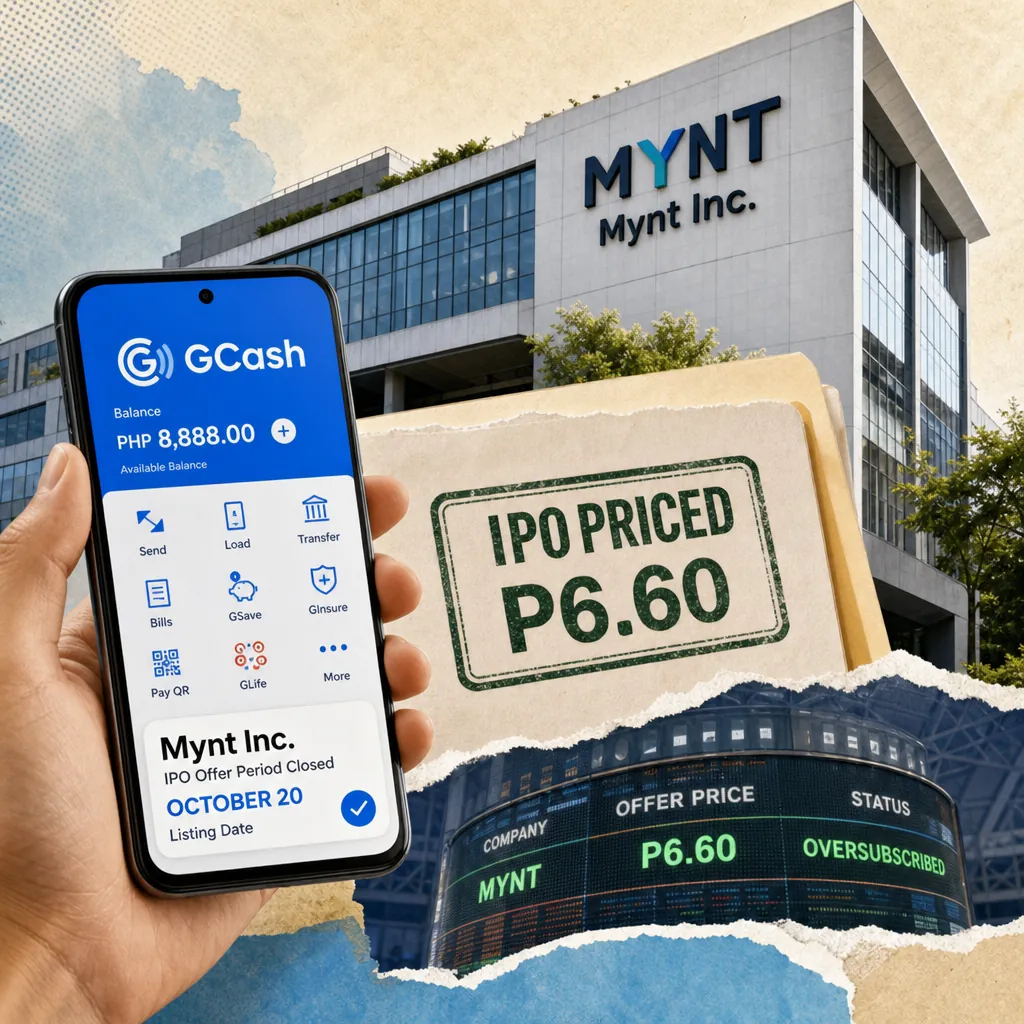
Mynt Inc., the company behind the GCash e-wallet, lists its shares on the Philippine Stock Exchange on Tuesday at ₱6.60 apiece, closing a ₱60.9-billion initial public offering that valued the company at about ₱441.5 billion11. Two days later, on Oct. 22, the Bangko Sentral ng Pilipinas (BSP) — the country's central bank — meets to set interest rates, and economists polled by three separate newsrooms expect another increase92552. Those two dates frame the week for Philippine finance, and the coverage gathered here returns to them from several directions: what GCash's listing says about how the company will grow now that most Filipinos who might use an e-wallet already do, what a fourth rate hike this year would cost borrowers, and how much fraud and bad debt are already eating into household budgets.
The GCash listing drew the most sustained attention in the items reviewed. Analysts quoted by the Manila Times and the Inquirer said Mynt's next phase of growth depends on getting existing users to buy more financial services rather than signing up new ones, because its domestic reach leaves little room to expand through new customers611. Investment banker Stephen Cuunjieng, interviewed on ANC's Market Edge, put it this way: "Shareholders who are patient will probably be happy because it is a different kind of financial services company that is very efficient and has fantastic scale."6 The listing also drew heavy business-page coverage in the broadsheets, including a Manila Standard piece on the index testing the 5,800 level this week26 and a Philstar analysis of how share prices will track both the debut and the central bank's decision55.
On the consumer side, the day's most concrete numbers came from two studies of financial crime and one set of central bank credit data. A white paper by trust-technology firm IDfy Philippines and credit-reporting agency CIBI Information Inc. estimated ₱603 billion in annual exposure to fraud involving money mule accounts — bank or e-wallet accounts used to receive and pass on money taken from scam victims2421. Separately, BSP data presented at a Manila forum showed non-performing credit card receivables rose 11.8 percent to ₱68.28 billion in June from ₱61.07 billion in March, while total card lending grew 5.3 percent to ₱1.294 trillion over the same period31. The BSP itself, through its consumer protection office, warned residents of Western Visayas that social engineering — tricking people into handing over passwords or transferring money themselves — accounted for 68 percent of reported cyberthreats nationwide in 202532.
Key themes
- GCash lists at ₱6.60 with the domestic portion heavily oversubscribed. Mynt's IPO covers 9.23 billion primary and secondary shares and values the GCash operator at about ₱441.5 billion11. Local brokerages reported that retail investors oversubscribed the domestic tranche, and the stock begins trading Tuesday6.
- Growth from here depends on selling more to existing users. Analysts said Mynt's reach leaves little room to add customers, so raising average revenue per user becomes the central challenge11. Cuunjieng expects returns "more typical of a mature business."11
- Economists expect a fourth BSP rate hike this year on Oct. 22. All 20 economists polled by the Inquirer expect a hike, with 18 forecasting a quarter-point and two a half-point9. The Manila Times poll of nine economists pointed to 5.25 percent25, and 12 of 13 economists polled by The Philippine Star expected an increase, with two forecasting 50 basis points52.
- Inflation hit 7.2 percent in September, the highest since March 2023. Food inflation reached 6.8 percent and rice prices rose 20.3 percent year-on-year; for the poorest 30 percent of households, inflation ran at 9.0 percent48. The BSP has raised its benchmark rate by a total of 75 basis points since April9.
- A study puts annual money-mule fraud exposure at ₱603 billion. IDfy Philippines and CIBI Information Inc. drew the estimate from 2025 payment data across PESONet and InstaPay, the BSP's two real-time payment systems2124. IDfy country head Raghu Chandrasekhar said technology alone cannot solve the problem and called for public awareness alongside safeguards and compliance with the Anti-Financial Account Scamming Act (Afasa)24.
- Credit card bad debts rose faster than card lending. Non-performing card balances climbed to ₱68.28 billion in June from ₱61.07 billion in March, lifting the distressed share of card receivables from 4.97 percent to 5.28 percent31.
- The peso hit a record low of ₱63.06 to the dollar last week. It recovered 7.5 centavos to ₱62.985 on Friday, but the weighted average rate still rose to ₱63.068 from ₱63.04912. The stock index closed at 5,782.70, up 1.43 percent week-on-week26.
- Banks and fintechs kept launching products through the week. Cebuana Lhuillier's Money Guro platform began offering loans to small businesses43, Manulife China Bank Life launched group life insurance for companies with five to 200 employees8, and Honda and PSBank rolled out a 0% interest car financing promo4142.
How the narratives stack
Dominant. The GCash listing and the coming rate decision dominate the items reviewed, and they are linked: brokerages and analysts treat the two as the week's twin catalysts for the stock market264055. The listing is the bigger corporate event — a ₱60.9-billion offer that puts a consumer e-wallet on the exchange at a valuation of about ₱441.5 billion11. The rate decision is the bigger household event, because the BSP's benchmark rate sets what banks charge on loans, and a fourth increase this year would raise the cost of borrowing for mortgages, car loans, and credit cards952. Coverage of the two ran across the Manila Times, the Inquirer, the Philippine Star, Manila Standard, and Inquirer Plus, and the combined advertising-equivalent value of the items captured here that discuss them runs into the millions of pesos — a measure of the space the stories took up, not of how many people read them.
Counter-narrative. The fraud and credit data tell a less optimistic story than the IPO coverage. The ₱603-billion mule-account estimate and the ₱68.28-billion bad-debt figure both describe money already lost or at risk, and both grew faster than the underlying activity they sit on: bad card balances rose 11.8 percent while card lending rose 5.3 percent31, and the BSP's own consumer office said 30 percent of Filipinos lost money to digital fraud in the past 12 months32. This material ran mostly in online outlets — Head Topics, the Manila Times, Panay News, and Retail News Asia — rather than on the business pages that carried the IPO story, and it drew far less space in the items reviewed.
Emerging. Two stories point forward. First, the Department of Finance is targeting a cut in the cost of sending money home by overseas Filipino workers (OFWs) to about 2 percent of the amount sent, from a World Bank average of 6.3 percent; Finance Secretary Frederick Go met payments firms Swift and Revolut on the sidelines of the International Monetary Fund–World Bank meetings in Bangkok to discuss it47. Second, IDfy Philippines said it plans to expand into insurance and telecommunications next year, building on work with more than 10 Philippine organizations including leading banks and thrift banks46. Both suggest the infrastructure around money movement — remittances and identity checks — is being rebuilt, which matters to every bank and e-wallet that touches either.
Under-covered. The peso's slide and the central bank's own finances got comparatively little attention. The peso closed at ₱62.985 on Friday after touching a record ₱63.23 during the session12, and the BSP reported net income of ₱170.2 billion in the first seven months of 2026, more than double the ₱79.2 billion in the same period last year, driven largely by ₱102 billion in foreign exchange gains59. A central bank earning more from currency swings while the currency weakens is worth watching, and it appeared in a single item here. Also lightly covered: the Philippine banking sector's total assets rose to ₱31.38 trillion as of end-August from ₱27.73 trillion a year earlier, which the Philippine Institute for Development Studies' John Paolo Rivera read as continued expansion despite elevated rates27.
Platform insights
- Facebook. The one social post in the writeup that carried a financial story — the Security Bank Wealth and St. Luke's Medical Center healthcare partnership — drew no comments or reactions in the days after it ran1. The same partnership was covered in Manila Standard as a photo item from the Oct. 15 signing at the Manila Polo Club2. A launch announcement with a bank president and a hospital chief executive, posted to a general-interest page, produced no measurable response; the audience for wealth-management news is not gathered on that page.
- X. No posts from X appear in the material reviewed.
- Reddit. No posts from Reddit appear in the material reviewed.
- YouTube. No posts from YouTube appear in the material reviewed.
The social side of this window is thin, and that is itself the finding: the day's financial news lived in newsrooms and analyst notes, not in public argument. The one consumer-facing social item — the Security Bank and St. Luke's launch — was a corporate announcement that produced no discussion1.
Key voices and communities
Equity analysts and brokerages. Cuunjieng of ANC's Market Edge611, Wendy Estacio-Cruz of Unicapital Securities55, F. Yap Securities40, Philstocks Financial26, and 2TradeAsia.com26 set the terms for how the market reads the GCash debut and the rate decision. Their framing — patient capital, mature-business growth, a quarter-point hike already priced in — shapes what investors expect from both events.
Economists polled on monetary policy. Nicholas Mapa of Metrobank argued the BSP should keep a "measured pace of tightening and avoid overzealous hiking" because current inflation is supply-driven and less responsive to rate moves3. Jonathan Ravelas of Reyes Tacandong & Co. and Jun Neri of BPI expect a larger half-point increase52. The spread between quarter-point and half-point forecasts is the main uncertainty in the rate story.
Fraud researchers and identity-verification firms. Chandrasekhar of IDfy Philippines2446 and the BSP's Consumer Protection and Market Conduct Office, represented by deputy director Alvin A. Tolosa32, are pushing public education alongside technical safeguards. Their audience is banks, e-wallets, and the regulators writing the rules under Afasa.
Wealth managers and retail investors. Rene Aguirre, Security Bank Wealth senior vice president, said Filipino clients chase short-term yield and warned that "if you're always chasing the short-term yield, when interest rates start to turn around, then you could easily be hit with reduced yields over the medium term."23 His comments, made at a Security Bank event, describe the behavior the bank is trying to change as it sells longer-term products.
Small-business lenders and insurers. Jean Henri Lhuillier of Cebuana Lhuillier framed the Money Guro loans launch around financial literacy: "Financial literacy is only meaningful when it empowers people to act."43 Manulife China Bank Life's group insurance products target employers with five to 200 workers8. Both are courting the same small-business segment that feels rate hikes first.
Narrative streams
GCash lists Tuesday with growth hinging on existing users
Mynt Inc. prices its shares at ₱6.60 and begins trading on the Philippine Stock Exchange on Oct. 20. The offer covers 9.23 billion primary and secondary shares for ₱60.9 billion and values the GCash operator at about ₱441.5 billion11. Brokerages reported the domestic portion was heavily oversubscribed by retail investors6. The question analysts raised is what happens after the debut. Cuunjieng said Mynt's extensive domestic reach leaves less room to expand through new users, making average revenue per user the key measure to watch11. He expects steady but modest returns as the company grows at a pace typical of a mature business11.
The read for the sector: banks and fintechs that compete with GCash should expect it to push harder into lending, insurance, and investments — products sold to people who already have the app — rather than into signing up the unbanked. That puts GCash into direct competition with the banks and insurers launching their own products this week, including Cebuana Lhuillier's small-business loans43 and Manulife China Bank Life's group insurance8. For the roughly 9.23 billion shares changing hands, the debut price is only the starting point; the trading that follows will show whether retail investors who oversubscribed the offer hold or sell.
The BSP is expected to raise rates for the fourth time this year
The Monetary Board meets Oct. 22 with the benchmark target reverse repurchase rate at 5.0 percent, after a 25-basis-point increase on Aug. 2725. The target reverse repurchase rate is the interest rate the BSP pays when it borrows from banks overnight; it sets the floor for what banks charge on loans and pay on deposits. All 20 economists polled by the Inquirer expect a hike, 18 of them by a quarter-point and two by a half-point9. The Manila Times poll of nine economists pointed to 5.25 percent25. The Philippine Star's poll of 13 found 12 expecting an increase, with Ravelas and BPI's Neri forecasting 50 basis points52.
The case for tightening rests on September inflation of 7.2 percent, the highest since March 2023, with food inflation at 6.8 percent and rice up 20.3 percent year-on-year48. The peso's record low of ₱63.06 to the dollar last week adds pressure, because a weaker peso makes imported oil and food more expensive1225. Mapa of Metrobank argued the BSP should not overreact, since current inflation is supply-driven and rate moves do less against supply shocks3. Philstocks said a hold would be a positive surprise and a hike larger than 25 basis points a negative one for the market26.
The read for the sector: a fourth hike raises the cost of every variable-rate loan in the country, from credit cards to mortgages to the small-business loans Cebuana Lhuillier just launched43. Banks will earn more on lending margins but face higher bad-debt risk, which the June card data already shows rising31. For households, the increase lands on top of 9.0 percent inflation for the poorest 30 percent48.
Money mule fraud could cost the economy ₱603 billion a year
IDfy Philippines and CIBI Information Inc. released a white paper, "Mule Hunting: Are We Chasing Ghosts?", estimating ₱603 billion in annual exposure to fraud involving money mule accounts, based on 2025 payment data across PESONet and InstaPay2421. PESONet and InstaPay are the BSP's two real-time payment systems: PESONet handles batch transfers such as payroll and supplier payments, and InstaPay handles instant retail transfers between banks and e-wallets. Money mules are people who knowingly or unwittingly let criminals use their bank or e-wallet accounts to receive and move stolen funds24. Chandrasekhar said: "While technical safeguards and regulatory compliance under Afasa are essential, technology alone cannot solve a problem"24. The Anti-Financial Account Scamming Act, or Afasa, is the law that requires banks and e-wallets to investigate and freeze accounts linked to fraud.
The BSP's own data supports the concern. Its consumer protection office said social engineering and identity theft accounted for 68 percent of reported cyberthreats nationwide in 2025, that 77 percent of Filipinos had encountered cyber scams, and that 30 percent lost money to digital fraud in the past 12 months32. Western Visayas accounted for less than 4 percent of complaints, but Tolosa said the region's share has remained steady32.
The read for the sector: banks and e-wallets face a compliance cost that is rising faster than their customer base. Every account opened through a mule — willingly or through identity theft — is a liability under Afasa, and the ₱603-billion estimate gives regulators a number to attach to enforcement. IDfy's plan to move into insurance and telecommunications next year46 suggests identity verification is becoming a standard cost of onboarding, not an optional add-on.
Credit card bad debts rise faster than card lending
BSP data presented by Estella Dhel Villamiel, head of institutional research at First Metro Securities, at a Manila forum showed non-performing credit card receivables at ₱68.28 billion in June, up 11.8 percent from ₱61.07 billion in March, while total card lending grew 5.3 percent to ₱1.294 trillion31. The distressed share of card balances rose from 4.97 percent to 5.28 percent in three months31. The report noted that a typical ₱20,000 rollover balance becomes harder to clear as interest compounds31.
The read for the sector: consumer lenders should expect delinquency to keep climbing while inflation runs above 7 percent, because card balances are unsecured and households under pressure pay secured debts first. The 5.28 percent distressed share is still low by historical standards, but the direction matters more than the level: bad balances are growing at more than twice the pace of new lending31.
Remittance costs and the peso's record low
Finance Secretary Frederick Go said he would be happy to bring the average cost of sending money home by overseas Filipino workers down to 2 percent from the World Bank's 6.3 percent average, after meeting payments firms Swift and Revolut at the IMF–World Bank meetings in Bangkok47. "Our OFWs work hard for every peso they send home," Go said47. Remittances are one of the country's largest sources of foreign currency, and their cost affects millions of households directly.
The peso, meanwhile, closed at ₱62.985 to the dollar on Friday, strengthening 7.5 centavos from Thursday's ₱63.06, after touching a record ₱63.23 during the session12. Total trading volume rose to $1.598 billion from $1.502 billion12. Ravelas attributed the pressure to "a series of unfortunate events," including higher odds of a US rate hike, geopolitical risk, and declining gross international reserves12.
The read for the sector: cheaper remittances would put more pesos into recipient households, but a weaker peso cuts the other way by making each dollar sent worth more in local currency while raising the cost of imports. Banks and remittance firms that depend on fees face pressure to cut them, and the BSP's rate decision on Oct. 22 is the next test of whether the peso stabilizes.
Banks keep launching products into a rising-rate market
Security Bank Wealth and St. Luke's Medical Center signed a partnership on Oct. 15 at the Manila Polo Club giving the bank's wealth clients concierge healthcare: appointment assistance, specialist referrals, help scheduling consultations and diagnostic procedures, executive lounge access, support during hospital admissions, and preferred rates on health screening packages12. Security Bank president and CEO Victor Lee said the partnership extends the bank's personalized service into healthcare access, and St. Luke's president and CEO Dr. Dennis P. Serrano said the two are safeguarding clients' health and time1. The launch post drew no comments or reactions on Facebook1.
Other launches filled the week. Cebuana Lhuillier's Money Guro platform, led by president and CEO Jean Henri Lhuillier, began offering loans to small and medium enterprises, moving beyond financial education into direct lending43. Manulife China Bank Life Assurance Corporation, the alliance between Manulife Philippines and China Banking Corporation, launched Secure Pinoy Group Life Care and Secure Pinoy Group Life Care Plus for companies with five to 200 employees, covering life, accident, and optional health-related benefits8. Honda Cars Philippines and Philippine Savings Bank launched a financing program, "Drive at Peace, Pay with Ease," offering either 0% interest with a 50 percent down payment over 24 to 60 months or low monthly amortization with a 20 percent down payment over 60 months on select models4142.
Aguirre of Security Bank Wealth said clients often want high yields, minimal risk, and immediate access at once, which do not always go together, and that the bank encourages diversification23. "A lot of our customers, we've seen them largely focus on the rate," he said23.
The read for the sector: with rates rising, banks are competing for deposits and wealth clients by bundling services — healthcare access, insurance, cheap car financing — rather than by offering higher yields alone. The 0% interest car promo is a bet that buyers will accept a large down payment in exchange for a lower monthly bill, which suits a market where borrowing costs are climbing.
The stock market's week runs through two dates
The Philippine Stock Exchange index closed at 5,782.70 on Friday, up 1.43 percent week-on-week, its second straight weekly gain, while the all-shares index rose 0.84 percent to 3,218.8126. Foreign investors were net sellers of ₱1.41 billion last week, according to 2TradeAsia.com, and trading volume stayed subdued26. F. Yap Securities said the Oct. 20 GCash listing and the Oct. 22 BSP meeting would be the main drivers, expecting the index to stay above 5,500 if the expected quarter-point hike lands, with a hold risking a reversal toward 5,700 and a 50-basis-point hike putting 5,600 in play40. Unicapital's Estacio-Cruz said investors are also watching September balance of payments data on Oct. 1955.
The read for the sector: the market has already priced in a quarter-point hike, so the surprise risk sits on both sides — a hold would lift stocks, a half-point hike would weigh on them2640. The GCash debut could lift sentiment briefly, but F. Yap said it would not chase the stock ahead of the rate decision40.
The BSP's own books and the banking sector's growth
The BSP reported net income of ₱170.2 billion in the first seven months of 2026, up 114.9 percent from ₱79.2 billion a year earlier and already 36.6 percent above its full-year 2025 earnings of ₱124.6 billion59. Net gains from foreign exchange fluctuations nearly tripled to ₱102 billion from ₱37 billion and accounted for about 60 percent of net income59. These are realized gains from transactions involving foreign currencies as exchange rates change, recorded separately from revenues59.
Philippine banks' total assets rose to ₱31.38 trillion as of end-August from ₱27.73 trillion a year earlier, according to BSP data27. Rivera of the Philippine Institute for Development Studies said the increase reflects growth in lending, deposit-funded activities, and investment holdings, suggesting the sector continues to expand despite elevated rates27. Metrobank ranked first among Philippine banks and securities firms in both the local-currency and G3 bond categories of The Asset Benchmark Research Awards 202644.
The read for the sector: a central bank earning most of its profit from currency swings is a side effect of the peso's slide, not a sign of policy success, and it does not change the rate decision. The asset growth figure shows banks are still lending into a rising-rate environment, which is where the bad-debt risk in the card data will show up next.
Conversation trajectory
Oct. 19–20: the GCash debut. Mynt begins trading Tuesday at ₱6.6011. Watch whether the stock holds above its offer price on the first day and whether the retail investors who oversubscribed the domestic tranche hold or sell6. A strong debut could lift market sentiment briefly, but F. Yap said it would not chase the stock ahead of the rate decision40.
Oct. 19: September balance of payments data. Unicapital's Estacio-Cruz flagged this release as a signal on foreign exchange flows55. A wider deficit would add pressure to the peso ahead of the rate meeting.
Oct. 22: the BSP decision. The Monetary Board meets with a quarter-point hike to 5.25 percent widely expected92552. The spread between forecasts — 18 of 20 Inquirer-polled economists at a quarter-point, two at a half-point9 — is the main uncertainty. A hold would be a positive surprise for stocks; a half-point hike a negative one26.
Late October: Afasa enforcement and fraud data. The ₱603-billion mule-account estimate24 and the BSP's warning on social engineering32 set up the next round of enforcement news under the Anti-Financial Account Scamming Act. Watch for announcements from banks and e-wallets on account freezes and identity checks, and for IDfy's expansion into insurance and telecommunications46.
November: credit card delinquency data. The next BSP quarterly release on card receivables will show whether the 5.28 percent distressed share kept climbing from June31. With inflation at 7.2 percent in September48, the pressure on household budgets has not eased.
Ongoing: remittance cost negotiations. Go's target of 2 percent from 6.3 percent47 depends on agreements with payments firms. Watch for announcements from Swift, Revolut, and the BSP on cross-border payment pricing.
Response guidance
Banks and e-wallets preparing for the rate decision. Prepare customer communications for a quarter-point increase to 5.25 percent, and a separate version for a half-point move, before Oct. 22. State plainly what changes for variable-rate borrowers and depositors, and avoid framing the increase as good news for the bank.
GCash and Mynt after the listing. Expect questions about average revenue per user and the shift from signing up customers to selling them more products11. Prepare plain-language answers on what new products are coming and how they are priced, and do not let the post-IPO narrative be set entirely by analyst notes.
Fraud and scam prevention. Treat the ₱603-billion mule-account estimate24 and the BSP's 68 percent social-engineering figure32 as the frame for consumer education through the rest of the year. Messages should name the specific scam types — account takeover, push-payment fraud, mule recruitment — and tell customers what the bank will never ask them to do.
Wealth and insurance product launches. The Security Bank and St. Luke's launch drew no measurable response on Facebook1. Plan distribution around where wealth clients actually are — relationship managers, email, and events — rather than general-interest social pages.
Small-business lenders. Cebuana Lhuillier's Money Guro loans43 and Manulife China Bank Life's group insurance8 both target small employers. With rates rising, lead with fixed-rate options and total cost over the loan term rather than headline rates.
Remittance and cross-border payments. Go's 2 percent target47 will draw comparisons with current fees. Remittance firms should be ready to explain their pricing and the exchange rate they apply, because the gap between the fee and the rate is where customers feel the cost.
Market commentary. With the GCash debut and the BSP decision two days apart, avoid attributing index moves to a single cause. F. Yap's scenarios — above 5,500 on a quarter-point hike, a test of 5,700 on a hold, 5,600 on a half-point hike40 — give a checkable frame for what to say after each event.
See the full picture behind today's signals.
This report draws from Media Meter's MediaWatch, our real-time monitoring engine tracking 2,470+ Philippine sources across print, broadcast, digital, and social. Explore how the platform turns raw coverage into decision-grade intelligence, then see how it's configured for teams like yours — whether you're in PR agencies, corporate comms, government, or marketing.
Want more? Browse our Report Library for sector and crisis intelligence, or request a demo and we'll have your brand set up before the call.
Want this kind of intelligence on your brand?
This brief is built on the same MediaWatch methodology that runs continuously across every brand we monitor. See your competitive landscape, Impact Score, and narrative trajectory in a 30-minute demo.