GCash IPO, peso record low frame PH finance day
Mynt's GCash listing is set to raise up to ₱60.9 billion on Oct. 20 as the peso hits a record low past 63 to the dollar. Banks face a shift away from SMS one-time passwords, and cash on delivery still holds about 23% of e-commerce value.
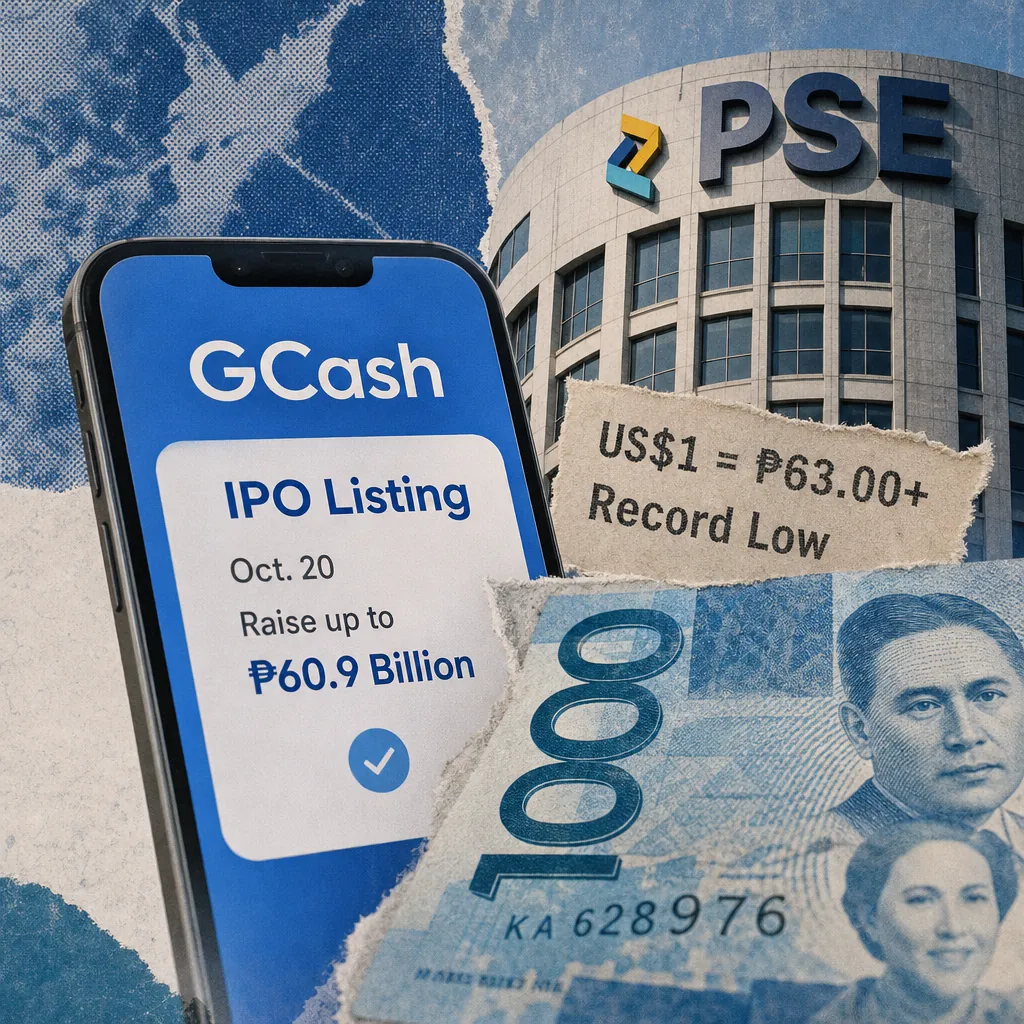
The peso closed past 63 to the U.S. dollar for the first time on October 15, 2026, a record low, while local shares rose for the first time in three days on bargain hunting1. The same day's market roundup carried corporate updates on a government-mediated meeting between Philex Mining and its Padcal union workers, and on Cebu Pacific's domestic passenger traffic1. The exchange rate now sits as the open question for banks, importers and anyone carrying dollar costs1.
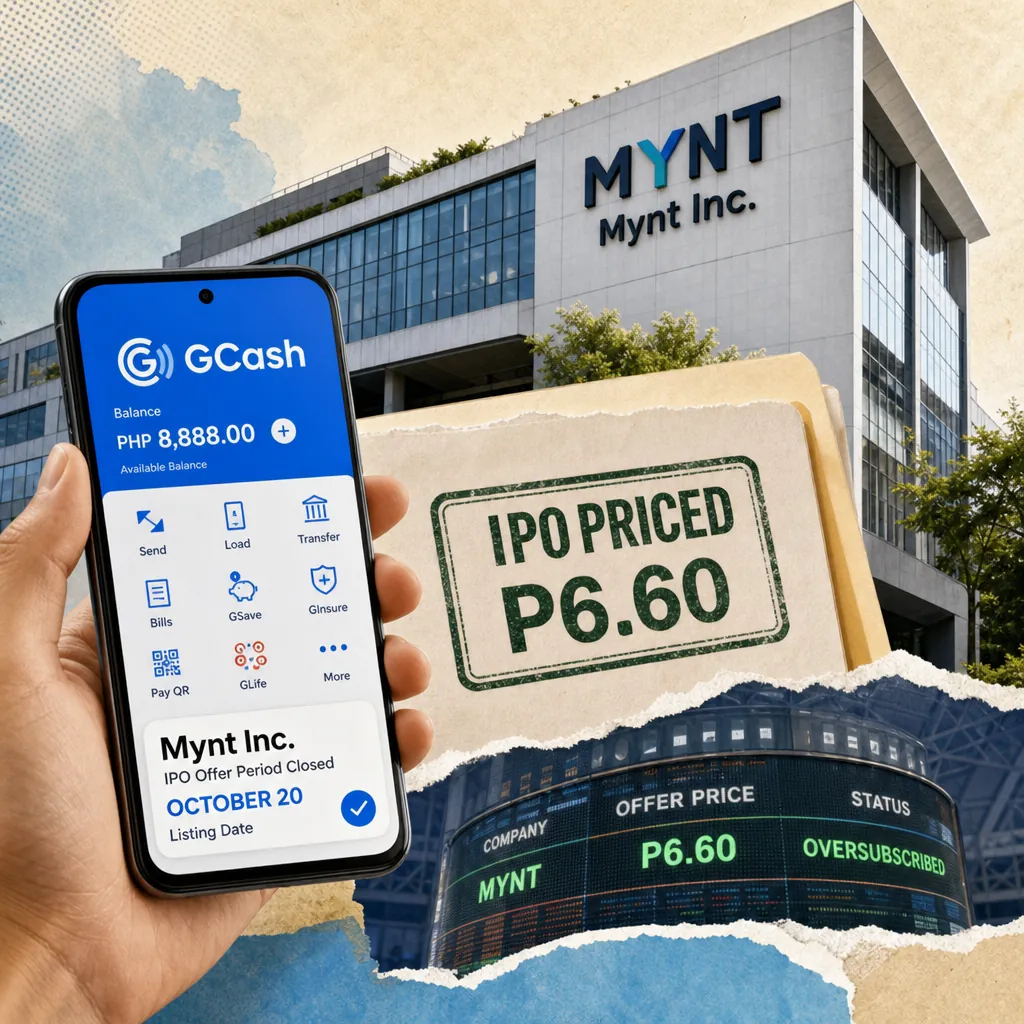
On the same day, the country's largest-ever stock market listing moved into its final stretch. Mynt, the parent of the GCash mobile wallet, is scheduled to debut on the Philippine Stock Exchange on October 20, after an offer period that ran from October 6 to 12 and drew allocations several times oversubscribed, according to brokers51. The base offer of 8.03 billion shares was priced at ₱6.60 each, and with an overallotment option of up to 1.2 billion secondary shares the deal could raise as much as ₱60.9 billion4451. Ayala Corp. president and CEO Cezar Consing framed the decision to list at home rather than abroad, where some shareholders had argued valuations would be higher, as a statement of confidence: "We are doing our part. We are betting big on the Philippines"44.
Around those two markers, the day's financial coverage spread across payments, fraud and identity. Xendit reported that QR Ph and InstaPay transactions on its platform nearly tripled, and that 41% of Filipino online shoppers who abandoned a purchase said their preferred payment option was missing2. Its E-commerce Payments Momentum Report, prepared with market intelligence firm Cube, put cash on delivery at about 23% of e-commerce transaction value processed through Xendit's Philippine platform, the highest share among six Southeast Asian markets, and projected the Philippines would remain the region's last major market where cash on delivery stays above a fifth of online purchases in 202752. Tala, an AI-native credit company, said it is widening partnerships with banks, payment networks and industry groups, its Philippines chief Moritz Gastl saying "Financial inclusion thrives when different parts of the ecosystem work together," and cited 58% of Filipino adults now holding a formal financial account3.
Key themes
- The peso passed 63 to the dollar for the first time on October 15. The record low sets the exchange rate as the variable banks, importers and dollar-cost holders now have to plan around, and it arrived in the same session that local shares rose on bargain hunting after three down days1.
- Mynt's GCash listing could raise up to ₱60.9 billion on October 20. At ₱6.60 a share for a base offer of 8.03 billion shares, with an overallotment option of up to 1.2 billion more, the deal would be the largest initial public offering in Philippine history, and brokers reported allocations several times oversubscribed4451.
- Cash on delivery still carries about 23% of e-commerce transaction value on Xendit's Philippine platform. That is the highest share among six Southeast Asian markets in the company's report with Cube, which projects the Philippines will remain the region's last major market above a fifth of online purchases paid on delivery in 202752.
- 41% of shoppers who abandoned an online purchase said their preferred payment method was not offered. Xendit's finding points to checkout configuration, not shopper preference, as a live constraint on converting Philippine online sales2.
- The Bangko Sentral ng Pilipinas is moving banks off SMS one-time passwords for high-risk transactions. A cybersecurity executive says facial biometric verification and liveness detection are needed because conventional authentication proves the credentials are correct without confirming who is using them2742.
- A Tarlac dentist lost ₱93 million to scammers using a deepfake video of President Ferdinand Marcos Jr. Police arrested two suspects in Angeles City in October 2025; the case is the local face of a fraud pattern mapped in the Sophos AI Security 2026 report28.
- IDfy Philippines turned scam education into a graphic novel. "Chaos in Cavite" follows an investigative journalist through a relationship-based "pig butchering" scam in which a retired banker's savings are split across mule accounts and converted to cryptocurrency9.
- The Securities and Exchange Commission set a ₱150-million capital floor for market makers. Memorandum Circular No. 28, Series of 2026, issued October 15, is the country's first comprehensive market-making framework and covers both equities and fixed-income securities25.
How the narratives stack
Dominant. The GCash listing carried the most consequence in the items reviewed here. Two separate business columns treated the October 20 debut as the week's main event, one calling it a historic week for Ayala Corp. and the other walking through the share counts, the ₱6.60 price, the ₱53-billion base size and the path to ₱60.9 billion if the overallotment is fully exercised4451. The coverage value attached to those two items alone ran to more than ₱1.1 million in estimated advertising-equivalent terms — the notional cost of buying the same column space as paid advertising, not a count of readers. The peso's record low shared the top of the day: it was the lead item in the market roundup and the one variable the writeup flagged as unresolved for banks and importers1.
Counter-narrative. Against the IPO's scale, the payments data described a market still partly running on cash at the doorstep. Cash on delivery at roughly 23% of e-commerce value on Xendit's platform, the highest of six Southeast Asian markets, and a 2027 projection that the Philippines stays above a fifth, sit awkwardly beside the premise that a listed GCash will pull the country into digital payments at speed52. The 41% abandonment figure sharpens it: shoppers are not refusing digital payment, they are finding their preferred option absent at checkout2.
Emerging. Fraud and identity verification produced the day's densest cluster of stories, all in The Manila Times' Sunday business section and its syndicated pickups. The BSP-hosted Scam Ready Asean National Public-Private Partnership Dialogue on October 12 brought government, law enforcement, financial institutions, technology companies and regional organizations together on education, regulation, technology and enforcement; the program is supported by a $5-million grant from Google.org29. The deepfake case, the biometric authentication push and the IDfy graphic novel all describe the same problem from different angles28279.
Under-covered. The SEC's market-making framework drew a single blog item in this set, despite setting a hard ₱150-million paid-up capital floor for firms that want to hold the role of keeping stocks and bonds trading smoothly25. Market makers quote both buy and sell prices so that other investors can trade without waiting for a counterparty; the circular is the first time the Commission has set out who may do that officially and how much capital they must hold. It matters to brokers weighing whether to apply, and it received a fraction of the attention the IPO did.
Platform insights
- Facebook. The Xendit findings circulated through a business-news page post that carried the QR Ph and InstaPay growth, the 41% abandonment figure and the cash-on-delivery ranking in one item2. The format suits the platform: a compact set of numbers a reader can absorb without leaving the feed, and the kind of post that gets shared by merchants and payments staff rather than the general public.
- YouTube. The peso's record low and the market roundup reached audiences through a video business bulletin, which packaged the exchange rate, the Philex Mining labor meeting and Cebu Pacific's passenger traffic into a single daily segment1. Video carries market news to viewers who do not read the business pages, and the peso item's placement at the top of the rundown reflects how the bulletin ranked it.
- X. The GCash IPO discussion ran through the business press and columnists rather than a single viral post, with the share counts and the oversubscription reports circulating as text4451. The detail-heavy nature of an IPO — price, base size, overallotment, allocation — travels well in short posts that quote a number.
- Reddit. The IDfy graphic novel and the deepfake case describe scams that begin in ordinary social settings, including a Facebook group in the "pig butchering" storyline9. Discussion of fraud mechanics tends to surface on forums where people compare experiences, though the items here report the launches and cases rather than forum reaction.
Key voices and communities
Ayala Corp. and the Mynt shareholder group. Consing's "betting big on the Philippines" line is the framing the IPO's sponsors want in circulation, and it answers a specific criticism: that listing abroad would have fetched a higher valuation44. The company's decision to proceed at home during a weak stretch for the stock market is the substance behind the quote.
Payments firms and merchants. Xendit's report gives merchants a concrete reason to review checkout options, and Tala's Gastl supplies the ecosystem argument for partnerships across banks, networks and industry groups23. Both are commercial voices making a case, and both rest on figures a reader can check against their own experience of shopping online.
Cybersecurity and trust-technology vendors. iProov's Dominic Forrest argues that "Traditional authentication can prove that the credentials are correct, but it does not verify the identity and presence of the person using them," a position that aligns with the central bank's move away from SMS codes2742. IDfy Philippines country head Raghuraman Chandrasekhar used the launch of "Chaos in Cavite" to put the mechanics of money mule networks in front of banking, fintech and regulatory leaders at The Peninsula Manila9. Sophos supplies the threat data behind the deepfake coverage28.
The Bangko Sentral ng Pilipinas and regional partners. The central bank hosted the Scam Ready Asean dialogue, positioning itself as the convenor of a response that spans education, regulation, technology and enforcement29. The BSP also sets the authentication rules that banks must now meet.
The Securities and Exchange Commission. The Commission's market-making circular makes it the standard-setter for a function most retail investors never see but all of them depend on when they want to trade25.
Narrative streams
GCash's operator heads for a ₱60.9-billion listing on October 20
Mynt's offer period closed on October 12 with allocations several times oversubscribed, and the shares are due to start trading on the Philippine Stock Exchange on October 2051. The base offer comprised 1.61 billion primary shares and 6.42 billion secondary shares, worth about ₱53 billion at ₱6.60 each; the overallotment option of up to 1.2 billion secondary shares could lift the total to 9.23 billion shares and the proceeds to ₱60.9 billion4451. Of the primary proceeds, 60% is earmarked for CreditTech — the company's lending monetization and wealth management services — with 20% for product innovation and 20% for general corporate functions51.
The listing matters beyond the deal size. GCash is the mobile wallet most Filipino smartphone users already have, and its parent becoming a public company means its lending and wealth products will be run for shareholders as well as users. The 60% allocation to CreditTech signals where the company expects growth: lending to people who may not have borrowed from a bank before. For banks and fintechs competing for the same customers, a listed, capitalized GCash with a lending mandate is a different competitor from a privately held wallet. The offer also gives the public direct ownership, which the coverage framed as a broadening of participation in the market51.
Ayala Corp.'s role is the subplot. The conglomerate's president said some Mynt shareholders initially wanted to list abroad where valuations would be higher, and that the decision to stay was a bet on the country "warts and all"44. The two columns carrying this story accounted for more than ₱1.1 million in estimated advertising-equivalent value across the items reviewed, the highest combined coverage value of any single story in the set.
The peso's first close past 63 to the dollar
The peso fell past 63 to the U.S. dollar for the first time on October 15, 2026, setting a record low, while local stocks rose for the first time in three days on bargain hunting1. The market roundup that carried the news treated the exchange rate as the unresolved question for banks, importers and anyone holding dollar costs1.
A weaker peso raises the peso cost of anything priced in dollars — imported fuel, raw materials, machinery, foreign debt service — and it changes the arithmetic for Filipinos receiving remittances from abroad, who get more pesos for each dollar sent. For banks, the exposure runs through dollar-denominated liabilities and through borrowers whose income is in pesos but whose obligations are not. Importers face the simplest version: the same shipment costs more this week than last. The roundup did not attach a forecast to the rate, and the direction from here is not established in the material.
The peso item shared the day with corporate news that would ordinarily lead a business bulletin: a government-mediated meeting between Philex Mining and its Padcal union workers, and Cebu Pacific's domestic passenger traffic1. Their placement below the exchange rate reflects how the bulletin ranked the day.
Cash on delivery holds about 23% of e-commerce value as digital payments grow
Xendit's report with Cube found cash on delivery at about 23% of e-commerce transaction value processed through its Philippine platform, the highest share among six Southeast Asian markets, and projected that the Philippines would remain the region's last major market where cash on delivery stays above a fifth of online purchases in 202752. The same body of work found QR Ph and InstaPay transactions on the platform nearly tripled, and that 41% of shoppers who abandoned a purchase said their preferred payment option was missing2.
QR Ph is the national QR code standard that lets a customer pay by scanning one code across banks and wallets; InstaPay is the central bank's instant interbank transfer system, which moves money between accounts in real time. Both are infrastructure the BSP built to pull transactions into digital rails, and both are growing fast on Xendit's platform. The cash-on-delivery share shows what remains outside them. For merchants, the 41% figure is the actionable one: a shopper who reaches checkout and finds no familiar option leaves, and the fix sits in the payment options a store enables rather than in a campaign to change shopper habits. For banks weighing checkout upgrades for their business clients, the abandonment number is the argument. Whether the cash-on-delivery share falls depends on merchants adopting more options, and no announced schedule in the material confirms when that would happen23.
Banks move off SMS one-time passwords as biometric checks take over
Banks need stronger ways to verify who a customer is and to document that the customer authorized a transaction, according to Dominic Forrest, chief technology officer of iProov, as the Philippines moves away from SMS-based one-time passwords for high-risk financial transactions27. iProov, founded in 2011, builds facial biometric verification and liveness detection — systems that check both that a face matches the account holder and that a real person is present during the interaction, rather than a photo or a recording27. The shift follows central bank regulations effective June 202642.
An SMS one-time password is a short code sent to a phone number; it proves someone has the phone, not that the person is the account holder. Scammers have learned to intercept or redirect those codes, which is why the central bank is retiring them for high-risk transactions. Forrest's point is that the replacement has to verify presence, not just credentials: "Traditional authentication can prove that the credentials are correct, but it does not verify the identity and presence of the person using them"27. For banks, the change means re-engineering account opening, login and high-value transfers around facial checks, and documenting the authorization so a disputed transaction can be traced. For customers, it means a selfie may replace a text code — a visible change at the moment of payment, and one that will generate questions at branch counters and in call centers.
A ₱93-million deepfake loss puts AI fraud on the business pages
Over about a year, a dentist in Tarlac handed ₱93 million to people she believed were working with the president, convinced by a video in which President Ferdinand Marcos Jr. appeared to endorse the investment28. The video was a deepfake — synthetic video made with artificial intelligence that reproduces a real person's face and voice. Police arrested two suspects in Angeles City, Pampanga, in October 2025 in an entrapment operation at a mall, on a charge of estafa in relation to cybercrime; over months the scammers had earned her trust with gifts said to come from the president, including a luxury bag and two vehicles28.
The case anchors the Sophos AI Security 2026 report, which draws on the security firm's casework across more than 625,000 organizations28. The pattern it describes is patient and relationship-based: the fake endorsement is not the opening move but the confirmation that arrives after trust has been built. For banks and financial institutions, the lesson is that identity fraud now arrives with convincing production values, and that customer education built around "check the sender" does not cover a video that looks like the president. The Manila Times ran the deepfake story, the biometric authentication story and a piece on measuring scam-fighting outcomes in the same Sunday business section, giving the cluster substantial coverage value in the items reviewed282729.
A regional anti-scam partnership and a graphic novel take the message to the public
The Bangko Sentral ng Pilipinas hosted the Scam Ready Asean National Public-Private Partnership Dialogue on October 12, gathering government, law enforcement, financial institutions, technology companies and regional organizations to discuss how education, regulation, technology and enforcement can address digital fraud29. Scam Ready Asean is a regional program supported by a $5-million grant from Google.org29. The dialogue's premise is that warnings and individual vigilance are not enough as more economic activity moves online, and that the response has to be coordinated across the institutions a scam touches29.
IDfy Philippines took a different route to the same audience. "Chaos in Cavite," an investigative graphic novel launched at The Peninsula Manila before leaders from banking, fintech and regulation, follows journalist Cal — first introduced in the company's "Mayhem in Makati" — as he investigates a relationship-based "pig butchering" scam targeting Ernesto Reyes, a retired banker in General Trias who lost his lifetime savings through a months-long setup inside a Facebook group9. The stolen funds are split into small transfers across mule accounts, converted to cryptocurrency and sent out of the country9. "Pig butchering" is a fraud in which a scammer builds a relationship with a victim over weeks or months before introducing an investment that turns out to be fake; money mule accounts are bank accounts used to move stolen funds so the original transfer is hard to trace. The graphic novel is an education product aimed at the industry as much as the public, and its launch put the mechanics of mule networks in front of the people who run the accounts.
The SEC sets a ₱150-million capital floor for market makers
The Securities and Exchange Commission issued Memorandum Circular No. 28, Series of 2026 on October 15, the country's first comprehensive market-making framework, requiring firms that want to hold the role officially to have at least ₱150 million in unimpaired paid-up capital, or a higher amount the Commission may prescribe25. The circular covers both equity and fixed-income securities and applies to trading participants accredited or recognized by the exchange where those securities trade; a market maker must be a trading participant in good standing with enough operational capacity and a satisfactory track record25.
A market maker stands ready to buy and sell a security so other investors can trade without waiting for a counterparty, which matters most in thinly traded stocks and bonds where a seller might otherwise wait days for a buyer. The capital floor is the Commission's way of ensuring only firms with the balance sheet to absorb that risk take on the role. For brokers, the circular sets a clear entry price for a business some may want and others cannot afford. For issuers of smaller stocks and bonds, a functioning market-making regime could narrow the gap between the price quoted and the price received. The framework drew a single blog item in this set, a fraction of the attention the GCash listing received25.
Digital banks build remittance and bond businesses around the season
GoTyme Bank, a joint venture between the Gokongwei Group and the multi-country digital banking group Tyme, is promoting cross-border remittance services with partners Cebu Pacific and TapTap Send ahead of the holiday season46. President and CEO Nate Clarke framed the pitch around the people sending money: "For Filipinos abroad, every remittance carries hard work, sacrifice, and love"46. Remittances are a large and steady source of foreign currency for the Philippines, and the peso's record low means each dollar sent converts to more pesos than before1. Digital banks compete for those transfers against established remittance channels and against each other, and the holiday months are when volumes peak.
On the institutional side, Metropolitan Bank & Trust Co. ranked first among Philippine banks and securities firms in both the Local Currency Bonds and G3 Bonds categories of The Asset Benchmark Research Awards 2026, and members of its Trust Banking Group received individual distinctions49. G3 bonds are debt issued in major global currencies. The recognition lands in the same week the peso hit a record low, a period when the banks that trade and manage peso and foreign-currency debt are being watched closely1.
Conversation trajectory
October 20 — Mynt's trading debut. The listing is the week's scheduled event, and the first-day price will be compared against the ₱6.60 offer price and against the oversubscription brokers reported5144. Watch whether the shares hold above the offer price, and whether the CreditTech allocation draws analyst comment on GCash's lending plans. Observation window: the trading day itself and the following week.
Through the fourth quarter — the peso's path past 63. The record low was set on October 15 with no forecast attached in the material1. Watch the next central bank policy meeting and monthly inflation and remittance data for whether the rate holds above 63 or retreats. Importers and banks with dollar liabilities will be repricing through the quarter.
June 2026 onward — the SMS one-time password phase-out. The central bank regulations took effect in June 2026, and banks are still re-engineering authentication around facial biometrics4227. Watch for bank announcements on biometric enrollment and for any reported fraud losses tied to the transition. Customer complaints about failed selfie checks at the point of payment are a likely early signal.
Ongoing — scam enforcement and the deepfake case. The Angeles City arrests in October 2025 moved the ₱93-million case into the courts28. Watch for trial developments and for further deepfake incidents involving public figures, which would test whether the Sophos findings describe a widening pattern or isolated cases.
2027 — cash on delivery's projected share. Xendit projects the Philippines will remain the region's last major market above a fifth of online purchases paid on delivery in 202752. Watch the company's next report and any merchant announcements on checkout options for whether the 23% share moves.
Trigger events. A central bank statement on the peso, a Monetary Board policy decision, Mynt's first quarterly results as a listed company, and any BSP circular detailing biometric authentication standards would each move these stories forward.
Response guidance
Payments and e-commerce communicators: lead with the checkout gap. The 41% abandonment figure is the most actionable number in the day's payments coverage2. Frame merchant messaging around the specific payment options a store enables, and avoid claims that Filipino shoppers prefer cash when the data shows a share of them simply did not find their preferred option.
Banks preparing for biometric authentication: explain the change before customers meet it. The move away from SMS one-time passwords changes what customers do at login and at payment2742. Prepare branch and call-center scripts that explain why a selfie replaces a text code, and document the authorization step so disputed transactions can be traced.
Financial institutions responding to deepfake fraud: treat the ₱93-million case as a training document. The Tarlac case shows a fake presidential endorsement used to close a relationship built over months28. Customer education that stops at "verify the sender" does not address a convincing video; materials should describe the relationship-building stage and the gifts and small requests that precede the loss.
Fintech and banking communicators around the GCash listing: separate the deal from the service. The IPO coverage is about share counts, price and proceeds5144. GCash users will ask whether the listing changes fees, lending terms or wallet features; answer that question directly rather than letting the deal narrative stand in for it.
Communicators addressing the peso: give the conversion, not the adjective. A record low past 63 to the dollar changes the peso cost of imports and the peso value of remittances1. State what a given dollar amount converts to and for whom, and avoid describing the rate as a crisis or a windfall.
Brokers and exchange participants weighing market making: read the capital floor as an entry price. The ₱150-million paid-up capital requirement and the good-standing conditions set who can hold the role25. Firms should assess whether the business fits their balance sheet before the Commission's framework takes practical effect.
Anti-scam program communicators: coordinate the message across the institutions a scam touches. The BSP dialogue's premise is that warnings and individual vigilance are insufficient29. Materials that name the bank, the platform, the police and the regulator in one place give victims a clear path; materials that only warn leave them to work it out.
Communicators using education products: put the mechanics in front of staff, not just the public. The IDfy graphic novel walks through mule accounts and crypto conversion step by step9. Bank and fintech staff who open accounts are the audience best placed to recognize the pattern.
See the full picture behind today's signals.
This report draws from Media Meter's MediaWatch, our real-time monitoring engine tracking 2,470+ Philippine sources across print, broadcast, digital, and social. Explore how the platform turns raw coverage into decision-grade intelligence, then see how it's configured for teams like yours — whether you're in PR agencies, corporate comms, government, or marketing.
Want more? Browse our Report Library for sector and crisis intelligence, or request a demo and we'll have your brand set up before the call.
Want this kind of intelligence on your brand?
This brief is built on the same MediaWatch methodology that runs continuously across every brand we monitor. See your competitive landscape, Impact Score, and narrative trajectory in a 30-minute demo.